Tag Archives: Salem State University Archives

The Salem Tercentenary, 1926

As I’ve been finishing up the manuscript of our 4o0th anniversary volume, Salem’s Centuries, I’ve been writing and thinking about Salem’s 300th anniversary quite a bit. For some reason I thought that I had already posted about this big event on this unwieldly blog, but I haven’t. Quite a lot is out there—the archivists at the Salem State University Archives and Special Collections oversee an ever-larger collection of historical photographs of Salem, many of which they have uploaded to Flickr, and among them are some great Tercentenary views. This is really the best place to go for local history, including an array of blog posts which put their collections in context. So maybe, in my writing-and-teaching-brain-fog, I confused their output for mine? I don’t know, but there’s certainly no Tercentenary post here so I thought I’d pull one together. I’m quite impressed by the activity of the 1926 Tercentennial but it was certainly more celebration than reflection. This was not a moment to be at all critical about the city’s past; this was a party! Beginning on July 3, 1926 and commencing on the 10th, city residents were feted by parades, street parties, reunions, balloon ascensions, a big ball, a field day, a firemen’s muster, a bonfire, various illuminations, and concerts, concerts, and more concerts. Many people were involved in the planning, at least hundreds if not more. Starting in 1924 a general committee came together, followed by the appointment of chairs of the various subcommittees: the bonfire, music, fireworks, the horribles parade, sports, the military, civic, and historical parade, historical exercises, banquet, costume ball, floral parade, firemen’s muster, entertainment and publicity. Then the work began and there were some alterations: a “great” civic and military parade was severed from the floral and historical parade when it became apparent that the consolidated parade would be very, very long and that the guest of honor, Vice-President George Dawes, could be in Salem only for a short period of time. (President Coolidge was invited to the Tercentenary shortly after his election and I have no idea why he couldn’t turn up—it seems like a slight, as didn’t he summer in Swampscott?) The planning seemed to go smoothly but I have no real insights into subcommittee deliberations—I’m not sure where the meeting meeting minutes are, or if there were any. But they seem to have thought of everything, including a temporary “hospital” installed in the Phillips School overlooking Salem Common. The one big pre-celebration problem that surfaced was in relation to one of the big arches erected at the entrances to the city, specifically the arch at the Salem-Beverly Bridge. Once completed, a furor arose: it said “Greetings” rather than “Welcome” and on the wrong side! Greetings was simply not welcoming enough, and people leaving the city and crossing over to Beverly were being greeted! It cost the princely sum of $700 to fix this arch sign but it had to be fixed and so fixed it was.

I think that was it for the missteps, and then came July, and they were off! Here’s the schedule:

Sunday the 4th: Bells ring all over the city, followed by religious services, and then a huge band concert on the Common. Presumably this is what the brand new bandstand was built for, but as the band consisted of “300 pieces” I don’t think all those musicians could have fit in there. In the evening, a 100-foot bonfire was set ablaze (we are right in the midst of Salem’s big July 4th bonfire craze at this time).

Monday the 5th: The “Grotesque, Antiques & Horribles Parade” featuring Salem schoolchildren in costume competing for prizes (this is another Salem/North Shore July 4th tradition).

We are the Freaks Float, Nelson Dionne Salem History Collection, Salem State University Archives and Special Collections, Salem, Massachusetts.

Tuesday the 6th: Tours of old Salem homes open for the occasion, many, but not all, on Chestnut Street, and an exhibition of “treasures brought to Salem by the sea captains of old days.” In the evening, a balloon ascension at Salem Willows and an “illumination” of US Navy vessels in Salem Harbor.

Wednesday the 7th: the “Great” Parade, with Vice-President Dawes in attendance. This was followed by an historical address on Salem Common, another band concert, and fireworks.

Vice President Charles G. Dawes, Mayor George J. Bates, Governor Alvan T. Fuller, and Congressman William M. Butler; Nelson Dionne Salem History Collection, Salem State University Archives and Special Collections, Salem, Massachusetts.

Thursday the 8th: Family reunions for “Old Planter” families; I’m not sure about everyone else. The first Chestnut Street Day, which was quite the event, and a field day on the Common. The Tercentenary Ball was held that evening at Salem Armory.

Friday the 9th: The other parade, the “Floral and Historical Parade.” (I just love the idea of this– flowers and history!)

Floral Float No. 9, 1926 and Brig Leander Float, Leland O. Tilford photographs, Salem News Historic Photograph Collection, Salem State University Archives and Special Collections, Salem, Massachusetts.

Saturdy the 10th: A huge firemen’s muster on Salem Common, yet another parade and band concert, and fireworks on Gallow Hill.

Quite a success I think, and there were some cultural consequences too. One thing I’m curious about is Salem artist Phillip Little’s “huge” painting of Derby Wharf at the beginning of the nineteenth century: it was commissioned by the Naumkeag Steam Cotton Company for a big home exposition in the spring of 1926 and supposedly shown in Salem for the Tercentenary, but I’m not sure where or when. And where is it now? I want to see it! Since I have not seen it, I have to say that my favorite Salem Tercentenary painting remains Felicia Waldo’s impressionistic view of the first Chestnut Street Day.

Felicie Waldo Howell, Salem’s 300th Anniversary, 1926, Christies.

These civic celebrations can seem frivolous on the surface, but they also reveal a lot about the communities which are putting them on. Much of these activities would have been very familiar to Salem people in 1926: they were used to parades, and old home days, bonfires and annual field days, in which children from every neighborhood competed against each other in a variety of athletic activities on Salem Common. It’s a huge generalization which deserves much more documentation and explanation, but Salem seems much more focused on its residents than its visitors at this time, and for much of the twentieth century. The comments and the coverage from 1926 indicate that what was really new about the Tercentenary were the open historic houses throughout the City, and on Chestnut Street in particular. The national house and garden magazines went crazy with the coverage! Chestnut Street Day was so successful that it was repeated on four more occasions, with the last one occurring in 1976 (there are some great Samuel Chamberlain photographs of later Chestnut Street days from the Phillips Library at Digital Commonwealth and here). And there was nary a witch in sight in 1926, certainly not on the official Tercentenary medal.


The End of Mill Hill?

Place names are a topic I have not explored much on this blog, which is odd, as they represent a major entry into the local past. There’s a great article in the old Essex Institute Historical Collections (Volume 31, 1894-95; it was also printed separately) by Essex Institute Secretary Henry Mason Brooks about Salem “localities”, featuring many names that are no longer with us and several that still are, including Carltonville, Blubber Hollow, and Castle Hill. Brooks weaves a historic narrative around most of his localities, but even though he references Mill Hill, he doesn’t have much to say about it. In his time, it was a relatively new route connecting central and South Salem, having only been “opened” or laid out in 1873-74. It is really just an extension of Salem’s central north-south thoroughfare, Washington Street, and a very short and shallow hill indeed. Yet despite its unimpressive size and scale, Mill Hill endured as a place name over the twentieth century. When I moved to Salem in the 1990s people would reference it often, and it took me quite a while to figure out where it was. A couple of years ago it was designated the site of a brand new development incorporating a Hampton Inn plus rental housing, but now that that prosaic structure sprawls across its base (and then some) I am wondering if this particular Salem locality has met its end.

Mill Hill Map 1897 (2) (1)

Mill Hill 1890s (3)

Mill Hill 1914 SSU

Mill Hill 1914 PC SSU

Mill Hill 1920s PEMSome different perspectives on Mill Hill beginning with the 1897 Atlas at the State Library of Massachusetts. The first view is looking NORTH, towards downtown Salem, the rest are looking SOUTH towards Lafayette Street. The Phillips Library via Digital Commonwealth (NORTH), two post-fire scenes from the Salem State University Archives and Special Collections, and another Phillips Library view from about ten years later, after considerable post-fire reconstruction. Of course, the old St. Joseph’s–and the new St. Joseph’s–are long gone.

Ok, get ready for the view now, as it is a shocker: first, from my car, trying to take a photograph from the same location as the last photo above. What you see on the left is the side of the sprawling new Hampton Inn. And then: the front, supposedly the best face forward?

20200127_155509

20200127_121047

20200127_121215

This big boxy building features a conglomeration of materials over all of its facades: it actually looks pretty good from lower Lafayette/ Derby Street and the rear! Salem desperately needs a large commercial hotel to cater to its tourist traffic, but I can’t help but look upon this as a lost opportunity: more proliferation of plastic, or whatever that material is. I can’t understand why the City doesn’t work with chains to conform construction to some semblance of the architecture which made Salem Salem—at least a reflection, or even a nod. Washington Street just seems like a very different place now than when I first moved to Salem decades ago, with generic boxy buildings on every block and an uninspired train station at its head. It’s always been a busy, commercial thoroughfare in transition, but seems increasingly soul-less and place-less: and Mill Hill is clearly no more, as the new hotel is situated (as more than a few people have pointed out to me, so apparently “Mill Hill” does have resonance for Salem natives) at the corner of “Washington and Washington Streets”.

20200127_121525


Salem during the Great War

I have been so impressed with the World War One centenary commemoration initiatives both in Europe (where they have been going on since 2014) and the United States (more recent initiatives, organized by towns, states, and the national Centennial Commission): poppies and lights galore, a real focus on humanity, and that amazing “We’re Here because We’re Here” living history event, which makes me cry every time I see more than one minute of video—nope, make that 30 seconds. Of course the commemoration has been more intense in Europe because the loss was more intense, but there have been some impressive American initiatives too: in our region, the Lexington Historical Society, in particular, has gone all out. Here in Salem, we have our veteran squares, which is a lovely program, but that’s about it: we have no organization committed to collecting and interpreting local history in its entirety and in context, and I doubt there’s much money to be made from commemorating the Great War. And that’s really too bad, because the history of Salem’s homefront experience during World War I is absolutely fascinating, and worthy of note. It took me about an hour to search for these items: just imagine if someone with more intent–and more time–did so.

By far the most news generated in local papers (besides reports of troop movements) in 1917 and well into 1918 is that concerned with fundraising, including relief initiatives and the Liberty Loan program by which the federal government financed the war. These were community efforts, involving drives, parades, and all sorts of events—and press. The national posters for the Liberty Loan are amazing (so many different themes and approaches, from full-on jingoism to fear to sentimentality) and the local response equally so. The Boy Scouts were deployed in this effort, and the boys of the Salem Fraternity clearly answered the call. The “Community Chest” initiative started just before the war, and during the war 300 American cities raised charitable funds according to set goals: Salem’s goal was $34,000 a month, which I’m not sure it met, but this big “War Chest” appeared on Washington Street so the effort must have been somewhat successful! There were several relief efforts in Salem: the one which seems to have been the most active was the American Fund for Jewish War Sufferers in the various war zones of Europe and Palestine, which raised 20,000,000 over the course of the war. Mrs. Nathan Shribman, the chair of the “Relief Bazaars” through which Salem would raise its share of those funds, is below in June 2017. One really does get the impression of frenzied fundraising during the entire war, even as the flu raged in the fall of 2018.

Liberty

World War Boy Scouts

WOrld War I Liberty Loan

World War I Salem 1918 Liberty Loan

Salem WWI Fraternity Liberty Loan

Salem World War I Treasure ChestLiberty Loan posters, 1917-1918, Library of Congress; Lining up to buy Liberty Bonds, Salem State University Archives and Special Collections; Salem Boy Scouts on Central Street during a Liberty Loan rally, October 1917, US National Archives; the War Chest on Washington Street, SSU Archives and Special Collections.

As we get into later 1917 and 1918, news from the front dominates the headlines of the Boston and Salem papers, but what happens over there always affects the home front. One of my favorite stories involves a film made by all the Salem families of soldiers in France and sent over there through the YMCA. A wonderful community effort—wish I could find it. Then there is the incredibly story of Salem’s own Ralph C. Browne, a self-taught “hitherto unknown Yankee inventor”, whose antenna firing device made possible the North Sea Mine Barrage in the closing phase of the war: local man wins the war!

WW I

WWI 2

WWI 5

World War I 8 Browne November 3 2018Boston Globe clips, 1918.

So many soldiers. Salem has its very own Saving Private Ryan scenario with the Gibney family, who sent four sons to France and were commended for their sacrifice by President Wilson in the Spring of 2018: this was a national story. Both the Salem and the Boston papers covered the war in a very personal way, sharing as many individual stories as possible, so these are just a few Salem soldiers who experienced terrible loss, joyful reunions, and distinguished themselves with great bravery. Meanwhile, back home, Salem’s residents were supporting their efforts in myriad ways right up until the end, and the Boy Scouts were drilling on Winter Island. Many came back, some did not, but the entire city seems to have turned out for the spectacular Armistice Day parade, a century ago.

World War I April 1918 Gibneys

PicMonkey Image

November 1918

Salem Fraternity Drill 1918

Salem World War 1 Armistice ParadeSalem 1918: just a few Salem soldiers’ experiences as reported in November, Boston Globe; the Boy Scouts drill on Winter Island, US National Archives; Armistice Day Parade, SSU Archives and Special Collections.


Au Courant Classrooms

For my annual back-to-school post, I want to focus on two very distinct phases of school reform, both of which focused on the aesthetics of the classroom. This will not be the case everywhere, obviously, but when I look around Salem and its environs, I see a lot of school buildings built in the later 19th century–World War I era, and an equal number built after World War II. Rather than thinking about demographics, my mind immediately wanders to the design elements of these structures. The exteriors are pretty obvious (solid civic Classical Revival for the former era, International-style boxes for the latter), but what about the interiors? It happens that the celebrated Salem artist Ross Turner was very active and influential in a movement dedicated to embellishing classrooms in the 1890s and after, a movement dedicated to “vitalizing the dormant sense of the artistic” among Americans, “which by false and ugly environment, has been so repressed as to be of little actual value to the community”.  Arts education and the decoration of the classroom went hand in hand for Turner, and he believed that students should be exposed to both as early as possible, in the (relatively-new)) kindergartens and primary schools. He had an effective partner in the Prang Educational Company, which published his works and produced artistic products for the classroom.

Stylish Schools Art for the Eye

Prang Educational Company AAS Courtesy, American Antiquarian Society.

Here are Turner’s design recommendations for classrooms: they should be quiet, harmonious in color and arrangement [with] the color of the walls selected according to the light…the use of dull colors–brown or slate colors–should be usually avoided. The color effect should be responsive and light, never dull, heavy or cold. Remember we have under present conditions to struggle against a hideous dulled surface known as the blackboard, too large and ugly…A comprehensive group or series of art subjects…beginning with primitive work, Egyptian and Assyrian, early Greek and Etruscan, and proceeding up through the Renaissance [not after] is essential, in plaster or pictorial forms. He recommends that statues and “solar prints’ be spread liberally around the classroom, as well as architectural fragments, and decorative designs in plaster. And one last thing: every schoolroom should have a bust or portrait of some eminent American citizen or patriot placed immediately above the desk of the teacher; above and around this the colors of our common country. Here should be the shrine of American patriotism. We should display the flag above patriotic busts, or portraits, inside as well as outside the schoolroom. Art for the Eye was first published in 1895: let’s look at some Salem classrooms from about a decade later to see if it had any impact. These photographs are all from the very accessible digital collections of Salem State University Archives and Special Collections.

Stylish Schools SSU Horace Man

Stylish Classroom SSU Horace Mann3

Stylish Schools SSU HOrace Man 2

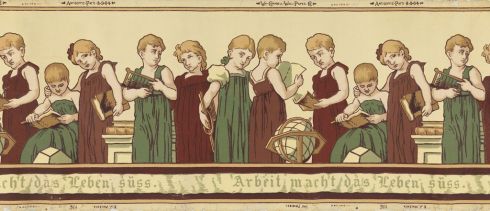
The photographs are from a series taken by Salem photographer E.G. Merrill of the Salem Normal School’s Training School, later known as Horace Mann, for the School’s 50th anniversary in 1904. It looks like the hideous chalkboard is still in the classroom (though utilized for artistic purposes via the elaborate blackboard sketching that was a speciality at Salem Normal School), but there are certainly a lot of other Turner-approved embellishments! It’s so perfect, I envision this wallpaper frieze from 1910, named after the inventor of kindergarten, in all Turner-approved classrooms!

Stylish Schools WallpaperWallpaper “Froebel” frieze, 1905, E.J. Walenta for Wm. Campbell Wall Paper Company, Machine-printed on paper, Hackensack, New Jersey, USA, Cooper-Hewitt Museum, gift of Paul F. Franco, 1938-50-15.

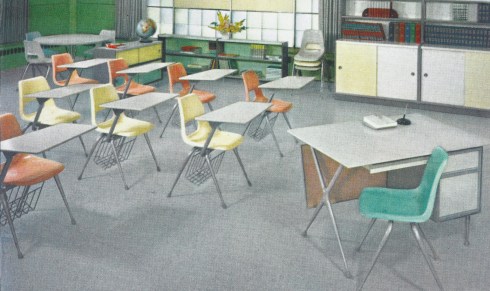
The second wave of educational aesthetic reform followed World War II, and seems largely focused on clearing out all of the elements that Turner advocated for, as well as letting in, or creating, even more light vis-à-vis the new fluorescent lighting. A model classroom was installed at Salem’s Bowditch School (then on Flint Street) by the Salem-based Sylvania factory, and promoted nationally by a serialized newspaper article in alliance with the National Education Association. I can’t get the photographs any clearer, but the description is helpful: blackboards replaced by tackboards (that won’t last), wooden floors replaced by tile, and “posture-improving desks” installed. In the permanent collection of the Museum of Modern Art there is a prototype desk designed for the Bowditch School by the architectural/engineering firm Markus & Nocka in 1946–ostensibly for this remodeling–but I can’t tell if these are the desks in the photograph (if they are, I wonder where they all went when the Bowditch was converted into condominiums!)  More likely something more conventional was chosen, like the colorful Brunswick desks in the advertisement below. These are what I grew up with, and I think there’s still more than a few in the old SSU Sullivan Building where I teach today.

Stylish Schools 1946

Stylish Schools MOMA

Stylish schoolchairs BrunswickBrunswick chairs c. 1958 from the VS Schulmuseum site. 

♣ Heads up: exhibition of Ross Turner’s works at the Kensington-Stobart Gallery at the Hawthorne Hotel opens this Friday September 8!


The Broomstick Brand Emerges

I was working on two things concurrently yesterday and they merged (sort of): a presentation on emerging civic identity in Renaissance Florence for my grad class and a post on yet-another batch of Salem trade cards from the eighteenth, nineteenth, and twentieth centuries. A lot of time-traveling, but a common theme of projection. Actually the post was supposed to be about candy; I thought I might be able to parlay one lovely colonial trade card into a whole series of Salem-made confections for Valentine’s Day. But no, not enough chocolate and Salem gibraltars are not particularly romantic. So instead I just looked at the emblems on my run of cards and saw an emerging brand and identity for Salem: from a maritime center in the nineteenth century to Witch City in the twentieth, with a few horses interspersed among the ships and broomsticks. This is much too selective a sample to prove anything, but at the very least it illustrates two hypotheses I have about the development of “Witch City” as Salem’s primary civic identity: it came about because of commercial factors more than cultural (or historical) ones, and it really intensified in the 1890s, coincidentally with the commemoration of the bicentennial of the Witch Trials in 1892. Apart from ascribing any wider meaning to this ephemera, I just love to look at it; there’s something about the inclusion of such artistic images and lettering on such everyday items as trade cards and billheads that impresses me: if only our disposable, digital age was interested in leaving as lasting an impression.

A century and a half of Salem commercial ephemera: from seaport to Witch City.

ephemera-1

ephemera-2-1790

ephemera-3

ephemera-4

ephemera-11-1874

ephemera-12-1874

ephemera-13-closeup

ephemera-14-1870s

ephemera-9-1889

ephemera-10-1897

ephemera-8

ephemera-7

ephemera-6

Salem trade cards and billheads via American Broadsides and Ephemera and Salem State Archives and Special Collections.


Some Came Back

Given that I, along with every other historically-conscious person in the world, have been thinking about World War One and its aftermath in this anniversary year of its commencement, that has to be my focus for this Veterans Day. I’ve been thinking about the impact of the Great War on Salem and its inhabitants for a while, but I haven’t really had time to engage in any serious research: I suppose that I have until 2017! This is one of those cases of “anniversary history” where the American and European perspectives are not quite in sync. I have found one great digital database, however: at the State Library of Massachusetts. A five-year project to digitize over 8,000 portraits of soldiers has created an amazing resource that every descendant of a Massachusetts doughboy will want to check out. Most of the photographs are accompanied by “cut slips” of paper that I find almost as poignant as the images themselves: data sheets for prospective Boston Globe stories which lists the soldier’s name, hometown, and story: either “experiences” or “killed in action”. The photographs were taken before the men shipped out; the slips were made out after armistice was declared. Some of these Salem men came back, and some did not.

Annable

Corp. Walter W. Annable, Battery F., 101st F. A.; Came Back.

Redmond

Capt. Ernest R. Redmond, Battery E, 101st F. A; Came Back (and ran unsuccessfully for Mayor of Salem in 1925).

Marcotte

Corp. Henry J. Marcotte, Co. M, 103rd Infantry; Came Back.

Lynch

Corp. Henry F. Lynch, 301st F. A.; Came Back.

Murphy

Henry G. Murphy, 101st F. A. Battery D.; Killed in Action in France.

Bufford

O. J. Bufford, Battery D., 101st F. A.; Killed by accident in France.

These are just a few Salem men and their fates: the entire record includes many casualties of war and as many–or more–of disease: the immediate post-war influenza epidemic which decimated the United States and the world. Imagine surviving the trenches and then dying from the flu in an army camp back home–or nearly there. Of course every death is heroic, but some were officially recognized as such, like that of Thomas Upton of Salem, who received a Distinguished Service Cross posthumously for extraordinary heroism in action near Belleau, France, on July 20, 1918. He voluntarily crossed a zone swept by machine gun and shell fire to aid wounded soldiers, and was killed. Conflict and contagion in 1918, and cheering crowds for those that came back.

Some Came Back 1918 Leslie Jones

Some Came Back 2 1918 Leslie Jones

Armistice Day 1919 SSU Dionne

Massachusetts troops arriving in Boston in 1918, Leslie Jones Collection, Boston Public Library; the first Armistice Day Parade in Salem, 1919, Dionne Collection, Salem State University Archives.