Tag Archives: Salem Houses

Houses are History

Last week I was thinking about all the things that annoy or concern me about Salem now, and the list seemed endless, which depressed me, and then I suddenly thought, why don’t I focus on the things that I love about Salem so I won’t be so depressed? This seemed like a good idea, and an easy realignment. Why did I move to Salem? Architecture. What do I love about Salem? Architecture. So I’m going to go back to the foundations of my own Salem story and getting back to architecture with an occasional series here and on social media (#salemhistoryhouses) looking at individual houses in the present and past as a means of telling more Salem stories. Just one house can open a wide window into the city’s history, American history, even world history, as Salem has always had a global orientation. This is not a novel observation, but somehow as I pursued a range of Salem topics here and in our forthcoming book Salem’s Centuries I lost sight of one of the most basic expressions of cultural achievement: houses. Besides the inspiration of merely pursuing my own happiness, I am also motivated by the efforts of two people who I’ve written about a lot here and also in Salem’s Centuries: Frank Cousins and Mary Harrod Northend. These two contemporaries dedicated a good part of their lives to highlighting Salem architecture in print and image. Both wrote books and magazine articles and established photographic publishing companies which distributed images of Salem houses nationwide. They were both particularly keen to emphasize that all not was lost with the Great Salem Fire of 1914, and that much of Salem’s architectural heritage remained; a decade later both were intent on celebrating that heritage during Salem’s Tercentenary in 1926. Cousins died the year before; Northend in that very year. I’ll feature a lot of their work in my series, as preserved and digitized by the Phillips Library (via Digital Commonwealth), the Winterthur Library, and Historic New England, as well as the large collection of images available at the Salem State University Archives and Special Collections. So there you are, or there I am: one of the things that annoys me about Salem is its lack of a professional historical museum, but all these institutions, and more, are in fact collecting, preserving, and sharing Salem history.

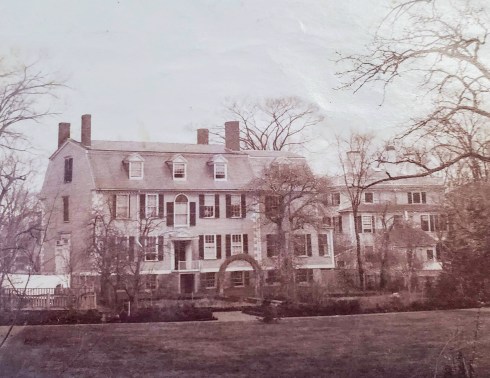
My first social media post is a great example of how just one house can lead you in all sorts of directions. The Eden-Browne has was built in 1762 by Captain Thomas Eden as a warehouse, and then converted into a (very elegant) residence by Benjamin Cox in 1834. Captain Eden was a trader in the codfish rectangular trade between Salem, southern Europe, and the West Indies, and the very first member of the Salem Marine Society: his grandaughter, the artist Sarah Eden Smith, lived and died in the house. Her other grandfather, Jesse Smith, was an officer in General Washington’s First Horse Guards, and she herself was a professional artist and instructor who spent several years at the Hampton Institute (now University) teaching Native American students. Miss Smith, “the last of her family,” was also the author of a lovely little pamphlet on the history of the Second Church of Salem, visible below in the top photograph, which obviously dates from before it was demolished by fire in 1903. So that’s a lot of history tied to just one Salem house!

A house that both Cousins and Northend adored (both really seem to have preferred Salem’s 18th-century houses) is the Dean-Sprague-Stearns House on the corner of Essex and Flint Streets. It was built in 1706 and acquired a portico by Samuel McIntire a century later. It has a connection to Salem’s most notable Revolutionary event, Leslie’s Retreat, through the residence of distiller Joseph Sprague, a major participant in that resistance, and it was operated as an inn named the East India House in the middle decades of the twentieth century. I love the description of this house in Samuel Chamberlain’s Open House in New England: “the EAST INDIA HOUSE  contains a wig room, two powder rooms and a Tory hide-out in one of the chimneys. A quadrille was given here for General Lafayette in 1824.” TORY HIDE-OUT.

Top photograph from the Frank Cousins Collection of Glass Plate Negatives at the Phillips Library, via Digital Commonwealth.

Talk about going back to Salem houses: One Forrester Street was one of the first house reports I researched and wrote for Historic Salem, Inc., way back in the 1990s! I was in graduate school, and this was my way of “learning” Salem. These are another great resource (and mine are far from the best!), as members of the Salem Historical Society digitized them several years ago. These house histories, in addition to the Massachusetts Historical Commission’s MACRIS database, represent accessible information about hundreds of Salem houses. I remember being very excited about researching One Forrester as it’s such a great house, with a distinctive profile right on Salem Common. Though built by a tanner named John Ives, the house was kept in the Webb family for quite some time, I think, almost two centuries. In the northwest corner of the house is a “cent shop” straight out of the House of the Seven Gables; it might even have been Hawthorne’s inspiration.

Stereoview (top) from the 1860s, and the  Nelson Dionne Salem History Collection at Salem State University.

There were many Webbs in Salem and it is quite a challenge to keep them straight! Sea captains in the 18th century, entrepreneurs in the nineteenth. Another Webb house is one of my favorite brick-sided houses in Salem, adjacent to what was long a Webb apothecary shop on Essex Street. These buildings are 52 (house) and 54 (shop) Essex Street, and they represent what were probably hundreds of attached or adjacent residences and shops which once existed in Salem.

Stereoview from the Dionne Salem History Collection, Salem State University Archives and Special Collections.

I’ve decided that I’m not going to feature lost houses in my little series, as I am engaged in the pursuit of happiness. But I’m definitely going to feature houses that were moved, because there are so many, and also because I love these examples of nineteenth-century (and a bit of twentieth-century) sustainability. One house that was moved from Salem’s main street, Essex, to a nearby side street is Five Curtis Street, which is featured prominently in one of my favorite architecture books, John Mead Howells’ Lost Examples of Colonial Architecture: Buildings That Have Disappeared of Been so Altered as to be Denatured: Public Buildings,Semi-Public Churches, Cottages, Country Houses, Town Houses, Interiors, Details (1931). It is indeed one of my favorite books, but I also realize that Howells makes a lot of mistakes, so I always check him. He indicates that the house was moved in 1895, which does check out, and refers to the house as the Joseph J. Knapp House. More recent researchers refer to the house as the the John White House, and I think this is correct: White, a mariner, built the house around 1802 and sold it to Knapp, another mariner (a loose term which generally means merchant and maybe captain but more likely owner of shares in a ship at that time) six years later. The house remained in the Knapp family until 1848, which means that this house has a connection to the most notorious murder in nineteenth- century Salem. Joseph J. Knapp’s two sons, John Francis (Frank) and Joseph Jenkins Jr., hired Richard Crowninshield to murder their wealthy uncle Captain Joseph White in 1830 and all three met their deaths before the end of that year. Mr. Knapp Sr. had already decamped for Wenham before these events, and he remained there until his death in 1847.

Frank Cousins photograph of the Knapp House in its original location on Essex Street (on the corner of Orange), John Mead Howells, Lost Examples of Colonial Architecture (1931). 


I’m Confused by Pineapples

This is one of those “writing it out” posts. It starts out with confusion in the hope that I can work it out, but I may not so it might end in confusion as well. I’m confused about the symbolism of pineapples. Of course everyone knows that pineapples represent “hospitality,” but do they really? What else might they represent? I started out with the question as to whether pineapples are Colonial or Colonial Revival, and it seems that that they are both. I’m also wondering if there are differences in what they represent in the northern US as opposed to the south, and between the US and the UK. My wonder is prompted by recent road trips down south, where I saw a lot of pineapples, as well as an interest in symbolism in general prompted by the recent discussions here in Salem over our official city seal, which some see as stereotypical and rascist and others see as evocative of a proud global maritime heritage. I always find that a historical perspective helps with understanding both images and events; apparently the members of the Task Force charged with examing the seal do not. In any case, there’s always a personal and arbitrary angle: it’s so interesting that different people see very different things in the same image. And that is true of pineapples too: while for the most part they seem to convey a sense of decorative hospitality, they also have associations with exoticism and exclusivity and excess, colonization, plantations (both in the West Indies and Hawaii), coerced labor and ultimately slavery. I am always interested in Salem’s famed “Pineapple House,” a Georgian structure first located on Brown Street and then removed to Brown Street Court which was demolished by 1911 with only its pineapple-pedimented door preserved, first in the Essex Institute and now in the American galleries at the Peabody Essex Museum. I’ve written about it before, but I know more now: its pineapple was not a local creation but rather a British import and its importer, Captain Thomas Poynton, became one of Salem first Loyalistist refugees, leaving his house (and his wife!) for England in 1775. That conspicuous (always gilded by all accounts) pineapple might have had Tory associations in Revolutionary Salem, but nevertheless it became the inspiration for one of Salem’s most important Tercentenary expressions, the band stand on Salem Common erected in 1926.

There are pineapple motifs on New England furniture and wallpapers from the 18th century through the mid-twentieth, but in terms of conspicuous architectural detail I think the best examples are the Hunter House in Newport, RI and the Wentworth-Gardner House in Portsmouth, NH (after Salem’s Pineapple House, of course). The Hunter House was also owned by a prominent Loyalist, and a recent article on its new Orientation Gallery describes its current interpretation as a  “paradigm shift”: Here visitors can examine a historic photograph of the house’s pineapple pediment alongside a silver coffee pot and a pair of covered baskets adorned with pineapple finials. The display discusses the tropical fruit as a product of colonization and slavery as well as a symbol of wealth and hospitality in colonial Newport. For the Preservation Society, which long ago adopted the pineapple as part of its logo, this analysis represents a paradigm shift. It’s been a few years since I’ve been on a tour, but I don’t think this kind of deep dive is offered up at the Wentworth Gardner House in Portsmouth, which was restored by none other than Colonial Revival evangelist and entrepreneur Wallace Nutting in 1916-18. And there’s no need, as Nutting added the pedimented pineapple, and the entire entrance surround to the house. This very Colonial Revival pineapple anticipated the ever-present fruit emblems at another prominent Colonial-esque institution: Colonial Williamsburg.

And down south, it’s the same thing: there are eighteenth-century pineapples and then there is a twentieth-century pineapple revival. Virginia’s oldest plantation, Shirley, has a very prominent three-foot-tall pineapple right at the apex of the roof of its main house, which was built around the same time as the Poynton House in Salem and the Hunter House in Newport.  Installing a pineapple on the pinnacle of one’s roof must have been a James River Plantation thing, as Brandon Plantation has one as well. Another interesting transatlantic pineapple connection relates to the last Colonial Governor of Virginia, John Murray, the fourth Earl of Dunmore, who commissioned a stone-carved pineapple summerhouse for his Scottish estate in 1761, likely the most famous pineapple construction in the world. The pineapple is very prominent in Charleston, of course, with the pineapple gateposts (which I think were supposed to be pinecones?) of the Simmons-Edwards House dating from around 1816 and the famous pineapple fountain dating from 1990.

Shirley and Brandon Plantations in Virginia; The Dunmore Pineapple, Stirlingshire, Scotland via the National Trust for Scotland; Gate at the Simmons-Edwards House at 14 Legare Street, Charleston, built 1816, from the lovely site Glimpses of Charleston; some pineapple images from one of my favorite books, Charleston Style, by Susan Sully with photographs by John Blais.

Pineapples on the gatepost (and I suppose by extension the very popular pineapple doorknocker) are said to be visual “traditions” based on the practice of ship captains returning from exotic realms displaying pineapples on their properties to indicate that they were home, and ready to receive visitors. This story is repeated again and again and again, but I don’t seem to find any references to it before the early twentieth century. I think it’s more Colonial Revival romance. Pineapple stories just keep getting repeated with very little insight, analysis or research, at least over here. With the exception of the Newport Preservation and a Smithsonian blog post about the “prickly” history of the pineapple, these storied fruits (and their visualizations) don’t have much cultural depth over here in the US: and if they are in fact emblems I think they should have more. But in the UK, wow! Here’s a great History Workshop piece with all sorts of associations, and very recently, a “sinister history of the pineapple” student project at the University of Southampton in collaboration with Royal Botanic Gardens at Kew was featured in DezeenMy research for this post exposed me to yet another pineapple association: apparently an upside-down pineapple sign on a door means means there are swingers within! That’s a long way from friendly sea captains, and obviously there’s much more to pineapples than meets the eye (but I’m still confused).

Dezeen Magazine, July 26, 2025: A “Sign of Status” by Jas Jones, who concludes “the pineapple is no innocent fruit.”


A Salem Women’s History Tour

For International Women’s Day today, I thought I would put together a walking tour of Salem women’s history. Of course, every street and every building in Salem has traces of women’s history, most of it hidden from us. I would like to include more than “notable” women on my tour, and I think I’ve busted out that category a bit, but there’s still a lot of work to do and a lot more to learn. I decided to limit the tour to existing buildings, so it definitely skews towards the nineteenth and twentieth centuries. I read revews of Salem walking tours occasionally, mostly because I want some sign of hope that Salem tourists are interested in topics other than the Salem Witch Trials, and that’s the number one complaint: we stood on the sidewalk looking at a parking lot. If they were interested in something other than the Salem Witch Trials, they would no doubt see more buildings and places than parking lots. So my tour is all about buildings, and the women who lived in them. Beware if you want to do it yourself: it’s a long tour—I easily got in my 10,000 steps!

We’re starting on Derby Street, right next to the Custom House, at 1) The Brookhouse Home for Aged Women. Not only is this a McIntire building and an early (1861) example of a privately-established residential home for senior women, but it was also the home of Massachusetts congressman and Secretary of the Navy Benjamin W. Crowninshield, whose wife Mary was quite the Washington socialite: her letters are very revealing about the social scene during the administrations of Presidents Madison and Monroe in general and Dolley Madison in particular. Mary Crowninshield spared no detail, either of drapery or dress trimmings.

Then it’s on to another impressive brick Federal house turned social institution, 2) the Woman’s Friends Society on Hawthorne Boulevard. Founded in 1876 as a residence and employment “bureau” for younger women, the Society acquired its impressive brick double house from Salem’s famed philanthropist Captain John Bertram and his daughter Jennie (Bertram) Emmerton, the mother of Caroline Emmerton of House of the Seven Gables fame. So it is the Emmerton House, and it continues in its original mission. Lots of women’s stories to tell here, as it also became a center for social work, craft eduction, and public health initiatives.

We walk westerly on Charter Street until we come to the so-called 3) Grimshawe House where the famous Peabody sisters lived and where Nathaniel Hawthorne courted his future wife, Sophia. This house was built around 177o and educators Elizabeth and Mary lived here between 1835-1841 with said Sophia, their parents and brother. It has been in decline for most of the second half of the twentieth century, serving as a eerie gray neighbor of the Charter Street cemetery, but last year signs of restoration (and color) appeared.

Now we’re walking towards the McIntire Historic District along Front and Norman Streets and then we’re on Chestnut. There are quite few houses on this street worth noting in relation to women’s history, but I limited myself to 4) Mrs. Parker’s house at #8, 5) Hamilton Hall; 6) the Phillips House, and 7) a Caroline Emmerton-commisioned house. My neighbors just across the street live in the beautiful house occupied by Mary Saltonstall Parker, an author and artist at the turn of the last center. Mrs. Parker loved traditional crafts and antiques and wrote about both in a succession of small books which reflect the Colonial Revival movement, but she was also a “maker” herself and one of her embroidered samplers was on the cover of House Beautiful in 1915. Hamilton Hall is a veritable monument to women’s history, including the work of the Remond family, all those festive fundraising fairs in the nineteenth century, debutante assemblies and the lecture series sponsored by the Ladies Committee in the twentieth. And schools! Dancing schools and “dame schools,” including that of Lucy Stone in the 1880s below. I certainly learned a lot about a variety of women working at the Phillips House this past summer, including ladies of the Phillips family and their staff, but I wanted to spotlight this house at was also the home of Caroline Howard King, the author of one of the most popular (and literary) Salem memoirs, When I lived in Salem. Before the house was the Phillips House, it was actually a genteel boarding house, and Caroline lived there from the 1890s until her death in 1907, I believe. The last house below is Caroline Emmerton’s commissioned copy of the Derby House by architect William Rantoul: it completes the street.

Over on Essex Street, we stop at the venerable 8) David Mason House⁠. Notable for its namesake occupant’s role in Leslie’s Retreat in 1775, more than a century later it was purchased and restored by the prolific author and suffragist Grace Atkinson Oliver, who also served as a member of Salem’s School Board. Across the street is the 9) Quaker Cemetery, where one can reflect on the persecution of Salem’s Quakers in the seventeenth century, including Cassandra Southwick and her daughter Provided. Further down the street towards downtown are 10) the Cabot-Endicott-Low House, childhood home of Salem’s only “dollar princess,” Mary Endicott Chamberlain Carnegie, pictured below just before she presented her stepdaughters to Queen Victoria, of whom she was reportedly a favorite, 11) Caroline Emmerton’s stately house and 12) that of Susan Osgood, another preservationist of sorts, who was the niece of Salem’s first, Joseph Barlow Felt, who was married to Abigail Adams’ niece, also named Abigail. Because the Felts had no children, a lot of her aunt’s things ended up with Susan, including items that Abigail Felt inherited from HER aunt Abigail Adams. Susan donated Abigail’s Inauguration dress (+ slippers!!!) to the Smithsonian Institution, where they reside in the First Ladies exhibit.

Through the Ropes Garden and over to Federal Street and the 13) home of Salem’s first female physician, Dr. Sarah Sherman. She was an amazing woman, who was also elected to the School Board in 1879, the first “school suffrage” election in Salem. Then we will walk towards downtown, cross North Street, and visit two Lynde Street houses, home to two accomplished Marys. First up is the 14) house of Mary Bradford Hagar, who served as the chair of the Salem Ladies Centennial Committee in the 1870s, which organized Salem”s exhibits for the Centennial Exhibition of 1876. Her committee did such a great job that it won national acclaim, and 100 years later in 1975, the Essex Institute mounted a re-exhibition. Next is the 15) house of Mary Harrod Northend, the prolific author of everything “Old Salem” in the early twentieth century. A very Colonial Revival street!

Salem walking tours always stop at the 16) Lyceum Building, now Turner’s Seafood Restaurant, on Church Street as it was supposedly the site of the first Witch Trial victim Bridget Bishop’s orchards, but I would include it on my tour because it was the site of so many meetings of Salem’s Suffrage Society from the 1870s on. I’m cheating a bit here as the present Lyceum building was not the one in which Salem’s Suffragists met: there was an earlier wooden structure on the same site. Like so many sites in central Salem, it is historic in more ways than one. Walking towards the Common, I think I would stop at the Peabody Essex Museum’s 17) Bray House, because it is so cute and also because Salem’s most successful commercial artist, Sarah Symonds, had a workship and retail space there.

I want to include at least one house on Washington Square on my tour, so I think I’m going with the present-day 18) Bertram House. What does this former home for aged men and current assisted living facility for both genders have to do with women’s history? My link is another Endicott and preservationist, Clara Endicott Sears (contemporary and cousin of Mary Endicott), who wrote a charming childhood memoir of life in this house with her grandparents entitled Early personal reminiscences in the old George Peabody mansion in Salem, Massachusetts (1956). The Bertram House overlooks the Common, where a grand historical pageant was present for the Salem Tercentenary in July of 1926: its author was Nellie Stearns Messer, who lived at 19) 15 Oliver Street, pictured just below. By all accounts that I have read and heard, she seems to have been a very active mid-century public historian, before that term was used. In addition to the Tercentenary pageant, she also wrote very substantive histories of the Tabernacle Church and Ropes House. We then walk northward towards Pleasant Street, and the 20) home of one of Salem’s most notable entrepreneurs, Charlotte Fairfield. Charlotte ran a coal company that undercut Salem’s coal cartel in the first decade of the twentieth century, and received lots of attention in the Boston papers for doing so. Independent indeed.

For the last leg of the tour we’re going to swing over to Pickman Street to see the building which houses the 21) Esther C. Mack Industrial School for Girls from the 1890s through the 1920s. Established by a large bequest in the will of its namesake, the school taught what we would call domestic rather than “industrial” skills, mostly sewing and cooking, to young girls and had quite a few collaborations with the Woman’s Friend Society. The photograph below, by Mary Harrod Northend, is of a sewing class. So many progressive women in Salem at this time: I haven’t even touched on the House of the Seven Gables except for showcasing several properties associated with its founder, Caroline Emmerton, or any of the public health and cultural initiatives of this era. This is why I get more than a little frustrated with the continuing almost-exclusive focus on 1692 in this city: it excludes so much history in general, and so much women’s history in particular. But we’ve walked enough for one tour, so I propose crossing the Common, perhaps taking a peak and the 22) birthplace of prominent Salem artist Fidelia Bridges, and then popping into the tavern at the Hawthorne Hotel for a drink, and a toast to the ladies.

Map made by John Northey for the Bicentennial in 1976: as you can see, there’s a lot more land to cover.


Merry Christmas from Salem

No deep dive here, just some photographs of Salem at Christmas time: my neighborhood, my house, other houses. It’s been a tough semester and a tough month, and I’m tired. I did Thanksgiving, so my brother and brother-in-law are on for Christmas and we’re off to the Hudson River Valley tomorrow. Many of us in Salem have experienced a loss today, and these pictures make me happy: I hope they give pleasure to you as well. Salem is really beautiful in December in general and at Christmas time in particular: at that other holiday she is wearing a costume and not her true self.

Love this wreath!

We were fortunate to be invited to a dinner at the Pickering House before the Hamilton Hall dance, which has been held since at least World War II, with similar events before—way before! I hope these two ladies don’t mind their inclusion in this post, I was just so impressed by their gowns–and their purses!

Home–and away we go. Merry Christmas and Happy New Year.

P.S. MANTELS! Thanks, Patricia.


Mint McIntire

It’s always a big moment when a Salem house crafted by Samuel McIntire comes on the market, and that moment is approaching! Likely the most important McIntire house still in private hands, the very-storied Cook-Oliver House at 142 Federal Street, is coming up for sale quite soon. This house will certainly need considerable work, but my title is an attempt to epitomize the great creative and material efforts of its successive owners to preserve McIntire’s design and craftsmanship. The house was built by Captain Samuel Cook (1769-1861) whose span of life represents Salem’s spectucular maritime rise and fall. He was one of a score of Salem captains and merchants who earned great profits by re-exporting commodities from the East Indies to Europe in the first few decades of the nineteenth century, and only a year or so after the dramatic shipwreck of his ship Volusia off Cape Cod in early 1802 he was able to finance the construction of a house which spared no expense by all accounts. The fortunes of these men always seem so fluid to me! The carved detail, evident inside and out, was so notable in its time that there emerged a narrative which connected Captain Cook’s house to an even more notable McIntire construction: the short-lived Derby Mansion in the center of town. Salem’s merchant prince or King, Elias Hasket Derby, financed the construction of what looks like a proper manor house in his declining years, and it was completed according to the plans of Charles Bulfinch and Samuel McIntire in 1799, the very year he died. Given its central and conspicuous location (right in the middle of what is now called Derby Square), the mansion’s life was short: it was torn down in 1815 to make way for what eventually became the Old Town Hall or Market House. Even though Cook’s house was built a decade earlier, there persisted a story that some of the woodwork was somehow salvaged by him. There is a particular focus on the gateposts of the Cook House having Derby Mansion origins, repeated again and again and again in periodicals and monographs on old American houses until Fiske Kimball dismissed the connection as “legend” in his 1940 study, Mr. Samuel McIntire, Carver: the Architect of Salem.

I was thrilled when my friend Michael Selbst, a very busy Salem realtor with the listing, texted me with an invitation to view the house just before the election, and we went in two days afterwards: a welcome distraction! As you can see, it was a sunny day and the house glowed, despite the traces of moving activity all around. I think that this is the only McIntire house in Salem in which I have not entered before: it was kind of chilling (in a good way) because I had seen so many photographs and now here I was in the real house. It’s hard to explain just how lovely this house is and the photos will not do it justice: there’s something about the combination of the smaller scale and the very detailed woodwork. It is not by any means a small house (especially with its additions) but it has a more intimate presence than the other McIntire houses I have been in: I was actually and immediately reminded of Leonardo’s embrace of the classical concept of in all things is the measure of man. It’s a humanist house!

These two doorways, to the right (parlor) and left (dining room) just as you enter the house, have been photographed so often over the last century or so that I was a little starstruck upon my entrance. 

It is also, and has always been, a family home, and Michael and its owners hope it will be a family home again, with its essential structure and details preserved intact. Captain Cook and his wife Sarah (Sally) lived in the house until their deaths in the 1860s and then it passed on to their daughter Sally and her husband Henry Kemble Oliver, real Renaissance Man: a soldier, officer, civil servant, politican and musician who served successively as mayor of both Lawrence and Salem. Sally Oliver died in 1866, but Henry continued to live at 142 Federal Street until his death in 1885. Several owners later, the long tenure of Dr. and Mrs. Carroli saw the only “losses” for the house as the Dufour wallpaper in the parlor was donated to the Society for the Preservation of New England Antiquities (now Historic New England) in 1904 and a cornice to the Metropolitan Museum of Art in the 1920s. There are apartment and porch additions to the back that did not alter the original structure in any way. The woodwork throughout looks to my eye exactly as it does in the many photographs that date from the early twentieth century. After spending a good part of last year working on the Colonial Revival chapter for our forthcoming book Salem’s Centuries, not always a pleasant task as it involved documenting the “stripping” of several Salem houses, it was nice to see so much in situ!

I got a little flustered in the parlor looking at a unique fireplace insert, so I didn’t get proper photos of the mantle or even much of the room! So I have included some HABS photos, as well as two Frank Cousins views from Historic New England and the New York Public Library Digital Gallery with the Dufour paper, which was removed in 1904. The mantle remains the same! A lovely Palladian window on the second-floor landing, which has a very unique detail. More details, the dining room, kitchen, and my favorite third-floor bedroom. There are more bedrooms, and quite a few cute little rooms—I actually lost count: a sewing room? studies, a trunk room?

All summer long at the Phillips House, I kept describing the original McIntire construction (or relocation to Chestnut Street) as “shallow,” just one room deep. You rarely see Federal houses with this original shallowness—over the nineteenth century they were built on and on and on as needs dictated and so they become more square than rectangular. There’s something about being able to see the backyard from the front door: it adds a lightness to a house. On the dining-room side of the Cook-Oliver house, a first-floor kitchen was added and then the apartments wing, but in the hall and on the parlor side, you can see right through. And what you see is a very expansive yard. A quarter of an acre! Very lavish for Salem, as if this house wasn’t amazing enough.


Appendix: Period Homes, 2005.


The Summer of Old Photographs

I worked all summer long on my chapters for Salem’s Centuries and a few other projects, researching and writing, researching and writing, researching and writing. Once I’m on the trail, I’m a pretty steady worker, but I do take breaks: I’ve learned from other writing projects that you have to pause to let your mind absorb and process information. Sometimes the break might be at night when you’re asleep—I got into the habit of leaving a notebook by my bedside when I was writing my dissertation and when I woke up in the morning sometimes I would see notations inside that I didn’t even remember writing! That must have been one of the benefits of a younger mind because it didn’t happen this summer, when all my breaks were conscious. Every time I went up to the Phillips Library in Rowley, I would dutifully call up boring municipal records but also collections which contained old photographs of Salem. I’d pore over them a bit and photograph them for later perusal, and by the end of the summer I had quite a collection. The Phillips has digitized two of its largest collections of Salem photographs: the Frank Cousins and Samuel Chamberlain collections, but there remain many seldom-seen images within collections. Fortunately there are great finding aids to locate such images, but also some very miscellaneous collections which yielded surprises, at least for me! I loved schoolteacher Grace Hood’s shots of the Salem and Massachusetts celebrations in 1926-1930 (PHA 67; including some completely new-to-me views of the opening day of Pioneer Village in 1930) and an unknown photographer’s depictions of a very gritty Salem encased in a large composite collection entitled Photographs of interiors and exteriors of Salem, Mass., circa 1890-1950 (PHA 151). And there’s much more.

Phillips Library PHA 67 & 151.

My favorite collection was the first one I accessed, back in May: a treasure trove of images contained in the scrapbooks of Francis Henry Lee of 14 Chestnut Street, mostly from the 1880s (Phillips Library MSS 128). Lee was the son-in-law of the woman who lived in my house, and a committed architectural antiquarian focused on documenting the history of every house on Chestnut and adjoining streets. He did not rely on hearsay, but sent queries to anyone who ever lived in the neighborhood, and his scrapbooks are filled with detailed responses, some written on black-trimmed stationery indicating that their authors were in mourning. I was familiar with his articles in the Historical Collections of the Essex Institute, but surprised to find his research materials accompanied by so many wonderful photographs.

Some of my favorites: (I filtered those that were really hazy or damaged).

Chestnut, Summer & Norman Streets from two perspectives. I’ll never get over how wonderful Norman Street was!

Riding and looking north on Summer Street, and then south (Samuel McIntire’s house is on the extreme left of the last photograph).

Broad Street, looking west.

Cambridge Street, looking north and south.

Work on Bott’s Court.

Hamilton Street, looking north.

Chestnut Street Houses—what’s going on with that figure at the third-floor level of the third photo above, which I think is #26?

Warren Street, looking towards the “Turnpike” (Highland Avenue).

There were several photographs which were especially exciting to see among the Lee papers, including those which show the magnificent formal garden in the rear of the Cabot-Endicott-Low House on Essex Street, which extended to Chestnut before no. 30 Chestnut was built in 1896. This garden was quite famous: it was prominently featured in many horticultural publications and was by all accounts quite the tourist attraction, especially in the spring. A 1904 Boston Globe article on “Beautiful Old Gardens of Salem” reports that for many years the tulip bed was the greatest feature of this garden, and each spring, when these flowers were in perfection, and upper portion of the high fence on Chestnut was removed to enable the public to view the exhibit.

Even more exciting than this lost garden were two photographs of my own house that I had never seen before, including one sans the apartment that was added on in phases between 1890-1910. Our house is the right side of a double house built in 1827: both sides were identifical until the 1850s, when one of our owners expanded the house considerably in back and altered the interior to look more fashionable at the time—round mouldings rather than square ones! The big entrance alteration reflects the changes inside, but I did not know that this guy also put new mouldings over the windows, and disdained shutters as too colonial, I guess. Several owners later, there was a sequential addition on the side of the house: first as an office for a very well-know opthamologist who lived here, and then bedrooms were built above: this is our present-day 7 1/2, a really cute apartment with the best views of Chestnut Street. I assumed that it covered up windows which were on the side of our house, but it looks like there were none. As you can see from all of the other photos of the street, Chestnut was driveway-less in the nineteenth-century: the larger houses had carriage access on Warren or Essex: the property of our house actually wrapped around Hamilton Hall next door and so our carriage house—long- demolished—accessed Cambridge Street.


After the Fire: a New Salem Saltbox

I like to recognize the anniversary of the Great Salem Fire (June 25, 1914) every year, or most years, as it was such a momentous event in so many ways, starting, of course, with sheer destruction and dislocation: 1376 buildings burned to the ground (out of around 5000 structures in Salem proper), 18,000 people lost their homes and 10,000 people lost their jobs. Only three people died, which seems incredible given the magnitude of this conflagration, but 60 people were injured. Like every disaster of this scale, there are so many topics to address about its aftermath: the immense shelter and aid effort, the rapid rebuilding program, the plans for a “new” Salem. New might not be the correct word, as the architects and planners and owners who sought to rebuild on the broad swath of fire-ravaged land along Lafayette streets and the harbor were very interested in fire-resistant building materials but their aesthetic preferences were more traditional. This is a moment when Colonial Revival Salem comes into full flower, after germinating for several decades. You could label the traditional brick, stucco, and wooden buildings which line lower Lafayette and its side streets “conservative” but I prefer the terms referential or contextual: I’m always impressed with the deep appreciation displayed by early twentieth-century architects for Salem’s colonial and federal architecture and their desire to study and emulate heritage buildings. Perhaps post-fire architects, builders and planners were a bit too deferential to the past (architectual author and photographer Frank Cousins seems to view the opportunity before Salem as one of colonial compensation after all those sub-par Greek Revivals and Victorians were swept away) but I’m alway happy to see the past privileged over the present. I thought I’d illustrate this Colonial Revival moment with just one “new” house: a saltbox built on Cedar Street for Mr. and Mrs. George A. Morrill as designed by architect A.G. Richardson.

Two Cedar Street, built 1815: today, in the 1980s, and as newly-built.

A.G. Richardson was a Boston architect who lived in Salem, and thus the recipient of quite a few post-fire commissions. His pre-fire work does not seem to be overwhelmingly reflective of colonial inspiration, but more like a mix of old and new. He did design a “new Colonial house” for a harborview lot on Lafayette which was featured in House and Garden magazine in June of 1907. But the Morrill house at 2 Cedar Street looks much more traditional, and Frank Cousins and his co-author Phil Riley even praised it as “practical” in their Colonial Architecture of Salem (1919): “the resulting house as it stands to-day represents virtually and exact copy of the Maria Goodhue house in Danvers, erected in 1690 and destroyed by fire in 1899. Its long roof-line, formed by the lean-to continuation of the same pitch, contributes a uniquely appropriate character to the modern architecture to the modern architecture of Salem and was found to provide a very practical way of bringing a piazza in the rear and all service appurtenances under one roof, thereby saving expense and avoiding all leadage complications common to roors considerably broken by gables or dormers.” Riley had praised the Morrill house earlier as “in the spirit of old Salem” in his 1916 article in The House Beautiful, but I think I should note that there were not many surviving saltboxes in early twentieth-century urban Salem, so Richardson had to look to nearby Danvers for inspiration! Fortunately Cousins had photographed the Maria Goodhue house (see below, from the Cousins Collection at the Phillips Library via Digital Commonwealth) before it was destroyed by fire. The new door of Two Cedar Street was definitely old Salem, however: Richardson copied the entrance of the Captain John Hodges House on Essex Street.

There was something about the Fire that fueled preservation in Salem and elsewhere, as story after story in national newspapers and periodicals emphasized the fact that the older sections of Salem escaped its path: an early report indicated that the House of the Seven Gables had been swept away, and it seems like there was a collective sigh of relief when it was revealed to be false. Wallace Nutting, that exemplar of the Colonial Revival, featured ethereal ladies draped in timeless white dresses on the steps of Chestnut Street houses spared from the fire in his 1915 “expansable” catalog, and the equally timeless saltbox merged colonial charm, clean lines, and (space for) modern conveniences.


Domed Doors

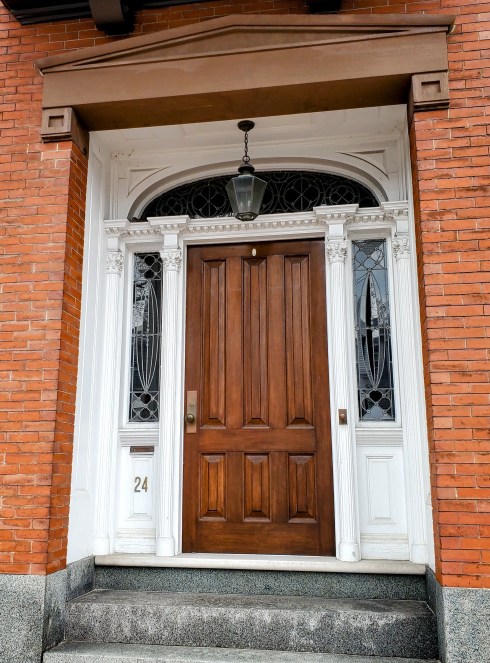
Salem is a great city for doors. There are so many exemplary doors in a succession of architectural styles: First Period, Georgian, Federal, Greek and Gothic Revival, all the Victorian varieties. There are simple plank doors, multi-paned doors, louvred doors, double doors, carved doors, doors with elaborate surrounds and vestibules, and doors of many colors (these have really multiplied over the last decade or so). There are Instagram accounts and hashtags for Salem doors. But one type of door is not very common in Salem: the rounded or arched door. I was looking through the remarkable memory album of G. Albert Lewis at The Library Company of Philadelphia, a volume with incredible illustrations of interiors and exteriors, when I became fixated on the arched entryways of his Philadelphia townhouses. I wondered if Salem had any rounded doors, did a quick Google image search (it was about 11:00 at night, otherwise I would have ran around town), and came up with multiple images of the doors of my own house! I never realized they were so conspicuous; rather I found them incongruous with the attached house next door, with its straightforward Federal entryway. See what I mean?

The second photo above is from the Instagram Account @doorsofsalem where you can see lots more Salem doors.

The double doors, and the entire entrance with bay window above, along with considerable interior alterations and a major addition, are the very tangible results of a considerable investment in the property made by its owner from c. 1860-1890, Willard Peele Phillips. Mr. Phillips was a lawyer, a state representative, and an aficionado of curves: he didn’t just bend the entrance of my house to his will: the parlor pocket doors, the china cabinets in his brand new dining-room, and all the first-floor entryways were rounded as well. He ripped out the elegant slim banister that ascended three stories and replaced it with a mahogany one that is much more bulky but also curvy. The second and third floors were left alone; I guess it was about keeping up appearances. It’s really interesting to compare the pristine house next door to my palimpsest one: 1827 versus 1877. Yesterday I went out in search of more rounded doors and did not find many, but it was fun to snap some beautiful square ones along the way. I’ve been taking photographs of Salem houses for over a decade just for this blog, but there is always a new door to discover.

As you can see, there is a rounded element in several of these Salem doorways in the form of the archways and fanlights, but the actual doors are still standard square (or rather rectangular). Besides my doors, I found arched doors on a famous McIntire summer house on the grounds of the Peabody Essex Museum’s Essex Street campus and its twin across town, constructed by a friend of mine just a few years ago, on Winter and Lafayette Street buildings, and what’s left of the Salem Armory. There are a few Salem churches which also have domed doors, but that’s about it.

But the Federal style which so defines Salem (for now, but maybe not much longer) emphasized light and decoration for its entryways, and so often there is an impression of roundness even if the door is more straightforward. A great example is the doorway of arguably the most beautiful house in Salem, the PEM’s Gardner-Pingree House: its portico and fanlight state (shout) round quite emphatically albeit elegantly. And look at the entrance to my neighbor’s beautiful Italianate house: all you see is curves but the door inside that fabulous vestibule is harmoniously straight.

So then I went back to my inspiration, the Lewis Memory Album at the Library Company, and looked at his doors, and was surprised to find they were not rounded at all—only their surrounds, and dormers! And therein is the magic of architectural texture, evident even on paper.

Illustrations from The old houses and stores with memorabilia relating to them and my father and grandfather / By G. Albert Lewis. The Library Company of Philadelphia.


Sidney Perley’s Houses

Sidney Perley (1858-1928) exemplified that exhausting mix of endeavors—historical, genealogical, archaeological, architectural, legal, literary—which in his time was represented by the occupational identity of an “antiquarian.” It was a title he proudly bore, and one which had primarily positive associations a century ago. Now it is itself an antiquated term and I don’t know any historian who would refer to themselves as such. I’ve read pretty much everything Perley wrote about Salem, including the multi-volume History of Salem he published just before he died, and while I wish his work had a bit more context and interpretation, I still value it and think of him as a historian, primarily because he was so very focused on making early public documents public. His meticulous research and publication of probate records, deeds, and town documents was service-oriented; he was very much a public historian in his own time. And more than that: there is a famous dual characterization/division of historians by the French historian Emmanuel Le Roy Ladurie, who observed that they fell into one of two camps, either that of truffle hunters, “their noses buried in the details,” or of “parachutists, hanging high in the air and looking for general patterns in the countryside far below them.” Perley was the ultimate truffle hunter, and I’m grateful for all of the detailed information he dug out for me. Because he was trained as a lawyer, Perley’s publications on local history are overwhelmingly based on deed research, and this focus made him somewhat of an architectural historian as well: he sought to portray the built environment, not just land grants and transfers. His wonderful little series of “Parts of Salem in 1700” (and other Essex County towns too), first published in the periodical Essex Antiquarian and/or the Historical Collections of the Essex Institute and later incorporated in the the History of Salem, always included charming illustrations of houses, both on his hand-drawn maps and in the text. Now while I trust Sidney Perley completely in his dates for the construction, transfer, and demolition of these houses, sometimes I think he displays a little artistic license in their depiction. But maybe not: I’m just not sure.

The Essex Antiquarian Volume III (1899).

I’m not sure because sometimes he is a bit vague about the sources for his house illustrations. I would say that I have complete confidence in the depictions of about three-quarters of his illustrations: they were still standing in his time, or had been recently demolished, or had been sketched or photographed before demolition. But with some houses, he is relying on the memory of an anonymous elderly gentleman who gazed at the house early in his life, or on an undated sketch by an anonymous artist found in the depths of the Essex Institute. I’m always interested in the early days of historic preservation, or the first stirrings of some kind of preservation consciousness, so the depictions of these first period houses by Perley and his fellow antiquarians are just fascinating to me: their visions created houses that are still showcased in Salem, most notably the House of the Seven Gables and the Witch (Jonathan Corwin) House. Their visions shaped our visions of the seventeenth century. I like to imagine Perley’s houses still standing, and the best way to do that is to map them: my progress in the acquisition of digital mapping skills stopped as soon as I got my book contract in the summer of 2020, and as I am now working on another book it will stay stalled for a while, but I can cut and paste with the best of them! I am using Jonathan Saunder’s 1820 map of Salem from the Boston Public Library as the background for an evolving Perley map here, but later maps, with more crowded streets, really make these structures stand out too: they must have been so very conspicuous in Perley’s time. I find it interesting that in Europe, very old and very modern structures can coexist, side by side, but we seldom see that in America.

Jonathan P[eele?] Saunders / Engraved by Annin & Smith, Plan of the TOWN OF SALEM IN THE Commonwealth of Massachusetts from actual Surveys made in the years 1796 & 1804; with the improvements and alterations since that period as Surveyed by Jonathan P. Saunders. Boston, 1820. Proceeding clockwise rather haphazardly from the Epes House, on the corner of the present-day Church and Washington Streets, to the Lewis Hunt House, which was photographed before its demolition.


The MacCarter and Bishop Houses: the latter burned down in the 1860s but was fortunately sketched a few years before.


Some survivors in this bunch! The John Day House survived until Frank Cousins could photograph it in the 1890s (Phillips Library, Peabody Essex Museum), I’m not sure if Perley’s “John Beckett” house on Becket Court is the “Retire Becket” House on the House of the Seven Gables’ campus? Half of the Christopher Babbidge house survives to this day, though it moved to the parking lot of the 20th century building which replaced it.


Salem in (water)color, 1939

Salem set the style standard in the first half of the century when Colonial Revival ruled, ruled, and continued to rule: right up to World War II and then beyond, according to the dictates of shelter magazines. In the first two decades of the twentieth century, you can find photos of Salem houses and house parts in issues of The House Beautiful and House & Garden from nearly every year: after that Salem is not quite as “present” but still around. Much of the attention shed on Salem is a result of two people I’ve written about here time and time again, Mary Harrod Northend and Frank Cousins, and after their deaths in the mid-1920s a Salem publicist-successor did not appear, yet “Old Salem” (rather than the “Witch City”) endured as the quintessential New England seaport. I’ve shared every Salem feature in these two particular periodicals from the teens and twenties in past posts, but not too many from the 1930s. A few weeks ago I came across some Salem images from a 1939 issue of House & Garden which were so striking that I knew I had to track down the original copy rather than rely on a digital version, and when it arrived I was not disappointed. This was an issue devoted to New England in all its glory, and Salem plays a central role. There is an interesting architectural introduction by Frank Chouteau Brown, some charming infographics that indicate that the Federal style had not yet been identified (???) but was rather referred to as the “Late Georgian,” and then some lovely watercolor vignettes of the interiors of several Chestnut Street Houses, the Gardner Pingree House, and the House of the Salem Gables by students at the New York School of Fine and Applied Art, which is now the Parsons School of Design.

Cover and illustrations from the June 1939 special New England issue of House & Garden. No Federal?


The Barstow West and Pickering Dodge Shreve Houses on Chestnut Street.


Parlors and Bedrooms of the Gardner-Pingree House of the Peabody Essex Museum.


Parlor and Dining Room of the House of the Seven Gables.


These rooms look so lively in these images: the interpretations really emphasize color and texture over pristine period perfection. There are some black and white photographs in the issue as well, like the one of the John Ward house below, but I don’t think they can compete with color. The magazine also aims to be a resource, so there’s a listing of all the historic houses in Salem and their hours of operation, which were far more extensive than today. You could go into the Peirce-Nichols House every afternoon from Wednesday to Saturday all year long, and the Gardner-Pingree and Derby houses every day!

The Ward House and notice for the Second Chestnut Street Day, 1939.