Tag Archives: Reenactments

They Came Back for the Cannon

This has been such a “revolutionary” year for me; I had to cap it off by an actual event: the reenactment of the raids on Fort William and Mary in New Castle, New Hampshire on December 14 and 15, 1774 this past weekend. There were two raids on this under-manned fort: first they came for the gunpowder, then for the cannon. From September of 1774 New England had been in a constant state of alarm: these December actions were the first overt revolutionary actions: if the Fort had actually been manned, I do believe the American Revolution would have begun in December of 1774 rather than April of 1775. “What if” history is generally pointless, but still, this particular episode has everything: a mid-day ride by Paul Revere warning the people of Portsmouth of the imminent arrival of warships, two raids on successive days, removing the “peoples’s” gunpowder and cannon from the “king’s” fort, a trampled British flag.

I was early for the December 15 reenactment, so I walked around a nearly people-less New Castle with bells ringing on Sunday morning: despite the calm, it was kind of exciting!

You can read that I am using the language from the official marker: “overt”. It was overt! It was open treason after Revere arrived in Portsmouth in the late afternoon of December 13. One of the town’s wealthiest and most influential residents, John Langdon (Continental Congress member and later President pro tempore of the US Senate and Governor of New Hampshire), recruited Patriot raiders on the streets with fife and drum, and eventually a force of nearly 400 militiamen assaulted the Fort on the next day. Inside were a mere five men under the command of Captain John Cochran, who gave this account to the Royal Governor John Wentworth:  About three o’ clock the Fort was besieged on all sides by upwards of four hundred men. I told them on their peril not to enter; they replied they would; I immediately ordered three four-pounders to be fired on them, and then the small arms, and before we could be ready to fire again, we were stormed on all quarters, and they immediately secured both me, and my men, and kept us prisoners about one hour and a half, during which time they broke open the Powder House, and took all the Powder away except one barrel, and having put it into boats and sent it off, they released me from my confinement. Despite the fire, there were no injuries, except for the Fort’s flag, which was pulled down and trampled upon. About 100 barrels of gunpowder were dispensed to nearby towns for safekeeping.

Howard Pyle’s illustration of the Surrender of Fort William and Mary, December 14, 1774, New York Public Library Digital Gallery.

And on the next day they came back for the cannon. Even more men, from both sides of the Piscataqua (the Maine side was then Massachusetts), under the command of Continental Congress member John Sullivan (another Continental Congress representative and future NH governor), raided the surrendered fort and carried away 16 cannon, 60 muskets and additional military stores. Sullivan had formerly been close friends with Governor Wentworth, but their relationship was severed by the latter’s Loyalism and lies to his countrymen, a point that was played up by the reenacting Sullivan in his speech to his troops and audience. I think they were planning to return to the pillaged port again but were preventing from doing so by the arrival of two British ships, the Canceaux and the Scarborough in the following week.

After a rousing speech by Sullivan (2024), off to the Fort!

Reenactors (and reenectment attendees) often endure extreme heat and cold waiting for reenactments to occur! It was a cold morning, but as you can see by this charming reenactor’s smile, also a pleasurable one. I was so whipped up by Sullivan’s (2024) speech that I felt that I had to visit Governor Wentworth’s nearby house, as if expecting to find him there to counter his former friend’s accusations. I will give him not the last word but a last word, as I think we need some more contemporary accounts: the letter from Portsmouth below was featured in all the American newspapers in the last week of December, and then Governor Wentworth’s proclamation followed in early January of 1775. The separation seems severe.

Essex Gazette, January 10, 1775.


Revolutionary Remembrance

Even more so than usual, this Labor Day weekend seemed like the end of summer to me. Actually, not just the end, but the finale. This was quite a productive summer, even though I didn’t really produce anything: there were more edits on Salem’s Centuries and the new experience of working as a guide at Historic New England’s Phillips House, but what I was really focused on was Salem’s experience of the American Revolution. I read really widely on this topic, and learned a lot: I honestly don’t think I’ve read as much history since graduate school. It actually felt like graduate school, but without the pressure. As I say all the time on this blog, I’m not an American historian, so to truly understand historical forces at work at any time in Salem’s history, I have to get up to speed by going through both the classic texts as well as more recent studies. For a topic as big as the AMERICAN REVOLUTION, “background” is going to involve reading a lot of books, and so I did. At the beginning of the summer, all I wanted was to understand Salem’s role as provincial capital during the summer of 1774, but I couldn’t really grasp that without some understanding of the forces (and people!) at play in British America in general and Massachusetts in particular during the period between the close of the Seven Years’ War and the Boston Tea Pary. I would finish one book on this era with the realization that I had to read two or three or four more. I had questions which led to more questions. And it was all so PERSONAL: I had to figure out all the networks as well. My “revolutionary Salem summer” reading project was also personal, but it had public validation: Massachusetts has been in revolution-commemoration mode for a while thanks to the efforts and organzation of Revolution250  so there were regional events all summer long and this is also the bicentennial year of the (General) Marquis de Lafayette’s triumphant return tour of the United States, an anniversary marked by a succession of reenactments in the towns and cities which he visited originally, including Salem this very weekend. For an early modern European historian, this kind of synchronicity seldom happens!

Waiting for the General/ Marquis at a Red, White, and Blue Picnic in Chestnut Street Park—in this last photo, a very chill cat on a leash captured everyone’s attention, especially this regency toddler!

Lafeyette arrived in Salem around 2:00 pm, there were formal welcomes and speeches and a few photo ops, and then he was on his way. This was a busy day for the Marquis/General: it started in Chelsea, and then he visited Marblehead, Salem, Beverly and ended up in Ipswich—just like August 31, 1824. This was a very enjoyable event, co-sponsored by nearly all of the non-witchy nonprofits of Salem: Hamilton Hall, The Salem Athenaeum, The Phillips House, and the Pickering House, as well as Essex Heritage and the Creative Collective, and the colorful assistance of the Danvers Alarm List Company. The 1824 tour of “the Nation’s Guest” was marked by a spirited public exuberance which sustained and even rekindled memories of the American Revolution; let’s hope this Bicentennial tour can do the same! If it does, it will be in large part due to the efforts of the American Friends of Lafayette, an organization which has been cultivating the General’s character and contributions since 1932. Even though it was just one pitstop on a long day for Lafayette in 1824, the preparations in Salem were detailed and complex: you can see John Remond’s catering accounts at the Phillips Library and read all about the lengthy cavalcade here. And Salem was not alone: for comparison’s sake (and to get inspired for this weekend), I went to see the Lexington Historical Society’s small exhibition, “The President and the General,” last week. While some of the exhibits clearly belonged to another time, others clearly have resonance in our own, like the banner that boldly states LIBERTY.

Couldn’t quite capture the T & the Y! An allegorical image of Lafayette returning to France with founding-father protectors; ribbon/sash, invitation, banners from the 1824 tour, Lexington Historical Society.


Revolutionary Summer, Part II: Heating Up

Today, part two of my occasional summer series on Salem’s role as provincial capital in the summer of 1774, illustrated by reenactors of the Encampment Weekend at Salem Maritime National Historic Site. Of course, there were no soldiers encamped along Derby Wharf in 1774: this was a busy, busy port, especially since the enforcement of the Boston Port Act. But they were a welcome sight (for those of us in Salem who believe that “history” happened in more years than 1692) in June of 2024, along with various townspeople, deputies to the resident General Court (including John Adams) and busy cooking and crafting women. Congratulation to Salem Maritime on a great event!

So now that we have the setting established, let’s return to the timeline. In Part I, I covered the background to Salem’s new revolutionary role and brought Governer Gage to town. He was followed by representatives from across Massachusetts to the General Court, which had its first Salem meeting on June 7. This session lasted ten days, and it did not go well from the British perspective for several reasons. The Boston Port Act had incited the majority of the representatives, and the dictates of the Massachusetts Government Act (published in the Boston Gazette on June 6) even more so: Governor Gage knew that he would soon be in a position of even more control over the government of Massachusetts, so he was completely reluctant to negotiate on anything: why they were all in Salem, first and foremost. From a local perspective, the Governor’s reactions to two very different addresses he had received upon his arrival in Salem, from the majority the majority Patriots and solid minority Loyalists, represent his point of view quite well. The former, along with their fellow Patriots in Boston and elsewhere in Massachusetts, were quite bolstered by the support from communities up and down the British Atlantic, and focused more on planning for participation in a Continental Congress than doing Gage’s bidding. When a special subcommittee submitted its plans for the Congress to the full assembly on June 17, the doors were locked to prevent any gubernatorial interruptions. Gage dissolved the General Court the same day, but it had already approved sending five delegates to the Congress, as well as a boycott on the purchase and consumption of tea and other imports from Great Britain and the East Indies. And so we move on.

Appendix: a cautionary tale!


Revolutionary Summer

Revolution 250, the initiative to commemorate the 25oth anniversary of the beginning of the American Revolution in our region, has been gearing up for some time, and now we’ve come to Salem’s time to shine: when General Thomas Gage arrived in Boston on May 13, 1774 he brought with him his credentials as the newly-appointed royal governor, and instructions to displace the city as both the chief port of New England and capital of colonial Massachusetts. Everyone knew about the Boston Port Act, a retaliatory measure in response to the Tea Party which mandated that “Marblehead in Salem Harbor” should become the official port of entry, but the Massachusetts Government Act was a more recent Parliamentary passage. These “Intolerable” acts (not a word that was really in use at the time) had the cumulative effect of uniting most of the colonies against Great Britain: donations pored into Boston from far and near, including Salem. While there were those in Salem who expressed some measure of cheer at the city’s elevated status, most (or at least most of the expressions) voiced displeasure: I am particularly interested in the change of tone from May 17 onwards regarding General (Governor) Gage’s residence. At first there is reference to a house in the “upper part of town” (I think this was William Browne’s stately house) and then he is banished to the “King” Hooper mansion in Danvers, presumably by the declaration of certain inhabitants of Salem “that they will not sell, or let an house or lodgings, to any person that will remove (t)hither, in consequence of the passing of the Boston Port Act, they being determined to show their distressed brethren in the capital city, every possible mark of their sincere sympathy.”

Can you imagine the charged atmosphere of those days, 250 years ago? Timothy Pickering was charged by his fellow patriots to relay the sentiments above to Governor Gage, while the town Tories gave him a welcoming address in which they expressed their regard for “his Majesty’s paternal Care and affection for this Province, in the appointment of a person of your Excellency’s Experience, Wisdom and Moderation in these troublesome and difficult times.” They rejoiced that Salem had been “distinguished for that Spirit, Loyalty and Reverence for the laws, which is equally our Glory and Happiness.” Following this warm welcome on June 2, a grand ball was organized for the King’s birthday, two days later! (King George was big on birthday celebrations for both himself and his Queen, Charlotte). I’m trying to imagine the revolutionary spaces, but the problem is that all of the buildings in which these “negotiations” played out are no longer there. Some deliberations were held at the Court/Schoolhouse at the head of Washington (then School) Street (demolished for Salem’s first train tunnel in the 1830s) and others at the royal Town House just down the street, which was summarily destroyed at the end of the Revolution. Gage’s House in Danvers, then called the Hooper Mansion and later the Lindens, was moved to Washington DC in the 1930s, and its interiors ended up at the Nelson-Atkins Museum in Kansas City. But everything was in relatively close proximity and it must have been one hot summer: Governor Gage set the first meeting of the General Court for June 7, and then they were off!

The Salem Courthouse from Massachusetts Magazine, 1790 and Smithsonian Library Collections; I dropped “General Gage” into his drawing room at the Hooper Mansion, photograph from the Nelson-Atkins Museum.

More on Revolutionary Salem all summer long! And next weekend, the British are coming to Salem (again) with an “Encampment Weekend” on June 15 at the Salem Maritime National Historic Site. More information here.


Glover Squad

With my February 1 deadline constantly in mind, I worked intently on the Salem book all weekend with the exception of Saturday afternoon and early evening, when my husband and I drove over to Marblehead for a tribute to Revolutionary War Brigadier General John Glover. Well, two tributes really: the revelation of the acquisition of a letter to Glover signed by General Washington by the Marblehead Museum, and then a walk from the Old Town to Burial Hill following Glover’s Regiment to mark the anniversary of the General’s death (which is actually today). Glover was a native son of Salem, but you’ll never hear boo about him here, and I knew the Marblehead commemoration would be poignant. And it was. The link between the big reveal and the cemetery commemoration is Glover’s Marblehead Regiment, a reenactment unit which takes its role as “custodian” of Glover’s revolutionary role and life in and out of Marblehead very seriously: its members funded the acquisition of the Washington letter and led us up the hill. I’ve been thinking about Glover for the last few months, ever since the beginning of a campaign in adjoining Swampscott to save the eighteenth-century house to which he retired after the war. They take their history seriously there too. Huzzah to all of the historians and preservationists and “pastkeepers” in Marblehead and Swampscott and to General Glover!

Our hero: Brig. General John Glover. It’s hard to overestimate his heroism. He and his regiments performed essential and  exemplary service both ferrying and fighting. I like this account of his military career, which illustrates why Washington didn’t want to let him go (as stated in the newly-aquired letter).

The events of the day and night in Marblehead, and things that caught my eye along the way.

Marblehead Museum Executive Director Lauren McCormack with members of Glover’s Marblehead Regiment; the letter; more members of the Regiment.

Glover’s “town” house in Glover Square; a great plaque, the March to Burial Hill and back to Glover’s house for another tribute.


Flight to Newbury

While I usually make plans to be as far away from Salem as possible on Columbus/Indigenous Day weekend to avoid the crowds and traffic, we had obligations this year so I was stuck in town. I can hide in my house or run over to the Salem Woods to escape the tourists, but not my feelings of anxiety at this time of year. It’s really hard for me to embrace the party as I can’t forget it is based on collective and individual tragedy so I’m just kind of seething in Salem. I wish I could lighten up, but I can’t so the best thing to do is get out of town: if not for a weekend at least for a day, or even a few hours. So as soon as I heard the laughter outside of my house I ran outside, jumped in the car, and drove north. The Newburys (Newbury, Newburyport, West Newbury) always calm me down with their seemingly endless inventory of perfectly restored old houses and litterless streets. Plus, this weekend the “Battle for Newbury” was on at Historic New England’s Spencer-Peirce-Little House: certainly a Revolutionary-war reenactment would distract me. And it did.

Two preserved early Colonial houses in very different places: Salem’s Witch or Corwin House and Historic New England’s Dole-Little House in Newbury. Heading north on Route 1A you come to another HNE property, the Spencer-Peirce-Little Farm, scene of the annual “Battle for Newbury.” Abbreviated tours of the house, which is dated 1690 with many later additions, were offered so I popped in with a bunch of soldiers (dining-room mantle, Federal parlor and back staircase above) but it was such a beautiful day to be outside!

So of course the real battles for Newbury occcurred across the pond during the English Civil Wars but it’s always fun to be with people who crave history, even in an idealized sense. That is certainly not the environment in Salem. And it was peaceful in Newbury, even with the mid-afternoon skirmish: clearly the reenactors, both soldiers and civilians, like to spend time together indulging in camp life. There were colonials from Rhode Island and Acton and Marblehead, Massachusetts, and the redcoats in His Majesty’s 10th Regiment of Foot are from Wrentham, I think (though they drill in Lexington). After a few hours at the Farm, I made a little tour of other seventeenth-century structures in Newbury and Newburyport and ended up at another Historic New England house, the Coffin House (1678), home to generations of the prolific Coffin family. I had a great tour and learned all about the evolution of the house, from its later seventeenth-century origins (oriented south), to its 1712 addition (what you see in “front” from Route 1A), and its 19th century division (so many interior windows!) and acquisition by Historic New England (then the Society for the Preservation of New England Antiquities) in that fateful year of 1929. So much history, so much texture! So calm.

The Coffin House in Newbury: exterior and original (back) house and newer (1712) addition in front: main room, bedroom, buttery, Georgian kitchen and parlors.


(Reen-)Action in Marblehead

There is filming or preparation for filming all around us this July: on Salem Common, in Forest River Park, in nearby Danvers and Marblehead. On Saturday I drove over to see Marblehead’s Old Town dressed as Salem during Halloween for a Netflix film starring Adam Sandler titled Hubie Halloween. I knew that the Revolutionary reenactment company Glover’s Regiment would also be camped out at Fort Sewall in Marblehead, and I thought the two “sets” might make for an interesting cultural clash. I was right: it was a theatrical afternoon. I have to admit to being a little annoyed that Salem could not play itself: we have to deal with the real Halloween but aren’t good enough to play the fake one? But watching the set designers put together their perfect Halloween town, it was obvious that they were going for a cute, hometown Halloween, not the darker version that has emerged in Witch City. At least Salem Common will see some action. The camp at Fort Sewall was well-established by the time I got there, with cream canvas tents all in a row, and visiting “French” and “British” soldiers—the latter were appropriately camped outside the fort’s walls!  For an hour or so, it really did seem like I was wandering around some Hollywood backlot to go from Halloween in July to an eighteenth-century encampment.

20190713_124346-1

20190713_134107

20190713_124537

20190713_124703

20190713_134040

20190713_133935

20190713_133633

20190713_125438

20190713_125234

20190713_125348

20190713_125425

20190713_131439

20190713_130837

20190713_131017

20190713_131335

20190713_131306

20190713_131720


Receptive Reenactments

I do not think that most professional historians care for reenactments of past events, primarily because of their belief that people in the present can never truly “reenact” the past and so any attempt to do so will lead inevitably to trivialization. There is also a general disdain for battle reenactments, which seem to dominate such endeavors. I share those views, but I also see a lot of positive aspects of communities coming together to explore various aspects of their past. I think activity is important, especially for the generation I’m teaching now, whose engagement in the past seems confined to video games. I was fortunate to grow up around reenactments of the more “festival” type, so I don’t associate period dress-up with formations necessarily, and here in Salem I’m an enthusiastic supporter of any attention to any event that does not revolve around profiteering from the tragic events of 1692. Looking at reenactment trends, it appears that we’re moving away from big battles and towards progressive social movements: suffragists, labor actions, protests. There are attempts to capture the spirit of the past in more engaging “pop-ups”, rather than by slavish devotion to every little stitch: just contrast this New York Times article about the diminished ranks at Gettysburg with this blog post on events celebrating Chicago’s more colorful past. Even though I am having real difficulties with the writing of PBS’s Victoria this year, I did like Lucy Worsley’s recreation and reenactment of Victoria and Albert’s 1840 wedding, which was all about the details: dress, venue, menu, CAKE. BUT Worsley was able to take all those details and weave them into something that had lasting significance: the reinvention of the British monarchy in the nineteenth century through big majestic events. Obviously we are still affected by royal weddings today.

Reenactment Cake

Leslie’s Retreat (which happened on this date in 1775), is a perfect event for reenactment as it involves both a military maneuver and social protest against that maneuver, is a local event that can be tied into a much larger context, and must be played out with both words and actions. Despite the weather, the third annual enactment went off very well on Sunday: instead of taking it outside and down to the riverside, everything happened in the confines of the First Church. Even though his role is mythical, Major Pedrick warned the congregation of the imminent arrival of the British, they marched, the compromise was reached, and the reception began.

Reenactment 2

Reenactment 10

Reenactment 1I am not showing you Major Pedrick because he should not have been there!

Reenactments can trap you in their details if you are not careful. Even though it was largely irrelevant to the day’s discourse, I became fixated on the logistics of the British soldiers’ landing and march. So off to Marblehead I went, to see the two referenced landing locations, very near to one another, and then their possible routes to Salem. There I also saw the Marblehead plaque marking the occasion, which (like the account of Samuel Roads in my last post) seemed to imply that the story was all about Marblehead!  Well there you have it: there are at least two sides to every story, so you might has well just aim for the spirit of the occasion.

Reenactment 3

Reenactment 8

Reenactment 9

Receptive Reenactment

Reenactment 5

Reenactment 6

March Map 1776 2 Des Barres

Thanks to Tom P. for leading me to what I think are Homan’s Cove and Lovis’s Cove, the landing places referenced in the sources. From there I presume that the British marched through the town of Marblehead (on what streets I do not know) and then to Salem along the above road on the 1776 Des Barres map (Leventhal Map Center, Boston Public Library).


Reports of Leslie’s Retreat

This weekend brings the third annual commemorative reenactment of “Leslie’s Retreat” to Salem, an enthusiastic event that I think everyone enjoys because of its non-commercial, non-1692 focus: at least I do! The reenactment marks an event which might have sparked the American Revolution weeks before Lexington and Concord, if shots had been fired; it was nonetheless a notable occurrence of an armed (and potentially very dangerous) resistance. In late February of 1775 General Thomas Gage, the military governor of Massachusetts, got wind of a store of cannon in Salem and dispatched Lieut. Col. Alexander Leslie and 240 soldiers of the 64th Regiment by ship from Boston to Marblehead on the 26th (a Sunday!), with instructions to march to Salem and seize them. There’s a lot of whispering and distrust in this story as the “Tory” and “Patriot” sides do not seem firm, but several Marblehead patriots rode ahead in Revere-like fashion and warned the people of Salem, and thus “the Sabbath was disturbed”. By the time the soldiers arrived in Salem a crowd had assembled in the vicinity of the (old) North Bridge, as across the North River was the blacksmith’s shop where the cannons were being affixed to field carriages. A prolonged standoff ensued with the drawbridge raised, during which the cannons were moved west, several ending up in Concord, I believe. The bridge was lowered so that Colonel Leslie could fulfill his orders, but it was too late, and so he and his troops turned around and marched back to Marblehead, their ship, and Boston. I’ve written about this event several times (here and here), there’s a nice narrative of events here, and the most insightful accounts are on J.L. Bell’s brilliant blog Boston 1775 (I especially like this post but check this one out too, and this one), so there is no need to go into any more detail, but there are three issues I’d like to raise, two “open” and one relatively new (I think, maybe not, not my period!), all from newspaper accounts written in the weeks after Colonel Leslie’s retreat from Salem.

Leslies Retreat Collage

Leslies Retreat Newport Mercury

Leslies Retreat March 15 Masthead

There is some back-and-forth, especially in the first few weeks after the Retreat, but for the most part the papers are essentially publishing the standard story first published by the Essex Gazette. There are so many details to this story, however, that it’s notable what is put in and what is left out. So here are my “outstanding” issues, in the form of a question and two comments.

How many damn cannon(s) were there in Salem?  I can’t lock down the number (and I know “cannon” is plural but I think I have to use cannons here). Apparently General Gage had received reports that old ships’ cannons were being converted in Salem and eight additional cannons had been imported from abroad, while the Essex Register’s report on the Retreat included the assertion that twenty-seven pieces of cannon were removed out of this town, in order to be out of the way of the robbers. I’ve read (and quoted) seventeen cannons, nineteen cannons, and twenty cannons. I think we’ve go to go with the eyewitness account cited by J.L. Bell, in which Samuel Gray, who was nine years old at the time, went into the smithy on the day after and asked how many cannons had been there the day before and was told twelve; understood they were French pieces, and came from Nova Scotia after the late French war; were guns taken from the French; does not know to whom they belonged previous to being fitted up on this occasion. TWELVE. Gray’s remembrances were in response to interviews that Charles Moses Endicott conducted to produce his Leslie’s Retreat; or the Resistance to British Arms, at the North Bridge in Salem, on Sunday, the 26th of February of 1775, which was first published as a separate Proceeding of the Essex Institute in 1856.

 (The remembrance and reconstruction of what became known as “Leslie’s Retreat” enable us to see how Salem’s history was collected, preserved and interpreted by the Essex Institute, one of the founding institutions of today’s Peabody Essex Museum. Contrary to the claims of the PEM leadership: yes, the Essex Institute DID function as a historical society, and that’s why its historical collections, including its publications and historical manuscripts and texts assembled in the Phillips Library, constitute an important archive of Salem’s history, and no, no institution is fulfilling that role for Salem now, so the decisions to end the Institute’s interpretation and collection missions and remove its archival collections from Salem will have far-reaching consequences. These decisions were made by Mr. Dan Monroe, and since he has announced his retirement it is time to consider his legacy—and this is a truly momentous one.) Sorry–the spirit of RESISTANCE overwhelmed me!

Back to the question of the cannon(s): for some reason Endicott goes with 17 in his account, which has become classic, but he includes Gray’s number in his footnotes, clearly giving some credence to his claim. I don’t know why we can’t believe the boy: certainly his would have been a crystalline memory.

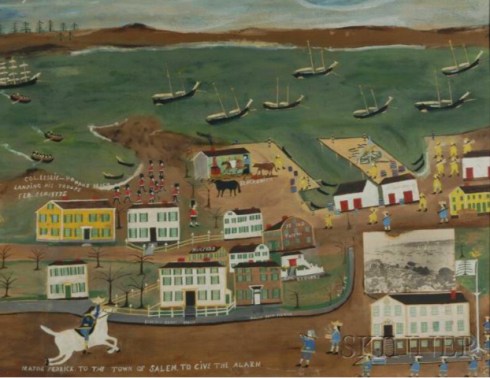
Major Pedrick was a Tory! None of the contemporary reports of the events of February 26, 1775 mention Major John Pedrick as the “alarming” figure who rode ahead of Leslie’s troops to warn the citizens of Salem of their imminent arrival, nor does Endicott. That’s because his role was made up after Endicott’s account. Pedrick was in fact a wealthy Tory who would not have been motivated to play such a conspicuous role at this time; he came around a bit later but anonymous Marbleheaders warned Salem on that Sabbath day. Again, I am relying on J.L. Bell’s succinct analysis of the “myth” of Major Pedrick, which has been perpetuated in the most recent scholarship as well as our reenactment. I was also inspired by Bell’s post to look around and see what else was made up about our event, particularly in the “creative” Marblehead accounts of the later nineteenth century. Samuel Roads Jr.’s History and Traditions of Marblehead (1880) turns Leslie’s Retreat into an all-Marblehead affair: Pedrick is prominent, of course, along with an entire Marblehead Regiment that came to Salem to take up with Leslie’s troops. Not a single Salem name is mentioned in Roads’ account, but we do hear of one Robert Wormsted, one of the young men from Marblehead,—who afterwards distinguished himself by his daring and bravery,—[and ] engaged in  an encounter with some of the soldiers. He was a skillful fencer, and, with his cane for a weapon, succeeded in disarming six of the regulars. Wow. No mention in Endicott of this cane-wielding Wormsted—or Pedrick—but Marblehead folk artist J.O.J Frost seems to have cemented the latter’s place in history in his early twentieth-century painting Major Pedrick. To the Town of Salem, to Give the Alarm.

Leslies Retreat Frost Courtesy Skinner Auctions; note the anachronistic photo inserted on the right.

“Anniversary History” was alive and well in 1775: Even in the standard reports of Leslie’s Retreat published in the week after, I couldn’t help but notice the juxtaposition of what had just happened in Salem and the imminent fifth anniversary of the Boston Massacre. Side by side we can read of Leslie’s “ridiculous” expedition and “an Oration, in commemoration of the Massacre, perpetuated in King-Street, on the 5th of March, 1770, by Joseph Warren, Esq.” and several reports made the connection between the two, which occurred on successive sabbaths. Dr. Warren actually spoke on March 6, 1775, and I wish he had referenced Salem, but he did not. Nevertheless, you can really feel the drumbeat of rebellion when you read the New England papers published in March of 1775: there are lessons to be learned and anecdotes to be memorialized. The editors of the Newport Mercury were also thinking historically when they opined that as our brave ancestors used to carry their implements of war with them to their places of worship during the Indian wars, perhaps our brethren of the Massachusetts Bay have good reason to make use of the same precaution at this day. I also can’t resist adding another eyewitness testimony here, from a “True Son of Old Ireland” who was on the spot, as well as my very favorite photograph of the First Reenactment of Leslie’s Retreat, two years ago: these guys played their roles really well.

Leslies Retreat Lessons Learned Newport Mercury March 6

Essex Gazette March 7 1775 Leslies Retreat

Leslies Retreat best photoThe Newport Mercury of March 6, 1775 and the Essex Gazette of March 7, 1775; Lt. Colonel Leslie (Charlie Newhall!!!) exasperated and outflanked two years ago.

Commemorating Leslie’s Retreat on February 24:  Reenactment at 11:15-11:30 for Redcoats (meet at Hamilton Hall) and Patriots (meet at the First Church). Reception afterwards at First Church.

A Staged Reading of Endicott’s Leslie’s Retreat at the Pickering House by Keith Trickett, 3pm: https://pickeringhouse.org/events/special-leslies-retreat-performance/.

Toast the Retreat and Salem’s Resistance at O’Neill’s Pub on Washington Street from 4-7pm.

And coming in April: the Resistance Ball at Hamilton Hall: https://www.hamiltonhall.org/full-event-calendar/2019/2/1/resistance-ball