
Wow, I don’t think I’ve posted on Salem real estate for quite some time! I’ve just been so serious, but actually there’s not much point: generally as soon as something comes on the market it is snapped right up. I’m sure that will be the case with this little house too, but I’ve also admired it, so I ran over this weekend for the open house. It’s a little two-story shop on Kosciusko Street, overlooking Derby Wharf and the entire Salem Maritime National Historic Site. Two stories, open-floor plan on both floors with a little bedroom and bathroom carved out of the second floor (as well as a “galley” full bathroom on the first), no parking, not much yard: very simple and very atmospheric.
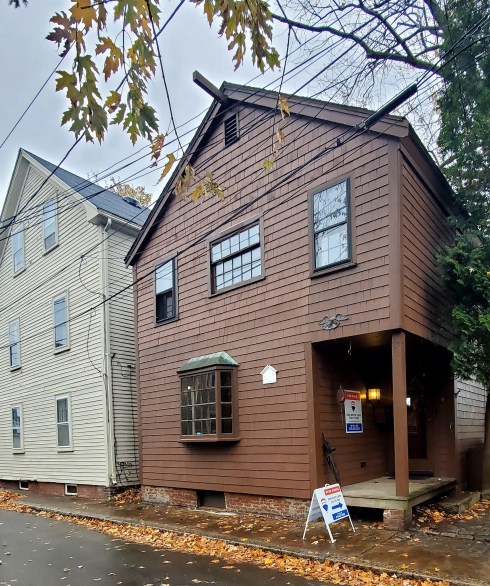


As you can see, there’s been quite a few twentieth-century alterations to this building, especially its fenestration. The plaque report by Historic Salem, Inc. asserts that it is an eighteenth-century structure moved to this site about 1870. The MACRIS inventory calls it “colonial inspired!” Both reports also suggest that it might be an ell that was previously attached to the adjacent building at 159 Derby Street. I’m not sure how this precise 1701 date, so proudly proclaimed, came about. A photograph from the 1930s features an exterior that looks quite different: this can be found at the amazing house history of 159 Derby, now the home of the Salem Arts Association, researched by art historian Franny Zawadski. I was thrilled to learn that both houses were owned by the Salem chapter of the Ukrainian Workingmen’s Association, an organization about which I intend to find out a lot more.


The Shop on the far right above, and on the 1874 Salem Atlas.
I think there’s a bit of Colonial Revivalish embellishment here but it’s fine with me: someone wanted this little old building to look like a ye old cooper shop and it does! It also looks like minimal maintenance to me: a condo alternative with a very tight basement (the advantage of being moved to this spot, I imagine). Since I haven’t written a real estate post in some time, I think I should address the location a bit more. Anyone moving to greater downtown Salem at this point has to consider the impact of tourism, as our City seems hell-bent on driving that engine as much and as far as possible. If you complain about tourism now, you’re going to get a “well, you moved to Salem so you knew what you were getting” sentiment, which I don’t think is fair if you located here twenty years or more ago when Haunted Happenings was much less intense in terms of length and traffic volume of both feet and vehicles. But if you move to Salem now, you better know what you will face (especially if you don’t have a parking place). I think this location has the benefit of being in the zone but protected by the expanse of the Salem Maritime park: I was in this vicinity during the most crowded weekends last month and there were far fewer people here than in the center of the city. I just don’t think the majority of Salem tourists are interested in “history” and this cooper’s shop is in the thick of it.


First and second floors looking out on the Custom House and Derby Wharf (it was kind of dreary outside yesterday but I think the weather just enhanced the coziness).


 Alpheus Crosby and several (not all!) of his equally successful siblings, the sons of Dr. Asa Crosby of Sandwich, New Hampshire. The Normal School at Salem on Broad and Summer Streets during Crosby’s tenure, c. 1857-1865, Salem State University Archives; just a few of the Salem institutions to which Alpheus Crosby volunteered considerable time: the Salem Lyceum, the Salem Athenaeum (then at Plummer Hall) and the Essex Institute, Cousins collection of the Phillips Library of the Peabody Essex Museum via Digital Commonwealth; Professor Crosby’s bestselling series of Greek textbooks, 1860.


 Post-“retirement”: advocacy for radical reconstruction and “impartial” suffrage, 1865-66, Library of Congress; just one donation to the Normal School at Salem. 111 Federal Street in Salem, the residence of Professor and Mrs. Crosby, along with Amy Lydia and Lucy B. Dennis, during the 1860s.


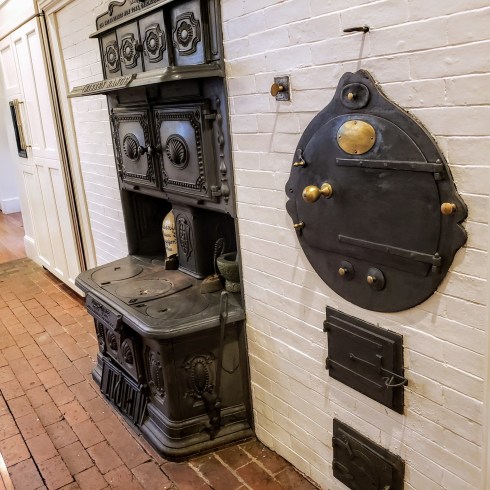 Another Rumford Roaster! I really believe that Salem can lay claim to being the city with the most Rumford Roasters.


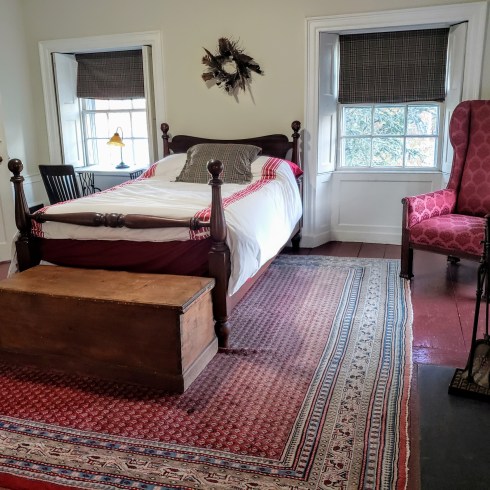

 Beautiful views over Oliver Street on one side of the house, and the Common on the other.


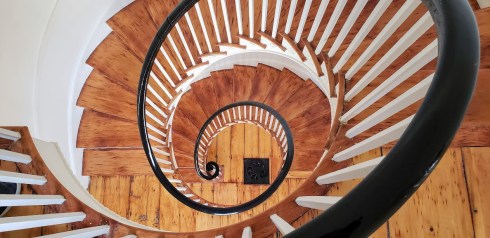
 That staircase!
 1818 & 1912



 Apparently over 1.5 million people visit Salem each year, with nearly 54% of that number in the month of October: for many of those 800,000 or so (I am severely math-challenged), this ⇑⇑ is historical interpretation.

 Carnival Confusion: a City ordinance against mechanical rides on the Common prohibited the annual carnival there, so it was relocated to the middle of Federal Street, but somehow there are electrical rides on the Common as well. This is all very confusing to me, but a colleague of mine commented that the Federal Street location was ok, as those columns on the Greek Revival courthouse are Egyptian Revival, so the Pharaoh fits right in.
 22 Andrew Street: a beautiful Federal (built 1808) located on a lovely street right off the Common (which will not be the site of a carnival for much longer): looks like its
  One Forrester Street is right on the Common—it looks Federal but was actually built in 1770. When I first moved to Salem this was the home of a lovely woman whose family had owned it since the 19th Century. It’s been cherished throughout its history, and is still for
  The Stephen Daniels House is a first-period house which just came on the


 Looking out these windows to the east and west, you see Old Salem in the form of the parochial school, which will also be converted into residences, and New Salem in the form of the Community Life Center and River Rock housing development beyond.


 Palpitations.




 Can you believe this amazing DOUBLE HOUSE!!!!!!


 Listing for One Mall Street, Salem:






