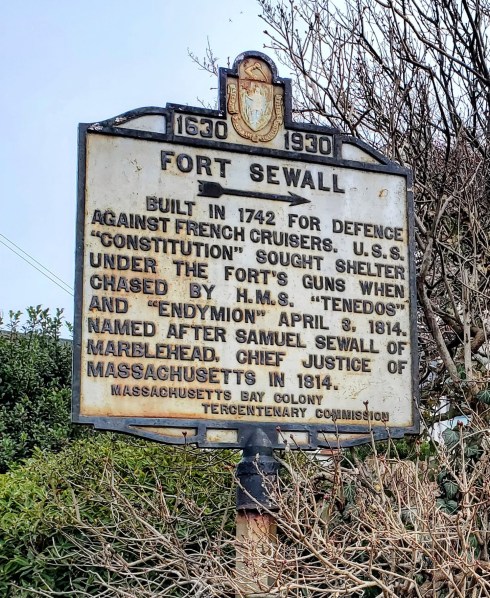
I often find that my profession and my residence are in conflict: it’s challenging to be an historian in Salem, especially at this time of year. More than one person has suggested that I move, and I think every one of my colleagues has done so when I come in all hot and bothered about one thing or another. But even though Salem is often frustrating, it is always engaging and has offered me many “teachable moments” throughout my career. The past few days, beautiful autumn days, have been a case in point. On Friday, we were considering the immediate and slightly longer-term aftermath of the Salem Witch Trials in my two freshmen seminars. I am not an American historian or an expert in the Trials, but the historian who is both of those things in my department, my colleague Emerson “Tad” Baker, has been working in the administration for the past few years so I have been pinch-hitting. Students come to Salem State with a certain degree of awareness and/or interest in the Trials and so we thought we should offer a freshman seminar focused on 1692 to introduce students to both college work and Salem. I put a lot of work into last year’s seminars so I thought I should repeat them this year, but never again: Tad is back and that is that! Anyway, on Friday we were reading about apologies, reversals, and restitution: several participants in the trials (Judge Samuel Sewall, the jurors, accuser Ann Putnam) issued apolgies after their conclusion, the General Court of Massachusetts reversed the attainders of witchcraft conviction for some (but not all) of the accused “witches” and also compensated their families for some (obviously not ALL) of their damages upon petition. Both my students and myself were very touched by the petition of Isaac Esty, Sr. for restitution following the execution of his wife Mary, one of the three former Towne sisters accused of witchcraft in 1692. Mary and her sister Rebecca Nurse were executed while their sister Sarah Cloyce escaped to Framingham. Here is Mr. Esty’s petition of September 8, 1710 and a transcription, from the University of Virginia’s Salem Witch Trials Documentary Archive and Transcription Project:

Isaac Esty Sen of Topsfield in the county of Essex in N. E. having been sorely exercis’d through the holy & awful providence of God depriving him of his beloved wife Mary Esty who suffered death in the year 1692 & under the fearfull odium of one of the worst of crimes that can be laid to the charge of mankind, as if she had been guilty of witchcraft a piece of wickedness which I beleeve she did hate with perfect hatred & by all that ever I could see by her never could see any thing by her that should give me any reason in the lest to think her guilty of any thing of that nature but am firmly persuaded that she was as innocent of it as any to such a shameful death — Upon consideration of a notification from the Honored Generall Court desiring my self & others under like circumstances to give some account of what my Estate was damnify’d by reason of such a hellish molestation do hereby declare which may also be seen by comparing papers & records that my wife was near upon 5 months imprisoned all which time I provided maintenance for her at my own cost & charge, went constantly twice aweek to provide for her what she needed 3 weeks of this 5 months she was in prison at Boston & I was constrained to be at the charge of transporting her to & fro. So that I can not but think my charge in time and mony might amount to 20 pounds besides my trouble & sorrow of heart in being deprived of her after such a manner which this world can never make me any compensation for. Isak Esty sen’r.
He had lost his wife 18 years previously, but it sounds like it was yesterday. She hated witchcraft: her death and execution was a “hellish molestation” for which “this world can never make me any compensation for.” She was imprisoned for 5 months, including three weeks in Boston, and he was compelled to pay for all of the associated expenses, which might amount to £20, “besides my trouble & sorrow of heart.” I found the combination of profound emotional distress and relatively inconsequential damages moving; my students did too. So there we were, discussing this horrible event and a community’s attempts at reconciliation. Class dismissed, and I’m walking home through the streets of Salem, and when I get to downtown there are laughing witches, young witches, older witches, half-dressed witches, all sorts of witches—all so celebratory, and happy to be in Salem, the Witch City, where Mary Esty and her sister died with others, proclaiming fervently that they were not witches. Later vindicated, but forevermore witches, because Salem needs to be Halloweentown, and what would Halloweentown be without witches? Our present Mayor, and soon-to-be Lieutenant Governor, expressed the connection succinctly:

And she is expressing a majority opinion. Halloween is very popular in Salem: the crowds get bigger and bigger with each passing year, and apparently so do the revenues, for both private businesses and the City. According to several sources, Salem tourists spent 140 million in the Witch City in 2020, 35% of which was spent during October: and that was a Covid year. I’m sure revenues will be off the charts this year, as crowds certainly are. I had numbers on my brain as I walked home on Friday night and woke up the next morning with them still in my head. We had discovered that the Massachusetts General Court alloted £578 to the Salem victims’ families in 1710-1711: how much would that be now my students asked? We went over to my favorite past-to-present currency calculator at the UK National Archives and came up with around £60,648, which is about $79,000 in US dollars. $79,000, 19 executions, one crushing, five deaths in jail, a succession of reversals of attainder and apologies: this all adds up to the “legendary witch history” referenced by Mayor Driscoll above, the basis of Salem’s spectacularly successful witchcraft tourism. 140 million in a pandemic year, with 49 million generated just in October, compared to a mere $79,000! I wonder if a reconsideration of compensation is in order? That would be one way to justify the exploitative nature of Salem’s witchcraft tourism: acknowledge it for what it is, just business. Thanks to all of the genealogical research on those accused of witchcraft in seventeenth-century Salem we probably know who and where all of their descendants are: why shouldn’t they get a cut? I just kept thinking about these numbers when I was walking around Salem this past weekend, amongst HUGE crowds: people = profits.


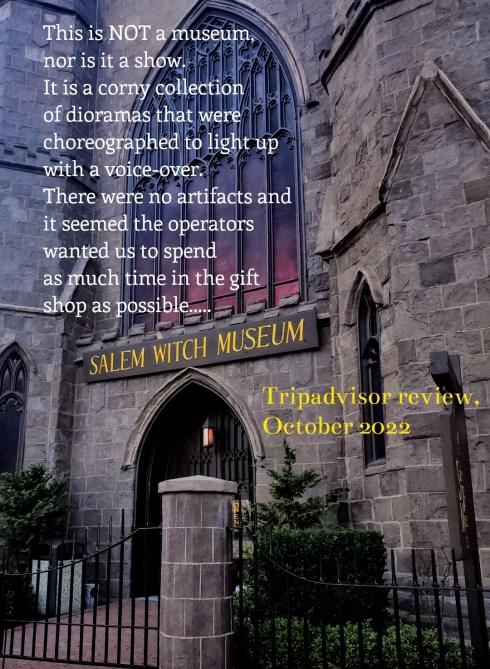
Scenes from a Salem weekend, October 2022: light and dark and a very well-dressed witch; there’s a tour guide in there somewhere (no one could hear him, so no one was listening); the line for PEM’s Ropes Mansion which seems to be identified primarily as “Allison’s House” from Hocus Pocus by Salem tourists; Chestnut Street from my bedroom window (that line of cars went on all day long on Saturday)’ the Salem Witch Museum is very proud that this is the 50th anniversary of Haunted Happenings.
Am I really recommending reparations? Sadly, no. I just want to point out the inequities between past and present, and the exploitation of the former by the latter. It’s nothing new, but I don’t think you can call it out enough. While reparations are most commonly referenced in the disastrous imposition on Germany following World War I and the ongoing issue of compensation for enslavement here in the US, there have been more successful experiments, most notably the restitution initiatives extended to the families of Japanese-Americans interned during World War II. But a Salem reparations program would be impossible: so much time as passed, there would be so many claimants, and so much money involved! Reparations would also run counter to Massachusetts state law, as politicians past protected witchcraft profiteering proactively. The legal exoneration of the persons convicted of witchcraft in Salem in 1692 came in three phases. In 1711 Chapter 80 of the Resolves reversed the attainder for the majority of victims, but excluded six women: Ann Pudeator, Bridget Bishop, Susannah Martin, Alice Parker, Margaret Scott and Wilmot Redd. Following World War II, relatives of Ann Pudeator started lobbying for her exoneration, which was finally achieved with Chapter 145 of the Resolves of 1957 . Finally, following the appeal of Salem State University graduate student Paula Keen and the concerned families, Chapter 122 of the Acts of 2001 included Bridget Bishop, Susannah Martin, Alice Parker, Margaret Scott and Wilmot Redd in the 1957 law, in which they were simple referred to as “others.” The 1957 Pudeator bill was debated for quite some time, particularly in the period 1954-1957, as legislators openly questioned the impact of the exoneration on tourism and the possibility that it might expose the Commonwealth to legal action. Consequently the language of the bill’s final passage specifically provides that descendants of the victims of 1692 may not sue for damages! No worries for Salem.

United Press National Headlines 1954 & 1957: not sure why Senator Evans of WAKEFIELD was so concerned but he gets the most quotes for sure!
The word “reparations” usually means money, but it also refers to repairing one’s reputation, image, or perception (and not simply replacing it with something new and shiny, as in Salem). I’ve been thinking about that process too, because of another witchcraft course I’m teaching this semester, Magic and Witchcraft in Early Modern Europe (yes, it’s a pretty intense semester). Unlike the situation in Massachusetts, there were no immediate attempts to rehabilitate the many victims of the succession of witch trials which occurred in much of Europe in the sixteenth and seventeenth centuries; indeed, that process is happening now. This very year the provincial governments of Scotland, where witch-hunting was particularly intense, and Catalonia, where witch trials began relatively early, have apologized formally for their witch hunts. Both exoneration movements were clearly feminist in inspiration, highlighting the fact that the majority of the victims in both regions were women, but both also focused on the necessity of repairing the historical memory of the accused. I’ve been so struck by the Catalan discourse, triggered by the slogan/hashtag No Eren Bruixes/ They were not witches. I hope that that the apologies to those who were not witches paves the way for true historical understanding through reparation in both Catalonia and Scotland, rather than expedient exploitation once the slate has been wiped clean.

“They were not Witches,” (they were Women): a call to action in Catalonia.





 A very typical 1770s shipping report in the Essex Gazette; of course the destinations listed point to the intersection of the fish and slave trades in the Atlantic system; Advertisements from the Salem Gazette, and a “Bilbao Mirror” from Bonhams Skinner. I should say that the only references that I found for “Bilbao caps” in the pre-revolutionary newspapers were in runaway slave advertisements.
 Two recent titles, including a stirring study of the namesake of Galveston, Texas, Bernardo de Gálvez; Diego de Gardoqui, Ca 1785. Courtesy Family Cano Gardoqui.
 Top: Nowland Van Powell’s depiction of Captain Haraden’s engagement with the Achilles, which had stolen his prize, the Golden Eagle, off Bilbao, Eldred’s Auctions.


 So, much of this seems fine, certainly the themes are great (more on them below), and the criteria professional. I’m having some difficulty envisioning the logistics of the vetting process, but will leave that to the experts. What does concern me, however, is the disassociation of “site” and “building” as referenced in #3 on. As you see in my graphic above, the Salem Witch Museum, the most profitable of the for-profits, is referred to as the former East Church, which is presumably how it made the cut. Why the East Church is deemed “historic” is beyond me, aside from its imposing Gothic Revival style: certainly it is no more historic than the nearby houses of ultra-philanthropist George Peabody and Supreme Court Justice Joseph Story, or the birthplace of the illustrious Benson brothers across the Common. When I asked why and how the Salem Witch Dungeon Museum, also located in a former church (built by the Christian Scientists and not the East Church parishioners), was included on the trail, I got this response from the Executive Director of Destination Salem: The Witch Dungeon Museum and Lynde Street are the site of early fortifications. English settlers knew that their presence in Salem immersed them in a web of global conflicts. Fearing reprisals from the indigenous people they were displacing and attacks from other colonial powers, the colony of Massachusetts erected a fort near this spot in 1629. Samuel Sharpe came from London with cannons to assume command of the militia. The first fort was probably made of tall wooden palisades, with extensions jutting out to prevent flanking. In the following decades, further fortifications were built along the Salem coast and a palisade was built along the western end of town. The early, feared attacks never happened. The East Church built a chapel on Lynde Street in 1897 and The Witch Dungeon Museum opened in the building in 1979. Visitors can watch a live-action reenactment of a witch trial and tour a recreation of the grim prison where the accused were kept. So basically: because a long-gone fort was once on the site of the Salem Witch Dungeon Museum, it qualifies for the trail? I don’t think I need to spend too long discussing the implications of this “standard.” In a city as old as Salem, every structure downtown was built on the site of something else: there are layers and layers and layers. The Witch Dungeon Museum’s storefront sister “museum” on venerable Essex Street, the Salem Witch History Museum, could claim that it sits on the site of Salem’s first printing house or any number of historic structures and thus qualify for the new Heritage Trail. Perhaps the cumulative criteria above could mitigate against this, but it does not appear to have done so with the Salem Witch Dungeon Museum: I think we need to be honest about where we are leading people—and why.
 Mannequin City: mid-20th century interpretive “technology” reigns in Salem’s for-profit witch “museums” which have no incentive to innovate, as the City delivers visitors right to their doors; Witch Dungeon Museum hanging mannequins.


 Salem tourism brochures from the 1950s through the 1980s: not until the last decade was the Heritage Trail restricted to downtown and the “story” increasingly restricted to witches. Love the sentiment of “traveling through history in Salem.”
 Higginson Square, 1893, Nelson Dionne History Collection, Salem State Archives and Special Collections. A big flatiron to highlight Asheville’s Flatiron building. It begs the question: no Parker Brothers site for Salem’s new Heritage Trail?


 Anchor from the Queen Anne’s Revenge, whose wreck was discovered in 1996. The Queen Anne’s Revenge
 A REAL Anchor.