Tag Archives: Public Art

I’m Confused by Pineapples

This is one of those “writing it out” posts. It starts out with confusion in the hope that I can work it out, but I may not so it might end in confusion as well. I’m confused about the symbolism of pineapples. Of course everyone knows that pineapples represent “hospitality,” but do they really? What else might they represent? I started out with the question as to whether pineapples are Colonial or Colonial Revival, and it seems that that they are both. I’m also wondering if there are differences in what they represent in the northern US as opposed to the south, and between the US and the UK. My wonder is prompted by recent road trips down south, where I saw a lot of pineapples, as well as an interest in symbolism in general prompted by the recent discussions here in Salem over our official city seal, which some see as stereotypical and rascist and others see as evocative of a proud global maritime heritage. I always find that a historical perspective helps with understanding both images and events; apparently the members of the Task Force charged with examing the seal do not. In any case, there’s always a personal and arbitrary angle: it’s so interesting that different people see very different things in the same image. And that is true of pineapples too: while for the most part they seem to convey a sense of decorative hospitality, they also have associations with exoticism and exclusivity and excess, colonization, plantations (both in the West Indies and Hawaii), coerced labor and ultimately slavery. I am always interested in Salem’s famed “Pineapple House,” a Georgian structure first located on Brown Street and then removed to Brown Street Court which was demolished by 1911 with only its pineapple-pedimented door preserved, first in the Essex Institute and now in the American galleries at the Peabody Essex Museum. I’ve written about it before, but I know more now: its pineapple was not a local creation but rather a British import and its importer, Captain Thomas Poynton, became one of Salem first Loyalistist refugees, leaving his house (and his wife!) for England in 1775. That conspicuous (always gilded by all accounts) pineapple might have had Tory associations in Revolutionary Salem, but nevertheless it became the inspiration for one of Salem’s most important Tercentenary expressions, the band stand on Salem Common erected in 1926.

There are pineapple motifs on New England furniture and wallpapers from the 18th century through the mid-twentieth, but in terms of conspicuous architectural detail I think the best examples are the Hunter House in Newport, RI and the Wentworth-Gardner House in Portsmouth, NH (after Salem’s Pineapple House, of course). The Hunter House was also owned by a prominent Loyalist, and a recent article on its new Orientation Gallery describes its current interpretation as a  “paradigm shift”: Here visitors can examine a historic photograph of the house’s pineapple pediment alongside a silver coffee pot and a pair of covered baskets adorned with pineapple finials. The display discusses the tropical fruit as a product of colonization and slavery as well as a symbol of wealth and hospitality in colonial Newport. For the Preservation Society, which long ago adopted the pineapple as part of its logo, this analysis represents a paradigm shift. It’s been a few years since I’ve been on a tour, but I don’t think this kind of deep dive is offered up at the Wentworth Gardner House in Portsmouth, which was restored by none other than Colonial Revival evangelist and entrepreneur Wallace Nutting in 1916-18. And there’s no need, as Nutting added the pedimented pineapple, and the entire entrance surround to the house. This very Colonial Revival pineapple anticipated the ever-present fruit emblems at another prominent Colonial-esque institution: Colonial Williamsburg.

And down south, it’s the same thing: there are eighteenth-century pineapples and then there is a twentieth-century pineapple revival. Virginia’s oldest plantation, Shirley, has a very prominent three-foot-tall pineapple right at the apex of the roof of its main house, which was built around the same time as the Poynton House in Salem and the Hunter House in Newport.  Installing a pineapple on the pinnacle of one’s roof must have been a James River Plantation thing, as Brandon Plantation has one as well. Another interesting transatlantic pineapple connection relates to the last Colonial Governor of Virginia, John Murray, the fourth Earl of Dunmore, who commissioned a stone-carved pineapple summerhouse for his Scottish estate in 1761, likely the most famous pineapple construction in the world. The pineapple is very prominent in Charleston, of course, with the pineapple gateposts (which I think were supposed to be pinecones?) of the Simmons-Edwards House dating from around 1816 and the famous pineapple fountain dating from 1990.

Shirley and Brandon Plantations in Virginia; The Dunmore Pineapple, Stirlingshire, Scotland via the National Trust for Scotland; Gate at the Simmons-Edwards House at 14 Legare Street, Charleston, built 1816, from the lovely site Glimpses of Charleston; some pineapple images from one of my favorite books, Charleston Style, by Susan Sully with photographs by John Blais.

Pineapples on the gatepost (and I suppose by extension the very popular pineapple doorknocker) are said to be visual “traditions” based on the practice of ship captains returning from exotic realms displaying pineapples on their properties to indicate that they were home, and ready to receive visitors. This story is repeated again and again and again, but I don’t seem to find any references to it before the early twentieth century. I think it’s more Colonial Revival romance. Pineapple stories just keep getting repeated with very little insight, analysis or research, at least over here. With the exception of the Newport Preservation and a Smithsonian blog post about the “prickly” history of the pineapple, these storied fruits (and their visualizations) don’t have much cultural depth over here in the US: and if they are in fact emblems I think they should have more. But in the UK, wow! Here’s a great History Workshop piece with all sorts of associations, and very recently, a “sinister history of the pineapple” student project at the University of Southampton in collaboration with Royal Botanic Gardens at Kew was featured in DezeenMy research for this post exposed me to yet another pineapple association: apparently an upside-down pineapple sign on a door means means there are swingers within! That’s a long way from friendly sea captains, and obviously there’s much more to pineapples than meets the eye (but I’m still confused).

Dezeen Magazine, July 26, 2025: A “Sign of Status” by Jas Jones, who concludes “the pineapple is no innocent fruit.”


Local Color: Salem June 2022

This is going to be an odd post which will start out sweet and end up a bit sour, but I can promise you that it will be colorful throughout. There’s one aspect of Salem’s history that I never seem to be able to cover completely, despite the longevity of this blog: its horticultural history. Salem was really famous for its horticulture a century or so ago: you can’t browse through a stack (or a database) of house and garden magazines from the first half of the twentieth century without encountering articles on the “old–fashioned” gardens of Old Salem. Several really notable cultivators and landscapers lived here, and one still does! There is continuity: the city still has some wonderful private and public gardens: among the latter are the Ropes Mansion and Derby House gardens, which are open to the public. There are so many flowering trees and to see in Salem just while walking down the street, especially at this time of year or a bit earlier. So I’ve got some nice photos from the past two weeks or so, and that was going to be the exclusive focus of this post: a parade of colors in Salem for Pride month! But, stuff happens, and in the middle of this very a trouble man painted the Bewitched statue in Town House Square red, setting off a wave of national headlines and local commentary. So I think I’ll add Samantha to this colorful mix. But first: Ropes and Derby:

Salem in June: the Peabody Essex Museum’s Ropes Mansion garden is really more of a high/late summer garden, but the Derby House garden at the Salem Maritime National Historic site is perfect in June.

My garden can’t really compete but I do want to show you my lady’s slippers and I really like the meadow rue that blooms at this time of year. I’ve thinned out my rose bushes, because they just don’t earn their keep in my small garden, so I only have the best bloomers and they are putting on a show right now. This the lady’s mantle time too: I’ve been training my younger cat Tuck on a leash, and the minute he gets it on he goes right for it, so you can see pre-bloom last week and bloom this week. Then there is the vertical garden at the new downtown condo building named Brix (not a fan of this building but I do like its exterior embellishments), peonies from around town, an impressive plant for which I need an identification outside the Peirce-Nichols house (baptisia?) and more roses, on Cambridge Street.

So that brings us to more unnatural color: blue trees and a red Samantha. In the side yard adjacent to the Peabody Essex Museum, the trees have been painted bright blue, a very bright royal blue. This is the 27th international installation of the artist Konstantin Dimopoulos’s The Blue Trees, an “environmental call to action” with watercolor which will fade with time. Very striking, especially at this time of year. With no manifesto and paint that was certainly not biologically-safe, a homeless man spray-painted the upper part of the Bewitched statue a few blocks away in downtown Salem in the middle of this past week. Red Samantha didn’t last long; indeed I’ve seldom seen a quicker response by the City. By the end of the day she was cleansed and a gofundme account set up to restore her to her former “glory”. For those of us in the never-Samantha camp, it was hard to bear the comments on social media protesting this act of vandalism as “disgusting” and “disrespectful” because that’s just how we view the statue: as disgusting and disrespectful to the victims of the 1692. Or maybe I should just speak for myself. As the story created regional and national headlines that night and the next day, I just couldn’t bear the use of the word “landmark” applied to this horror: a landmark should be something that one points to with pride, not embarrassment, which is generally how I feel every time I pass by Samantha. Salem Mayor Kim Driscoll praised the quick cleanup by her public services team and opined that “Samantha brings a degree of joy and whimsy to our downtown and has become a landmark location for thousands of visitors to Salem each year” but such craven capitalization on suffering remains incomprehensible to me. To return to my color theme (and lighten up things a bit), there was also a difficult juggling act for those who did not want to praise vandalism by any means, but at the same time thought that Samantha looked better draped in red. Anything could improve that eyesore, and I always see red when I gaze in her direction.

The Blue Trees of Konstantin Dimopoulus; and a fleeting Red Samantha.


A Bush Garden

Last week I spent a day in Kennebunkport, a town long associated with the Bush family because of Walker’s Point, which was purchased by President H.W. Bush’s maternal great- and grandfather after the turn of the last century. The usual congregation of onlookers was there, looking down on the Point compound: summer white house towns seem to have lasting appeal and Kennebunkport is a summer white house town x two. I was thrilled because the gate to St. Ann’s-by-the-Sea, a bit further down the coast, was open and so too was the church itself: I had never been inside and this was my chance! It did not disappoint: what a lovely seaside chapel that actually accentuates its setting, a great achievement as its setting is magnificent.

On the road that connects Kennebunkport harbor and downtown to the coast is a small park owned and maintained by the Kennebunkport Conservation Trust named River Green which is the site of a lovely little garden dedicated to former First Lady Barbara Pierce Bush. “Ganny’s Garden,” referring to the name she was called by her 17 grandchildren, was laid out in 2011 and became a memorial garden after Mrs. Bush’s death in 2018. It is completely charming, and also provides a good lesson about what one can do in a relatively small space. It is packed with plants, including some unusual ones (I was struck by the liberal use of mustardbut also personality and presence: bronze “statues” of Mrs. Bush’s gardening shoes and hat lie adjacent to that of an open book (her favorite Pride and Prejudice) as if she had just been there—or was still there.

The garden is overlooked by another statue dedicated to the seafaring forebears of Kennebunkport: Frank Handlen’s Our Forebears of the Coast, which was commissioned in 1994. Its presence made me wonder, in my compare-everything-to-Salem habit which I am trying to kick this summer: why no monument to Salem seafarers? If ever a settlement was made by the sea, it’s this one!


Women on a Pedestal

Obviously statues have been in the news of late, so I thought I would tap into the national (and international) focus by looking at some of our country’s more notable monuments to women, either striving for the franchise or striving in general, for this week’s #salemsuffragesaturday post. It doesn’t matter what your political inclination is, everyone seems to agree that there are not enough statues of women anywhere and everywhere, and corrective measures are being taken, along with initiatives associated with this Suffrage Centennial year. The husband and wife team who constitute Statues for Equality have established that statues of women represent less than 10% of public monuments in several American cities, and far less in most. In Salem we have only one statue to a woman: Samantha Stevens from Bewitched, situated in our city’s most historic square. She never accomplished anything (because she never actually existed) and her prominent situation and whimsical depiction mocks the real victims of the 1692 trials who were falsely branded “witches”, but nonetheless she is deemed worthy of monumental representation in Witch City. There are so many more women (real women) that deserve to be put a pedestal in Salem—that’s what this year has been all about for me.

pixlrSamantha is currently wearing an ensemble by local artist Jacob Belair, which I think is lovely on its own but also because it covers part of her up! I wish it extended to her unfortunate pedestal. I’m not in Salem now, so I asked my stepson ©Allen Seger to take the photos of Samantha in crochet.

Let’s turn to some more serious representations. Ever since it’s installation 15 years or so ago, the Boston Women’s Memorial has been one of my favorite monuments: not only is it aesthetically pleasing and immediately engaging, but it represents a spectrum of women who shaped Boston’s history (as well as that of Massachusetts and the nation): Abigail Adams, Phillis Wheatley, and Lucy Stone. These women are not just on pedestals (actually they have come off their pedestals) but depicted by sculptor Meredith Bergmann in the process of thought and activity, with their words accompanying them. Monumental women are in large part, active women, the feminine counterpart of all those masculine equestrian statues.

Screenshot_20200612-082211_Chrome

Screenshot_20200612-082224_Chrome

Screenshot_20200612-082234_ChromeThe Boston Women’s Memorial by Meredith Bergmann; photographs from her website.

Meredith Bergmann was also commissioned to create the most anticipated installation of this Suffrage Centennial Year: the Women’s Rights Pioneers Statue in Central Park in New York City, which will be unveiled on August 26, the date on which the ratification of the 19th Amendment was certified in 1920. This will be the park’s first statue honoring real women, and it also focuses on their activity: Sojourner Truth, Susan B. Anthony, and Elizabeth Cady Stanton are gathered around a table, intently focused on drafting a document. The statue had a controversial conception in that Truth was originally excluded, but public discussion and debate resulted in a more inclusive—and representative—monument.

Screenshot_20200612-082723_Chrome

Screenshot_20200612-082623_ChromeModel and Mock-up of the first and final monument to the Women’s Rights Pioneers by Sculptor Meredith Bergmann, to be unveiled in Central Park on August 26, 2020.

As the state which ultimately ratified the 19th Amendment in August of 1920, Tennessee takes its suffragist history very seriously and has produced two notable monuments to the women who worked so hard to make it happen (because it’s really not all about a wavering state senator is it?) There is the Tennessee Woman’s Suffrage Memorial (2006) in Knoxville, depicting Lizzie Crozier French, Anne Dallas Dudley, and Elizabeth Avery Meriwether, and the Tennessee Woman Suffrage Monument (2016) in Nashville’s Centennial Park, featuring Dudley along with Abby Crawford Milton, J. Frankie Pierce, Sue Shelton White and Carrie Chapman Catt. Even more recently, the Commonwealth of Virginia—always the site of so much statue furor—dramatically increased its commemorative depictions of accomplished women with its Virginia Women’s Monument: Voices from the Garden initiative, honoring the “full scope” of women’s achievements with twelve representative statues.

Screenshot_20200612-075354_Chrome

Screenshot_20200613-080549_Chrome

Screenshot_20200612-072439_Chrome

Screenshot_20200612-072336_ChromeThe Knoxville and Nashville Suffrage statues—both by Tennessee sculptor Alan LeQuire—and the unveiling of seven statues of prominent Virginia women last fall: former Virginia First Lady Susan Allen points to a statue of Elizabeth Keckley, dressmaker for Mary Todd Lincoln, and suffragist Adele Clark among the crowds (Bob Brown/ Richmond Times-Dispatch).

I like the fact that so many of these monuments are collective, featuring women engaged with each other. Sometimes they are working, sometimes they are simply “conversing”—or meeting for the first time like one of the most famous Suffragist monuments, the “When (Susan B.) Anthony met (Elizabeth Cady) Stanton” statue in Seneca Falls, New York, portraying the moment when these two icons were introduced by Amelia Jenks Bloomer in 1851. My very favorite “conversation piece” is the lovely statue of two prominent Rochester, New York suffragists, Anthony and Frederick Douglass, having a cup of tea: I would love to have been a fly on the wall (or the bench) for that conversation!

Screenshot_20200613-075828_Google

Screenshot_20200613-080112_ChromeThe Anthony-Stanton-Bloomer statue (1998) by Ted Aub in Seneca Falls; Ira Srole’s “Let’s Have Tea” (2009) in Rochester.

The most official Suffrage statue of all, Adelaide Johnson’s “Portrait” monument to Anthony, Stanton, and Lucretia Mott completed (and dedicated) in 1921, is also a collective representation but the women don’t seem particularly engaged with each other: it’s not my favorite statue but that doesn’t mean I think it should have been hidden away for most of the twentieth century! The “unfinished” appearance of the work also engulfs the women in their “pedestal” rather than placing them on it, but rumor has it that Johnson was making room for at least one more prominent woman—perhaps the first female president—to be carved out of that raw marble in the back at some point in time. Clearly not 2020.

Capitol StatueOffice of the Architect of the Capitol.


Portuguese Pavement

Like everyone else in the world, I admire Portuguese sidewalks, paved in mosaic patterns of polished white and black limestone, hand-cut and hand-laid: calçada Portuguesa is definitely an important part of Lisbon’s municipal identity, with a bronze installation of two pavers (calceteiros) at work situated in one of its central squares. We had great weather last week, but I’ve been on these sidewalks in the rain before, and I know that they are definitely slippery when wet. Consequently they have their critics, but I think the more serious threat to their continuing existence comes from the production side, as low wages, arduous work, and long hours have diminished the number of calceteiros working in Lisbon in recent decades. One article asserts that there are a mere ten pavers in Lisbon today, compared with 400 in the eighteenth century. I saw several pavers working while I was there, and they looked just like this bronze pair below: craftsmanship from time immemorial, still very evident along the streets of Lisbon.

Port Pav 9

Port Pav 6

Port Pav 2

Port Pav

Port Pav 8pixlr

Even the beautiful store Vista Alegre was inspired enough by Portuguese sidewalks to design and produce an entire line of dinnerware with some traditional motifs: just stunning. It was hard to resist these plates but I was worried about breakage: and now I see I can buy them here!

Port Pav 4

Port Pav 3

Port Pav 5


Art+Science

The Salem Arts Festival was this past weekend in Salem: its tenth anniversary. Last year plastic-bag jellyfish were suspended above Derby Square and Front Street; this year it was all about bees. Salem’s art scene is very vibrant now, but this little city has always had a bustling community of artists (well, after the Puritans morphed into the Congregationalists) and craftsmen. I’ve written about quite a few individual artists, but I thought I would look for more collective precedents, and that quest took me directly to the fairs of the Salem Charitable Mechanic Association (1817-1932). The records for this association, like those of nearly every Salem institution and organization, are relatively inaccessible, as they are in the Peabody Essex Museum’s Phillips Library, which has been closed in Salem, removed to Rowley, and for which digitization plans are nonexistent at present. But fortunately the Association wanted to showcase the creations of all its exhibitors, and so compiled a wonderful program for its first fair in 1849 that has been digitized in several places. This was held in its very own Mechanic Hall, built a decade before.

Art + Science collage

Art + Science The_Salem_Charitable_Mechanic_Association

Art + Science Mechanic Hall SSUTwo copies of  Reports of the First Exhibition of the Salem Charitable Mechanic Association, 1849, a certificate from the exhibition (Boston Athenaeum), and Mechanic Hall at the corner of Essex and Crombie Streets in Salem, built in 1839 and destroyed by fire in 1905 (Dionne Collection, Salem State University Archives).

This program makes for very interesting reading for several reasons. First of all, the judges of each category are very detailed and opinionated about their criteria for awarding diplomas and silver medals–although it appears that everyone who showed up got the former. The sheer eclecticism of the entries is notable, as is the relatively small number of industrial entries–surprising as the exhibition was occuring in the midst of the Industrial Revolution in Massachusetts. The organizers address this deficiency in their introduction: it is to be regretted that there was not a greater display of the Manufactures of Old Essex, especially of Cotton and Woolen Goods. Andover and Newburyport, with their numerous and extensive Cotton and Woolen Manufacturing Establishments, did not exhibit a single article. Saugus with her Flannel and Yarn Factories—-none, and Danvers, with her Carpet and Tweed Factories, was also deficient. When we consider that Essex County produces more than the whole State of South Carolina—-that her products are more than twenty millions of dollars—and a fair share of it in the articles alluded to—the display was not what it should have been. But notwithstanding these adverse circumstances, the energy and the perseverance of the mechanics of Salem, essentially aided by the Ladies, produced one of the most beautiful exhibitions ever witness in this vicinity. I guess they just didn’t get the word out! And yes, “the Ladies” are very well-represented in this 1849 exhibition, which showcased every possible type of art: mechanical and utilitarian, “fine” and decorative.

PicMonkey Image

1849salemmechassoc_obvDiplomas and medals for “drab” clothing, an artificial leg, mineral teeth, a miniature steam engine and a Patent Cloth Folder used at the Naumkeag Steam Mills in Salem, among other exhibits; a rare medal from the 1849 exhibition, from John Kraljevich Americana.

Above all, the integration of art and science seems very apparent in this exhibition: perhaps it is highlighted by the paucity of industrial exhibits but there are still many categories that we would consign to an arts festival today rather than one celebrating “mechanics”. Besides “Fine Arts”, everything created with a needle was on display, along with everything for the house and the body. This exhibition was all about creation, pure and simple. I love this universality and lack of separation between the artistic and the scientific: it illustrates the continued influence of the culture of the Renaissance, the period in which I was trained, during which everything was an art. But the Charitable Mechanic Association had its categories too, some of which seem rather arbitrary: the sole Daguerreotype exhibitor, one of Salem’s three practitioners at the time, was D.S. Bowdoin, who won a silver medal in the Fine Arts category for “a very admirable collection of Specimens, showing great skill in the mechanical execution, good taste in the arrangement of subjects, and in the management of light and shade”.  To me, the daguerreotype seems a near-perfect combination of art and science.

Bowdoin collageI couldn’t find any D.S. Bowdoin daguerreotypes from 1849, but here are two cartes de visite from later: studio portraits portrait of Robert Daley (or Daily), a Salem “expressman”, c. 1855 (Historic New England) and John Lewis Russell, a well-known botanist and Unitarian minister (Wisconsin Historical Society). According to the later photograph, Bowdoin’s studio was in the Downing Block, Salem.

Back in the present and now that I think about it, this arts festival does indeed bridge the gap between art and science in its own way: what could be more technological than transforming commissioned plastic bees into building materials? I have never really understood the stem vs. steAm debate, and let’s throw an H for history in there somewhere!

bee collage 2

Arts Festival 1

Arts Festival 3

Arts Festival 2

Arts Festival 4

Arts Festival 8

Arts Festival 6

Arts Festival 7

Arts Festival 9Scenes from the Salem Arts Festival on Saturday: my neighbor Racket Shreve’s “Best in Show” painting in the gallery in Old Town Hall along with “Remembering Georgie” by Heather M. Morris; the Mural Slam—just loved this work-in-progress of “Salem from Above” by Casey Stanberry, especially in its partially finished state.


From Space to Place

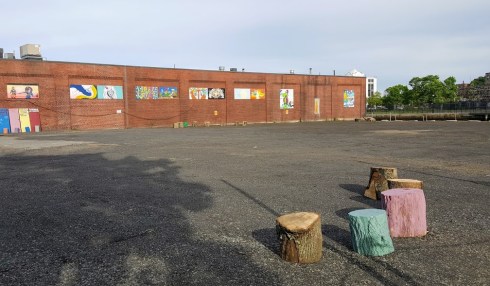
The City of Salem has purchased a large vacant lot at 289 Derby Street which has long served as an industrial and commercial site given its location on the South River that opens up into Salem Harbor. A few weeks ago a public “placemaking” process commenced, under the auspices of the City, CBA Landscape Architects, Salem Public Space Project and Creative Salem : engaging events are happening every Wednesday night until June 21st and people can also write their ideas on an on-site chalkboard whenever they happen to be passing by. After all the unimaginative private projects that have come our way over the last few years this is a welcome opportunity for the public to imagine and impact a key Salem development, and transform an empty space into an inviting place.

Placemaking Lot

Placemaking 1897 The lot today and on the 1897 Salem Atlas, marked by the old lightbulb. It was R.C. Manning & Company’s coal and lumber yard then, and it served in a similar capacity well before and after. Below: the process of placemaking.

Placemaking board

Placemaking Boards

Placemaking Events

I’m feeling left out as I have my summer research seminar class every Wednesday night so I’m missing all these events! I guess I’ll just have to put my idea out here. It’s not really original, it’s a bit silly, and it probably doesn’t suit the lot, but here it is: a Monopoly Park. To pay tribute to one of Salem’s most illustrious businesses and products, I’d like to see this lot transformed into some semblance of the iconic board game. This is how I envision it: real estate lots around the perimeter, perhaps just painted concrete (maybe some benches that somehow reference the look of Monopoly houses and hotels), inside a courtyard of grass, with tables that look like Community Chest and Chance cards and topiaries that look like Monopoly tokens! Can’t you picture it? I really can (with a little help from some of the pins below), and I think it would be pretty low maintenance with the exception of the topiaries. Topiaries can be troublesome.

Monopoly in the Park in San Jose, California: Why San Jose and not Salem? Ours could be better: more creative, more green, more place-appropriate, more of a Monopoly Park than Monopoly in the Park.

Monopoly in the ParkMonopoly in the Park in San Jose (You can see more images at Anna Fox’s Flickr album); there have also been temporary life-sized Monopoly boards built in other places, including Atlantic City, of course.

Monopoly in the Streets of Chicago: the creation of an anonymous artist referred to as Bored. Those plywood cards could be enlarged for our tables! Dice for stools.

bored-8

bored-3 Street Monopoly by Bored, via Colossal.

I’m not sure how to integrate the Monopoly houses and hotels into the design (benches? public bathrooms? snack bar?) but we could have Monopoly murals on the side facade of the adjoining brick building, just like there are now (this would require Hasbro’s permission–and perhaps we could get some underwriting too?). I’m seeing green, so it would be great if the tokens could be topiaries but I guess they could be sculptures—which would enhance the park’s attraction all year long.

Monopoly gameMonopoly Mural

Monopoly Big Cat

Monopoly Token CollageCanadian artist An Te Liu’s Monopoly House in suburban Toronto; Tom Taylor’s mural for Hasbro; a 6-foot tall promotional replica of the new cat token, carted around London in 2013; the displaced iron token (my favorite!!!) and the hat from “Your Move“, (Daniel Martinez, Renee Petropoulis & Roger White), a public art project commissioned by the City of Philadelphia.

So that’s my pitch: a Monopoly Park/ Parker Brothers Place. The other idea that keeps popping into my head is move Samantha to Derby Street, a far more appropriate place than Town House Square. But every time I criticize that stupid statue I get into trouble, so I’m just going to leave that there.


Spectral Visions on Derby Wharf

All summer and fall the Salem Maritime National Historic Site is featuring a virtual exhibition called “The Augmented Landscape” which brings eight spectral sculpture assemblages–visible only through a smartphone equipped with the layar app–to Derby Wharf. It’s a more artistic form of Pokémon Go, with global and topical themes and layered connectivity. Everyone in Salem is missing the site’s major attraction—the Friendship–and while this exhibition/experience is not a replacement, it is certainly a distraction! The creations are the work of four artists commissioned by Boston Cyberarts: John Craig Freeman, Kristin Lucas, Will Pappenheimer and Tamiko Thiel. Thiel’s “GardenAnthropocene” imposes a vivid and chilling vision on a familiar place, a “dystopian science fiction future for the landscape as we enter the Anthropocene, a new geologic time period created by human activity……[in which] native plans grow and mutate in response to the earth’s changing conditions, adding to their evolving climate and altering the landscape as we know it”. This doesn’t sound–or look–good!

Spectral Collage

Spectral Garden GardenAnthropocene

Thiel’s other installation, “TreasuresOfSheRem” focuses more on the past than the present, featuring the coins and commodities that Salem traders brought to the East to exchange for tea, spices, porcelain and other exotic goods. Poppies, yes, but somehow I didn’t know that sea cucumbers were so important to the China Trade……

Spectral Money

Spectral Treasures 2

Spectral Treasures TreasuresOfSheRem

More familiar cod hover over the wharf in Will Pappenheimer’s “Ascension of Cod” and privateers clash, visualized through a “virtual ball of classic galleon type ship masts obtained from disassembled ship models accessed from shared 3D model websites”. I think I was supposed to conjure this up (and that’s what it feels like) in front of the Derby House rather than by Pedrick’s storehouse—I couldn’t quite master the geographical aspect of these installations and ended up with strange things in strange places (but maybe that’s the point?)

Spectral Cod

Spectral PrivateersAscension of Cod and Privateers

My favorite installation is Kristin Lucas’s “Elephant in the Room”, referencing the Crowninshield Elephant that landed in Salem in 1796. He looked funny in the Derby Garden and a bit better in front of the Custom House, but never really in his element. Lucas’s “Goodbyes” also stressed out-of-element images, representing departure, which (on the other hand) is of course quite appropriate for a port. For me, the most literal of the virtual installations are John Craig Freeman’s “Virtual China” and “Virtual Russia”, which project images of Wuhan and St. Petersburg onto Salem’s port[al], emphasizing global connectivity, past and present.

Spectral Goodbye

Spectral people

Specral China

Spectral RussiaGoodbyes, Virtual China and Virtual Russia


Why are there no WPA Murals in Salem?

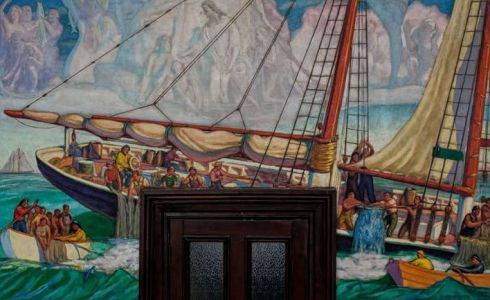
The various initiatives of the Works Progress Administration made their mark on Salem during the Depression: substantive work on Greenlawn Cemetery and the Salem Armory was completed, wharves and docks were built or rebuilt all around Salem Harbor, and the Salem Maritime National Historic Site was created along Derby Street. Many historic structures in Salem were measured and photographed under the aegis of the Historic American Building Survey, for which I am grateful nearly every day. I’m sure there were more infrastructural improvements implemented with federal funds in Salem in the 1930s, but I don’t have the time or the inclination to lose myself in the massive archives of the New Deal!  There is a conspicuous absence of federally-funded art in Salem however: no murals in the Post Office or City Hall illustrating the city’s dynamic and dramatic history. This absence is conspicuous because Massachusetts in general, and the North Shore in particular, is home to some notable New Deal murals, commissioned by various Federal cultural agencies to embellish public spaces with uplifting, patriotic, accessible American scenes while simultaneously providing unemployement for artists. There are amazing murals in Boston, Worcester and Springfield, and in Natick, Lexington, and Arlington, and here in Essex County, in Gloucester City Hall, Abbot Hall in Marblehead, the Topsfield Public Library, and the Ipswich Post Office. Moreover, there were several Salem artists who painted murals for the WPA elsewhere–but not in the city of their birth or residence. Why?

wpa-mural9-large

wpa-eliot-natick

wpa-lexington-ma-po-mural-1024x512

wpa-mural-gloucester

gloucester-wpa-mural-3

Umberto Romano, “Mr. Pynchon and the Settling of Springfield”, Commonwealth of Massachusetts State Office Building, formerly the US Post Office, Springfield, Massachusetts, photograph by David Stansbury, and Hollis Holbrook,” John Eliot Speaks to the Natick Indians”, US Post Office, Natick, photograph by Thomas Cortue, both part of the joint Smithsonian National Postal Museum and National Museum of the American Indian exhibition, “Indians at the Post Office: New Deal-Era Murals”; Aiden Lassell Ripley, “Paul Revere’s Ride”, US Post Office, Lexington; and Charles Allen Winter’s “Protection of the Fisheries”,  and “Education” , two of 6 murals in Gloucester City Hall that have been recently restored.

I’ve been wondering about this for a while, but this weekend I was engaging in my semi-regular weekend fantasy-shopping-on-1stdibs session and I came across a study painting by Dunbar Beck for a mural entitled The Return of Timothy Pickering which eventually embellished the interior of the Danvers Post Office, where it remains to this day. And I thought to myself: why the hell was the mural commissioned for DANVERSWhy didn’t it come to Salem? Timothy Pickering is one of the most famous native sons of Salem, his house is here, and his mural should be here too. Danvers is the former Salem Village, and was long part of Salem, but still this mural clearly portrays Salem Town and harbor.

pickerings-return

wpa-mural-crop-pickering

Dunbar Beck, Study Painting for the Danvers Post Office mural “The Return of Timothy Pickering”, currently available from Renaissance Man Antiques on 1stdibs.

So, why no murals of Salem’s earliest settlements, famous vessels, lively port, sea captains’ mansions, or Witch Trials on the walls of public building downtown?  Well there would have had to be some visual reference to 1692, and that was hardly an uplifting American episode that could be used to raise spirits during the Depression. That’s the curse of 1692, which manifests itself time and time again. Or maybe there was no place for one in Salem’s relatively new Post Office or venerable City Hall. But I for one would like to see a simplistic scene of North America’s first elephant stepping on Salem soil somewhere around town.


Conflagration Commemoration

Across the Atlantic, the year-long commemoration of the 350th anniversary of the Great London Fire of 1666 is peaking this weekend, today actually, with a contained conflagration: a 400-foot wooden replica of the seventeenth-century city will go up in flames on the Thames at 8:30 pm tonight. This is only one spectacular event amidst many creative ventures  organized by the arts production company Artichoke, which seeks to”transform people’s lives and change the world through extraordinary art” along with other institutional purveyors. The Artichoke events include illuminations, projections, lectures, interactive performances, pub crawls, a “fire food market” and “fire garden”, all offered under the umbrella of “London’s Burning”, while London’s more traditional institutions are offering a variety of thematic exhibitions and displays. It’s a very complete commemoration, befitting a transformative event in London’s–and Britain’s–history.

Fire of London St Pauls

Fire of London model Flames projected onto the dome of St. Paul’s Cathedral, the symbol of post-Fire London. Photograph: Chris J. Ratcliffe/Getty Images;  the David Best-designed wooden model to be set on fire tonight @artichoketrust.

Fire has played such a huge role in London’s history–not only in the seventeenth century, but also in the nineteenth and twentieth centuries, when another Great Fire of 1834 leveled much of Westminster and the Blitz destroyed much of the central City. The commemoration of tragedy in general, and fires in particular, must necessarily focus on loss and devastation but also on rebuilding–and how the process of rebuilding reflects on the particular society that is engaged in it. I think an incandescent commemoration of 1666 is appropriate because it will illuminate the loss at least as much as the rebuilding–which has always been the focus in remembrance of this particular Great Fire: Wren’s London. We don’t even know how many people died over those three burning days: we have precise knowledge of property damage but a woeful lack of comprehension about the human toll. When the Fire burnt itself out late in the day on September 5 it had consumed 13,200 houses, 87 churches, and St. Paul’s Cathedral and left up to 200,000 people homeless, but how many people?  Who knows: anywhere from hundreds to thousands (doubtless including anonymous souls who had survived the preceding plague year), yet we still seem to repeat the ridiculous number of only six verified deaths. Then as now, it seems that we can only begin to process the enormity of destruction in a visual and structural way.

Griffier I, Jan, c.1645-1718; The Great Fire of London, 1666

Fire of London print BM Griffier

Fire of London print BM after Griffier2 BM

The paintings of Dutch artist Jan Griffier I (c. 1645-1718), who came to London just after the Great Fire, seem to be particularly influential depictions: his view of the burning of Ludgate (Museum of London Collection) was reproduced in scores of prints over the next century and a half (Trustees of the British Museum).