Tag Archives: printing

Cutting Cartoons

As we’re off to New York City at the end of the month for a little break, I’ve been making of list of things I’d like to do and see.  Time will be limited, and I’m going for a nice balance of cultural pursuits and shopping.  Regarding the former, one event that is pretty high on my list is the new exhibit at the Metropolitan Museum of Art:  Infinite JestCaricature and Satire from Leonardo to Levine (through March 4).  A genre that exists at the intersection of print and visual culture is right up my alley, but the prints that I’ve been able to access online look a little tame, mocking manners and fashions rather than actions and ideas. Here are two images from the exhibit:  the first is an English print based on an image of the Swiss artist Samuel Hieronymus Grimm of a gentleman farmer aghast at the appearance of his dandified son, while the second is a hand-colored lithograph by an anonymous French artist, mocking the fashions of 1830.

Apparently one section of the exhibit focuses on political satire, and (of course) includes James Gillray’s classic “Plum Pudding” cartoon from 1805, in which the very thin British Prime Minister William Pitt and the very small Napoleon carve up the world.  You can’t beat this for an image, and a teaching tool; it is immediately accessible.

I often incorporate cartoons into my teaching as they really drive home the point I’m trying to make.  Reformation cartoons, in particular, hammer (bludgeon) my points home.  I can understand why the curators of the exhibit began with Leonardo (everything begins with Leonardo!) but I would have worked Luther into the title as Reformation cartoons are really in a league of their own.  The early Protestants would stop at nothing to demonize the Pope, as you can see.

Not-so-subtle Reformation “cartoons”:  Martin Luther’s “Against the Papacy founded by the Devil”, 1545 (the Pope, with donkey ears, is sitting on a pyre in the midst of the mouth of Hell, surrounded by demons who are in the process of crowning him their king), a really neat cartoon card with a flap which folds down, exposing Pope Alexander VI as the Devil, and Philip Melanchthon’s famous/infamous “Pope-Ass”, first published in 1523.

What better way to reveal the zeal of the reformers than through these images?  More than a century later, the connection between the Pope and the Devil is maintained in this print from 1680, at probably the height of popular anti-Papism in Britain.

Moving into the more secular world of the later eighteenth and nineteenth centuries, cartoons branch out in several directions; they continued to mock those in power but also those in “fashion”.   At nearly the same time that Gillray was making fun of Pitt and Napoleon, he was taking on the elaborate turbans of society ladies in the delightful “Lady putting on her Cap” (Collection of the Victoria & Albert Museum).

Several decades later, a more serious subject is taken on by Robert Seymour, in “The Absentee” (1830).  An absentee landlord of an Irish estate lives the good life while his tenants starve, years before the great potato famine.

And finally, two cartoons that anticipate twentieth-century political caricatures:  the first, from 1871,  illustrates Chancellor of the newly-unified Germany Otto von Bismarck on top of the world.  It’s by the French illustrator Jean Renard, and clearly presents a French perspective:  not only is Bismarck stepping on France, he’s only wearing his underwear.  Renard manages to make the imposing Bismarck look both imperialistic and ridiculous at the same time.  The second is a classic images that always helps me to explain late-nineteenth imperialism to my students:  “China–the Cake of Kings…and Emperors” from 1898.  The cake (it actually always looked more like a pizza to me) that is China is being carved up the world’s powers (Queen Victoria/Great Britain, Kaiser Wilhelm/Germany, Tsar Nicholas/Russia, Marianne/France, a Japanese warlord) while its personage looks on helplessly.  Things have definitely changed over the last century!


Trendy Tobacco

The Peabody Essex Museum‘s exhibit Golden: Dutch and Flemish Masterworks from the Rose-Marie and Eijk van Otterloo Collection closes this weekend after a spectacular run.  I think that Dutch “Golden Age” paintings are so popular because of the combination of technical precision and enhanced intimacy; both the familiar and the exotic are rendered with such artistry that one is drawn into the painting in a very absorbing way. I went to the Museum several times this past week to find crowds of people sneaking in their last peaks and individuals studying every little detail of the paintings so intently (with supplied magnifying glasses) that they appeared to be almost falling into the frames.

Everybody’s (including Mr. van Otterloo’s, apparently) favorite painting from the exhibition seems to be a small portrait of a white sleeping dog, with its hair and form so precisely and warmly rendered that you really did want to reach out (in) and touch him.  Because I like things, my favorite paintings were the still-lifes, and one still-life in particular, Willem Claesz. Heda, Still Life with Glasses and Tobacco, 1633.

Willem Claesz. Heda, Still Life with Glasses and Tobacco, 1633. Rose-Marie and Eijk van Otterloo Collection. Image courtsey Peabody Essex Museum

Tobacco (and its accessories) was such a popular subject matter in the mid-seventeenth-century Low Countries that a subgenre of still lifes, toebakje, was entirely devoted to it.  Indeed, tobacco can be seen in all sorts of  Golden Age paintings, in the background, in the foreground, as a primary or ancillary activity.

Pieter Claesz, Tobacco Pipes and a Brazier, 1636. The Hermitage, St. Petersburg

Adriaen Brower, The Smokers, 1636. Metropolitan Museum of Art

Tobacco was the most popular “American” plant in early modern Europe not only because of its addictive qualities but also because of its perceived medicinal virtues.  The esteemed Spanish physician Nicolas Monardes, whose work was published in England under the title Joyfull Newes out of the New Found World in the 1570s, wrote enthusiastically about the virtues of tobacco,”an herb of great estimation”, that can “reduce wounds to perfect health” and cure “griefs” of the head, breast, joints, stomach, teeth, and women.  Due to the influence of Monardes and other “medical” writers, as well as that of Sir Walter Raleigh who returned from America a fierce (addicted) advocate of tobacco, smoking became particularly popular in England.  Instead of lovely oil paintings, illustrations from popular pamphlets illustrate the general English acceptance of what Ben Jonson called that tawny weed.

Illustrations from Anthony Chute’s Tabaco (1595), Richard Braithwaite’s The Smoking Age (1617), George Glover’s Fowre Complexions (1630), and The Sucklington Faction or (Sucklings) Roaring Boyes (1641)

Another indication of the popularity of tobacco in England was the protestation of King James I (r. 1603-25) against it.  In his Counterblast to Tobacco, first published in 1604, the King condemned smoking as “a custom loathsome to the eye, hateful to the nose, harmful to the brain,dangerous to the lungs, and in the black stinking fume thereof, nearest resembling the horrible Stygian smoke of the pit that is bottomless.”  The King had his anti-tobacco admirers, but his prescient words didn’t really catch on for another 350 years.


A New/Old Boston Print Shop

Just in time for Patriots Day here in Massachusetts, an eighteenth-century print shop has opened up in Boston:  the Printing Office of Edes & Gill, located in the Clough House adjacent to the Old North Church in Boston’s North End.  Named for the Revolutionary-era publishers of the Boston-Gazette and Country Journal, John Gill and Benjamin Edes, the print shop will be open on Fridays, Saturdays and Sundays through mid-June and then every day for the summer.  Pictured below are images of printed matter past and present, including Paul Revere’s masthead logo of Britannia with liberty staff and cap, freeing a bird from its cage.


Demon-made Rum in Salem


It is no coincidence that in the 1830s and 1840s Massachusetts was both a leading producer of rum and an early center of the Temperance movement.  A third-generation Salem distiller named John Stone built our house in 1827, and 8 years later he found himself at the center of a storm whipped up by a pro-Temperance pastor named George Barrell Cheever, a classmate of Nathaniel Hawthorne’s at Bowdoin College who had recently taken up the pulpit at the Howard Street Congregationalist Church.  Cheever was a passionate Northern reformer, equally zealous about banning alcohol and slavery.  For both theological and moral reasons, he was also quite opposed to the Unitarian Church, which was very well established in Salem.  So John Stone was a perfect target:  not only was he Salem’s largest and wealthiest distiller, but he was Deacon John Stone of the Unitarian First Church in Salem.  An attack on him would be like killing two birds with one stone!

Reverend Cheever in the 1850s, NYPL Digital Gallery

a mid-nineteenth-century Tree of Temperance, producing all good things

In 1835 Cheever published an article in the religious newspaper The Salem Landmark entitled “Inquire at Amos Giles’ Distillery”  about an allegorical dream featuring a deacon/distiller, “a man who loved money, and was never troubled with tenderness of conscience”, whose employees were devils who manufactured not only rum (or “liquid damnation”) but also diseases, murder, insanity and all the evils of the world.  All hell broke out with the publication of this article:  Deacon Stone immediately recognized himself as Deacon Giles (Cheever had inserted many obvious clues in his “dream” story), his foreman attacked Cheever in the street, and a mob descended on the offices of the Salem Landmark.  Cheever was sued for libel, found guilty, and ordered to spend a month in jail (where Nathaniel Hawthorne apparently visited him) and pay a $1000 fine.  There was no sympathy in Salem for Cheever, who was referred to as the “Lord’s Annoited” by The Salem Gazette, but he moved on to bigger and better things: a new post in New York City and a national stage for his pro-temperance, anti-slavery advocacy.  His little story fled Salem as well, and was reprinted as a broadside and pamphlet in New York and elsewhere under variant titles of Deacon Giles’ Distillery.  


Scenes from “Deacon Giles”:  demons in the distillery & dispensing damnation, from Building the Nation:  Events in the History of the United States  from the Revolution to the Beginning of the War between the States, by Charles Carleton Coffin (1882)

And what role does our house play in this story?  Not much of one, except for the fact that we have lots and lots of storage compartments in the basement, including a “secret” one that actually extends under part of the street (or at least the sidewalk; I’ve never ventured into it–too scary).  All of this storage space could have been used for supplies and stores, as Deacon John Stone operated our house as a rooming house while he lived across the street, or just maybe it housed all that rum.


New Year’s Greetings

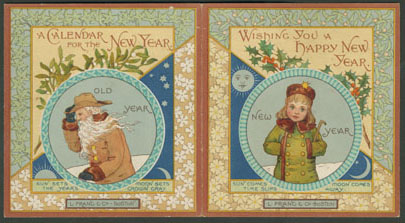
In its infancy and adolescence, the period from about 1840 through the 1880s, the greetings card industry in Britain and America clearly differentiated between the two holidays of the “holiday season” and produced distinct Christmas and New Year’s Day cards rather than the combined Seasons’ Greetings and Happy Holidays cards of today.  Below are examples of New Year’s Day cards from the 1870s and 1880s, from the manuscript collection s of the Lilly Library of Indiana University.   Most are British, with the exception of the first calendar card, which was published by Louis Prang & Company of Boston in 1883.