Tag Archives: print culture

Of Mummies and Mums

I discovered an amazing woman last week, a woman who was creative (and versatile) enough to have written a very early science fiction book about a time-traveling mummy as well as a series of popular garden books, which she also illustrated. Jane Webb Loudon (1807-1858) was born into a wealthy industrial family and later married to a gentleman, but both father and husband left her virtually penniless and to her own devices. She made her own way, in her own fashion.

When she was only 20, Jane published (anonymously) The Mummy!:  Or a Tale of the Twenty-Second Century, featuring an Egyptian mummy named Cheops who is “reanimated” in 2126 in a very connected, technological, and female-dominated world which is nevertheless plagued by political discord and moral decay. No doubt she was influenced by the publication of Mary Shelley’s Frankenstein a decade earlier, as well as the fascination with all things Egyptian, initiated by Napoleon’s expedition to Egypt in 1798, and the publication of his entourage’s 24-volume Description of Egypt. The Mummy! (love the exclamation point) apparently sold well and relieved Miss Webb of some of the financial stress she must have felt after the death of her father.

Jane connected her world to that of the future through steam:  still a dynamic force, it powered the movement of people, houses and plows. The reference to a steam-powered plow caught the attention of her future husband, John Claudius Loudon, an increasingly-eminent horticultural writer and landscape architect nearly twenty years her senior.  They met, married, had a daughter, and forged a professional relationship in addition to their personal one, working together on a series of agricultural encyclopedias and guides to garden design.  As a novice gardener herself, Jane must have realized that her husband’s technical publications would not satisfy the demand for more accessible gardening advice, and so she began authoring a series of illustrated books catering to the ladies: Young Ladies Book of Botany (1838), Gardening for Ladies (1840), Botany for Ladies (1842) and the multi-volume Ladies Companion to the Flower Garden, published just after her husband’s death in 1843.

Before his death, Mr. Loudon became involved in an arboretum plan that left Jane saddled with debt (shades of her father’s “legacy”), so she ramped up her publishing, catering to the demand that she virtually created with more popular gardening books for ladies, illustrated with the colorful groupings of flowers that would be the standard in horticultural illustration for years to come. Chromolithography probably broadened the appeal of the multiple editions of The Ladies’ Flower Garden and British Wild Flowers as well, and consequently the self-taught Mrs. Loudon seems to have emerged as a more recognizable authority on Victorian gardening than her scholarly husband.

Plates from The Ladies’ Flower Garden of Ornamental Annuals (1842) and British Wild Flowers (1846), Victoria & Albert Museum, London.

I’d like to know a lot more about Jane Webb Loudon so I’m chasing down a few sources. Sheffield Hallam University reportedly has one her scrapbooks in its archives which I’d love to see and the National Trust has published a modern version of Mr. Loudon’s travel diaries titled In Search of English Gardens:  The Travels of John Claudius Loudon and His Wife Jane (ed. Patricia Boniface, National Trust Classics, 1987).


The Boston Massacre in Black, White & Color

Today, or rather tonight, marks the anniversary of the Boston Massacre of 1770, the most dramatic manifestation of the rising tensions in Boston accompanying the occupation of the city by British troops sent from London to enforce the Townshend Acts and make the colonists pay for their Seven Years’/French and Indian War. Well, there you are: the conflicted sentiments of an English historian who is also a native New Englander are readily apparent!  What became known as the Boston Massacre affords an excellent opportunity to examine the shadings of perspective in history, and we have the perfect image to work with:  Paul Revere’s iconic Bloody Massacre perpetuated in King Street Boston on March 5th 1770 by a Party of the 29th Regt., published less than three weeks after the event.

Revere was such a clever entrepreneur and propagandist; it’s too bad his midnight ride obscures his other talents and contributions. The engraving that produced these viral prints was very closely based on that of Henry Pelham, whose own massacre image “The Fruits of Arbitrary Power”, did not go on the market until several weeks after Revere had essentially flooded the market and sparked a revolution. The most “inspirational” detail of the print, in terms of igniting revolutionary fervor up and down the eastern seaboard, was no doubt the portrayal of the British troops in a firing squad format, shooting on the unarmed, passive, victimized colonists, but one other detail, or missing detail, is equally important: all of the victims of Revere’s massacre are white; the fledgling revolution’s first victim, a man of mixed race named Crispus Attucks, is not present.  The colorists of Revere’s engraving added to its appeal (and inspiration) by adding a lot of bright red blood to the print, illustrating and emphasizing his original title:  Bloody Massacre.

A print from a little later in 1770, and accounts of the five victims of March 5 from the Boston Gazette, and Country Journal, March 12, 1770, all from the Library of Congress.

Only a year later, when the first event of the massacre was commemorated, it was already being referred to as the Boston Massacre, largely due to the efforts of another brilliant propagandist, Samuel Adams. All narrative (as opposed to visual) accounts depict more of a confused melee, in which British soldiers fired into a threatening crowd under cover of darkness. But that was beside the point for the entire nineteenth century–and well after. The active abolitionist movement in New England will resurrect Crispus Attucks as an active participant, victim, and martyr of the Boston Massacre in the 1850s,but the Redcoats retain a relatively rigid line.

Putting Crispus Attucks in the picture:  the frontspiece of William Cooper Nell’s Colored Patriots of the American Revolution (1855), chromolithograph by John H. Bufford based on a drawing by William L. Champney (1856), and Howard Pyle’s illustration for Harper’s Magazine (1883).

Despite Attucks’ prominent placement in the prints above, he goes missing again in several popular prints from the later nineteenth and earlier twentieth centuries. The Alonzo Chappel image below, produced for Heppenheimer and Maurer’s popular Centennial Album in 1873, appears to be loosely based on the Bufford chromolithograph above, but a white man has replaced Attucks in the central position.  The 1901 image by Francis Luis Mora beneath it, published in Harper’s Magazine, retains Revere’s menacing Redcoats (made more menacing by the perspective) and even the dog which he placed in the middle of the event.

Prints by Chappel and Mora, New York Public Library Digital Gallery.

A half-century later, Crispus Attucks returns in two modern depictions of the Massacre:  a mural at the Recorder of Deeds Building in Washington, DC by Herschel Levit, and William H. Johnson’s Crispus Attucks. The events of March 5, 1770 fade into the background, or are substantively altered, as Attucks assumes center stage. Another figure who is associated with the Boston Massacre, John Adams, has become the central focus of the event in recent years, following the publication of David McCullough’s popular and Pulitzer Prize-winning John Adams in 2001 and the ensuing HBO miniseries based on the book. As Adams served as defense counsel for the accused British soldiers, this seems to have shifted the historical perspective a bit, from event to aftermath, while at the same time revealing a little bit of British sentiment.

Herschel Levit, Crispus Attucks (1943) and Philip H. Johnson, Crispus Attucks (1945), Smithsonian Archives of American Art; Alonzo Chappel, John Adams, Library of Congress.


Leaping Ladies

I don’t know about the supposedly “medieval” custom of ladies proposing to their fellows on Leap Days; it sounds like another example of what cultural historians call the invention of tradition to me.  As stated again and again (especially on the internet), the “Ladies’ Privilege” dates from either the future St. Patrick’s dialogue with the future St. Bridget in the fifth century, or a Scottish Act of Parliament in the thirteenth century.  In the Tudor-Stuart period that I study, I have found a few references to this odd day out, a day that doesn’t quite fit on the calendar, and one on which unusual things may occur, notably in the 1600 play The Maydes Metamorphosis, which contains the couplet Master be contented, this is leape year, Women wear breetches, petticoats are deare.

Actually there’s a long tradition of turning-the-tables in western culture:  lords of misrule, charivari, the “world turned upside down”, festivals.  Probably in other cultures too.  So I think the irregularity of leap day became equated with a day when women wore the pants, obviously an equally unnatural occurrence.  Not only do we have the Mayd’s Metamorphosis rhyme, but two images from several centuries later, both of which clearly express not-so-subtle political (King George IV wearing a dress) and social (bloomers!) sentiments.

George Cruikshank, A Leap Year Drawing Room, or the Pleasures of Petticoat Government, 1820. British Cartoon Prints Collection, Library of Congress.

Bloomers for Leap Year, Harper's New Monthly Magazine, 1852. New York Public Library Digital Gallery.

The cartoons above are critical caricatures, but women acting like men could also be entertainment, as very literally illustrated by this 1896 poster for the Forepaugh & Sells Brothers Combined Circus (from the Library of Congress), featuring “”the leap year ladies of laughter” and  “the only clown women who wear the comic crown”.

As far as I can tell, it is not until after the turn of the century, when we enter into a “golden age” for postcards, that we see the almost-exclusive association of Leap Year and the Ladies’ Privilege.  Rather than “new women” pushing the boundaries, we see desperate women chasing men pictured on penny postcards.  So many of these ephemeral items survived that they must have been manufactured by the ton, particularly in the leap years 1908 and 1912. After World War I, it was a different story.  There are some lovely, wistful women, but also a lot of unattractive and old maids, doing anything to catch a man on that special leap day.  Here is just a small selection of some random but (I think) representative samples, starting with some relatively mild examples from 1904 and then proceeding t0 the heady year of 1908 (popping ladies, man in a mousetrap).

And one postcard from 1912, another leap year that produced a mountain of cards portraying women in pursuit of men, and this one, which brings us back to who wears the pants.


Scarlet Letters

A is for…adultery, or Athenaeum?  I was at a meeting of the trustees of the Salem Athenaeum the other night at which we were discussing a new logo for this venerable library.  The design which we were considering featured a very prominent red capital letter A, and all I could think of was The Scarlet Letter.  My concern was that we were tying ourselves too exclusively to Hawthorne, but our discussion quickly revealed that my fellow trustees just didn’t connect the A to the book (or adultery); it was a literary Rorschach test, and all they saw was a letter, not a Scarlet Letter.

Scarlet letters were etched in my mind, so I went in search of some more; I thought it would be interesting to see how an assortment of book illustrators took this simple letter and ran with it.  Surely the illustrations for The Scarlet Letter—most especially the cover—would be a lot more interesting than those for The House of the Seven Gables or any other Hawthorne title.  I was not disappointed, and it was a red letter afternoon.

My very favorite Scarlet Letter cover is that of the Vintage Classics edition published by Random House UK in 2008; it is simple, clever and textured.  Below that cover is the Ruben Toledo illustration for a Penguin edition from the following year.  I like the relatively recent (1994) Dover Thrift Edition as well; this one got me wondering about a field of A’s so I made my own “fabric” via Spoonflower with a cropped image of a seventeenth-century commonplace book.

Earlier editions of The Scarlet Letter are a bit less overt with their A’s.  The first edition was published in 1850, and an illustrated edition was not published until a generation later, with a discreet A on the title pages.  Rather than a badge of shame, the A of the 1878 James R. Osgood edition looks rather heraldic, while those of the editions of 1905 (Grosset & Dunlap), 1920 (Methuen Press, London), 1931 (Cheshire House), and 1941 (my spoonflowered version of the Limited Editions Club cover) look a bit more creative, and also reflect their eras.

I’m afraid to even look for the A in my version of The Scarlet Letter, one of the 22 volumes in the Houghton Mifflin/Riverside Press Complete Writings of Nathaniel Hawthorne (1900), because I fear it might fall apart if I do so!  I found the complete set in a box in a Maine antique shop several years ago and bought it very cheaply because of the books’ deteriorated condition; they had been in a basement for many years, and their leather bindings were (and still are) cracked and their pages mildewed.  I’d like to restore them, but that goal is pretty low on my priority list for now, so I’ve tied them up with ribbons and put them on the bookshelf.  The cloth covers and endpapers are still very beautiful, as you can see.

Hester Prynne bears badges of various designs in the various editions of The Scarlet Letter, but let’s face it, the A has to be pretty prominent.  One of the earliest and most illustrious illustrators, George Henry Boughton, gives the demure Hester a large A patch in 1881, but it is not scarlet. Hugh Thomson’s more romantic Hester, from 1920, wears her scarlet A with nurse-like calm, as does Lillian Gish in the film version from a few years later.

There’s a lot of places that I could go from here because The Scarlet Letter has become so allegorical and the striking scarlet A so…….adaptable, for lack of a better word:  political cartoons (anti-American!), the Atheists‘ Speak Out campaign, Emma Stone in Easy A.  But I think I’ll stick to the scarlet letter, and end with another textual image, from the New Orleans artist Scott Campbell.


Patriotic Publishing: Britain in Pictures

I had very little time last weekend but still found myself rearranging bookshelves, a typical procrastination tactic.  Yet more time disappeared when I started opening up the slim volumes of the Britain in Pictures series, published by Collins (the forerunner of HarperCollins) in the 1940s when Great Britain was facing the imminent threat of German invasion.  Over 100 volumes were issued from 1941, each one covering a basic and essential aspect of British civilization, ostensibly in case it disappeared.  The volumes feature a colorful cover with standardized type, lots of illustrations to record the institutions, places and customs that were threatened with annihilation, and equally illustrious authors:  Cecil Beaton on English Photographers, Edith Sitwell on English Women, John Betjeman on English Cities & Small Towns, and (the most amazing pairing of all), George Orwell on The English People.


Much to my shame, I have to admit that I first bought a few of these books when I was looking for PINK and RED books to decorate the bookcases in my double parlor:  you will notice the preponderance of pink below.  This is a mortifying admission, as an English historian, as an Anglophile, as a reader.  I just loved the way these books looked, never mind the content.  But after they went on the shelf, I started (occasionally) pulling them off and reading them, and then I wanted more, never mind the cover color.  They are written in the most accessible way, almost blog-like, and definitely with the mission of capturing the essence of every single topic, whether it is British fashion, clubs or trade unions.  So now I have quite a few titles, most of which I bought from a used book store in Concord, Massachusetts owned by a woman who always seemed to be able to get more.  No longer; I notice they are fetching higher and higher prices on Ebay and AbeBooks, and there is even a book on collecting them:  Michael Carney’s Britain in Pictures:  A History and Bibliography (1995).

The categories of the series are on the back of each volume, encouraging collection in the 1940s and today:  Art and Craftsmanship, including both the visual and performing arts, History and Achievement (lots of military topics, like the book above, but also books on mountaineering and polar exploration), Social Life and Character (including my three favorite books, British Rebels and Reformers by Harry Roberts, Life among the English by Rose Macaulay, and The English at Table by John Hampson), Natural History, Education and Religion, Literature and Belles LettresTopographical History, Science, Medicine and Engineering, and Country Life and Sport (lots of lords and ladies made contributions here).  The back cover of one of the first books to be published also describes the rationale for the entire series:  The English have never been good at describing themselves or their ways, either for their own benefit or for the benefit of others.  It is, therefore, not surprising that no comprehensive series of books, at a popular price, illustrating, in print and picture, the life, art, institutions and achievements of the British people has ever been issued, either for British or for foreign readers.  At this time, when it has become essential for citizens throughout the Empire to take stock of themselves and their ideas and to express them to others, it is desirable to fill this gap.

A few observations about the series title:  Britain in Pictures.  You can tell from the quote above that while the goal was to capture British civilization, an English bias would emerge.  The majority of the titles focus on English life, although there are volumes on Wales, Scotland, Ireland and Commonwealth countries.  All of these books are illustrated histories in every sense of the word:  images were culled from libraries and museums but also commissioned from contemporary artists. The past and the present come together in these little British books, just in time.

Random illustrations from British Historians by E.L. Woodward, The English at Table by John Hampson, British Clubs by Bernard Darwin, and British Garden Flowers by George M. Taylor.


Maps of the Human Heart

Heart-shaped maps are one thing, but maps of the human heart are quite another, and I’ve got both on this Valentine’s Day.  The charting of emotional territory, as opposed to physical space, has resulted in the production of several interesting maps from the seventeenth century to the near-present.  Below are the companion Map of the Open Country of a Woman’s Heart and Map of the Fortified Country of a Man’s Heart, ostensibly and anonymously drawn “by a lady” and published by the Kellogg Brothers of Hartford, Connecticut in the 1830s.  These heart maps, along with lots of other examples of the Kellogg’s impressive lithography, can be viewed at the online gallery of the Connecticut Historical Society and Museum.

I’ve brightened and cropped both maps so that you can better see the different regions that make up these human hearts. It’s very interesting that the woman’s heart is an “open” country while the man’s is a walled fort.  Money seems to take up a lot of territory in the man’s heart while outward appearances dominate the woman’s; romance and sentiment take up space but love is referenced only with power, ease, eating, dress and admiration!  Matrimony is very clearly outside of the man’s heart (whereas the “citadel of self-love” is inside).

These heart maps seem to be fusing together two cartographical trends from the early modern era:  the cordiform map, in which actual places are displayed in a heart-shaped map, and allegorical maps, which use map formats but dispense with the places altogether in order to put forth the message, often in caricature.  The most famous world map with a cordiform projection, the Nova, et Universi Orbis Descriptio of Oronce Fine, was published in a succession of early modern atlases after its initial appearance in 1531.

As for the allegorical, two very sentimental maps were published in the sixteenth and seventeenth centuries:  the carte de tendre, a road map to and through the country of “tenderness” first published in Madeleine de Scudery’s novel Clelie in 1654, and the “Empire of Love” map published by German typographer Johann Gottlob Immanuel Breitkopf in 1777.

The Carte de Tendre: beware of the “Lake of Indifference” and “Dangerous Sea”!

The Empire of Love:  proceeding from the “land of youth” at the bottom, northward to the “land of lust”, and then easterly to the “land of happy love” (hopefully).

Even after the turn of the twentieth century, emotional maps continued to be published in various formats.  I found a Brazilian postcard from 1904 in a collector’s forum along with a locally-made map of “Loveland”  in the collection of the Leventhal Map Center at the Boston Public Library (part of their ongoing exhibition of “unconventional maps”), and two heart maps that are clearly based on the Kellogg prints which were first published in McCall’s Magazine in 1960 and reprinted in the fascinating book by Katherine Harmon, You are Here:  Personal Geographies and Other Maps of the Imagination (Princeton Architectural Press, 2004).

A map of “Loveland” by Ernest Dudley Chase dating from 1943; it doesn’t scan very well, but a zoom feature is available at the BPL map site.  Lots of very 1940s-ish cartoon characters.

Geographical Guide to a Woman's Heart Emphasizing Points of Interest to the Romantic Traveler: illustration by Jo Lowrey for McCall' s Magazine, 1960

Geographical Guide to a Man's Heart with Obstacles and Entrances: illustration by Jo Lowrey for McCall's Magazine, 1960

Times and sentiments change; I think we’re about due for an updated map of the human heart.


Corporate Interiors

I like reading contemporary shelter magazines, but they seldom offer any advice for one of my central decorating dilemmas:  how to integrate the front Federal part of my home with the rear Victorian addition (never mind the kitchen from the 1920s and other architectural details from that “renovation” scattered around the house).  So I thought I’d browse (digitally) through some “house beautiful” books from the later nineteenth century, to see if they could offer any tips or inspiration.  There are lots available on the Internet Archive, but (apart from Edith Wharton’s writing style) I didn’t find them very inspiring, or nearly as interesting as the trade catalogs of the same era.  It seems like much of the Winterthur Library’s collection of these publications is now available in digital formal.  These catalogs range from mere brochures to actual decorating books, published by wallpaper, fabric, paint, carpet, and furniture companies for both wholesale and retail customers, I suppose.  I’m sure that I’m far from the first to recognize that they must be an extremely valuable resource for charting changing styles.

Below are a couple of plates from Suggestions for Modern Interior Decoration, published by the Henry Bosch wallpaper company of Chicago and New York in 1906.  The entire book consists of plates of interior vignettes, followed by appropriate wallpaper samples; here’s a very Arts & Crafts sitting room with entrance hall in the background.

Next, the cover and “Boston Room” of the 1917 Home Decorations Book published by the Star Peerless Wallpaper Mills, manufacturers of “Black Cat Wallpapers” for the home.  The Boston Room is of course in an understated “colonial” style.  For a stark contrast, I’ve jumped forward several decades, to the eve of World War II, and a very dynamic bedroom in the 1939 catalog of the Celotex Corporation, Interiors with Beauty, Comfort and Quiet. Quite an interesting combination of colors there; not very quiet.

Paint companies, including Sherwin-Williams and Glidden,  really ran with the “decorating catalog” concept before and after World War One.  A 1910 billiard room demonstrated “handicrafted effects” from Sherwin-Williams Your Home and its Decoration, and (again for contrast) two decades later a very bright (and much less crafty) living room appears in The Home of To-Day (1930).  For a post-war view, I’ve also included a colorful bathroom from Glidden’s 1946 catalog, The Key to Color Harmony in Your Home.  This book really recommends the color combination of aqua, pink and brown, and not only for bathrooms.

Back to a browner age. My last two images don’t really fit in with those above–rather than interior vignettes offering decorating advice as well as goods they are examples of more standard advertising–but the lithography is so striking I wanted to include them.  Below are two pages from the undated Album of Maine’s Atkinson House Furnishing Company, established in 1884 and “the only in the US doing business under a special contract system and Installment Plan”:  the exterior of its main Portland store and the interior sales floor, an actual corporate interior.


Singular Snowflakes

I woke up this morning to no snow (as usual, this particular winter), but also to a Google homepage “doodle” that told me that today is the 125th anniversary of the appearance (falling?) of the world’s largest snowflake!  During a ferocious winter storm in Montana in 1887, snowflakes were observed as large as “milkpans” and one in particular measured 15 inches in diameter. What a delightful anniversary!  Obviously I can’t let it go by without marking it in my own way, so I’m showcasing one of my favorite images for the second time:  a very early view of snowflakes viewed through a microscope from Robert Hooke’s Micrographia (1665).

Like the images in my last post, this is not only aesthetically pleasing and representative of its historic time and place, but also a great teaching tool:  what better way to demonstrate the pure empiricism of the Scientific Revolution?  Snowflakes were great objects of study in the seventeenth century, beginning with Johannes Kepler’s 1611 essay On the Six-Cornered Snowflake.  Kepler pondered the very essence of the snowflake, which “comes down from heaven and looks like an angel” yet evaporates into nothing. 


Calendar Girls

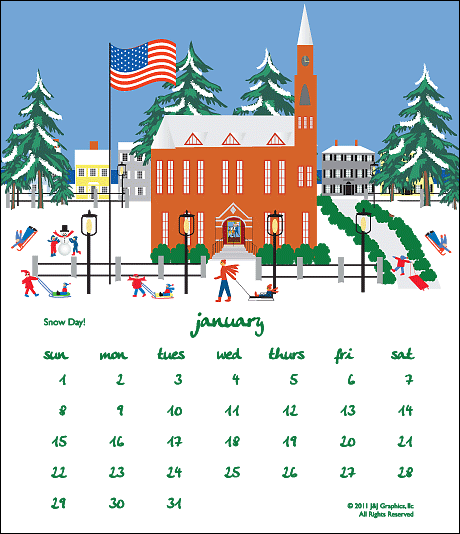
I’m a bit late for a calendar post, but then again I always buy my calendars after January 1st–sometimes well after January 1st.  While I’m not likely to engage in consistent sale-shopping or coupon-clipping, for some reason I get great pleasure from buying my annual calendars after they have gone on sale.  We usually purchase a “North Shore Folk Art” calendar from J & J Graphics at the Peabody Essex Museum shop for our refrigerator, and sometimes I even wait until they have their big January sale (this year it’s on the weekend of the 20th-22nd, definitely worth a visit if you’re in our area).  I’ll post January right here so I know what the date is until I get my own.

Upstairs in my office I generally pick something a bit more girly, whimsical, botanical, historical..whatever catches my eye.  Right now I’m liking this ethereal calendar from Irena Sophia, already on sale on Etsy!  I like the September and October girls–and Miss foxy February.

Calendars are an important form of ephemera that I haven’t featured on the blog yet, so why not now?  At the same time, they are among the timeliest and most artistic of genres.  And like all the pieces of paper we’ve examined over the last year–postcards, trade cards, book plates–they emerged as a mass-produced product in the later nineteenth century, coincidentally with the development of chromolithography.  I love the calendars from the “Penfield era”, from about 1890 to 1920, when the distinctive designs of illustrator Edward Penfield (1866-1925) graced the covers of magazines and the pages of the new poster calendars much more than those that came later with their Vargas-inspired pin-ups.  My “calendar girls” kept their clothes on!

Penfield calendars for 1897 and 1906 from the Library of Congress, above, and the work of some of his predecessors below (so you can see what an impression he made on turn-of-the-century graphic design):  an 1876 advertisement calendar for cigars and champagne, and two calendars by Boston-era publishers, also from the Library of Congress.

Calendars from Penfield’s fellow art nouveau illustrators  Louis Rhead (for Prang) and A.B. Wenzell for 1897 and 1899 are below, along with another rather less-artistic 1907 Boston calendar, for the beloved Necco wafers, all from the New York Public Library.


Tea Party Tempest

One of the most interesting jobs of the historian is figuring out when and why an occurrence becomes an EVENT.  Lots of things that happen never rise to the level of “history”, but those things that do often get embellished over time.  A great example is the Boston Tea Party.  As the anniversary of this big event occurs this week (December 16), I thought I’d take a break from the holidays and get back to history.

As I’m not an American historian I asked my question when did the Boston Tea Party become the Boston Tea Party to a number of experts, both in person and on the web.  There seems to be a general consensus that the event was almost immediately recognized as extraordinarily significant but that the actual term doesn’t appear until decades after the Revolution, when its last participants (particularly George Hewes ) began recording their memoirs.  Apparently the first historians of the American Revolution did not want to herald an event involving the destruction of property, but in 1826 newspaper reminiscences started to use the term “Tea Party” or “Tea-Party”, and it was consequently adopted by historians. (Apparently the first use of the term referred to the participants rather than the event).  There are comprehensive discussions and comments about every aspect of the Tea Party, and all the other pre-Revolutionary agitation in Boston, at the great blog Boston 1775.

Across the Atlantic, the historical significance of the Tea Party was realized relatively early.  Just several years into the Revolution, the German engraver Carl Gottlieb Guttenberg published The Tea-Tax Tempest, or the Anglo-American Revolution (1778), an adaptation of an earlier political print by John Dixon which was itself adapted by the British caricaturist William Humphreys as The Tea-Tax-Tempest, or Old Time with his Magick-Lantern (1783).  In both we have allegorical figures representing the world and Europe looking on at an exploding teapot and agitated Americans.

Tea Tax Tempest caricatures at the online exhibition “America in Caricature, 1765-1865”, Lilly Library at Indiana University.

With the close connections between France and America during the American Revolution, it was only natural that Europeans emphasized the American rebellion of the 1770s when the French Revolution broke out in 1789.  The Tea Party becomes a precedent, or a first act, in what may be a universal revolution.

The History of North America, E. Newberry, London, 1789.  Library of Congress.

So the occurrence of 1773 is clearly recognized as an important event well before the turn of the nineteenth century, a realization that is reinforced by the success of the American Revolution and the beginning (and drama) of the French.  But the tempest doesn’t become the “party” until James Hawkes’ Retrospect of the Boston Tea-Party with a Memoir by George R.T. Hewes (1834), and it takes off from there, in both print and image. The rest is history.

Covers of James Hawkes’ Retrospect of the Boston Tea-Party (1834) and H.W. McVickar’s children’s book The Boston Tea Party (1884), both Library of Congress.