Tag Archives: Popular Culture

Playing with Fire

Francis Bacon heralded the compass, printing, and gunpowder as the three European (really Chinese) inventions that changed the world, but he also had words of praise for another Renaissance (Chinese) innovation:  fireworks. Like gunpowder, fireworks represented the Promethean feat of his age:  stealing fire from heaven, and in both his Essays (1612; “On Masques”) and The New Atlantis (1627) he references the achievement:  we represent also ordinance and instruments of war, and engines of all kinds: and likewise new mixtures and compositions of gunpowder, wildfires burning in water, and unquenchable. Also fireworks of all variety both for pleasure and use.

I’m not sure what the recommended use of fireworks was besides pleasure, but I thought I’d indulge in a brief (and very Eurocentric) illustrated history of fireworks for the beginning of our July 4th week.  As always, when I compare the past and present, I’m struck by the artfulness of the former:  fireworks displays from the Renaissance through the nineteenth century seem to have been as much focused on a flagrant display of machines on the ground as light in the sky. As evidence, look at the elaborate seventeenth-century (Italian, of course) creation below, and an illustration from John Babington’s Pyrotechnia.

Engraving by Lodovico Ottavio Burnacini (1636-1707), courtesy Victoria & Albert Museum, London; John Babington, Pyrotechnia (1635), courtesy Folger Shakespeare Library.

Fireworks demonstrations in Europe are first recorded in the fifteenth century, so two centuries later they are not quite the marvel they once were and the “pyrotechnists” had to stage ever-more elaborate displays in order to impress at every royal and national event:  weddings, coronation, victories in battles and wars. Views of London fireworks celebrating the English victory at the Battle of Boyne in Ireland in 1690 and the Peace of Aix-la-Chapelle in April of 1749 are below;  the latter celebration definitely had its highs and lows. The high was the first performance of Handel’s Music for the Royal Fireworks, while the “low” was a firework-sparked fire which burned the central pavilion to the ground, accompanied by a swordfight between the pyrotechnist-architect of the performance, Giovanni Niccolo Servandoni, and the organizer of the event, the Duke of Montagu.

Night-time fireworks celebrating William III’s victory at the Battle of Boyne, 1690, British Museum; two views of the fireworks and fireworks pavilion celebrating the Peace of Aix-la-Chapelle, April 27, 1749, British Library and Victoria & Albert Museum.

In the nineteenth century, fireworks celebrations look a bit more recognizable (boring), so I’m going to shift to ephemera and fireworks-related items.  From either end of the century, some great British trade cards and a beautiful cover of Lippincott’s Magazine by Will Carqueville.

Trade cards from the British Museum and British Library; Lippincott’s cover from July 1895, Victoria & Albert Museum, London.

Back to the art of fireworks for the last century:  Eric Revilious’ amazing fireworks design for Wedgwood, commemorating the 1937 coronation of King George VI on a coffee cup, and a recent photograph by Sarah Anne Johnson.

Eric Revilious mug for Wedgwood, 1937, Victoria & Albert Museum, London; Chromogenic print with applied photospotting ink, acrylic ink, gouache, and india ink by Sarah Anne Johnson, New York Public Library Digital Gallery.


The Pied Piper

The Catholic liturgical calendar reveals that today is the day of the martyred saints John and Paul, the day on which (in 1284) several late medieval sources report that a man wearing a multicolored cloak strode into the small town of Hamelin (Hameln) in lower Saxony, and upon the request of the townspeople, took up his pipe and played a tune that lured all of their troublesome rats out of town and to their deaths. The piper returned for his payment, and when rebuffed, went away and then returned yet again, this time wearing the dark green cloak of a hunter.  He picked up his pipe again, and played a tune that lured Hamelin’s children–130 children in all–away, never to return.  And so the piper got his revenge, and a community lost its children for failing to pay its debt.

Engraving by Henry Marsh after John La Farge, 1868, Metropolitan Museum of Art, New York; 1930 Hameln postcard, Casas-Rodriguez Collection.

Such a dark story, and a source of puzzlement ever since its rediscovery and publication by the Grimm Brothers in the  nineteenth century.  Actually it never really disappeared; there seem to have been variant “rat-catcher” stories in circulation all over central Europe, and even in Scotland.  But the Grimms spread the tale far and wide, and Robert Browning’s 1844 poem made it even more popular.  Given the prominent role played by RATS in the narrative, it is an easy connection between the loss of the children and the momentous mortality of the Black Death, but the chronology doesn’t work:  the story dates to almost a century before the arrival of the plague in Europe.  In any case, the earliest references to the Pied Piper don’t even mention rats; they first appear in the sixteenth-century Zimmern Chronicle. The other references from that century, a time not only of periodic plague but also religious wars and witch hunts, seem to be transforming the piper into either the Devil or the grim reaper, leading the children in a “dance of death”.

The haunting Dance of Death at the end of Ingmar Bergman’s 1957 film The Seventh Seal.

Robert Browning’s poem, based on the version of the Pied Piper contained in Nicholas Wanley’s six-volume Wonders of  the Little World; or, A General History of Man (1677), somehow presents alighterversion of the story while still maintaining all the dismal details. I think this is because of all the colorful illustrations in the many Browning editions:  by Kate Greenaway (1888), Hope Dunlap (1910), and Margaret Tarrant (1912), among others.  Browning also has a similar “tribe” of people resurfacing in far-east Transylvania, a reference to Ostsiedlung, the eastward migration of the Germans in the high middle ages, a more likely basis for the Pied Piper tale.

As is always the case, folklore serves up useful metaphors to the present, for both social and political commentary. The first half of the twentieth century used the piper for a variety of messages: in two very timely (and different!)  American images, he is leading a pack of criminal and/or radical European immigrants across the sea and a group of children gardeners after World War I, while in Germany, he is a leftist devil, leading the fledgling German republic Into the Abyss.

Anti-immigration and US School Garden Army posters (1909 & 1919), Library of Congress, and “Into the Abyss” poster by Theo Matejko (1919), Victoria & Albert Museum, London.


Coney-Catching

Back to the reign of another long-reigning queen, Elizabeth I.  For my summer graduate course, I’ve been immersed in the pamphlet literature of the 1590s, including those relating the exploits of  London rogues, vagabonds, pickpockets, card-sharks and coney-catchers, to use the language of the day. In the contemporary vernacular, coneys (alternatively spelled conys, connys, connies) were domesticated rabbits (as opposed to wild hares), bred for the table and easy prey. Consequently coney-catchers were those who preyed on similarly-vulnerable human targets in the streets of London:  in today’s language, con-men.

The term seems to have been crafted by playwright, poet and pamphleteer Robert Greene (1560-1592), one of the “university wits” of late Elizabethan London, and an author who definitely wrote more for the public than the court.  Before his untimely death in 1592, Greene waged a war in print on those who had taken advantage of him while he was down and out, in the streets (quite a common state for him due to his profligate lifestyle).  The pamphlets were popular, and the term caught on. Its meaning, fool-taking or-making was easily grasped by everyone, and satirical responses kept the rabbits in print, as did Greene, by publishing under pseudonyms like “Cuthbert Conny-catcher”.

Greene’s conies between the covers.

All of these rabbits (coneys) remind me of those that magicians (conjurers) pull out of a hat:  there must be a connection. The John Derian decoupage tray on my mantle, called “the magician’s apprentice”, is making me think so too.


Maypoles

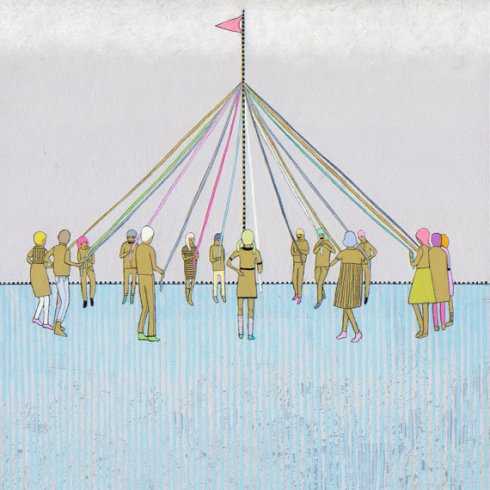
When I was a very little girl my family lived in a small village in central Vermont which had no preschool program, so my parents sent me to a private school the next town over.  My memories of this school are positively idyllic:  reading Peter Rabbit, singing, games, toast.  A singular memory, reinforced by a photograph of me looking like a little dark-haired Swiss girl in a dirndl, is of a Maypole, and going round and round it holding my ribbon.  Because of the Maypole, May Day was the most special holiday to me as a child, and I’ve tried to keep it up as an adult, with wreaths and May wine (made with sweet woodruff, a great spring plant) and a general spirit of merriment.  But I’ve yet to erect a Maypole in my backyard.

It is interesting to me that my experience with the Maypole happened in Vermont, the least puritanical of all the New England states. The Puritans hated Maypoles, and any ceremony or ritual or image that detracted from the word of God.  So dancing around the Maypole, a very popular custom in the medieval and Tudor eras, was prohibited during much of the very Puritan seventeenth century, both in old and New England.  There was definitely a revival in the eighteenth century, but it might have been too late for Massachusetts.  Thank goodness I had my Vermont childhood!

It’s hard to separate survival and revival in the history of the Maypole, but the custom seems to have been alive and well in the Elizabethan era, as illustrated by these amazing painted glass panels from the later sixteenth century depicting a Maypole and the various “Morris Dancers” who danced around it on May Day.  They are from Betley Hall in Staffordshire, and were somehow saved from Puritan iconoclasm and incorporated into a later house.  May Day celebrations seem to be part of every romantic history of the Elizabethan era, if only because the first Elizabeth makes a perfect May Queen.

Betley Hall glass panels, later sixteenth century, Victoria & Albert Museum, London; “May Day in the Reign of Queen Elizabeth”, Hodgson & Graves print, c. 1836, British Museum, London.

After the English Revolution, the maypoles of England reappeared, including a famously tall one in the Strand in London (to which, according to Walter Thornbury’s “St Mary-le-Strand and the Maypole” , Old and New London, Volume 3 (1878), Sir Isaac Newton attached his telescope) and in the center of the weeks-long “May Fair” in the Mayfair neighborhood.  The Great Fire and the great rebuilding of the later seventeenth and and eighteenth centuries removed maypoles from the streets of London but the custom apparently continued, as they appear in print and paintings as symbols of “Merry Old England”.  This particular symbolism seems to intensify in the nineteenth century, an age of dynamic change which threatened to sweep everything away that was both merry and old.  There is a definite revival of the Maypole motif in the later nineteenth and early twentieth century by the Arts and Crafts movement; as the old merrymaking custom endures, so too will traditional craftsmanship in the midst of mass production.

Country Dances Round a Maypole, Francis Hayman, c. 1741-42 (Supper Box Decoration at Vauxhall Gardens), Victoria & Albert Museum, London.

Edward Henry Corbould, May Day, 1873, British Museum, London; Kate Elinor Lambert, Woodcut device for the Stanton Press, 1921-22.

Another later nineteenth-century trend–the politicization of everything–also affected the maypole, which was appropriated primarily by the left side of the political spectrum, coincidentally with the association of May Day with workers’ movements.  Below are two illustrations of  a more modern Maypole:  around which monopolists and workers dance.

Frederick Barr Opper, the Monopolists’ May-pole (including lots of Vanderbilts), Puck Magazine, 1885 and Walter Crane, The Workers’ May-pole”, 1894, Library of Congress.

Back to basics:  of course, the survival (or revival) of the Maypole, in the nineteenth century and today, might simply be due to the fact that it provides entertainment for children, who probably see no greater meaning in its form than the focus of a simple dance in celebration of spring!  That’s my memory.

May Day in Central Park, c. 1905, Detroit Publishing Company, Library of Congress; May Pole by Jennifer Davis, Etsy.


Anniversary History

Sometimes I think that all history in the public sphere is anniversaic, as if nothing in the past matters unless there’s a big anniversary involved, generally a centennial.  In the past few weeks, I’ve heard countless stories in the media about the sinking of the Titanic and the opening of Fenway Park, two very diverse events that happened in 1912 and thus share an anniversary in 2012.  On a more personal note, this is a big year for our family as my grandmother turns 100:  1912 was a very big year indeed.

As a professional historian, history-as-anniversary kind of bothers me: it is exclusively event-oriented, ignores more complex social, economic and cultural developments, and is so obviously subjective.  On the other hand, it does raise awareness about the past, which is always a good thing in my opinion, and it can be fun.  I thought I would sprint backwards through the last millennium and pick my own big events for the years 1812, 1712, 1612 and so on, thus demonstrating how very arbitrary such an exercise can be:  as someone trained in late medieval and early modern European history living in New England, my chosen events are going to be very different from those of, say, a modern African historian living on the West Coast.  So what is history?

I’m starting out here in Salem, a century ago, where crowds are in Town House Square, soon (April 29) to be the site of a campaign stop by former President Theodore Roosevelt, now a candidate for the Progressive (“Bull Moose”) party.  Roosevelt took the train up from Boston, gave a quick speech, and departed for the next town.

Moving backwards to 1812, my Salem perspective mandates that I pick the War of 1812 as my big event of the year (even though it certainly wasn’t over in 1812).  This war had a huge impact on Salem (and other eastern seaports), in effect ending its golden age.  This summer, there will be courses and exhibits at Salem State University and the Salem Athenaeum:  anniversary history.  I wonder if I was standing on Salem’s highest point, Legge’s Hill (now the site of a hulking YMCA, but offering the best view of Salem Harbor) could I have seen the engagement between the American Chesapeake and the British Shannon or the USS Constitution being chased by two British frigates?

The Constitution in 1803 by Salem artist Michele Felice Corne; the Capitol after burning by British Troops, 1814 (Drawing by George Munger, Library of Congress).

For the year 1712 I’m leaving Salem, no longer the center of the action, and crossing over to Britain. My big event for this year is the invention of the Newcomen Engine, the first machine to harness steam power for practical purposes–in this case, pumping out mines.  Thomas Newcomen’s steam engine might be less well-known than James Watt’s, which came later in the eighteenth century, but it was the first step of the Industrial Revolution.

The Newcomen Steam Engine, circa 1725.

I’m going to stay in Britain for the year 1612 and pick the Lancashire (Pendle) Witch Trials for my event of the year.  This was England’s largest witch hunt, small by continental comparison (12 accusations, 10 convictions on charges of murder by witchcraft, 10 executions) but one of the first trials in England which was focused on collective devil worship as opposed to individual maleficia.  It’s also an exceeding well-documented series of trials, and northern England seems to be gearing up for a Salem-esque 400th anniversary “commemoration”.

A 1612 chapbook about the Pendle Witches, and the 400th anniversary logo.

I’m heading to Italy for the year 1512: it’s the height of the Italian Renaissance and Michelangelo Buonarroti has completed the ceiling of the Sistine Chapel, which is summarily unveiled to the public by Pope Julius II.  I don’t think I need to say anything else.

God Dividing the Waters detail, Sistine Chapel.

You notice that I haven’t left Europe?  I’m going to remain there for 1412 and choose a birth for that year:  the birth, sometime in January, of the “Maid of Orléans”, Joan of Arc, the French national heroine who inspired the French victory in the Hundred Years War (1337-1453) and was martyred and canonized as a consequence.

Jeanne d’Arc in the company of saints, miniature circa 1485.

I am going to leave Europe and the west for my next big event:  1312 marks the beginning of the reign of arguably the greatest medieval African ruler, Mansa Musa (I) of the Mali Empire in west Africa.  Known for his great wealth, his cultural patronage (including the building of Timbuktu) and his pilgrimage to Mecca, Mansa Musa appears in European maps and texts long after his death.

Mansa Musa in the center of the Catalan Atlas, c. 1375.

North to Europe (sort of):  1212 was a big year in the history of the Spanish Reconquista, the centuries-long struggle on the part of Iberian Christians to recapture their peninsula from Muslim rulers.  At the Battle of Las Navas de Tolosa that year, King Alfonso VIII of Castile and his Christian allies (including many crusader knights) won a decisive victory, leading to the decline and fall of the Almohad Empire in Spain.

1112 might have been the year that Hildegard of Bingen, one of the most remarkable and accomplished women of the Middle Ages (mystic, author, artist, abbess, composer) was “enclosed” in the Church by her parents, commencing her spiritual and artistic journey.  In any case, it looks like 2012 will be the year that Hildegard finally receives her canonization, after a long campaign.

One last martyr.  2012 marks the millennial anniversary of the martyrdom of Aelfheagh (Alphege), the Archbishop of Canterbury, who was beaten to death by a mob of drunken Danish Vikings who had taken him prisoner on April 19, 1012.  The Danes who were occupying England at the time wanted “protection money” more than land or power, but the Archbishop refused to be ransomed, and so they killed him in frustration.  He was the first Archbishop of Canterbury to die a violent death (and subsequently be martyred and canonized):  Thomas à Becket apparently prayed to St. Alphege before he met his own death in Canterbury Cathedral.

British children as Vikings outside St. Alfege Church,  Greenwich, near the scene of the crime.  One view of St. Alphege Millennium observances held around Great Britain last week.

And that concludes my millennium of time-traveling (really hit-and-run) history!


Bicycle Girls

I seem to be returning to the topic of women bicyclists again and again, but I can’t help myself:  I’m so struck by the images I keep coming across.  The last photograph in the collection/exhibition I shared in my last post is an equally striking one:  ladies (and some men) on a cycling tour of the North Shore rest long enough on Salem Common to have their picture taken on October 15, 1885.  This is just before the introduction of the modern “safety bicycle”, so they have been touring, rather precariously I would think, on their penny farthings.  And I’ve cropped the photograph of Essex Street activities from this same post, just so we can see the shirtwaisted lady in the foreground a bit better:  she looks like a model for the bicycle art of her era, examples of which are below.

bicycle-girl-essex-street text

Some more photographs, spanning the era of a bicycle craze for women (and men) from the 1890s through the 1920s: a stereoview issued by the American Stereoscopic Company in 1897, an image from what looks like a rather well-to-do British family’s album in the collection of the Victoria & Albert Museum, and a bicycle girl messenger for the National Women’s Party in 1922 (Library of Congress).

These women look so happy–well at least most of them do.  Bicycle girls often appear in the illustrative art of the era as well, in single prints, advertising posters, and on magazine covers.  On both sides of the Atlantic, the most eminent graphic artists of the day appear to have been inspired by their carefree images, including Will Bradley, Cecil Aldin, and Charles Arthur Cox, who created 10 absolutely charming covers for the Chicago-based bicycling magazine Bearings in the 1890s.

Will Bradly advertisement for Victor Bicycles and Cecil Aldin illustration for Rudge Whitworth Bicycles, both 1896 and Collection of the Victoria & Albert Museum, London; Charles Arthur Cox’s covers for Bearings Magazine, New York Public Library Digital Collection.


Alternate Histories

I don’t really like to engage in “what if” history with my students or read alternative histories, but I like the visual images associated with the genre, ostensibly very current but actually quite historical itself.  Renaissance artists inserted anachronistic imagery in their works all the time, partly because they were so immersed in the classical era and could not help drawing comparisons to that time and their own. For example, the northern Renaissance painting The Martyrdom of St. Ursula and the 11,000 Virgins depicts contemporary Turkish soldiers slaying the virgins rather than the legendary Huns.  The Turks had conquered Constantinople in 1453 and were now poised to expand into Europe, whereas the Huns occupied a similar position a millennium before.

The Martyrdom of St. Ursula and the 11,000 Virgins, Master of the St. Ursula Legend, Cologne c. 1492. Victoria and Albert Museum, London.

Invasion seems to be the most popular premise for alternate histories:  the Turks in the Early Modern Era, Napoleon in the nineteenth century, Kaiser Wilhelm and Hitler in the twentieth.  Widely acknowledged to be the first book in an emerging genre of alternate history, Louis Geoffroy’s Histoire de la Monarchie universelle: Napoleon et la conquête du Monde (1836) envisioned a world pacified and modernized under the benevolent dictator Napoleon.  Between the reimagined Napoleonic worlds of the nineteenth century and the reimagined Germanic worlds of the twentieth century is a peculiar little story by Salem’s own Nathaniel Hawthorne, “P’s Correspondence” from Mosses from an Old Manse Volume II, in which the author’s deranged friend P recounts his encounters with Romantic poets of an earlier era in 1845 London.  Hawthorne’s version of Midnight in Paris!  Somehow Napoleon appears here too, completely feeble but still under guard, along with an even more incapacitated Sir Walter Scott.

A beautiful first edition of Geoffroy’s Histoire, a Currier & Ives print of the iconic Napoleon Crossing the Alps by JacquesLouis David (Library of Congress) , and a modern mash-up on a tee-shirt.

The twentieth century, with its succession of invasions and conquests and technology, created a natural environment for alternative histories, increasingly recognized as a genre with a special name:  uchronia (which seems to accommodate both “what if” speculations and constructed worlds).  The classic example is J.C. Squire’s If it Had Happened Otherwise:  Lapses into Imaginary History (1931; also published under a variant title:  If:  Or History Rewritten).  The quality of Squire’s contributors (including Winston Churchill) must have gone some way towards legitimizing the relatively new genre.

The late twentieth-century invention of photoshop brought about a whole new realm of visual alternative histories, and the most charming examples I could find were, of course, on Etsy, in the alternatehistories shop. So here, in sort-of chronological order, are slightly altered images of the signing of the Declaration of Independence in 1776, Chicago during the Columbian Exposition of 1893, and the Green Monster in Boston, just in time for opening day at Fenway next week.


Utopia, not Dystopia

Last week was a bit unnerving, unsettling, disconcerting.  Not only because of the unseasonably warm weather, but also because of a word (or two):  dystopia or dystopian.  The opposite of utopia, not a perfect, elusive place, often in the future, but rather a repressive and hostile place, definitely in the future, where individual freedoms are subjected to some all-powerful system. Whenever I was near a radio or a television,  I kept hearing that word, at least 20 times, more than I have ever heard that word in my life.  The primary contexts for the word were reviews of the Hunger Games film, set in a decidedly dystopian future, and related stories about the popularity of dystopian themes in young adult fiction, which is itself disconcerting.

As is always the case when things are not just quite right for me, I retreat to the past.  What better way to counter dystopia in the present than with some utopias of the past?  I really don’t know that much about ancient history, so I skipped the Garden of Eden, the Isles of the Blessed and Elysian Fields and went back to the Renaissance Utopia, Thomas More’s 1516 book, and then moved forward, more happily, toward the present.

Early Modern Utopias:  More’s Utopia, Tommaso Campanella’s City of the Sun (1602), Bartolomea del Bene’s City of Truth (1609), and Francis Bacon’s New Atlantis (1624).

As you can see (you’ll have to take my word on the cropped Bacon image), all of these utopias are self-contained islands or cities, apart from the corrupt world, and their very existence is a commentary on that world.  It’s also very interesting to me that in these four works, two written by Englishmen and two by Italians, a distinct nationalistic vision of utopia has emerged:  More and Bacon have located their utopias on islands and Campanella’s and del Bene’s utopias are walled cities.  The Italians seem to think they can find utopia through urban planning, which was both an artistic and a logistical enterprise. Not only did the Italian Renaissance inspire and create paintings like Piero della Francesca’s Ideal City (c. 1470) but also the Venetian “development” of Palmanova in 1593, a real “ideal city”.

With the coming of industrialization in the modern era, cities could not possibly be utopian.  The ideal life/world could now only be found in a long-lost Arcadian past or a pastoral enclave in the present.  American utopianism in the nineteenth-century seems to be best represented by the romantic landscapes of the Hudson River Valley school, like Thomas Cole’s Dream of Arcadia below, and social experiments like Brook Farm here in Massachusetts, where Nathaniel Hawthorne spent a few (apparently miserable) months in 1841.  A young and struggling writer at the time, Nathaniel clearly did not find his utopia at Brook Farm:  too much manure.

Thomas Cole, Dream of Arcadia, 1838. Denver Art Museum.

Joseph Wolcott, Brook Farm with Rainbow, 1845. Massachusetts Historical Society.

I’m not sure how the quest for utopia has fared in the twentieth century, and into the twenty-first.  Have we given up on it?  Are utopian ideas and ideals so personal that we don’t have a collective cultural vision?  Is is all about dystopia?  At least in the first part of the century, and despite the dreadful First World War, the Bauhaus movement was definitely driven by utopian ideals as well as the passion for modernism and the desire to integrate art, design and technology.  All of these goals are exemplified by the title and the typography of their publications from the early twenties:  the volumes of  Utopia:  Dokumente der Wirklichkeit (Utopia: Documents of Reality) were designed by Oskar Schlemmer in a style that still looks modern today.

An etching by the American artist Peter Larsen from just about the same time as the beginning of the Bauhaus School shows a decidedly more inaccessible Utopia, like that of Thomas More.  So we’re right back where we began, with those who believe that Utopia is within reach, or at least worth striving for, and those that believe it’s just a fantasy.

Peter Larsen, Utopia,1919. Smithsonian American Art Museum.


Up, Up and Away

Today is Jules Verne’s birthday, and as I’ve been engaged in putting together a steampunk-themed exhibition and event at the Salem Athenaeum and have hot air balloons on the brain, I thought I’d share some of my favorite images of the balloon craze of the later nineteenth century.  Even though hot air balloons were invented in the later eighteenth century, they really picked up steam a century later due in large part to the enormous popularity of Verne’s “Voyages Extraordinaires”,  beginning with the publication of Cinq Semaines en Ballon (Five Weeks in a Balloon) in 1863.  The Balloon became the most accessible and emblematic of Verne’s fantastic wayfaring machines, and started to show up in all sorts of places.


Frontpieces to early Hetzel editions of Jules Verne’s collected Voyages Extraordinaires.

In addition to Verne’s texts, one of the very best places to look for early balloon images of all types is in the Tissandier collection at the Library of Congress.  Gaston and Albert Tissandier were balloon enthusiasts, collectors, and contemporaries of Jules Verne’s, and the Library of Congress purchased their 400+ item collection in the 1930s.  Here are the two balloonist brothers in the 1880s: as you can see, shortly after balloons captured the public’s imagination, airships of all kinds began to appear.  Anything was possible in the air.

A rather arbitrary sampling of the Tissandier collection is below:  Gaston and some journalist companions passed out due to lack of oxygen after their balloon Zénith reached a record height of 28,000 feet over Paris in April of 1875, an advertisement for balloon rides over Paris from the 1880s, and a photograph of several balloons within the newly-built Eiffel Tower at the Paris Exhibition of 1889.

In France, ballooning clearly became an art form, both the activity itself and its graphic depictions, as well as an expression of patriotism.  I love the print by Camille Grávis below, with a clockface balloon flying over the Eiffel Tower; it dates from the 1890s and exemplifies the time and place so well. Then we have a tricolor balloon and a fleet of balloons, all bearing the tricolor.

The next step was to remove the basket altogether and attach the balloon, or balloons, directly to a person, or to a horse, or to a person on a horse, or perhaps to a bicycle on its way to the moon.  Nothing was impossible; no place was unreachable–in the worlds of Jules Verne.

Throughout the western world, the motif of the hot air balloon infiltrates nearly every manifestation of popular culture  in the later nineteenth century:  advertising, entertainment, political satire, housewares, clothing, and ultimately moving pictures as well as still ones. I could post about balloon shows, women balloonists, politicians depicted as balloons (not a stretch for late nineteenth-century cartoonists), balloon wallpaper and fabric, balloon-view maps, and all the different types of balloon ephemera. Certainly the actual balloonists–the Montgolfiers in the eighteenth century, the Tissandiers in the nineteenth, and all of their followers–are responsible for this infiltration, but so too was Verne. It’s no accident that the pioneering 1902 Georges Méliès film Voyage dans la lune (of Hugo fame) was inspired by Verne’s earlier story From the Earth to the Moon.  At that point in time, Verne was nearing the end of his long and prolific life, and already recognized as a “prophet” of the new century.


Downton Abbey Double

I like Downton Abbey as much as the next person (woman), but I must admit that I tune in as much (or more) for the setting and costumes, the general ambiance, as I do for the plot and the acting.  The real star of the show for me, so impressive that it even upstages Maggie Smith, is the “abbey”, or Highclere Castle.  Highclere has been the seat of the Herbert Family, the Earls of Carnarvon, from the eighteenth century.  In the 1830s, the third Earl, Henry Herbert, commissioned Sir Charles Barry, the architect of the Houses of Parliament, to dramatically enlarge and remodel an existing Georgian house into the grand Elizabethan Revival castle that it is today.  It seems to me that the Herberts were a bit nouveau riche; their peerage was of relatively recent vintage and so was their house, so they hired the  neo-Gothic architect to build them a ne0-Elizabethan house.  It’s a very Victorian story.

Highclere Castle circa 1850s-70s by photographer Francis Frith. Victoria & Albert Museum, London

Sir Charles Barry’s 1842 Study for a Highclere tower from the Christies archives; Highclere Castle today.

Apparently Downton Abbey saved Highclere Castle.  In a 2009 Daily Mail article entitled “Can Highclere Castle be Saved? Historic Home is Verging on Ruin as Lord Carnarvon Reveals £12 million Repair Bill”, the 8th Earl reveals not only the imposing estimates for the repair of his ancestral home but the dilapidated (and moldy) rooms upstairs, which contrast sharply with the ground-floor state rooms that we see on Downton.  There was even talk of subdividing the Capability Brown-designed grounds (perhaps this is still on the table). Shortly after the article was published, Andrew Lloyd Webber offered to buy the castle to house his art collection but was rebuffed by the Earl and Countess.  Then the producers of Downton came in to save the day.

Highclere upstairs bedroom, downstairs saloon and library.

From an interesting “country life” publication entitled The Field, we can see Highclere’s silk-wrapped drawing room in Downton’s time, and contrast it with a photograph from the present. Like Downton, Highclere was used as a rehabilitation hospital during the First World War and here is Downton’s Lady Sybil in the same drawing room.  After the war, the Castle underwent a “modern” redecoration, but not too modern, apparently, if this “Highclere” Liberty fabric is any indication.

"Highclere" fabric by Liberty & Co., 1931. Victoria & Albert Museum, London

I particularly like the dining-room scenes on Downton Abbey, as we can get a glance at the 1633 equestrian portrait of King Charles I by Anthony van Dyck behind Lord Grantham’s head.  Below is the dining room as set, with the Van Dyck in the background, from the Highclere Castle website.  Finally, the weathered front doors of Highclere, which are really getting a workout these days, I should think.