Tag Archives: Popular Culture

Hex Appeal

A week or so ago when I posted on the Samantha statue in downtown Salem many people voiced their support of this…….(searching for objective word) semblance, most expressing the point of view that Bewitched came to Salem at its low point, after the Northshore Mall had been built and all the Salem shops had left downtown and urban renewal had emptied the city. Samantha symbolizes the full-scale, no-holds-barred adoption of witchcraft tourism as Salem’s key late twentieth- and twenty-first century industry, the equivalent of its maritime trade in the early nineteenth century and its textile and leather industries in the early twentieth. So it follows that this television show is an important part of Salem history, right up there with the Witch Trials, Leslie’s Retreat, the China Trade, the Massachusetts 54th, the Great Salem Fire, and the contributions of Salem men and women to the cumulative national efforts in both World War I and World War II and later conflicts. With this in mind, I feel completely justified in my focus on a rather silly (but nonetheless charming) movie today, just because this particular movie is the precursor/inspiration for the all-important Bewitched. Without this movie, I Married a Witch (1942), there would be no Bewitched, and presumably for some, without Bewitched, there would be no Salem!

Veronica Lake Poster

I’m a devoted TCM fan but somehow I had never seen this classic, so when it aired on Sunday afternoon I gave it my full attention. It definitely paved the way for Bewitched in more ways than one: adorable blonde witch (in this case Jennifer played distinctively by the it-girl of the moment, Veronica Lake), stiff husband (Frederic March), mischievous witch parent (Cecil Kellaway rather than Agnes Morehead), a Hollywood view of the old country (Massachusetts). Here’s a succinct plot summary: Jennifer and her father were burned at the stake after being found guilty of witchcraft in 1672 (not 1692) with stalwart Puritan Jonathan Wooley serving as the key accuser; in return they curse successive Wooleys with bad wives, and we see some brief scenarios from 1770, 1861, and 1904 in which Wooleys are married to shrews. Flash forward to 1942 when lightning strikes the old oak tree in which the witches have been encased: they are liberated as mere wisps of smoke and they venture to a nearby house, where Wallace Wooley (March) is attending a fundraiser in support of his bid for Governor of Massachusetts, shrewish fiancée (Susan Hayward) in tow. Jennifer sets her sights on Wallace–she wants to continue the curse–so they follow him to Boston, still as puffs of smoke. When they see the Pilgrim Hotel, they decide to light it on fire (not quite sure why, except for the PILGRIM name), and Wallace stops to show his concern since he is running for governor. He ends up rushing into the hotel and “rescuing” Jennifer, who now assumes her Veronica Lake form. She seldom leaves his side after that, and concocts a love potion so that he will marry her rather than Susan Hayward. By mistake, SHE drinks the love potion and then all bets are off…….and marriage ensues. The ending suggests that Wallace is going to have an interesting life (like Darren!) from that point on.

Verinca 001

Verinca 003

Verinca 008

Verinca 011

Verinca 026

Verinca 043

Verinca 044

Veronica Lake 2

Veronica Collage

Verinca 091

A few notes on the scenes and the film:  opening shots–Preston Sturges was originally involved with the  film, and Dalton Trumbo was one of the (uncredited) screenwriters! A blurry scene (sorry): but this is where they are selling concessions between witch burnings, which is immediately telling the audience that this is not your standard Salem film. I wasn’t crazy about March in this film and apparently he wasn’t crazy about Lake; “in flight”; the PILGRIM HOTEL before it is set ablaze; from then on, it’s all Veronica: she spends a lot of time curled up kittenishly in the wing chair in Wooley’s “colonial” house in what is presumably Boston, before portraits of his unhappy ancestors. Couldn’t they find an all-black cat? All you see are the white paws and nose as it dashes around. Together at the end, back in “Salem”, Veronica in a beautiful sheer black dress, almost rivaling her hair.


History by HBO

Much, most, actually all of the last week was spent in bed with the world’s worst cold, which dragged on and on and on. At first I thought fine, I need a break, I’ll just lie here and read, but I was so stuffy and sneezy and miserable that I couldn’t really concentrate on most of the books I had on hand, so I gave in and turned on the television. Hours passed by staring rather blankly at the screen, and my beloved TCM let me down by showing too many Marx Brothers movies and musicals, so I became my own programmer and ordered up a bunch of HBO movies. I know we’re in the (second) Golden Age of Television, but I really couldn’t commit to an entire series–after all, I could have died at any moment. I started with Elizabeth I (2005) which is actually a miniseries, but I have seen it before so I thought I could commit (or live through) four hours–and it always makes me feel better to see or think about Elizabeth. This particular Elizabeth is characterized by a rather plodding narrative of events during the latter half of the Virgin Queen’s reign, but Helen Mirren (of course) gives a tour-de-force performance and the production values are amazing: you don’t feel as if you are jettisoned into Tudor World as completely as with Wolf Hall and its natural light filming, but Tudor texture is definitely there. Nevertheless, I grew increasingly weary of the exclusively romantic focus: the hardest thing to govern is the heart reads the film’s tagline, but that’s not really true.

History by HBO 5

Once I left Elizabeth I, I started searching for something that was a bit more foreign to me–and that brought me to films about the twentieth century. I’ve actually watched some of HBO’s films about the very recent past (Recount, Game Change, Too Big to Fail), but I wanted to go a bit further back: the twentieth century is my least-familiar, least-favorite century, so I knew I wouldn’t grind my teeth over every little detail as with a Tudor film. I landed on a rather inanely titled film named Conspiracy (2001) which I had never heard of but which almost immediately caught my attention–and held it, rapt. Conspiracy is about the January 1942 Wannsee Conference which settled upon the Final Solution in a single afternoon, actually only 90 minutes as it was more of an announcement that a settlement. The whole movie is Hannah Arendt’s banality of evil in action: the conversation about “evacuation” happens during a long lunch in the beautiful dining room of a suburban Berlin villa. Not just the idea, but the logistics of the Final Solution are discussed while horrible men (played by wonderful and familiar actors, including Kenneth Branagh, Colin Firth, Stanley Tucci, and Downton Abbey’s Brendan Coyle) are eating and drinking. A really chilling film that deserves a less generic title.

HBO History Collage 2

HBO History Collage 1

Conspiracy was so good I wanted more, but I didn’t really find anything that came close among my options: John Frankenheimer’s Path to War (2002), about LBJ’s escalation of the Vietnam War, probably came the closest because you felt a bit of a chill (when American generals were talking, rather than German Nazis) but it still seemed like more of a “made-for-television-movie” rather than a film. Michael Gambon as Johnson was riveting, though, as most British actors playing American presidents are. Most, but not all: Kenneth Branagh’s performance as a pre-presidential FDR dealing with his diagnosis of polio in Warm Springs (2005) really pales–I suppose it has to–in comparison with his haunting characterization of SS General Reinhard Heydrich, the so-called “Hangman” and/or “Blonde Beast” and chair of the Wannsee Conference, in Conspiracy. Nevertheless, I felt sorry for Mr. Roosevelt and grasped the empathetic development of his social conscience, just like HBO wanted me to. Still in the mood for statesmen, I finished my HBO history film series with two biopics about Winston Churchill: Winston in the wilderness in The Gathering Storm (2002, featuring Albert Finney and Vanessa Redgrave) and Winston at war in Into the Storm (2008, featuring Brendan Gleeson and Janet McTeer). Both were fine, with the first better than the second, which suffered from the Elizabeth I problem: we are not satisfied to focus exclusively on Winston when World War II is on in full force. By that time, even with my foggy brain, I had discerned the HBO formula for a historical film:

  1. A lavish budget: to purchase the services of the best directors and actors, and realistic sets, perfect in every little material detail.
  2. A focus on personalities. “History” is represented solely as the acts or reactions of people, with little or no attention given to larger environmental or intellectual forces, or context. This approach works best with individuals, which is why so much of HBO history is biography. Conspiracy is an exception, as multiple viewpoints are represented, and even though the context is assumed, there is an underlying subtext of SS infiltration of the entire Nazi regime which enhances the complexity of the presentation.
  3. Narrative. Given this biographical approach to history, departures from narrative can be as confusing as multiple perspectives.
  4. The more recent, the better. Because of the reluctance to engage in complexities and the personal approach, the better HBO histories are going to be focused on relatively recent topics and personalities where there is some familiarity or expectation on the part of the audience. This is why, despite all of the above, Helen Mirren, and a reliance on the BBC’s 2005 Virgin Queen series, Elizabeth I seems rather soul-less and unsatisfying.
  5. Intimacy. Ultimately, HBO wants to get us into the room where it happened. And of course, we can’t go there.

Christmas Play

The invention of Christmas as not only a religious and social holiday but also as family time over the course of the nineteenth century meant that people had to find things to do while at home for stretches of time. Imagine what we now call “the Holidays” spent in the company of our extended families with no telephones, televisions, or computers and you can can quickly grasp the need for some form of distraction, occupation, or Christmas “merriment”: songs, tales, but above all, games. The Victorians were great entertainers and also avid consumers of board games, first for educational and later for entertainment purposes, so it only makes sense that they would develop parlor games which were specifically focused on their favorite holiday. The first Christmas game I found actually pre-dated Victoria herself:  Christmas circles : or amusement for the new year. A new game designed to entertain a numerous party, featuring a board of concentric circles consisting of Christmas objects and characters, dates from about 1825. There are tokens but no apparent rules, and in the center of the board said objects and characters are “staged”, suggesting a pantomime at home. This is a London-made game, and given the British propensity for pantomines at holiday time, a domestic version makes sense. Just a few decades later, Alfred Crowquil’s Pantomime (As it was, is, and will be…to be played at home) brought pantomimes into the parlor, though accessible illustrations of stock characters.

Christmas Circles VandA

Christmas Pantomines 1849

Pantomimes Harvard

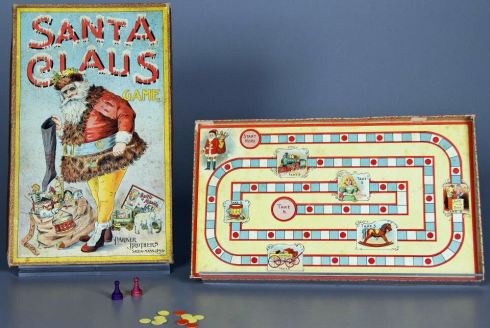
Christmas pantomimes never really caught on on this side of the Atlantic, and I don’t think a Christmas dinner party game called The Feast of Reason. A Christmas Dinner Party Puzzle did either, as I have been able to locate only two copies, one in the collection of the Boston Athenaeum and one which sold to a private buyer at auction a few years ago. Both were published by the Salem firm C. M Whipple and A.A. Smith in 1865, after a charming drawing by the artist William Emmerton (featuring marginalia that looks like a medieval manuscript) and lithography by the J.H. Bufford firm. There are multiple riddles for each course, and I have yet to figure out even one. Later in the century, another Salem producer, Parker Brothers, manufactured several games for Christmas time, including The Santa Claus Game and The Night before Christmas.

Feast of Reason BA

Feast of Reason 2p

Christmas Games Santa Claus Parker Brothers

Christmas Games Parker Brothers 1896 BGG

As the Parker Brothers’ games illustrate, by the twentieth century Christmas games seem to have evolved into children’s games primarily, rather than family or parlor games. There are a few exceptions, but there seems to be a holiday segregation of sorts, with the children preoccupied with gaming and gifts and the adults occupied elsewhere (purchasing, preparing, drinking?). At least everyone comes back together for the feast, followed by a little Crackers merriment, always over in Britain and increasingly over here.

Christmas Game 12 Days

Christmas Crackers V and A

Christmas games:  Christmas Circles, c. 1825, The Twelve Days of Christmas, c. 1950, and Batger’s Crackers, 1920s-30s, Victoria & Albert Museum Collection; Alfred Crowquil’s Pantomime, Harvard University; The Feast of Reason, c. 1865, Boston Athenaeum, Parker Brothers’ Santa Claus games, 1890s, National Museum of Play, ©The Strong.


The Cries of Paris

A title that is all-too-poignant if perceived literally from our perspective here and now, in mid-November of 2015, but historically refers to a genre of popular prints from the early modern era depicting everyday people in the streets, carrying on their business openly and freely: modernity means “progress”, you say? The title is paradoxical because these are visual media, but if we could hear the cries we would be offered a multitude of services and products: chimney-sweeping, firewood, rags, vinegar, milk, cakes, bread, varieties of vegetables. Everyone was a specialist, and of course these images are essentially idealistic–yet still they are notable attempts to represent the people. The Cries genre encompasses not only Paris but also London and a few other European cities, and pre-dates print, but the printed images became particularly popular in the later seventeenth and eighteenth centuries, when many variants of original etchings were produced. They are key sources for economic, social, and cultural historians, but also for those of fashion and print. The Cries of Paris images disappear during the French Revolutionary era, only to reappear in the nineteenth century as a form of nostalgia for the “simpler” ancien regime: it is in that spirit that I am presenting them now. Nineteenth-century street cries images appear not only on print series but also on board games and playing cards: a judge is included in sets of latter, declaring “Peace, peace” in order to stop the game.

Cries of Paris Milkmaid Bnf Arsenal

Cries of Paris Rat Poison MFA

Cries of Paris Nutcrackers

Cries of Paris BM

Cries of Palace Frontspiece

Cries of Paris Collage

Cris de Paris Playing Cards Auction Results

Milkmaid from Les Cris de Paris, c. 1500, BnF, Arsenal. Est. 264 ; A seller of rat poison, engraving by Abraham Bosse’s Small Trades and Cries of Paris, 1630, Museum of Fine Arts, Boston; Nutcrackers, from Les Cris de Paris, after Jacques Philippe Le Bas and François Boucher, 18th century, Metropolitan Museum of Art; Crit de Paris, published by Adriaan Schoonebeek, 1675-1714, British Museum; “Bill stickers” from variant versions of the Cries of Paris, 1740s; “Tisane seller”, conjurer, and umbrella pedlar, from The Cries of Paris series, engraved by Francois Seraphin Delpech after Antoine Charles Vernet, early 19th century, Musee de la Ville de Paris, Musee Carnavalet, Paris, France; Les Cris de Paris. Amusement de Société set of playing cards, Paris, 1820, Dreweatts & Bloomsbury Auctions.


Cakes for Souls and Spouses

Some day, some night, I swear I am going to offer the hordes of Halloween trick-or-treaters that darken my door traditional soulcakes rather than Kit Kats or Butterfingers: now that would be asking for a trick! I think about doing this every year but never follow through: I’m too scared of the consequences, I think, or lacking in confidence in my ability to produce some decent looking cakes. I have already purchased my requisite 1400 pieces of candy so I’ll probably chicken out this year too. Soul cakes are often described as a cross between a biscuit (in the English sense, or an American cookie) and a scone, and sometimes as shortbread: there are lots of recipes available on the web, many adopted from early modern cookbooks. If I were going to go for it, I would probably go with one of the two recipes available here, my go-to source for food history. I suppose that the cakes are more appropriately distributed on All Saints or Souls Day (November 1 and 2), but no one will be coming to my door then: Salem will be returned to its residents! In any case, my Halloween cakes would be perfectly respectable with recognition of the pre-modern Hallow-Tide, which covers all three Hallowed days: from All-Hallows Eve or Halloween on 31 October through All Saints and All Souls Days. These Christian days were superimposed upon earlier Pagan holidays and traditions, creating a period in which the dead and the living were particularly close, and could affect one another’s fate. The medieval Christian view was that this was a time that the living should be working to get the dead out of purgatory, so bells were run, prayers were said, and gifts were given–in the form of cakes disbursed to bands of “soulers” who went from house to house singing ancient souling songs and offering prayers for the dearly departed. After the Reformation and the disappearance of a soul-packed Purgatory in most of Protestant Britain, souling evolved into outright begging, and eventually (jumping the Atlantic) into trick-or-treating. If there was no English Reformation, I wonder if we would all still be giving out soul cakes? Probably not.

Souls 17th Century

Soul-Cake-Main

soulcake

Seventeenth-century Souls, simply existing and ascending directly to Heaven without stopping at Purgatory–they don’t need any prayers or cakes! (Karel van Mallery after Jan van der Straet, Antwerp, 1609 and Johannes Amos Comenius, Orbis sesualium pictus, Nuremburg, 1658 , both Wellcome Library Images); Shropshire Soul Cakes, from a recipe available here, and a more modern Halloween cake on an early 20th century postcard.

Another cake long associated with Halloween in parts of the British Isles, most particularly western Scotland and the Isle of Man, is dumb- cake, very simple, salty grain and water cakes baked in the fire by unmarried women at midnight, with the aim of revealing their future spouses. While holding the pan, they were said to recite an ancient rhyme—Two must make it, two must bake it, and two must break it— and afterwards their future mates would be revealed in their dreams. Presumably the word “dumb” is a variant of “doom”, the Old English word for fate or destiny, although I’ve also read that the girls were supposed to remain mute while they baked the cake (then how would they recite the rhyme?). This kind of “divining for husbands” takes many different forms (cabbage-pulling, mirror-gazing) on both sides of the Atlantic, and survives in the form of various cultural expressions into the twentieth century.

Dumb Cake Play 1907

Halloween cake postcard

Title and first page of the play entitled The Dumb-Cake by Arthur Morrison and Richard Pryce, London, 1907, and an early twentieth-century variant of a dumb cake on a postcard from the same era.


Pyewacket

Pyewacket: lots of cats named “Pye”, why? If you’re of a certain age (born in the 60s at the very least) you might associate this name with the 1958 Jimmy Stewart/Kim Novak film Bell, Book and Candle, in which the modern sexy witch Novak had a Siamese familiar named Pye OR the children’s book by Rosemary Weir titled Pyewacket published a decade later. The origin of this name goes way back to the seventeenth century, when the notorious and self-proclaimed “Witchfinder-General” Matthew Hopkins tried several women for witchcraft (among many others) who claimed to have a number of “imps” or familiars in their service, including Holt, Ilemauzar, Pyewackett, Pecke in the Crowne, Grizzedl Greedigutt, Jarmara, Sacke & Sugar, Newes, and Vinegar Tom. All of Hopkins’ “discoveries” are proudly proclaimed in the 1647 pamphlet THE Discovery of Witches: IN Answer to severall QUERIES, LATELY Delivered to the Judges of Assize for the County of NORFOLK. And now published By MATTHEVV HOPKINS, Witch-finder. FOR The Benefit of the whole KINGDOME.

Pyewacket Life

Pyewacket finally

Pyewackett Hopkins 2

The pamphlet reports that in March 1644 there were some seven or eight of that horrible sect of Witches living in …. a Towne in Essex called Maningtree, with divers other adjacent Witches of other towns, who every six weeks in the night (being alwayes on the Friday night) had their meeting close by his house, and had their severall solemne sacrifices there offered to the Devill, one of which this discoverer heard speaking to her Imps one night, and bid them goe to another Witch, who was thereupon apprehended, and searched by women who had for many yeares knowne the Devills marks, and found to have three teats about her, which honest women have not: so upon command from the Justice, they were to keep her from sleep two or three nights, expecting in that time to see her familiars, which the fourth night she called in by their severall names, and told them what shapes, a quarter of an houre before they came in, there being ten of us in the roome. Holt appeared “like a white kitling”, then Jarmara, “who came in like a fat Spaniel without any legs at all, she said she kept him fat, for she clapt her hand on her belly, and said he suckt good blood from her body”. Next was Vinegar Tom, “who was like a long-legg’d Greyhound, with an head like an Oxe, with a long taile and broad eyes, who when this discoverer spoke to, and bade him goe to the place provided for him and his Angels, immediately transformed himselfe into the shape of a child of foure yeeres old without a head, and gave halfe a dozen turnes about the house, and vanished at the doore”. Sacke & Sugar appears like a black rabbit and Newes, a polecat, and the rest of the imps, including Pyewacket, are not identified, so among them we only have one cat, Holt (kitling is an old form of kitten). I have searched in vain for Pyewacket references in the eighteenth and nineteenth centuries and found none: the author of the 1950 play on which Bell, Book and Candle was based, the English playwright John van Druten, must have plucked Pyewacket out of semi-obscurity and associated the name with a cat, because by that time, everyone knew that familiars were feline.


Zombies on the Streets of Salem

A pack of zombies infiltrated Salem on this past Saturday, “landing” at Collins Cove and making their way through downtown, along the Common and Essex Street, into Derby Square to Derby Wharf. It wasn’t quite an invasion, but more of a parade: they had a police escort (as well as a hearse and banner) and did not really proceed in that distinct zombie shuffle (?): I suppose that would have taken too long, so they just walked. I really don’t mind zombies: even though they are often disgusting, at least they are creative, and they’re not out to make a quick buck like all the witches around town (of course they have no zombie “forbears”–that we know of–on whom to capitalize). One little stroll on a sunny Saturday and they’re gone, although a few will, no doubt, linger until the end of the month.

Zombie Arrival

Zombies 1

Zombies 2

Zombies 051

Zombies 062

Zombies 073

Zombies 066

A little scuffle at the corner of the Common, but most of the zombies were peaceful paraders, like the lovely family above. Derby Square in the clear.


Arkham/Salem

I have never been a fan of H.P. Lovecraft but having spent most of my professional life in the company of 20-year-olds here in Salem I’ve definitely been exposed to the man and his works, especially as they (supposedly) relate to our gothic city. Many of my students believe that the Lovecraftian city of Arkham was modeled on Salem, and its Miskatonic University, our university. They might be right about the former, as the fictional Arkham does indeed have a lot of Salem features, but Lovecraft’s Miskatonic U. is a lot more ivy-covered than our concrete Salem State: most experts assert that is modeled after Bradford College, a now-defunct college up in Haverhill, or perhaps even Brown University, located in Lovecraft’s hometown of Providence, Rhode Island. We have a great nursing program but no medical school (to service our sanitarium) or Department of Medieval Metaphysics. Apart from the University, The Arkham/Salem connection seems so well-established that I’ve always been curious that Lovecraft has not been assimilated more comprehensively into the relentless Witch City campaign, but that seems to be changing now: I’ve seen Lovecraft walking tours and an exhibit over the past year, and for the next few weeks the Salem Theatre Company is staging an adaptation of The Thing on the Doorstep, the Lovecraft story most closely associated with Salem through its references to the old Derby house and the old Crowninshield place.

Thing on the Doorstep

One of my former students directed me to a site that really drives home the Salem/Arkham connection: The Miskatonic Railroad, 18821907. The centerpiece and absolute focus of this Arkham is Salem’s fortress-like train station, which was demolished in 1954. I don’t believe that Lovecraft ever mentioned the Salem Depot in his works, but it certainly appears Lovecraftian, both in photographs and as recreated for the model Miskatonic Railroad. Its creator, John Ott, doesn’t care much for the rest of Salem, but he is duly impressed by our long-gone station: “Salem today rates about a seven on the dreary scale—not much to see, despite its touristy cant. But up until about sixty years ago, Salem boasted the most spine-tingling eerie Gothic-Norman stone train station in North America”.  Apparently he doesn’t share Lovecraft’s affection for Federal architecture!

Salem Train Depot SSU

Salem Train Depot Razing SSU

Arkham Ott

Arkham Ott 2

Salem Train Depot side view LOC

Miskatonic RR Station

Photographs of the old Salem Train Depot from c. 1905, 1910 & 1954 (the razing!!!), from the Dionne Collection at Salem State University Archives and Special Collections and the Library of Congress interspersed with John Ott’s model Miskatonic Railroad Station. Many more images (and stories) of the latter here.


American Girls

Countless cards were inserted in countless packs of cigarettes for decades starting in the later nineteenth century, for product (to avoid crushing the cigarettes inside), advertising, and revenue purposes (encouraging the formation of collections) and consequently cigarette cards form a huge category of ephemera. This is not really my category, but I do find some of the collections to be really interesting expressions of their era. A case in point are the several series of “State Girls” or “State Belles” offered by various publishers in the first decade of the twentieth century: the girls (or young women) are portrayed in a way that supposedly characterized their state, accompanied by other state symbols, and sometimes situated in representative settings. I became acquainted with these particular cards, which I have seen in both cigarette and postcard forms, through a flea market discovery of a Massachusetts girl, wearing academic dress while standing out on some North Shore rocky coast. This find occurred just several days after I received my Ph.D., and so this girl had a particular appeal to me: here I am, I thought, Scholar Girl, a Bay State Belle!

MA Girls Collage

As you can see, not all Massachusetts girls walked around in academic gowns, books in hand. The Raphael Tuck (on the rocks), Langsdorf (schoolmarmish) and National Art Company (sans glasses) girls do, but not those on the Platinachrome Company’s “alphabet” cards, which focus more on the letter and the state seal and flower, or the Fatima Turkish Cigarettes cards, which are all about the elaborate hats which adorn the heads of rather indistinct state girls. The ladies from all 45-48 states (depending on when these cards were published, and sometimes including the District of Columbia) get more detailed characterizations on some cards while on others they are simply idealized lovely-but-generic belles. Miss Pennsylvania is portrayed in colonial dress, armed with a musket and adorned with a tricorner hat, on the National Art Co. and Langsdorf cards below, while the “Keystone Belle” stands before the bustling factories of what I presume is Pittsburgh on the Tuck Card: the past and the present. Not yet quite a golden girl, Miss California is identified with her steamship and her oranges. The “Lone Star Girl” of Texas has her bluebonnets, and the “Opera Belle” of New York comes equipped with a skyscraper. There are girls equipped with fishing poles (Wisconsin, Washington, Oregon and Maine), swords (Maryland), paddles (Virginia), riding crops (New Jersey) and locomotives (Illinois), but the majority of young women are pictured with farming equipment or produce, a reflection of our then still-agrarian nation. A 21st century update on these cartophilic characterizations would be quite interesting.

PA State Girl Collage

State Girls CA collage

State Girls TX Collage

State Girls NY Collage

(Just click on the collages to enlarge)


Casting Dice

The sheer beauty of the Chestnut Street park this spring–just outside my bedroom window–combined with the solicitousness of my neighbors in picking up after their dogs (newly allowed this year) has got me thinking about lawn games, played, of course, on a perfect summer day (or early evening), g&t in hand. There is always croquet or bocce, but somehow three pictures of lawn dice popped up on my computer screen in the last few days, so right now that’s my focus: I’m not quite sure what you do with these jumbo dice, but I like the concept. When looking around for some game possibilities, I fell down the rabbit hole that is the history of dice–back to antiquity. What we think of as a simple game certainly had some weighty symbolism attached to it in the past: the die is cast for Julius Caesar, Roman soldiers casting dice to determine who would get the bloodstained garments of Jesus after the crucifixion, dice games played with Death Personified during the Middle Ages, vice, vice, and more vice. Think about the evolution of the verbs associated with dice: casting is somewhat suspicious, but once it evolves into a game of throwing, it becomes an increasingly harmless activity. And tumbling dice are clearly even more innocuous.

Park 002

Lawn Dice

Dice Smithfield Decretals BL

Dice Players Walters Art Gallery

DES94132 Fashion textile design depicting tumbling dice, French, c.1930s (gouache on paper) by French School, (20th century); © The Design Library, New York, USA; French,  it is possible that some works by this artist may be protected by third party rights in some territories

Jumbo Wooden Dice sets from Paper Source, Crate and Barrel, and The Grommet; lazy (half-naked!) dice players in the Middle Ages and Renaissance (The Smithfield Decretals, British Library MS Royal MS 10 E IV; Walters Art Gallery MS W4492V by Master Jean de Mauléon, c. 1542); the modern design motif: tumbling dice fabric from the 1930s, ©The Design Library, New York.