Tag Archives: Photography

Past and Present

A very special post today, presenting some seldom-seen images of Salem streets and people from 1860 to 1930, part of an exhibition of photographs from the collection of the Phillips Library of the Essex Institute (now Peabody Essex Museum) held at Old Town Hall in 1974.  This was an interesting time in Salem’s built history; the city had just been through the worst of urban development and was now embarking on a redevelopment plan to save what was left.  The captions on the back of the enlarged postcards, which must have been souvenirs of the exhibition, refer (with great hopefulness) about the various elements of this plan, including the creation of the pedestrian mall on Essex Street, which is slated for a major redesign now, in the present.  These photographs are amazing; I’ve included a few present shots for comparison but I didn’t do that for every image because frankly, it was depressing:  I prefer to stay in the past.

Norman Street from the vantage point of Chestnut Street, 1885 and this morning.  A shocking comparison.  All of those charming houses on Norman are gone, replaced by parking lots.  Consequently the people are gone too; this is one of the most dangerous intersections in the city for pedestrians.  For orientation,  that little stubby post in the center of the modern shot is the remnant of the gaslight on which the policeman leans in the 1885 photograph.  And they say the 20th century was progressive?

Busy downtown Salem:  the Boston & Maine Railway Station, demolished in 1954, Front Street, looking toward Washington, in 1885, and Derby Square and Old Town Hall in 1890.

Delivery boys for the Salem Evening News pose for the photographer in front of the Daniel Low building, 1886, Edward’s Market on Hardy Street, circa 1900, and the Toll House on what is now Salem’s main “big box” thoroughfare, Highland Avenue, 1860.  Toll rates for sleighs and sheep!

Bathers at Collins Cove and wharves and pavilions at the Willows, 1891.

The Jonathan Corwin house in disguise as an apothecary, 1872 and today, as the “Witch House:  a rare present improvement (thanks to Historic Salem, Inc.) except for the name.

Across the street from the Jonathan Corwin house, looking down Essex Street  toward Washington, 1885 and today. At least the street hasn’t been widened beyond recognition.  Look at that bicycle girl in the foreground of the 1885 picture!

Appendix:  the Future?  A rendering of the new and improved Essex Street pedestrian mall below. No cars, more people, just like 1885.


Alternate Histories

I don’t really like to engage in “what if” history with my students or read alternative histories, but I like the visual images associated with the genre, ostensibly very current but actually quite historical itself.  Renaissance artists inserted anachronistic imagery in their works all the time, partly because they were so immersed in the classical era and could not help drawing comparisons to that time and their own. For example, the northern Renaissance painting The Martyrdom of St. Ursula and the 11,000 Virgins depicts contemporary Turkish soldiers slaying the virgins rather than the legendary Huns.  The Turks had conquered Constantinople in 1453 and were now poised to expand into Europe, whereas the Huns occupied a similar position a millennium before.

The Martyrdom of St. Ursula and the 11,000 Virgins, Master of the St. Ursula Legend, Cologne c. 1492. Victoria and Albert Museum, London.

Invasion seems to be the most popular premise for alternate histories:  the Turks in the Early Modern Era, Napoleon in the nineteenth century, Kaiser Wilhelm and Hitler in the twentieth.  Widely acknowledged to be the first book in an emerging genre of alternate history, Louis Geoffroy’s Histoire de la Monarchie universelle: Napoleon et la conquête du Monde (1836) envisioned a world pacified and modernized under the benevolent dictator Napoleon.  Between the reimagined Napoleonic worlds of the nineteenth century and the reimagined Germanic worlds of the twentieth century is a peculiar little story by Salem’s own Nathaniel Hawthorne, “P’s Correspondence” from Mosses from an Old Manse Volume II, in which the author’s deranged friend P recounts his encounters with Romantic poets of an earlier era in 1845 London.  Hawthorne’s version of Midnight in Paris!  Somehow Napoleon appears here too, completely feeble but still under guard, along with an even more incapacitated Sir Walter Scott.

A beautiful first edition of Geoffroy’s Histoire, a Currier & Ives print of the iconic Napoleon Crossing the Alps by JacquesLouis David (Library of Congress) , and a modern mash-up on a tee-shirt.

The twentieth century, with its succession of invasions and conquests and technology, created a natural environment for alternative histories, increasingly recognized as a genre with a special name:  uchronia (which seems to accommodate both “what if” speculations and constructed worlds).  The classic example is J.C. Squire’s If it Had Happened Otherwise:  Lapses into Imaginary History (1931; also published under a variant title:  If:  Or History Rewritten).  The quality of Squire’s contributors (including Winston Churchill) must have gone some way towards legitimizing the relatively new genre.

The late twentieth-century invention of photoshop brought about a whole new realm of visual alternative histories, and the most charming examples I could find were, of course, on Etsy, in the alternatehistories shop. So here, in sort-of chronological order, are slightly altered images of the signing of the Declaration of Independence in 1776, Chicago during the Columbian Exposition of 1893, and the Green Monster in Boston, just in time for opening day at Fenway next week.


A List and Links

Having been nominated for a Versatile Blogger award last week by the gracious author of Moving in Time, to whom I extend my gratitude, I want to follow the rules of the award by: 1) revealing 7 things about myself and; 2) recommending 15 blogs which I admire.

The first task:

1. I am the very last person in the world who does not have a cell phone.

2. I’m a terrible clotheshound who can’t seem to break the habit.

3. Doris Day movies make me happy.

4. Contrary is one of my favorite words.

5. I detest eggs:  I have to run from the room if anyone is breaking one or cooking one.

6. Also succulent plants:  they really give me the creeps.

7. I dislike the color blue (except turquoise).

And the second.  It should go without saying that I admire all the blogs on my blogroll and check in with them regularly.  So for this task, I’m choosing blogs that I have not linked or referenced before, including several that are relatively new to the web.  This seems to be in keeping with the spirit of the award.  All of the blogs below are either very creative, very well-researched, or very fresh, original and earnest–another one of my favorite words–in some way. So, here is my rather random list of links:

Secret Gardener.  Beautiful images here–and words.

Blanket and Bone.  A lovely eye; my idea of a design blog.

Absinthefiend. A new blog about absinthe–need I say more?

Restaurant-ing through History.  Looking at history through the perspective of restaurants;  a nice window into the recent past.

Got Medieval. This is a very well-established, popular blog, but I haven’t shared it before so I am now.

 The Quack Doctor. Again, a blog  that has been around for a while, but as the popular history of medicine is a bit obscure, well worth sharing.

Joie de VivreA strong sense of place, in this case Ireland.

Spitalfields Life:  A strong sense of place, in this case East London.

Desideratum:  The blog as a work of art.

Animalarium:  The best animal images anywhere.

The Passion of Former Days: a great site for old photographs.

Tattered and Lostone of several great ephemera sites.

The Bygone Object:  we’ve been on a big public history push at SSU, and this academic blog has helped me to focus my thinking about the field and its endeavors.

Lostpastrememberedmuch, much more than a food blog; all sorts of context, and great images.

Piewacket: a nice photography and design blog (and I love the movie which is I assume is the source of its name:  Bell, Book and Candle).


Salem Film Fest 2012

The Salem Film Fest began yesterday, marking its fifth year.  It’s an all-documentary festival with screenings at three downtown venues (Cinema Salem, the Peabody Essex Museum, and Salem Maritime’s Visitor Center) spread out over a week.  This is a nice Salem event: well-organized, well-timed, and increasingly well-attended. I’m very pressed for time this week as somehow I find myself putting together an exhibit of the literary and historical sources of steampunk culture at the Salem Athenaeum (more later–am I qualified to do this? no) among other more academic obligations, so I’m probably going to be able to see only one film.  Therefore I must choose well.  Last year, I saw some ok films but missed the big hit of the festival (and the year):  Bill Cunningham New York.  I saw it later on television but Mr. Cunningham was so charming I would have liked to have seen him on the big screen.

So what do I have to choose from?  Films which examine:  a matchmaking mayor in Slovakia, trying to reinvigorate his demographically-challenged town, the architecture of the Cuban Revolution, Native American ironworkers, the making of a Santa Claus, the artistic process of Gerhard Richter, Mardi Gras Indian Chiefs in New Orleans (which I really would like to see, as I do like the HBO series Treme but can never figure out where the Indian Chief is coming from), the transformation of a western feminist into a devoted Muslim in Yemen, and the world of romance novels, just to name a few of the diverse offerings.  The Festival’s theme is see the world, and these are certainly very different worlds.

All (well, most) of the films on the schedule sound interesting, but the two that I am particularly drawn to are Battle for Brooklyn, about one man’s battle against the Atlantic Yards development in Brooklyn, and In Heaven, Underground, about the 130-year-old Weissensee Cemetery, one of the largest Jewish cemeteries in Europe, located in one of the northeastern suburbs of Berlin.  The former film appeals to me because I’ve seen my share of downtown development battles (albeit on a much smaller scale) here in Salem, and I love films that look at a big issue from a very personal perspective.  Also, my brother lives in Brooklyn and I think it’s amazing.  In order to make my decision, I looked up some reviews of the film (all of which were very good) and found myself on the Develop don’t Destroy. Brooklyn site, which has a header quote by Atlantic Yards developer Bruce Ratner that made me really want to see the film:  “Why should people get to see plans?  This isn’t a public project”.

But as compelling as Battle for Brooklyn sounds, I think I’m going to have to go for In Heaven, Underground.  I’ve got to find out how this amazing cemetery, framed by art nouveau mausoleums, survived the Nazi Regime.  Apparently more grave sites were lost to incidental allied bombings!  The Weissensee Cemetery survived more than the Nazi Regime however; it also survived 40+ years of neglect under the German Democratic Republic, because (of course) there were no German Jews left to safeguard it.

Tough choice; maybe I can make both, or more.

Still photograph from In Heaven, Underground; Albert Eisenstadt, A Girl in the Jewish Cemetery, Weissensee, East Berlin, 1979.  International Center of Photography’s eMuseum.


George Washington Slept Here

Last summer, I wrote about George Washington’s visit to Salem in a post on the Assembly House where he dined; today I’m featuring the house where he spent the night (October 29, 1789) after he was feted by the city’s notables:  the Joshua Ward house, built between 1784 and 1788 on what was then waterfront and what is now busy Washington Street.  Like my post on Lincoln last week, I’m trying to recognize and remember American statesmen on the days they were actually born (February 12 and 22) rather than on the generic “Presidents’ Day”.

Teddy tries to take over:  Puck Magazine, February 1909.

President Washington came to Salem as part of a New England tour in the Fall of 1789.  His diary entries indicate that he was impressed with the commerce of the town, but he has little to say about its architecture.  Washington was no Jefferson; he was clearly more interested in the quality of the land and the roads along his route than he was in culture, material or otherwise.  The Joshua Ward house was a brand new mansion when he arrived, ostensibly the finest residence in town, but he refers to it only as his “lodgings”.  He spent the night in the second-floor northeast bedchamber, on the right in the pictures below.

A bust of Washington appears to peer out at Salem from a window over the entrance of the Joshua Ward House.

The house is now home to the Higginson Book Company and appears well-maintained and seemingly-secure, despite being wedged in between a Dunkin Donuts (one of 57,000 in Salem), modern condominiums, and an office building.  Its location has determined that the Ward House has had an interesting history, to say the least.  At this point in time, it is far better known as a haunted house than a historic one, due to the fact that it was built on the former site of the house of  George Corwin, the High Sheriff of Essex County who issued the warrants for those arrested in the Witch Trials of 1692 and infamously placed the sequential stones on Giles Corey’s body which crushed him to death for failing to enter a plea.  Sheriff Corwin dropped dead of a heart attack 4 years after the trials at age 30, and the combination of a series of shady stories involving a curse and his corpse, along with an equally shady “spirit photograph” ostensibly taken in the early 1980s, have created a ghostly reputation for the Joshua Ward House.

Its location has threatened not only its reputation but also its preservation.  The Ward house was originally built on a bluff overlooking the South River, but as Salem developed the river was filled in to create the major commercial thoroughfare of Washington Street, and Salem’s massive Boston and Maine Railroad Station was built virtually in its front yard.  Eventually it became the “Washington Hotel”, indicating that its association with Washington was well-known, and commercial storefronts were built in front of it and a “New Washington House” adjacent.

The view looking south on Washington Street in the later nineteenth century and the Boston & Maine terminal in 1910, Detroit Publishing Company. The Ward house is located just beyond and behind the “Boston” building on the right:  quite a change from the river view of a century before!  A postcard from the late 1920s.  Below, a northwestern orientation, FACING but still obscuring the Ward House:  the New Washington House  (Dionne Collection, via Salem Patch), Washington Street in the 1930s, and today.  The posts in the lower left-hand corner of the modern picture are those of the Joshua Ward House fence.

The house is obscured in all of these pictures of its streetscape, but fortunately it is revealed in the photographs of Arthur C. Haskell, taken for the Historic American Buildings Survey in 1937 and accessible at the Library of Congress. These pictures show a house (labelled the Joshua Ward “Washington” House) that looks like it has fallen upon hard times on the outside, but relatively well-preserved on the inside.  The first two exterior views show appendages growing out of both front and back, and a missing balustrade, but the interior views show an empty but still elegant interior, with woodwork which is often attributed to Samuel McIntire.  I think that the second-floor landing between the front and rear stairs is particularly impressive.

A sketch of the house; you can see all the stuff that has been built in front of it.

HABS photographs by Arthur C. Haskell, 1937:  Ward House front and back exterior, first-floor parlor mantle, second-story landing, and the room that George Washington slept in on the second floor.

It’s so interesting to see a city–the world–grow and change from the perspective of one house, bearing silent witness.  Things will get worse for the Joshua Ward house before they get better. In that horrible time of urban renewal, the 1960s and early 1970s, a developer approached the Salem Redevelopment Authority (which has planning jurisdiction over downtown) to tear down the  “junk” in back of the Washington Street storefronts at no. 148, meaning the Ward House!  In the ensuing uproar the way was cleared for an extensive restoration supervised by Salem preservation architect Staley B. McDermet, revealing the elegant mansion of Washington’s time–and ours.



Before Photoshop

A retrospective exhibit of Jerry Uelsmann’s “non-literal” photography opened last weekend at the Peabody Essex Museum here in Salem and continues through May 13.  The Mind’s Eye: 50 Years of Photography by Jerry Uelsmann  includes over 90 works by the photographer, dating from the 1950s to the present.  I was too busy and sick (with the dreadful, everlasting cold that everyone seems to have this winter) to make it for the opening festivities last weekend, featuring a presentation by Mr. Uelsmann as well as a screening of the documentary on his work by Daniel Reeves entitled Outside In:  The Transformative Vision of Jerry Uelsmann, but yesterday I spent an hour or so wandering around the gallery and plan to go back soon.  The museum itself was quite crowded, given that it was a Saturday and there were lots of family activities in the Atrium relating to the other major exhibition that recently opened, Shapeshifting:  Transformations in Native American Art, so I didn’t stay long.  One of the major benefits of living (and working)  in Salem is being able to pop into the world-class museum that the Peabody Essex has become between classes or appointments on a quiet Tuesday afternoon.

Uelsmann’s  photographs were all amazing, but I particularly liked those with architectural details, very predictable given my predilection for the built environment.  Apparently I’m in good company, because the works below are among his most popular.  The last one reminds me of the “feral houses” of Detroit, first showcased on the great blog Sweet Juniper.  I also liked the animal-themed photographs, including one of Uelsmann’s first wife Marilyn with some out-of-scale sheep in their bedroom and another in which a black dog surveys a block of houses (architecture and animals, perfect).

Untitled, 1964.

Untitled, 1976 (Sometimes referred to as "The Philosopher's Desk" but not by Mr. Uelsmann).

Untitled, 1982.

Uelsmann’s photographs made me curious about the history of photomontage, defined by David Evans in the Grove Dictionary of Art as a “technique by which a composite photographic image is formed by combining images from separate photographic sources”.  I knew that the Surrealists played around with photography at the turn of the last century, but I had no idea that the very first generation of photographers did so as well.  So even though Uelsmann is obviously a master of photomontage, he is not a pioneer; an entire century earlier photographers like Oscar Gustave Rejlander and Henry Peach Robinson, both working in Britain from the early 1850s, were experimenting with what was then called “double printing” or “combination printing”.  It’s only natural that people would want to manipulate the new medium almost as soon as it appeared, although “artistic photography” bothered those who wanted photography only to document reality.  A very focused website, nureal:  a timeline of fantastic photomontage and its possible influences, 1857-2007 features a very substantive history of the technique and the artist-technicians, and the website of the George Eastman House, International Museum of Photography and Film can also provide context and images, including that of Robinson’s famous combination print Fading Away (1858), made from five different negatives.  Robinson had trained as a painter and seems to have been more motivated by artistic principle in his photographic compositions than a desire to capture reality, as illustrated by his 1880 print Two Figures in a Landscape in which the models were photographed in his studio and then “placed” outdoors in the final image.

Two photographs by Henry Peach Robinson:  Fading Away (1858, George Eastman House) and Two Figures in a Landscape (1880).

Robinson wrote about his cut-and-paste technique, so not long after this second photograph anyone could have themselves pictured before Niagara Falls, without ever traveling there.  Things get a little bit more fantastic in the last decades of the nineteenth century, with “spirit photography” and photographic collages and all sorts of surrealistic images appearing on both postcards and larger prints.  Another good online source to explore the history of photography in general and photomontage in particular is the American Museum of Photography, which maintains several digital exhibitions, including a charming one on the work of trick photographer and publisher William H. “Dad” Martin, whose images of “homespun surrealism”/ fantastic farming were incredibly popular just before World War One.


Collecting Salem on Etsy

Time for another Etsy post, motivated by finding one of my very favorite Salem books on the site:  Salem Interiors by Samuel Chamberlain (1895-1975).  Chamberlain was a Marblehead-based photographer, artist and author, whose books of New England photographs are now classics–and very collectible.  The 1950 edition on Etsy looks like it is in great condition and is very reasonably priced.  Just click on the image (and those following) and you’ll get to the Etsy listing.

I’m not one to promote Salem witch items, but there is an amazing collectible plate on Etsy right now:  an early (circa 1900) souvenir plate rimmed with 18 little witches made by the Petersyn Company of Passaic, New Jersey.  For a witch plate, this one is quite charming, relatively rare, and well-priced. This is one of the earliest porcelain expressions of “Witch City”.

There are some lovely Hawthorne editions on Etsy now, including several that are very collectible, like a 1930s edition of Tanglewood Tales with illustrations by the short-lived artist Virginia Francis Sterrett, whose flying dragon seems like a good companion for the Salem witches.

Lots of carte-de-visite and cabinet cards from Salem’s many turn-of-the-century photographers:  a “young dark-eyed woman in a walking suit” taken by the Cook Photograph Studio in the 1890s, a “beautiful Victorian woman in a romantic, angelic pose” from the 1880s, and a “lambchop whiskered” man (love these Etsy descriptive titles!) photographed by the Bonsley and Moulton Studio. I tend to like the typography as much (or more) as the photography.

Vintage Game collectors can always find Parker Brothers products on Etsy.  I have never seen or heard of this “reading” game called Peter Coddle’s Trip to New York but it looks interesting, and I’m intrigued by all these scraps of ephemeral paper; it’s a miracle they survived this long.

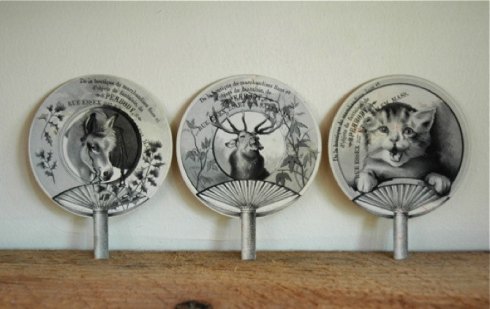
And finally, some amazing pieces of advertising ephemera:  three advertising fans, in French, for the Peabody’s Dry and Fancy Goods Bazaar in downtown Salem.  Salem had a large and growing French-Canadian population in the first half of the nineteenth century, and I suppose this was the target audience for the fans, which feature a stag, a pony, and (of course), a kitten.


Trimmings and Tidings

The streets of Salem at Christmas time, 2011:  a walk around the decorated city.  I was attracted to simplicity and creativity, two things that I’m going to strive for in the New Year.

Skates and a sweater on black doors, on and around Federal Street.

River Street always goes all out, for every season.

These two houses on Federal Street always look great.

It doesn’t really “pop” in my picture, but the juxtaposition of the tiny vintage Christmas figurines in the window of this Broad Street house with the rusty old piece of machinery was really neat.

Minimal decoration, but I love these carriage houses.  The top one belongs to the Pickering House on Broad Street; the bottom one, just off the Common, has been recently restored.

Adorable window at the Mighty Aphrodite, a maternity consignment shop on Essex Street.  Green and red maternity dresses and a snowy, sparkly baby.

Glad Tidings to everyone this holiday season.


Historypin

If you’ve followed this blog for any time at all you know I love old photographs, so I’ve been enjoying Historypin, a (relatively) new website from Britain on which people post/pin their old photographs for locations around the world.  By “old”, I mean nineteenth century or 1999.  You can search by location and even see old photographs superimposed on contemporary street scenes.  What is particularly interesting about this site–about the entire project—is the range of photographs:  from public and event-oriented to private and family-oriented.  It’s always interesting to get a more intimate view of the past, and Historypin has the potential to do just that.  There are audio and video clips as well, and “tours” that you can take through various visual histories.

You can also make your own collections, from photographs that are already on the site as well as your own.  Here’s a photograph of a stylish couple at Royal Ascot in 1936 from the “Fabulous Fashion” collection:

There are not very many Salem photographs pinned to this digital map yet, but there was one I had never seen before, of an unidentified church near the House of the Seven Gables in 1929, from the collection of the Boston Public Library.  The site looks unrecognizable to me, but the Gables has a very large parking lot.

There’s a very nice collection of historic photographs of Marblehead, the town next door, pinned by an obviously enthusiastic collector.  I particularly like this one:  four girls and their bicycles on State Street, summer of 1898.


Double Vision

This past weekend, I attended a nice event at the Salem Athenaeum for Salem collector Nelson Dionne’s new book Salem in Stereo. Victorian Salem in 3D. It’s a gorgeous little book, full of Salem stereo views which one can peruse with the included prismatic viewer. We did just that, as Mr. Dionne regaled us with tales from his lifetime of collecting and plans for future projects.  The book was published by HARDY HOUSE Publishing of Salem, and is available at their website.

So many stereo view cards survive, that America must have been “stereoscopic nation” in the later nineteenth century–and after.  The steady improvement of viewers after the invention of the new technology in the 1830s enabled everyday Americans to build stereo view collections for the purposes of both entertainment and education.  One could travel the world through the lenses of a stereoscope, and there are lots of charming “parlor stereographs” showing people doing just that.

The Holmes viewer and a stereoscopic shop, both 1870s, and a stereograph advertisement for the Underwood & Underwood Patent Extension Cabinet, 1902, all Library of Congress, Prints & Photographs Division.

Big events and city scenes, like those included in collections such as that of the Salem shopkeepers Guy & Brothers, definitely comprised a majority of published stereographic offerings, but consumers clearly wanted more whimsical and domestic scenes as well:  weddings, domestic scenes (staged and otherwise), picnics, children and pets (just like videos today).  For some reason, sleeping children and cats were particularly popular, but you can find virtually anything by accessing the Robert N. Dennis Collection of Stereoscopic Views (over 72,000 images) at either the New York Public Library Digital Gallery or the Library of Congress.


Folder for Guy & Brothers Stereo View Collection and Whipple & Smith’s view of Winter Street in 1873 above; the “light keeper’s daughter”, Charlestown, Massachusetts, and sleeping children and cats cards below, along with a lone cat on a tree stump, somewhere in the Adirondacks in 1915.