
Tag Archives: Phillips Library

Two Visions for Salem

I’m in the history business, so I rarely dwell on visions, unless they are in the rear-view mirror. But last week I happened to take two photographs while running around in downtown Salem, and when I looked at them later on my phone I realized that they represented two visions for Salem, at least to me. Here they are and then I’ll explain.

The first (top) one is a photograph of recent changes to Washington Street, the key north-south corridor in downtown Salem forever. Vehicle traffic has been limited to just one lane now, with parking alongside and an expanded sidewalk and hot-top bikelane. The present administration LOVES bike lanes and wants to install as many as possible anywhere and everywhere, even in this case at the expense of safety (how can an ambulance or fire truck possibly get through with one lane, especially during peak tourist time?), aesthetics, and congestion (look at all that parallel parking—that takes time–even for those who know how to do it!)

The second (bottom) photograph shows Salem’s 157th t-shirt shop, now installed in a very prominent building on the corner of Essex and North Streets, just across from the Witch/Corwin House. Just rows and rows and rows of t-shirts.

For me, the first photograph represents the City’s attempt to take back territory ceded to cars over the past century or so, in terms of both parking and driving. This is certainly a laudable goal with which I have no problem (except with the implementation—there’s just too much ugly concrete going in downtown in my opinion) but I think a corollary of that vision is one of a “15-minute city” in which residents can obtain all essential goods and services within a 15-minute walk or bike ride in any direction.The 15-minute city concept has been popular among planning professionals for the last decade after being introduced by Carlos Moreno, an urban studies and business professor at IAE Paris – Panthéon Sorbonne University. I actually think that Salem could be a 15-minute city, BECAUSE IT WAS, but not now—as that goal is completely incompatible with its current status as mecca for witchcraft tourism. I’m sorry, but I don’t think droopy or pointy witch hats are an essential good, nor palm readings an essential service. I live in downtown Salem, or right on the edge of it, and I know that I must drive to purchase shoes or go to the dry cleaner or the doctor. I’m not sure the concept of the 15-minute city is compatible with any city centered on tourism, unless it’s a big city, like Paris. But smaller cities have to make a choice, and to me, it seems like Salem has chosen tourists over residents. As evidence of that choice let me offer up another photograph that I took this past week, of the bump-out and bollards in front of the Ropes Mansion. Because of Hocus Pocus rather than history, this historic house is a popular walking tour and selfie destination, and unfortunately a car-on-pedestrian accident happened a few years ago. To accomodate and protect the crowds, the city expanded the sidewalk and installed many shiny black bollards, just another example of how Salem’s streetscape is being shaped not by the rhythms of daily life for its residents, but the demands of larger and larger crowds of tourists.

I’ve been thinking about the 15-minute city concept for quite a while, after discovering (actually being shown) an amazing map of downtown Salem in 1946 at the Salem State Archives and Special Collections. It’s a real estate map with a focus on businesses, incredibly detailed and revealing very clearly a 15-minute city in which everyone could buy or do anything within that radius. The variety of shops was just amazing: just place little witch hats on one part of one street on the sites of buildings  that were formerly shoe shops, druggists, stores selling fruit, paint, rubber, hats, and draperies, dry cleaners, and “Topsy’s Chicken Coop,” and you have the visual history in a nutshell. The SSU Archives has tons of busy street scenes on their Flickr page but I thought I would feature some more focused street scenes from a newish and loose collection of “Salem Streets” images from the Phillips Library as I have become enraptured by them! So yes, even though I started and titled this post with “visions,” I have reverted to form and am looking back. I just can’t help it: the future is a bit scary.

The incredibly detailed Nirenstein Realty Map of the “Business Section of Salem,” 1946, Salem State Archives and Special Collections and Dockham’s Salem Business Chart, n.d., Phillips Library Broadsides, above.

Views of Central Street, 1880s-1932, from the Phillips Library Salem Streets collection:

Brown Street, c. 1910, Phillips Library Salem Streets Collection.

A very old shop on Mill Hill (Washington Street) before the Great Salem Fire of 1914, Phillips Library Salem Streets collection.

And the cutest cobbler shop ever on Broad Street (of course there was no comprehensive zoning before the 1930s either—so the home/work/shopping radius could be very small indeed). Phillips Library Digital Collections.


Norman Street Will Break Your Heart

Norman Street has been an important street in Salem for centuries, serving as an east-west way first to the harbor, then to the train station, and linking downtown and the city’s west-lying residential neighborhoods. It was once tree-lined, along with Georgian colonial houses interspersed with shops. It had a bit of a reputation as an American “Harley Street,” with several prominent physicians in residence, and it even has an eerie element, referenced by an entry in Nathaniel Hawthorne’s notebook for 1839 in which he recounts a story told to him by Custom House inspector William Pike, who “Another time — or, as I think, two or three other times — saw the figure of a man standing motionless for half an hour in Norman street, where the headless ghost is said to walk.” Norman street was also Samuel McIntire-central: Fiske Kimball asserted that the great architect and woodcarver was born at #21, and both his father and brother lived (and worked) on the street. Despite its heritage, and because of its continuous role as a central corridor, Norman Street was very vulnerable to one of the most dominant forces of the twentieth century: the car. From about 1930, it was transformed from a human-scaled city street into a wide suburban “connector,” a process that was intensified with the construction of two large buildings at its eastern and western ends, a new U.S. Post Office building and the headquarters for the Holyoke Mutual Fire Insurance Company. These buildings wiped out more than 50 residences on their side of the street and adjacent streets, even more after the Holyoke building’s expansion in the 1970s. On the north side of Norman, the New England Telephone Company initiated a similar cascade of demolition commencing several decades earlier. Business and residency had co-existed on Norman Street since Salem’s founding, but these larger businesses brought more workers and more traffic. The street was widened considerably, causing it to lose much of its residential charm, and one by one the remaining colonial houses fell, along with all of its trees. There is no question that the car was the major culprit in this unfortunate transformation, but Norman Street is also a study in how little control a municipality has over urban development if it does not have robust planning tools in place, or if it chooses not to utilize those tools.  When I look at Norman Street today it appears that the City of Salem seems to have essentially written it off, leaving it to landlords and speeding cars. If you’re a preservationist or a pedestrian, Norman Street will break your heart, especially if you know what was there before.

Norman Street past.

Looking down (east) Norman Street in the 1880s and 1910s, Lee MSS & Frank Cousins slide, Phillips Library, Peabody Essex Museum; the Cox House, 1890s, Dionne Collection, Salem State University Archives & Special Collections. EIGHT LARGE BRICK OVEN FIREPLACES in the Felt House, an “antiquarian’s delight.” Looking west towards Chestnut Street, Lee MSS, Phillips Library and “Newsboys” at the corner of Washington and Norman Streets, c. 1910, Salem State University Archives & Special Collections. The very famous Mansfield House with its carved stair and mantel, Cousins photos and Boston Architectural College Yearbook for 1925; wallpaper from Dr. Cook’s famous house on Norman Street, the Magazine Antiques, June 1925; Postcard of the new Holyoke Mutual Fire Insurance Company headquarters at the corner of Summer and Norman Streets, 1936, SSU Archives & Special Collections; the Texaco station across the street, 1979, MACRIS; New condos at the northeastern end of Norman Street, 1982, Boston Globe and SSU Archives & Special Collections.

The last two photos of condo conversion and construction in the 1980s represent a positive change for Norman Street: the return of residents! The business blocks and setbacks, along with the widening of the street, have certainly left their mark, however, as you can see from the photographs below which I took this weekend. It’s hard to recognize this once charming street. A couple of years ago, I kind of got my hopes up for Norman, and that’s why heartbreak is in my title (and also the description of the Felt House above). Responding to the crush of traffic at the terrible intersection of Norman and Summer, the City installed a mini roundabout, and I thought this might be the start of a concerted effort to recognize the street as a proper entrance corridor, but no, it’s just a circle of fake brick in the middle of the road. Drivers still get so frustrated by this intersection that they tend to speed up before and after, which is why I’m always anxious about crossing Norman Street. Bordering this circle are beautiful Chestnut Street houses on the west side and the hulking former Holyoke building  and an 18th century house with a strident 21st century addition on the east: this space sends a mixed message! Last summer, the weeds surrounding the Holyoke building reached up to its lower windows, and signs and litter are always strewn about. Its owner has had difficulty finding commercial tenants, and so part of the building (I think the original 1930s building) will now be consigned to a homeless center for families operated by Centerboard, the largest housing provider in Massachusetts. A proposed new housing development for the Texaco site across the street has just been granted significant tax credits by the Commonwealth, and so will now go forward. At the very least, this project (you can see a rendering here, but it’s from a couple of years ago) should eliminate that hole along the streetscape, but I hope the design does more than that. In fact, I think that this new building is Norman Street’s only hope.

Norman Street present.


It would be nice if that “Caution X-Walk Ahead” sign was positioned towards drivers in the street rather than pedestrians on the sidewalk.


A Salem Printer & Procrastination

It’s the end of the semester, a transitional time in which I traditionally don’t quite know what to do with myself. Instead of finishing up all of my little annoying tasks, I am persusing random pieces of print here and there. My stepmother has observed that my father can be sidetracked very easily from any task by “printed matter,” generally a newspaper or magazine, something that can be read quickly but is not (by him). I have observed this many times. It runs in the family: I too can be diverted by printed matter, but for me, it’s not the text but rather the type. I don’t really care what the words (or images) are, it’s how they have been printed, their design and composition. This goes back decades with me, since I wrote my dissertation on English printers in the sixteenth and seventeenth centuries. I did so much research on their world, their shops, their type, that I became a typography fan for life. If I happen to spot a striking typeface, a new-to-me specimen pamphlet, or an interesting title page, I will chase these impressions down to the ends of research database-earth. That happened this past weekend: hours went by, but I did discover a new Salem printer. One glance at the bookplate of Irving Kinsman Annable in the large collection of bookplates amassed by Daniel Fearing at Harvard’s Houghton Library, and I was lost.

Annabale (1867-1949) was a Salem resident who established and ran the Berkeley Press of Boston for over 50 years, eventually passing the business down to his son Walter. When I read some of the advertisements for the Press, I assumed they were job printers, producing forms and flyers, envelopes and enclosures. These very practical (and emphemeral) products were the basis of the Berkeley business, but clearly the Annabales had an artistic and skilled devotion to their craft and were not just pumping pieces out. Inland Printer, the long-running printing industrial periodical, has many reviews of the Berkeley Press, and also features the full range of its advertising: again and again the claim is “a specialty of out-of-the-ordinary printing.” Besides these orders, the Berkeley Press produced or contributed to lots of specialty publications for regional institutions and trade organizations, as well as a succession of patriotic pamphlets, including the Declaration of Independence and Gettysburg Address. Houghton Mifflin even commissioned Berkeley to produce one of the earliest (and most popular) pictorial maps, the black-and-white version Melanie Elisabeth Leonard’s view of Cape Cod, in 1926. Catalogs, portfolios, all sorts of enclosures: the press printed anything and everything, except for larger books. (I think, but I don’t have access to any business records, though there are papers in the Phillips Library collection that I want to check out if my curiosity continues). Of course, Berkeley’s own advertising materials, like the pamphlet on decoration below in the collection of Historic New England, are the most beautiful.

The first half of the twentieth century was such an exciting time for the craft of printing as its practicioners were earnest advocates for its skills and exemplars in the face of increasing mechanization. These men (mostly) were all inspired by William Morris and his Kelmscott Press, but they went on to acquire distinct skills and attributes through their own practice, societies, and appreciation of printing history. They kept their businesses small and identified as artisans first. In Boston, the leader of the printing craft movement was clearly Daniel Berkley Updike (1860-1941) and his Merrymount Press, which produced lots of ephemera as well, but many more books than Berkeley, each one a work of art. I don’t think the contemporaries Updike and Annabale were competitors; I think they were colleagues, and both were active in the Boston Society of Printers. Annabale was definitely more interested in advertising as an art, writing quite clearly about the power of “word images.” The Berkeley Press did produce several small books, especially if there was a local connection as in the case of Joseph Ashton’s History of the Salem Athenaeum, 1810-1910, but they are nothing to get excited about. On the other hand, Annable seems extremely excited about the power of perfectly printed slogans and symbols. In the press prospectus Houseflags & Trademarks (1924—the author is not credited but this reads like all of Annable’s other copy) he compares the flags flown by New England ships a century before, when they “were such frequent travellers across the waters of the world….[that] their flags were familiar spots of color in the harbors of six continents” with the trademarks of his day: if the design was right the same “familiarity” would emerge. Though he did some printing in Salem for friends and organizations which which he was associated, and even produced some picture and postcards which he sold himself (enough that I’m wondering if there was a press at home—a really cute mansard roof cottage still standing on Willow Avenue), I think Annabale saw his professional life as existing in Boston, for over fifty years.

Houseflags & Trademarks courtesy of Bailgate Books, Ltd.


Salem Silk Swatches

Periodically I dip into the papers of Salem supercargo Benjamin Shreve (1780-1839), which offer interesting and insider perspectives on Salem’s early 19th century global trade. Fortunately these sources have been digitized by the Phillips Library, but even before they were available to the general public I had access through an Adam Matthew source collection, to which the Salem State Library has subscribed for quite some time. Benjamin Shreve is interesting, as he is not from one of those old Salem families (nor is he attached to the Shreves of Crump and Low): in the Boston Weekly Magazine for July of 1804, he is described as a “merchant of Alexandria” in the notice of his marriage to Miss Mary Goodhue of Salem, but he quickly made his mark in his wife’s native city. Shreve opens a window into a world of trading logistics and trends through his meticulous commercial correspondence: he’s a numbers guy for sure but also a diplomat of sorts, negotiating the best price and quality for his Salem purchasers back home from his suppliers in South America, East Asia, and Europe. Wherever he goes, he has to fulfill large orders but also buy smaller items for all the wives of his employers back home, as well as for his own. He writes everything down, sometimes in duplicate or triplicate. If I dig into his papers for long my head will start to swirl, so I have to be pretty focused, and this time I was focused on silk. I’m in the exciting stage of research on my next book, which is on saffron in the late medieval and early modern eras, and there are some interesting parallels between it and silk, so that’s where I was coming from, but how I ended up in 19th-century Salem I do not know; I guess it’s just that persistent Salem tug on my time! Anyway, I was looking through a bound book of Shreve’s miscellaneous memoranda from 1809-30 when I came across these cool silk samples in the midst of much drier fare: I was caught!

Benjamin Shreve Papers (MH 20), Trade Memoranda, 1809-1830, Phillips Library, Peabody Essex Museum.

These are samples of Italian silks sent to Shreve by a friend in letter packets, with advice on how and where to buy silk in Italy. It’s 1819; Shreve has certainly been buying silk in China for a while, but he was always looking to expand his sources. I think this is so interesting because I have long thought that Salem’s trade with Europe as compared to Asia has been under-represented in the scholarship. Italy and France were great suppliers of silk so why not buy there if the price was right? And Shreve himself is also under-represented in the scholarship! Why isn’t there a book on him, using all of his amazing accessible papers? He is best represented in China Trade expert Carl Crossman’s book, The China Trade: Export Paintings, Furniture, Silver and Other Objects, 1785-1865, which was published in 1972 and reprinted several times afterwords. Crossman knew the collections of the Peabody (now Peabody Essex) Museum and its library very well and drew on them heavily—I learn a ton of stuff whenever I pick up his book. And as I was just reading about Shreve there, I found two other “Salem silk swatches” from the Shreve papers included by Crossman as illustrations: two sheets of silk samples from the Chinese merchant Eshing given by Pickering Dodge of Salem, owner of the Governor Endicott, to Shreve as a buying guide for Canton, and a letter with some strands of raw silk from Dudley Pickman to Shreve–plus a miniature portrait of our man Shreve on ivory! Crossman digs even deeper into some of the Shreve sources for his last book, The Decorative Arts of the China Trade: Paintings, Furnishings, and Exotic Curiosities (1991). Encouraged by Crossman, I went back to Shreve (for just a bit!) and found one more silk swatch among the Government Endicott papers, a sample of black “Levantine” silk. 

Not for the first time, my title is a bit deceptive: swatch books from the early modern era and after are numerous and generally refer to sample books offered up by producers rather than buyers. The Victoria & Albert Museum has several in its collection, including my favorite, a confiscated traveling salesman’s book of silk samples from Lyon, reproduced in the amazing book Selling Silks. A Merchant’s Sample Book 1763 by textile curator Leslie Ellis Miller. Shreve’s snippets of cloth, embedded in commercial paper, can’t compare to a comprehensive collection such as this, but they certainly offer some visual insights into the global trade of this conspicuous commodity in the early nineteenth century.


Headline History

I went up to the Phillips Library in Rowley to look through some scrapbooks memorializing the Salem Tercentenary of 1926 late last week and found myself enchanted by the presentation and curation of one particular album put together by a certain Frank Reynolds. There were two big scrapbooks actually, and while I was expecting photographs (I guess that would be an album, rather than a scrapbook), there were only newspaper articles pasted in in a meticulous and chronological manner with attached white labels. At first I was disappointed, but then I went with it, and found the juxtaposition of the headlines really interesting. Then I came upon one particular article that really illustrated the concept of “headline history” and then I had my post.

Thus inspired, I divided my Tercentenary headlines into several categories:  1) The Big Row; 2) Getting Ready; 3) Advice to Tourists; 4) Dress Up; 5)) Crowds; 6) Presidential Address.

The Big Row was over the date of the founding of Salem, actually no, it was over what “founding” meant. Everyone knew that Roger Conant came down from Gloucester to Salem in 1626 with the “Old Planters” but William Crowninshield Endicott, Jr., the President of the Essex Institute, insisted that Conant and his colleagues were mere “fishermen and squatters” and Salem wasn’t really founded until his ancestor John Endecott arrived with the first royal charter in 1628. So Salem’s Tercentenary should be delayed for two years. The most eminent Salem historian of the time, Sidney Perley, made it clear that this was a ridiculous stance, and resigned in protest from his curatorial postition at the Essex Institute. Then Endicott resigned, and that was the situation in March of 1926, only a few months before the celebrations were to begin. I’m really not sure how it was resolved, but it took a lot of meetings and made a lot of headlines. Endicott went on to become President of the Massachusetts Historical Society, so maybe all the Boston Brahmins got together and offered him a bigger prize to back down.

Full speed ahead! We get some great headlines about getting ready. A lot of focus on cleaning Salem up. There was one big new project—a pineapple-topped bandstand on Salem Common—but much more of an emphasis on restoring and scrubbing (reports on parades later on often noted how clean Salem’s streets were). Hamilton Hall was stripped of its paint; the massive train depot was sandblasted.

There were some interesting marketing campaigns associated with the Tercententary. Every Salem store seems to have dressed up its windows with historical scenes; Parker Brothers reissued its first board game, The Mansion of Happiness. There seems to have been an outreach to Quebec, because of Salem’s large Franco-American population, but also to other areas of the country, and I think that might explain these odd witch headlines. The Salem Tourist Camp at Forest River Park seems extraordinary to me: this very same space hosted a refugee camp after the Great Salem Fire just twelve years earlier (and no, the Fire was not “kind to the city.”)

So many “antiques”! The word is used very broadly: houses, dresses, furnishings, all on display. There was a great opening of houses throughout Salem, and also a great opening of attics. While the parades presented a broad overview of Salem’s centuries, the open houses and performances were very focused on the Colonial: and its revival.

The entire July week was jam-packed: THREE parades, a big bonfire on the fourth in the Salem tradition, fireworks in the Willows along with a triple parachute jump from a hot air balloon and then an attempted quadruple jump two days later by Louise Gardner (who would fall to her death before an Atlanta crowd of 15,000 two years later), athletic competitions, lectures, a ball, all sorts of exhibitions. The Massachusetts papers covered everything in detail, as did some national papers, and there were a lot of headlines about crowds. For the Historical and Floral parade at the end of the week, the participants were estimated at 10,000 and the crowds at nearly 100,000.

By all accounts the Salem Tercentenary was a resounding success, but clearly there was a need for a presidential nod to cap it off. I had always thought that Calvin Coolidge was dissing Salem by not attending the big event as he always summered nearby, but apparently this year he was in another part of the country. So he sent Vice-President Charles Dawes, who interrupted his annual fishing trip to Maine. The Vice-President reviewed the first tercentenary parade, and gave a speech on how the radio could safeguard the constitution from rampant populism. But even that sounds better than President Coolidge’s note, below. So enthusiastic: “even if Salem ships no longer circle the world and the life of the community goes on in less picturesque and spectacular channels” Salem still has its history! You’d think Silent Cal would have congratulated the city on putting on such a big party, but no. The President does make the point that anniversary of the Declaration of Independence was being celebrated in the Salem year as Salem’s 300th and this year we have another concurrence with the 250th anniversary of the beginning of the American Revolution. From what I’ve seen so far, I think Revolution 250 is going to leave Salem 400+ in the dust, but we shall see.

Tercentenary font? Quincy is up this year: you can check out their schedule here.


Miss Abbott’s Albums

Summers have been about old Salem photographs for the past several years. I go up to the Phillips Library to research something, order up a few old photograph albums to give myself a break, and then just dive in to another world, another Salem. Last year I really had to restrict myself as I was still wrting chapters for our forthcoming book Salem’s Centuries; this year the book is essentially done so I’m just looking for a few images to illustrate it, or so I tell myself. Really, I just like to look at old photographs. Last week I looked through the three albums of Miss Lilly S. Abbott, a librarian at the Salem Public Library, who began her tenure in 1925 and rose through the positions of assistant, children’s librarian, reference librarian, acting director and assistant director over her 47 years at the library. She was obviously a committed collector and curator of photographs, choosing very important images for her albums, and labeling them on the front or back. She supplied photographs to the Salem Evening News, and also to the Salem Cultural Council’s exhibition of “Salem Streets and People” in 1971. Some of her photos I had seen before, but many were new to me. I sharpened up a few photographs below, but most of her photos were very clear and had been processed from lantern slides very effectively. Unlike a lot of Salem photographers and photography collectors, she was obviously more focused on Salem streets and people than on structures: most of her album photos feature downtown, and she obviously loved the Willows too.

Here are some of my favorites: first, a group of photos of downtown Salem—some are dated, most are not, but I think they’re from about 1900-1920, beginning with this great photo of Ash Street in 1900. Urban Renewal wiped Ash Street out, and now it only has one house!

Ash Street, Crombie Street, Essex Street, Norman Street, North Street and Bridge, Washington Street.

Here’s a few of Derby Street, including the Philadelphia wharf—-I was very excited to see this as it was built by the man who lived in my house. Plus, David Little on his “Little Steamer,” Salem’s first automobile! (Miss Abbott seems to have been very interested in transportation).

On to the Willows: including interior and exterior shots of the famous Brown’s Flying Horses carousel, in situ in Salem until 1945.

Some odds and ends: the only photos of famed Chestnut Street in Miss Abbott’s albums are very different: a car driving west, which to us will look like the wrong way, as it is one-way the other way now, and the day after the fire that destroyed Samuel McIntire’s Second Church in 1903. I’ve never seen this. Then there’s the Tontine building on Warren Street, destroyed by the Great Salem Fire in 1914, and a great photo of the Gedney House on High Street before its acquisition and restoration by Historic New England. Finally, Old Home Week, always a BIG celebration in Salem, in 1909. I’m grateful to Miss Abbott for preserving these wonderful images of Salem streets and people.

Town House Square, 1909.

Lily S. Abbott Photographic Albums (PHA 113). Couresy of Miss Abbott and the Phillips Library of the Peabody Essex Museum, Rowley, Massachusetts. Miss Abbott donated the albums to the Essex Institute in Salem in 1981 in memory of her brother, William.


The Summer of Old Photographs

I worked all summer long on my chapters for Salem’s Centuries and a few other projects, researching and writing, researching and writing, researching and writing. Once I’m on the trail, I’m a pretty steady worker, but I do take breaks: I’ve learned from other writing projects that you have to pause to let your mind absorb and process information. Sometimes the break might be at night when you’re asleep—I got into the habit of leaving a notebook by my bedside when I was writing my dissertation and when I woke up in the morning sometimes I would see notations inside that I didn’t even remember writing! That must have been one of the benefits of a younger mind because it didn’t happen this summer, when all my breaks were conscious. Every time I went up to the Phillips Library in Rowley, I would dutifully call up boring municipal records but also collections which contained old photographs of Salem. I’d pore over them a bit and photograph them for later perusal, and by the end of the summer I had quite a collection. The Phillips has digitized two of its largest collections of Salem photographs: the Frank Cousins and Samuel Chamberlain collections, but there remain many seldom-seen images within collections. Fortunately there are great finding aids to locate such images, but also some very miscellaneous collections which yielded surprises, at least for me! I loved schoolteacher Grace Hood’s shots of the Salem and Massachusetts celebrations in 1926-1930 (PHA 67; including some completely new-to-me views of the opening day of Pioneer Village in 1930) and an unknown photographer’s depictions of a very gritty Salem encased in a large composite collection entitled Photographs of interiors and exteriors of Salem, Mass., circa 1890-1950 (PHA 151). And there’s much more.

Phillips Library PHA 67 & 151.

My favorite collection was the first one I accessed, back in May: a treasure trove of images contained in the scrapbooks of Francis Henry Lee of 14 Chestnut Street, mostly from the 1880s (Phillips Library MSS 128). Lee was the son-in-law of the woman who lived in my house, and a committed architectural antiquarian focused on documenting the history of every house on Chestnut and adjoining streets. He did not rely on hearsay, but sent queries to anyone who ever lived in the neighborhood, and his scrapbooks are filled with detailed responses, some written on black-trimmed stationery indicating that their authors were in mourning. I was familiar with his articles in the Historical Collections of the Essex Institute, but surprised to find his research materials accompanied by so many wonderful photographs.

Some of my favorites: (I filtered those that were really hazy or damaged).

Chestnut, Summer & Norman Streets from two perspectives. I’ll never get over how wonderful Norman Street was!

Riding and looking north on Summer Street, and then south (Samuel McIntire’s house is on the extreme left of the last photograph).

Broad Street, looking west.

Cambridge Street, looking north and south.

Work on Bott’s Court.

Hamilton Street, looking north.

Chestnut Street Houses—what’s going on with that figure at the third-floor level of the third photo above, which I think is #26?

Warren Street, looking towards the “Turnpike” (Highland Avenue).
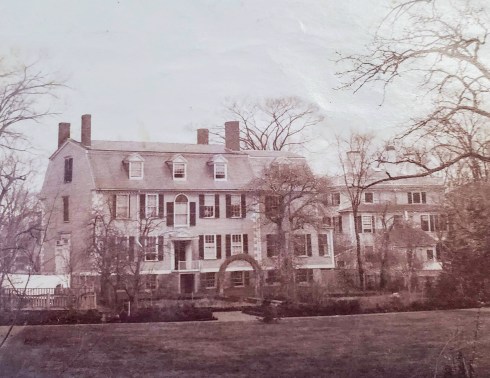
There were several photographs which were especially exciting to see among the Lee papers, including those which show the magnificent formal garden in the rear of the Cabot-Endicott-Low House on Essex Street, which extended to Chestnut before no. 30 Chestnut was built in 1896. This garden was quite famous: it was prominently featured in many horticultural publications and was by all accounts quite the tourist attraction, especially in the spring. A 1904 Boston Globe article on “Beautiful Old Gardens of Salem” reports that for many years the tulip bed was the greatest feature of this garden, and each spring, when these flowers were in perfection, and upper portion of the high fence on Chestnut was removed to enable the public to view the exhibit.

Even more exciting than this lost garden were two photographs of my own house that I had never seen before, including one sans the apartment that was added on in phases between 1890-1910. Our house is the right side of a double house built in 1827: both sides were identifical until the 1850s, when one of our owners expanded the house considerably in back and altered the interior to look more fashionable at the time—round mouldings rather than square ones! The big entrance alteration reflects the changes inside, but I did not know that this guy also put new mouldings over the windows, and disdained shutters as too colonial, I guess. Several owners later, there was a sequential addition on the side of the house: first as an office for a very well-know opthamologist who lived here, and then bedrooms were built above: this is our present-day 7 1/2, a really cute apartment with the best views of Chestnut Street. I assumed that it covered up windows which were on the side of our house, but it looks like there were none. As you can see from all of the other photos of the street, Chestnut was driveway-less in the nineteenth-century: the larger houses had carriage access on Warren or Essex: the property of our house actually wrapped around Hamilton Hall next door and so our carriage house—long- demolished—accessed Cambridge Street.


Salem’s Wooden Watchman

Before there was Samuel McIntire, there was Lemon Beadle. Remember that name: Salem’s nineteenth-century antiquarians certainly wanted us to. Sometimes “Lemuel” is the spelling, but I’m going with Lemon, because Lemon Beadle!  On this past Thursday I went up to the Phillips Library in Rowley, source of most of Salem’s history in textual and material form, to look at some sources for the history of Town House Square, the subject of the last piece I have to write for our Salem’s Centuries book. I had ordered up a notebook entitled “Salem Estates and Localities 1629-1842” which included a “Chronological Chart of Churches in Salem, Mass.” mostly because I wanted to look at the latter (and it is pretty great). The notebook consitutes the notes of William Phineas Upham, the son of  Charles Upham, the first great historian of the Salem Witch Trials. William, who prepared what must be one of the most important maps in American history (perhaps an overstatement, but I live in Salem), a 1692 view of Salem Village for his father, was clearly gathering information for his own magnum opus. The notebook was filled with extraordinary detail about many structures in Salem, illustrated occasionally with marginalia drawings of little houses. I found it charming and informative, but not particularly relevant to my topic, and I was about to close it and move on when I came to William’s rather compelling depiction of Salem’s central 18th century watch house, with its life-sized watchman on top, carved by Lemon Beadle. 

From Phillips Library Fam. Mss. 1047, Salem Estates and Localities, 1629-1842 by William P. Upham.

This illustration really intrigued me: could the “soldier” (as Upham calls it above) or “watchman” (according to other sources) really have been that big? Were there any other depictions out there? Sadly, I have found none so far, but I did get more details from a variety of old Salem sources. This particular watch house was likely Salem’s second, and it was built on Schoolhouse Lane, later School Street and the present-day Washington Street, in 1712: the carved wooden figure on its roof bore the date Anno Regina 1712 in large gold letters. If it was not conspicuous enough, town records indicate the watchman/soldier was painted in 1725. Lemon Beadle was chosen for the commission because of his experience crafting figureheads, and the entire production seems to have been part of policy to improve and standardize the watch system and remind Salem men of their civic responsibilities. While real watchmen endured into the nineteenth century, I’m pretty sure that was not the case with their wooden representative; there are the references to the watch house’s survival fifty years after its construction, but that’s it. Upham clearly wanted to “see” and portray it in his notebook, along with its adjacent whipping post.

Upham’s whipping post and other Salem structures; a watchman by Albert Blaisdell; Salem printer Ezekiel Russell’s watch order, 1777, Sang Collection via Sotheby’s;  Salem Gazette.

Since my focus is on the watchman statue, I’m a little out of my depth and discipline, but I did find one text which asserted that Lemon Beadle’s work is “the first documentable piece of free-standing sculpture in Massachusetts” (Benno M. Forman, American Seating Furniture, 1630-1730: An Interpretive Catalogue, 1988). That’s a pretty big claim; I wonder if it’s still standing. Elias Hasket Derby commissioned woodcarvers John and Simeon Skillen to carve four “free standing figures of larger dimensions, ranging between 4 and 5 feet in height” for his summer estate near the end of the century, but I have to say that without a more detailed depiction, Upham’s watchman sketch reminds me more of the……….(searching for correct word here, can’t come up with anything really applicable) rather less elegant figures which “graced” the very notorious Timothy Dexter’s estate in Newburyport. There were 40, including one of Dexter himself, and the Reverend William Bentley was not impressed when he visited in 1803: “There is no horrid violation of proportion in the district objects but the vast columns, the gigantic figures, the extended arches, & absurd confusion of characters, tend to convince us of the abuse of riches….Dexter was within doors, drunk, having just suffered from a heavy beating from his drunken son, urged on by a drunken daughter.”

 I have no doubt that Lemon Beadle could have done better.

 John Rubens Smith (engraver), A View of the Mansion of the late LORD TIMOTHY DEXTER in High Street, Newburyport, 1810.


A Big Move

No, not me: the Crowninshield-Bentley House! Visiting Louise DuPont Crowninshield’s former garden in Marblehead last week prompted me to reconsider her impact on Salem as a preservation advocate and philanthropist as it is considerable. At least two institutions in Salem, the Salem Maritime National Historic Site and the Peabody Essex Museum, reflect her commitment to the preservation of Salem’s material heritage which was manifested both by her direct involvement and her inspiration. The best example of the latter is one of the Peabody Essex Museum’s historic houses, the Crowninshield-Bentley House, which was moved by the Essex Institute from a rather precarious position on Essex Street to its current location in 1959. This early Georgian house, home to generations of the Crowninshield family as well as Salem’s pre-eminent diarist the Reverend William Bentley, was originally located at 108 Essex Street. In 1958 the Hawthorne Hotel donated the house to the Essex Institute with the condition that it be removed to make way for a parking lot. The move to its new site adjacent to the Gardner-Pingree House and across the street from the Hotel, was preceded by the demolition of a venerable commercial building and succeeded by a comprehensive restoration to its 18th century form under the direction of Abbot Lowell Cummings as a tribute to the “work and memory of preservationist Louise DuPont Crowninshield.” The Crowninshield-Bentley House became the cornerstone of the Essex Institute (now Peabody Essex Museum)’s main “campus” of historic structures, and to complete the vision, gardens also dedicated to the legacy of Mrs. Crowninshield were installed in its midst. Another reason I wanted to post on this big move today is the great visual documentation by Essex Institute President Albert Goodhue, Jr., who snapped photographs of the the entire process over what must have been several days (weeks???) in 1965. These are among some great sources at the Phillips Library in Rowley documenting Salem’s ever-evolving streetscape, one of the major topics we’ll be covering in our upcoming book Salem’s Centuries.

Washington Square West and Essex Street, Salem (Mass.) Photographs, MSS 0.1619. Courtesy of Phillips Library, Peabody Essex Museum, Rowley, MA.

Amazing!!! I love the nonchalance of the pedestrians, and not a police detail in sight. Everyone is just going about their business while the walls are tumbling down! The building being demolished was quite a storied commercial building, also an 18th century structure (I think) but altered and extended considerably. There were some very notable apothecary and stationary shops located within, and Salem architect/artist William Henry Emmerton made an iconic image of it in 1850 when it was his cousin’s apothecary shop (Emmerton was a great draftsman, and the Phillips Library has digitized the records of his architectural firm, Emmerton, Foster & Putnam, so you can see more of his work here). Those big storefront windows were apparently the second of their kind installed in Salem, and the Paracelsus bust trade sign was pretty conspicuous too. After the move and restoration was completed, the Crowninshield-Bentley House received a lot of attention in both academic and popular publications: there are both feature articles and cover stories throughout the 1960s into the 1970s and even the 1980s. The more scholarly pieces tend to focus on the detailed 1761 probate inventory of Capt. John Crowninshield as a primary source for the restoration (which includes references to “a Negro man” valued at £66.13.4 and a “Negro woman” valued at £40 about whom I’d like to know more)§ while trade periodicals seem to focus overwhelmingly on the kitchen. There’s a big spread on the interior of the house in the July 1987 Colonial Homes, part of feature on Salem as the “showcase of early America,” which it was, then.

William Henry Emmerton, Apothecary shop of James Emerton in Salem, c.1850 (pen & ink and sepia wash on paper), Peabody Essex Museum; the Crowninshield-Bentley House on the cover of Americana, September 1973; the kitchen as photographed by Samuel Chamberlain (1970, Phillips Library via Digital Commonwealth) and in House and Garden, January 1974; Frank Cousins photograph of the house in its original Essex Street location, 1890s, Phillips Library via Digital Commonwealth. The House today.

§ The Phillips Library has also digitized all of the booklets in the Essex Institute Historic House Booklet Series, including The CrowninshieldBentley House, Essex Institute historic house booklet series, no. 2, by Abbot Lowell Cummings, Dean A. Fales, Jr., & Gerald W.R. Ward, which you can access here. “An Inventory of the Estate of Capt. John Crowninshield Late of Salem and Apprized by Us the Subscribers at Salem November 10th 1761” is included as an Appendix.


Public Works: Salem 1957-1958

“Cities have the capability of providing something for everybody, only because, and only when, they are created by everybody.” Jane Jacobs, The Death and Life of Great American Cities 

Do cities ever stop building? Are they ever finished? I don’t think so, and for a relatively small city, Salem seems to me to have been especially busy building over these past few decades with more to come. Its 21st-century building boom began with courthouses: the Ruane Judicial Center which set the standard for the expanded scale of new construction and a gorgeous renovation and addition at the Probate Court next door, leading to a new parking garage across the way and ultimately to an adjacent residential building which will block the view of the Probate Court as one drives into town but also provide the funding for the restoration and redevelopment of the obsolete and proximate Victorian and Greek Revival courthouses. The Ruane courthouse also rendered the 1970s District Court across Washington Street obsolete and so it was demolished and replaced by a large residential builing called the Brix, and at the southern end of this same street an even larger Lego-like Hampton Inn now rises above the fray. This has all been a bit overwhelming, and more big projects are on the way! When I feel pressed by the present I always escape to the past for some perspective and a newly-digitized collection from the PEM’s Phillips Library gave me just that: photographs taken by Salem contractor William Franklin Abbott, chiefly of Salem’s big tunnel project of the 1950s as well as the construction of Lee Fort Terrace, a public housing community for the elderly of which he was Clerk of the Works. There are other collections of photographs of the the tunnel construction (I’ll put some links at the end) but I find Abbot’s color images especially captivating: how did the residents of Salem live through this all-consuming Big Dig???

October 1957

Well, they persevered, I guess, as Salem residents always do. The newspapers report that between 25 and 40 downtown merchants shut their doors during the delayed construction, some for good, apparently. The timing of the project was not good: construction of the Northshore Shopping Center, just a few miles away in Peabody, was concurrent, and as been noted millions of times, the latter had a great deal to do with the end of Salem’s reign as shopping center of Essex County. There were rats, there was noise, there was a rank odor present downtown due to the diversion of sewage pipes into the North River. Yet the City had been gearing up for this project since the beginning of the twentieth century, particularly as the grade crossings at Bridge and Norman/Mill Streets were seen as a “constant menace” and the source of increasing congestion. WPA funds were designated for a comprehensive plan including the construction of a new tunnel and station to replace the pioneering 1839 tunnel and 1847 Gothic Revival depot, fondly referred to as the “Old Castle”  but not as beloved in its declining years as it became after it was gone. Nevertheless, work did not begin for a decade later, with the commencement of construction on the Bridge Street overpass. After its completion in 1952, there seems to have been a pause until 1954, when the Depot was demolished and work commenced on the southward extension of the tunnel. The target completion date was 1956, but its completion was delayed until 1959 due to (take your pick): 1) the over-his-head contractor; 2) poor management at the state level; 3) a national cement drivers’ strike; 4) change orders—especially a switch to steel pilings. The summer of 1957 was hot with hearings! Abbott’s photographs illustrate the most intense phase of construction, from a professional perspective.

Above: Boston Globe: Salem’s “ancient” station featured in a December 1938 article; headlines from the summer of 1957; Below, Abbott’s photographs of the construction, 1957-58, first looking south, then north.

November 1957-February 1958, looking southward.

April 1957-January 1958, looking north.

There are more photos, especially of the southern extension of the tunnel, but I was focused on downtown: I can’t even begin to imagine the daily disruption! We hear about the suffering merchants, but I can’t find a source that testifies to the experience of mere Salem residents, trying to go about the business of daily life. I can imagine Abbott walking over from his office on Norman Street during his lunch, observing and documenting the ongoing construction with great interest. You can discern a much more personal perspective in his photographs of the construction of Leefort Terrace as he is as focused on the workers as the work-in-progress. Pride comes through, and there are photographs of the dedication ceremony, including a nice shot of Governor Foster Furcolo and Mayor Francix X. Collins looking like the pols they were (actually I don’t know much about either of them, but those hats make them look like pols). These little brick buildings are not long for this world, as a the City has established a partnership with a Boston development firm, Beacon Communities, to replace them with a multi-story building. Public-private partnerships seem to be the trend going forward with Salem construction projects, including the Offshore Wind Terminal which will be built on that part of the site of our former coal plant which was previously designated for public use. While this project has the potential to reap huge benefits for the economy and the environment, its scale is huge, and its construction and operation will affect the residents of the greater Derby Street neighborhood in myriad ways. They will have to persevere, as will my neighbors in the greater Endicott Street neighborhood, who are faced with a dramatic expansion of the presence of a Marblehead-funded philanthropic organization in the form of three five-storey buildings which will cast their much-smaller dwellings into perpetual shade.

Building Leefort Terrace in 1957-1958; Governor Furcolo and Mayor Collins.

Appendix/ More Sources for Salem’s Tunnel project:

Salem’s “Big Dig” at SSU Archives & Special Collections.

Historic Beverly’s Walker Transportation Collection.

Baccari Collection of “New Salem Tunnel” project photographs at SPD.

