I suppose it’s a bit melancholy to be dwelling on cemeteries in the midst of a golden August but the community conversation around the proposed closure of Salem’s oldest cemetery, the Old Burying Point on Charter Street, during October when it is besieged by crowds, has my head spinning in several directions. I’m thinking about preservation, education, memory, and reverence, public history and family history. Cemeteries are more complicated than I thought, but generations past valued these spaces in ways worthy of revisiting, and to do so I started searching through some old photographs of Charter Street, most by Frank Cousins, whose large collection of glass plate negatives has recently been digitized by the Peabody Essex Museum and Digital Commonwealth. There are no people in Cousins’ photographs of Salem cemeteries in the 1890s and 1910s, so they don’t shed any light on social practices, but the fact that he made so many photographs of both graveyards and gravestones is a testament to their perceived value in the urban landscape. I always thought of Cousins as primarily an architectural photographer, but of course cemeteries are a form of architecture, and he was also a contemporary of Harriette Merrifield Forbes (1856-1951), whose Early New England Gravestones and the Men who Made Them, 1653-1800 (1927) was a groundbreaking work on colonial funerary art. Forbes included Charter Street gravestones in her work, and I think every single regional guidebook from this fledgling age of heritage tourism drew Salem visitors to the Old Burying Point in general and the graves of Bradstreet, Mather, Lindall, Hathorne, McIntire, More (and more) in particular.


 It seems as if Timothy Lindall’s gravestone has always been in the spotlight.
Cousins photographed all of Salem’s cemeteries–the “newer” ones, Greenlawn and Harmony Grove as well as the Colonial grounds, Broad, Howard, and Boston Streets—but he really focused on Charter Street, in more ways than one. We see all the details of the individual stones as well as the big picture, including a built context which is very different now. The photographs are just beautiful, and important, as he captured fragile objects for all time.


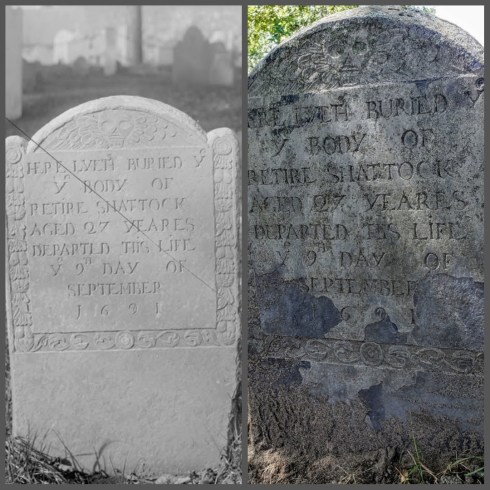
The fragility of these memorials is very apparent when we compare Cousins’ photographs to their condition today (though I am not the photographer that Cousins was obviously and I think black-and-white really serves cemetery photography better). Of course time wears everything down, and the competing demands of Salem’s rich material heritage necessitate prioritization: as I said in my last post, I think the City should be commended for its preservation initiatives of recent years. But we really need to remember that these memorials are going to deteriorate under the best of conditions, and the intense crowds of every October are the worst of conditions.


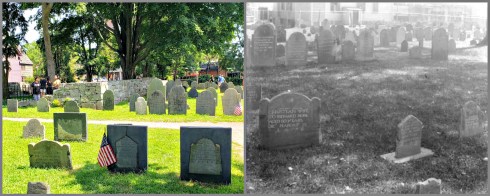
 I feel particularly bad for Mr. and Mrs. Nutting, put to rest in a lovely calm neighborhood and now in the midst of the Salem Witch Village! And I really wish that Cousins had photographed my very favorite Charter Street gravestone: that of Mr. Ebenezer Bowditch. What are those carvings? Does anyone know?

When our descendants look at photographs of the Old Burying Point in our time a century from now, what will they see? I really hope it’s these weathered but still-stately stones, and not the props I saw when I searched through several social media sites with the hashtag #salemcemetery. This is just a sampling, I’m sorry to say.
 Old Burying Point Cemetery, Charter Street, Salem, October 2017 & 2018.


 Mid-August in Salem and Boston: a sunset sail on the Schooner


 Summer Street from Broad with the Doyle Mansion on the right, Frank Cousins


 Views of the exterior and interior of the Doyle Mansion by Frank Cousins, collection of glass plate negatives at the Phillips Library of the Peabody Essex Museum, Digital Commonwealth.

 Boston Globe, June 1934; the Holyoke Mutual Fire Insurance building, built in 1936 and now owned by Common Ground Enterprises (and its rather weedy sidewalk!)

 The John P. Felt House on Federal Court past and present: despite a rough last half-century or so, the house is still standing in good form, lacking only its widow’s walk and shutters.
 Barton Square has been pretty much annihilated.
 Change and continuity on Bott’s Court: old house on the left, newer (both 1890s) houses on the right. Cousins is showing us the demolition of the former house on the right with his preservationist eye.
 Kimball Court present and past: Cousins is showing us the birthplace of Nathaniel Bowditch below: this house is in the top right corner above. In front of it today is a house that was brought over from Church Street during urban renewal in the 1960s when that street was wiped out.
 18 Lynde Street: this appears to be the same house, with major doorway changes.
 The house on Mall Street where Nathaniel Hawthorne wrote the Scarlet Letter: there was an addition attached to the house at some point in the 1980s or thereabouts.
 134 Bridge Street: As a major entrance corridor–then and now—Bridge Street has impacted by car traffic pretty dramatically over the twentieth century; Cousins portrays a sleepier street with some great houses, many of which are still standing—hopefully the progressive sweep of vinyl along this street will stop soon.
 17 Pickman Street seems to have acquired a more distinguished entrance; this was the former Mack Industrial School (Cousins’ caption reads “Hack” incorrectly).
 Great view of lower Daniels Street–leading down to Salem Harbor–and the house built for Captain Nathaniel Silsbee (Senior) in 1783. You can’t tell because of the trees, but the roofline of this house has been much altered, along with its entrance.
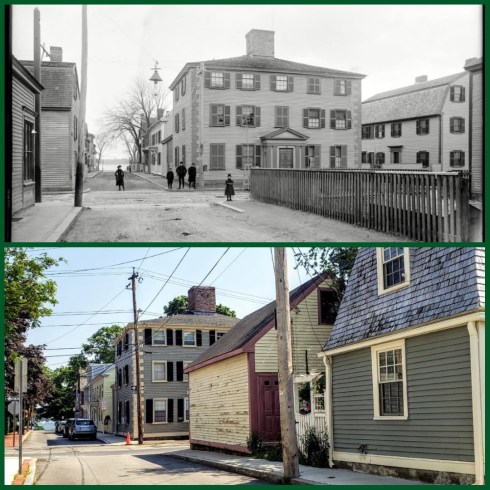 Hardy Street, 1890s and today: with the “mansion house” of Captain Edward Allen still standing proudly on Derby Street though somewhat obstructed by this particular view. You can read a very comprehensive history of this house
 The Frank Cousins “Team”/ Employees’


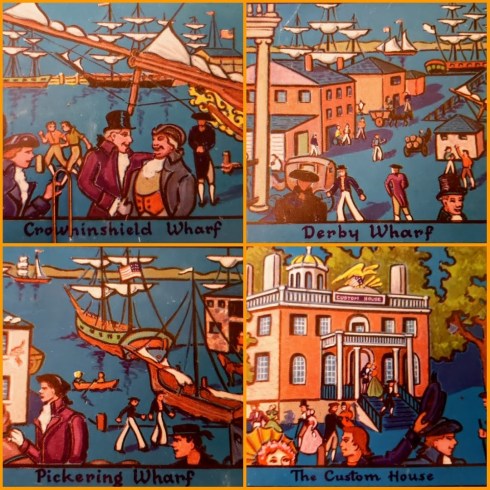


 The Hawthorne Hotel’s lobby and Main Brace cocktail lounge; Jonathan Butler, Harriet Shreve & John Pickering X in the Main Brace c. 1942 from Kenneth Turino’s and Stephen Schier’s Salem, Volume 2 (Arcadia Publishing, 1996); Larry O’Toole’s Salty Map of Cape Ann from


 Salem Gazette, July 1796.
 .
.


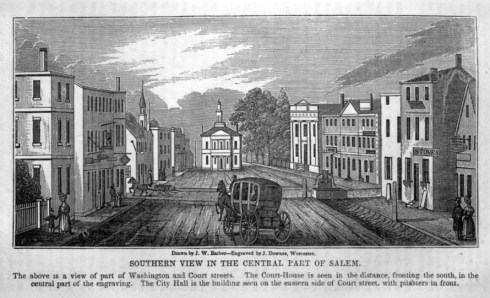

 The Tabernacle Church of 1777-1854, from Samuel Worcester’s Memorial of the Old and New Tabernacle (1855); payments to Daniel Bancroft in the Tabernacle Church administrative

 There is a facsimile edition, but how amazing to see the original 1693 maritime atlas of Pierre Mortier, the “most expensive sea-atlas ever published in Amsterdam in the seventeenth century” according to the eminent Dutch cartographical historian Cornelis Koeman. Stunning plates of beautiful European ships: here is a “Tartane de Pesche”.
 Mr. Monroe at the 1/11/18 public forum at PEM.


 Tried to get more juxtapositions of historical and modern dress but what can I say? I was enjoying the party! Above is my beautiful friend and a very talented seamstress, Louise Brown, in her own creation of course. Below is our committee (with a few conspicuous absences) with chair Michael Selbst in the middle, to the right of me! And then we have some swag…..thanks to all our sponsors too!


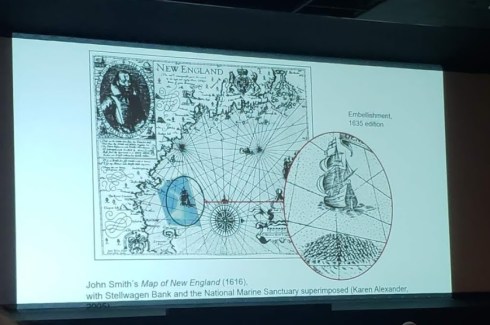

 Scenes from the Salt Cod for Silver Symposium, and the demolition of the Stacks next door.