
Back in Salem until I take off for Scotland at the end of next week. I’ve got lots of teaching, writing, and organizing to do, but I ignored all of my obligations last weekend and read a fascinating book about early American trade in the South Pacific: Nancy Shoemaker’s Pursuing Respect in the Cannibal Isles. I couldn’t put it down! It gave me all sorts of insights into a very particular and profitable trade dominated by Salem merchants and sea captains in the 1830s and 1840s: in bêche–de–mer or sea cucumbers, highly sought after in China for medicinal and culinary uses. Trepang (the primary eastern term) were and are sea cucumbers (often called sea slugs in the 19th century) which were processed in a special way, still in use today: boiled in sea water, placed in baskets and washed again, then dried in smokehouses. A Pacific example of the importance of dried seafood in world history, the bêche-de-mer trade was characterized by boom and bust phases over its long history due to overfishing in response to the sustained demand, but in the 1830s and 1840s Salem traders were very dominant. Shoemaker provides her readers with an appendix of Salem ships engaged in the trade, from ship Clay in 1827 to bark Dragon in 1857, with all sorts of familiar Salem names on board. William Driver, of Old Glory fame, then second mate on the Clay, claimed that he was the first “white man” (not westerner, or American, or Salemite) to execute the bêche-drying process sucessfully, thanks to the instruction of a band of pirates from Manilla. This trade has it all, believe me: daring captains working for equally-daring shipowners engaged in a risky trade that was potentially lucrative but also completely dependent on native “cooperation,” profit-seeking pirates and bureaucrats, a range of nineteenth-century ethnographic attitudes, tales of cannibalism and violence, big money.


 Still very much in demand: bêche-de-mer at a Hong Kong market, photo by G. Clayden
My colleague Dane Morrison works in the field, and I can understand why he finds it so enticing: the stories and the sources are amazing, lending great narratives to important historical analyses of trade, imperialism, and cross-cultural influences and interaction. Using a micro-historical approach, Shoemaker explores American-Fijian encounters through the lives of three people: David Whippy, a Nantucket whaler who remained in Fiji and became an extremely important intermediary, Mary D. Wallis, the wife of Salem sea captain Bejamin Wallis who accompanied her husbanad to Fiji in the 1840s and later wrote about her experiences (as an anonymous “Lady”) there in Life in Feegee. Five Years Among the Cannibals (1851), and John B. Williams, son of a prominent Salem commercial family who tried to make his own fortune in the islands through a more bureaucratic route. So we have quite a Salem focus here: it’s another reminder that the historical Salem experience is played out in Salem and abroad. Williams in particular offers a very interesting perspective: born into money and raised on Chestnut Street (at #19) he was desperate to make his own fortune, beause “to go home poor its a curse in Salem.” These stories of Massachusetts men (and one woman) abroad illustrate how the entire bêche-de-mer trade was dependent on Fijian labor, coerced by native elites with whom the Salem traders negotiated and paid off. So many interesting anecdotes emerge from Shoemaker’s analysis of the exploitative yet intimate relationships tied to this trade: a powerful chieftain named Cokanauto whom Salem captain John Eagleston nicknamed Phillips after his employer Stephen C. Phillips back home (apparently it stuck), a young native woman named Phebe who became the servant (slave???) of Mrs. Wallis, a “Feegee dwarf, about four feet in height, —- said to have been a man of some distinction at home,” transported to Salem on the ship Eliza. (Shoemaker tells us that he made it back home). Captain Eagleston, who made four voyages to Fiji (on the Peru, Emerald, Mermaid, and Leonidas) from 1831-1841, called “his” bêche-de-mer operations “our little city.”
 Cokanauto in Charles Wilkes’ United States Exploring Expedition (1845): 3:122.


 The Zotoff (1922 lithograph) and Emerald returning to Salem, (c. 1950 postcard issued by the Salem Chamber of Commerce).
Shoemaker’s focus is appropriately on Fiji, but it would be nice to explore the impact of this trade on Salem: the sources are numerous as many participants, Eagleston among them, memorialized their particpation in logs, journals, and reminiscences. I’m always looking for narratives to counter Salem’s storied post-1820 decline, as it seems to imply that merchants and seafarers just sat on their hands looking at empty wharves like Nathaniel Hawthorne. I’m not digging into the economics here, but Shoemaker does, and the fortunes that could be made from this trade were astounding! We can see the material legacy of the trade among the Oceanic collections at the Peabody Essex Museum here in Salem, as all of the bêche-le-mer traders were members of the East India Marine Society and thus brought stuff home, but I want to know more.
 Bure Kalou (Spirit House), Fiji. Peabody Essex Museum. Gift of Joseph Winn Jr., 1835.

 How and when my Salem house was built.


 First up in my neighborhood, I wanted to showcase these two houses whose owners have invested in a lot of work! Kudos to them! Both are on Chestnut. As you can see, the first house has a way to go, but its very impressive entrance was just re-attached. It’s such a great house, with an amazing garden. Nathaniel Hawthorne lived briefly in the blue house. A rare Salem front garden on Essex—and this house has been thoroughly renovated as well. Besides the Witch House and the House of the Seven Gables, the only historic house that Salem tourists seem interested in these days is the Ropes House, because it was featured in Hocus Pocus of course. The Ropes Garden is consequently very crowded in the fall, but I caught it during a relatively calm time: more ropes in the Ropes Garden than ever before. This gate on Federal Court started off my iron hunt–I’m obsessed with it.


 Downtown is quite a vibrant shopping scene with more than occasional bones and bats, and porta-potties, of course. There are some very well curated shops amidst the general kitsch, particularly
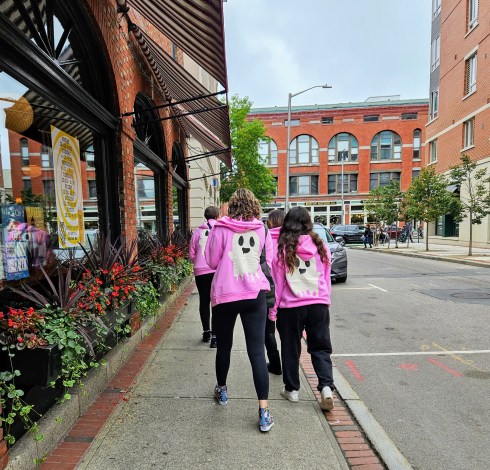


 Ghosts might trump witches this year eveywhere but Salem, of course. The ironwork at the Peabody Essex’s Gardner-Pingree House (which is never open) is simply astounding! A very busy Common, as the annual Food Truck Festival was underway, but once you get into the realm of Salem Maritime along Derby Street, not so busy. I still haven’t been in the Derby House even though it has been open this summer. The last photo just above is to remind me that I want to plant that particular variety of clematis next year!
 I finished up my walk on Charter Street, where the Witch Trial Memorial and Burying Ground is located. As soon as I entered the latter, I was confronted by these strange mannequins, propped up right against the Cemetery’s gate and stones! So Salem: the juxtaposition of the sacred and the tacky, remembrance and exploitation, enduring and ephemeral.

 Phillips Library PHA 67 & 151.
 Chestnut, Summer & Norman Streets from two perspectives. I’ll never get over how wonderful Norman Street was!


 Riding and looking north on Summer Street, and then south (Samuel McIntire’s house is on the extreme left of the last photograph).
 Broad Street, looking west.
 Cambridge Street, looking north and south.
 Work on Bott’s Court.
 Hamilton Street, looking north.


 Chestnut Street Houses—what’s going on with that figure at the third-floor level of the third photo above, which I think is #26?
 Warren Street, looking towards the “Turnpike” (Highland Avenue).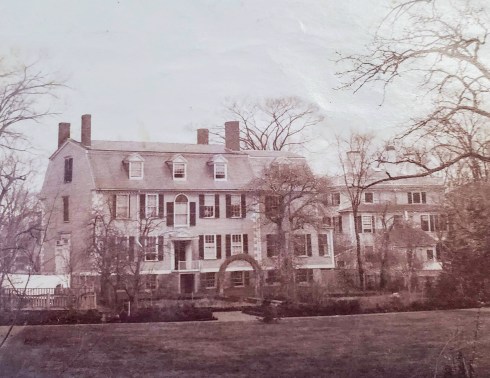


 The Narbonne House of the Salem Maritime National Historic Site; John Ward and Crowninshield-Bently Houses, Peabody Essex Museum.
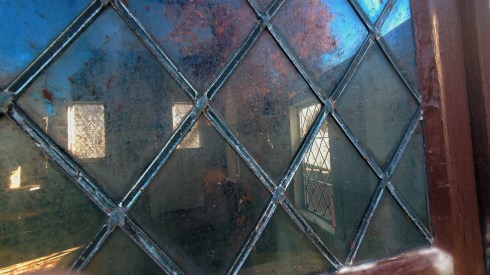 Window of Quaker Meeting House, Salem, Peabody Essex Museum.


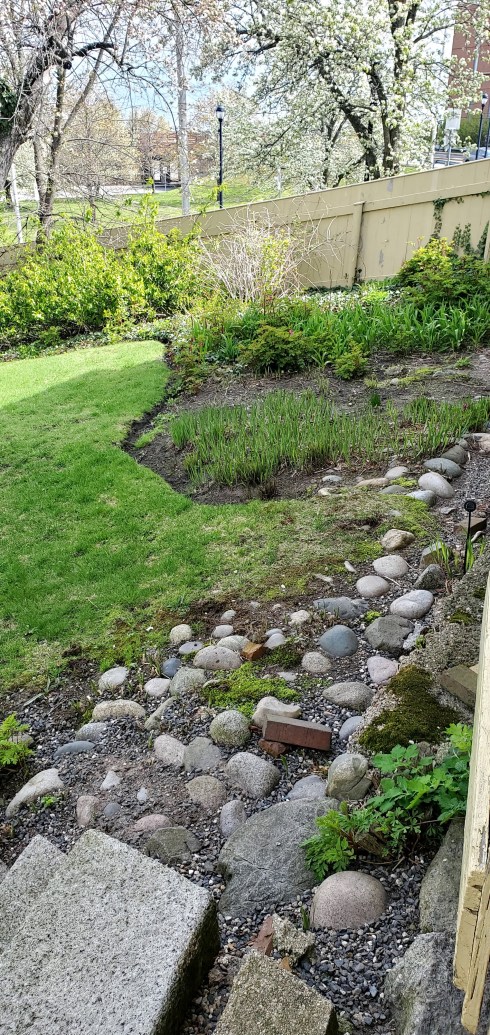


 Winter Street

 On Washington Square East.


 Salem Maritime National Historic Site and the Salem Arts Association.


 From the Brookhouse Home to the PEM’s row of historic houses on Essex Street. Memorial stone in the Brookwood garden: Miss Amy Nurse, RN, an Army Nurse (1916-2013).


 Charter, Front & upper Essex Streets.





