Tag Archives: Peabody Essex Museum

A Sampler of Salem Folk Art

Salem is not particularly known for its folk art, I think. The standard for craftsmanship during the later eighteenth and early nineteenth century was so high, and production so prolific, that the curatorial and collecting emphasis always seems to be on the best and the brightest of the decorative arts rather than the more idiosyncratic. But I’m always looking for interesting examples of folk art, and every once in a while I do a round-up of samplers, silhouettes and signs. The Peabody Essex Museum has wonderful examples of Salem-made folk art in their huge collection, including my favorite trade sign, featuring a bust of Paracelsus made for James Emerton’s Essex Street apothecary shop, samplers from the famous Sarah Stivours school, and the “soft sculpture” (I’m not sure what else to call it) of textile artist, author and abolitionist Lucy Hiller Lambert Cleveland. And all manner of maritime objects of course. The amazing decoys of Captain Charles Osgood, carved while the Captain was biding his time waiting for his gold rush ship to set sail from San Francisco back to Salem in 1849 and hidden in a friend’s hunting lodge in Rowley for a century thereafter, are valued quite highly. Most are in the collection of the Shelburne Museum in Vermont, but one came up for auction recently with an impressive result.

 Lucy Hiller (Lambert) Cleveland, Sailor’s Home, mid-1800s, cotton, wood, leather, pigments, Gift of Mary T. Saunders, 1915, Peabody Essex Museum; Sally Rust’s Sampler from the Sarah Stivours School, 1788, Peabody Essex Museum; three Osgood decoys, Shelburne Museum.

But a lot of anonymous pieces crafted in Salem seem to sell for very little money. There’s a painting of Salem Harbor by an anonymous artist coming up for auction later this month at Eldred’s Auctions that is so beautiful I could fall into it—and it has a higher starting bid than I’ve seen before for folk art marine paintings. It seems worth it; this is not just a painting of a ship, but of life on land and sea. Contrast this with another nautical view below, a reverse glass painting of “Ship Siam of Salem / Built 1847 / Capt. Ebenezer Graves” sold by Jeffrey S. Evans & Associates Auctions. There’s certainly a lot more going on. Also from Evans, these two wonderful carved allegorical figures, which were apparently located at Salem Willows! I really can’t imagine where, precisely. Silhouettes cut in Salem appear at auctions frequently, but I’m not sure these would count as Salem art as such artists seemed to have been characteristically itinerant.

Folk art painting of Salem Harbor, Eldred’s Auctions; reverse glass painting and allegorical figures, Jeffrey S. Evans & Associations Auctions; Massachusetts cutwork silhouette “of S.P.H. of Salem, cut by S.A.D,” Dovetail Auctions.

Besides the first painting above, my favorite recent folk art finds are twentieth-century creations: a c. 1910 popcorn popper  and a wooden house purse made by Mercedes Hitchcock of Houston, Texas. You can find more about her business, “Houses by Hitchcock,” here. Apparently women from all over the country would send in photographs of their houses to her, and she would make scale model wooden pocketbooks for them! The owner of a Summer Street house commissioned a purse, and it came up for auction a few years ago. I’ve got to go for a walk–not quite sure which house it is. But it’s November, so safe now.

Scary Salem Popcorn Popper, c. 1910; Mercedes Hitchcock Folk Art Wooden Salem House Purse, Fairfield Auction; Salem Popcorn Popper, Bray & Co. Auctions.


“Salem is not a Theme Park”

You hear my title phrase all the time in Salem now, with increasing frequency. It’s a way to acknowledge the fact that residents of Salem have to (or want to): go to work, drive to their appointments, take their kids to school, walk along the sidewalk or sit on their front stoops in the prolonged Halloween season of September and October (and a bit of November, and…….) when a million people shuffle around our very small city taking pictures of each other. Most people say it out of frustration. I’ve heard this expression from members of our City government as well, no doubt to also express frustration but at the time time, as coverage for doing nothing to ease it. Because the (other) official party line is that no one can do anything about it; the tourists just come and we have to do everything possible to accomodate them. We couldn’t possibly be asking them to come, in any way, because that would indicate a deliberate campaign to exploit an historic tragedy. Nope, they just come, we can’t stop them, and Salem is a real city, not a theme park, and if it exhibits theme park characteristics in response to the demands of the crowd, it’s the tourists’ fault and not ours! I understand the desire to point out that Salem is not a theme park, but at the same time, it looks like one to me, during this time of year, and increasingly all year long. And there’s a bit of protesting too much that it isn’t one going on here.

Here’s my argument for.

Some definitions of a “theme park”:

Oxford English Dictionary (my holy grail): an amusement park designed or organized around a unifying idea or subject.

Merriam-Webster: an amusement park in which the structures and settings are based on a central theme.

Cambridge Dictionary: a large permanent area for public entertainment, with entertaining activities and big machines to ride on or play games or restaurants, etc., sometimes all connected with a single subject.

Collins: theme park is a large outdoor area where people pay to go to enjoy themselves. All the different activities in a theme park are usually based on a particular idea or theme.

This last definition could undermine my assertion, as people do not pay an admission fee to enter Salem—but they certainly pay in all sort of other ways. Still, it makes the point that a theme park is generally seen as a private enterprise, and I think that’s a big part of the “Salem is not a theme park” refrain. It’s not Disney. But I’m still going to beg to differ. And certainly no one can argue that Salem does not have a central, unifying theme! I could show you tons of pictures of a packed Essex Street which would look very theme-parkish, but I really feel that the City looks most like a designated entertainment zone—or even a movie set– early in the morning when no one is about. Right in the center of it all is Samantha, the Bewitched statue, surveying her domain.

It was a slow burn, but once the Hocus Pocus fan base reached critical mass, that gloss was added to Salem’s veneer as key scenes were shot here. During the week before Halloween, the Peabody Essex Museum dresses up the Ropes Mansion as “Allison’s House,” which you can see above, along with the City’s new bollards installed to protect picture-takers and tour groups. This scene definitely reinforces the “Salem as set” impression! Across town, Salem Common is transformed into a marketplace, food court, and carnival site at this time of year, and you can’t get more theme park than that–a large outdoor area where people pay to go to enjoy themselves.

And then there’s the coordinated messaging/marketing. Don’t get me wrong, it is necessary: people need to know which roads are closed and encouraged to take the train. But it looks and feels commercial rather than civic. Look at this first photo–posted by the Salem Police Department, whose badge bears the image of a witch on a broomstick. Just below, a post from the City’s official travel and tourism agency, Destination Salem: I’m sure this cookie is delicious (the Chocolate Pantry on Derby Street features wonderful treats all year long), but would it be front and center if it didn’t bear the City’s offical witch brand? The “unifying” or “central” focus is the defining characteristic of a theme park and you just can’t miss it in Salem. I completely understand the sentiments of frustrated Salem residents—-I think I actually uttered these same words myself to a squad of felt witch hat ladies who were just standing in the middle of my street obliviously when I was trying to pull out of my driveway, nearly late for class. But I think the City should own it; after all, it is no mean feat to transform a city into a theme park.


The Battle of Bunker Hill: it’s Personal

A grand reenactment of the Battle of Bunker Hill to be staged at Gloucester’s Stage Fort Park has been in the planning for months to mark its 250th anniversary and I planned to go on this past Saturday until just a few days before. On the actual anniversary, June 17, I started reading some diaries of participants and observers and I soon realized that I wanted continue on with this personal commemoration rather than travel to an offsite reenactment—although I heard it was amazing! As always, I try to find the local angle on big events, and so I have three Bunker Hill Salem stories today. The first is a revisit: a few months back I returned to this post on Lieutenant Benjamin West, the sole Salem casualty at Bunker Hill. I had remembered a reference to a portrait of West, perhaps lodged in the collection of the Essex Institute/Peabody Essex Museum. Could it be found? The answer is YES. I emailed Dr. Ruthie Dibble, the Robert N. Shapiro Curator of American Decorative Art at the Peabody Essex Museum, who solicited the aid of her colleague Dr. Jeff Richmond-Moll, the George Putnam Curator of American Art, and very quickly HE appeared on my screen, in somewhat distressed condition, but still there. It was very poignant to see him.

Artist in the United States, Portrait of Lieutenant Benjamin West, 1774-1775. Pastel on paper. Gift of Mrs. Sarah C. Bacheller, 1922. 116640. Peabody Essex Museum.

Lieutenant West, and all the Salem men who were at (or near) Bunker Hill on that day, did not march in a Salem regiment but rather with other companies. Apparently Salem’s chief military officer Timothy Pickering, who left very late for Lexington and Concord and saw no action, did not respond to the Bunker Hill call at all. But another man living in Salem did, for both professional and personal reasons. Dr. John Warren, the younger brother of General (and Dr.) Joseph Warren, saw and heard the fire in the direction of Charlestown and saddled up in the middle of the night. The younger Dr. Warren had moved up from Boston to study with the eminent Salem physician Dr. Edward Holyoke several years before, eventually establishing his own practice, by all accounts popular but not especially renumerative. His brother set an example for him in both his profession and patriotism, and the younger Warren volunteered for military medical service right after the Boston Tea Party. On his ride south on the night of the 17th, Warren stopped in Medford, where he “received the melancholy and distressing tidings that my brother was missing.” He continued to Cambridge, where he heard differing accounts of his brother’s fate.“This perplexed me almost to distraction,” he confessed, [amd so] “I went on inquiring, with a solicitude which was such a mixture of hope and fear as none but one who has felt it can form any conception of. In this manner I passed several days, every day’s information diminishing the probability of his safety.” And so a brother learns of a martyrdom, gradually. The surviving Dr. Warren left his Salem practice immediately and carried on the life and work of an army surgeon until 1777, after which he returned to Boston, married, and eventually resumed his civilian practice. Dr. John Warren went on to become was one of the founders and first professors at Harvard Medical School, and a President of the Massachusetts Medical Society. In the year of his marriage (which produced 17 children!) he adopted his brother’s four children, who had become a patriotic cause unto themselves after their father’s heroic death, with even Benedict Arnold contributing funds to their care and upkeep. Sometimes the world of Revolutionary movers and shakers seems very small and personal indeed. (Consider that Dr. Joseph Warren saved John Quincy Adams’ finger from amputation—the latter could never attend a Bunker Hill “celebration” afterwards—and that his remains were finally identified by the presence of a tooth fashioned for him by Paul Revere).

Portrait of Joseph Warren by John Singleton Copley, 1765, and John Trumball’s The Death of General Warren at the Battle of Bunker Hill June 17, 1775, Museum of Fine Arts Boston; Portrait of John Warren by Rembrandt Peale, Harvard Art Museums. Dr. John Warren was also Grand Master of all the Lodges of Freemasons in Massachusetts, and appropriately his medical trunk is in the collection of the Scottish Rite Masonic Museum & Library. John Warren’s journal entries are in a volume edited by his son, John Collins Warren (also a prominent physician) entitled Genealogy of Warren : with some historical sketches (1854).

The hero surviver of Bunker Hill was Colonel William Prescott: he’s right there in the Trumball painting above, in the midst of the Patriot contingent behind the fallen Warren. It happens that Prescott’s grandson is Salem’s most esteemed historian (well maybe excepting one or two of my colleagues at Salem State), William Hickling Prescott. The bronze statue of Colonel Prescott was actually created by Salem-born sculptor William Wetmore Story with the aid of a photograph of his grandson. When William H. Prescott married Susan Amory in 1820, he was gifted by her uncle a sword owned by his father Captain John Linzee, a British naval commander fighting on the opposite side on June 17, 1775!  (Linzee does not seem to have been as heroic, or perhaps as successful, as Prescott according to this account). This sword was donated by Prescott to the Massachusetts Historical Society, and the Linzee sword was later donated by his wife to the same institution so that they might not be separated. And thus they exist together at the Society, a personal and public memento of conflict, cohabitation, and commemoration.

Plaque with Crossed Swords, Massachusetts Historical Society. Silver-hilted small-sword belonging to Col. William Prescott, created by Jacob Hurd, circa 1730-1750 and small-sword for an officer of the Royal Navy, belonging to Capt. John Linzee, created by unidentified maker, circa 1780s. More description here.


Saints & Sinners & a Bad Professor

So you would think that I would be happy when an exhibition of paintings, texts and objects right in my teaching sweet spot of late Medieval/Renaissance/Reformation/Early Modern Europe comes to my very own city, and yes, I am. Have I taken advantage of said exhibition and brought my students to see things which I regularly refer to? No I have not. The “Saints & Sinners” in my post title refers to the current exhibition at the Peabody Essex Museum, Saints, Sinners, Lovers, and Fools: 300 Years of Flemish Masterworks, and the “Bad Professor” is me. This has happened before: the PEM has a global purview, and several exhibits which have complemented my courses have been up, but this one is really spot on. So when I finally went yesterday afternoon (it opened in December and is up until May), I really enjoyed it, but also felt bad. I am really not good at out-of-the-classroom activities with my students: I never have been and I never had to be. All my colleagues are a lot better. I always used to think, oh well, they’re Americanists, it’s easy for them, but that’s not going to work in this case is it? And I’ve always blamed it on Salem State’s location—about a mile out of downtown Salem. It’s not very far, but it feels far, when you’re trying to cover so much in the limited time of a semester. I walk it often, but to and from is going to eat up an entire class with not much time for viewing in between. The original Salem State (Salem Normal School) was located just behind my house on Broad Street, but in the 1890s there was a big move to a more expansive—now residential—area south. The move made sense at that time, but now I think our university would benefit from a downtown location, or maybe I’m just making excuses! I have occasionally invited my students to join me at exhibitions, and a few have, but never the entire class: my students seem very busy, taking six classes and working two jobs—oops, more excuses. In any case, I’m certainly going to extend that offer to them for this exhibition, because they will in fact see many things which they have heard about before.

Detail  from Jan Wildens, Panoramic View of the City of Antwerp across the River Scheldt, 1630.

Saints and Sinners is a traveling exhibition co-organized by the Denver Art Museum and the Phoebus Foundation in Antwerp, and it is very Antwerp-centric. Once certainly gets a sense of the somewhat wider world that was late medieval and Renaissance Flanders, but Antwerp is the star of the show. But that’s ok, because Antwerp was a very dynamic city in this era–the first non-Italian European entrepot. [a great read for the non-specialist is Michael Pie’s Europe’s Babylon: the Rise and Fall of Antwerp’s Golden Age] The exhibition opens with two galleries exploring intense late medieval piety and the rise of Christian humanism in northern Europe: there wasn’t much discussion in the exhibition text about the latter (or humanism in general, really) but I saw it all around me in both the Christocentric devotion and the subtle critique of the Church, most evident in Anthony Rebukes Archbishop Simon de Sully in Bourges, (c. 1475, by Master of the Prado Adoration). There is a lovely little triptych with a nice interpretive feature.

Circle of Dirk Bouts, The Virgin and Child in an Enclosed Garden , about 1468; Master of the Prado Adoration, Anthony Rebukes Archbishop Simon de Sully in Bourges, about 1475; Artist in the Southern Netherlands, Triptych with Saint Luke Painting the Virgin Mary and Jesus, 1520-30.

Then we were on to more worldly things: shockingly fresh portraits of people who were not saints, still-lives of stuff, a few landscapes, battle scenes, scenes of daily life and satire, cabinets of curiosities. The segue between the spiritual and material worlds was a succession of Adoration of the Magi paintings, focusing on stuff. You can never underestimate the impact of the Renaissance portrait, and I was particularly wowed by the portrait of Joost Aemsz. van der Burch by Jan van Scorel. He looks very (Thomas) Cromwellian to me, and yes, he was a contemporary and also a legal advisor, to Holy Roman Emperor Charles V. I love portraits of the new nobility of merit or robe (rather than the sword) and also of merchants, the other new men of the era. One of the most captivating (double) portraits of this exhibition is the rather pointed portrait of two “tax collectors,” a copy of the famous Quentin Massys painting of the same title. This image is a great teaching tool: I suspect the men were in fact “tax farmers,” collecting taxes for the government for a certain percentage, a practice which emerged before the expansion of professional state fiscal agencies, and their depiction conveys a lot about attitudes towards money, class, occupation, society, and even color. Another double portrait of a married couple was also interesting: they are obviously well-heeled and playing “triktrak,” an early form of backgammon.

Quinten Massys, Tax Collectors, late 1520s, oil on panel, 86 x 71 cm. Liechtenstein Collection, Vaduz/ Vienna.

LOVE this first portrait above: Jan van Sorel, Portrait of Joost Aemsz. van der Burch1530-1; Marinus von Reymerswaele, After Quinten Metskis, Tax Collections, about 1530; Jan Sanders van Hemessen (Hemessen c. 1504-1556 Antwerp), Double Portrait of a Couple Playing Triktrak, 1532.

I was familiar with most of the printed texts in the exhibitions but the key reference works were there: the very important and popular Cosmographia of Petrus Apianus, the pioneering On the Fabric of the Human Body by Andreas Vesalius, and the Nova Reperta engravings by Flemish artist Johannes Stradanus published by Philips Galle. The Nova Reperta (New Intentions of Modern Times) is a portfolio of 19 European “inventions” (many of which are not inventions and certainly not European inventions) is such a testament to European pride (and invention!) at the end of the very dynamic sixteenth century. The frontispiece alone is revealing [I use this great digital site at the Newberry Library in class]: highlighted are 1) the western hemisphere (ok Europe gets credit for that discovery), the printing press (Chinese origin–I don’t see the type here!), distillation (I would call this a Eurasian collaboration), wood from the guiacum tree in Brazil (then thought of as the cure to another American import, syphillis, but soon to be abandoned for mercury), a cannon (ok the Europeans encased Chinese gunpowder), a saddle with stirrups (ancient!), a clock (clock history is complicated but if we’re talking mechanical I think I will give it to Europe).  As the exhibit moved into a surreal and satirical gallery, with a Bosch-esque Hell, and lots of foolery, I was with it, but I walked right through the boring Classical Impact section (not what I’m looking for in Antwerp) into the galleries of wonder and cabinets of curiosity. It was fun to see actual Wunderkammer as well as paintings of wealthy Flemish men and women with their collections of exotic objects and paintings; one can easily grasp how connoisseurship expanded into collecting and it was almost as if these galleries were a mirror of the entire exhibition.

Andreas Vesalius, On the Fabric of the Human Body in Seven Books, 1543; Follower of Hieronymus Bosch, detail from Hell, 1540-5-; Daniel Teniers, Festival of Monkeys, 1633;  Gillis van Tilborgh II, Twelve Gentlemen in an Elegant Interior, about 1661; The Famous Pocupine in London, 1672 @Trustees of the British Museum. After I saw him in the bottom right corner of the Cabinet in the exhibition, I had to put in him here as he is my favorite early modern porcupine.

Leslie’s Retreat 250

More local Revolutionary history! I know I have not been straying far from this focus lately, but this past weekend (well, really February 26) marked the 250th anniversary of Leslie’s Retreat here in Salem with several colorful events which definitely deserve a post. And fair warning, there will be more 1775 over the next few months: I’m giving a talk on Salem’s “pre-Revolutionary Revolution” for Historic New England in April and then there will be the big commemoration of Bunker Hill and then……….we’ll see. I promise to sneak some other topics in here, but for Massachusetts in the American Revolution, it’s really all about 1775, so there’s a lot going on. Saturday’s commemoration kicked off with a presentation at St. Peter’s Church which echoed the sequence of events in 1775 when the Sabbath was disturbed by the arrival of British soldiers in Salem in search of contraband cannon. I arrived a bit late for this event, as it was advertised as featuring “stakeholders” and I knew that meant politicians: that is the term that our previous mayor and present Lieutenant Governor, Kim Driscoll, used all the time during her tenure to distinguish VIPs from mere residents. It’s still used all the time in Salem, and I always bristle when I hear it, so my little rebellion was to stomp over to St. Peter’s late. By the time I arrived, there was a full church listening intently to the last of the stakeholders, our present Mayor Dominick Pangallo. Then we heard from Lt. Colonel Leslie himself, sang a hymn and listened to a timely sermon, and watched as the news of the marching soldiers (some of whom were apparently right next door) interrupted the everyday life a few colonial Salemites. And then we were off to the North Bridge!

The “congregation” walked over to the site, now pretty unrecognizable or unimaginable if you know the historic terrain, where the parley which brought about, and constituted, Leslie’s Retreat, happened nearly 250 years ago. The major difference between this special commemoration and those of previous years was the presence of many more reenacting regiments, so the crowd and the soldiers were separated on two lanes of the bridge, with traffic blocked off (which was quite something, as route 114 is a major artery). In past years civilians and soldiers were mixed in together, and there was less of each. I couldn’t really see or hear the negotiations between Lt. Col. Leslie and the Salem men, but everything that transpired seemed to happen much quicker than was the case in 1775. Leslie retreated very quickly, followed by a few regiments of Colonials which had formed on the other side of the river. All I could really capture was the marching, to and from. A lot of players—I’m sure this took a lot of coordination. After witnessing this, I cannot imagine the complexities of the “curation” of the Battle of Bunker Hill in June.

There were trolley tours and a great exhibit at the Salem Armory Visitor’s Center, but I was focused on a fashionable event in the afternoon: “Fashion in the Season of Revolution: a Panel Discussion and Reenactor Promenade” at the Peabody Essex Museum. This was so interesting: I’m still kind of thinking about it. There were scholarly talks about Abigail Adams’ quilted petticoat and Eldridge Gerry’s sister’s wedding ensemble and the revolutionary preference for homespun as it related to shoes, and then there were questions for an ensemble of reenactors in the audience and on stage. Their answers were really thoughtful and fascinating, including those of a 14-year-old girl who had come up to Salem with her regiment for the day (I’m only 14 so I can’t carry a musket but I have a bugle. Who knew that musiciansuniforms had variant stripes?) I have to tell you that most academic historians have a bit of a snobby attitude towards reenectors: I would include myself in this company until the last few years. It’s the dominance of archival research in our profession, and an assumed exclusive association with military history, I think. Speaking for myself, I had always associated reenacting and “pageantry” with the Victorian romanticization of the pre-modern past, something I’ve always had to counter throughout my teaching career. But my perspective on this has changed over the years, especially as I’ve met local history enthusiasts in this region. I still really can’t handle a Renaissance Fair, but it’s clear to me that for many reenactors, who engage in the pursuit for decades, both their “kit” and their engagement in commemoration are ways to study and venerate the past at the same time. I clearly am craving a material connection to the past as well, as all I really want to do on most days is drive around and look at seventeenth-century houses: and I envy their comaraderie!

After all that, it was off to the Revolution Ball next door at Hamilton Hall. It took me a while to get dressed, as I had my own little reenactor “Caraco” jacket which laces up the front and a really nice dark red silk “petticoat” (skirt) which also took me a while to figure out. The ball was really magical: the Hall looked gorgeous, I hope you can get some sense of it in the photographs below. It was period dress/black tie, and it seemed liked it was about half and half. Dancing with a caller, cocktails, I even ate, which I never do at parties for some reason. There were quite a few people there that had participated in the events of the day, and who were part of other commemoration activities, so there quite a bit of festive camaraderie, so much so that I can justify using that word twice in one post.

N.B. Saturday was a fun celebration, but I woke up on Sunday to a flag hanging upside down at Yosemite National Park (where a former student works, still, I think), a distress signal from its rangers/stewards. So I have to add my hope that the revolutionary commemorations of 2025, 2026, and beyond can communicate to the American public the extreme sacrifices that the Revolutionary generation made for real freedom, not just lower consumer prices. Moreover, this long commemoration is itself threatened by this administration’s attack on federal employees in general and those of the National Park Service in particular: Salem Maritime National Historic Site historian Emily Murphy curated and presented the exhibit on Leslie’s Retreat which will be on view all spring, and obviously Minute Man National Historic Park will be center stage for the commemorations of Lexington and Concord in April. A comprehensive list of the Revolution 250 inititatives and events planned by Massachusetts National Historic sites and parks is here: please support their efforts and their personnel.


The First Weekend of October in Salem

It’s been a long time since I spent an October weekend in Salem, but there I was on this past Saturday, walking through the crowded streets on my way to the Peabody Essex Museum to take their new “Brick by Brick” architectural walking tour (this is the exact same name as Historic Salem’s Christmas in Salem Tour this year; I sense collusion). I got behind some baby strollers which cleared my path like a snowplow, and dodged and darted amidst the sea of felt witch hat wearers. I knew they would put me in a nasty mood, so as soon as I spotted one “1692/They Missed One” t-shirt, I put on invisible blinders. This was the only day that I could take this tour, and I was desperate to get into one of the Peabody Essex Museum’s long-shuttered period houses: I wasn’t sure which one we were entering but it turned out to be Gardner-Pingree, the most beautiful house in the world! The tour encompassed all of the PEM’s houses save for the Assembly House, and we navigated the path between them relatively quietly armed with audio devices and earbuds, hardly new inventions but still apparently unknown to many Salem tour guides.

random scenes on my way and back; don’t drive to Salem!

I always feel sorry for the Gardner Pingree House this time of year: it’s so beautiful and the tourists don’t seem to notice it; they lean on its amazing fence looking away and down at their phones. But being inside while the crowd was outside was very calming; I could barely hear a thing! It’s a fortress against vulgarity. We got to go into the McIntire summerhouse out back and then heard brief histories outside the exteriors of all the other PEM buildings, again while tourists turned their back on them, their doors rendered to mere frames for selfies.

 Gardner-Pingree, Crowninshield-Bentley, Derby-Beebe summerhouse, John Ward, and Andrew Safford houses of the Peabody Essex Museum.

The main guide (Isabel? I believe, in the striped shirt) was very good at weaving in general Salem history with the history of the houses, so I think this would be a very good tour for new visitors to Salem who are not looking for well-worn witch trial narratives and ghost stories. It also has the benefit of getting new visitors out of the congested downtown into the McIntire Historic District, where the Peirce-Nichols house and Ropes Mansion are located. Salem’s “Heritage Trail” (yellow line) just doesn’t go there. The Ropes is the only PEM House that is open on weekends, and it is a Hocus Pocus house with a beautiful late-season garden, so it’s always a draw, but Peirce-Nichols hasn’t been open for decades. I don’t follow the party line in Salem that “tourists come for the witch stuff, but come again for the history” but my summer at the Phillips House has convinced me that a certain percentage of our tourists are actually coming for the history, so I’m glad that there are institutions which can provide it.

Peirce-Nichols house and Ropes Mansion garden–now in full bloom.

back to work: one good thing about October is I can’t find excuses not to walk to work, along Lafayette Street where there is a range of “decorations”. I like these little skeletons.


Reverential Restoration

I was browsing through the Flickr photographs of the Salem State Archives and Special Collections the other day, when I came across several photographs of crowds in and around the Gardner-Pingree House on Essex Street. This is one of the Peabody Essex Museum’s houses, and it is seldom open, so these crowds caught my eye. It’s also one of my very favorite houses in Salem, so every time I see it, in reality or in print, I stop and look. The photographs were from the Salem Evening News, which is my new favorite collection at Salem State, and they were part of the coverage of the reopening of the Gardner-Pingree after a substantive, source-based restoration in 1989. I didn’t live in Salem then, but I moved here not too long after, and one of the first things I did was go into this recently-restored house which I had heard, and read, so much about. It was absolutely stunning to me; I can still remember being shocked by the colors and patterns and detail. At that point in my life I was finishing my dissertation, then starting my teaching career, but at the same time I was increasingly obsessed with historic interiors. I had all the magazines and books, and they were like carrots that got me through all the work I had to do. My obsession is part of the reason I moved to Salem, and seeing this house just reinforced my instinct that it was the right place for me. After my first tour I bought a poster in the gift shop of the Essex Institute, and it still hangs on the wall: in my first Salem house it had pride of place, and now it dwells in a third-floor bathroom, but I still gaze upon it from time to time. I remember thinking when I bought it: this will be the inspiration for my own decoration–high standards indeed!

Unattainable standards obviously. If the colors above look blueish, be asssured they are not; there are layers of the most beautiful greens in that photograph. There must be 100 different shades of green in that house! I was impressed immediately, and my first instinct thereafter has always been to paint a room green. Our present house is north-facing, and green is not really the best choice, so I’ve used what I always think of as “Gardner-Pingree yellow” in several rooms. I tried to use what I think of as “Gardner-Pingree pink” in the double parlor but my husband objected so we have a compromise peachy salmon pink (although he would object to the label “pink”.)  It wasn’t only the colors–it was the slipcovers, the cream painted “fancy chairs,” the Brussels carpets, the fire buckets in the back hall: I could go on and on and I’m kind of ashamed to admit that whenever I’ve been in this house I notice the decoration more than McIntire’s woodwork. And I’m not the only one: this restoration certainly received acclaim from curatorial and preservation professionals but it was also featured in a cascade of shelter magazines and decorating books. Chalk paint pioneer Annie Sloan focused intently on one Gardner-Pingree green and that perfect pink, which is in the kitchen.

Just a few books which feature the Gardner-Pingree House.

It was a very important and influential restoration, and not just from my personal perspective. In several articles discussing its process and inspiration, then Essex Institute Research Curator and Project Director Dean Lahikainen (who later wrote the definitive book on Samuel McIntire, Carving an American Style) always seems slightly (though politely) appalled by the preceding restoration of the 1930s in which all the woodwork was painted white according to the dictates  of the Colonial Revival style which was so prevalent at the time. Fifty years later, Lahikainen and his team took their cues from historical sources rather than contemporary preferences, creating an interior that seemed both “refreshed” and restored. The house was  reopened this very week after a five-year restoration, and all the recorded visitors’ reactions run along these lines.

Stories from Lynn Daily Item and Boston Globe, June 1989 and 1990; photographs from the Salem Evening News, June 1989, Salem State Archives and Special Collections. The “formal English garden” photograph is of my garden! (Now not quite so formal) The last photograph above is of the small exhibit on the house which was in its carriage house, I believe.

You can see my photographs of the house from the last time I was inside, in 2017, in this post, and also here. Below are a few more, but I really don’t have very many good ones: every time I’m in this house I’m kind of overwhelmed and aware that I have this rare opportunity and I don’t focus on what I want to capture. On my past two spring break road trips, I thought that the Read House in New Castle, Delaware, and then Kenmore in Fredericksburg, Virginia might have supplanted the Gardner-Pingree as my very favorite house, but looking at these pictures again, I think not.


A Salem Walking Tour for Presidents Day

Sorry I’m a little late with this Presidents Day post, but I woke up this morning with an earnest desire to take a walk around Salem, an urge I haven’t felt for quite some time. And since it was Presidents Day, I had a walking theme, which is always nice. We had a lovely weekend in New Hampshire with old friends and a equally lovely dinner with my brother and brother-in-law when we returned last night, and I woke up feeling happy and finally rested from finishing THE BOOK. So off I went in search of presidential places on this sunny but chilly day. This is a little breezy, I certainly didn’t do any research, so feel free to make corrections and/or additions. I’ve plotted my tour on a 1915 “New Map of Salem for the for Motorists and Tourists” from the Library of Congress, and most of the tour stops (marked with stars) are standing today: one had yet to be built (the Hawthorne Hotel) and another (the Ruck House, marked by a special star) was torn down to make way for the new Post Office in the 1920s, along with 50+ other old structures in the vicinity.

I always start my walking tours at Hamilton Hall on lower Chestnut Street because I live right next door. So many things happened at the Hall, however, that it is not only a convenient place but also a logical place to start a Salem history tour. Quite a few presidents have visited the Hall, John Quincy Adams, Martin van Buren, and Theodore Roosevelt for certain. The latter came up to Salem from Harvard for debutante assemblies in the later 1870s, and I think he might have even met his first wife, Alice Lee, there, as several letters in the Pusey Library refer to their courtship amidst the assemblies. Then Vice-President Van Buren reportedly referred to Chestnut Street as “the most beautiful street I have ever seen” at an 1817 reception though this oft-quoted opinion has been attributed to others.

Keep walking up Chestnut and cross over to Essex on Flint, then walk eastward towards Grace Church, our second stop. President William Howard Taft, who maintained  “Summer White Houses” over in Beverly for several seasons, attended services here occasionally from 1909-1912. Like several other presidents, Taft also visited the Peabody Museum and the Essex Institute and spoke at the Salem Armory, and an endorsement from Mrs. Taft indicates that he was a big fan of the chocolates at the Moustakis Brothers’ “Palace of the Sweets” at 220 Essex Street (although I’m pretty sure he didn’t shop for them there himself.) Continue walking eastward on Essex and cross over to Federal Street at Monroe, after passing the Cabot-Low-Endicott house on the right: I really think President Grover Cleveland visited his first Secretary of War, William Crowninshield Endicottt, there but I can’t find the documentation.

On Federal, we’re just going to head west for a bit until we come to the Peabody Essex Museum’s Assembly House, where President George Washington was wined and dined at a reception during his big trip to Salem in October of 1789–he stayed at the Joshua Ward House on the street that would be renamed in his honor after this visit, now The Merchant Hotel. Then it’s a long walk towards downtown along Federal Street to Washington and the Tabernacle Church, where Calvin Coolidge attended services while maintaining his Summer White House in Swampscott in the 1920s. Then we walk down to Town House Square where several presidents traversed and campaigned, including Ulysses S. Grant, Chester Arthur, and Theodore Roosevelt.

President and Mrs. Coolidge attending services at the Tabernacle Church, Salem, on July 4, 1925, Special Collections and University Archives, University of Massachusetts Amherst Libraries.

Walk down Essex Street to the East India Marine Hall of the Peabody Essex Museum, which was visited by a succession of presidents from John Quincy Adams to Taft and Coolidge. The Salem Armory (or what’s left of it) also hosted several presidential receptions. It’s difficult to orient yourself historically on Essex Street as so much is new, but Thomas Jefferson (1784), James Monroe (1817), and Andrew Jackson (1833) all visited famous dwellings in this vicinity. Jackson was not popular, and he did not attend a special  “handsome and good dinner including mock turtle soup” for 150 attendees on June 26 prepared by famed Hamilton Hall caterer John Remond, pleading illness. His great opponent, the former president John Quincy Adams, later expressed his doubts about Jackson’s debility, which he called “politic,” at best.

Make your way over to Salem Common by the Hawthorne Hotel, from which President George H.W. Bush WALKED down Hawthorne Boulevard and Lafayette Streets for his speech at Salem State College (now University) in May of 1994. I’m not sure whether or not his fellow presidential speakers in the famed series, Presidents Ford, Carter, and Clinton, stayed or were “received” at the Hotel, but they were certainly in Salem!

On the Common, head for the northeast corner and the Washington Arch, recently restored by the Salem Common Neighborhood Association. (unfortunately the attendant sign is incorrect: while Salem’s privateering record is impressive, the port did not account for half of the estimated 1800 captured British vessels during the Revolution. This kind of sloppiness is unfortunately all too common with Salem’s historical signage). From the arch you can look at two “presidential” houses at either side of this corner, the former Silsbee house (now beautiful condos!) and the Joseph Story house, both of which served as venues for the reception of President James Monroe in the summer of 1817. From this vantage point, I can also imagine President James K. Polk’s entourage speeding down Winter Street towards Beverly in 1847.

Walk south towards Salem Harbor and Derby Street, where you will find the stately Brookhouse Home for Aged Women right next to the Custom House. It was built for Benjamin Crowninshield, who was a US representative and Secretary of the Navy under both Presidents Madison and Monroe, and the latter stayed her during his 1817 visit to Salem. From there its a pretty straight shot along Derby, Charter and Front Streets to the Joshua Ward House/Merchant, where President Washington stayed  in October of 1789. A friend of ours restored the building (very meticulously!) and so as soon as it was open for business, we booked the very room in which Washington slept, which was quite a thrill! From the Merchant you can look out to where the Ruck house once stood, now occupied by the Salem Post Office. This was the home of Abigail Adams’ sister and brother-in-law so often visited by the Adamses in his pre-presidential years. The two wonderful pastel portraits of Abigail and John by Salem artist Benjamin Blyth were no doubt a product of their familiarity with this house and Salem.

Abigail and John Adams by Benjamin Blyth, c. 1766, Massachusetts Historical Society.


Salem 1799

I always tell my students forget dates, you can always look them up, dates are a terrible way to learn history, but sometimes dates just stand out: 1348, 1517, 1776, 1789, 1914. The other day I was engaged in some endnote-editing and somehow, the date 1799 just started jumping out at me: it suddently seemed like the most important date in Salem’s history! Why? A lot of building mostly: of two of the most spectacular Derby houses and Salem’s first federal frigate, the Essex. But there were other notable things that happened in that year too: the foundation of the East India Marine Society for one, and the renaming of Salem’s long-ignored seventeenth-century fortification, Fort Pickering, for another. 1799 was a big year for Salem, then the eighth largest “city” in the United States with a population of over 9000. Its commercial vitality was already well-established, but it aquired a new civic reputation with the construction-by-subscription of the Frigate Essex for the federal government. The most wonderful book sheds light on the whole commission/subscription/construction process: Philip Chadwick Foster Smith’s The frigate Essex papers : building the Salem frigate, 1798-1799 (1974): I wouldn’t presume to add to it! I will, however, include a couple of its maps. Salem had terrible flooding last weekend and I think we need to remember that we live in an infilled-city, and that a river runs through it.

The US Frigate Essex, built in Salem by Salem residents.

Joseph Howard, watercolor of the Essex, after 1799, Peabody Essex Museum.

Maps from Philip Chadwick Foster Smith’s The Frigate Essex Papers.


Not one but TWO Derby houses built in 1799, with Bulfinch & McIntire designs.

The Ezekiel Hersey Derby House and the Elias Hasket Derby Mansion, one which existed long enough to be “denatured” into a commercial building and the other very short-lived, as its commissioner, the wealthy merchant Elias Hasket Derby, died in the same year that it was built: 1799. Think about the Salem in which these two structures were raised: talk about McMansions! These were conspicuous structures: Chestnut Street was at least five years into the future.

These were houses of a son and father of Salem’s first family. I’m not sure how long Ezekiel, the fifth child of Elias Hasket Derby, lived in his elegant house, one of just a few in Salem to be designed by Charles Bulfinch (with interior architectural details by Samuel McIntire). He was more focused on agricultural pursuits and the development of south Salem, where he had a sprawling farm. His town house stood long enough to be stripped, as happened to so many notable houses, and architectural historian Fiske Kimball established a Derby Room at the Philadelphia Museum of Art with its architectural features.

Plans and photos of the Ezekiel Hersey Derby House, Phillips Library, Peabody Essex Museum; the Derby Room at the Philadelphia Museum of Art.

Elias’s mansion did not stand long enough to be “denatured” (which certainly would have happened in its central location, maybe its short life was a blessing) or photographed, but there are sketches and plans in the PEM’s Phillips Library. It gave way to the present-day Derby Square.


Captain Devereux opens up trade with Japan!

It is decidedly NOT true that Commodore Perry opened up trade with Japan in 1853; rather, Captain John Devereux of Salem and the Boston ship Franklin did so in 1799. The Dutch had had a monopoly on western trade with Japan since the early 17th century, primarily because they did not proselytize like their European counterparts during the Reformation. Two centuries later, they licensed American ships to go to their trading post on Deshima Island just off the port of Nagasaki, including the Franklin in 1799 and the Salem ship Margaret in 1801. Devereux brought Japanese goods back to Salem, and so did the captain of the Margaret, Samuel Derby. The former’s account book in the Phillips Library lists “128 raincoats” purchased there, as well as several items of “lacked” (lacquered) furniture: the Peabody Essex Museum has a Hepplewhite-style knife box, several card and tip-top tables, and a large server/oval waiter in its collection from this cargo, the focus of an article in the July, 1954 Magazine Antiques below. Of course, the Reverend Bentley ran right over to see Captain Devereux’s hall at his house on the Common as soon as he returned, as recorded in his famous Diary.


The Foundation of the East India Marine Society!

The Peabody Essex Museum’s foundation date of 1799 and claim to be the oldest (maritime) museum in the United States is based on the establishment of the East India Marine Society in that year. I love the description of the society included in the American Neptune of 1944, in an article marking the completion of the restoration of the the Society’s East India Marine Hall: In the autumn of 1799 a group of thirty Salem shipmasters met to found a society so exclusive that only those who had sailed around Cape Horn or the Cape of Good Hope as masters or supercargos would be eligible for membership. As the first New England vessel had reached China only thirteen years before, this requirement made the society comparable, for its time, to a modern aviation club, for which only pilots who had successfully crossed the Atlantic or Pacific could qualify. Its members were equipped with notebooks so they might advance navigational and geographical knowledge, and like Captain Devereux, they brought home things to embellish their Society’s “cabinet”. There are quite a few old histories of the Society (like the 1920 text below) which reprint the foundation documents and highlight all sorts of little details, but there’s also George Schwartz’s recent history, Collecting the Globe, which presents a more comprehensive context for its foundation year, 1799.


Before, During and After the Revolution

I have been thinking about Salem during the American Revolution quite a bit over the past few months. It’s yet another era in Salem’s history which is tragically under-represented, and we’re going to try to correct that with our forthcoming book. We have one whole chapter on the Revolution, and a shorter piece on privateers, but Salem really deserves an entire book on its revolutionary role. And why our city has a “real pirates” of Cape Cod museum and no exhibition on privateers when Salem supplied more sailors and ships than any other American port remains inexplicable to me. In any case, our chapter on the Revolution, written by Hans Schwartz, is really interesting: his thesis is that the Revolution was revolutionary for Salem, which sounds simplistic but is not. He examines the social changes in Salem during and after the Revolution, using houses and neighborhoods as one way to illustrate transitions. I didn’t agree with all of his analysis (which is presumptuous of me since he knows far more about this era than I do, but I guess editors need to be presumptuous), but it certainly got me thinking about houses built in Salem in the Revolutionary era. I decided to take a little tour of before, during and after. Federal Street seemed the best place to start.

The first three houses illustrate a pre-revolutionary style: two-story boxes, square or rectangular. They get additions and embellishments later on, but they are stalwart, well-built houses from the pre-Revolutionary era. They make me wonder: what were their builders thinking? Oh, this will all blow over? Obviously building a house is an expression of hope and confidence, or maybe I’m just projecting too much of a modern mindset. And when the war is not quite over, we start to see the Salem Federals built: larger three-story buildings that just exude confidence—we’re winning (lots of houses built in 1782, including the Peirce-Nichols House below) or we’ve won. 

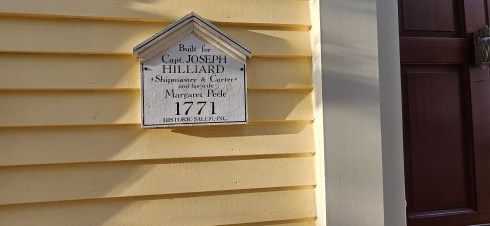
Does style follow politics? I’m just not certain: I think fashion might, but architecture? Most of the characteristic Federals for which Salem is famous were built at the beginning of the nineteenth century, not the tail end of the eighteenth. And if you widen your search for Revolutionary-era houses to all of downtown Salem, an architectural conservatism is immediately apparent: the first house below, on Turner Street, was built in 1771, but it’s similiar to the two yellow houses off the Common and Derby Street built ten and twenty years later. And before the Revolution, before the laying out of Chestnut Street in 1805 really, there is no housing segregation, so we are left with an interesting mix of architectural styles: so very evident along Essex and Derby Streets.

Building in 1779-1780: now that’s confidence. Elias Hasket and Derby began construction on Salem’s Maritime’s Hawkes House in the latter year, as their family had outgrown the Derby House next door.

I’m off to Scotland on Friday so no posts for a few weeks: “see” you after Thanksgiving! In the meantime, if you’re interested in Salem architecture, tickets for Historic Salem’s Christmas in Salem tour on December 2-3, featuring houses in the Salem Common neighborhood, are available here.