Tag Archives: Old Salem Houses

My Top Ten Books on Salem’s Architectural History

I thought I would combine my traditional spring book list with the Preservation Month of May and put together a list of my top ten books on Salem architecture in historical context. I’m a rank amateur admirer of New England architecture up to about 1840 or 1850 but a bit more focused on the later eighteenth and early nineteenth centuries when it comes to Salem structures. While I am offended by every new Salem building which is erected there’s enough inventory from this golden era to keep me enthralled—for now: I’m not at all convinced that our city’s self-professed preservation ethic still holds. These are the books about Salem houses from which I have learned the most and to which I return the most often: some are just picture books but I find myself going back to them again and again for some reason. But this first book, Fiske Kimball’s study of Samuel McIntire, defined architectural history for me. I love Dean Lahikainen’s more recent Samuel McIntire: Woodcarver of Salem too, but Kimball is always near. I’m a big fan of Frank Cousins, of course, but I share the view of his contemporaries at the Essex Institute that his McIntire book was a bit slight—and so they commissioned Kimball. I do rely on Cousins’ (and Phil M. Riley’s) Colonial Architecture in Salem quite a bit though, so it’s number two. I’ll read anything by Frank Chouteau Brown, and the compilation Colonial architecture in Massachusetts : from material originally published as the White pine series of architectural monographs, edited by Russell F. Whitehead and Frank Chouteau Brown (1977) includes one of his classic Salem articles. Likewise, I will read anything by his fellow architect Frank E. Wallis, who came up from Boston to measure and draw Salem exteriors and interiors often in his early career. Wallis was a big contributor to a succession of portfolios of measured drawings published as The Georgian Period and edited by William Rotch Ware which were first published in The American Architect and Building News. These portfolios are GORGEOUS—my former neighbors had one and let me peruse it for a bit: I have no idea why I don’t have at least one myself!

I carry Edwin Whitefield’s books with me in the car everywhere, just because they are so charming. You never know when I will find myself in a town with one of his houses!  Albert MacDonald’s Old Colonial Brick Houses of New England, which has the long subtitle edited and published with the purpose of furthering a wider knowledge of the beautiful forms of domestic architecture developed during the time of the colonies and the early days of the republic is pretty much a picture book too, as is Halliday’s Collection of Photographs of Colonial and Provincial Houses 1628-1775. Early American Architecture by Hugh Morrison is rather old-fashioned but also very practical—it’s the only book on this list that has anything to say about construction. And finally, this is BORING I know, but if you’re interested in Salem architecture you must realize that it was written about quite a bit in early architectural periodicals, so I felt that I should include this classic bibliography.


Before, During and After the Revolution

I have been thinking about Salem during the American Revolution quite a bit over the past few months. It’s yet another era in Salem’s history which is tragically under-represented, and we’re going to try to correct that with our forthcoming book. We have one whole chapter on the Revolution, and a shorter piece on privateers, but Salem really deserves an entire book on its revolutionary role. And why our city has a “real pirates” of Cape Cod museum and no exhibition on privateers when Salem supplied more sailors and ships than any other American port remains inexplicable to me. In any case, our chapter on the Revolution, written by Hans Schwartz, is really interesting: his thesis is that the Revolution was revolutionary for Salem, which sounds simplistic but is not. He examines the social changes in Salem during and after the Revolution, using houses and neighborhoods as one way to illustrate transitions. I didn’t agree with all of his analysis (which is presumptuous of me since he knows far more about this era than I do, but I guess editors need to be presumptuous), but it certainly got me thinking about houses built in Salem in the Revolutionary era. I decided to take a little tour of before, during and after. Federal Street seemed the best place to start.

The first three houses illustrate a pre-revolutionary style: two-story boxes, square or rectangular. They get additions and embellishments later on, but they are stalwart, well-built houses from the pre-Revolutionary era. They make me wonder: what were their builders thinking? Oh, this will all blow over? Obviously building a house is an expression of hope and confidence, or maybe I’m just projecting too much of a modern mindset. And when the war is not quite over, we start to see the Salem Federals built: larger three-story buildings that just exude confidence—we’re winning (lots of houses built in 1782, including the Peirce-Nichols House below) or we’ve won. 

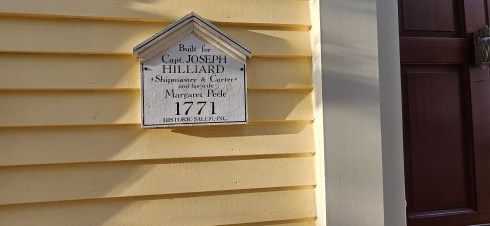
Does style follow politics? I’m just not certain: I think fashion might, but architecture? Most of the characteristic Federals for which Salem is famous were built at the beginning of the nineteenth century, not the tail end of the eighteenth. And if you widen your search for Revolutionary-era houses to all of downtown Salem, an architectural conservatism is immediately apparent: the first house below, on Turner Street, was built in 1771, but it’s similiar to the two yellow houses off the Common and Derby Street built ten and twenty years later. And before the Revolution, before the laying out of Chestnut Street in 1805 really, there is no housing segregation, so we are left with an interesting mix of architectural styles: so very evident along Essex and Derby Streets.

Building in 1779-1780: now that’s confidence. Elias Hasket and Derby began construction on Salem’s Maritime’s Hawkes House in the latter year, as their family had outgrown the Derby House next door.

I’m off to Scotland on Friday so no posts for a few weeks: “see” you after Thanksgiving! In the meantime, if you’re interested in Salem architecture, tickets for Historic Salem’s Christmas in Salem tour on December 2-3, featuring houses in the Salem Common neighborhood, are available here.


An Enigmatic Etcher

I wanted to share some examples of the work of the Salem artist George F. White, Jr., better known as George Merwanjee White (1849-1915), but I wish I could also share more details about his life. He’s a bit mysterious, particularly his chosen middle name, Merwanjee, a notable Parsi name. He was the proverbial “son of a Salem ship captain” whose most well-known works are quite local in focus, yet there is evidence that he also traveled widely, in both Europe and India. White’s father, George F. White Sr., made many voyages to the Indian Ocean for shipowners from Salem, Boston, and even New York, so perhaps his son might have accompanied him and was thus exposed to Indian influences, but this is complete conjecture on my part. In any case, by the time White Jr. married at the age of 27 he had shed the “F.” and acquired the “Merwanjee” and that is how he was known throughout his life. George M. White is recognized as part of an “Etching Revival” in Boston and Salem,, a movement which began in the last two decades of the nineteenth century in the latter city, exemplified by the little-known artists Harriet Frances Osborne and White and the more well-known Frank Benson. In addition to his etchings, White produced oil and watercolor paintings and was also recognized as a gifted producer of bookplates, but architectural etchings and drawings seem to be his preferred genre. There is a beautiful portfolio of his images of old Salem houses published by subsciption in 1886 entitled Etchings of Old Houses and Places of Interest in and about Salem which has been digitized for the “Peabody Essex Museum Publications” at the Internet Archive, and below are some of my favorite views. First, the process of production, followed by what was then generally known as the “Roger Williams House” and now the “Witch House,” the Philip English Mansion, the “Old Bakery” on St. Peter Street, later to be moved and renamed the John Ward House at the Essex Institute, the seventeenth-century survivor Narbonne and Pickering Houses, the lost Lewis Hunt and Richard Prince Houses, and Nathaniel Hawthorne’s birthplace in its original location on Union Street.


White’s images are of both old Salem houses—emerging landmarks—which had survived the dynamic nineteenth century (or most of it) as well as fabled houses which had not, thus expressing the beginnings of a preservation conciousness which is also evident in the similar sketches of Edwin Whitefield’s Homes of our Forefathers series, which was published just about the same time. Whitefield is a bit more romantic; White a bit more realistic. White wants to show and tell us what was special about the English, Hunt, and Prince Houses, and he’s wistful about the “picturesque” past: this is a word he applies to both the lost Prince House and the “living” Pickering House, the exterior of which was “fashioned” in the picturesque style of a bygone age in the 1840s. You can’t help but feel that modernity is encroaching.

Heliotype prints from George Merwanjee White’s Etchings of Old Houses and Places of Interest in and about Salem, Limited Edition, 1886.