Like everyone else, I’m thinking about healthcare workers these days, so I wanted to focus on Salem women who were physicians or nurses for this week’s #SalemSuffrageSaturday post: I’ve found THREE practicing women physicians in Salem before 1900 and lots of wartime nurses. But I don’t have their stories straight yet: I need more context, more details, more narrative. They are not ready, or more accurately, I am not ready for THEM. So I thought I would focus on philanthropic ladies’ fairs in general, and one fair in particular, as these events were a major expression of the civic engagement of Salem women in the mid-nineteenth century. Starting in the 1830s and extending through and beyond the Civil War, Salem ladies held fairs for a host of benevolent societies and causes: seamen’s aid, widows and orphans of seamen, anti-slavery, the Sanitary Commission and other efforts to support the Union army, temperance, suffrage. These fairs were months in the planning, raised significant funds, and got a lot of press. They were not only a major form of civic engagement for women, but also of civic action and association. It seems impossible to underestimate them, although I’m sure I’m only dealing with the veneer of Salem society that had the time and the resources to dedicate to such endeavors. But still, you’ve got to follow your sources, and many of mine lead me to fairs.
 Ladies Fair for the Poor in Boston, 1858. Boston Public Library
I believe that the first fair in Salem was in 1831, but the first fair that made a big splash and set the standard for all of the fairs to follow was held two years later at Hamilton Hall as a benefit for the newly-established New England Asylum for the Education of the Blind (later the Perkins School for the Blind), the first institution of its kind in the country. Its founding director, Samuel Gridley Howe, has developed a reputation as the authoritarian husband of abolitionist and suffragist Julia Ward Howe of Battle Hynm of the Republic fame, but in the 1830s he was a handsome and dashing doctor (and also a passionate abolitionist) who had served six years in that most romantic of conflicts, the Greek Revolution, and wrote about it. It’s easy to understand how and why he inspired devotion among the ladies of both Salem and Boston: there were competing fairs for his school in 1833, which drew a lot of attention to both. There were quite a few articles on the rival fairs in a variety of newspapers, and we also have the Fair program, as well as the substantive research of Megan Marshall, who identifies Elizabeth Palmer Peabody as one of the prime movers behind the Salem event in her Pulitzer-prize-winning book The Peabody Sisters. Three Women who Ignited American Romanticism.

 Samuel Gridley Howe in the 1850s; Megan Marshall’s great book, although I also like the earlier text on the Peabody sisters: Louise Hall Tharp’s Peabody Sisters of Salem, which I read over and over again as a teenager—I think it’s one of the reasons I ended up in Salem! A really good example of collective biography.
Elizabeth was the eldest of the famous three Peabody sisters of Salem (who deserve their own post; I can’t believe I haven’t written about them yet!), all of whom became intertwined in a Boston world of romanticism and reform. Middle sister Mary would marry educator Horace Mann, and youngest sister Sophia would eventually marry Nathaniel Hawthorne, but in the 1830s they were all struggling in somewhat-genteel poverty. Elizabeth had made the acquaintance of Howe (through Mann) in Boston, and believed in him and his cause, but she also saw the fair as a way to promote the artistic talents of Sophia and possibly raise the family’s dwindling fortunes. This explains why Sophia’s name—(along with that of Hawthorne cousin Ann Savage)—are the only names in the entire program for the Ladies Fair.


 Catalogue of Articles to be Offered for Sale at the Ladies’ Fair at Hamilton Hall in Chestnut Street, Salem, on Wednesday, April 10, 1833 for the Benefit of the New England Asylum for the Blind, National Library of Medicine @National Institute of Health.
It is so great to have the entire catalog for this fair, evidence of the creative craftsmanship—and scavenging I suspect—of Salem ladies! Lots of dolls and figures (I would love to see the “large” Queen Elizabeth): so much needlework, so many pincushions, and the two “splendid” paintings by Miss Sophia Peabody, of a place she had never seen—but would much later, after she married Mr. Nathaniel Hawthorne. It was a huge success in terms of proceeds, a fact acknowledged even by the Boston papers, and inspired many repeat performances.


 $3000! in proceeds reported in the Boston Post; Hamilton Hall this morning: still the site of much civic engagement, but unfortunately not today, or for a while……..


 Just some of the charms of Concord, Massachusetts: the Alcott Orchard House, the Old Manse, Hawthorne’s Wayside, the Emerson House, and the Concord Museum. (Every time I see Hawthorne’s Concord House, it reinforces how much he disliked his native city, as it is the most un-Salem house I’ve ever seen!)
 The emphasis is on HOMES and MANSIONS for Concord and Salem on Ernest Chase Dudley’s 1964 map of Historic Massachusetts, Leventhal Map Center, Boston Public Library. No Witches (but Witch City of course).
 And yes, Concord has maintained its Tercentenary markers.


 Boston Herald, May 1904; New York Public Library Digital Gallery.

 The emphasis on Hawthorne’s “Homes and Haunts” begins with the Prang publication of William Baxter Palmer Closson’s portfolio in 1886 and continues today! Salem: Place, Myth and Memory was edited by my colleagues at Salem State University and includes a great chapter on Hawthorne by Nancy Lusignan Schultz. I haven’t read Milder’s Hawthorne’s Habitations yet, but it sounds like it is more focused on his time in England and Italy. The Smithsonian photograph above, of the newly-installed statue in front of the newly-built Hawthorne Hotel in 1925, was taken by Salem’s great horticulturist and planner Harlan Kelsey.


 Mary Ann Wilson, Young Woman Wearing a Turban, c. 1800-1825, Museum of Fine Arts, Boston; Portrait of a “fashionable” woman, c. 1810, Northeast Auctions; Hepzibah and her turban (or turbans, as they all seem to be different styles) by Maude and Genevieve Cowles (1899), A.A. Dixon (1903) and Helen Mason Grose (1924), and a more recent (1997) Classics Illustrated cover depicting a very grim turban-wearing woman indeed.

 Photograph of Dolley Madison by Mathew Brady, 1848, Library of Congress; Painting by William S. Elwell, also 1848, National Portrait Gallery. Dolley descends upon the White House and witnesses her husband’s presidential oath, be-turbaned of course, in two YA books, Dolley Madison, First Lady, by Arden Davis Melick (with illustrations by Ronald Dorfman), 1970 & Dolly Madison, Famous First Lady, by Mary R. Davidson (with illustrations by Erica Merkling), 1992.
 Jesse Willcox Smith, 1900

 My newly-shorn rue and its illustration in my favorite Renaissance herbal, that of Giovanni Cadamosto (late 15th Century, British Library MS Harley 3736); A much more OBVIOUS poisonous plant in my garden, baneberry or Actaea Rubra: beware of those berries!

 Alnwick’s Poison Garden; a Colin Stimpson

 The newly-restored House of the Seven Gables, 1910, Harvard Fine Arts Library Postcard Collection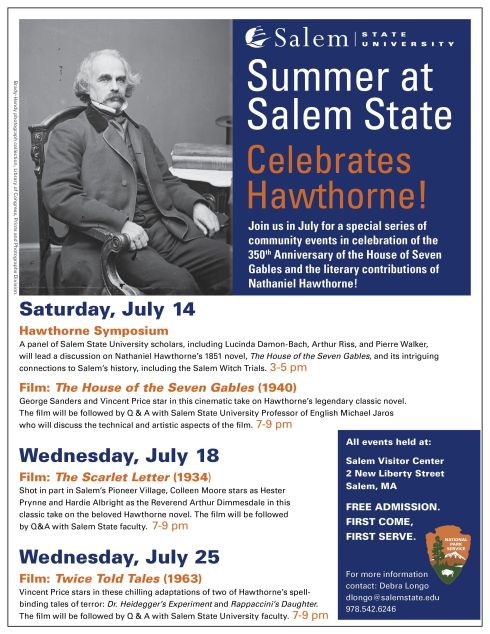
 Still from The
  From Burroughs & Company’s Interesting Houses of New England, 1915: with a photograph of the Gables before its restoration/recreation.