Tag Archives: museums

Where’s the Fire (Engine)?

Exactly one hundred years ago in Salem, people were flocking to the Essex Institute to see a piece of Salem history that had recently been returned to their fair city: a Georgian fire-fighting engine, by all contemporary accounts the oldest in America. Here we see a complete reversal of the situation we find ourselves in now, with the Essex Institute’s successor, the Peabody Essex Museum, shipping out the city’s material history rather advocating for its return—and showcasing it. The Union hand-tub engine was imported from Great Britain by one of Salem’s first private fire-fighting companies, the Union Fire Club, established in 1748. In the following year the company placed its order for one of Richard Newsham’s recently-patented “water engines for the quenching and extinguishing of fires”, and it arrived in Salem in 1750.

Fire Engine Colonial WilliamsburgA Newsham Engine of similar vintage @Colonial Williamsburg.

The Union was in service for quite some time as far as I can tell, but by the middle of the nineteenth century both its technology and its company was obsolete: steam and public fire-fighting departments were replacing hand-tubs and clubs. On a ceremonial visit to Philadelphia in the summer of 1866, a few remaining members of the then Union and Naumkeag Fire Club gifted their hosts, the William Penn Hose Company, with the Union. This provoked a “great hue and a cry” at home in Salem, but the old engine was not returned until 1917: and right into the Essex Institute it went. (I am wondering if Salem’s experience of conflagration in 1914 inspired the City of Brotherly Love to return the Union as a sympathetic gesture, but cannot find any confirmation of this theory).

Fire 1865

Fire Union 1866 Collage

Fire PhotoRobert Newall photograph of the William Penn Hose Company in Philadelphia with their steam engines, 1865, The Library Company; Harper’s Weekly photograph of the Union, “the oldest fire-engine in the United States” in 1866; a photograph of the Union in an article announcing its return to Salem in The American City, January 1918.

You can easily discern how important the threat of fire and the organization of fire-fighting was in the eighteenth and early nineteenth centuries by browsing through the online catalog of the Phillips Library, where the papers of the Union and Naumkeag Club are held, along with its predecessor club, the Union and Essex, and myriad other fire clubs: the Active, Alert and Amity clubs, Engine #9, the Enterprise Club, the Franklin Hook & Ladder No. 1, the Friend Engine Company, the Old Fire Club, the Social Club, the Reliance Hose Company, and the Relief Fire Club, among others. I do appreciate the PEM’s digitized library catalog, although it does not quite compensate for the lack of digitized items, or their removal from Salem. However, as I have been meeting and talking to people who have much longer associations with the PEM’s predecessors and the Phillips Library than I do, I am increasingly aware that they are missing objects as much as texts, and those objects are difficult to locate, both on the web and in reality. In the company of the “world-class” museums it claims to be, the Peabody Essex does not seem to be committed to comparative open access, to either its texts or its objects. Several years ago, one could search through a “collection gateway” that seemed to yield access to a good part of the PEM collections (it can still be accessed here but appears to be functional only in accessing items from the Native American collection), now we can only see selected “highlights”. Try comparing the collections portals of say, the Museum of Fine Arts in Boston, or the Metropolitan Museum of Art, or even the Worcester Art Museum, with that of the Peabody Essex Museum: and see how little you will yield. I wouldn’t know where to find the Union online: the Phillips Library finding aid description states that both it and an oil painting entitled The Union Hand-Tub by W.B. Eaton are in the PEM collections, but they are both absolutely unattainable in both digital and actual forms: a regression, certainly, from 1918.

Fire brochure

Fire 1970s

firebucket_fpoThe Union and some fire buckets were featured prominently in a 1978 Essex Institute booklet: Museum Collections of the Essex Institute by Huldah Smith Payson, and fortunately for us, one of those very same buckets is one of the PEM’s online highlights of its American art collection.


Salem Film Fest 2018

It is that time of year again: time for the annual Salem Film Fest, now in its eleventh year and very firmly established on the cultural calendar. Over the years, it has been very inspiring to see the festival’s growth: in terms of participation, attendance, offerings and impact. The care taken with curation is always very apparent to me: resulting in a nice balance of films with themes that are global and local, environmental and material, very serious and a bit more whimsical. One of the first films I saw at the festival was Grown in Detroit, way back in 2011: this was an interesting window into the urban crisis playing itself out in Detroit at the time and this year’s Beauty and Ruin offers another by focusing on the collections of the Detroit Institute of Art, which some thought might provide a solution to the city’s bankruptcy in 2013. I’m really looking forward to this film: as most of you know, the sanctity (and proximity) of a community’s treasures are important to me, and this film will be playing in PEM’s lovely Morse Auditorium!

FilmFest

FilmFest2 Stills and scenes of Detroit past and present in Beauty and Ruin.

I have a friend who oversaw the recent Skinner auction of items from Avis and Eugene Robinson’s collection of African American history (and also this beautiful–but troubling—catalog), so I’m also interested in seeing Black Memorabilia, which examines “the subculture around the collectibles and antiques that serve as reminders of America’s troubled racial past and present”. And speaking of subcultures, I might go for Mermaids, in which a select group of individuals idolize, identify and occasionally “become” sirens of the sea. In keeping (somewhat) with the marine theme, the South Korean film Old Marine Boy about a daring North Korean deep-sea diver in the South, looks amazing. On a very different note, I’m kind of interested in seeing Rodents of Unusual Sizeabout the enormous orange-toothed swamp rats (nutria) which have infested the waters of Louisiana post-Katrina and oil spills, but I’m not quite sure I want to spend so much time with these odious creatures on the big screen.

Mermaids Film

Old Marine Boy

Rodents2Scenes from Mermaids, the Old Marine Boy, and the poster for Rodents of Unusual Size.


A Thin Veneer of Heritage

Six weeks into the struggle to convince the leadership of the Peabody Essex Museum to return its Phillips Library to Salem, I find myself with lost faith and many learned lessons. The phrase “broken trust” has been applied to the PEM’s actions many times over these past weeks, but that is too legal a concept for me: I prefer to think in terms of faith, encouraged by Victor Hugo’s lovely observation that A library implies an act of faith which generations, still in darkness hid, sign in their night in witness of the dawn. Under the guise of preservation and with a consistent disdain for accessibility and accountability, the PEM leadership broke faith with the community of Salem, and now I have lost faith in them. I’m trying to separate the leadership from everyone else who works at this large Museum, in effect the Museum itself from the policy regarding the Library and its collections, but that’s tough to do when such an all-encompassing feeling as faith is in play. Working on it.

PEM East India Room collageThe interior of the East India Marine Hall past and present, and before the installation of the PEM’s newest exhibition, Play Time.

I’ve learned many lessons over these past weeks but I think the most important one is about prejudging in general and my own prejudices in particular. I’ve been concerned about the commodification of history in Salem for quite some time (as regular readers are all too aware!) and assumed that this trend was driven exclusively by the many tour guides in town, who were presumably more concerned with #tourismmatters than heritage. Now I know that that predisposition is largely incorrect, as I have seen and heard tour guides take earnest and public stances in support of the return of the Phillips while established heritage institutions have stood silently on the sidelines, taking no position and choosing not to exercise their more considerable influence. I remain impressed, and heartened, by the power of history to unite a broad spectrum of people, although at the same time I realize that history, or the perception of one’s history, is also intensely personal.

Essex Institute 1980

Phillips RizviThe Collections of the Essex Institute in the Phillips Library Reading Room, 1980, and the library collections reinstalled, 2008, Rizvi Architects.

I’ve been having difficulty separating the personal from the professional in my reaction to the PEM’s policy towards the Phillips ever since the “announcement” was made—actually I don’t even think I can get past the “announcement”, or lack thereof! But I better try, because obviously no apologies will be forthcoming; instead PEM CEO Dan Monroe offered only the assertion that there was an expectation by a number of people that we had a responsibility to consult with them about what would be done with the Phillips collection…an expectation we didn’t particularly share or understand in last week’s Boston Globe article. I certainly wasn’t expecting a consultation, but an announcement might have been nice, especially as the PEM’s last official word on the Phillips was that it would be returning to Salem in……..2013.

Thank goodness, when confronted with such adversity, healthy instincts of self-preservation begin to take over, and so I’ve started to privilege the professional over the personal in my considerations. When I look at the situation from the former perspective it is clear to me that I don’t need the Phillips Library in Salem or even in Rowley. I have a car, a Ph.D., and a flexible schedule so I can probably gain access to the new warehouse library during one of the 12 hours a week or so that it will be open (well maybe not, after my running commentary over these past weeks) if I want to. In any case, I’m an English historian, fortunate to be equipped with academic databases and dependant on repositories that have made the accessibility of their collections a priority. Local history is just a lark for me, right?  Unfortunately, private priorities only work for a while: when I start thinking about all those records relating to Salem people, places and institutions, and all those Salem donors, I find myself right back in the realm of public history.

Actually, I do have three presentations coming up this year on the intersection of the Colonial Revival and historic preservation movements here in Salem—all of which were scheduled just before the temporary Phillips facility closed down on September 1, ostensibly so that materials could be readied for the big move to Rowley (which was not, of course, announced at that time). I was looking forward to using the library’s collections intensively for the first time in my career, an opportunity that will sadly not come to pass. I’ll have to make do, and I will make do, with the help of other institutions that have made their materials more accessible and lots of secondary sources, but I fear I will only be scratching the surface of this Salem story without the Phillips sources.

Colonial Stairway Wallis 1887

Colonial Frank Wallis Stairs 1887

Colonial Frank Wallis 1887

Colonial Seating collage

Colonial Tables Wallis 1887

Colonial Doorway Salem Wallis 1887

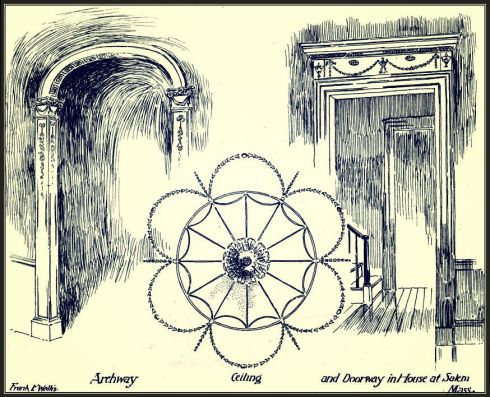
Colonial Gates Wallis 1887And I really fear I’ll be too reliant on the detailed-yet-romantic work of Maine-born architect Frank E. Wallis, whose reverence for Salem is all too apparent! Plates from Frank E. Wallis, Old Colonial Architecture and Furniture. Boston: George H. Polley & Co. Publishers, 1887. 


Art vs. History: a False Dichotomy

Over the last three weeks, as I have listened to the public discourse surrounding the Peabody Essex Museum’s reluctant announcement that it was planning to house the Salem-dominant collections of its research arm, the Phillips Library, in a vast collections center (encompassing both archives and objects) in Rowley, I have heard a constant refrain: the PEM doesn’t want to be a history museum. They are only interested in art (That’s why they are taking/hiding our history away). I’m not sure this is entirely true, but if it is, it is a stance that is based on a false dichotomy, because these two disciplines are not incompatible or in competition: art is history and if done well, history is an art.

Art and History Vermeer.jpg Vermeer’s Art/Allegory of Painting, Kunsthistorisches Museum: featuring Clio, the Muse of History. 

Several PEM exhibitions in recent memory have featured historical components, from the wonderful Samuel McIntire: Carving an American Style (2008) to Asia in Amsterdam: The Culture of Luxury in the Golden Age (2015) and even the Victoria & Albert traveling show, Shoes: Pleasure and Pain (2016-2107) featured a few placards on the regional shoe industry when it made its pitstop at the PEM. But I can understand why my fellow Salemites feel that their history is being ignored by the very institution that has the responsibility of stewarding it. The Museum seems to have an ever-increasing appetite for gallery space, always justified by its large collections, yet we seem to see more of other Museum’s collections in these showy spaces. The Phillips print and manuscript collections, along with all of those unseen objects, are now on a slow boat to Rowley: one wonders if it was possible to move the historic houses also entrusted to the museum whether they would be on their way too. I don’t really think so, but I like to force the connection between textual and material history.

ropes-renovMoving the Ropes Mansion back a few feet in the 1890s.

As I looked back at PEM exhibitions over the past fifteen years or so, all of which I have seen and enjoyed, I gradually came to an awareness that the PEM does indeed “like” history, just not local history. There has been a great emphasis on Asian history certainly, and European history, and Native American history, but local history, not so much. I wonder why this is so, given the museum’s focus on connections: doesn’t it want to connect with its local audience? All of its engagement initiatives seem to have been focused on entertainment rather than exhibits: the monthly Thursday PEM/PM events, free to all Salem residents, but ending this very month. Everyone says: I enjoyed it [insert exhibition, particularly blockbuster variety] for an hour or so, but that’s it. No need to go back again. I myself clung to just one poster in the recent Ocean Liners: Glamour, Speed and Style exhibitionBoston-published, depicting the watery grave of Lusitania victims.

pem-enlist-loc Library of Congress.

So let’s work with this image–its meaning and its power. We are in the midst of the centenary of World War I, a major turning point in world and American history. Museums across the country (and across the Atlantic, of course) have produced exhibitions focused on this epic event, including art museums like the Museum of Fine Arts in Boston and the Metropolitan Museum of Art in New York City. The latter’s World War I and the Visual Arts encompasses all artistic mediums to present a cultural history of the conflict drawn from their own collection, while the MFA’s show focused on propaganda and recruiting posters similar to Fred Spear’s evocative Enlist above. Despite 18 boxes of World War materials in the collection of the Phillips Library (processed with the support of a federal grant from the National Historic Publications and Records Commission but currently inaccessible and undigitized), the PEM offered up shoes, wearable art, horror movie posters and ocean liners in the centennial year of 2017: all fun and visually-stimulating exhibitions, but can we really engage in a thoughtful exploration of the human experience through these topics?

Art and History HassamChilde Hassam, Avenue of the Allies, Great Britain, 1918, Metropolitan Museum of Art.

I see the PEM’s reluctance to delve into local heritage as tragic for Salem, which is left to the devices of market-driven Halloween “history”, but also for the museum itself, which is losing out on an obvious way to connect to its local audience on which its future is surely dependent at least in part—it can’t be all about big donors, can it? (Maybe it is). In its rationale for not reopening the Phillips Library in Salem, the PEM pointed to declining patronage by Salem residents, but this was surely a self-fulfilling prophecy fueled by declining hours and programming based on the library’s collections. A reopened and revitalized Phillips Library reading room, serving as a nexus for introspective examinations of greater Salem’s experiences in the contexts of global, national, and local history, could serve as a draw for both locals and tourists. Even though history may seem “dusty” to some, the public’s interest in heritage is both universal and increasing: with many state and local history museums reporting upswings in attendance all over the country in the last few years and record-setting crowds flocking to the Smithsonian’s National Museum of African American History and Culture in just its first year. And here in Massachusetts, with a statewide celebration of the 400th anniversary of the Plymouth landing in the works for 2020, the Museum–and its Library– in the midst of the other prominent Puritan colony will find itself very much in demand.

MA400-Mayor-Panel A panel of mayors, including Kim Driscoll of Salem, at the Massachusetts 400 Forum in 2016.


Doors of Deerfield

Last weekend I drove out to the Pioneer Valley and spent some time at Historic Deerfield, an outdoor museum of eighteenth-century houses located (and assembled) all along one street in the midst of fertile farmland. The museum was founded in 1952, and I’ve been there several times but never by myself, so it was nice to have the time and freedom to focus on whatever I wanted to–and what I wanted to focus on was doors. All I could see was doorways, and it seemed like I couldn’t look at each and every one for long enough. This is certainly not an original preoccupation: I saw the requisite “Doors of Deerfield” posters and postcards in the Museum Shop, where I also picked up a copy of Amelia F. Miller’s Connecticut River Valley Doorways. An Eighteenth-Century Flowering (1983), one of the “Occasional Publications” of the Dublin Seminar for New England Folklife, to take home with me. I expect that I may need to drive out west again very soon—and head south along the river—so that I can see all of these special Connecticut River Valley doorways. Living here in Salem, I’m used to historic doorways, but they are for the most part quite restrained in that Federal way, so these “western” doors provide quite the contrast in terms of detail. Miller agrees (or rather I agree with Miller): Connecticut River Valley doorways bear little resemblance….to doorways of the same period found one hundred miles to the east in coastal Massachusetts and Rhode Island towns.

So here are my favorite Deerfield doors, following Miller’s categorization of scroll pedimented doorways, triangular pedimented doorways, segmental pedimented doorways (apparently there are none in Deerfield?) and flat-top doorways. Plus a few more that defy categorization (at least for me): one of the nice things about Historic Deerfield is the interspersing of private homes among the museum buildings, and the former have great doors too.

Scroll Pedimented Doorways: 

Deerfield Ashley Scroll

Deerfield Ashley Scroll 2

Deerfield Dwight best

Deerfield Door Scrolled

Dwight House in Springfield

The Ashley House (1734) and Dwight House, built in the 1750s and moved to Deerfield from Springfield, Massachusetts. Miller includes a c. 1920 photograph of the Dwight house in situ in Springfield (above) and informs us that Mr. Henry Francis Du Pont purchased the door in 1924, and subsequently installed it first in his Long Island home and later at Winterthur. The Dwight House was moved to Deerfield in 1951, and a reproduction door was produced. I’m always aware of Salem houses being picked apart but really no Massachusetts house was safe!

Triangular Pedimented Doorways:

Deerfield Brown

Sheldon House text

Deerfield Red

The Sheldon House (1755), today and in a 1910 photograph in Miller’s text, and a private home across the street.

Flat-top Doorways: not sure these all fit the exact designation, but they have flat tops!

Flat-top Allen

Flat-top Allen doors

Flat-top Barnard

Flat-Top blue

Deerfield Yellow Garden

Deerfield Yellow Door

The Allen House (1734), home of Henry and Helen Flynt, the founders of Historic Deerfield; the Barnard Tavern (1795), with reproduction flat-top door on right and reproduction triangular-pedimented door on left; the beautiful BLUE Wells-Thorne House (1734) and two private homes in between. Not sure how to categorize this last doorway……….

The Federal houses of Deerfield, with their fanlights and transoms and rounded doorways, don’t look so unfamiliar to me: obviously the region was increasingly open to trans-Atlantic and national aesthetic influences in the later eighteenth and nineteenth centuries. As is the case with every outdoor or living-history museum that I’ve visited, you do get that still, out-of-time feeling, although the Deerfield experience is enhanced by the proximity of private homes and Deerfield Academy. Still, it was nice to return home to historic Salem, even though it’s a bit too lively for me at this time of year.

Deerfield Stebbins

Deerfield glass 5

deerfield glass 4

Deerfield Glass 3

Deerfield glass

Deerfield Printing

The Stebbins (1799), Williams (remodelled 1817) and Wright (1824) houses of Historic Deerfield; two adjacent private homes; the Wilson Printing Office (1816).

And of course we must have flagrant pumpkin displays for this time of year:

Deerfield Pumpkins


Among the Cathedrals

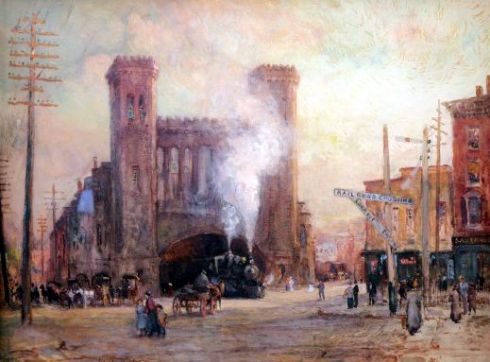
I’m always looking for artistic impressions of Salem’s long-lost train depot (1847-1955), so was thrilled to come across a painting by the Philadelphia-born artist Colin Campbell Cooper the other day. Campbell is universally characterized as an Impressionist, but he seems to have been fascinated by structure, as there are many cathedrals, skyscrapers, and train stations (the cathedrals of their day?) among his works: you can see why he was drawn to the Salem station. Here is his impression, from 1910, along with Walker Evans’ photograph from the 1930s and a street-level stereoview published by Charles Beckford: contrasting views of an imposing edifice.

Cooper Roundhouse

walker-evans-train-station

Salem Stereoview Beckford Cropped

Colin Campbell Cooper, Train Roundhouse, Salem, Massachusetts, c. 1910, Sullivan Goss Gallery; Walker Evans, Boston and Maine Train Station, c. 1931, ©Walker Evans Archive, Metropolitan Museum of Art; Charles A. Beckford, American Views series, n.d.

Cooper had a vibrant and varied artistic life. He was born in Philadelphia in 1856, and after his artistic education at the Philadelphia Academy of Arts (with Thomas Eakins) he was off: to New York, to Europe, to Asia, and eventually to California. While in the Netherlands in 1897, he met and married his first wife, Emma Lambert, who was also a promising and increasingly-prominent artist. They traveled extensively together: one dramatic voyage had them assisting in the rescue of Titanic survivors while aboard the RMS Carpathia en route to Gibraltar in the spring of 1912. Prior to this adventure they came to Salem together–perhaps they were visiting Frank Benson, or Philip Little, or maybe Ross Turner? I can’t discern the details, but three paintings bear witness to their time here in 1910-1911: Colin’s Train Roundhouse and Salem Mansion (alternatively titled A Salem Residence), for which he won the Beal Prize in 1911, and Emma’s Fruit Stand, Salem, Massachusetts.

Cooper Mansion

Cooper Market

Colin Campbell Cooper, A Salem Mansion, 1910, The International Studio, Volume 45; Emma Lampert Cooper, Fruit Stand Salem Massachusetts, Cottone Auctions.

After Emma’s death in 1920, Cooper relocated to California, where he became Dean of the Santa Barbara School for the Arts, and eventually remarried. He kept his studio in New York City, but California terraces began to replace the skyscrapers….and he became a playwright! He died in 1937, just a few years before the foundation of the Santa Barbara Museum of Art, for which he was an energetic advocate. Cooper’s paintings are in many American museums, and Sullivan Goss, the Santa Barbara gallery that represents his estate, is also a great resource for his life and work.

Cooper Glass Train Shed

CCC Grand Central Station MET

CCC Broadway

Cooper Beauvais Cathedral

Charles Campbell Cooper, Glass Train Shed, Philadelphia, and Grand Central Station, New York, both 1910 (the same year as his Salem paintings), Metropolitan Museum, New York; Broadway, c. 1909Biggs Museum of American Art; Beauvais Cathedral, 1926, Sullivan Goss Gallery.


Destination Tamworth

Even though I previously, and unjustly, relegated New Hampshire to the status of “drive-through” state, it doesn’t mean that I never stopped in its midst. I brake for historical markers, and I’m pretty certain that New Hampshire has more markers than all of the other New England states combined—and not just to dead white men like Mr. Webster below. All sorts of events, institutions and individuals are memorialized by green road-side Bicentennial markers: combined with the historical societies which seem to be located in nearly every New Hampshire town, they are a testament to a state that takes its history seriously. This earnest presentation is refreshing, frankly, especially when contrasted with Salem’s more cynical commercialization of just one aspect of its more varied past: history for history’s sake rather than for profit. Driving northwesterly across the state to the Lakes Region, I wanted to stop at each and every historical society, but I was pressed for time: I did stop at many markers.

NH Marker Webster

Many people are drawn to New Hampshire for its mountains and lakes, but these attractions are secondary to me: if you’ve spent any time at all on this blog you will have noticed my preference for the built landscape! So even though I had a prominent lakes/mountain destination last weekend, I became much more fixated on a town nestled between the two: Tamworth, established in 1766. Tamworth has everything: a picture-perfect town center, a pedigreed summer theater (the Barnstormers), a museum dedicated to life and work of  two country doctors (The Remick Country Doctor Museum & Farm) a presidential (Grover Cleveland) summer house, a babbling brook (the Swift River), a farm-to-table restaurant and grocer (The Lyceum), a general store (the Other Store), an amazing foundational edifice named Ordination Rock, a shiny-new distillery (Tamworth Distilling), and an inn (Highland House) built by a Salem sea captain! I’d love to have a summer house here (if I can convince my husband that it is possible to live more than a half-mile from the ocean and still be happy, a big if).

Tamworth Library

Tamworth House

Tamworth House 3

Tamworth Sign

Tamworth Barnstormers

Tamworth Poster Barnstormers

Tamworth Remick Museum

Tamworth Remick Barns

Tamworth Remick House

Tamworth Livestock

Tamworth Cow

Tamworth Brook

Tamworth Lyceum

Tamworth Poster

Tamworth Concert

Tamworth Distilling

Tamworth Brandy Sights & happenings of Tamworth: the Library, Barnstormers Theater, Remick Museum +Buildings+”Inhabitants”, Tamworth Lyceum, Sunday concert, Tamworth Distilling & Mercantile.

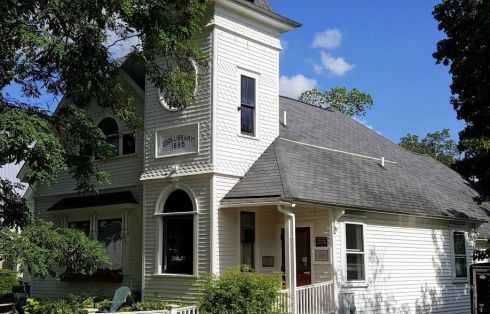
Given its heritage, of course Tamworth also has a historical society, recently re-christened (as you can see below) the Tamworth History Center. We found it open and bustling, with volunteers within eager to tell us about the town and the Center, which features revolving exhibits in its two ground-floor rooms: currently the early history of the Barnstormers is on, along with a very comprehensive genealogical exhibition on one of Tamworth’s prominent families. There is a dual preservation/presentation mission at present: focused continually on the town’s heritage as well as on the ongoing restoration of the Center’s c. 1830 headquarters. I enjoyed the exhibits immensely, but became a bit distracted by the untouched-for-decades attractions of the house’s central hallway! When restoration is complete, the house will not feature the traditional period rooms; instead it will serve as a forum, or center, for “the many stories that have made Tamworth unique, from 1766 onwards”. I want to hear more.

Tamworth History Center

Tamworth collage

Tamworth Exhibit

Tamworth HC

Tamworth HC2 Inside the evolving Tamworth History Center above; another visual presentation of Tamworth’s past—and present.

Tamworth PC


Give me Mrs. Miniver

My husband, myself, and my stepson can rarely find a movie we all want to see together: the latter is 16 so of course all summer movies are made for him, but I can’t stand the bombastic computer-generated imagery and violence and the predictable scripts. When Christopher Nolan’s Dunkirk came out, we all wanted to see it and so went together last week: a rare occasion. We did not return home together, however, as I had to run out less than halfway through! It wasn’t that it was bad–it was actually riveting–but also just too painful for me to watch all those men on the beach, so exposed and so vulnerable. I knew the Armada was coming but I couldn’t wait for it.

Dunkirk film

Dunkirk real The film and the reality, June 1, 1940 ©Imperial War Museum, London

It’s ridiculous I know, but I think I prefer the Mrs. Miniver version of Dunkirk, in which the gentleman-architect Mr Miniver takes his pleasure craft (conveniently docked in front of his Hollywood-perfect expansive English cottage) out into the Channel and returns only slightly battered (and bearded) a few days later. During his absence, Mrs. Miniver battles a downed Nazi in their kitchen. She wins, of course, but the Director William Wyler gives him a speech intended to bolster the Allied effort (by the time the film was released in 1942, the United States had already entered the war, but during its production Wyler was concerned about American isolationism): We will bomb your cities…Rotterdam we destroy in two hours. Thirty thousand in two hours. And we will do the same here! Combined with all other “inspirational” details in the film, including the bombing of the Miniver house, the heartbreaking death of their new daughter-in-law, and the village vicar’s closing sermon, it’s no wonder that Joseph Goebbels was afraid of it.

Mrs. Miniver 2

Mrs Miniver

It was acceptable to make propaganda films in the 1940s: today things must be as real as (technically) possible and sometimes that is unrelenting, at least for me: I fear my stepson is inured due to a steady diet of video games. I would like to see the Dunkirk miracle play out so I think I’ll have to steel myself to go back and see this film again, but in the meantime I’ll occupy myself with more distant records of this epic event, in paper and a paint. The Imperial War Museum in London has many photographs (including several of the Germans moving in after the evacuation), oral histories, and paintings of Dunkirk among its collections, although after I spent some (digital) time with these memorials I realized they weren’t that distant after all.

Dunkirk collage

Dunkirk 1940 IWM jpeg

Dunkirk painting 1940

Dunkirk Drawing IVW

Dunkirk abstractJune 3 headlines from the Sydney Morning Herald and the Los Angeles Times; a small fraction of the 200,000 British Expeditionary Forces who were evacuated (+140,000 French troops), ©IWM; Charles Ernest Cundall, The Withdrawal from Dunkirk, 1940© IWM (Art.IWM ART LD 305); “little ships” in Muirhead Bone’s The Return from Dunkirk; Arrival at Dover, 1940, © IWM (Art.IWM ART LD 251); Rudolf A. HaywoodThe London Fire-Boat ‘Massey Shaw’ approaching Dunkirk at 11 pm on the 2nd June 1940, © IWM (Art.IWM ART LD 248).


A Weekend Photographer

I discovered a digitized collection of over 2,000 photographic negatives by amateur photographer Robert L. Bracklow (1849-1919) at the New York Historical Society this past weekend and became lost in another world for several hours–hours which I probably could have used more productively, but I do not regret their “loss”. Bracklow’s photographs are primarily, though not entirely, of New York City and its vicinity in the 1890s and early twentieth century, and show a city in transition in which multi-story buildings were going up alongside wooden “garrets” and cows are still grazing by the side of the road. He captured all the monuments, and people visiting them on the weekends, like himself: his primary occupation was that of a stationer, and he went roving about on the weekends after he had closed his shop doors. Besides monuments, he loved churches, milestones, bridges, and people:  though Bracklow is often compared to Alfred Stieglitz, my own (parochial)  frame of reference is of course Salem’s Frank Cousins, who was clearly more transfixed by architecture than society. Not so Bracklow, who seems quite as determined to show the mix of people as of buildings in his time. Though Bracklow lived and shot primarily in New York, I found quite a few Massachusetts photographs in this digitized collection: lots of Great Barrington and Marblehead, several of Nantucket, Medford, and Salem. The New York Historical Society digital achive of his photographs is absolutely wonderful because you can zoom and see: a lone lady bicyclist pedaling over the Parker River Bridge in Newbury, Massachusetts, the parcels of a Marblehead housewife walking home from her shopping, crumbs on the shirt of a child at a tea party in Bensonhurst in 1898.

bracklow-balloon-harlem-river-boat-races-1900

bracklow-brunos-garrett

bracklow-greenwood-cemetery-brooklyn

bracklow-kaisers-ship-1902

bracklow-bensonhurst-1898

bracklow-nyhs

H:5 in. W:7 in.; Glass negatives; Negatives (photographic)

bracklow-door

bracklow-salem-monumentbracklow-bershires

bricklow-bridge-of-parker-river

bracklow-gregory-street-marblehead

bracklow-darling-street-marblehead

Photographs by Robert L. Bracklow from the collection of the New York Historical Society:  blowing up a balloon for the Harlem River boat race, 1900; Bruno’s Garret in Greenwich Village, entrance to Green-wood Cemetery in Brooklyn; a crowd greeting Kaiser Wilhelm’s yacht in New York, 1902; an afternoon tea party in Bensonhurst; milestones to New York and Boston; North Shore Massachusetts door; Leslie’s Retreat Monument in its original location on North Street in Salem, the Red Lion Inn (?), Stockbridge, Parker River Bridge, Newbury, Gregory and Darling Streets, Marblehead. All from the Robert L. Bracklow Collection at the New York Historical Society.


The Lollipop Cemetery

Such an undignified name for such a solemn place: the Shaker cemetery in Harvard, Massachusetts, one remnant of the industrious community of Shaker non-genealogical families that resided in this beautiful Massachusetts town from 1769 until the First World War. But that’s what people call it. I had a hankering to see it the other day, and so I drove to Harvard and asked for directions, because it’s a bit off the beaten path (I never use my phone for navigational purposes on a road trip; that would defeat the whole point for me–it’s either wander or inquire): oh, the Lollipop Cemetery? Just drive towards Ayer and take a right on South Shaker Road. And so I did and there it was.

Shaker Cemetery Sign

Shaker Cemetery Stone

Shaker Cemetery markers crop

Shaker Cemetery Markers

The gate was locked, and I didn’t want to trespass on this sacred ground, but I think you can comprehend the lollipop characterization of these cast iron markers, which replaced the original stones from 1879. Here is a close-up of an individual marker from a wonderful site where you can research both the cemetery and its inhabitants, as well as a rather haunting photograph from Clara Endicott Sears’ Gleanings from Old Shaker Journals (1916). The Harvard Shaker community closed down in the following year, and the cemetery was deeded to the town of Harvard in 1945.

Shaker Marker

Shaker Cemetery gleaningsfromold00sear_0375

Boston patrician (with Salem roots) Clara Endicott Sears (1863-1960) became devoted to preserving the memory and material of the Harvard Shakers as their numbers dwindled to single digits. She had already established one of America’s first outdoor museums adjacent to her summer home on Prospect Hill a few miles down the road after she realized that a farmhouse on her property had been the site of Bronson Alcott’s short-lived Transcendentalist experiment when the few remaining Shakers in Harvard began selling their buildings.Clara bought the original 1794 office building and moved it to her hilltop museum, uniting Transcendentalist and Shaker visions (and later those of Native Americans and Hudson River Valley artists). Following this path, I drove over to the Fruitlands Museum, passing a few more Shaker structures along the way.

Shaker Old Stone Barn

Shaker Building Harvard Ruins of the Old Stone Barn and the South Family Building, Harvard Shaker Village.

The interpreters at Fruitlands emphasized “community” as the theme tying Transcendentalists and Shakers together rather than any Utopian dream, which seems appropriate to me, especially as the latter were entrepreneurial workers and the former were idealistic intellectuals. The relocated Shaker office is a testament to the aesthetic and industrious pursuits of the brothers and sisters; I came away overwhelmed by the sheer drive of young seedsman Elisha Myrick, who left the Harvard community, like many of his brethren, around the time of the Civil War. I just felt sorry for the Alcott children, who had to endure a cold and hungry 6 months in the farmhouse just down the road.

Shaker Boxes

Shaker Ads

Shaker Cloak

Shaker Industry

Fruitlands Farmhouse

Fruitlands Fruit

At Fruitlands: Shaker artistry and industry, the Alcott Farmhouse, and artist-in-residence Carolyn Wirth’s 3D take on Shaker gift drawings, installed in a grape arbor.

Driving out past the town common, I was waylaid by some beautiful houses: Harvard is really gorgeous, and calm. I drove back to Salem thinking (not for the first time) that perhaps it was a little too busy (and loud!). I hope I’m not turning into my great-great-great? grandfather, who sold everything (including a beautiful Tudor house), and left his family and friends in England for America, and the Shaker community of New Lebanon, New York.

Harvard Tavern

Harvard Colonial House

Harvard Brick House

Just a few Harvard houses: this first one was once a tavern, I presume.