Tag Archives: museums

Streets of North Adams

I found myself in the western Massachusetts city of North Adams on this past Saturday morning, having driven across the state to sit on a panel for an honors thesis defense at the Massachusetts College of Liberal Arts the day before. I love the Berkshires, but I must admit that if I’m driving out on Route 2 I generally drive right through North Adams to reach more pastoral destinations except for a few visits to Mass MoCA, the Massachusetts Museum of Contemporary Art, splendidly housed in an old textile/electrical factory in the city center. But as I woke up in North Adams (in a beautiful bedroom at Porches, quite literally in the shadow of Mass MoCA), I was determined to stay there and explore for a bit. So I set off on foot, armed only with my phone, which was loaded with a walking-tour app provided by Historic North Adams, a collaboration between MCLA’s History Department, the North Adams Public Library, and the North Adams Historical Society. After I got the downtown down, I headed up one of the city’s several hills to discover its houses.

20190504_083019

20190504_083007

20190504_083108

20190504_082005

20190504_081728

20190504_081414

20190504_091858

20190504_104435

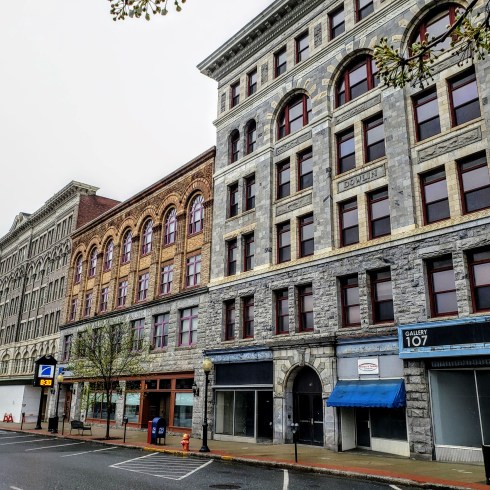
Judging from the simple house plaques that adorn many of North Adams’ eclectic Victorians, North Adams became a boomtown in the last three decades of the nineteenth century, with the Arnold Print Works (1862-1942) turning out textiles for a global market from its complex of mill buildings along the Hoosac River—later the home of Sprague Electric, and now Mass MoCa. The Hoosac Tunnel was completed in 1875 (at great cost of treasure and lives—its workers named it the “Bloody Pit”) making North Adams a railway gateway to the west. Walking the streets of the city, you can feel and see the expansion of that era through the architecture: every single structure seems to date from the 1870s and 1880s with nary a Colonial in sight. The sound of hammers must have been constant in this period, along with the smell of smoke. There were several larger Victorians in divided and dilapidated states, but it was also clear that preservation was at work in North Adams, and as our entire region was plunged into a prolonged period of gloomy rain last week, it was nice to be among more colorful houses. This is just a small sampling: I’ll need to go back!

20190504_085514

20190504_085537

20190504_085138

20190504_090021

20190504_090620

20190504_084931

20190504_084327

20190504_084308-1

20190504_084250

20190504_090957Some of the larger Victorians on Church Street (just above) need some help, but just up the hill is a lovely neighborhood of mostly-restored structures. Below: the Arnold Print Works produced a full line of textiles over their long history, but one of their popular products in the 1890s were these stuffed animal templates (examples below from the collections of the Rhode Island School of Design Museum & Cooper Hewitt): the finished products are very collectible and you can buy reproductions too (here are some Etsy examples). 

North Adams RISD North Adams 1892

North Adams Arnold Print Work Owl Cooper Hewitt

North Adams Cat


Wonders of Winterthur

I am still processing Winterthur, so this is a rather premature post, but I wanted to get my first impressions and thoughts out there and sometimes posting is processing! It was just so wonderful, in so many ways, especially as my friends and I toured its many period rooms in the company of Wendy A. Cooper, Curator Emerita of Furniture and conservator Christine Thomson. If the majesty of the rooms and their furnishings was not enough, the commentary of these two brilliant women on style, detail, condition, context, and provenance provided a soundtrack of sorts which enhanced the whole experience. And we got to go where more scheduled tours could not–which is always fun: if we did not make it through Winterthur’s 175 rooms, we came pretty close, and by the time of the closing bell we were on the top floor. While Ms. Cooper’s specialty is furniture, she seemed to have a mastery of every object in every room, as well as the history of Winterthur itself, so the takeaway was a very personal, even intimate, view of both the museum, its collections, and its founder, Henry (Harry) Francis du Pont (1880-1969). During our tour, I was so focused on absorbing every little detail that I didn’t really process, but afterwards, and all this week, I kept comparing Winterthur to another famous house museum, across the pond: Sir John Soane’s Museum. I needed context, I needed a comparison, and while I know that Winterthur is comprised of parts of many different houses and inspired more by the tradition of installing period rooms that started right here in Salem with George Francis Dow’s exhibits at the Essex Institute and Soane’s (much smaller) house is uniquely his place and collection, and fixed at a more exact point in time, the two houses seem both stuffed and the stuff of very personal passions for collecting: materialistic rather than “scientific” wunderkammers.

20190427_135800

the_south_drawing_room_derry_moorePort Royal Parlor at Winterthur and South Drawing Room at Sir John Soane’s Museum, photograph by Derry More.

The personal was my window into Winterthur: somehow stories of Mr. du Pont entertaining antique dealers over dinner and then proceeding to invite them to help rearrange the furniture reminded me of the more eccentric Mr. Soane. As I did when I first visited the London museum, I really felt the stamp of Mr. du Pont on Winterthur: period rooms can be rather cold, detached places (as they are literally detached), but Winterthur felt warm. The big, showy parlors and dining rooms of the main floors less so than the upper stories, but still, altogether an inviting installation—impressive for a museum of such scale.

20190427_174024

20190427_172437

20190427_153703

20190427_154512

20190427_154601

20190427_154448

20190427_154426

20190427_153526-1

20190427_133830

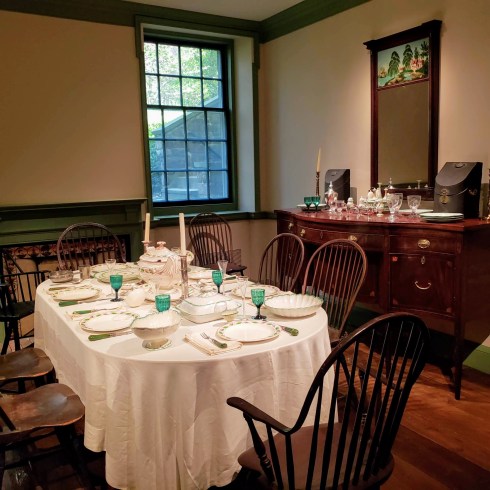
20190427_145051So many rooms—and stuff—for eating and drinking, of course, but dining rooms can be very revealing in their details. After the famous Chinese Parlor are several shots of the Du Pont Dining Room, with the Derby family’s green knives and knife boxes (+ McIntire chairs and Needham secretary, and adjacent candlestick closet. I can’t remember the name of the second, simple dining room, which is one of my favorite Winterthur rooms, but the photograph just above is of Queen Anne Dining Room, which really represents Mr. du Pont’s creative abilities (as well as his collecting efforts).

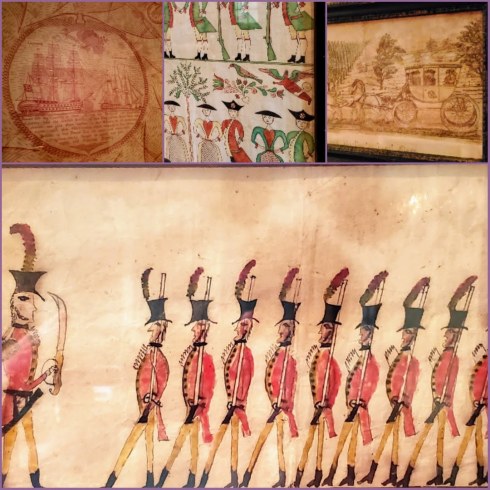
Some more observations and thoughts not yet fully developed, impressions: you really have to put your New England preferences aside and pay tribute to Philadelphia and New York furniture when you visit Winterthur (particularly the former, wow), but Mr. du Pont seems to have been just as passionate a collector of American (or should I say eastern American) folk art as high-style furniture. I knew I could get pictures of the grand rooms from the Winterthur website (plus they have a great digital database) so I took pictures of lots of little things that caught my eye (see some below). How many eagles are there in Winterthur? They seemed to be everywhere. And tea tables! Apparently Mr. du Pont’s collections started with pink transferware and he continued to assemble pottery collections with great conviction: there are several rooms devoted entirely to a variety of wares, even spatterware. And yes, parochial person that I am, I did seek out Salem items, which were not hard to find: there’s a whole room dedicated to McIntire, and other pieces scattered around. In just one room, of painted furniture pretty high up, Ms. Cooper casually pointed out a lovely silk chimneypiece embroidered by Sarah Derby Gardner and a Silsbee chair. The Du Pont Dining Room (above) featured not only knives from the Derby family, but also some McIntire side chairs, and an amazing secretary/bookcase made by Nehemiah Adams. In his own suite of rooms, Mr. du Pont worked on another Salem secretary, with a Nathaniel Gould chest of drawers nearby. An entire room is wallpapered with a mural painted by Michel Felice Corné for the Lindall-Barnard-Andrews House at 393 Essex Street in Salem.

Winterthur Secretery best

20190427_153224-1

20190427_163422

20190427_165224

20190427_152226

Winterthur eagle

20190427_133515

pixlr-1

Winterthur Tea Collage

20190427_132758

20190427_161302

20190427_161025

20190427_164308

20190427_164321

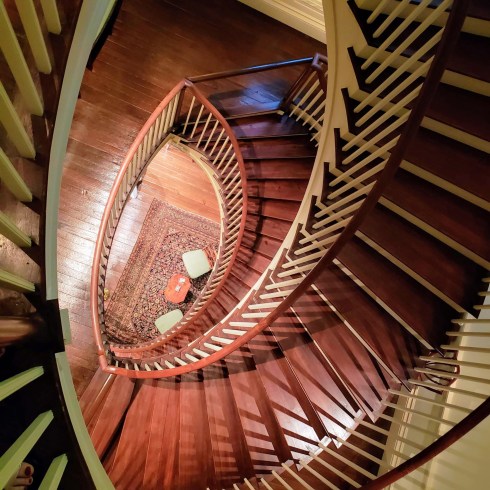
20190427_160227The Montmorenci stair, taken from a North Carolina house, replaced the “baronial” staircase which Mr. du Pont’s father installed. Folk objects and images, just a few tea tables, and just one china room. Several Salem items: the chimneypiece embroidered by Sarah Derby Gardner, a Silsbee chair, Mr. du Pont’s secretary (and bed), and the Corné mural from the Lindall-Barnard-Andrews House.

I could go on and on and on, but I’m going to wrap it up with just a few more of my favorite things/rooms, in no particular order. I really loved the William and Mary Parlor, pretty much every image of George Washington (and there were many), the detail on an otherwise simple chest of drawers, two pastels by John Singleton Copley of himself and his wife (and the amazing high-style parlor which they overlook), a very early billiards table, and an elegant curved settee for which Mr. du Pont built a wall. And just to bring in a touch of a real wunderkammer, a wonderful little anatomical plate.

20190427_142749

20190427_142843

20190427_162201

20190427_131347-1

20190427_162240

20190427_140726

20190427_140431

20190427_155945

20190427_170140

20190427_142043


Brandywine Weekend

I am just back from a long weekend spent in the Brandywine Valley spanning the border of Pennsylvania and Delaware. A few friends and I drove down principally to visit Winterthur, but I think we were blindsided by all the attractions of this beautiful region: the lush landscape was a welcome escape from still-Spartan New England too! As usual, time was limited, so I felt like I was rushing around trying to see and capture as many houses, gardens, and treasures as possible, but there was simply too much. I’m going to have to go back and spend a week or more. So what you will see in these next two posts are rather impressionistic views of the region in general and Winterthur in particular. When I return, the first thing I’m going to do is drive down every single road slowly (or maybe bicycle) so I can see as many old houses as possible: stone, brick, wood, and combinations thereof, small and large.

20190427_085236

Brandywine Houses 4

Brandywine houses 5

Brandywine Houses 9

Brandywine Houses 8

Brandywine Houses 3

20190428_100837

Brandywine Houses 11

Just a sample of the many beautiful houses in the Brandywine Valley: you can see that I was drawn to the stone as it’s more unusual in New England. We were fortunate to be taken to see Primitive Hall, a 1738 manor house in Chester County, Pennsylvania, with its double (“pent”) roof, a common architectural feature of early houses in the region, including the Gideon Gilpin House at the Brandywine Battlefield site. The Battle of Brandywine was the Marquis de Lafayette’s first American battle, and he was quartered at the Gilpin House.

Brandywine Houses 2

20190428_105237

Brandywine Houses 10

Brandywine Houses 1

20190427_100956

pixlr-1

Primitive Hall exterior and interior and the Gideon Gilpin House at the Brandywine Battlefield site; outbuildings of both houses—I could write an entire post on historic Brandywine sheds!

The region is beautifully preserved, in large part due to the work of the Brandywine Conservancy, as well as the institutional presence of the Brandywine River Museum, Winterthur, and Longwood Gardens, and the efforts of farm (horses! mushrooms!) owners as well, I am sure. What really stood out for me, besides the abundance of open land, were a number of really stately trees—and I am no tree girl. Looming over the public part of the Brandywine Battlefield site is an American sycamore tree dating to 1787–almost a witness to the Revolution. We saw a seventeenth-century “Penn Oak” on the grounds of the London Grove Friends Meeting House in West Marlborough, Pennsylvania, and many old trees in Longwood Gardens.

20190427_101414

20190427_101127

20190428_101211

20190426_144635

Longwood Gardens, the lifetime passion and achievement of industrialist and philanthropist Pierre S. du Pont (1870-1954) was almost overwhelming in its beauty, scale, organization and administration. What a resource for this community! I would live there if I lived nearby. I think we visited at the perfect time with abundant spring blooms everywhere, but I’m sure it’s beautiful in every season and I intend to visit in every season. There was rather dreary day on the Friday we visited, but the sun miraculously appeared for the afternoon, so no filters were needed for these photos!

20190426_140806

20190426_141528

20190426_141645

20190426_142535

20190426_141858

20190426_143633

20190426_142712

20190426_152647

20190426_153003

20190426_153332

pixlr-2

20190426_153431Longwood Gardens + Conservatory and “Green Wall” surrounding restroom doors!

I don’t think that we were completely prepared (yet again) for just how charming the Brandywine River Museum of Art is, with its comprehensive yet intimate focus on multiple generations of the multi-talented Wyeth family. I was pretty familiar with patriarch N.C. Wyeth’s illustration work,, somewhat familiar with that of his son Andrew, and a bit familiar with that of his grandson Jamie, but I had no idea that all of his children were so talented, that he was mentored by my favorite illustrator of all time, Howard Pyle, and that he suffered such a tragic death (crushed by a train, along with his little grandson, in 1945). There was also a poignant tribute to Phyllis Mills Wyeth, the wife and muse of Jamie Wyeth, who died just this past January, in the form of an exhibition of Jamie’s works which depict and were inspired by her—including a series of charming Christmas cards which he made for her every year. A visit to the Wyeth family home and N.C.’s studio nearby enhanced the whole experience, and also highlighted how and why the Brandywine Valley was and is so inspirational.

Brandywine Museum

20190426_114708

pixlr-3

20190426_114325

20190426_111338

20190426_114047

20190426_134129

20190426_111751

20190426_132428

20190426_112800

20190426_115536Treasures of the Brandywine River Museum of Art, including: Howard Pyle’s influential “historic” illustrations and a N.C. Wyeth cover, Andrew Wyeth’s Snow Hill  and Jamie Wyeth’s Lime Bag, N.C.’s studio exterior and interior and in Andrew’s North Light, N.C. Wyeth, framed by his parents and looking down on his talented family, a Jamie Wyeth Christmas card for his beloved wife Phyllis.


City of Seven Hills

I’m just back from a wonderful vacation to Lisbon during which I took hundreds of photographs, so advance warning to those who are more interested in local history and culture: this is definitely going to be a “streets of Lisbon” week! I’ve been to Portugal several times before, but my last visit was quite a while ago, and I never spent more than a few days in the capital so there were many discoveries: plus Lisbon is incredibly photogenic as it is so full of texture and color. I walked everywhere so I could capture every little detail, only popping on a yellow tram near the end of a long day when I was looking up at yet another hill (there are seven, just like Rome) which had something I had to see at its top. We had wonderful weather, and Lisbon appeared very bright and shiny, with its multichromatic buildings, both tiled and color-washed, contrasting with its black and white sidewalks and squares. Yellow popped out particularly, not just on the trams but also on private and public buildings and even the cranes which hovered over sections of the city. Like so many other cities, Lisbon appears to be having a building boom, encompassing both the construction of new structures and the “renewal” of others. It’s a city that has always embraced the new and cherished the old in a particularly effective way, certainly since the devastating earthquake of 1755 and no doubt well before, as it is an ancient settlement. I’ve got my favorite photos from the trip today, and my next posts will focus on the sidewalks and shops of Lisbon, then I’ll get back to some Salem stuff (though I think I have enough photos to feature Lisbon for some time).

Yellow City 20

Yellow City 33

Yellow Lisbon Black Horse Square

Yellow City 2

Yellow City 25

Yellow City 5

Yellow City 26

Yellow Lisbon 2The arch of the Praça do Comércio, the Square of Commerce, is the proper entry to Lisbon, from the sea, but it’s a nineteenth-century construction after the rebuilding of the square following the earthquake of 1755. A great mural in the Museu Nacional de Arte Antiga shows the pre-1755 square. The Church of The Church of Nossa Senhora da Conceição, the ruins of the Cormo Convent (another memorial to the losses of 1755), the interior of Lisbon Cathedral, just another beautiful church square, and a quote by the 18th century Jesuit father Antonio Vieira “Para nascer, Portugal. Para morrer, o mundo” testifying to the still-evident Portuguese pride in its global reach.

Yellow City

Yellow City 9

Yellow City 10

Yellow City 8

Yellow Lisbon Castle2

Yellow City 31

Yellow Lisbon Castle

Yellow Lisbon Church

Yellow City 4

Yellow City 3I’m trying to show the integration and proximity of new and old with these pictures, which include several streetscapes, views from the Castelo de S. Jorge, the Church of São Vicente of Fora, and a shot of the botanical garden, but they also present a lot of yellow, a very conspicuous color in Lisbon.

Yellow Lisbon Belem 3

Yellow City 32

Yellow Lisbon Belem

Yellow Lisbon Belem 2

Yellow Clevely Belem

Tarts

Yellow Lisbon CarriageBelem: site of the iconic Manueline Jerónimos Monastery and Belem Tower + tarts and the maritime history and coach museums, and a very strident 20th-century monument to the discoveries. 

Yellow Lisbon Museum

Yellow City 24

Yellow City 23

Yellow City 21

Yellow City 40

Yellow City 12

Yellow City 22

PharmacyMuseums:  so many! History museums and museums of every conceivable form of art: “ancient” (pre-1850), modern, decorative, TILES, marionettes. The famous Gulbenkian collection and several less well-known house museums: I was blown away by the CasaMuseu Medeiros e Almeida in particular. I have a new appreciation for Portuguese artists of the Renaissance (Gregório Lopes in particular: look at that Martyrdom of St. Sebastian). And I couldn’t leave without visiting the Museu da Farmácia, of course. 


Saratoga September

We were in Saratoga Springs for a big family wedding this past weekend, one of four (or did I hear six?) that the city absorbed effortlessly: by all appearances Saratoga has its tourism game down and seems to be just as accommodating and entertaining to its permanent residents. Everything about it speaks to careful planning and “showcasing” for lack of a better word: wide boulevards, strong commercial and residential architecture (in close proximity), a Visitor’s Center and History Museum both in the city center within a beautifully-maintained park (+carousel), a performing arts center a bit further out in the Saratoga Spa State Park, an intact Armory transformed into a military museum, a mixture of commercial and boutique hotels, uniform, aesthetically-pleasing SIGNS (including iron markers for every neighborhood), public art that both reflects and enhances its streetscape, a seasonless economy, and clean sidewalks. Saratoga Spring has been a city of attractions for a long time, offering up a succession of healing waters, potato chips, horse racing, gaming, and a variety of arts to its many visitors over a century and a half, and its experience—and pride–shows.

Saratoga 1

Saratoga 2a

Saratoga 2

Saratoga 7

Saratoga 6

Saratoga 10

Saratoga 4

Saratoga past and present

Saratoga past and present 2Horses and ballet slippers (a nod to the New York City Ballet’s summer residence at the Saratoga Performing Arts Center) abound on Saratoga’s main streets as do markers; the Saratoga History Museum in the former Canfield Casino has both permanent and rotating exhibits and tours; two views of old and new—I really liked this gallery floor made up of scanned postcards of all Saratoga’s great hotels. AND now for some houses: this is just a sampling, as there are MANY to see, mostly different varieties of Victorian and some early twentieth-century styles. You could take a walking tour focused entirely on variations of the Italianate.

Saratoga 31

Saratoga 29

Saratoga 21

Saratoga 20

Saratoga 18

Saratoga 30

Saratoga 17

Saratoga 16

Saratoga 19

Saratoga 12

Saratoga 15

Saratoga 11

Saratoga 14

Saratoga 32


A Displaced Doorway

It’s August, so we’re coming up on the day a year ago when the Peabody Essex Museum quite suddenly closed the doors of its temporary Phillips Library facility in Peabody and issued an ominous and mysterious statement that the Library would be opening up in a “new location” in the spring. In December, the Museum announced admitted that this new permanent location would be the town of Rowley, where it had purchased a utilitarian structure to house its amalgamated “Collection Center” (why is it not Collections Center—just not indiscriminate enough?) And just like that, Salem’s oldest and most comprehensive archive was gone, along with the very special library that had housed it for well over a century. The Collection Center Library, which I cannot bear to call the Phillips, is now open and able to accomodate 14 researchers in what is by all accounts (I haven’t been there yet, but I fear I will have to at some point) a massive structure, yet another indication that this facility was built to house material objects rather than texts: the announcement of its opening featured a curator examining a Chinese object. I’m quite aware that the PEM requires a vast amount of space to house its vast collections: I just don’t understand why this space could not have been found in Salem or why the Library had to be assimilated within it. Through this whole saga, I’ve talked to many people who have been just as upset over the removal of objects from Salem as texts: the assorted Americana and maritime memorials of the former Essex Institute and Peabody Museum. For me, it’s always been exclusively about paper. But just the other day, someone took a picture of the crated doorway of the Gideon Tucker House, being readied for its departure to Rowley I presume, and I started to think about the loss of material culture for the first time when I went over to see it for myself.

Gideon Tucker Doorway 2

Gideon Tucker Doorway

I guess I should be glad that this doorway still exists and is still—or has been–in Salem, as it is a long-admired example of Samuel McIntire’s work; indeed when students from MIT’s pioneering architectural school came to Salem in the summer of 1895 to measure and draw its storied buildings, their professor Eleazer B. Homer identified the elliptical doorway of the Gideon Tucker House (also called the Tucker-Rice House) as the “best-proportioned” in the city. We have photographs of the doorway in situ, but most images of it date from after 1896, when the Tucker house was acquired by the Father Mathew Total Abstinence Society and transformed into an institutional headquarters. By 1910 the famous doorway had been removed and donated to the Essex Institute, which eventually affixed it to the rear of Plummer Hall. I’m not sure when it was removed and placed in storage: Bryant Tolles refers to its relocated situation in his Architecture in Salem (1970) but the doorway of the “Grimshawe House” on Charter Street is affixed to the rear of Plummer at present–and has been for some time.  Across Essex Street, the Gideon Tucker house was further “denatured” by the addition of commercial storefronts in the mid-twentieth century, but fortunately rehabilitated for residences under the supervision of Newburyport architect Jonathan Woodman in the 1980s, at which time it acquired its reproduction entrance.

Tucker collage

Gideon TUcker Brickbuilder 1915

Gideon Tucker NYPLDG

Gideon Tucker PC

gideon-tucker-house-with-commercial-storefront

Gideon Tucker todayThe Gideon Tucker Doorway and House (1804): Frank Cousins photographs from the 1890s; the Brickbuilder, January 1924; New York Public Library Digital Gallery, n.d.; Essex Institute postcard, MACRIS (1979) and present.

The Essex Institute garden must have been a very interesting place to visit in the midst of the twentieth century with its eclectic mix of houses and house parts assembled by George Francis Dow: in addition to the Tucker Doorway, there was a McIntire cupola from the Pickman/Derby/Rogers/Brookhouse Mansion which was demolished in 1915. It was infested with beetles and destroyed in the 1970s, and only its eagle survives. I am grateful that this beautiful doorway has not met a similar fate, along with all the architectural fragments in the PEM’s collections, but the removal from the cultural context which created them makes me anxious for their future significance—and meaning.

Napoleon “Eh bien, Messieurs! deux millions”: Napoleon displaying the treasures of Italy—in France, 1797, Library of Congress.


History is not a Spectator Sport

I was in several New Hampshire towns in the Monadnock region over the past weekend, and in each and every one of them there was a centrally-located History Center or Historical Society, open for business with timely exhibitions on view. These institutions were clearly both engaging and reflecting the collective curiosity of their respective communities, rather than just offering up a commodity or tablets (in whatever media form) of established facts that anyone can look up at any time. And once again I returned to Salem, a city that calls itself “Historic” but yet has no public history museum that is collecting, preserving, interpreting, and exhibiting its history and has experienced the removal of most of its archives by the Peabody Essex Museum, in an exasperated state. It’s not that there aren’t some great historical attractions and experiences in Salem: there are. But for the most part, Salem’s “history” is either siloed or for sale: there is no center, no apparent concern for the public record or the public memory, and an overwhelming emphasis on performance or presentation rather than participation.

WOrld War Jaffrey

World War Jaffrey 2

WOrld War HancockHistorical markers are everywhere in New Hampshire—and Salem’s Massachusetts Tercentenary markers are still among the missing; a Sunday afternoon exhibit/gathering at Hancock’s Historical Society.

I have two very specific cases in point to illustrate my assertions. We are in the midst of a national commemoration of World War I, inspired by the United States World War One Centennial Commission, of which all five living presidents serve as honorary co-chairs. All around me there are great local exhibitions on the Great War, from Hancock, New Hampshire in the north (see above) to Framingham and Lexington in the west, to Orleans on the Cape (where the only German attack on American soil occurred 100 years ago last week!) What’s happening here in Salem? Two very discreet digital exhibits, so discreet that I doubt very few people know about them. The Salem Public Library has several collections relating to individual Salem residents’ experiences during World War among their “Digital Heritage” items, including lovely silk postcards received by Anna Desjardins from soldiers stationed “somewhere in France”, and the Salem Veterans’ Services Department of the City of Salem actually has a “World War One Centennial Project” on the city website which I found while I was looking for something else entirely! Great resources here, including photographs of the two units in which Salem soldiers fought, individual biographies and obituaries, and newspaper clips, but where’s the engagement, and where’s the press? The introductory text references a collaboration with the Salem Public Library but I don’t see any links there, nor at the Salem Museum, Destination Salem, or anywhere else that keeps track of Salem events and initiatives, but I’m going to put it out there. This welcome but unheralded effort of 2018 contrasts dramatically with the reception the returning soldiers received a century ago when it seems like every parish and ward turned out for ceremonies and financed the monuments that still stand,  so “time will not dim the glory of their deeds”. I hate to disagree with a monument, but I do think the glory of past deeds is dimmed if awareness of such deeds is limited to a name on a plaque.

EPSON scanner image

World War 101stThe 101st Field Artillery in France, and just three of Salem’s World War I Memorials.

You can also find Salem’s City Seal on the city website, which is described as: a ship under full sail, approaching a coast designated by the costume of the person standing upon it and by the trees near him, as a portion of the East Indies; beneath the shield, this motto: “Divitis Indiae usque ad ultimum sinum,” signifying “To the farthest port of the rich east”; and above the shield, a dove, bearing an olive branch in her mouth. In the circumference encircling the shield, the words “Salem Condita A.D. 1626” “Civitatis Regimine Donata, A.D. 1836. Actually the costume very specifically identifies a native of Banda Aceh, the capital city of the Aceh province of Indonesia, on the northern tip of the island of Sumatra. Salem’s monopoly of the pepper trade with this region initiated and defined its golden age in the first decades of the nineteenth century, and when the seal was designed in 1836 this connection was not just acknowledged, but sealed. And in the spirit of historical and cultural engagement, the Acehnese dance company Suang Budaya Dance will be performing the traditional “Dance of  the Thousand Hands” at the (30th!) annual Salem Maritime Festival this coming weekend—on the very wharf where Salem ships once departed for their native land and returned to discharge “Salem Pepper”. The folks at the Salem Maritime National Historic Site know how to pay tribute to the past by engaging the present and the City of Salem should take a lesson: though perhaps war and trade are simply not hip, funky or witchy enough to attract the attention of City Hall.

Active Sport Salem City Seal


My Salem Museum

The Peabody Essex Museum has made an additional concession in the mitigation dialogue following their admission to the relocation of Salem’s historical archives to a “Collection Center” in Rowley: a presentation/exhibition on the “Salem (Historical?) Experience” to be permanently installed in Plummer Hall. This could be good news—-like everything else the devil will be in the details—but it in no way compensates for the removal of historical materials left in good faith to the care of the PEM’s predecessors by scores of Salem families. Still, Salem has always needed a proper Salem Museum, with texts, objects, and interpretations of key events and themes in its history presented in an installation that is both contextual and chronological. This could be an opportunity to have some semblance of that, as the PEM has wonderful curators and resources, but the institutional reluctance to actually showcase authentic Salem items—combined with the word “experience”—leaves me a bit worried that all we’re going to get is some sort of virtual presentation. Nevertheless I was inspired to put together my own Salem Museum, and here are its key components.

Salem Worlds: I would prefer a thematic presentation to a chronological one, but after teaching history for 20+ years I know that chronology is important—-people want to get the facts straight and in order. So I think I would use a “worlds” approach in which Salem expands from a tiny little settlement into one which is an important part of the entire world, and then create various other worlds which represent different aspects of Salem’s history. Worlds are a way to combine themes and chronology: we need to know about Salem’s experience as a colonial outpost of the expanding British Empire, its role in a world of Revolution, and its preeminence in a world of global exchange, but also about the worlds of ideas, work, and association which flourished within its borders. I’d like to flesh out the isolated world of seventeenth-century Salem and its environs that served as the setting for the witchcraft accusations of 1692 as much as possible, but also trace the legacy of the Trials through the evolution of the “world(s) of Witch City” from its first expressions until today. We need to peer into the worlds of Salem’s many activists—whether they were working for abolition, temperance, social reforms, or suffrage in the nineteenth century, or striking for more job security at Pequot Mills in 1933. I’d like to recreate Nathaniel Hawthorne’s Salem world with texts and images, and also that of one (or more) of the lesser-known diarists whose memorials are locked in the Phillips Library. Different worlds could be explored in keeping with the PEM’s programming (I guess I have to make that concession).

Virtual is fine, but we need objects and texts too: I’ve been to quite a few city history museums (but unfortunately none on this list) and it seems to me that the mix is best. There’s always some sort of “orienting” video, so that might be the best way to deal with the chronology: I love the Museum of the City of New York’s Timescapes in particular. The only way we can create some semblance of seventeenth-century Salem is through cgi, and I cannot watch Pudding lane Productions’ deep dive into seventeenth-century London enough (and my students love it).

My Museum Timescapes

In this era of immersive make-believe, people crave authenticity, so we need to see real stuff too: personally, I’d love to see the 1623 Sheffield Patent, which granted rights to Cape Ann to several members of the Plymouth Colony and was contested by a representative of the Dorchester Company. This is a connecting link between Plymouth and the North Shore, and between Plymouth and Salem: as Cape Ann didn’t quite work out at that time the old planters migrated down the shore. Later in the seventeenth century, let’s widen the circle of persecution a bit by showing items that illustrate the struggles of Thomas Maule and Philip English—what an Atlantic world the latter represents! The widening world of eighteenth-century Salem could be explored through periodicals, ephemera, and any and all expressions of “trade port culture”, which the PEM loves (as long as the port in question is not Salem). Craftsmanship (or simply work), consumption, and activism are themes and worlds that can take us (or Salem) from the eighteenth century through the nineteenth century and all the way up to today.

SHeffield Patent

My Museum Maule

My Museum Handkerchief PEMThe Sheffield Patent, 1623, Phillips Library, Peabody Essex Museum; Title page of Thomas Maule’s New England Pesecutors Mauld, 1697; The Poor Slave (Dedicated to the Friends of Humanity), ca. 1834, copperplate-printed cotton, Boston Chemical Printing Company, The Joseph Downs Collection of Manuscripts and Printed Ephemera, Henry Francis DuPont Winterthur Museum (Also in the Phillips Library). 

Art+History=Culture+Connections: The past five months—this entire semester!—has been like a Museum Studies course for me as I have been reading and exploring museums and historical societies around the world to see if I could come up with some compensation for the cultural deficit we have here in Salem, where the institution with most of the historical collections has withdrawn, leaving behind an infrastructure of largely commodified historical interpretation. There are many historical museums doing amazing things, but I’ve been particularly impressed by what I’ve seen (only online) at the Santa Cruz Museum of Art and History. I spent a summer in Santa Cruz years ago on an NEH grant, so I have a fondness for that place anyway, but I love how this particular museum merges art, history, and community engagement into a mission that stresses relevance and region. It is an institution that is governed by the same “connections” mission that PEM references all the time, but their much stronger emphasis on place (in part through history) must make the pursuit of those connections more attainable and meaningful. As I haven’t been there, I’m not sure exactly how SCMAH presents the past, but my Salem History Museum would not recognize divisions between art and history, or material and textual culture. I’d have both, together, and a very particular emphasis on architecture. Lots of McIntire drawings, a whole gallery wall of Frank Cousins photographs, and some modern representations of Salem buildings to illustrate their (ever-) lasting impact. I would certainly have some of John Willand’s houses on a wall of my museum as I already have one on a wall of my house: each one is amazing, and I know he prefers a collective display. I would also feature some of the wonderful photographs of Salem captured by Salem instagrammers: more posts than #pem, just count the hashtags.

My Museum Little collage

My Museum collage

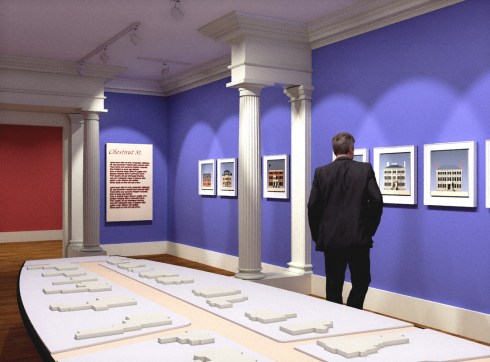
My Museum 30 Chestnut

Willand Gallery

Two sides of Salem artist Philip Little (1857-1942) from the PEM’s own collection: “Submarine Baseball” and A Relic of History, Old Derby Wharf, Salem, c. 1915; A Frank Cousins (18501927) portfolio; John Willand’s 30 Chestnut Street and Chestnut Street “Gallery”.


Where’s the Fire (Engine)?

Exactly one hundred years ago in Salem, people were flocking to the Essex Institute to see a piece of Salem history that had recently been returned to their fair city: a Georgian fire-fighting engine, by all contemporary accounts the oldest in America. Here we see a complete reversal of the situation we find ourselves in now, with the Essex Institute’s successor, the Peabody Essex Museum, shipping out the city’s material history rather advocating for its return—and showcasing it. The Union hand-tub engine was imported from Great Britain by one of Salem’s first private fire-fighting companies, the Union Fire Club, established in 1748. In the following year the company placed its order for one of Richard Newsham’s recently-patented “water engines for the quenching and extinguishing of fires”, and it arrived in Salem in 1750.

Fire Engine Colonial WilliamsburgA Newsham Engine of similar vintage @Colonial Williamsburg.

The Union was in service for quite some time as far as I can tell, but by the middle of the nineteenth century both its technology and its company was obsolete: steam and public fire-fighting departments were replacing hand-tubs and clubs. On a ceremonial visit to Philadelphia in the summer of 1866, a few remaining members of the then Union and Naumkeag Fire Club gifted their hosts, the William Penn Hose Company, with the Union. This provoked a “great hue and a cry” at home in Salem, but the old engine was not returned until 1917: and right into the Essex Institute it went. (I am wondering if Salem’s experience of conflagration in 1914 inspired the City of Brotherly Love to return the Union as a sympathetic gesture, but cannot find any confirmation of this theory).

Fire 1865

Fire Union 1866 Collage

Fire PhotoRobert Newall photograph of the William Penn Hose Company in Philadelphia with their steam engines, 1865, The Library Company; Harper’s Weekly photograph of the Union, “the oldest fire-engine in the United States” in 1866; a photograph of the Union in an article announcing its return to Salem in The American City, January 1918.

You can easily discern how important the threat of fire and the organization of fire-fighting was in the eighteenth and early nineteenth centuries by browsing through the online catalog of the Phillips Library, where the papers of the Union and Naumkeag Club are held, along with its predecessor club, the Union and Essex, and myriad other fire clubs: the Active, Alert and Amity clubs, Engine #9, the Enterprise Club, the Franklin Hook & Ladder No. 1, the Friend Engine Company, the Old Fire Club, the Social Club, the Reliance Hose Company, and the Relief Fire Club, among others. I do appreciate the PEM’s digitized library catalog, although it does not quite compensate for the lack of digitized items, or their removal from Salem. However, as I have been meeting and talking to people who have much longer associations with the PEM’s predecessors and the Phillips Library than I do, I am increasingly aware that they are missing objects as much as texts, and those objects are difficult to locate, both on the web and in reality. In the company of the “world-class” museums it claims to be, the Peabody Essex does not seem to be committed to comparative open access, to either its texts or its objects. Several years ago, one could search through a “collection gateway” that seemed to yield access to a good part of the PEM collections (it can still be accessed here but appears to be functional only in accessing items from the Native American collection), now we can only see selected “highlights”. Try comparing the collections portals of say, the Museum of Fine Arts in Boston, or the Metropolitan Museum of Art, or even the Worcester Art Museum, with that of the Peabody Essex Museum: and see how little you will yield. I wouldn’t know where to find the Union online: the Phillips Library finding aid description states that both it and an oil painting entitled The Union Hand-Tub by W.B. Eaton are in the PEM collections, but they are both absolutely unattainable in both digital and actual forms: a regression, certainly, from 1918.

Fire brochure

Fire 1970s

firebucket_fpoThe Union and some fire buckets were featured prominently in a 1978 Essex Institute booklet: Museum Collections of the Essex Institute by Huldah Smith Payson, and fortunately for us, one of those very same buckets is one of the PEM’s online highlights of its American art collection.


Salem Film Fest 2018

It is that time of year again: time for the annual Salem Film Fest, now in its eleventh year and very firmly established on the cultural calendar. Over the years, it has been very inspiring to see the festival’s growth: in terms of participation, attendance, offerings and impact. The care taken with curation is always very apparent to me: resulting in a nice balance of films with themes that are global and local, environmental and material, very serious and a bit more whimsical. One of the first films I saw at the festival was Grown in Detroit, way back in 2011: this was an interesting window into the urban crisis playing itself out in Detroit at the time and this year’s Beauty and Ruin offers another by focusing on the collections of the Detroit Institute of Art, which some thought might provide a solution to the city’s bankruptcy in 2013. I’m really looking forward to this film: as most of you know, the sanctity (and proximity) of a community’s treasures are important to me, and this film will be playing in PEM’s lovely Morse Auditorium!

FilmFest

FilmFest2 Stills and scenes of Detroit past and present in Beauty and Ruin.

I have a friend who oversaw the recent Skinner auction of items from Avis and Eugene Robinson’s collection of African American history (and also this beautiful–but troubling—catalog), so I’m also interested in seeing Black Memorabilia, which examines “the subculture around the collectibles and antiques that serve as reminders of America’s troubled racial past and present”. And speaking of subcultures, I might go for Mermaids, in which a select group of individuals idolize, identify and occasionally “become” sirens of the sea. In keeping (somewhat) with the marine theme, the South Korean film Old Marine Boy about a daring North Korean deep-sea diver in the South, looks amazing. On a very different note, I’m kind of interested in seeing Rodents of Unusual Sizeabout the enormous orange-toothed swamp rats (nutria) which have infested the waters of Louisiana post-Katrina and oil spills, but I’m not quite sure I want to spend so much time with these odious creatures on the big screen.

Mermaids Film

Old Marine Boy

Rodents2Scenes from Mermaids, the Old Marine Boy, and the poster for Rodents of Unusual Size.