Tag Archives: Massachusetts

Picturing Louisa

Today is the birthday (in 1832) of Louisa May Alcott, who I have always thought of as a real Massachusetts girl, with her Transcendentalist upbringing, her independent spirit, and her lifelong reformist tendencies. Sometimes it’s hard to separate her from Jo in Little Women, but she was a real person who served as a Civil War nurse (briefly) rather than waiting at home in Concord, who had many menial jobs, who wrote sensationalistic penny dreadfuls under a pseudonym as well as her classic bestsellers, and who was a lifelong abolitionist and suffragette. She never married, and died at 55 from what some people say was lupus, others mercury poisoning, and she herself thought might be meningitis. I know Louisa had her own life, but I can’t help associating her with Jo, primarily because of the movies rather than the book.  When I picture Louisa, I generally think of Katherine Hepburn playing Jo in the 1933 version of Little Women, rather than June Allyson in the 1949 version or Winona Ryder in the 1994 film; I think June and Winona did well, but Kate is seared in my memory.  If I had not seen any of these films, perhaps I could separate Louisa and Jo; but I have (and there you see my main teaching challenge:  many of my students have learned their “history” from films).

Stacy Tolman drawing of Louisa, reproduced in Lilian Whiting’s Boston Days (1902); a 1933 publicity pamphlet for George Cukor’s 1933 Little Women.

Back to the book.  I have several editions of Little Women, but my most prized one is an 1880 copy published by Roberts Brothers in Boston and illustrated by Frank Thayer Merrill. I’ve looked at other editions, but I like my Merrill best, and since I’ve made the Louisa/Jo connection, this is how I picture the Louisa and her world as well.

The last way I picture Louisa is in Concord, at Orchard House and its environs.  And when I think of her there, I wonder about her and her family’s relationship with Nathaniel Hawthorne, who purchased the Alcott’s first Concord house after he fled Salem.  He renamed their “Hillside” the Wayside, and it is just down the road from Orchard House:  apparently the Alcotts even became the Hawthorne’s tenants while their house was undergoing renovations.  Nevertheless, the relationship does not appear to have been a close one, and I wonder why. A recent book by Eva LaPlante, Marmee & Louisa: The Untold Story of Louisa May Alcott and Her Mother, explores the relationship between Louisa and her mother, Abigail May Alcott, who was a descendant of the Salem Witch Trials judge Samuel Sewall.  Of course, we know that Nathaniel Hawthorne was a descendant of another Witch Trials judge, John Hathorne. You would think that Louisa and Nathaniel could have bonded over these shared skeletons in their closets, but perhaps not.


Cranberry Picking

“…as why are Strawberries sweet and Cranberries sowre, there is no reason but the wonderfull worke of God that made them so…”.  John Eliot, the Puritan “Apostle to the Indians”, used the “American” name rather than the preferred English fenberry (variantly bear-berry and mosse-berry) in his 1647 treatise The Day-Breaking if not the Sun-Rising of the Gospell with the Indians in New-England, one of several seventeenth-century references to the sour little berry that was so common in Massachusetts. Along with corn, this was one native American crop that captured the attention of  the English early on–though most of their efforts seem to have been directed at transforming cranberries into something sweeter:  syrups, tarts, sauces.  They could not ignore a berry that ripened in the winter!

One last Thanksgiving weekend post on a fruit that remains one of Massachusetts’ few commercial crops, although we are no longer the country’s leading producer:  that title is now claimed by Wisconsin.  Still, there’s a major harvest every year starting in late September, and it’s a beautiful sight to see.  I just couldn’t make it down to the southeastern part of the state this busy semester, but here’s a great recent photograph of a bog at the A.D. Makepeace Company in Wareham, one of the state’s oldest producers.

Photo credit:  Charlie Mahoney for the Boston Globe; 1907 Makepeace Co. cranberry sign,Etsy.

The conditions of cranberry picking have changed a lot over the last century, for the better. Documentary photographers like Lewis Wickes Hine focused on the industrial exploitation of child and migrant labor in the early nineteenth century, and contemporary photographs of very small children, native Americans, and newly-arrived Europeans (in the case of southeastern Massachusetts, primarily Portuguese “bravas” from New Bedford, led by bog bosses called padrones) abound.

Portuguese cranberry pickers at the Eldridge Bog in Rochester, Massachusetts, and the “tenement” that housed them, September 1911, and a boy “scooper” at the Makepeace Bog. The caption of the last photograph reads: Gordon Peter, using scoop with metal teeth not covered. Said 10 years old. One of the smallest scoopers that we found. Usually scooping is done by adults. Been picking 3 years. Location: Makepeace near Wareham, Massachusetts. Lewis Wickes Hine, Library of Congress.

The pictures above contrast sharply with the recent photograph of the cranberry harvest at Makepeace, but also with artistic representations of cranberry picking in the nineteenth and twentieth centuries. Two paintings that fall on either side of Hine’s photographs are Eastman Johnson’s Cranberry Pickers, Island of Nantucket (1880) and Provincetown artist Ross Moffett’s circa 1930 Cranberry Pickers. Moffett’s modernistic representation of the workers in their spare Cape Cod context is a lot bleaker than Johnson’s more romantic image, but both artists seem to focus on the landscape at least as much as on the pickers.

Eastman Johnson, Cranberry Harvest, Island of Nantucket, 1880, Timken Museum of Art, San Diego; Ross Moffett, Cranberry Pickers, c. 1927-30, Smithsonian American Art Museum.


The Spoils of War and Thanksgiving

I’m going to bypass any politically correct discussion of Thanksgiving this week and return to the source:  William Bradford’s Of Plymouth Plantation.  Bradford was the second governor of the Plymouth Colony, and his personal history of the spiritual and literal journeys of his fellow Separatists out of England and to the New World is one of the earliest and most important sources of British American history. Bradford began writing the book in 1630, and it covers the formation of the Plymouth colony up to 1647, including that first legendary “Thanksgiving”, which did not become an official holiday until two centuries later. Ironically, one factor which rather inadvertently led to the establishment of Thanksgiving as the quintessential American holiday was the theft of the source which first referenced it.

A paragraph from Plymouth Plantation; Paul Manship’s idealistic image of the first Thanksgiving, 1930s, Smithsonian institution.

Bradford’s book was known and referenced by colonial American historians in the seventeenth and eighteenth centuries, but it remained in manuscript form. After the siege of Boston, when the British occupied downtown, troops ransacked the Old South Church (and turned it into a riding school, of all things) and found Bradford’s Plymouth Plantation lodged in the steeple. One (or several–who knows?) soldier took it as a spoil of war, and it made its way to Canada and later to Great Britain where it somehow (again–who knows?) found  its way into the Library of Fulham Palace, the official residence of the Bishop of London.  There it was used and referenced by several British historians of early America, bringing it to the attention of American scholars–who had apparently forgot all about it?  I know; there are a lot of question marks in this story! In any case, the sole copy of this very important American source  was in England and a movement to get it back began organizing in the 1840s. It took a while–a half-century to be precise– but the British “borrowers” did consent to have the text printed while it was in their possession.  It was published in 1856, under the auspices of the Massachusetts Historical Society, and it clearly revived interest in the history of the “Pilgrim Fathers”.

Old South Church, Boston, apparently threatened after surviving the great Boston fire of 1872, and in 1898, Boston Public Library; Fulham Palace in the later nineteenth century.

The publication of Plymouth Plantation came at a time when the United States was increasingly divided over the issue and expansion of slavery, and the text seems to have stimulated interest not only in the Pilgrims but in the Northern settlement at Plymouth, to counterbalance the earlier Southern settlement at Jamestown. After the Civil War broke out, President Lincoln responded to the continued lobbying of the influential author and editor Mrs. Sarah Josepha Hale, a strong advocate for the extension of New England values to the rest of the country as a way towards national unity, and proclaimed Thanksgiving a national holiday in 1863. George Washington had issued a similar proclamation, but Lincoln formalized the custom and standardized the date, in the spirit of both thanksgiving and union in the midst of war.

Two Winslow Homer views of Thanksgiving Day, 1865 from Frank Leslie’s Illustrated:  Hanging up the Musket and The Church Porch, Smithsonian Institution.

And what of Bradford’s manuscript?  It remained at Fulham Palace for nearly the rest of the nineteenth century, despite some high-ranking diplomatic deliberations. Trades were attempted, and some papers of King James I were sent over to Great Britain, with the hope of receiving Plymouth Plantation back.  To no avail:  the Bishop of London had to consult with the Archbishop of Canterbury, who had to confer with the Prince of Wales.  It all took some time:  not until 1897 was the manuscript returned to Massachusetts, where it remains, in the State Library.

Two pages from the Bradford manuscript at the State Library:  the title page and a list of Mayflower passengers.  Note the IT NOW BELONGS TO THE BISHOP OF LONDON’S LIBRARY AT FULHAM note on the former.


Atlantic Earthquakes

I experienced my very first earthquake last night, and even though it was a small one by global standards (4.5 on the Richter Scale) it was scary. I happened to be in the Salem Athenaeum (a brick building) when it occured, next to several tall windows, which shook vigorously along with the rest of the building for about a minute. There was no mistaking it for anything else. For me, it was a sensation without precedent, and my first thought (sadly) was for my tall brick chimneys back home. As stunning as it was, this earthquake was not enough to end the meeting I was attending, so after an hour or so I returned home to still-standing chimneys and a husband and stepson who didn’t even notice the earthquake!  I wanted to make sure that I and my fellow library trustees had not fallen into a parallel universe, so I turned on the television and googled and found that indeed, there had been an earthquake in New England and that its epicenter was in southern Maine–where my parents live!  A quick phone call reassured me that not only were they just fine, but they too had failed to notice the earth shaking under their feet (in a Chinese restaurant).

When you search for “New England Earthquake” on Google, you are going to be directed first and foremost to sites related to the Cape Ann Earthquake of 1755, not yesterday’s little quake.  The mid-eighteenth century earthquake, estimated to have been between 6.0 and 6.3 in strength and centered in the Atlantic Ocean just off Cape Ann in northeastern Massachusetts, must have been an extremely unnerving event not only because of its impact (as many as 1800 chimneys fell down in Boston) but also because it happened only 17 days after the great Lisbon Earthquake of 1755, which (combined with a subsequent fire and tsunami) leveled that city. As news and impressions of both quakes set in, they were linked together by commentators up and down the Eastern seaboard.  This was the middle of the eighteenth century, the century of Enlightenment, but the majority opinion was still more focused on God’s wrath, as illustrated by Boston preacher Jeremiah Newland’s Verses Occasioned by the Earthquakes in the Month of November, 1755.  Addressing the “God of Mercy”, Newland writes:

Thy terrible Hand is on the Land,
by bloody War and Death ; It is becaufe we broke thy Laws,
that thou didst shake the Earth.

1755 Broadside, Collection of the Massachusetts Historical Society; Contemporary woodcut of the Lisbon Earthquake and “Ruins of Lisbon immediately after the Earthquake and Fire of 1 November, 1755”, print by Robert Sayer after Le Bas, British Museum.

Like many of his fellow contemporary sermon writers, Newland displays no faith in science or reason in his Verses but he does have an “Atlantic” perspective, which is interesting.  And far from ceasing, the “bloody war and death” he references would only intensify in the very next year when the Seven Years’ War began, an epic conflict fought on both sides of the Atlantic.


Parks and Preservation

Just north of Salem are two adjoining state parks, Bradley Palmer State Park and Willowdale State Forest, which spread over parts of the towns of Topsfield, Hamilton and Ipswich. I took advantage of a free afternoon and the return of the sun and headed up there yesterday, in search not only of woods and trails but also houses, of course. Nature is never enough for me!  These properties were named after their donor, Bradley Palmer (1866-1946), a prominent U.S. and corporate attorney who built a beautiful Arts and Crafts country house called Willow Dale in 1901 at which he entertained such splendid company as HRH King Edward VII and President William Howard Taft.  In 1937, Palmer began donating sections of his large estate to the Commonwealth of Massachusetts and it was transformed into the parks.  All of the buildings on the Palmer estate, including Willow Dale and its outbuildings and the older Lamson and Dodge houses, have been leased by the state to long-term tenants who pay their “rent” in sweat equity through the Historic Curatorship Program, preserving these structures at minimal public cost.  The mansion has been transformed into the Willowdale Estate, a very elegant function facility, its coach house has just been completely renovated, and the older houses are in the process of being rehabilitated by their “resident curators”.

The Structures:  The Willowdale Estate  and its newly-restored coach house.

The Georgian Lamson House, considerably expanded by Bradley Palmer, and described as a “unique amalgam of Colonial and Colonial Revival styles” by the Massachusetts Department of Conservation and Recreation.  Images from 2008 –when its resident curators were chosen–and yesterday.

I have to admit that I couldn’t find the Dodge house, which was disappointing because I have been reading the great blog by its resident curators for the last several months.  If you’re interested in the Historic Curatorship Program (and Massachusetts has several other great properties it would like to lease) this record of the ongoing process is a must-read.  Lots of “restoration” blogs seem to be more about design and shopping, but not this one!  The Dodge house appears to date from the late eighteenth century, and Palmer made some “improvements” (including electricity) to this structure as well.

Dodge House exterior and wallpaper from residentcurator.com.

As you can see (read), the houses were the primary reason for my visit to the Palmer and Willowdale parks, but it was beautiful day, so I took a walk through the woods. Trails for people and horses (Palmer was an enthusiastic equestrian) are laid out through the Palmer park, and while it is possible to get off the beaten track, you’re never too far away from a steeplechase jump.  There is also a large meadow in the midst of the park, with the most luxurious moss edging I have ever seen. Willowdale is a bit less landscaped, but it also has laid-out trails:  this is Massachusetts, after all.


Iron Animals

It seemed like everywhere I went this (past) summer there were animals made of iron or some other metal.  Large or small, inside or out, they were in shops, parks, and museums.  So I snapped away, and here are some of my favorites, in chronological order of sighting.

All Summer long: horse sculpture by Deborah Butterfield in the atrium at the Peabody Essex Museum; in the midst of what used to be a Salem street.

Early July:  a stag and yet another noble horse at Smith-Zukas Antiques @ Wells Union Antique Center, Route One, Wells, Maine.

Late July:  a climbing tree frog by North Shore artist Chris Williams in Ipswich. 

Late August:  Big cats by Wendy Klemperer face off each other in Lenox.

Late August, again:  a tortoise and a hare in Copley Square, Boston.


Road Trip, Part Six: The Other Naumkeag

On the last day of my road trip, before I headed home to Salem, I visited a house named for Salem: Naumkeag, the Stockbridge summer cottage of Joseph Hodges Choate (1832-1917).  The native Americans called the land encompassing Salem Naumkeag, and the Salem-born Choate, a prominent New York attorney who took on Boss Tweed and served as Ambassador to Great Britain before World War I, named his country house for his native city.  I had never been to this western Naumkeag, but I had heard great things about it for many years, and I was not disappointed.

Naumkeag (1885), an early commission of Stanford White of McKim, Mead & White, Stockbridge, Massachusetts:  rear, front & detail views.

Actually, that’s putting it mildly:  I loved this property, which surprised me.  I grew up in a house in southern Maine not dissimilar from Naumkeag:  a shingle-style Victorian with dormers, porches, and a big hallway.  And while I love this house, when I moved away and grew up I always sought more straightforward houses for myself :  Federal and Greek Revival houses with clean lines and open facades in which squares are more important than curves.  Naumkeag is very curvy; it’s the antithesis of my beloved Federal style, but it is so perfectly placed in its setting that it cannot fail to charm.  I quickly realized that it was not just the house, but the house and its surrounding landscape, that was captivating me.  Mr. Choate and his wife Caroline had summered in the Berkshires for many years before they purchased the land on which they built their summer house, and they knew just where they wanted to build it–on a bluff overlooking a pastoral valley very close to the village of Stockbridge, where terraced and sloping gardens could surround the house and link it to that same valley below.

Naumkeag today, house and grounds tied together in a series of interior and exterior “rooms” which provide vistas that look both inward and outward, is not only the result of the collaboration of Mr. and Mrs. Choate and their consultants but also of another extraordinary partnership, between their daughter Mabel and the amazing landscape architect Fletcher Steele (1885-1971).  Mabel met Steele just before she inherited Naumkeag in 1929, and they embarked on a 30-year joint endeavor which made Naumkeag even more magical.  All the details–structural, horticultural, practical, were overwhelming!  I could write a separate post on just how water was moved from place to place.

Fletcher Steele’s work at Naumkeag: the “afternoon garden”, forged steps and “runnel” leading down to the famous, iconic Blue Steps.  My photograph is followed by one by Carol Highsmith (1980; Library of Congress), obviously a much better photographer.

Those blue steps: how amazing.  Art Deco in a “Victorian” garden (or is it?) and also an interesting juxtaposition of beauty and practicality; after all, they exist to channel water down to the lower perennial garden. The use of the azure blue, carefully chosen by Steele after much deliberation apparently, brings the sky down to the ground.  Here’s charming photograph of Steele and Mabel on the blue steps before they were blue:

Back to Salem, the first Naumkeag, where a statue dedicated to Joseph Hodges Choate marks one of the entrance corridors into the city.


Road Trip, Part Five: Two Sculptors in the Summer

Two very famous sculptors of the American Renaissance, a time when sculpture seems to have much more appreciated than now, maintained summer houses and studios in New EnglandAugustus Saint-Gaudens (1848-1907), creator of the Robert Gould Shaw memorial on Boston Common among other masterpieces, and Daniel Chester French (1850-1931), who sculpted Abraham Lincoln and The Minute Man.  I visited both estates on the road trip:  Aspet House, in Cornish, New Hampshire, and Chesterwood, in West Stockbridge, Massachusetts.

After Saint-Gaudens rather reluctantly settled into circa 1800 former tavern that he renamed Aspet House about 1885 and built several studios and gardens, he inspired the foundation of the “Cornish Art Colony” in the border town and its surrounding area.  It’s a golden valley, encompassing towns in both New Hampshire and Vermont on both sides of the Connecticut River and framed by mountains beyond, particularly Mount Ascutney.  The train was the key factor here as well as down in Stockbridge:  artists and others could escape from sweltering New York City relatively easily and spend their summers in bucolic New England.  After Saint-Gaudens’ death in 1907, the estate declined; generations of preservation advocacy resulted in its acquisition by the federal government in the 1960s and the establishment of the Saint-Gaudens National Historic Park in 1977.  It is beautifully maintained and well-interpreted, well worth a visit from near or far, and there are over 100 examples of Saint-Gaudens’ work on view.

Augustus Saint-Gaudens: a photograph of the sculptor at work by Kenyon Cox (Library of Congress), Aspet House, grounds, and the Little Studio, details and sculpture.

About 140 miles to the southwest, Daniel Chester French bought a 122-acre farm in the western part of Stockbridge, Massachusetts (actually it might be in the little village of Glendale) in 1896 and commissioned architect Henry Bacon, with whom he had and would work on a number of memorial projects, to build first a studio (1897) and then a house on a bluff overlooking the Berkshire hills. While Saint-Gaudens remodeled his colonial dwelling (substantially), French opted to replace the existing colonial with a new Colonial Revival house.  Chesterwood is the only historic site that I have ever visited that is owned and operated by the National Trust for Historic Preservation, which received it from French’s daughter in 1969.  The Trust has not merely preserved the estate however; it is very much a living place, with modern sculptures placed artfully in the gardens (which are also beautiful, and designed by French himself, just as Saint-Gaudens designed the gardens at Cornish).

Daniel Chester French:  in his Chesterwood studio, 1907; the house and studio, tracks leading outside of the studio so French could work in natural light, and modern sculptures on the grounds.

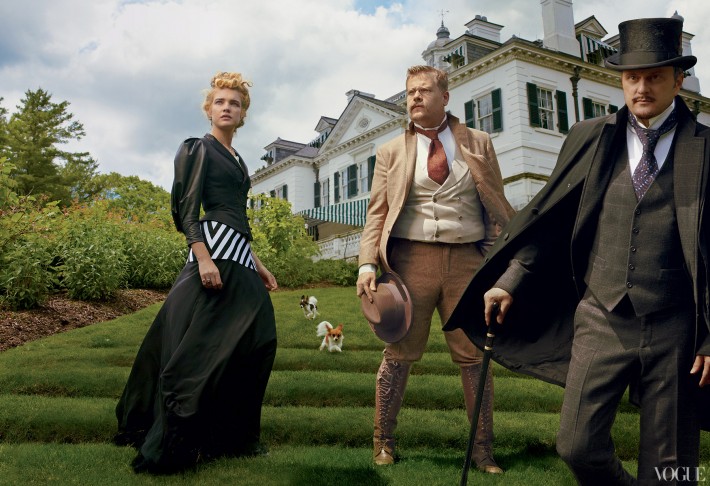
French operated in the same milieu as Edith Wharton, whose Berkshire country house, The Mount, I visited in a previous post.  And as Edith, her house, and her circle (played by contemporary models, actors, writers and artists) are featured in this month’s Vogue, so too are French (played by artist Nate Lowman) and his Chesterwood studio.  Saint-Gaudens will have to wait for a later issue, but I can’t imagine a better setting for a photo shoot than Cornish.


Road Trip, Part Three: Pilgrimage to the Mount

The contrast between Edith Wharton’s aunt’s house, Wyndcliffe, and her own Berkshire “cottage”, The Mount, could not be more extreme:  decaying Victorian Gothic indulgence as opposed to restored (or in the process of being restored) and restrained American neo-Classicism.  Even before Wharton penned her fictional bestsellers she wrote a popular interior design manual with her friend and collaborator Ogden Codman, Jr., The Decoration of Houses (1898), and The Mount fulfilled her vision. There have been some obstacles and challenges in its ongoing restoration over the past 15 years, but on this beautiful August morning it looked bright and cheerful and orderly. By all accounts, Wharton considered The Mount to be her first real home, and it seems like such a shame that she only spend a decade in seasonal residence, from its construction in 1902 until the break-up of her marriage and departure for France in 1911.

Our vivacious guide kept referring to the house as English in inspiration and style, and I suppose it is:  Wharton always proclaimed her admiration for the Georgian style above all others.  But The Mount felt very American to me, in that assimilated, melting-pot way: Georgian house, Italian gardens, French courtyard.  None of the original furnishings are in the house, so contemporary designers have recreated an updated Edwardian ambiance inside, adhering to the original finishes and arrangements whenever possible.  I did like Bunny Williams’s dining room, but I was more drawn to the original features of the house no matter how mundane:  hardware, the “trunk lift”, the unrestored scullery in the basement.

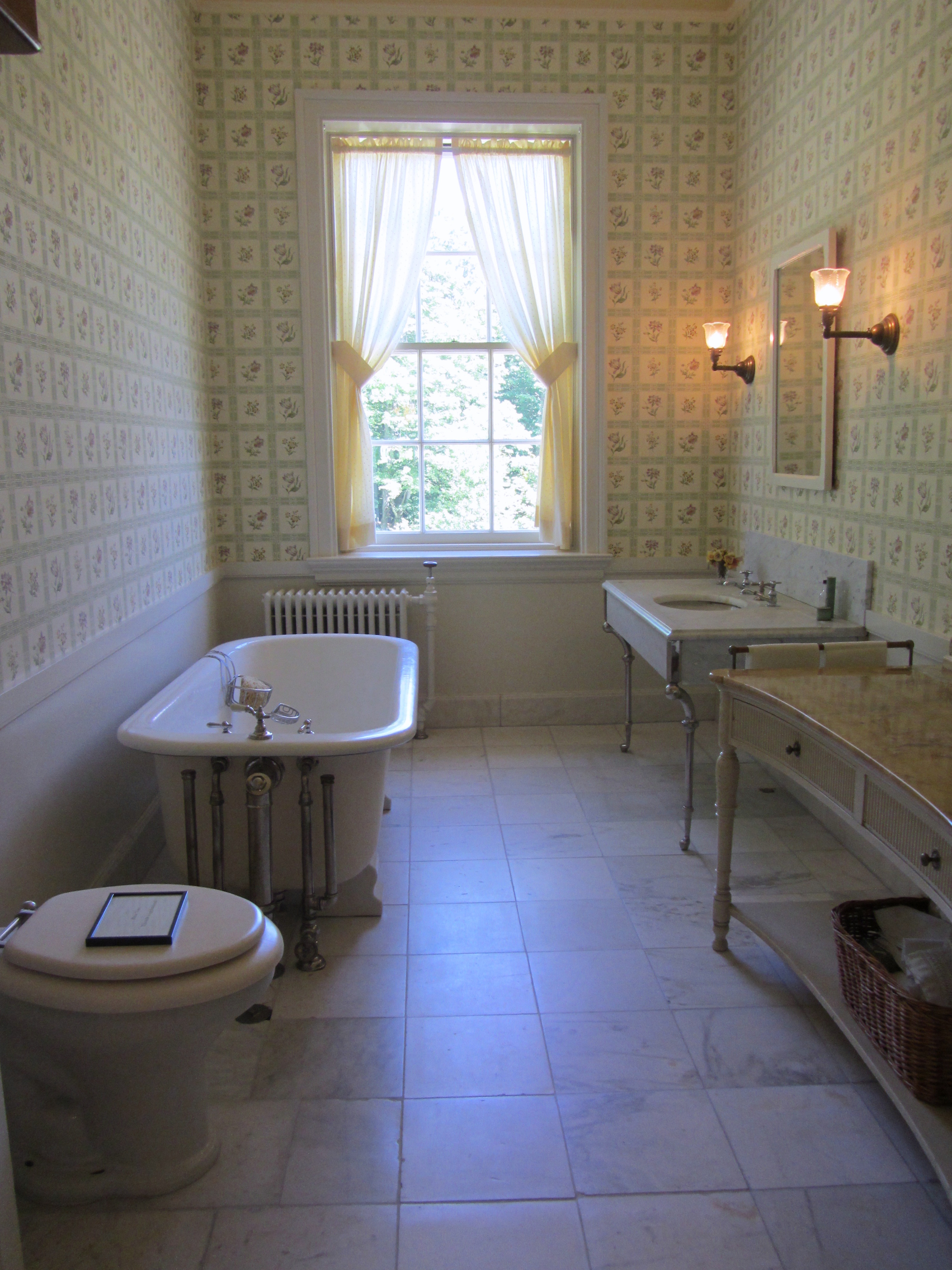
Less decorative license was taken upstairs in the private rooms of The Mount, including in what is arguably the most important room in the entire house, Mrs. Wharton’s bedroom, where she did all of her writing, in bed.  She would write every morning, numbering her pages and casting them to the floor, where her maid would pick them up and send them off to her secretary to be typewritten.  She loved little yapping dogs, whose presence is felt by the placement of stuffed animals around the house and a pet cemetery out back.

Private spaces made public:  Edith Wharton’s bedroom and adjacent bathroom.

The Mount, Plunkett Street (off Route 7), Lenox, Massachusetts.

Because I was having a completely indulgent day (one in a series), after my morning at The Mount, I stopped on the way back to my inn to pick up that must-have publication of the season, the September issue of Vogue Magazine.  I opened it up, and there she was:  Edith Wharton in Vogue!  Or model Natalia Vodianova playing Edith in residence, in an 18-page article and spread entitled “The Custom of the Country” by Colm Tóibín with photographs by Annie Leibovitz. There was Edith/Natalia ensconced where I just was, along with various actors, authors and models playing members of her inner circle who were regularly invited to the Mount (Henry James, Walter Berry, Theodore Roosevelt, her landscaper niece Beatrix Farrand, and sculptor Daniel Chester French–whose home I also visited yesterday).  A happy coincidence.


Mourning in England and America

When I found the painting below, alternatively titled The Saltonstall Family, or Members of the Saltonstall Family, and painted by David Des Granges about 1636-37, I was immediately drawn to it for several reasons.  I teach several courses on this period, so I thought it would be very useful in illustrating the importance of family in Stuart England. And then there was the Salem connection:  the Saltonstalls were one of the founding families of Massachusetts and of Salem:  Nathaniel Salstonstall (1639-1707) was one of the judges in the witch trials and Leverett Saltonstall (1783-1845) was the city’s first mayor and later a U.S. representative. We have a Saltonstall School and a Saltonstall parkway.  However, a little genealogical research (I never like to engage in too much genealogy–it’s a tangled web) has convinced me that I don’t really have a Salem story:  the man in the painting is indeed Sir Richard Saltonstall, but he is not THE Sir Richard Salstonstall (1586-1661), who sailed up the Charles River in 1630 and became the founder of the Massachusetts Saltonstalls of later fame and fortune. This Sir Richard Saltonstall (1595-1650) never left England, and in the same year that the man who shared his name was exploring the New World he was losing his first wife, who is also pictured below, along with his second, and the children he had with both women.

David Des Granges, The Saltonstall Family, 1636-37.  Tate Museum, London.

This, then, is a mourning portrait, depicting the living and the dead, together:  a truly blended family!  Sir Richard is pictured alongside his dead first wife, Elizabeth Basse, who is pointing to their two surviving children, Richard (wearing a long skirt as was customary for English boys of a certain class until age 6 or 7) and Ann, who link hands with each other and with their father, demonstrating the bonds of family.  Sir Richard’s second wife, Mary Parker, is seated with their newborn child on the right, completing the framed family.

Though some might think it a little creepy to have a dead person in the picture (though certainly far less creepy than those Victorian photographs of the dearly departed), I think that this painting is a rather tender portrayal of remembrance. Sir Richard’s outstretched hand seems to be including everyone in his family, and reminding his children not to forget their mother.  Here mourning is about remembering the dead, rather than just dwelling on loss by putting something on–a dress, a ring, a brooch, an armband.  In terms of aesthetics, I have always admired the elegant American mourning paintings from the Federal period–usually painted on silk and with the requisite weeping willow taking center stage–but this earlier English example strikes me as far more personal, and poignant.

New England mourning paintings on silk from 1810, 1811 & 1815, Metropolitan Museum of Art, New York, and a D.W. Kellogg chromolithographic print of an 1825 painting, Library of Congress.