Tag Archives: Mary Harrod Northend

Houses are History

Last week I was thinking about all the things that annoy or concern me about Salem now, and the list seemed endless, which depressed me, and then I suddenly thought, why don’t I focus on the things that I love about Salem so I won’t be so depressed? This seemed like a good idea, and an easy realignment. Why did I move to Salem? Architecture. What do I love about Salem? Architecture. So I’m going to go back to the foundations of my own Salem story and getting back to architecture with an occasional series here and on social media (#salemhistoryhouses) looking at individual houses in the present and past as a means of telling more Salem stories. Just one house can open a wide window into the city’s history, American history, even world history, as Salem has always had a global orientation. This is not a novel observation, but somehow as I pursued a range of Salem topics here and in our forthcoming book Salem’s Centuries I lost sight of one of the most basic expressions of cultural achievement: houses. Besides the inspiration of merely pursuing my own happiness, I am also motivated by the efforts of two people who I’ve written about a lot here and also in Salem’s Centuries: Frank Cousins and Mary Harrod Northend. These two contemporaries dedicated a good part of their lives to highlighting Salem architecture in print and image. Both wrote books and magazine articles and established photographic publishing companies which distributed images of Salem houses nationwide. They were both particularly keen to emphasize that all not was lost with the Great Salem Fire of 1914, and that much of Salem’s architectural heritage remained; a decade later both were intent on celebrating that heritage during Salem’s Tercentenary in 1926. Cousins died the year before; Northend in that very year. I’ll feature a lot of their work in my series, as preserved and digitized by the Phillips Library (via Digital Commonwealth), the Winterthur Library, and Historic New England, as well as the large collection of images available at the Salem State University Archives and Special Collections. So there you are, or there I am: one of the things that annoys me about Salem is its lack of a professional historical museum, but all these institutions, and more, are in fact collecting, preserving, and sharing Salem history.

My first social media post is a great example of how just one house can lead you in all sorts of directions. The Eden-Browne has was built in 1762 by Captain Thomas Eden as a warehouse, and then converted into a (very elegant) residence by Benjamin Cox in 1834. Captain Eden was a trader in the codfish rectangular trade between Salem, southern Europe, and the West Indies, and the very first member of the Salem Marine Society: his grandaughter, the artist Sarah Eden Smith, lived and died in the house. Her other grandfather, Jesse Smith, was an officer in General Washington’s First Horse Guards, and she herself was a professional artist and instructor who spent several years at the Hampton Institute (now University) teaching Native American students. Miss Smith, “the last of her family,” was also the author of a lovely little pamphlet on the history of the Second Church of Salem, visible below in the top photograph, which obviously dates from before it was demolished by fire in 1903. So that’s a lot of history tied to just one Salem house!

A house that both Cousins and Northend adored (both really seem to have preferred Salem’s 18th-century houses) is the Dean-Sprague-Stearns House on the corner of Essex and Flint Streets. It was built in 1706 and acquired a portico by Samuel McIntire a century later. It has a connection to Salem’s most notable Revolutionary event, Leslie’s Retreat, through the residence of distiller Joseph Sprague, a major participant in that resistance, and it was operated as an inn named the East India House in the middle decades of the twentieth century. I love the description of this house in Samuel Chamberlain’s Open House in New England: “the EAST INDIA HOUSE  contains a wig room, two powder rooms and a Tory hide-out in one of the chimneys. A quadrille was given here for General Lafayette in 1824.” TORY HIDE-OUT.

Top photograph from the Frank Cousins Collection of Glass Plate Negatives at the Phillips Library, via Digital Commonwealth.

Talk about going back to Salem houses: One Forrester Street was one of the first house reports I researched and wrote for Historic Salem, Inc., way back in the 1990s! I was in graduate school, and this was my way of “learning” Salem. These are another great resource (and mine are far from the best!), as members of the Salem Historical Society digitized them several years ago. These house histories, in addition to the Massachusetts Historical Commission’s MACRIS database, represent accessible information about hundreds of Salem houses. I remember being very excited about researching One Forrester as it’s such a great house, with a distinctive profile right on Salem Common. Though built by a tanner named John Ives, the house was kept in the Webb family for quite some time, I think, almost two centuries. In the northwest corner of the house is a “cent shop” straight out of the House of the Seven Gables; it might even have been Hawthorne’s inspiration.

Stereoview (top) from the 1860s, and the  Nelson Dionne Salem History Collection at Salem State University.

There were many Webbs in Salem and it is quite a challenge to keep them straight! Sea captains in the 18th century, entrepreneurs in the nineteenth. Another Webb house is one of my favorite brick-sided houses in Salem, adjacent to what was long a Webb apothecary shop on Essex Street. These buildings are 52 (house) and 54 (shop) Essex Street, and they represent what were probably hundreds of attached or adjacent residences and shops which once existed in Salem.

Stereoview from the Dionne Salem History Collection, Salem State University Archives and Special Collections.

I’ve decided that I’m not going to feature lost houses in my little series, as I am engaged in the pursuit of happiness. But I’m definitely going to feature houses that were moved, because there are so many, and also because I love these examples of nineteenth-century (and a bit of twentieth-century) sustainability. One house that was moved from Salem’s main street, Essex, to a nearby side street is Five Curtis Street, which is featured prominently in one of my favorite architecture books, John Mead Howells’ Lost Examples of Colonial Architecture: Buildings That Have Disappeared of Been so Altered as to be Denatured: Public Buildings,Semi-Public Churches, Cottages, Country Houses, Town Houses, Interiors, Details (1931). It is indeed one of my favorite books, but I also realize that Howells makes a lot of mistakes, so I always check him. He indicates that the house was moved in 1895, which does check out, and refers to the house as the Joseph J. Knapp House. More recent researchers refer to the house as the the John White House, and I think this is correct: White, a mariner, built the house around 1802 and sold it to Knapp, another mariner (a loose term which generally means merchant and maybe captain but more likely owner of shares in a ship at that time) six years later. The house remained in the Knapp family until 1848, which means that this house has a connection to the most notorious murder in nineteenth- century Salem. Joseph J. Knapp’s two sons, John Francis (Frank) and Joseph Jenkins Jr., hired Richard Crowninshield to murder their wealthy uncle Captain Joseph White in 1830 and all three met their deaths before the end of that year. Mr. Knapp Sr. had already decamped for Wenham before these events, and he remained there until his death in 1847.

Frank Cousins photograph of the Knapp House in its original location on Essex Street (on the corner of Orange), John Mead Howells, Lost Examples of Colonial Architecture (1931). 


A Salem Women’s History Tour

For International Women’s Day today, I thought I would put together a walking tour of Salem women’s history. Of course, every street and every building in Salem has traces of women’s history, most of it hidden from us. I would like to include more than “notable” women on my tour, and I think I’ve busted out that category a bit, but there’s still a lot of work to do and a lot more to learn. I decided to limit the tour to existing buildings, so it definitely skews towards the nineteenth and twentieth centuries. I read revews of Salem walking tours occasionally, mostly because I want some sign of hope that Salem tourists are interested in topics other than the Salem Witch Trials, and that’s the number one complaint: we stood on the sidewalk looking at a parking lot. If they were interested in something other than the Salem Witch Trials, they would no doubt see more buildings and places than parking lots. So my tour is all about buildings, and the women who lived in them. Beware if you want to do it yourself: it’s a long tour—I easily got in my 10,000 steps!

We’re starting on Derby Street, right next to the Custom House, at 1) The Brookhouse Home for Aged Women. Not only is this a McIntire building and an early (1861) example of a privately-established residential home for senior women, but it was also the home of Massachusetts congressman and Secretary of the Navy Benjamin W. Crowninshield, whose wife Mary was quite the Washington socialite: her letters are very revealing about the social scene during the administrations of Presidents Madison and Monroe in general and Dolley Madison in particular. Mary Crowninshield spared no detail, either of drapery or dress trimmings.

Then it’s on to another impressive brick Federal house turned social institution, 2) the Woman’s Friends Society on Hawthorne Boulevard. Founded in 1876 as a residence and employment “bureau” for younger women, the Society acquired its impressive brick double house from Salem’s famed philanthropist Captain John Bertram and his daughter Jennie (Bertram) Emmerton, the mother of Caroline Emmerton of House of the Seven Gables fame. So it is the Emmerton House, and it continues in its original mission. Lots of women’s stories to tell here, as it also became a center for social work, craft eduction, and public health initiatives.

We walk westerly on Charter Street until we come to the so-called 3) Grimshawe House where the famous Peabody sisters lived and where Nathaniel Hawthorne courted his future wife, Sophia. This house was built around 177o and educators Elizabeth and Mary lived here between 1835-1841 with said Sophia, their parents and brother. It has been in decline for most of the second half of the twentieth century, serving as a eerie gray neighbor of the Charter Street cemetery, but last year signs of restoration (and color) appeared.

Now we’re walking towards the McIntire Historic District along Front and Norman Streets and then we’re on Chestnut. There are quite few houses on this street worth noting in relation to women’s history, but I limited myself to 4) Mrs. Parker’s house at #8, 5) Hamilton Hall; 6) the Phillips House, and 7) a Caroline Emmerton-commisioned house. My neighbors just across the street live in the beautiful house occupied by Mary Saltonstall Parker, an author and artist at the turn of the last center. Mrs. Parker loved traditional crafts and antiques and wrote about both in a succession of small books which reflect the Colonial Revival movement, but she was also a “maker” herself and one of her embroidered samplers was on the cover of House Beautiful in 1915. Hamilton Hall is a veritable monument to women’s history, including the work of the Remond family, all those festive fundraising fairs in the nineteenth century, debutante assemblies and the lecture series sponsored by the Ladies Committee in the twentieth. And schools! Dancing schools and “dame schools,” including that of Lucy Stone in the 1880s below. I certainly learned a lot about a variety of women working at the Phillips House this past summer, including ladies of the Phillips family and their staff, but I wanted to spotlight this house at was also the home of Caroline Howard King, the author of one of the most popular (and literary) Salem memoirs, When I lived in Salem. Before the house was the Phillips House, it was actually a genteel boarding house, and Caroline lived there from the 1890s until her death in 1907, I believe. The last house below is Caroline Emmerton’s commissioned copy of the Derby House by architect William Rantoul: it completes the street.

Over on Essex Street, we stop at the venerable 8) David Mason House⁠. Notable for its namesake occupant’s role in Leslie’s Retreat in 1775, more than a century later it was purchased and restored by the prolific author and suffragist Grace Atkinson Oliver, who also served as a member of Salem’s School Board. Across the street is the 9) Quaker Cemetery, where one can reflect on the persecution of Salem’s Quakers in the seventeenth century, including Cassandra Southwick and her daughter Provided. Further down the street towards downtown are 10) the Cabot-Endicott-Low House, childhood home of Salem’s only “dollar princess,” Mary Endicott Chamberlain Carnegie, pictured below just before she presented her stepdaughters to Queen Victoria, of whom she was reportedly a favorite, 11) Caroline Emmerton’s stately house and 12) that of Susan Osgood, another preservationist of sorts, who was the niece of Salem’s first, Joseph Barlow Felt, who was married to Abigail Adams’ niece, also named Abigail. Because the Felts had no children, a lot of her aunt’s things ended up with Susan, including items that Abigail Felt inherited from HER aunt Abigail Adams. Susan donated Abigail’s Inauguration dress (+ slippers!!!) to the Smithsonian Institution, where they reside in the First Ladies exhibit.

Through the Ropes Garden and over to Federal Street and the 13) home of Salem’s first female physician, Dr. Sarah Sherman. She was an amazing woman, who was also elected to the School Board in 1879, the first “school suffrage” election in Salem. Then we will walk towards downtown, cross North Street, and visit two Lynde Street houses, home to two accomplished Marys. First up is the 14) house of Mary Bradford Hagar, who served as the chair of the Salem Ladies Centennial Committee in the 1870s, which organized Salem”s exhibits for the Centennial Exhibition of 1876. Her committee did such a great job that it won national acclaim, and 100 years later in 1975, the Essex Institute mounted a re-exhibition. Next is the 15) house of Mary Harrod Northend, the prolific author of everything “Old Salem” in the early twentieth century. A very Colonial Revival street!

Salem walking tours always stop at the 16) Lyceum Building, now Turner’s Seafood Restaurant, on Church Street as it was supposedly the site of the first Witch Trial victim Bridget Bishop’s orchards, but I would include it on my tour because it was the site of so many meetings of Salem’s Suffrage Society from the 1870s on. I’m cheating a bit here as the present Lyceum building was not the one in which Salem’s Suffragists met: there was an earlier wooden structure on the same site. Like so many sites in central Salem, it is historic in more ways than one. Walking towards the Common, I think I would stop at the Peabody Essex Museum’s 17) Bray House, because it is so cute and also because Salem’s most successful commercial artist, Sarah Symonds, had a workship and retail space there.

I want to include at least one house on Washington Square on my tour, so I think I’m going with the present-day 18) Bertram House. What does this former home for aged men and current assisted living facility for both genders have to do with women’s history? My link is another Endicott and preservationist, Clara Endicott Sears (contemporary and cousin of Mary Endicott), who wrote a charming childhood memoir of life in this house with her grandparents entitled Early personal reminiscences in the old George Peabody mansion in Salem, Massachusetts (1956). The Bertram House overlooks the Common, where a grand historical pageant was present for the Salem Tercentenary in July of 1926: its author was Nellie Stearns Messer, who lived at 19) 15 Oliver Street, pictured just below. By all accounts that I have read and heard, she seems to have been a very active mid-century public historian, before that term was used. In addition to the Tercentenary pageant, she also wrote very substantive histories of the Tabernacle Church and Ropes House. We then walk northward towards Pleasant Street, and the 20) home of one of Salem’s most notable entrepreneurs, Charlotte Fairfield. Charlotte ran a coal company that undercut Salem’s coal cartel in the first decade of the twentieth century, and received lots of attention in the Boston papers for doing so. Independent indeed.

For the last leg of the tour we’re going to swing over to Pickman Street to see the building which houses the 21) Esther C. Mack Industrial School for Girls from the 1890s through the 1920s. Established by a large bequest in the will of its namesake, the school taught what we would call domestic rather than “industrial” skills, mostly sewing and cooking, to young girls and had quite a few collaborations with the Woman’s Friend Society. The photograph below, by Mary Harrod Northend, is of a sewing class. So many progressive women in Salem at this time: I haven’t even touched on the House of the Seven Gables except for showcasing several properties associated with its founder, Caroline Emmerton, or any of the public health and cultural initiatives of this era. This is why I get more than a little frustrated with the continuing almost-exclusive focus on 1692 in this city: it excludes so much history in general, and so much women’s history in particular. But we’ve walked enough for one tour, so I propose crossing the Common, perhaps taking a peak and the 22) birthplace of prominent Salem artist Fidelia Bridges, and then popping into the tavern at the Hawthorne Hotel for a drink, and a toast to the ladies.

Map made by John Northey for the Bicentennial in 1976: as you can see, there’s a lot more land to cover.


Mary’s House

I’ve posted previously (several times, actually) on one of my favorite Salem Colonial Revivalists, the author, photographer, and photographic purveyor Mary Harrod Northend (1850-1926), but I am focusing on her again today for two reasons: 1) I’ve uncovered quite a bit of new information about her; and 2) I think those of you who live outside of Salem might not be aware of what has happened to one of her primary residences, which sustained a terrible fire in late November of 2018. I say “primary” because my new information has uncovered a variety of addresses for Mary, but I still think of 12 Lynde Street as Mary’s House, and it’s been sad to see it in a distressed state for the past year. But never fear, it is rising from the ashes: its very responsible owners have hired (SHAMELESS PLUG FOLLOWING) my husband to shepherd its restoration. Whatever fabric (brick foundation, though all the bricks had to be reset and cleaned, some wood, including the front doors which will be dipped) could be saved will be saved, and it will get new window frames, wooden siding and windows, and a rebuilt interior. It was even lifted to straighten it out! It will be stunning, but it’s still unsettling to walk by, especially as I have such a soft spot for Mary.

20190925_165127

20190925_165058

20190925_165011

20190925_164951

20190925_165303

It looks better and better with each passing day, I promise! And while I have you here, does anyone know the name of the entrance detail motif? I have not seen that before: thankfully it was unharmed. Mary’s professional life remains enthralling to me: it started late in life (when she was in her 50s) and was still going strong when she died from complications sustained in an automobile accident in 1926. Consequently it was compacted, and intense: besides her twelve published books there were literally hundreds, maybe even thousands, of magazine articles, on everything from andirons to bread crumbs. In 1914 alone, she sold over 150 articles, employed a stenographer, several file clerks, and a full-time photographer, enabling her to illustrate her own works as well as those of other authors. She had started out ten years earlier with her own camera, and a few sporadic submissions to random publications: now she was almost an industry unto herself, an industry based on highlighting the best of Salem rather than exploiting the worst, darkest days. I guess that’s why I admire her so much.

Mary's House Letter

Here is a letter documenting the very beginning of her career, ten years earlier, from the Century magazine collection at the New York Public Library’s Digital Gallery. At this point in her life, Mary, her widowed mother and younger sister, were living in what sounds like genteel poverty, in the Rufus Choate House just next door to 10-12 Lynde Street. As you can read, Mary has yet to take up her camera or her pen to highlight Salem’s streets and houses, but she is still trading on her Salem connections and heritage: in this case seeking to publish some letters from Nathaniel Hawthorne’s “most intimate friend”, Horace G. (Connolly) Ingersoll, written to her father. She is trying to get in on the big Hawthorne anniversary that year (and boy is she a bad writer! or typist. or both). The Century did not publish these letters, but they are the substance of a 1937 article published in The Colophon by Manning Hawthorne. Mary met with success with other submissions shortly thereafter, largely by abandoning her father’s connections in favor of her own perspectives on architecture and antiques, culled from living in the rapidly-disappearing world of “Olde Salem”. In a marvelous biographical article in the 1915 issue of Massachusetts Magazine, she credits her success to her “friends, the citizens of my hometown, Salem. Had they not thrown open their homes for my inspection and reproduction, I would have been nothing.” The article’s author, Charles Arthur Higgins, opines a bit after that admission, asserting that “now the owners of those beautiful Salem mansions are as proud of the fame and authority of their author as they are of her subject matter” and revealing that “Miss Northen has been repeatedly urged to maker her abode in New York; but she states that nothing can make her forsake the city that has so kindly aided her to fame.”

Mary's Houses Arts and Decoration

Mary's Success 2

Mary's DoorsFame AND Authority:  Occasionally Mary Harrod Northend would present wistful Wallace Nutting-esque views, but mostly she was all about bringing antique material culture into the modern world; notices in Who’s Who in New England and the Architectural Record, citations in trade catalogs were common from 1915 on.


Two Sides of Salem

I haven’t been posting on Salem very much: my blog is going to lose its name! Long-time readers will know that I always hide or leave during October as I do not care for Haunted Happenings, but I’ve been out of step with Salem for about a year now: it doesn’t really feel like home anymore. Lovely people, lovely houses, and the perfect small-city vibe remain, but I can’t get past the history thing. I grew up in a town (York, Maine) with a strong sense of historical identity, and moved to Salem because I felt that same strong sense here. I took it for granted, and went about my business, which is European history, and only became more locally-focused when I started this blog. Now I feel the effects of the removal of the Phillips Library, the repository of so much of Salem’s history, every single day. All the towns around Salem have these great historical museums—-the Marblehead Museum, the Beverly Historical Society, the Ipswich Museum, I could go on and on—and we have the Witch Museum. I’m jealous, and fearful of the future, because I know how much effort and energy past generations invested in the preservation and presentation of Salem’s multi-faceted history and I don’t see that same conviction here and now.

Two SIdes 2

Two Sides 6Apparently over 1.5 million people visit Salem each year, with nearly 54% of that number in the month of October: for many of those 800,000 or so (I am severely math-challenged), this ⇑⇑ is historical interpretation.

Two Sides 7

Two Sides 4

Two Sides 3Carnival Confusion: a City ordinance against mechanical rides on the Common prohibited the annual carnival there, so it was relocated to the middle of Federal Street, but somehow there are electrical rides on the Common as well. This is all very confusing to me, but a colleague of mine commented that the Federal Street location was ok, as those columns on the Greek Revival courthouse are Egyptian Revival, so the Pharaoh fits right in.

BUT, I must stress that there are still considerable efforts and energies in evidence in Salem. We do not have a single institution charged with collecting and interpreting the city’s history, but we do have myriad heritage and cultural organizations, all pursuing their own missions and planning their own programming. There’s the ever-expanding Peabody Essex Museum, the evolving Punto Urban Art Museum of murals in the Point, and a really active arts association. There’s a big university, a big hospital, and a big courthouse (which doesn’t have a carnival in front of it). Salem is accessible by both train and seasonal ferry, and for better or worse, is in the midst of a major building boom. It’s a lively place, to be sure, and right in the midst of all this it happens that four of my very favorite Salem houses are for sale at the same time, so if you can put the history thing aside, take a look: actually I think this first one is already under agreement.

Two Sides 10 22 Andrew Street: a beautiful Federal (built 1808) located on a lovely street right off the Common (which will not be the site of a carnival for much longer): looks like its sale is indeed pending.

Two Sides 9 One Forrester Street is right on the Common—it looks Federal but was actually built in 1770. When I first moved to Salem this was the home of a lovely woman whose family had owned it since the 19th Century. It’s been cherished throughout its history, and is still for sale.

Two Sides 1The Stephen Daniels House is a first-period house which just came on the market. It was expanded and transformed into its present shape in the eighteenth century. It’s on a side street that runs from Essex down to Derby, on a really nice lot that could be a great garden. 

Two Sides 11

Machado House

Machado House 2Five Carpenter Street, in the McIntire District, is a gorgeous Federal which was once the home of the architect Ernest Machado. This was one of Mary Harrod Northend’s favorite doorways in Salem: she must have taken 30 pictures of it for her 1926 book Historic Doorways of Old Salem (1926). These stills are from Winterthur Digital Collections.

So you can sense that I’m torn. I seem to be dissing and selling Salem at the same time! Maybe I’ll snap out of it in November–I generally do, but this year feels different. In the meantime, I’m hoping that more of the thousands of tourists who descend upon Salem this month for its “history” make it into the neighborhoods to see Salem’s beautiful houses, not far from the maddening crowd, as I would rather they take away an impression of preservation than opportunism. I do see more tour guides and their increasingly-large groups out my window—and that’s good news.

Two Sides 17

Two Sides 14

Two Sides 12

Two Sides 13


Tea & Sympathy

This weekend, I gave a talk on Salem author Mary Harrod Northend, the Martha Stewart of her day (1904-26), at the House of the Seven Gables and my favorite part (not sure about my audience’s) was her commentary on tea rooms, accompanied by her always-illuminating photographs. In a 1915 article in American Cookery, Miss Northend hails “The Coming of the Tea-House” as a sign of both women on the move and an indication of increasing interest in her beloved Colonial style: even though she admits that tea houses are of Japanese origin those “that are dotted along the automobile routes of New England never fail to give to the tourist the savor of the time when the old coaches drove along the turnpikes, the travelers stopping at ‘ye ordinary’ or inn for crisp waffles, maple syrup and fragrant, steaming coffee” (I really did not know that waffles were colonial fare).  She highlights those that possess such ambiance, and also the social roles of tea houses and rooms, particularly for women: who opened them for respectable “livelihoods” and frequented them at all stages of life: as college students, young mothers, and empty nesters (although she of course does not use that term). Miss Northend seldom indulges in social history so this is interesting in general, and particularly so is her story of the Puritan Tea-House in Beverly, whose owner, “losing her home in the Salem fire, took refuge in a small, homely little house, just a minute’s walk from the station and cornering two roads. It is at the center of a group of all-year-round houses founded by people who had tired of the bustle and confusion of the city. It was an ideal spot for a tea-house and an easy matter to remodel the little old farmhouse to present-day use”. And so this Salem refugee thrived in Puritan-style.

Mary Harrod Northend’s Tea-Houses, c. 1915-1925, courtesy of Historic New England: The Tea House at the Gables, the Fernery and Martha Ann Tea Shop on Essex Street in Salem, and the sign for the Tea Kettle and Tabby Cat in Wenham.

Mary Gables Tea House 2

Mary Gables Tea 3

Mary Gables Tea House

Mary Fernery Tea Room 1913 Essex Street

Mary Martha Ann Tea House 2

Mary Martha Ann Tea House

Mary Tabby Cat Tea Room Wenham


The Lost Bungalows of Great Misery Island

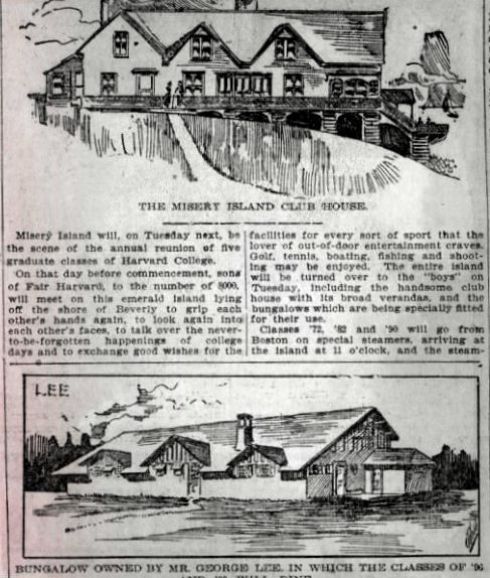
Out on Salem Sound the other day, sailing in a beautiful boat, I looked over at one of the several islands that mark the entrance to Salem Harbor and tried to imagine what once was. Off Great Misery Island there is a calm maritime meeting place referred to as “Cocktail Cove”: while one imbibes off-island now a century ago drinks were served on the island, first at the Misery Island Club, which became the Casino Hotel in 1904, and also in private cottages: 26 in all. Most of the structures on Great Misery were swept away by a fire in May of 1926 (just before the season), and both it and its adjacent island, Little Misery, reverted to nature under the stewardship of the Trustees of Reservations. But for a quarter of a century or so, Great Misery was quite a happening place, and its cottages attracted the attention of contemporary shelter magazines. House & Garden and The House Beautiful featured several Misery Island summer houses on their pages in their “aughts” heyday,  all bungalows, and all the work of Salem architect Ernest M.A. Machado, an extremely enterprising young architect who died far too soon.

Sailing to the Misery Islands, passing the Fame along the way–off Great Misery.

Misery Sailing

Misery Fame

Misery Today 2

Ernest Machado’s buildings on Great Misery: the Clubhouse/Casino (MIT Archives); the bungalow of Mrs. Charles Steadman Hanks (Mary Harrod Northend, “Some Seacoast Bungalows”, House and Garden, June 1905), “Ye Court of Hearts” (The House Beautiful, June 1905), the bungalow of Mr. George Lee, “The Anchorage” of Mr. George Towle (The House Beautiful, June 1909) , and “The Bunker” of Mr. Jacob C. Rogers (The House Beautiful, June 1906).

Misery Island Club

Misery Hanks collage

Misery Island Lee Bungalow

Misery Bungalow 2

Misery Bungalow 3

Misery Bungalow Bunker

Misery Bungalow Bunker 2

All of these Misery Island bungalow-owners lived on the mainland, either down in Boston or somewhere on the North Shore (Rogers was the last private owner of Samuel McIntire’s majestic Oak Hill, where the Northshore Mall now stands, or should I say sprawls), but they also owned summer houses along the Gold Coast: these cottages were for the weekend! The magazine articles accompanying these images emphasize the simplicity of the island bungalows, but it was a very deliberate, and very occasional, ethic. For about a quarter century, Misery was a Gilded Age playground, complete with shooting range and golf course, perfect for Harvard senior “Robinson Crusoe” picnics and reunions. Its moment might have been even shorter: social register references seem to appear with much less frequency in the teens and twenties, and then this very social chapter in the island’s history closes much more abruptly with the 1926 fire.

Misery club Bonston Post June 25 1902

Misery Reunion 2

Misery Fire collage May 8-10 1926 Boston Daily Globe

Misery Today

Misery Salem Harbor 2Newspaper reports of the 1902 Harvard reunions (Boston Post, June 22-25, 1902 ) and 1926 fire (Boston Daily Globe, May 8-10, 1926); Great Misery today, and home in Salem Harbor on a glorious early evening!


Mary Harrod Northend

I’m not bound to such designations, but as we’re almost running out of Women’s History Month and our mayor has declared March 29 Salem Women’s History Day I’ve decided to feature a notable Salem woman on this last weekend in March. After much deliberation–as there are many notable women in Salem’s history–I’ve settled on the author and entrepreneur Mary Harrod Northend (1850-1926). She has interested me for some time, and she’s popped up in several posts in the past, but she deserves her own. Northend was from old, old Massachusetts families on both sides, and this heritage is key to her life and work. Both parents were actually from northern Essex County, but moved south after their marriage: her father, William Dummer Northend, became a prominent attorney and a state senator for Salem. Mary was born at 17 Beckford Street, a side-to-street late Federal house, but the family moved over to Lynde Street, in the shadow of the Federal Street courthouses, in the later 1850s. Their grand Italianate double house, photographed for Mary’s books later, is now sadly chopped into 12 apartments by my count. The few biographical details I could gather refer to a childhood sickness; in fact by all accounts (or by no accounts) Mary led a quiet life in her childhood and adulthood, until she burst out in her 50s and started writing all about colonial Salem and colonial New England, necessitating regional travel, which she clearly embraced. Eleven books were published between 1904 and 1926, when she died in Salem from complications sustained from a car accident, and many, many articles for magazines such as Good Housekeeping, The Century and The House Beautiful: I haven’t had time to compile a proper bibliography. But she was an incredibly prolific woman: an acknowledged expert on New England architecture and antiquities, with a touch of Martha Stewart-esque domestic stature as well, forged by her publications on decorating and party-planning. Let us, she writes in a very Martha tone in The Art of Home Decoration: link the old and the new, working out entrancing combinations that are ideal, making our home joyous and bright through the right utilizing of great grandmother’s hoard.

Northend Birthplace Beckford Street Salem

Northend 1862 Portrait

Mary Harrod Northend’s birthplace at 17 Beckford Street, Salem; her father William Dummer Northend, newly-elected State Senator from Salem, 1862, State Library of Massachusetts.

Her books and articles reveal Mary to be a fierce advocate for “Old-time” New England; she is at the forefront of that (second?) generation of strident Colonial Revivalists, fearful that the (changing) world around them hasn’t developed proper appreciation for colonial architecture and material culture. She is evangelical in her love of clapboards, mantles, arches, doorways, garden ornaments, pewter and seamless glass. The phrase “detail-oriented” doesn’t even come close to capturing Mary’s appreciation of the things that were built and made in the colonial past: these things are her life and her world. And like any good educator–which she was–Mary wanted her (growing) audience to see her world and so she spared no expense when it came to photography, first taking her own photographs and then “directing” commercial photographers in the manner of a cinematographer, according to Mary N. Woods’ Beyond the Architect’s Eye: Photographs and the American Built Environment (2011). The end result was a vast collection of still images (there are 6000 glass plate negatives in the collection of Historic New England alone, though the entry in the biographical dictionary Who’s Who in New England for 1915 indicates that Mary has “20,000 negatives and prints of American homes”) which she used to illustrate her own books, sold to other architectural writers, and colorized in the style of  Wallace Nutting to sell directly to the public.

Northend Historic Homes 1914

Northend Doorways 1926

Northend Cook Oliver

Northend Framed Photo Cook Oliver

Two of Northend’s most popular titles, Historic Homes of New England (1914) and Historic Doorways of Old Salem (1926); the Cook-Oliver House on Federal Street in Salem, featured in Historic Homes and sold as an individual colorized print, “The Half Open Door”.

It’s relatively easy to research the work of Mary Harrod Northend: her books are still readily available in both print and digital form and prints from her photographic collection are at Historic New England and the Winterthur Library. But I wish I knew more about her business, the business of publishing books and photographs, writing, lecturing, collecting. I’m also curious about money: there’s definitely a bit of voyeurism in Northend’s books and I can’t discern why she remained in the family home on busy Lynde Street rather than move to the McIntire District just a few blocks away. In one of her most personal, yet still fictionalized, books, Memories of Old Salem: Drawn from the Letters of a Great-Grandmother (1917), the great-grandmother in the title lives on Chestnut Street, but Mary never did. This might have been a family matter: her widowed mother and sister lived right next door in the Italianate double house, which was also an appropriate “stage” for some of her photographs. I also think it was quite likely that Miss Northend was seldom at her own home, as she was so busy documenting those of others!

A very random sampling of Mary Harrod Northend photographs, mostly from Historic Homes and Colonial Homes and their Furnishing (1912), all from the Winterthur Digital Collections:

northend-gables-door1

Northend 10 Chestnut Door

Northend Robinson House Summer Street

Three very different Salem houses:  doorway at the House of the Seven Gables, entrance of 10 Chestnut, side view of the Robinson House on Summer Street.

Northend Pewter Mantle

Northend Waters House Mantle

Northend Mantles

Salem mantles: a pewter display, McIntire mantle at the Waters House (LOVE this louvred fire screen), Whipple and Pickman mantles.

Northend 29 Washington Square Hallway

Northend Ropes Windowseat

Northend Saltonstall House Haverhill Hall

Northend Kittredge House Yarmouth Remodeled Farmhouses Cape

Northend Bright House Beds

Details & decor I love:  hallway of 29 Washington Square, Salem, Ropes Mansion windowseat, entry hall at Saltonstall House, Haverhill, Attic and twin canopy beds on the Cape (from Remodeled Farmhouses, 1915–but all of Miss Northend’s books feature canopied beds! I would place them headboard to headboard.)

Northend Kate Sanborn House Spinning Wheel

Northend House Winterthur

Flagrant displays of Colonial Revivalism: Spinning wheel and fire buckets at the Kate Sanborn House, and Miss Northend’s own house on Lynde Street, all dressed up for Spring.