
While looking for an early map to illustrate the Gulf of Maine for my last post, it became increasingly clear to me how important Cape Cod was to early modern navigators and cartographers. It’s such a distinctive landmass, jutting, or curving, out into what was originally known as the “Western Ocean”; it’s no wonder the Pilgrims landed first on its tip, in present-day Provincetown. The more maps I looked at, the more it appeared to me that the Cape was absolutely central to the cartographic creation of New England as a region, though this might just be my eastern (or southern) bias. I assembled a chronological succession of early maps from the digital collections at the Fordham University Library, the Osher Map Library at the University of Southern Maine, and the Norman B. Leventhal Map Center at the Boston Public Library to illustrate my point.
One of the earliest maps of the eastern coast of North America was drawn by the Italian cartographer Giralamo Ruscelli in 1561. Ruscelli’s Tierra Nueva is based on the discoveries of the French-sponsored explorers Giovanni di Verrazzano and Jacques Cartier, consequently the place-names are in French and Latin and the depiction of New England (called Nurumberg and later “Norumbega”) is extremely minimized and conjectural. There’s a small curved peninsula on the right-hand side of the map but as the island of “Terra Nova” (New World—Newfoundland) is just off of it, I doubt it is Cape Cod. For reference (you can zoom in on the map at the BPL), the place labelled “Angoulesme” at center right is roughly equivalent to New York City.


Norumbega in the Theatrum Orbis Terrarum of Abraham Ortelius, 1570
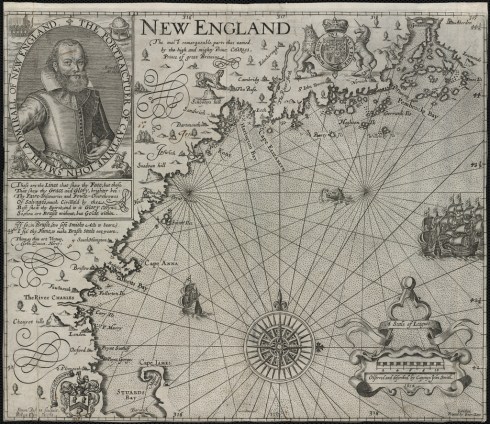
Jumping forward several decades, New England begins to assume a recognizable shape, and gets its name, on the 1624 map of Captain John Smith, based on his explorations of a decade before. This map was first published just after Smith’s return to England, and was very influential in the Pilgrims’ planning. Here you see a very realistic Cape Cod (named “Cape James” for the King) and lots of English place-names, some of which stuck, most of which did not. “Cape Anna” did become Cape Ann, though Salem (or Beverly, I can’t tell) replaced Bristol and my home town of York did not retain its designation of “Boston”.
As there was constant competition for colonial territory in North America, French and Dutch maps also depict New England and its waters in detail. Dutch cartography was the most advanced in Europe in the seventeenth century, and Dutch mapmakers issued a succession of “Nova Anglia, Novum Belgium et Virginia” maps from the 1630s, including that of William Blaeu below. Despite its distinct orientation, Cape Cod (or Codd) is immediately recognizable, and it is equally prominent in two late seventeenth-century English maps. The last map below, published by John Seller in 1679, is entitled A Chart of the Sea Coasts of New England, New Jarsey, Virginia, Maryland & Carolina from Cape Hatteras to Cape Cod. European cartographers clearly had a grasp on southern New England by this time, but northern New England, most especially Maine, remained elusive.


In the eighteenth century, everything intensified: competition for empire, mapmaking technology, and settlement, consequently we see quite sophisticated political and navigational maps, like the detailed charts of the Atlantic coastline by the Swiss-born cartographer Joseph Frederick DesBarres, produced for his 4-volume atlas American Neptune (1777-1781). The marine galleries at the Peabody Essex Museum feature a blown-up version of the DesBarres charts, revealing their intricate detail much more effectively than is possible here.


By contrast, London publisher Carington Bowles’ “pocket map”, also issued in the Revolutionary era, emphasizes the Inhabited parts of New England (Library of Congress).

From Ruscelli to Russell. After the Revolution, New England endures as an assemblage of states rather than colonies. The John Russell map of 1795 illustrates the “Northern or New England” states of America, and the District of Maine, just prior to the boundary settlement between America and Great Britain.

And finally, a completely different view of the Cape, from a century later and the golden age of “bird’s eye” maps: looking southward from Boston.






