Tag Archives: maps

Two Visions for Salem

I’m in the history business, so I rarely dwell on visions, unless they are in the rear-view mirror. But last week I happened to take two photographs while running around in downtown Salem, and when I looked at them later on my phone I realized that they represented two visions for Salem, at least to me. Here they are and then I’ll explain.

The first (top) one is a photograph of recent changes to Washington Street, the key north-south corridor in downtown Salem forever. Vehicle traffic has been limited to just one lane now, with parking alongside and an expanded sidewalk and hot-top bikelane. The present administration LOVES bike lanes and wants to install as many as possible anywhere and everywhere, even in this case at the expense of safety (how can an ambulance or fire truck possibly get through with one lane, especially during peak tourist time?), aesthetics, and congestion (look at all that parallel parking—that takes time–even for those who know how to do it!)

The second (bottom) photograph shows Salem’s 157th t-shirt shop, now installed in a very prominent building on the corner of Essex and North Streets, just across from the Witch/Corwin House. Just rows and rows and rows of t-shirts.

For me, the first photograph represents the City’s attempt to take back territory ceded to cars over the past century or so, in terms of both parking and driving. This is certainly a laudable goal with which I have no problem (except with the implementation—there’s just too much ugly concrete going in downtown in my opinion) but I think a corollary of that vision is one of a “15-minute city” in which residents can obtain all essential goods and services within a 15-minute walk or bike ride in any direction.The 15-minute city concept has been popular among planning professionals for the last decade after being introduced by Carlos Moreno, an urban studies and business professor at IAE Paris – Panthéon Sorbonne University. I actually think that Salem could be a 15-minute city, BECAUSE IT WAS, but not now—as that goal is completely incompatible with its current status as mecca for witchcraft tourism. I’m sorry, but I don’t think droopy or pointy witch hats are an essential good, nor palm readings an essential service. I live in downtown Salem, or right on the edge of it, and I know that I must drive to purchase shoes or go to the dry cleaner or the doctor. I’m not sure the concept of the 15-minute city is compatible with any city centered on tourism, unless it’s a big city, like Paris. But smaller cities have to make a choice, and to me, it seems like Salem has chosen tourists over residents. As evidence of that choice let me offer up another photograph that I took this past week, of the bump-out and bollards in front of the Ropes Mansion. Because of Hocus Pocus rather than history, this historic house is a popular walking tour and selfie destination, and unfortunately a car-on-pedestrian accident happened a few years ago. To accomodate and protect the crowds, the city expanded the sidewalk and installed many shiny black bollards, just another example of how Salem’s streetscape is being shaped not by the rhythms of daily life for its residents, but the demands of larger and larger crowds of tourists.

I’ve been thinking about the 15-minute city concept for quite a while, after discovering (actually being shown) an amazing map of downtown Salem in 1946 at the Salem State Archives and Special Collections. It’s a real estate map with a focus on businesses, incredibly detailed and revealing very clearly a 15-minute city in which everyone could buy or do anything within that radius. The variety of shops was just amazing: just place little witch hats on one part of one street on the sites of buildings  that were formerly shoe shops, druggists, stores selling fruit, paint, rubber, hats, and draperies, dry cleaners, and “Topsy’s Chicken Coop,” and you have the visual history in a nutshell. The SSU Archives has tons of busy street scenes on their Flickr page but I thought I would feature some more focused street scenes from a newish and loose collection of “Salem Streets” images from the Phillips Library as I have become enraptured by them! So yes, even though I started and titled this post with “visions,” I have reverted to form and am looking back. I just can’t help it: the future is a bit scary.

The incredibly detailed Nirenstein Realty Map of the “Business Section of Salem,” 1946, Salem State Archives and Special Collections and Dockham’s Salem Business Chart, n.d., Phillips Library Broadsides, above.

Views of Central Street, 1880s-1932, from the Phillips Library Salem Streets collection:

Brown Street, c. 1910, Phillips Library Salem Streets Collection.

A very old shop on Mill Hill (Washington Street) before the Great Salem Fire of 1914, Phillips Library Salem Streets collection.

And the cutest cobbler shop ever on Broad Street (of course there was no comprehensive zoning before the 1930s either—so the home/work/shopping radius could be very small indeed). Phillips Library Digital Collections.


“A Country by Itself”

A mayoral task force commission has been meeting for the past few months, called to contextualize charges that Salem’s City Seal is demeaning to Asian Americans and explicity rascist. The image in question depicts an apparent native of Sumatra’s westernmost province of Aceh in the foreground, with a pepper plant alongside and (an apparent) Salem ship in the background: a rare 19th century acknowledgement that a western society’s (Salem) prosperity was tied to its trade with the East. I posted about this issue back in the fall of last year, when my stance was generally supportive of the 1839 seal but open to a community dialogue. I’m doing so again because I’ve watched (there is no other way to “participate” besides a form you can send in) four of the Task Force’s meetings and after looking at images of the Sumatran figure presented alongside Sambo images as “proof” of racism and hearing an assertion that the seal is the equivalent of the Confederate flag I am convinced that this is not a serious inquiry. The Task Force has scheduled a listening session for July 14 and one member who is a Salem native and expert in Indonesia’s history and culture has yet to make an appearance so perhaps things will get a bit more substantive but I don’t have high hopes at this point. That a tradition of such longstanding should be given such short shrift is unfortunate—actually more than unfortunate, unsettling.

Salem’s City Seal was adopted as the insignia of the City in March 1839, and it was a rather “flexible” image for the next fifty years or so: the central figure even changed from a man to a woman!  In 1888, artist Ross Turner was commissed to paint the orginal seal (bottom left) and it was pretty much standardized after that. For the 1926 Tercentenary of the founding of Salem, the City produced Seal medals (bottom right). There has been no attempt by the Task Force as of yet to place this image—or its evolution—in any historical context; the assumption seems to be that the existence of an 1839 rendering of an Acehnese Native is without question objectionable and the best way to modify the Seal is simply to remove said Native and have a lovely Sumatran scene sans person. The City motto, “Divitis Indiae usque ad ultimum sinum” – “To the farthest port of the rich East” – never changed and doesn’t appear to bother the Task Commission. It has inspired a number of artistic creations: the piece below is quilted fabric but I’ve seen the same in tile and as a painting and print.

I really don’t want to watch these meetings anymore.; I come away from them feeling quite sad. I know why Salem people are troubled by the prospect of an altered seal because I’ve heard from some: for some civic service or upon retirement fathers and mothers and brothers and sisters received a seal from the Mayor of the moment as a photograph was taken and a memory made. It’s not so personal for me, but I do have a somewhat-related memory from around the time I first moved to Salem. I was still in graduate school, working on my dissertation, and I used the purchase of my first house and the move as a rationale to procrastinate as much as possible from working on it: I had four new (old) fireplaces and suddenly it was really important to deck them out with andirons and everything—even though it was June! So I drove around the North Shore, poking around every antique shop that I came upon. In Essex (most definitely the antique capital of the North Shore) I got into a really nice discussion with a man who told me (I’m paraphrasing from memory here) that in its heyday Salem was so prosperous and Salem ships so numerous that all of its trading partners in the East Indies thought it was “a country unto itself.” To them, Salem was the United States or the United States was Salem. I was looking at maps in his shop (because of course I had to have antique maps all over my new walls) and he said something like—and there’s a map somewhere, with Salem depicted as the United States. Well, for the next decade or so, I was looking for that map. I thought it would look something like this:

Well maybe a less strident SALEM but you get the point. Of course I never found this map, because it never existed! Once I started reading about Salem history (which was pretty much when I started this blog) I soon realized that my antique dealer had it wrong or I had it wrong: but the perception behind the nonexistent map was very, very real. It is expressed generally in all the maritime histories of the nineteenth century, as well as texts that probe the cultural history of America’s encounters with the East. Samuel Eliot Morison gives the most detailed description in his Maritime History of Massachusetts: While Boston ships followed Magellan westward around the Horn, Salem sent her vessels eastward to the Dutch East Indies, Manila, both coasts of Africa and the smaller islands of the Pacific, and so thoroughly did they pre-empt this trade that as late as 1833 Po Adam, the wealthiest merchant of Quallah Battoo ‘‘believed Salem to be a country by itself, and one of the richest and most important sections of the globe.” I’m not sure Po Adam was the wealthiest merchant of Quallah Battoo (Kuala Batu), the major pepper port in Aceh, but he was a well-known friend of the American traders who disembarked there, warning Captain Charles Endicott of the impending attack on his ship Friendship in 1831 which resulted in the retaliatory attack by the U.S. Naval Frigate Potomac in the following year. In his account, Endicott called him “my old and tried friend” and captains for the ships owned in part or whole by Salem’s largest pepper trader, Joseph Peabody, expressed the same sentiments. Trade is always about human relationships, for better or for worse, and I think that’s why Joseph Peabody’s son George, the Salem alderman who is universally credited with the conception and depiction of the Salem Seal in 1839, placed a person in the center of it. And when that figure is stripped from Salem’s seal, inevitably it seems at this point, all we will have left is a commodity (like a Witch here in the Witch City).

Drawing of Po Adam from James Duncan Phillips, Pepper and Pirates, 1949; George Peabody by John Singer Sargent, Museum of Fine Arts, Boston. 


Special Little Places: Closes, Corridors and Courts

Still basking in my Edinburgh afterglow as we finish the last week of classes of the Fall 2023 semester: at home, as a deficient boiler has rendered Salem State’s North Campus an uninhabitable place. Shades of 2020-2021 for sure! I’m actually teaching two online classes by choice next semester, but I was not expecting to be back on Zoom so soon. I had a bit of time to think about some themes I wanted to emphasize about my Scotland trip, and one is “special little places”: I find that in most (not all) European cities that I have visited there are urban spaces which preserve a bit of the past, off the beaten path. Little courtyards and lanes and ways. Off the Royal Mile in Edinburgh there are so many “closes”! It’s quite extraordinary really–some access other ways, some are closed-off, all seem to transport you off a busy street into somwhere else. Here are just a few: Riddell’ss Close AND Court, Advocate’s Close, Tweeddale Court and Bakehouse Close: the latter two arre Outlander locations, and I encountered an Outlander tour just after I took these pictures!

There are some special places in Edinburgh’s 18th century “New Town” as well, but not as many: it was laid out for breadth, perspective, and movement, just like an American city (well, at least the latter). There are places and lanes that give you a bit of that enclosure within the larger city feeling, like Circus Lane below, and the spectacularly picturesque Dean Village. You can still get away, or get back, in the New Town.

There are a few places in America where you can get this out-of-time experience. Beacon Hill in Boston is like that for me. Neighborhoods in Charleston, Alexandria, Annapolis, Newport and Nantucket. Salem used to have lots of little ways and squares, but it has always evolved, and most have disappeared. Everybody’s favorite little street is actually a court, Bott’s Court between Chestnut and Essex, and I can spot a really special little way on a 1916 map of Salem: (the) North Pole! I’m not sure where that place went, but it’s definitely no longer here.


A Slave Trader in Salem

I’ve learned a lot about Salem’s African-American history while writing this blog; I don’t think I would look at the city the same way otherwise. I associate Chestnut Street, where I live, much more with the Remond family and their myriad activities centered on Hamilton Hall than with any particular Salem merchant or sea captain. When I walk to work down Lafayette Street, I pass a neighborhood of parallel streets on my right, beginning with Pond and ending with Cedar, on which numerous African-American families lived in the mid- and late nineteenth century: John Remond had a house on Pond, and his eldest daughter Nancy Shearman lived in the neighborhood with her family, along with his successor as caterer to Hamilton Hall, Edward Cassell. I don’t have the same place-association as I do with the Hall on Chestnut Street, as all the structures on these streets burned to the ground during the Great Salem Fire of 1914, but I think about the neighborhood that was there before. The city directories make it clear that this wasn’t an African-American neighborhood; it was rather an integrated neighborhood, just like the Salem public schools from 1844. This neighborhood was so diverse that it was even home to a notorious Virginian slave trader, who resided at 29 Cedar Street intermittently for a decade or so, from 1851 to the beginning of the Civil War, along with his common-law African-American wife and their four children. As they say, you can’t make it up.

Part of Salem’s Ward Five: Henry McIntyre / H. E. B. Taylor / Friend & Aub’s Lith., MAP OF THE CITY OF SALEM MASS. From an actual Survey By H. McINTYRE. Cl. Engr. H. E. B. TAYLOR, ASSISTANT. Philadelphia: Henry McIntyre, 1851.

The slave trader in question was named Bacon Tait and his common-law wife was named Courtney Fountain. Both came from interesting Virginia families. I certainly did not discover their stories: as much as the limited sources allow, Hank Trent pieced together what can be known about their lives in a slim well-sourced volume entitled The Secret Life of Bacon Tait. A White Slave Trader Married to a Free Woman of Color (LSU Press, 2017) and you can also read an excellent summary at the Encyclopedia Virginia. But I think we need more Salem context, and I have questions; actually, just one: how did a notorious domestic slave trader maintain a residence in which was supposedly such an abolitionist stronghold as Salem? Obviously there are two assumptions in that particular question: that Tait was notorious (or at the very least conspicuous) and that Salem was abolitionist. To support the first assumption, we’ve got to start in Richmond, the second-largest slave-trading market of the antebellum domestic slave trade (after New Orleans). When he traveled to the United States as secretary to the popular novelist William Makepeace Thackeray in 1852-1853, the artist Eyre Crowe took advantage of downtime in Richmond to walk several blocks from his fashionable hotel to the slave market to sketch the scenes he saw there (before he was asked to leave), publishing them in the Illustrated London News upon his return to Britain. These sketches were studies for two paintings which illustrated and publicized the process of slave-trading on both sides of the Atlantic: Slaves Waiting for Sale, Richmond, Virginia and After the Sale: Slaves Going South from Richmond.

Eyre Crowe, Slaves Waiting for Salem, Richmond, Virginia (1861), Heinz Collection, Washington D.C.; After the Sale: Slaves Going South from RIchmond (1853), Chicago History Museum.

Bacon Tait was a major player in this Richmond trade and in Richmond itself: the pages of the Richmond Enquirer, the Richmond Dispatch, the Richmond Daily Times and the Richmond Whig record his real estate transactions, his political successes, and his slave-trading activities from the 1820s to the Civil War, even after he had moved to Salem in 1851: he traveled back to conduct business and also employed surrogates. His trade is also documented in the Slave Ship Manifests at the National Archives (a chilling source that I had never consulted before: not my period, thank goodness!) Notices of his “holding” facilities are particularly lengthy, and the Visitor’s Guide to Richmond (1871) records that Tait was the original builder of the infamous “Lumpkin’s Jail” (otherwise known as the “Devil’s half-acre”) in 1825. An “under new management’ advertisement from several years later reveals the inhuman dimensions of this particular side of the business.

In Massachusetts, William Lloyd Garrison’s weekly abolitionist newspaper, The Liberator, printed excerpts from the Richmond papers frequently, with lengthy commentary and annotations. When Tait announced the opening of his new “private jail” in 1834, The Liberator reprinted the copy and commented upon it, and a certain “P.H.” took the liberty of rewriting it for its readers: the entire piece was featured prominently on the front page of the December 27, 1834 edition of the paper. Charles Lenox Remond was the agent of The Liberator in Salem at the time: it’s unlikely that this item escaped his notice.

Tait’s relationship with Courtney Fountain began in the early 1840s, while she might have been in his employ as a housekeeper. She was originally from Winchester, Virginia and part of a minority (10%) of free blacks in Richmond at the time, but members of her family resided in the North and were active in abolitionist circles in both New York State and Massachusetts. It’s not entirely clear from Trent’s book how they ended up here, but Courtney’s sister Ann and brother John resided in Salem, as well as several cousins. Tait and Courtney had four children in the 1840s: Celine, Constance, Bacon Jr. and Josephine, each two years apart. Salem’s schools were desegregated in 1844 (thanks to the efforts of the Remonds) and Massachusetts abolished its anti-miscegenation law the year before. You can certainly understand the lure of Salem for Courtney, but it’s hard to picture Tait as a doting family man, which seems to be the only incentive for his departure from Richmond in 1852. In any case, he purchased the Leach House at 29 Cedar Street in July of that year: it looks like it was a lovely property, located on a bluff at the end of the street overlooking Mill Pond.

Bacon Tait is listed in the Salem Directories of the 1850s as a “merchant” living at 29 Cedar Street and in the 1855 state and 1860 federal censuses as well: there are no indications that Salem residents were outraged by his residence in their town or even aware of his existence. Charles Lenox Remond was living on Pond Street during the 1850s, just three streets over, and just a few doors down Cedar Street lived Adeline Roberts, a Salem schoolteacher and long-time corresponding secretary of the Salem Female Anti-Slavery Society. Miss Roberts corresponded regularly with William Lloyd Garrison, Lucretia Mott, and other abolitionist leaders, and in the very year that Tait moved to Salem, she was organizing a series of seven lectures on the abolition movement to be held at the Salem Lyceum in the fall. Tait never appears in her letters, but she must have been aware of his residency. Were there whispers at the Lyceum before every lecture? Was Salem society gossiping behind closed doors? I just don’t know. Tait seems like a ghost in Salem, but he was still conducting his business in Richmond: I suspect a lot of family letter-burning later on. That’s the problem: we can’t see (or hear) whispers from the past or letters that have been destroyed, we can only speculate. I’m assuming that Courtney’s family was protecting her and her children (and by extension, him), and I’m also assuming he kept his head down and conducted his trade via post and travel. All census documents from Salem indicate that Courtney and Tait were married, but there is a difference between state and federal censuses in designation of race: the federal census indicates that the entire family was white while the Massachusetts censuses indicate that Courtney and her children were of mixed race. I’m not sure what this means in terms of their presentation or perception.

What happened when the war broke out? Tait seems to have returned to Richmond permanently, leaving his family in Salem. He instructed one of his daughters to sell the house on Cedar Street in 1864, yet they all appear on the Massachusetts census as living there in 1865. Both Courtney and Tait died in 1871: she in Salem, he in Richmond: their four children remained in Salem, residing at various addresses. Tait left several wills, and the most recent one, leaving his fortune “to his illegitimate children by a mulatto woman, who held to him the relation of housekeeper, he having no lawful wife” was contested by various partners and employees in Richmond. Many transactions dissolving his real estate ensued, but I have no idea where the money went. Courney’s death notice was printed in the Salem Register (as “Mrs. Courtney Tait, Richmond papers please copy,”) as was Tait’s, with no further identification or detail. She is buried in Harmony Grove Cemetery with a lovely epitaph from her children; he is buried at another Gothic Revival cemetery, Hollywood in Richmond, with no epitaph at all. As for his reception, or lack thereof, in Salem, I haven’t found the answer to my question, but maybe my presumption is wrong. Maybe Salem wasn’t an “abolitionist stronghold;” maybe it was home to only a small minority of very vocal abolitionists in the 1850s who invited William Lloyd Garrison to speak every other month, protested the Dredd Scott decision vehemently, organized August 1st Emancipation Day celebrations, and pushed for Charlotte Forten’s appointment as the first African-American teacher in the Salem public schools. We always want righteous causes to be more popular than they generally were. Or maybe Tait just maintained his privacy: this seems more possible at that time than today. As I think about the past and the present I am struck by how wide the gap was between Bacon Tait and many of his Salem neighbors: we tend to think of our own time as divisive, but our divisions seem relatively insignificant compared to theirs.

No stigma in Salem: Celine Tait Burding, Courtney and Tate’s eldest child, commissioned a Tait family plot in Harmony Grove Cemetery for her mother as well as her own family: she married Willard Burding in 1873, had four children, and died in Salem in 1886. Courtney’s gravestone in the center reads simply “Our Mother” and bears an inscription derived from Shall we Gather at the River, published only six years before: “on the March of the Beautiful River that flows by the Throne of God she waits for us.” In Virginia, Tait’s family is described in less reverential terms: Petersburg Progress-Index, June 21, 1871.


A Big end-of-year Book Post

I always do a book post at this time of year for several reasons: it’s fun to go through the mental process of compiling “best of” lists, I like to offer gift suggestions, and the time between semesters is always one of intense reading for me. This year, I’m a little late for gift suggestions, but the two other inspirations apply: I read some great books over the past summer and I have my usual stack of unread books right by my bedside, all ready for December 26. This was the year that I published my own book, so I had more time for reading, but now I’ve just finished proposals for two new books, so the next year might not be so free (hopefully). I want to take advantage of the time that I have to read as much as I can, and I’m driven to learn more about: 1) Ukraine (because war); 2) commodities and trade in the pre-modern world (because saffron, the subject of one of my proposed books; 3) information dispersion, broadly defined (because academic+general interest); 4) the history of science (because academic+general interest); 5) early American history (because Salem, the subject of the other proposed book); and anything to do with design (just because). No fiction recommendations here, sorry: I  like fiction, I try to read fiction, but I just don’t seem to be able to finish novels at this point in my life. I put them down because I get curious about something: there are dog-eared spine-cracked books all over the house! So here goes: this is a “best of” list of what I’ve read or was on my radar in 2022 rather than what was published this year, and it’s pretty academic, but there are some fun and beautiful books here too.

Ukraine: I read Yale historian Marci Shore’s The Ukrainian Night: An Intimate History of the Revolution this past summer (and into September—it took me a while): I really learned a lot. My Ph.D. is in European comparative history, but boy, this book made me realize how little I know about Eastern Europe—and the twentieth century. The Ukrainian Night places the Crimean crisis of 2014 in historical context and thus also provides the context for the current crisis, and it is very much a personal, “intimate” history rather than an academic tome. I picked up Polish journalist Pawel Pieniazek’s Greetings from Novorossiya (2017) for more personal history of the ongoing conflict in eastern Ukraine and Timothy Snyder’s introduction: the latter (also at Yale) is my guide to everything Ukraine on Twitter (still). I imagine we’ll get “first-draft” histories of the Russian assault and Ukrainian response soon.

The demand, supply, consumption, and exchange of a range of commodities in the late medieval and early modern world are all academic and personal interests of mine, and 2022 was a banner year for books on all sorts of economic history. Any former student of mine will tell you that I believe that the Black Death was the most consequential event ever, for a variety of reasons, so I have been waiting for Belich’s book forever. It’s brilliant, and ties together all the trends and themes I have been teaching for years. I wanted to assign it to my undergrads this past semester, but I thought it would be a bit much for them. Future grad students, however, are duly “warned.” In terms of economic dominance in the world the plague made, it’s increasingly all about the Dutch, so Pioneers of Capitalism. The Netherlands 1000-1800 is a welcome book too. I like its long time span: too often the Dutch “Golden Age” seems to spring from a rather shallow pool. Anne Gerritsen’s The City of Blue and White has been by my bedside for a year or so, but I recently moved it to the top of the stack.

The City of Blue and White is definitely calling me, but it will probably have to wait until I have finished Pamela H. Smith’s latest book From Lived Experience to the Written Word. Reconstructing Practical Knowledge in the Early Modern World as I’m reviewing it for an academic journal. I wish I had read this book before I wrote my own, but Smith is a prolific and active scholar so I had the benefit of her prior publications. She teaches at Columbia, where she is also the Director of the Center for Science and Society and its Making and Knowing Project, which “explores the intersections between artistic making and scientific knowing.” There’s nothing new about “maker culture” and it was far more robust and fluid in the early modern era, when making became knowing. Jumping up a century or so and into the realm of visual information dissemination, I am obsessed with the new book series from San Francisco’s Visionary Press : Information Graphic Visionaries, edited by RJ Andrews, who told Print magazine’s Steven Heller that he is “obsessed with craft. To me, the most fascinating thing is to understand the story behind how something came to be.” That’s just how I feel, so I wish I had put these three books on my Christmas list. I’ll just have to buy them myself, beginning with volume on Emma Willard’s history maps (the “Temple of Time,” above, is just one) which are just fascinating in so many ways.

Speaking of ambitious and confident Victorians who believed in progress passionately, Iwan Rhys Morus’s How the Victorians Took Us to The Moon is a survey of nineteenth-century British innovators as well as the innovative “spirit” of their era. It’s a bit biographical for me but that approach definitely increases its accessibility. The other history of science, broadly and brilliantly focused, which I purchased this year is Lorraine Daston’s Rules: A Short History of What We Live By. I thought it would be a good aid for teaching, but I just devoured it, and find myself picking it up often: reference and readability: you can’t beat that!

My Salem State colleagues and I are collaborating on a book of essays for Salem’s 400th anniversary in 2026 and I’m going to have to do a deep dive into several periods of American history for my contributions. Since I’m not an American historian, I need some foundations, and I really like the “American Beginnings” series from the University of Chicago. Three series books are above: the first two explore a topic that my colleague Dane Morrison has been working on for a while: how trade to the East in particular and maritime history in general contributed to the formation of American identity. Dane has a book out this year too: Eastward of Good Hope. Early America in a Dangerous World. Salem was absolutely central to this expansive trade and thus to America’s emerging identify, and this is the broad context that we want for our book.

I’m just realizing that this is a very serious list so let’s lighten it up a bit! I’m not sure it’s an actual genre, but my favorite books to read for pleasure are “house stories” focused on houses and their evolution over time, along with, and because of, the people who lived in them. Here are three examples I picked up this year:

I absolutely hated the recent Netflix series on Anne Boleyn, Blood, Sex & Royality: it is that same weird hybrid documentary drama approach last seen in The Last Czars, which remains the most appalling historical “thing” I have ever seen. It’s so odd to see the main characters, actual historical people, engaging in intimacies followed by the commentary of a talking head. Anyway, one of the talking heads in Anne’s story, Owen Emerson, is one of the authors of The Boleyns of Hever Castle, which I absolutely love. I bought the book after I viewed the program, just to get all the horribly imagery of the latter out of my head, and it did. Clive Aslet’s The Story of the Country House is just wonderful, and I think Ruth Dalton’s Living in Houses. A Personal History of English Domestic Architecture (over four centuries) is going to be great too: I do hope I have time to read it. As you can see, I really need some stories of houses outside of Britain, so please send recommendations! Merry Christmas to all, and to all: try to reserve the week between Christmas and New Year’s for yourself: for reading (or whatever else you like to do).


Massachusetts Route 57

I have taken a lot of road trips this summer: west, south, north. On my way to any place in the first two directions, I’ve tried to explore a territory I call “middle Massachusetts” between the greater Boston area (which I tend to extend to Worcester) and the Berkshires. The latter has a very strong identiy as you can see from the map I found in a shop in Great Barrington, below, as does greater Boston, the North and South Shores, and Cape Cod. But I’m just not sure about the middle: part of it could be called the Connecticut and/or Pioneer valley, but other parts seem not exactly mysterious to me, but rather amorphous. My attempts to discover and characterize Middle Massachusetts has taken me down some small old roads, and so far my favorite route has been Massachusetts Route 57, which extends from just south of Springfield almost to Great Barrington, just north of the Connecticut border. This route is perfect: not one chain store, lots of old houses, general stores, taverns, rolling hills, rivers, state forests, and a lake or two. I’m not sure why it’s not referenced on maps of nineteenth-century Massachusetts turnpikes, as it was clearly a major route from Springfield to the Berkshires from quite early on judging by the structures that line its path.

From the Berkshire perspective above, Route 57 includes several western Massachusetts towns, but I don’t know, Sandisfield doesn’t feel very Berkshirey to me although it is formally in that county. My favorite town on Route 57, Granville, is definitely not a Berkshire town, nor is neighboring Tolland, and then you drive through the New Boston village of Sandisfield, Sandisfield proper, New Marlborough, Monterey, and then finally Great Barrington. Route 57 merges with Route 23, another nice old route but not quite as pristine and rural. Great houses line the road, some a little shabby, some very shiny. Soon I was in New York State, and I returned home on a series of other lesser-known east-west routes, in northern “Middle Massachusetts.” It’s just too easy to take the Mass Pike.

Structures in Granville, West Granville (for some reason I didn’t snap a picture of the very much open Granville General Store—which has great cheese—but I did capture the very closed West Granville Store) New Boston, Sandisfield and New Marlborough along Route 57.


A Salem Slaver

It’s beautiful here in Salem and I had a very colorful post all lined up for you: gardens, the arts festival, blue trees, doors of many colors, cats, my lady’s slippers, simple pleasures. But no, I had to read a letter from a son in a distant port to his mother back in Salem informing her of his father’s and her husband’s death during a slave revolt. I’ve even read this letter before, I’ve seen it quoted in undergraduate papers, I’ve been aware of its existence for years: but for some reason when I read it last night I knew I had to write about it, to exorcise it. I have been thinking about Jeremiah Lee of Marblehead and his wealth for several days, ever since I visited his beautiful house last week. I was curious about whether or not his wealth had been expanded through enslavement, and so I consulted the Massachusetts Slave Census of 1754, which has been digitized and made searchable by a very useful website entitled Primary Research: unfortunately, there was no return for Marblehead, but there was for Salem (83 enslaved persons) and since I was there I looked for some other Salem sources and then I found the letter. I thought, “I should read this again” and so I did and since then I’ve been unable to think of much else. It’s a terrible letter, but a very, very important one.

Transcript of the Fairfield/Felicity letter from Primary Research: it is also available in several collections and studies, and was first printed in the Essex Institute Historical Collections in 1888 (Volume XXV) where it is called a “strange epistle”. The original is in the Phillips Library. Crop of John Cary’s New Map of Africa, from the Latest Authorities (1805); A very complete description of Cape Mount several decades later is in Théodore Canot’s Captain Canot or Twenty Years of an American Slaver (1854): Canot was apprenticed in Salem, which he calls a “seafaring emporium” in the 1820s.

Here we have an early typed transcript of the letter of April 23, 1789 in which William Fairfield Jr. recounts a “very bad accident” which happened aboard the ship captained by his father William Fairfield, Sr., the schooner Felicity of Salem, while engaged in an illegal triangular trade: the legal institution of slavery had been outlawed in the Commonwealth of Massachusetts in 1783 and the slave trade in 1787. Bound for Cayenne, the capital of French Guiana and a major slave market, with a cargo of 35 enslaved persons on board, the “slaves rised above us” on March 26, killed Captain Fairfield and held the ship for a while, before young William and his confederates regained control. It sounds like William was incapacitated for a while as a result of being “scalt with hot chocolate” so I suppose it was the Felicity‘s crew who repossessed the ship without his help. After recounting the death and burial of his father, William adds that “we have sold part of the slaves [in Cayenne] and I hope to be home soon.” He’s so callous, so matter-of-fact, talk about the banality of evil: I scalded myself with hot chocolate but am otherwise in good health and we sold part of the slaves—I hope to see you soon! He is writing to his mother, of course, but this is a man who sounds as if he fears no consequences, and I couldn’t find any consequences for him or the crew of the Felicity. Young William continued his maritime career, often sailing on ships belonging to one of the Felicity’s owner Joseph White, who would be murdered in his bed in one of Salem’s most scandalous crimes in 1830. There is no mention of how he died in Captain Fairfield’s brief death notice in the Salem Mercury. 

The only person who seems to cast judgement on the Fairfields, or Mr. White, is (of course) the Reverend William Bentley, our constant commentator, who criticized all the vague trips to an unspecified “Africa” during the 1780s and 1790s in general and Captain Fairfield’s voyage in particular. In the Fall of 1788, he wrote: Captain William Fairfield, Felicity, Sch. sailed, according to clearance for Cape Verde Islands. It is supposed from the cargo, this latter carried and the character of the owner, that the vessel is intended for the slave trade. The owner confesses that he has no reluctance in selling any part of the human race. The even in its probably consequences gives great pain to thinking men, and in consideration of the owner’s easy circumstances, is supposed to betray signs of the greatest moral depravity. It is a daring presumption to dictate to divine wisdom, but when God’s judgements are abroad in the earth, sinners will tremble. The positive law of this Commonwealth is against the Slave Trade which it is to be hoped will be seriously noticed [Diary, Volume I, 104]. Well obviously Bentley spared no words regarding Mr. White, but does not opine on the death of Captain Fairfield, noting only that he was “killed by negroes” in the following June. And I don’t seem to be able to find any “serious notice” taken of this particular voyage or the sixteen other slave voyages from Salem before 1860 listed in the Transatlantic Slave Trade Database [another extremely valuable source]. Perhaps that’s why there was a slave ship sitting in Salem Harbor on the eve of the Civil War.


The Eminent Antiquarian

I have been meaning to post on the most eminent of Salem’s antiquarians, Henry FitzGilbert Waters (1833-1913) for a while, but I kept finding more information about him and thought I’d wait until I had the total picture: but clearly he is one of those people for whom references will always appear and it will be impossible to draw the total picture unless one is doing so in the form of a longer piece or even a book. His papers are at the Phillips Library in Rowley, so that might be an interesting project for someone, as genealogy is so popular right now and he is clearly one of its pioneering professional practicioners. But for (or from) me, just a little introduction. Salem produced a succession of eminent antiquarians—-Joseph B. Felt, Sidney Perley, George Francis Dow—so calling Henry F. Waters the most eminent is a big statement, but I think he was: his combinantion of intense genealogical research and incessant collecting gave him a very public status in the later years of his life, and after. And he was the New England Historical and Genealogical Society’s first “foreign agent!” In the obituary written by his friend and Harvard classmate James Kendall Hosmer for the January 1914 issue of the NEHGS’s Register, Hosmer calls Waters “the most eminent antiquarian of his time, perhaps of all times,” so I am just following suit.

Waters in his uniform at the beginning of the Civil War (he served with Co. F, 23rd Regiment, Massachusetts Volunteers until he came down with rheumatic fever followed by yellow fever and then in hospitals after his recovery) and in the facing pages of his publications; portrait by Salem artist Isaac Caliga in the bottom right corner.

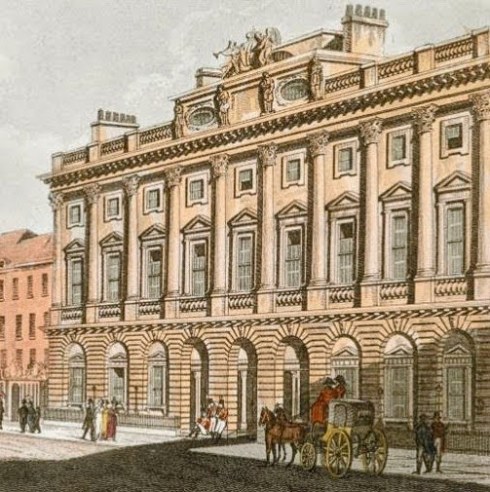
Waters grew up in Salem and went on to Harvard and service during the Civil War, after which he returned to his native city and dabbled according to Hosmer: he “was engaged not earnestly in educational work, collected old furniture, and pored over old documents.” He lived with his parents and unmarried brothers at 80 Washington Square, a c. 1795 McIntire mansion on Salem Common which belonged to his mother’s family (the Townends—who seem to be the reason for his ability to dabble, though his father was a judge). This house was obviously very important to him, as it was his primary residence for his entire long life, but I believe that another “house” was even more important to him: Somerset House in London, a grand classical building on the Strand which is now an arts center, but was the principle probate records repository during Waters’ lifetime—and long after. Waters went to London for the first time in 1879 with his friend Dr. James A. Emmerton (a medical doctor who also preferred to dabble) and they dove into these and other records, looking for anything and everything that might pad the pedigrees of New England families. They were very successful, and published genealogical “gleanings” in both the Historical Collections of the Essex Institute and the Register. Requests for more research were forwarded to both institutions, and in 1883 Waters returned to London as the first salaried “agent” of the New England Historical and Genealogical Society. He remained there (with occasional trips back home) for the next 17 years, during which he traced the lineages of just about every Salem mercantile family and established a national reputation through the continual publication of his genealogical research in journals and books as well as his detailed ancestries of John Harvard, Roger Williams, and George Washington.

80 Washington Square in the 1890s, Frank Cousins Collection at the Phillips Library via Digital Commonwealth; Somerset House in London, Rudolph Ackermann, 1809, British Library; An Examination of the English Ancestry of George Washington: Setting Forth the Evidence to Connect Him with the Washingtons of Sulgrave and Brington (1889).

Waters is credited by his contemporaries with “historical” discoveries as well as genealogical ones: I’m always a bit suspect of archival “discoveries” as that word slights the efforts of archivists, something I am always reluctant to do! But Waters brought several seventeenth-century maps to light, at least over here, including what became known as the “Winthrop-Waters Map” of the coast of Massachusetts c. 1630 and a colored map of Boston Harbor in 1694 which he had copied, as well as Samuel Maverick’s Briefe discription of New England and the severall townes therein: together with the present government thereof (1661) which had been purchased by the British Library several years before his arrival in London. I really think we should term these American discoveries, but they are very much in keeping with Water’s role as a retriever of textual and material heritage.

Copy of “A Draught of Boston Harbor: By Capt. Cyprian Southake, made by Augustine Fitzhugh, Anno 1694;” made for H. F. Waters, Esq., from the original in the British Library, copyright New England Historical and Genealogical Society.

On to the material. Waters’ lifetime closely coincides with the rise of Colonial Revival culture in New England, although he had a headstart on collecting: Hosmer and other observers state that he was able to get the good stuff before antiquing became fashionable and New England became picked over. The authors of the first books on American antiques all referred to him, and Dr. Irving Lyon, the author of the popular and influential The Colonial Furniture of New England is positively deferential, showcasing seventeenth-century chests, a desk and a chair, and other items from the “Waters Collection.” It was clearly all about the seventeenth century for him; I presume he believed that Salem’s Federal-era furniture was appreciated sufficiently in his day.
Furniture from the “Waters Collection” in Irving Lyon’s Colonial Furniture of New England; Essex County cabinet, c. 1670-1710, from the collection of “noted” antiquarian Henry F. Walters, Yale University Art Gallery; An English chair brought to America in the 1630s from Walters’ collection, Museum of Fine Arts, Boston.

This was a man who was appreciated during his lifetime, and after, but I think there is still more to discover and emphasize about him. We could embellish his role as Colonial Revival “influencer”: former Peabody Essex Museum curator Dean Lahikainen emphasized this role in relation to Salem artist Frank Weston Benson in the PEM’s 2000 Benson exhibition. Waters had tutored Benson and his brothers who grew up nearby on Salem Common and several of Benson’s paintings featuring interiors included items from the Waters collection or inspired by it. I think that Waters’ educational roles are a bit underemphasized: he was a gentleman tutor for sure: but he also held formal teaching positions at different times in his life and served on the Salem School Committee. His family is very interesting: he proudly served in the Massachusetts Massachusetts 23rd and in the medical corps, but several of his Waters cousins owned and operated plantations in the south—in Georgia and Louisiana (The Waters Family papers at the Phillips Library in Rowley will yield many “discoveries”, I am certain). And there is also more to say about his genealogical methodology, which I think would be of interest to contemporary genealogists. Salem is projecting a strong and rather stodgy heritage profile during the dynamic Gilded Era, and Mr. Waters was one of its most prominent exemplars.


Sidney Perley’s Houses

Sidney Perley (1858-1928) exemplified that exhausting mix of endeavors—historical, genealogical, archaeological, architectural, legal, literary—which in his time was represented by the occupational identity of an “antiquarian.” It was a title he proudly bore, and one which had primarily positive associations a century ago. Now it is itself an antiquated term and I don’t know any historian who would refer to themselves as such. I’ve read pretty much everything Perley wrote about Salem, including the multi-volume History of Salem he published just before he died, and while I wish his work had a bit more context and interpretation, I still value it and think of him as a historian, primarily because he was so very focused on making early public documents public. His meticulous research and publication of probate records, deeds, and town documents was service-oriented; he was very much a public historian in his own time. And more than that: there is a famous dual characterization/division of historians by the French historian Emmanuel Le Roy Ladurie, who observed that they fell into one of two camps, either that of truffle hunters, “their noses buried in the details,” or of “parachutists, hanging high in the air and looking for general patterns in the countryside far below them.” Perley was the ultimate truffle hunter, and I’m grateful for all of the detailed information he dug out for me. Because he was trained as a lawyer, Perley’s publications on local history are overwhelmingly based on deed research, and this focus made him somewhat of an architectural historian as well: he sought to portray the built environment, not just land grants and transfers. His wonderful little series of “Parts of Salem in 1700” (and other Essex County towns too), first published in the periodical Essex Antiquarian and/or the Historical Collections of the Essex Institute and later incorporated in the the History of Salem, always included charming illustrations of houses, both on his hand-drawn maps and in the text. Now while I trust Sidney Perley completely in his dates for the construction, transfer, and demolition of these houses, sometimes I think he displays a little artistic license in their depiction. But maybe not: I’m just not sure.

The Essex Antiquarian Volume III (1899).

I’m not sure because sometimes he is a bit vague about the sources for his house illustrations. I would say that I have complete confidence in the depictions of about three-quarters of his illustrations: they were still standing in his time, or had been recently demolished, or had been sketched or photographed before demolition. But with some houses, he is relying on the memory of an anonymous elderly gentleman who gazed at the house early in his life, or on an undated sketch by an anonymous artist found in the depths of the Essex Institute. I’m always interested in the early days of historic preservation, or the first stirrings of some kind of preservation consciousness, so the depictions of these first period houses by Perley and his fellow antiquarians are just fascinating to me: their visions created houses that are still showcased in Salem, most notably the House of the Seven Gables and the Witch (Jonathan Corwin) House. Their visions shaped our visions of the seventeenth century. I like to imagine Perley’s houses still standing, and the best way to do that is to map them: my progress in the acquisition of digital mapping skills stopped as soon as I got my book contract in the summer of 2020, and as I am now working on another book it will stay stalled for a while, but I can cut and paste with the best of them! I am using Jonathan Saunder’s 1820 map of Salem from the Boston Public Library as the background for an evolving Perley map here, but later maps, with more crowded streets, really make these structures stand out too: they must have been so very conspicuous in Perley’s time. I find it interesting that in Europe, very old and very modern structures can coexist, side by side, but we seldom see that in America.

Jonathan P[eele?] Saunders / Engraved by Annin & Smith, Plan of the TOWN OF SALEM IN THE Commonwealth of Massachusetts from actual Surveys made in the years 1796 & 1804; with the improvements and alterations since that period as Surveyed by Jonathan P. Saunders. Boston, 1820. Proceeding clockwise rather haphazardly from the Epes House, on the corner of the present-day Church and Washington Streets, to the Lewis Hunt House, which was photographed before its demolition.


The MacCarter and Bishop Houses: the latter burned down in the 1860s but was fortunately sketched a few years before.


Some survivors in this bunch! The John Day House survived until Frank Cousins could photograph it in the 1890s (Phillips Library, Peabody Essex Museum), I’m not sure if Perley’s “John Beckett” house on Becket Court is the “Retire Becket” House on the House of the Seven Gables’ campus? Half of the Christopher Babbidge house survives to this day, though it moved to the parking lot of the 20th century building which replaced it.


A Tory-Loving Town?

Salem has a bit of a reputation as a “Tory-loving town” due to the sentiments of some of its more conspicuous residents on the eve of the Revolution: prominent judges, merchants and lawyers could not reconcile their local and imperial loyalties and thus became exiles for the duration of the Revolution, or for the rest of their lives. The Banishment Act of the State of Massachusetts, issued in 1778 “to prevent the return to this state of certain persons therein named and others who have left this state or either of the United States, and joined the enemies thereof” named only four Salem Loyalists, William Browne, Benjamin Pickman, Samuel Porter and John Sargeant, but this is only a fraction of those who were identified as Tories by their own words or those of their contemporaries. The British archives, family genealogies, and contemporary newspapers point to a lot more: I did a very cursory search and came up with: Henry Gardner, merchant and shipowner, Captain Thomas Poynton, apothecary Nathaniel Danby, physician John Prince, Customs official Jonathan Dowse, merchant George Deblois, schoolmistress Mehitabel Higginson, John Fisher and Samuel Cottnam, as well as the well-known gentlemen Andrew Oliver, Samuel Curwin, the Honorable Benjamin Lynde, and William Pynchon, and I’m sure that this is not an exhaustive list. Most of these names are featured on the very warm address offered to General Gage upon his removal of the provincial capital from Boston to Salem in the late Spring of 1774, and I suspect the remaining signatories had similar sympathies.¹ Timothy Pickering’s father was a Tory! Despite the pretty dynamic historiography of New England Loyalists, and some very accessible accessible primary sources, I don’t think we know enough about Salem’s Tories and their stories.

Just a few monographs and primary sources for the further study of Salem’s Loyalists; Congratulations to General Gage.

Some of the more interesting Tory anecdotes focus on houses. In Sarah Orne Jewett’s The Tory Lover (1901) a character expresses her concern for the potential consequences of her friend’s entanglement: “I could not pass the great window on the stairs without looking out in fear that Madam’s house would be all ablaze…..There have been such dreadful things done against the Tories in Salem and Boston!” The “dreadful” acts against Salem Tories included a mob attack on the Ropes Mansion in March of 1774 while Judge Nathaniel Ropes lay inside dying (of smallpox) and the shattering of windows at William Pynchon’s Summer Street house. The cause of the mob attack on the Ropes house might have been the judge’s high judicial salary or contagious disease; nevertheless he died the day after it happened. Salem’s nineteenth-century historians recounted a “family tradition” that Thomas Poynton’s house, with its distinctive gilded pineapple over the doorway, was also attacked: he fled in 1775 and died in England in 1791. William Pynchon boarded up his windows and remained in Salem, documenting its revolutionary social life in his famous diary. Other Tories remained and appear to have suffered few consequences for their views (Andrew Oliver) while several were welcomed back after 1783 (Benjamin Pickman; Henry Gardner). Diaries and letters reveal some of their stories, but I think a more collective and integrative approach would yield more insights. It was all so very personal: there were obviously family and friendship connections among Salem’s Loyalists, but some families were divided by the Revolution as well. Salem has no Tory Row like Cambridge because the site of many Loyalist residences was the ever-evolving Essex Street, but a primitive (sorry! still working on my digital skills here; the book interrupted my progress) mapping can mark the Tory presence and/or absence.

Tory Houses: several survive but most are long gone. The Ropes Mansion in its original location, right on Essex Street (Old-Time New England, 1902); The Salem Chamber of Commerce is located in Dr. John Prince’s much-altered house on Essex Street, and Historic Salem, Inc. is located in the much-altered Curwen House, which used to be situated on Essex Street.

Only William Browne’s mansion, firmly and conspicuously located in the center of Salem, was confiscated: it would be replaced by the grand (but short-lived) Derby Mansion after the Revolution. The transition of power and influence from the Brownes to the Derbys seems rather revolutionary in many ways. When I look at the last Salem advertisements of two Tory shopkeepers, I wonder about all their stuff: for them, leaving was not just a matter of turning a key and leaving some associate (or their wives) to look after their property. (I also wonder if Nathaniel Dabney’s “Head of Hippocrates” sign was quite as big as depicted). Henry Gardner apparently paid taxes to the Town of Salem during his period of exile: perhaps that preserved whatever property he left behind. By contrast, Samuel Porter was clearly missing things upon his return. And what of Salem’s African-American residents, especially those who were enslaved: a 1777 petition by a “Great Number of Blackes” stated their case for freedom with revolutionary rhetoric, but were others enticed by British offers of liberty? Clearly there is lots to learn about Loyalists.

Essex Gazette, June, 1774; Salem Mercury, June 20, 1788.

¹James Stark, in his Loyalists of Massachusetts and the Other Side of the American Revolution (1910) states that “The importance of the following addressers is out of all proportion to their apparent significance. They are an indispensable genesis to the history of the Loyalists. For the next seven years the Addressers were held up to their countrymen as traitors and enemies to their country. In the arraignments, which soon began, the Loyalists were convicted not out of their mouths, but out of their addresses. The ink was hardly dry upon the parchment before the persecution begain against all those who would not recant, and throughout the long year of the war, the crime of an addresser grew in its enormity, and they were exposed to the perils of tarring and feathering, the horrors of Simbury mines, a gaol or a gallows.” but I think this is a bit of an overstatement.