Tag Archives: Local History

Heroes Uncovered

Salem has three historic downtown cemeteries and the one closest to my house is Broad Street, where I go weekly to wander around and learn something new from the gravestones. Its neighbors have been stewards for as long as I’ve lived in Salem, but over the past few years the cemetery has just looked better and better, acquiring a new permanent entrance sign featuring its notable occupants and seasonal flags for those who were veterans. Yesterday, there were more waving flags than ever, as the Friends of the Broad Street Cemetery held an event showcasing the efforts of their vice-president Kenneth Dike-Glover, who has uncovered many previously unknown graves of veterans, particularly those of the Revolutionary War. Ken was aided by a newly-discovered map, a local example of the Veterans Graves Registration project undertaken under the auspices of the WPA in the 1930s, and he told us in exuberant detail how he worked with this map to mark graves that he (we) didn’t even know were there. It was a lot of work, and it is ongoing: one particular mystery involves of the most famous graves in the cemetery, that of Timothy Pickering, Quartermaster- General of the Army during the Revolution and later Secretary of War and State, who just might not be buried under the perfectly preserved and DAR-marked Pickering family stone but rather under a derelict and unmarked one a few feet over! This is just one example of the often-perplexing process of correlating written documents with physicial spaces: it’s not as easy as it sounds. Maps do not always reveal all; sometimes they create more mysteries. But there were definitely revelations in terms of uncovered ground markers and veterans less conspicuous than Pickering whose graves were “hiding” under their family markers–now uncovered, and in plain sight. Ken had marked each grave with a flag and brief biographical and historical references, so after his talk, we all wandered around and got to know these uncovered heroes. I can’t imagine a more perfect Memorial Day activity.

A beautiful day in the Broad Street Cemetery. Ken Dike-Glover and the WPA Map; City of Salem Veterans Agent Kim Emerling, and some of the marked graves, including the two Pickering tombs. The Friends of the Cemetery are soliciting volunteers to help with their inititatives and advocacy, so if you’re interested in early American history (or just cemeteries), check out their facebook page here.

As I was meandering about digesting all of this new information, I was struck by how many privateers are interred in this cemetery. I knew about Jonathan Haraden, the superstar of Salem’s privateers (on whom we have a short chapter in Salem’s Centuries, featuring lots of new research!) but Captains David Smith and Francis Dennis (among others) were new to me and I look forward to reading more about their exploits and service. Captain James Barr (one of about a score of Revolutionary War veterans who lived long enough to be photographed) is also buried in Broad Street, along with approximately 70 of his contemporary brothers-in-arms, but the cemetery also features the recently-rededicated tomb of Brigadier General Frederick Lander and on an adjacent stone, the poignant epitaph of his Civil War comrade, Brevet Colonel Samuel Cook Oliver, who was wounded severely at Antietam: died after many years of suffering, cheerfully and bravely borne.

Salem heroes, long-known and recently-uncovered.


A Big Salem History Project, 1952!

I receive gifts from readers of the blog from time to time and they are all very special and much appreciated. A reader sent me a slim, illustrated and bound History of Salem prepared by a “committee of students and teachers of the Salem Public School System” in 1952 several years ago, and I was immediately charmed by it but not quite inspired to post about it. But yesterday I woke up and it was the first thing on (in?) my mind. I think I’m inspired by the end of the academic year and the completion of academic projects, by my own local history project, and by the Salem Quadricentennial planning, or lack thereof. The City has not put a lot of resources or time into planning for Salem’s 400th anniversary in 2026, and there have been meetings only for invited “stakeholders” rather than the general public. A dedicated website went live only last week, and the dedicated coordinator seems largely on her own. I was getting quite depressed about this, especially the lack of public engagement, but last week we came up with a neat (public) initiative at Salem State, so my depression turned into excitement—-and then I thought of this little book.

This little book has a strong voice, and it is a voice from 1952. It really captures the perspective of that year, that moment. Of course, there is the “White Man” and there are the “Indians” and they seem to have a very Thanksgiving-esque relationship. There are entire chapters on civic responsibilities (including a relatively long discussion of TAXES) and “Salem’s Contributions to our Country’s Call.” There are no women, and no one with anything but a very Anglo name, included in the chapter on “Famous Citizens of Salem.” It’s pure unbridled mid-century optimism, but from more of a working-class than privileged perspective. Students from the Salem Vocational High School contributed to this volume (including the great illustrations which I am including here—trying not to crop the names of the illlustrators), along with those from the Salem Classical and High School and the Phillips, Pickering, and Saltonstall Schools. This history portrays a city to which many visitors come to see the architecture, but is not yet Witch City. The Salem Witch Trials get a few pages; the Revolution gets more—even the Civil War gets more (we read about all the Union generals that visited Salem and that in 1866, “111 applications for financial assistance were received by the Naumkeag Army and Navy Relief from Civil War veterans and their families.” Details, details!)  The Salem Fire seems like a very, very recent memory: their parents and grandparents must have impressed it upon them.

And of course, World War II is a much more recent memory, even their memory. At the end of each chapter, there are “suggested activities” for students and two such activities were to “talk with relatives and friends and learn their reaction to the Pearl Harbor affair on December 7, 1941”  and to “bring in any decorations that your relatives have earned.” Pride characterizes this activity and this chapter, but really the tone throughout the entire text is one of pride, pride in Salem because it is an “important” city characterized by beautiful architecture and busy mills (not a contradiction in their representation) and its citizens have made “important” contributions to the nation. The students feel sure that [their readers] will be proud to say “I live in Salem, a city rich with dramatic reminders of the past, a city which with its great industrial power offers me a bright and promising hope for my future.” 


Salem and the Eclipse of 1806

Apparently we have not seen a solar eclipse of such long “totality” since 1806, and in that year the “point of greatest duration” of daytime darkness was Salem, timed at 4 minutes and 48 seconds! When I read that, I had to drop everything and do a little research into this very notable eclipse in early America, starting with a pamphlet by Boston instrument maker Andrew Newell entitled Darkness at Noon (more than a century before and much more literal than Koestler). This is a wonderful little book that Newell published just before the 1806 eclipse, to get everybody ready, and it actually made me more excited for the great North American Eclipse of 2024! I will not be following Newell’s advice for eclipse-viewing, however, using “a piece of common window glass, smoaked on both sides sufficiently to prevent any injury to the eye.” The author James Fenimore Cooper offered colored panes of glass to friends and family viewing the eclipse in New York State, where Spanish astronomer José Joaquín de Ferrer, made measurements and drawings of its totality in Kinderhook, and coined the term corona.

Andrew Newell, Darkness at Noon: or, the Great Solar Eclipse of the 16th of June, 1806. Boston: D. Carlisle & A. Newell, 1806 (you can read the entire text at the Linda Hall Library); Ferrer’s Corona Sketch, 1806.

Back in Salem, the famed mathemetician Nathaniel Bowditch was also recording observations of the phenomena he observed on June 16, 1806, right in his backyard. They were later published as a Memoir on the Solar Eclipse of June 16, 1806 (plus an addition). You can sense the intellectual community in which he lived from his notes:  The time of conjunction deduced from my observations at Salem compared with the time of conjunction at Paris, computed by La Lande, gives, by allowing 53 seconds for the difference of meridians of Salem and Cambridge, the longitude of Cambridge Ah. 44 24 *9 W from Greenwich, as is shown in the additional observations on that eclipse given in this memoir. Among the general population, there is no sense of fear, only wonder, and the most popular adjective in day-after reports of the eclipse was sublime. The Salem Gazette’s report was purely descriptive: Yesterday the great solar eclipse took place, agreeably to the calculations which had been made. The day was very favorable to viewing it. The air was remarkably clear, and there was not a cloud in the hemisphere. As the sun shut in, the stars appeared, and many were visible at the time of total darkness. A considerable alteration in the temperature was felt during the continuance of the eclipse.

Philadelphia publisher John Poulson adapted Newell’s pamphlet for his Philadelphia readers in the  “Approaching Solar Eclipse” (courtesy Boston Rare Maps) and Simeon De Witt, the Surveyor General of New York State, described the eclipse in Albany in a letter to the American Philosophical Society which was accompaned by a painting of its corona by local artist Ezra Ames. (I’m kind of anxious about how these guys captured their coronas!) The broad swath of the 1806 eclipse.


The Salem Tercentenary, 1926

As I’ve been finishing up the manuscript of our 4o0th anniversary volume, Salem’s Centuries, I’ve been writing and thinking about Salem’s 300th anniversary quite a bit. For some reason I thought that I had already posted about this big event on this unwieldly blog, but I haven’t. Quite a lot is out there—the archivists at the Salem State University Archives and Special Collections oversee an ever-larger collection of historical photographs of Salem, many of which they have uploaded to Flickr, and among them are some great Tercentenary views. This is really the best place to go for local history, including an array of blog posts which put their collections in context. So maybe, in my writing-and-teaching-brain-fog, I confused their output for mine? I don’t know, but there’s certainly no Tercentenary post here so I thought I’d pull one together. I’m quite impressed by the activity of the 1926 Tercentennial but it was certainly more celebration than reflection. This was not a moment to be at all critical about the city’s past; this was a party! Beginning on July 3, 1926 and commencing on the 10th, city residents were feted by parades, street parties, reunions, balloon ascensions, a big ball, a field day, a firemen’s muster, a bonfire, various illuminations, and concerts, concerts, and more concerts. Many people were involved in the planning, at least hundreds if not more. Starting in 1924 a general committee came together, followed by the appointment of chairs of the various subcommittees: the bonfire, music, fireworks, the horribles parade, sports, the military, civic, and historical parade, historical exercises, banquet, costume ball, floral parade, firemen’s muster, entertainment and publicity. Then the work began and there were some alterations: a “great” civic and military parade was severed from the floral and historical parade when it became apparent that the consolidated parade would be very, very long and that the guest of honor, Vice-President George Dawes, could be in Salem only for a short period of time. (President Coolidge was invited to the Tercentenary shortly after his election and I have no idea why he couldn’t turn up—it seems like a slight, as didn’t he summer in Swampscott?) The planning seemed to go smoothly but I have no real insights into subcommittee deliberations—I’m not sure where the meeting meeting minutes are, or if there were any. But they seem to have thought of everything, including a temporary “hospital” installed in the Phillips School overlooking Salem Common. The one big pre-celebration problem that surfaced was in relation to one of the big arches erected at the entrances to the city, specifically the arch at the Salem-Beverly Bridge. Once completed, a furor arose: it said “Greetings” rather than “Welcome” and on the wrong side! Greetings was simply not welcoming enough, and people leaving the city and crossing over to Beverly were being greeted! It cost the princely sum of $700 to fix this arch sign but it had to be fixed and so fixed it was.

I think that was it for the missteps, and then came July, and they were off! Here’s the schedule:

Sunday the 4th: Bells ring all over the city, followed by religious services, and then a huge band concert on the Common. Presumably this is what the brand new bandstand was built for, but as the band consisted of “300 pieces” I don’t think all those musicians could have fit in there. In the evening, a 100-foot bonfire was set ablaze (we are right in the midst of Salem’s big July 4th bonfire craze at this time).

Monday the 5th: The “Grotesque, Antiques & Horribles Parade” featuring Salem schoolchildren in costume competing for prizes (this is another Salem/North Shore July 4th tradition).

We are the Freaks Float, Nelson Dionne Salem History Collection, Salem State University Archives and Special Collections, Salem, Massachusetts.

Tuesday the 6th: Tours of old Salem homes open for the occasion, many, but not all, on Chestnut Street, and an exhibition of “treasures brought to Salem by the sea captains of old days.” In the evening, a balloon ascension at Salem Willows and an “illumination” of US Navy vessels in Salem Harbor.

Wednesday the 7th: the “Great” Parade, with Vice-President Dawes in attendance. This was followed by an historical address on Salem Common, another band concert, and fireworks.

Vice President Charles G. Dawes, Mayor George J. Bates, Governor Alvan T. Fuller, and Congressman William M. Butler; Nelson Dionne Salem History Collection, Salem State University Archives and Special Collections, Salem, Massachusetts.

Thursday the 8th: Family reunions for “Old Planter” families; I’m not sure about everyone else. The first Chestnut Street Day, which was quite the event, and a field day on the Common. The Tercentenary Ball was held that evening at Salem Armory.

Friday the 9th: The other parade, the “Floral and Historical Parade.” (I just love the idea of this– flowers and history!)

Floral Float No. 9, 1926 and Brig Leander Float, Leland O. Tilford photographs, Salem News Historic Photograph Collection, Salem State University Archives and Special Collections, Salem, Massachusetts.

Saturdy the 10th: A huge firemen’s muster on Salem Common, yet another parade and band concert, and fireworks on Gallow Hill.

Quite a success I think, and there were some cultural consequences too. One thing I’m curious about is Salem artist Phillip Little’s “huge” painting of Derby Wharf at the beginning of the nineteenth century: it was commissioned by the Naumkeag Steam Cotton Company for a big home exposition in the spring of 1926 and supposedly shown in Salem for the Tercentenary, but I’m not sure where or when. And where is it now? I want to see it! Since I have not seen it, I have to say that my favorite Salem Tercentenary painting remains Felicia Waldo’s impressionistic view of the first Chestnut Street Day.

Felicie Waldo Howell, Salem’s 300th Anniversary, 1926, Christies.

These civic celebrations can seem frivolous on the surface, but they also reveal a lot about the communities which are putting them on. Much of these activities would have been very familiar to Salem people in 1926: they were used to parades, and old home days, bonfires and annual field days, in which children from every neighborhood competed against each other in a variety of athletic activities on Salem Common. It’s a huge generalization which deserves much more documentation and explanation, but Salem seems much more focused on its residents than its visitors at this time, and for much of the twentieth century. The comments and the coverage from 1926 indicate that what was really new about the Tercentenary were the open historic houses throughout the City, and on Chestnut Street in particular. The national house and garden magazines went crazy with the coverage! Chestnut Street Day was so successful that it was repeated on four more occasions, with the last one occurring in 1976 (there are some great Samuel Chamberlain photographs of later Chestnut Street days from the Phillips Library at Digital Commonwealth and here). And there was nary a witch in sight in 1926, certainly not on the official Tercentenary medal.


One Hero and 17 Rescinders

I am staying in my family’s house in York Harbor for the month of June, mostly writing with occasional breaks for gardening and sightseeing. But you know me: I can never really get away from Salem! On this past Saturday, a single word was uttered which provided me with a connecting link between my hometown and my principal place of residence: rescinders. This is not a word you come across often, but within a couple of days I did, quite by happenstance. I love it when that happens, so here’s the context and the connection, starting with yet another preservation challenge back in Massachusetts concerning a structure associated with Revolutionary War Brigadier General John Glover. Glover is associated with two standing structures, a landmark house not far from Marblehead Harbor and a “retirement” home located on the Marblehead/Swampscott/Salem line which had a long and varied history following his death in 1797. “Glover Farm” was most recently the “General Glover House,” a restaurant owned and operated by Anthony Athanas of Pier 4 fame, but the entire property, including the 1762 house in which John Glover lived and died, has been left to deteriorate following its closure in the 1990s. While various officials of the town of Swampscott have proclaimed the property “blighted,” the Swampscott Historical Commission (which seems to be 10x more proactive than its counterpart in Salem) voted to issue a demolition delay and is seeking ways and means to save it in collaboration with the Swampscott Historical Society and local preservationists and any- and everyone who is interested in material heritage.

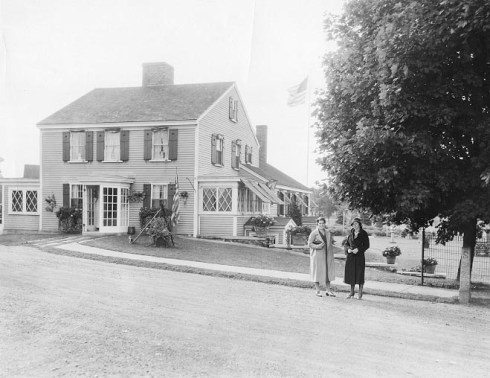
Glover Farm as the General Glover Inn, part of Sunbeam Farm, 1920s-1930s, Swampscott Public Library. Anthony Athanas opened the General Glover House in 1957 and here are menu covers and ads from the 1950s, 1960s and 1970s from guidebooks of those eras. It looks like the perfect “ye olde” restaurant: I wish I had went!

General Glover was a true American hero, outfitting his own ships as privateers, ferrying General Washington across the Delaware on that fateful Christmas night in 1776 and serving at Saratoga, Newport, and the Hudson River highlands successively between bouts of ill health on his part and returns to Marblehead to attend to his ailing wife. He sought retirement at the close of the Revolution, and General Washington notified him of Congress’s approval in a letter dated July 30, 1782, closing with wishes for a restoration of health, attended with every happiness in your future walks of life. Apparently Glover found that happiness at the rural farm some distance from Marblehead’s busy docks, in a house that its still standing despite decades of active development all around it. I started digging into this particular Glover House when my friend and former colleague, Nancy Lusignan Schultz, brought it to my attention: as chair of the Swampscott Historical Commission, she is right at the center of the preservation efforts (which you can learn much more about in this podcast). But as soon as I realized who built the house, I was caught, or caught up: it was William Browne, Salem’s richest and most notorious Loyalist, whose considerable properties were confiscated after he fled to Britain in 1776, eventually ending up as the colonial Governor of Bermuda. Browne deserves much more scrutiny than I can give him here, but he was a powerful man in Salem and Massachusetts, whose fall from grace came when he became one of the 17 “Rescinders” who were described by John Adams as Wretches, without Sense or Sentiment after they voted to rescind the Massachusetts Circular Letter which had been drafted by the provincial Assembly in response to the Townshend Acts in 1768. The Letter called for resistance, and was sent to all of the other colonies, prompting the protest of Governor Francis Barnard on behalf of London. Bernard ordered the Assembly to rescind the letter, and the Assembly put the matter before a vote: 92 nays and 17 yeas, with Salem’s representatives Browne and Frye loudly voting YEA. This lead to one of the most important moments in Salem’s political history, a town meeting assembled to vote for replacements for Browne and Frye which exposed the deep divisions of the day, and about 30 Salem Loyalists. Browne and Frye and their 15 fellow wretches were “memorialized” by the ever-ready Paul Revere in his adaptation of a British broadside entitled The Scots Scourge issued under the title A Warm Place—[in]Hell and Boston merchant John Rowe noted the names in his diary, “for my own satisfaction.”

A Warm Place—Hell by Paul Revere, American Antiquarian Society.

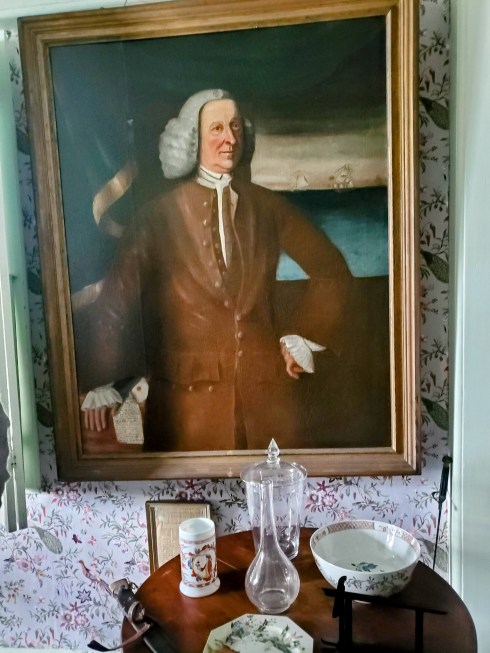
How I love Rowe’s sentiment: I record the 17 yeas, that were so mean-spirited to vote away their Blessings as Englishmen, namely their Rights, Liberties and Properties and how lovely that one of Browne’s properties should go to such a self-sacrificing patriot as General John Glover. But this is not the end of my rescinder rap. I was so focused on Frye and Browne and Salem that I did not take note of all the names on Rowe’s list immediately. I drove up to York on Friday and went to an open house at our local Historic New England property on Saturday: the Jonathan Sayward House, where I interned in college. As soon as I stepped in the parlor, I remembered: he was a rescinder too, and there he is on Rowe’s list, just above Browne (Maine was of course part of Massachusetts until 1820). Sayward did not suffer as much loss as Browne, who I believe was a much bigger fish: no exile (just confinement to this very home), no confiscation, and reconciliation after it was all over. George Washington and King George III share wall space in the Sayward House today.

Portrait of Jonathan Sayward, Rescinder, in his family home, anonymous artist, and the right parlor, above. Below, our hero, Brigadier General John Glover: a study by John Trumbull drawn while Glover was living at his farm, 1794. Yale University Art Gallery.


A Neighborhood Besieged

A dynamic, healthy city is composed of neighborhoods: this is a time-honored, universal observation, so much so that I believe it is a truism. It follows that municipal leaders should prioritize the protection of neighborhoods, but too many times, far too many times in my opinion, the City of Salem has pitted residents against developmental entities which seek to alter the composition and character of neighboods in overwhelming ways. I’m really worried about a neighborhood located just south of where I live, through which I walk and/or drive pretty much every day, which seems to be facing a development of gargantuan proportions: three multi-storey buildings for shelter and senior housing along with adminstrative and retail facilities, to be built in and on a small area of narrow streets and small houses, the remainder of a storied section of our city. The neighborhood now goes by the name of “Greater Endicott” for the major street that runs through it, but in the past it was: a ship-building district at the head of the South River proximate to Mill Pond, “Roast Meat Hill,” Salem’s first African-American neighborhood, and Little Italy, a tight-knit neighborhood clustered around a community-built church.

A Stereoview of the Boston & Maine Depot, with Mill Pond in back and the Endicott Street neighborhood top right, from the Dionne Collection at Salem State University Archives and Special Collections, 1870s. Jen Ratliff of the Archives has recently published a post on Salem’s “Little Italy,” which you can find here, along with links to more photos and ephemera.

The development at issue has not been proposed formally to a City board yet, but its developers, two regional non-profits, Lifebridge Northshore and Harborlight Community Partners, have met with city councillors and the neighborhood association. Lifebridge operates a homeless shelter on part of the site on which they want to expand, and Harborlight is a community development nonprofit which has built and redeveloped many affordable housing projects on the North Shore. There is no question that both organizations are engaging in laudable and necessary work, but in this particular case I believe that their missions are in conflict with the viability of an historic Salem neighborhood. Their proposal is to demolish the current Lifebridge Shelter, once the parish hall for St. Mary’s Italian Church, as well as the church itself and adjacent buildings, to build two five-storey buildings along Margin Street, and an additional four-storey building for senior housing behind these two structures, on the existing playground along Pratt Street. Very little parking is specified: 12-15 spaces for three huge buildings, several of which will have considerable visitation and staffing needs. And there’s one odd little detail: because one of the buildings which will be demolished is the Christopher Columbus Society, which features a bar, Lifebridge has proposed relocating said bar in its dry shelter building! I believe that none of the new housing facilities are limited to Salem residents; both Lifebridge and Harborlight operate as regional organizations. As there is a state law mandating the replacement of playground facilities, a new playground will be built along Endicott Street. I have seen a rendering of this proposal, but I don’t really know where it came from or if it is accurate so I’m not going to publish it here: suffice it to say that it’s rather horrifying!  The buildings don’t look like anything else in the neighborhood—this could be the beginning of the Hampton Inn-ization of Salem as the project looks like it will mirror the new Hampton Inn across the way (the less stripey part), and I’m no architect or surveyor, but I don’t really see how everything will fit.

As there has been no formal proposal yet, my sources for this proposal are notes from several meetings of the Greater Endicott Neighborhood Association: with the developers and with the two candidates for Mayor in Salem’s recent special election. Sadly, both of these men sound a bit resigned about the development: their answers to the residents’ questions give the impression that resistance is futile! The relationship between Lifebridge and Harborlight and Salem’s municipal government seems very close: both organizations were collaborating “partners” in the creation of the Salem Housing Road Map for FY 2023-2027, and last fall Harborlight hosted a ‘Housing Institute‘ at Old Town Hall for city councillors and staff. Photographs of smiling Salem politicians at Lifebridge and Harborlight fundraisers and legislative breakfasts appear regularly: there doesn’t seem to be the same separation as is the case with private developers, or maybe I’m just being naive about the latter. The proposal is in serious conflict with the zoning for the neighborhood, but there are tools to overide these restrictions in Massachusetts: 40B and 40R statutes, which grant developers free reign if sufficient affordable housing is part of the proposal. Salem has already met (and exceeded) the 40B requirement of 10% affordable housing, but 40R is more of a “carrot” than a stick approach to urban development, aimed at creating “smart growth districts” in proximity to mass transit by “streamlining” the permittal process and incentivizing the host city/town with cash payments. This could happen here, but it would take a majority vote of the City Council. There’s no question that more housing is a drumbeat echoing out from City Hall, but I believe that our councillors care about neighborboods too: I’m not as pessimistic (yet!) as one commentor in the meeting notes who observed that “a group of 100 individuals is being privileged over a neighborhood, and by extension, a city.”

The Harborlight Homes Housing Institute at Old Town Hall, Salem, Sept. 22, 2022.

What came before, and what next? That’s about as much housing policy discussion as I can engage in. It’s more simple for me, really. When I think about this neighborbood faced with this looming development, my mind conjures up one question: hasn’t it suffered enough? Of all Salem’s historic neighborhoods, this one is the least protected and has withstood the most challenges: from economic dislocation in the 18th and 19th centuries, from the Great Salem Fire which singed its borders in the early 20th, to development in the 20th centuries. And now this. People in the nineteenth century were very conscious of its venerability and vulnerability in a way that people in the 21st century are not, because it had already lost so much. Salem’s first two custom houses were located in this neighborhood, the so-called “Port House” and “French House”: the latter survived into the nineteenth century and was verified as Salem’s old house by none other than the Reverend William Bentley, who found “1645” carved into a mantle. In the vicinity of High Street were myriad seventeenth-century houses, including the famous Palmer House drawn by Edwin Whitefield in the 1870s and the Pease and Price Bakery, captured by Frank Cousins in the 1890s. And then of course there is the 1665 Gedney House, certainly not as noted as these structures a century ago but now an illustrative study house owned by Historic New England, which has recently confirmed that it operated as a tavern operated by widow Mary Gedney during the Witch Trials. I think the development of a preservation mentality in Salem in the later nineteenth century was very much focused on this neighborhood, rather than more illustrious ones, because the progressive filling-in of the South River and Mill Pond and the coming of the railroad yards had transformed it into a marginal location over the century: “Knocker’s Hole,” named for the loud knocking of shipwrights’ mallets in the shipyards along the shore, was no more. In an “epitaph” for the recently-demolished Palmer House in the 1880s, a Salem antiquarian noted that the “old homestead” had been named for “the old pioneer ship-builder of Knocker’s Hole, Richard Palmer, who had grants among the first of those who wrought so lustily in the noisy shipyards about Creek Street.”

As the neighborhood became less central, it became more affordable of course, and so a succession of African-Americans who worked in the city’s many service industries took up residence there, from the 1820s into the 1870s: mariners gave way to cooks and hairdressers, chimney sweeps and cartmen. Clarissa Lawrence opened Salem’s first school for African-American children in the neighborhood as early as 1807, and letter settled at 8 High Street, which she passed down to her children. She founded the Colored Female Religious and Moral Society of Salem, which soon merged with the integrated Salem Female Anti-Slavery Society, for which she traveled to the third national convention of the Women’s Anti-Slavery Society in Philadelphia in 1839 (on a segregated train) to give her rousing speech about meeting the “monster prejudice everywhere.” In the 1840s, there were seventeen African-American households on High Street, and more on adjoining streets, including that of Mercy Morris, the sister of the pioneering Boston lawyer Robert Morris, on Creek Street. A decade later, the Fletcher family was living on nearby Pratt Street (likely the street to be most impacted negatively by this development), including Francis Fletcher, who advocated for the formation of an African-American Regiment during the opening years of the Civil War in correspondence to Massachusetts Governor John A. Andrew, and then joined the Massachusetts 54th himself.

Clarissa Lawrence’s (of High Street) big speech, and Francis Fletcher of Pratt Street. Pratt Street runs right by the High Street playground, which is a designated site for one of the multi-storey buildings, so everything you see on the left above will be a big building. No more tree-filtered sun for this neighborhood.

Salem’s City Directories reflect a change after the Civil War: not so many of the familar names of African American families in the nighborhood, replaced by a succession of Irish and then Italian names. Between 1880 and the restrictive immigration act of 1824, 4 million Italians came to the US, part of a larger “Great Migration” during which 17 million Italians left their country after unification, most from the still-agriarian South rather than the more urban, and industrializing North. Massachusetts was a major destination, and Salem then offered employment in thriving textile and shoe factories, but all the sources I consulted indicated that Italian-Americans in Salem didn’t break into that more lucrative work in great numbers until World War I and after: there was a lot of ditch-digging for instrastructure projects and employment in various service industries before. It’s hard not to come to the conclusion that a community of Italian-Americans in Salem formed around the foundation of a church: St. Mary’s Italian Church, built on Margin Street by this community in the 1920s and the center of this neighborhood until closed by the Archdiocese of Boston in 2003. Stripped and subjected to iconoclastic destruction between intervening periods of Lifebridge ownership thereafter, it’s almost painful to read about the great reverence that this community held for this Church before, expressed in material ways by everything from an embroidered altar cloth to the tower bell, cast on-site in the Italian tradition. You can see the bell today right next to the Christopher Columbus Society, and I wonder where it will end up if this proposal goes forward.

Salem’s Italian-American Community in the 1920s and the building and embellishment of St. Mary’s Italian Church & the former church today: the Lifebridge/Harborlight plan seems to call for either outright demolition or facadism. One immediate consequence of the foundation of this Italian-American parish/neighborhood was the recognition of Salem’s Italian-Americans as such: before they were Italians, then they were Americans, celebrating July 4th with one of their traditional arts! Postcard of St. Mary’s from the SSU Dionne Collection.

The Great Salem Fire of 1914 was capricious in this area, taking out some streets and leaving (High!) others alone: when you walk around you will see a lot of buildings dating from 1915-1916 as rebuilding and building went together in the neighborhood. More damaging were two major “developments” of the 1930s along its northern boundary: the building of the Salem Post Office on Margin Street and the Holyoke Building resulted in the razing of at least 50 buildings for the Post Office alone. Samuel McIntire’s house on Summer Street was demolished to make way for the Holyoke in 1935, and this decade of depression and rampant destruction was also when venerable Creek Street was eradicated altogether.

X marks the spot of the future Post Office and Holyoke Building, along with curving Creek Street: many of the structures in this photograph would be demolished in the 1930s, including Samuel McIntire’s house on Summer Street (yellow arrow). Another arrow marks St. Mary’s Italian Church, SSU Archives and Special Collections. The Post Office rising, also SSU and charming Creek Street by Frank Cousins, Phillips Library Digital Collections via Digital Commonwealth.

When I look at the aerial photograph above I see the housing density that the leaders of the City of Salem crave now; it was destroyed by those 1930s developments in the name of progress. And while the Lifebridge/Harborlight proposal is driven by a more humane mission, it will inevitably impact the remainder of this still densely-settled and heritage-rich neighborhood in a negative manner just because of its size and scale. And it doesn’t have to be that way: there are other sites in Salem, far more appropriate sites which could accomodate the proposal’s various programming needs much more effectively.  The City should work with the developers to find a suitable site rather than to impose this project on a neighborhood which has stood the test of time.


A sunny Memorial Day in the Greater Endicott Street Neighborhood.


Some Salem News and Views

A whirlwind of a week! Or should I say a rollercoaster, from my personal perspective. Against the backdrop of finishing the semester, grading and graduation was Salem’s special mayoral election, as our previous Mayor ascended (?) to the office of Lieutenant Governor in last fall’s election. The first new Mayor in 17 years: an exciting and momentous occasion, especially given all that’s happened over those years, particularly the intensification of both development and Haunted Happenings. I was with the candidate who expressed some concerns about both trends, and he lost to the candidate who served as our former mayor’s right-hand man, so I assume that both trends will continue unabated. A disappointing outcome for me, but not nearly as disappointing as the turnout: a miserable 28% of the electorate. Both candidates were out there, there was was spirited debate, and signs everywhere, but as they say, signs don’t vote, and neither did the vast majority of Salem people. So I had a day to process that disheartening development, and then the clouds cleared when my co-editor and I received word that Temple University Press was extending a contract to us for our proposed book on Salem history tentatively titled Salem’s Centuries: New Perspectives on the History of an Old American City, 1626-2026! This is a project we put together for Salem’s coming 400th anniversary in 2026, and I couldn’t be more pleased and excited that it will materialize.

As soon as you know you’re going to get a book published, you think about the cover! Or at least I do. One of the major reasons I started blogging is my interest in historical imagery: I’m always matching words and pictures in my head. I’ve always liked past and present blended photographs, so I made one for our big announcement, but my co-editor and colleague Brad Austin chose a crop of Salem artist George Ropes’ Salem Common on Training Day (Peabody Essex Museum) for our proposal image. I love this painting too, but I think it’s been used too much over the last decade so I’d like to find something else for our cover: I have a digital file of all my favorite Salem images and I’m sure I’ll be creating various compilations, collages and compositions over the next year or so, particularly when I’m struggling to write! I also welcome all suggestions. Whatever we choose will need to feature Salem people, as our book is first and foremost a social history of Salem: early Salem settlers and those who lived on the land before it became Salem, traders, farmers, and the accused and the enslaved, soldiers from Salem who served in the Revolutionary, Civil, and World Wars, entrepreneurs and privateers, Salem expats in the East, Salem families, Salem African-Americans, Irish-Americans, Polish-Americans, Italian-Americans, French Canadian-Americans and Hispanic-Americans, Salem antiquarians and reformers, Salem students, Salem men and Salem women, as individuals and as members of the community, the parish, and the neighborhood. Another photograph which we featured in our proposal was of the dedication ceremony for the “Mourning Victory” statue erected in Lafayette Square in 1947 to honor the men and women of St. Joseph’s Parish who served in both World War I and World War II. Contrast this with a more recent photograph of the crowd at the dedication (I think that’s the wrong word)/ revealing of the Bewitched statue in June of 2005: what a difference! Unity and division, service and entertainment, but both Salem.

The dedication of “Mourning Victory” in September 1947; the unveiling of the Bewitched statue in Town House Square, photograph from the June 16, 2005 edition of the Lynn Daily Item.

I plan to write the concluding chapter of Salem’s Centuries on the evolution of the square in which Samantha stands, formally known as Town House Square as this is where Salem’s first meeting house was built as well as the site of other notable buildings, from the seventeenth century to the present. I’m also writing several other chapters, as well as the introduction with my colleague and co-editor Brad Austin, but the remaining chapters will be written by our colleagues at Salem State (and also several of our grad students who have gone on to Ph.D. programs) according to their fields and expertise. We have an amazing department: we’ve been together for a while and we have a very united front when it comes to teaching and our role in the university, but we also have very different research fields so this project represents a unique opportunity to work together. This makes me very happy, and you should be happy too, dear readers, especially those of you who have been following along for a while, because the strident, snippy and snarky writer of recent years, clearly and consistently frustrated by the state of historical affairs in Salem, will retreat! The reason that I have been so frustrated with Salem’s arbitrary heritage initiatives is their inability to engage: both the past in meaningful ways, and the public in representative ways. Select committees of “stakeholders” (one of our former Mayor’s favorite words, along with “hip”) responded to the Peabody Essex Museum’s removal of Salem primary historical resource and repository, the Phillips Library, oversaw a plan (with some very expensive consultants) to move Salem’s Colonial Revival Pioneer Village, beloved by many people in our city) to Salem Willows, plotted out Salem’s “new” Heritage Trail, and are currently planning Salem’s 400th anniversary celebrations. I have learned that there’s no way to penetrate the structure of these select stakeholder committees, so I’m delighted that I will be engaged in a more constructive activity from now on. I do wonder if this restricted access to civic heritage, along with its commodification, has had some impact on declining civic engagement in Salem? I think that question is beyond the bounds of our book, but it’s something to consider.

I tried! It’s great that we have Remond Park, but there’s no association of place and the sign is incorrect: a “large population of African Americans” did not live in the vicinity; I can’t find one African-American resident of this neighborhood. I presented my evidence to the powers that be years ago: no response– the inclusive moment had passed. There ARE two Salem neighborhoods which were quite cohesive in terms of African-American communities at different times in the nineteenth century: neither are recognized by the City, and one is in imminent danger of being overshadowed and overwhelmed by a proposed over-sized development. We will have several chapters on Salem’s African-American history in the Salem’s Centuries and some smaller pieces too: we’ve got an interesting format which will feature longer academic chapters and shorter topical “interludes” which we hope will attract a range of readers.


Daniel Low and the Art of Advertising

Very often, one of Salem’s longest-running and best-known businesses, Daniel Low & Company, is reduced to a pioneering seller of witch wares with their souvenir witch spoons and other “memorabilia” issued before, during and well after the very important Bicentennial of the Witch Trials in 1892. It all started with a spoon, say the proponents of witchcraft tourism, long ago: we didn’t start it! And they are not wrong: the Company certainly sold its share of witch spoons, plates, dishes, thimbles, scissors, and more unusual items like “penwipers”. But Daniel Low & Co was also a Salem institution for over a century: evolving from its jewelry and silver foundations to a major purveyor of all manner of decorative accessories for the home over its long history (1867-1994). It “sold Salem” in more ways than one: if you visited its landmark store, situated in Salem’s most historic square in the former site of its First Church, you would see not only floors of display cases but also “unique antique rooms” featuring reproductions of Salem’s more traditional products; if you ordered from the annual Daniel Low year book you would receive a receipt bearing an illustration of an historic Salem structure as well as a copy of the company pamphlet The Salem Pilgrim. 

You could write a book entirely on Daniel Low’s advertising methods and campaigns: there’s just so much information and copy. The company advertised both locally and nationally: to support both its wondrous store and its annual year book, issued from the 1890s into the 1960s (I think—I can’t find the end date). But it’s not just the means by which Daniel Low reached out and reached in to homes across America, it’s the messaging. The store’s advertising philosophy was expressed in a number of speeches and articles by Robert R. Updegraff, its manager of publicity, from the teens into the thirties. Everything I read by Updegraff, who seems to have been a pioneering practicioner of the new “art” of advertising, reminded me of Don Draper’s Kodak carousel pitch in Mad Men: aim for the heart, and treat your customers like neighbors. Only a year into his job, Mr. Updegraff summarized his pitch and his profession in a serialized article entitled “The Story of the Year”:  One thing is sure, the advertising man who is to be the real power in the future will be the man who stops thinking in terms of type and borders and magazines and billboards and street car cards and printing presses and halftones. He will think in terms of neighborliness and life. He will write simple, sincere, friendly messages to these neighbors of his. He will think and write in terms of ideas, emotions, experiences, merely using words as vehicles to convey his message and printing presses to multiply it. He will use illustrations only when they tell the story better than the same amount of space used in words. His advertisements will be efficient because they are sincere and have the beauty of truth. And they will be effective. [Macleans magazine, September 1913]. Updegraff believed that Salem’s past could be utilized to emphasize sincerity and exemplify the “beauty of truth”: not its witch-trial past but rather a more hopeful, gilded, and gentle “old Salem.” In a 1914 article in Printers’ Ink he elaborates on how the imagery of truly Colonial Salem conveyed an atmospheric sincerity in the Daniel Low Year Books which began offering “glimpses of old Salem” from that time until the 1950s.

A half-century of Daniel Low & Co. Year Books: from Historic New England, Salem State University Archives and Special Collections Flickr photostream, Harvard University Digital Collections and my own collection.

Glimpses of Old Salem was a constant, but not Daniel Low’s exclusive pitch: it aimed to be a traditional-yet-modern “Treasure House” too, a phrase that was adopted by the Essex Institute and applied to all of Salem from the mid-century: before Witch City crowded out all other messaging at its close.


The Skeletons of Lagrange Street

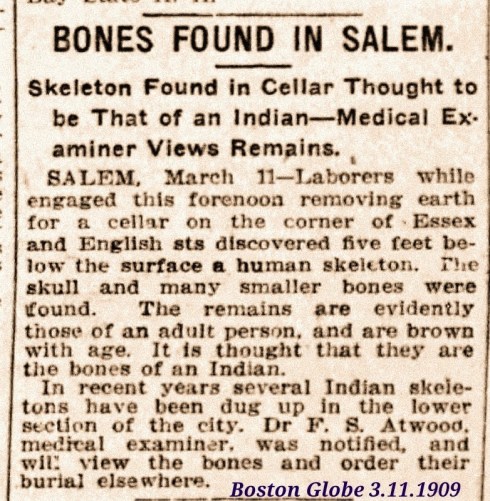
Salem is a place where everybody always says that the “past is present” or something to that effect; one discerns the ongoing presence of the past in the old structures and streets and cemeteries. That used to ring true for me, but not so much anymore. I still have a sense of Salem as a palimpest city, though: with layers and layers of history beneath my feet, reinforced when I walk by one of the seldom-ceasing infrastructure projects downtown and see all the cobblestones that lie beneath. I often think of Salem in the nineteenth century, when there was so much new but also so much more old all around, as a time when people must really have been aware of the past in a material way because of the contrast: the factories were so big and noisy and the surviving relics of the “olden time” so decayed, rather than perfectly preserved (if they survive) today. And it seems as if every time one of those relics was demolished for new construction, more relics were found underground, sometimes human remains. Nathaniel Hawthorne has a story in one of his notebooks of a skeleton that was found, in parts, underneath High Streeet, identified by one of the older residents of the neighborhood as a Frenchmen who came to town. It was a notable, but not a shocking, discovery: I perused nineteenth-century Salem and Boston newspapers and regular reports of skeletons uncovered in Essex Country appeared fairly regularly, generally presumed to be Native Americans. Even early in the century, Salem’s great diarist, the Reverend William Bentley, ran over as soon as remains and “curiosities” emerged from the soil: to Winter Island, to Northfields, and to Southfields. Over time, the majority of the reported skeletons of Salem seem to have surfaced in a pretty specific area: in South Salem, along Palmer’s Cove, on a street that was called Lagrange in the 19th century and is now Leavitt. Here is the unfolding tale of their uncovering:

So, some awareness that there might have been an Indian Burial Ground in what was then Southfields as early as the 1850s, and a succession of extractions from 1809 on with no apparent effort to protect the site. Of course not, this follows in the tradition of founding father Thomas Jefferson, who conducted an archaelogical dig adjacent to Monticello even as he noted local Native Americans making “sorrowful” visitations, and Surgeon General Joseph K. Barnes, who directed U.S. Army medical officers to collect the skulls of Native Americans in 1868, so that the craniological collection of the Army Medical Museum could facilitate “the progress of anthropological science by obtaining measurements of a large number of skulls of the aboriginal races of North America.” Later in the nineteenth century, the pseudo “race sciences” of phrenology and eugenics continued to justify this competitive collecting. The reference above to the Essex Insitute’s possession of an infant skeleton is not surprising, given that one of its founding institutions was the Essex County Natural History Society. It’s my only clue as to where any of these skeletons might have wound up (so far), but it is leading me nowhere: the Peabody Essex Museum’s 2018 completed inventory of human remains and associated funerary objects (in compliance with the Native American Graves Protection and Repatriation Act or NAGPRA of 1990) does not reference remains from the Lagrange area specifically. The inventory includes “the physical remains of 45 individuals of Native American ancestry” taken from sites in Salisbury, Newbury, Ipswich, Gloucester, Marblehead, Revere and Salem. The Salem remains were taken from an “old cistern in Front Cellar in 1993” (????) and south Salem, so this could be Lagrange Street: the cranial fragments unearthed from this site apparently belonged to a teenager. It looks like one skeleton (in the 1892 clip) simply dissolved in the open air, but I am curious about how the rest of the remains were treated, and what became of them. My only remaining thread is intrepid medical examiner Frank S. Atwood, who seems to be taking the remains into professional custody, at the very least. Called to the scene of yet another discovery at the corner of English and Essex Streets in 1909, it is reported that he ordered their burial elsewhere. In just the past year or so, several unmarked graves of African-Americans have been identified and restored, and I’m wondering if that is within the realm of partial possibility for these earlier, displaced, settlers of Salem.

Lagrange Street on the 1911 Salem Atlas: in three years all this would be swept away by the great Salem Fire, and then rebuilding, again.


Open House in Essex County

It occurred to me the other day that during the long life of this blog I have never spotlighted Trails and Sails, a calendar of dedicated events and openings throughout Essex County in September organized by the Essex National Heritage Area. I feel remiss; I have friends and former students who work for Essex Heritage, and I myself am a commissioner! These folks know what heritage is and are able to discern it from tourism, and so they connect and cast light on institutions and areas which represent this region’s cultural and material legacy in meaningful ways. Trails and Sails is a 10-day extravaganza of free events throughout our region, beginning next weekend. I’ve picked my events, and my participation will pretty much revolve around visiting old buildings, but don’t let my game plan (mis-) inform yours: there are plenty of events that involve much more outside action like walking, paddling, biking, apple-picking, cider-making, birding, and even “forest bathing” (whatever that is) right here in Salem. So go to the website, or download the digital guide, and chart your course. Note that many (but not all) events and openings are recurring and some require reservations.

Saturday, September 17I’ve got to get into the glorious Grand Army of the Republic Hall in Lynn, so that will be my first stop. I’ve wanted to see this hall for about five years. From Lynn, I’ll drive over to Danvers to tour the 1670 Judge Samuel Holten House, another building which I’ve long admired and never been inside. Same with the Platts-Bradstreet House in Rowley, so that’s next, then back to Salem for a walking tour of Charlotte’s (Forten) Salem by History Alive, Inc.

Lynn’s GAR Hall, two seventeenth-century houses, and Charlotte Forten about to lead us around Salem!

Sunday, September 18: I know that I will have to do some lecture and presentation prep on this day but I am still going to the Open House at the Rocks Village Handtub Building and Toll House Museum on the Merrimack as I love that building and (again) have never been inside. I might as well go to the Brocklebank Museum on Georgetown as it’s on the way home.

Rocks Village,Georgetown, and the Jackman-Willet House in Newbury.

The following week, unfortunately, is super busy and I have my own presentation on Saturday the 24th, so that leaves Sunday the 25th, when I’ll go up to Newbury and see the seventeenth-century Jackman-Willet House and anything else that is happening in that part of the county. I feel like I’m missing out on some great events, particularly Fletcher Steele and Frederick Law Olmsted tours and a view of Gloucester from its grandiose city hall. But there’s always next year: Trails and Sails is an established tradition. As I was looking at the schedule, thinking about where I would like to go, and reflecting upon my past summer, it was just houses, houses, houses! I love visiting old open houses, but I think I must be an outlier among heritage tourists today. I’ve been talking to a few museum professionals over the summer, and they all tell me that house museums just aren’t as popular as they used to be. This might explain why so many in Salem are closed, including all of the Peabody Essex Museum’s houses save the Ropes Mansion and Salem Maritime’s Derby House (well, save the ell). But everywhere I have gone this summer—in New York, and all the New England states—there have been good-sized parties touring houses with me so it makes me feel like there are still some old-house afficionados out there! An anecdotal view, I know, but a hopeful one. Perhaps I should finally admit, however, that my essential childhood bedside book, Samuel Chamberlain’s Open House in New England, might have been a bit odd.