
Last week I had a terrible night full of no sleep and the worst thoughts—it was the debate, my garden, my book, everything and nothing catastrophic, just made so in the dead of night. The next morning I had my coffee and drove to the DeCordova Sculpture Park and Museum in Lincoln, the leafiest of Boston’s leafy suburbs. Modern sculpture doesn’t usually speak to me, but on this occasion and in this setting, it did. I calmed way down, was capable of enjoying the low 80s, sunny and no- humidity weather, and forgot my concerns for a good part of the day. I didn’t spend the whole day there (my title is an alliterative exaggeration) but a solid morning, during which I walked around the 30+ acres with a skip in my step which I managed to maintain for the rest of the day–no exaggeration. So here are some of my highlights, starting with an off-kilter person and house, because that’s how I felt when I arrived.


Joseph Wheelwright. Listening Stone; Hugh Hayden, A Huff and a Puff (inspired by Thoreau’s cabin, not too far away!)
The DeCordova Sculpture Park and Museum was established on the former estate of local businessman Julian de Cordova on the southern shore of Flint’s Pond in Lincoln in 1950 and purchased by the Trustees of Reservations in 2019. There are some 60 sculptures outside and the castle-like main building is currently closed for HVAC repairs. The last time I visited was in the fall, and the sculptures were stunning against the foliage, but this was a glorious day too. It’s an engaging way to view art as you can approach the installations from any angle—Hugh Hayden’s cottage above is a perfect example above as is Alyson Shotz’s Temporal Shift below (which has the additional quality of being “site-responsive”): what do you want to frame and how do you want to frame?


Alyson Shotz, Temporal Shift; Lars-Erik Fisk, Decordova Ball; Reno Pisano, Torso; Christopher Frost, A Mile from Any Neighbor from Walden; Rona Pondick, Otter (my photo is not really enabling you to see the otter qualities of this stainless steel sculpture!); Kitty Wales, Feral Goose; Robert Schelling, Time at the Museum; George Greenamyer, Mass Art Vehicle; John Buck, Dreamworld; Jim Dine, Two Big Hearts.
I walked right by—more subtle sculptures!


Andy Goldsworthy, Watershed;Richard Rosenblum, Venusvine; Robert Lobe, Environmental Impact Statement (from afar I thought it was just a big boulder but it is made of hammered aluminum).
Transparent sculptures: the most site-responsive!


Saul Melman, Best Of All Possible Worlds; Dan Graham, Crazy Spheroid—Two Entrances (which I loved because it made me look tall!)






 The site, and the North River coastline near the bridge, 1851, 1890s and 1912, when the first City Plans Commission report asserted that the river “needed to be redeemed”.
 Philip Horton Smith’s Franklin Street “low rent brick cottages”, 1915.


 Just one weekend in Salem: The Salem Award Foundation’s 25th Anniversary Celebration and Salem’s Trials Symposium. Below, the Witch Trials Memorial off Charter Street, yesterday: for much less contemplative times, click

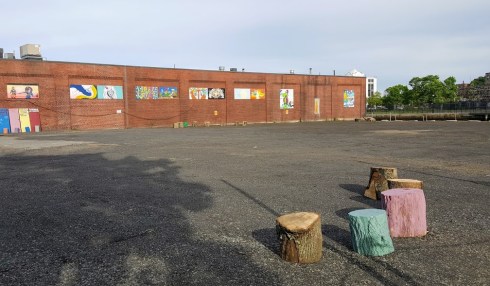
 The lot today and on the 1897 Salem Atlas, marked by the old lightbulb. It was R.C. Manning & Company’s coal and lumber yard then, and it served in a similar capacity well before and after. Below: the process of placemaking.


 Monopoly in the Park in San Jose (You can see more images at Anna Fox’s
 Street Monopoly by Bored, via


 Canadian artist An Te Liu’s





