Tag Archives: Illustrations

Words or Pictures or Numbers?

This post is about the work of a venerable but new-to-me graphic designer, Seymour Chwast, but before I get to him I have to explain how I got to him. If you have been reading the blog over the past year or so, you might have perceived that I have become mildly obsessed with two images associated with Salem: the official Salem City Seal with its Sumatran trader, now likely on its way out after 180 years or so, and more recently a cartoon cat mascot chosen by the Mayor of Salem and the Salem 400+ Committee to represent our city’s “unique identity” for our upcoming Quadricentennial. The discussion, and in the latter case lack thereof, over both images has been perplexing. I’ve written quite a bit about the seal, and was going to write more about the mascot, but I now realize that such efforts are a waste of time. These images, deemed rascist or representative or not, will stand or fall according to the whims of five or six or maybe 20 people at best. That’s how Salem works: the average person has very little power over matters of civic identity or branding (or anything else for that matter.) Nevertheless, it’s been so interesting exploring the power of images over the past year or so in various ways. As a Renaissance historian, I’ve always been aware of the complexity of images, but if you want to consider their power in the present, that brings you into the realm of graphic design, and so that brought me to Seymour Chwast, briefly. And then he popped into my consciousness again just last week when I was searching for an image of the Battle of Sluys for a powerpoint lecture on the Hundred Years War. The search led to a compelling image of a medieval naval battle which was not Sluys but rather Chwast’s depiction of the Battle of Zonchio in 1499, fought between Venice and the Ottoman Empire. This is just one of nine hand-colored linocut battle scenes, paired with literary quotes on the opposing page, included in Chwast’s 1957 folio A Book of Battles. 

Chwast is in his 90s and still working, I think: his career is too prolific and illustrious to summarize here but I will take a stab. Over six decades he has published all sorts of images and illustrations, individually and on behalf of the Push Pin Studios (now Group) the graphic design firm he co-founded in the 1954. From magazine covers to posters to corporate advertising to packaging to theatrical backdrops to his own publications: he has done it all. Chwast is the author of 30 childrens’s books and four graphic novels, and he is also a typeface designer! Chwast’s career is marked by his intent and ability to utilize design as a political force on many occasions, and one theme seems to run through much of his editorial work from the beginning: pacifism. This was certainly the inspiration for his Book of Battles, as the juxtapositions of images and words make clear.

And then, in 2017, a capstone (or maybe not yet) anti-war book, At War with War: 5000 Years of Conquests, Invasions, and Terrorist Attacks. An Illustrated Timeline. More striking graphics and literary excerpts, but a timeline too, which means numbers. The (red) numbers somehow make the illustrations all the more menacing, especially as we proceed into the (modern?) information age in which casualties can be marked along with dates. It all packs a powerful punch.


Summerlands

I am just back from a very festive wedding in Mexico, blitzed and therefore completely incapable of presenting a proper post. But I have been saving up some images by Jazz Age commercial artist John Held, Jr. (1889-1958) for a while, and today seems like the perfect time to put them out there. Held’s popular flapper images, appearing as magazine cover and content illustrations throughout the 1920s, are a perfect representation of their age, but it was his pictorial maps which first caught my eye. I also like the posters he created for the New York, New Haven & Hartford Railroad, enticing travelers to locations all around New England and beyond, northward, the same direction my travels will take me this summer. No more south, except for Rhode Island and maybe Connecticut! Held used the term “Vacationland” several times in his New Haven posters, but I never liked that term while growing up in Maine so I streamlined his alternative “Summer Play Land” for a more timeless title.

Travel Posters by John Held Jr. from Artsy and Swann Auction Galleries Archives.

Held was a wonderful illustrator but his work cannot be confined to that genre; even though he published over 100 cartoons in the New Yorker in the 1920s and 1930s he can’t be identified exclusively as a cartoonist either. He worked in many mediums: watercolor, ink drawings, engraving, woodblock prints, even sculpture. On several of his fanciful maps, he refers to himself as a cartographer, and he wrote as well as illustrated. In his commercial heyday in the 1920s he was reportedly the highest-paid graphic artist in America but his commissions declined and fortunes failed with the Depression. So he seems to define (some critics even say document) an era even as a moved on to less popular (flapper-less) artistic expressions. Many of his engravings and prints have an intentional primitivism that makes them almost timeless in my view, among them several Salem ships.

Cape Cod poster, 1931, David Pollack Vintage Posters; Ships by John Held, Syracuse University Museum; Ship Bonetta of Salem Departing from Leghorn, William Bunch Auctions & Apraisals.


A Bewitching Bicentennial Book

Salem has been a tourist city for more than a century, so there has been a succession of guide books spotlighting the city’s landmarks and attractions from their particular chronological perspectives. I think I’ve referenced every guide book here, with the exception of the one I am featuring today: The Illustrated Salem Guide Book. Beyond Witch City, published for the Bicentennial in 1976. If you read all the Salem guides in chronological order, two themes are readily apparent: the increasing commodification of history and creeping witches crowding everything else out. The bicentennial book is an exception to both of these trends: it’s a breath of fresh air, guiding its readers to a more cohesive Salem 1976 rather than just downtown “attractions,” and its “Beyond Witch City” subtitle is accurate. It has wonderful illustrations and writing: the efforts of my neighbor Racket Shreve, a well-known maritime artist, and Robert Murray, respectively. It’s just a very special little book: I really love it. It actually makes me nostalgic for a city I never lived in!

One of the key differences between The Illustrated Salem Guide Book and its predecessors and successors is that it was published by the Salem Bicentennial Commission rather than a tourist agency. So the focus is much more on hospitality and non-profit attractions than salesmanship. As you can see above, it proudly bore the (competition-winning) Bicentennial logo as well as a Samuel McIntire swag on its back cover. Inside, we read that “This Guide Book is intended both as a portrait of Salem—an evocation of Salem, old and new, as well as a practical directory for How, What, Where and When.” The combination of aims makes for a thoughtful and accessible book; in its own words, “practical and irreverent.” This book was only one of Salem’s Bicentennial projects: the Commission also organized Visitor Hospitality Centers (in all of Salem’s churches—staffed by volunteers), the development of Fort Lee & Fort Pickering as natural preserves (1976 must have been the last time anyone paid attention to these sites), work on a Salem bikeway, the reconstruction of Samuel McIntire’s Washington Arch (recently restored), “Operation Sail” focused on the waterfront, and several Salem Symposiums “examining Salem’s Past, Present and Future.” This was a very ambitious and engaging agenda. It’s the evocative mission that I’m the most interested in, and while that quality is probably best illustrated by Racket’s illustrations, Robert Murray’s writing is also essential towards realizing this aim: On Oliver Street, an old clockface, empty of hands, hangs on the coach house behind No. 31, its gold numerals luminous at Noon. Attached to the rear of No. 5, two identical carvied friezes, attached side by side upon a stable wall: a touch of Federal surrealism. Beneath the friezes, a sign: Beware of Dog. Murray is particularly good on the history of Salem’s churches: I learned quite a bit. Racket provides some great illustrations of these buildings, and then they both take us all around Salem–not just to the “pretty” spots.

There’s a lot of Salem pride in this book. I was really happy to see a sentiment that I discovered when I was writing about urban renewal for our forthcoming book: an assertion that Salem had “triumphed” over urban renewal, and transformed all those Federal dollars into an initiative that actually focused on renewal rather than destruction. Murray emphasizes  the “imaginative” choice by the Salem Redevelopment Authority to substitute historic renovation for demolition. Salem has won national recognition for its adaptation of its old glories for its modern needs. This is true, and not appreciated sufficiently. Present-day witch-pitching people spin the story that witchcraft tourism “saved” Salem, but I don’t know, 1976 Salem looks pretty dynamic: all of the Essex Institute houses are open, as is its Phillips Library, there’s an ongoing archaelogical dig at the Narbonne House, “a group of rusty oil tanks huddle together aware that they are disliked and soon to be removed” for Pickering Wharf, Pioneer Village is deemed “an excellent place to begin a study of the evolution of the American home.” There were lots of restaurants: Red’s Sandwich Shop, the Lyceum, the Beef & Oyster House, In a Pig’s Eye, Strombergs, the Gutenberg Press Restaurant & Pub, and more—and if you had a party of six you could have dinner at the Daniel’s House: just phone Mrs. Gill and byob.

This little book succeeds in capturing Salem’s past and present from a 1976 perspective: it is not characterized by sickening sentimentality or boosterism. Salem emerges as a city shaped by its past and being shaped by its present. I wish its author and illustrator would create a Salem guide book now (for the 400th anniversary!), because I think it would be very interesting.

What was lost and what remains—the cement slide at Forest River Park! Below, the guide’s map and Racket’s Hamilton Hall Antique Show (a benefit for the then-Peabody Museum of Salem) covers.


A Big Salem History Project, 1952!

I receive gifts from readers of the blog from time to time and they are all very special and much appreciated. A reader sent me a slim, illustrated and bound History of Salem prepared by a “committee of students and teachers of the Salem Public School System” in 1952 several years ago, and I was immediately charmed by it but not quite inspired to post about it. But yesterday I woke up and it was the first thing on (in?) my mind. I think I’m inspired by the end of the academic year and the completion of academic projects, by my own local history project, and by the Salem Quadricentennial planning, or lack thereof. The City has not put a lot of resources or time into planning for Salem’s 400th anniversary in 2026, and there have been meetings only for invited “stakeholders” rather than the general public. A dedicated website went live only last week, and the dedicated coordinator seems largely on her own. I was getting quite depressed about this, especially the lack of public engagement, but last week we came up with a neat (public) initiative at Salem State, so my depression turned into excitement—-and then I thought of this little book.

This little book has a strong voice, and it is a voice from 1952. It really captures the perspective of that year, that moment. Of course, there is the “White Man” and there are the “Indians” and they seem to have a very Thanksgiving-esque relationship. There are entire chapters on civic responsibilities (including a relatively long discussion of TAXES) and “Salem’s Contributions to our Country’s Call.” There are no women, and no one with anything but a very Anglo name, included in the chapter on “Famous Citizens of Salem.” It’s pure unbridled mid-century optimism, but from more of a working-class than privileged perspective. Students from the Salem Vocational High School contributed to this volume (including the great illustrations which I am including here—trying not to crop the names of the illlustrators), along with those from the Salem Classical and High School and the Phillips, Pickering, and Saltonstall Schools. This history portrays a city to which many visitors come to see the architecture, but is not yet Witch City. The Salem Witch Trials get a few pages; the Revolution gets more—even the Civil War gets more (we read about all the Union generals that visited Salem and that in 1866, “111 applications for financial assistance were received by the Naumkeag Army and Navy Relief from Civil War veterans and their families.” Details, details!)  The Salem Fire seems like a very, very recent memory: their parents and grandparents must have impressed it upon them.

And of course, World War II is a much more recent memory, even their memory. At the end of each chapter, there are “suggested activities” for students and two such activities were to “talk with relatives and friends and learn their reaction to the Pearl Harbor affair on December 7, 1941”  and to “bring in any decorations that your relatives have earned.” Pride characterizes this activity and this chapter, but really the tone throughout the entire text is one of pride, pride in Salem because it is an “important” city characterized by beautiful architecture and busy mills (not a contradiction in their representation) and its citizens have made “important” contributions to the nation. The students feel sure that [their readers] will be proud to say “I live in Salem, a city rich with dramatic reminders of the past, a city which with its great industrial power offers me a bright and promising hope for my future.” 


Good Queen Bess

It’s the first week of a new semester, and I’m still working on my Salem book for imminent submission, so I have to admit that I don’t have much time or energy to post here. But it’s also coronation week for Queen Elizabeth I (in 1559) and I’ve come across a lovely children’s book which has captured my teaching imagination—why these scenes? why these stories? Sometimes the blog is a nice break from pressing responsibilities, and that is the case here. Good Queen Bess (1907) is a quarto containing 23 illustrations by the artist John Hassall and text in red by Miss Brenda Girvin. The visuals are striking in their color and context, with some editorial choices immediately apparent (of course we need to see Sir Walter Ralegh’s puddle-covering cloak) while others are a bit more elusive, but all portray the iconic queen as a person first and foremost, beginning with her childhood.

It’s a children’s book, so it might be a bit jarring to depict the young princess alone, as the orphan she was. Instead, she’s with her longtime companion Kat Ashley, cuddling by a fire with dog and toys nearby. Years later, her situation more precarious during her sister Mary’s reign, she is “imprisoned” at Woodstock, with Ashley and more dogs nearby. Not too scary, but still an experience that will shape the young Elizabeth. Somehow her character got her out of that situation, and she is next pictured accompanying Queen Mary at her entrance into London, echoing another entrance image in Parliament. Hassall misses a great opportunity to show the poignancy of the moment in which Elizabeth is informed of her sister’s death and her own ascendance at Hatfield, depicting her in a crowd rather than alone under the venerable oak tree of legend. At this moment, and again at her coronation, Elizabeth’s profile is that of the majestic mature Queen in white (with “wings”) rather than the young woman that she actually was, with her hair down. As Queen, she has to have that majestic look, whether she is stepping on Ralegh’s cloak, dancing (as she loved to do), receiving the famous authors of her reign (Shakespeare and Bacon), refusing the crown/title offered by Dutch emissaries at war with Spain (an odd choice for a children’s book) or addressing her troops at Tilbury with her “heart and stomach of a king” speech.

Elizabeth is defined by her own personal characteristics and experiences but she also represents a “Golden” Age so we must see some scenes without her: a man in stocks represents her policy towards “tramps” (better known as “masterless men” in her own era), reluctant Elizabethans cultivate the potato (perfect, this is my favorite illustration, although cultivation began long after introduction), and then of course we must see the glorious defeat of the Spanish Armada, a fitting finale.


Salem’s Bêche-de-mer Boom

Back in Salem until I take off for Scotland at the end of next week. I’ve got lots of teaching, writing, and organizing to do, but I ignored all of my obligations last weekend and read a fascinating book about early American trade in the South Pacific: Nancy Shoemaker’s Pursuing Respect in the Cannibal Isles. I couldn’t put it down! It gave me all sorts of insights into a very particular and profitable trade dominated by Salem merchants and sea captains in the 1830s and 1840s: in bêchedemer or sea cucumbers, highly sought after in China for medicinal and culinary uses. Trepang (the primary eastern term) were and are sea cucumbers (often called sea slugs in the 19th century) which were processed in a special way, still in use today: boiled in sea water, placed in baskets and washed again, then dried in smokehouses. A Pacific example of the importance of dried seafood in world history, the bêche-de-mer trade was characterized by boom and bust phases over its long history due to overfishing in response to the sustained demand, but in the 1830s and 1840s Salem traders were very dominant. Shoemaker provides her readers with an appendix of Salem ships engaged in the trade, from ship Clay in 1827 to bark Dragon in 1857, with all sorts of familiar Salem names on board. William Driver, of Old Glory fame, then second mate on the Clay, claimed that he was the first “white man” (not westerner, or American, or Salemite) to execute the bêche-drying process sucessfully, thanks to the instruction of a band of pirates from Manilla. This trade has it all, believe me: daring captains working for equally-daring shipowners engaged in a risky trade that was potentially lucrative but also completely dependent on native “cooperation,” profit-seeking pirates and bureaucrats, a range of nineteenth-century ethnographic attitudes, tales of cannibalism and violence, big money.

Still very much in demand: bêche-de-mer at a Hong Kong market, photo by G. Clayden

My colleague Dane Morrison works in the field, and I can understand why he finds it so enticing: the stories and the sources are amazing, lending great narratives to important historical analyses of trade, imperialism, and cross-cultural influences and interaction. Using a micro-historical approach, Shoemaker explores American-Fijian encounters through the lives of three people: David Whippy, a Nantucket whaler who remained in Fiji and became an extremely important intermediary, Mary D. Wallis, the wife of Salem sea captain Bejamin Wallis who accompanied her husbanad to Fiji in the 1840s and later wrote about her experiences (as an anonymous “Lady”) there in Life in Feegee. Five Years Among the Cannibals (1851), and John B. Williams, son of a prominent Salem commercial family who tried to make his own fortune in the islands through a more bureaucratic route. So we have quite a Salem focus here: it’s another reminder that the historical Salem experience is played out in Salem and abroad. Williams in particular offers a very interesting perspective: born into money and raised on Chestnut Street (at #19) he was desperate to make his own fortune, beause “to go home poor its a curse in Salem.” These stories of Massachusetts men (and one woman) abroad illustrate how the entire bêche-de-mer trade was dependent on Fijian labor, coerced by native elites with whom the Salem traders negotiated and paid off. So many interesting anecdotes emerge from Shoemaker’s analysis of the exploitative yet intimate relationships tied to this trade: a powerful chieftain named Cokanauto whom Salem captain John Eagleston nicknamed Phillips after his employer Stephen C. Phillips back home (apparently it stuck), a young native woman named Phebe who became the servant (slave???) of Mrs. Wallis, a “Feegee dwarf, about four feet in height, —- said to have been a man of some distinction at home,” transported to Salem on the ship Eliza. (Shoemaker tells us that he made it back home). Captain Eagleston, who made four voyages to Fiji (on the Peru, Emerald, Mermaid, and Leonidas) from 1831-1841, called “his” bêche-de-mer operations “our little city.”

Cokanauto in Charles Wilkes’ United States Exploring Expedition (1845): 3:122.

The Zotoff (1922 lithograph) and  Emerald returning to Salem, (c. 1950 postcard issued by the Salem Chamber of Commerce).

Shoemaker’s focus is appropriately on Fiji, but it would be nice to explore the impact of this trade on Salem: the sources are numerous as many participants, Eagleston among them, memorialized their particpation in logs, journals, and reminiscences. I’m always looking for narratives to counter Salem’s storied post-1820 decline, as it seems to imply that merchants and seafarers just sat on their hands looking at empty wharves like Nathaniel Hawthorne. I’m not digging into the economics here, but Shoemaker does, and the fortunes that could be made from this trade were astounding! We can see the material legacy of the trade among the Oceanic collections at the Peabody Essex Museum here in Salem, as all of the bêche-le-mer traders were members of the East India Marine Society and thus brought stuff home, but I want to know more.

Bure Kalou (Spirit House), Fiji. Peabody Essex Museum. Gift of Joseph Winn Jr., 1835. 


Domed Doors

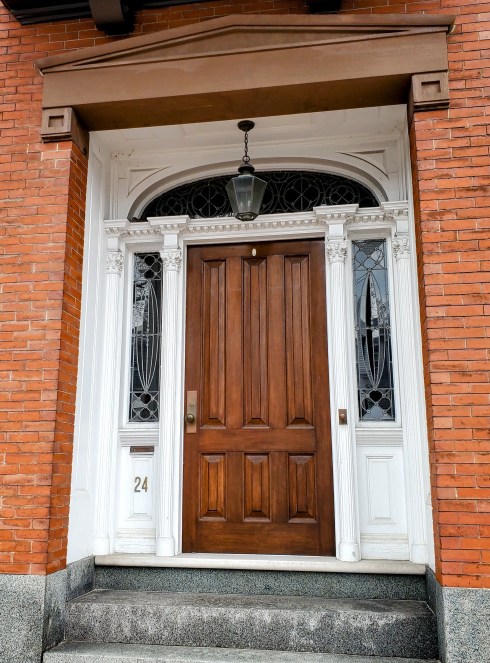
Salem is a great city for doors. There are so many exemplary doors in a succession of architectural styles: First Period, Georgian, Federal, Greek and Gothic Revival, all the Victorian varieties. There are simple plank doors, multi-paned doors, louvred doors, double doors, carved doors, doors with elaborate surrounds and vestibules, and doors of many colors (these have really multiplied over the last decade or so). There are Instagram accounts and hashtags for Salem doors. But one type of door is not very common in Salem: the rounded or arched door. I was looking through the remarkable memory album of G. Albert Lewis at The Library Company of Philadelphia, a volume with incredible illustrations of interiors and exteriors, when I became fixated on the arched entryways of his Philadelphia townhouses. I wondered if Salem had any rounded doors, did a quick Google image search (it was about 11:00 at night, otherwise I would have ran around town), and came up with multiple images of the doors of my own house! I never realized they were so conspicuous; rather I found them incongruous with the attached house next door, with its straightforward Federal entryway. See what I mean?

The second photo above is from the Instagram Account @doorsofsalem where you can see lots more Salem doors.

The double doors, and the entire entrance with bay window above, along with considerable interior alterations and a major addition, are the very tangible results of a considerable investment in the property made by its owner from c. 1860-1890, Willard Peele Phillips. Mr. Phillips was a lawyer, a state representative, and an aficionado of curves: he didn’t just bend the entrance of my house to his will: the parlor pocket doors, the china cabinets in his brand new dining-room, and all the first-floor entryways were rounded as well. He ripped out the elegant slim banister that ascended three stories and replaced it with a mahogany one that is much more bulky but also curvy. The second and third floors were left alone; I guess it was about keeping up appearances. It’s really interesting to compare the pristine house next door to my palimpsest one: 1827 versus 1877. Yesterday I went out in search of more rounded doors and did not find many, but it was fun to snap some beautiful square ones along the way. I’ve been taking photographs of Salem houses for over a decade just for this blog, but there is always a new door to discover.

As you can see, there is a rounded element in several of these Salem doorways in the form of the archways and fanlights, but the actual doors are still standard square (or rather rectangular). Besides my doors, I found arched doors on a famous McIntire summer house on the grounds of the Peabody Essex Museum’s Essex Street campus and its twin across town, constructed by a friend of mine just a few years ago, on Winter and Lafayette Street buildings, and what’s left of the Salem Armory. There are a few Salem churches which also have domed doors, but that’s about it.

But the Federal style which so defines Salem (for now, but maybe not much longer) emphasized light and decoration for its entryways, and so often there is an impression of roundness even if the door is more straightforward. A great example is the doorway of arguably the most beautiful house in Salem, the PEM’s Gardner-Pingree House: its portico and fanlight state (shout) round quite emphatically albeit elegantly. And look at the entrance to my neighbor’s beautiful Italianate house: all you see is curves but the door inside that fabulous vestibule is harmoniously straight.

So then I went back to my inspiration, the Lewis Memory Album at the Library Company, and looked at his doors, and was surprised to find they were not rounded at all—only their surrounds, and dormers! And therein is the magic of architectural texture, evident even on paper.

Illustrations from The old houses and stores with memorabilia relating to them and my father and grandfather / By G. Albert Lewis. The Library Company of Philadelphia.


Runaway Wives of Salem

I don’t think I’ve posted enough about women’s history for this women’s history month so I have put some extra effort into this last March post! Two caveats to the preceding statement: 1) If I do say so myself, my deep dive into local women’s history in the 2020 commemorative year should have earned me “surplus merit” and; 2) extra effort was not a hardship because the subject of this particular post is so interesting but yet elusive: “runaway wives” notices from the later eighteenth and early nineteenth centuries. Every historian, or every social historian I should say, wants to get into the house (or even into the bedroom) of people who lived in the past so these notices of women who left the “bed and board” of their husbands are interesting entryways, but in most cases the door slams shut before you can learn too much!

What’s going on behind closed doors? Illustration from The Life of George Cruikshank in Two Epochs by George Cruikshank and Jerrod Blanchard, 1882. Courtesy of Forum Auctions UK.

The notices are certainly numerous: in the first two decades of the nineteenth century, nearly every issue of the Salem Gazette and the Salem Register contains one or more. They are legal and financial notifications first and foremost, in which husbands announce that they will take no responsibility for the expenses of their runaway wives going forward, but depending on the nature of the separation, they are also an airing of dirty laundry or downright slander. The wives respond occasionally but not consistently, so we are left with only one side of the story for the most part. Sometimes the notice is on the very first page, above the fold (like this first example below) and sometimes it is buried deep inside the paper. Some notices are pro formawhile others contain considerable detail.

Front and Center, 1806, and for some reason 1804 was a banner year for runaway wives.

Let’s look at my sampling in chronological order to see if we can spot any trends. This IS a sampling: there are a lot more of these notices, and reoccurring ones as well. For example, George Felt disavowed his wife Sally in 1807 (below) and then again in 1818. So your eyes don’t blur and headaches occur, I’m breaking up the notices with a few images from chapbooks of the period from the collection at the National Library of Scotland. In general American chapbooks seem more concerned with instruction than relationships, and these British ones are a bit more bawdy, often highlighting the exploits of marital strife in a humorous, lyrical manner.

A Collection of New Songs, etc. Edinburgh 1802. National Library of Scotland Chapbook Collection.

In this first batch we have a combination of the straightforward (Daland and Young) and the slander. Note the phrases and adjectives utilized among the latter: “unbecoming the character of an honest woman,” and “intemperate, quarrelsome and troublesome,” even evil: clearly the men want to justify their abandonment of legal responsibility for their wives. The last notice, just above, is the most detailed and therefore the most interesting: Mrs. Teague has absented herself “frequently” and run up “extravagant” debts, and Mr. Teague provides several aliases for her so people in the “many” towns she visits can be on guard. This cautionary, “I’m doing you a favor” tone is very consistent in runaway wife notices.

The Farmer’s Son; or The Unfortunate Lovers, Glasgow, 1805. National Library of Scotland Chapbook Collection

The batch of notices above contains pretty standard examples, save for the removal of furniture from the family homes by Molly Ives and Mary Vincent. By the 1830s, these notices were clearly old hat, and even a decade before the editors of the Salem Gazette conveyed that sentiment by running an opinion piece which called them “excessively tiresome” as well as one which conveyed the other side of the story in a rather amusing way (notice that the word elope was generally used to refer to getting out of a marriage rather than into one in the early nineteenth century). I wish we had more responses from Salem women, but there are only a few, generally referencing fear of bodily harm (I researched all the women referenced above and found nothing). Going back to the very beginning of our period, Hannah Peele posted publicly in the Gazette that the reason she left her husband Roger’s house for one of their daughter’s as “because I have conceived my life to be imminently in danger while I lived with him: the reasons for which suspicion are too well known to many.”

Just as separations were public, so too were divorces in Colonial and Federal-era Massachusetts. From my perspective as an English historian, it’s pretty clear that divorces were much easier to obtain in New England than Old England. The Puritans of Massachusetts considered marriage a civil contract rather than a religious sacrament and so divorce could be, and was, granted by the authorities  on grounds of bigamy, adultery, abuse and abandonment (although there were also a few successful cases of claims of their husbands’ “insufficiency” on the part of female petitioners): maintaining the social order was the primary consideration. Massachusetts Bay granted the first divorce in British America in 1639 and between 1692 and 1785 the Massachusetts General Court heard 229 petitions for divorce and granted 143. Divorce was not common or easy, but it was an option for Massachusetts men and women. And as is the case with any conflict or schism, we can learn a lot about the parties involved than in cases of peaceful continuity.

Four Excellent New Songs, including Over the Moor to Maggie, Edinburgh, 1780. National Library of Scotland Chapbook Collection.

In contrast to Salem’s most famous divorce, the well-publicized and  scandalous split of elites Elizabeth Derby West and Nathaniel West in 1806, I think that Mrs. Anderson’s 1815 suit (above) is probably more representative. The wife of a mariner during Salem’s most prosperous age, she had not seen or heard from her husband in five years and had no “maintenance” for herself and her child. He was the “runaway” rather than her, and I wonder how many other contemporary Salem women found themselves in such situations. The lives of mariner’s wives: yet more uncharted territory in the history of a city which is overwhelmingly focused on that well-trodden.


Shore Dinners

I have a guilty secret to admit, one which will reveal me to be out of step with most of my fellow Salem residents (no, it’s not about “witches”): I’m not particularly fond of Salem Willows. It’s got a great history and a great spirit, and I’m always happy when I go there, but I don’t really appreciate it. I’m sure I must be a bit of snob about seaside amusement parks, as I never really appreciated York Beach while I was growing up in York either. I don’t understand chop suey sandwiches, and while the popcorn at Hobbs is great, I enjoy my friend Carol’s just as much. While I can take or leave the Willows, I know that many Salem natives wait eagerly for its opening every spring: they have strong memories and associations which I don’t have, and they like chop suey sandwiches. The other day, I came across an article in a 1941 issue of Woman’s Day in a trial database of women’s magazines that we just obtained at Salem State: it was so enthusiastic about the Willows experience back in the day that I began looking at it in a new (old) light.

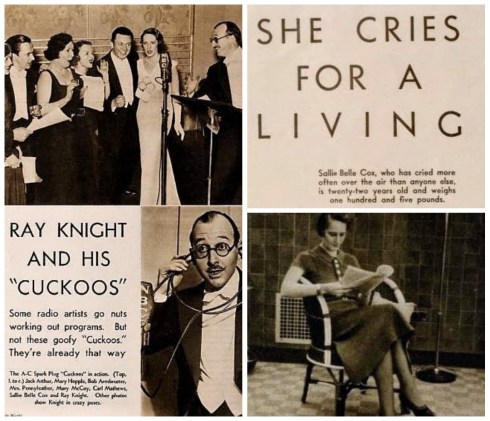
The article is primarily about Ebsen’s, established in 1885 and the last restaurant standing on the Willows’ Restaurant Row. By the end of the decade, it would be gone, but it was clearly alive and well in 1941. Since that was such a fateful year, one can’t help but feel we are “witnessing” the end of the era in the enthusiastic prose of Sallie Belle Cox, who was embarking on her second career after making a name for herself as the “cry baby of the airwaves” playing crying babies on radio broadcasts in the 1930s. On one such program, she met her husband, radio writer and broadcaster Raymond Knight, a Salem native. She became his second (of three) wives, and by her account he was horrified that she did not know the glories of Salem Willows in general and Ebsen’s in particular, so they drove up from New York City in the early summer of 1941. While her husband insisted that his hometown was the “one city in the world where they know how to make a fish dinner,” Cox’s image of Salem was “a weird, fascinating place filled with clipper ships and jaunty old sea captains who brought home exotic wives with rings in their ears to annoy all the other natives whose only fun in life was roasting witches on dull Saturday nights.”

Salem native Raymond Knight and his soon-to-be wife Sallie Belle Cox (behind the microphone at left) in Radio Stars magazine, 1933-34.

And straight to the Willows and Ebsen’s they went. The restaurant was packed, its oilcloth-covered tables and chairs the same which had been installed in 1890. They partake of equally-old Charley Ebsen’s Shore Dinners: fish or clam chowder, fried clams, fried flounders, and fried lobster, with potato chips, pickles, ice cream, and their choice of non-alcoholic beverages. Cox finds the chowder divine and furnishes her readers with the recipe from chef Fred Millet, who has also been around since before 1900. She also notes that “the Rhode Island and Manhattan clam chowders are not even considered worth discussing in Salem” and admits that there can never be enough fried seafood.

“Shore Dinners” by Sallie Belle Cox, Woman’s Day, July 1941.


In the Thick of It

This weekend is the annual commemoration/celebration of Leslie’s Retreat, a pre-Revolutionary event which could have marked the beginning of the American Revolution, if not for the patience, restraint, and diplomacy of participants on both sides, and one man in particular. On February 26, 1775, British Lieutenant Colonel Alexander Leslie and 240 soldiers of the 64th Regiment, acting upon the orders of General Thomas Gage, landed in Marblehead and began marching to Salem in pursuit of a rumored store of cannon. This was a Sunday, and thus “the Sabbath was disturbed” in both Marblehead and Salem, as patriots from the former town rode ahead and warned residents of the latter. When the British arrived, a stand-off ensued between the assembled crowd and the soldiers, during which the drawbridge across the North River was raised, enabling the not-so-secret cannon on the other side to be carried on field carriages out of town. A frustrated Colonel Leslie was allowed to march his troops across the bridge after the cannon had left the scene, therefore fulfilling his orders from General Gage. Then he and his troops retreated back to Marblehead and their ship, and sailed back to Boston. Things were a little hotter than I am depicting in this brief summary, but fortunately cooler heads prevailed, among them that of the Reverend Thomas Barnard Jr., the minister of Salem’s North Church, which was very much in the thick of things. I’m going to let Edwin Monroe Bacon, author of Historic Pilgrimages in New England (1898) set the scene.

A profile portrait of the Reverend Thomas Barnard Jr. (1748-1814) which looks quite similar to that of his father, the Reverend Thomas Barnard Sr. (1716-1776), above, Skinner Auctions.

I like this description because it conveys a sense of place. Just three years earlier, the North Church had separated from Salem’s First Church and constructed its first meeting house on the corner of Lynde and North Streets, not far from the river and the bridge (and the cannon). Reverend Barnard Jr., the peacemaker of “Leslie’s Retreat,” was actually the cause of the schism: his appointment following his father’s illness divided the congregation. As we can read above, the British soldiers marched past the “old First Church” in Town House Square towards the North Church, where a large crowd had assembled along with their young pastor, whose “counsel prevailed” that late afternoon. This North Church was ephemeral, only in service until 1835 when the congregation built a new and fashionable Gothic Revival meeting house on Essex Street, which became the present First Church after the schism was ended in 1923. The annual commemorations of Leslie’s Retreat take place in and around this church, with good reason, but I wish the old North Church was still standing: its clearly Colonial stature could lend some contemporary ambiance to the proceedings. But it is long gone, replaced first by a grand Victorian house, and then by the parking lot of the adjacent Methodist Church. But what happened to its clock?

“First Meeting House of North Church” by Thomas Davidson (not sure of source, likely the Phillips Library of the Peabody Essex Museum, but I found it in the November 23, 1942 issue of Life Magazine); George Francis Dow, Old Wood Engravings, Views and Buildings of Essex County (1908): with caption: “The North Meeting House, Salem, Built in 1772 at what is now the Corner of North and Lynde Streets, Abandoned for Religious Purposes in 1835 and taken down about 1860. Engraved in 1873 after a Drawing made by Dr. George A. Perkins.” Frank Cousins photograph of Lynde and North Streets, 1890s, Phillips Library, Peabody Essex Museum via Digital Commonwealth.

BELOW: Before Salem became Witch-central, Leslie’s Retreat was THE big historic story, especially for children, so there’s several YA books which feature it. I was trying to get that sense of place, running-through-the-snow-on-a- cold-winter-afternoon-through-close-Colonial-streets perspective in this post, and these illustrations by Lynn Ward from Jean Fritz’s Early Thunder (1967) come close. My favorite contemporary account of Leslie’s Retreat is actually from a boy, Samuel Gray, which is recounted in this post from J.L. Bell’s wonderful blog, Boston 1775. While you’re there, you should read all of Bell’s posts on Leslie’s Retreat as he is the absolute authority (and he doesn’t quite trust all of Gray’s details).

Illustrations by Lynn Ward from Jean Fritz’s Early Thunder (1967), set in Salem in 1774-1775.