Tag Archives: horticulture

Ever Eglantine

I’ve got roses on the brain, but not just any rose, eglantine roses, a wild, shrubby variety (otherwise known as sweetbriar or Rosa rubiginosa or eglanteria) at once very common but surprisingly elusive now.  I’ve been thinking about these roses for several reasons.  It is late May, and my roses are about to bloom, and I’ve come to the realization that I just don’t like several of them:  hyper-hybridized varieties that let me down every summer. Too pumped up and showy.  I want to go back to basics, and the eglantine rose is a very old rose, pared down and rambling, with a lovely scent. Chaucer wrote about this rose, as did Shakespeare, and Elizabeth I adopted it as her favorite symbol.

A beautiful sweetbriar rose in the Cloisters Garden.

So I have personal reasons for thinking about the eglantine rose, but also scholarly ones.  Summer classes start this week, and after an administrative semester, I’m back to teaching (gratefully): a course on “Shakespeare’s England” and one on Renaissance art, science and technology.  Content from both will probably appear in future posts, and the eglantine rose definitely ties in to the first, because “Shakespeare’s England” was largely Elizabethan England, and Elizabeth loved eglantine roses. The last Tudor had her family emblem, the Tudor Rose, and she used it often, but she adopted the more natural eglantine, symbolizing royalty and chastity, as a personal device, particularly after she had forsaken marriage in favor of “marrying England”.  The “Phoenix Jewel”, from about 1574, show Elizabeth surrounded by intertwined Tudor and eglantine roses (as the Virgin Queen, she preferred white), though in the more public “Phoenix portrait”, from about the same period, she is holding the Tudor Rose. Almost two decades later, William Rogers’ print “Rosa Electa” shows her with the Tudor Rose on one side (left) and the eglantine on another:  at this last phase in her long reign, she was widely associated with eglantine roses, even sometimes referred to as the Eglantine.

The Tudor Rose in BL MS Royal 11 E xi, ff. 2v-3 (a canon for Henry VIII); The “Phoenix Jewel”, circa 1574, British Museum; The “Phoenix Portrait”, attributed to Nicholas Hilliard, c. 1575, National Portrait Gallery, London (on loan to the Tate Museum since 1965).

More visual evidence of the first Elizabeth’s association with eglantine roses is her court painter Nicholas Hilliard’s miniature, Young Man among Roses (1585-95), in which a young courtier (often identified as Robert Devereux, the 2nd Earl of Essex) pays tribute to her simply by standing among eglantine roses (with his hand on his heart).  And then there is George Peele’s exhortation to his fellow Englishmen and -women to wear eglantine, and wreaths of roses red and white put on in honor of that day, for her Accession Day, November 17.

Nicholas Hilliard, Young Man among Roses (1585-95), Victoria & Albert Museum, London.


After Elizabeth, the eglantine rose continues to be admired, though perhaps not with the symbolism it had before. It’s a simple, country rose, contrasted with more extravagant varieties:  natural, wild.  Like all roses, it acquires all sorts of romantic associations in the eighteenth and nineteenth centuries, only to be turned into a tobacco brand in the twentieth!

“Rosa Eglanteria Zabeth” (Queen Elizabeth’s Eglantine Rose), Pierre-Joseph Redoutélater 18th century;  The “Wild Rose”, W.L. Ormsby lithograph, NYPL; a lithograph by Jane Elizabeth Giraud from “The Flowers of Milton”, 1846, NYPL; Tobacco Card, Duke University Emergence of Advertising Digital Collection.

The prettiest paper eglantine roses seem to be on paper:  William Morris chose the rose and its vine for one of his earliest, and most popular designs, “Trellis” (1864), and there is a lovely, simple pattern reproduced by Carter & Company Historic Wallpapers based on paper found in a house in Georgia that dates from the 1840s.  I love this company’s slogan:  History repeating itself….

“Trellis” wallpaper by William Morris, Victoria & Albert Museum, London; “Marietta Eglantine” wallpaper by Carter & Company Historic Wallpapers, LLC.


Long Hill

Just to the north of Salem, over the Danvers River, is the city of Beverly, of similar size demographically but much larger geographically.  Beverly has a vibrant downtown, which is surrounded by lots of neighborhoods which are quite distinct: Ryal Side on the river, the historic Cove, the affluent coastal communities of Beverly Farms and Pride’s Crossing, inland Montserrat and Centerville, and North Beverly.  This is not an exhaustive list; neighborhood identities are well-established in Beverly. There are amazing Gilded Age mansions in the Farms and Pride’s Crossing, and the entire North Shore coast achieved an even more gilded reputation after President William Howard Taft made Beverly the site of his “Summer White House” in 1909, first renting the Stetson Cottage at Woodbury Point in the Cove and then “Parramatta”, a house in Montserrat.

President Taft’s first Summer White House in Beverly; after 2 summers here, his landlady, Mrs. Maria Evans, informed the President that she was replacing the house with an Italian garden (still there, in the now-public Lynch Park)!  The house was cut into halves, put on barges, and floated across the water to Peaches Point in Marblehead.  You can see all the pictures at the digital exhibition of the Beverly Historical Society.  Paramatta, the second Taft Summer White House, is below.

By way of introducing I am digressing!  Suffice it to say that Beverly had a well-established reputation as the site of a wealthy and politically-connected summer society before and after the coming of President Taft, and the architecture to prove it.  I’m going to take on a few of the greater North Shore’s more famous (and interesting) summer “cottages” myself this summer,but in the meantime you can satisfy any curiosity you may have with the wonderful book by Pamela W. Fox, North Shore Boston: Country Houses of Essex County, 1865-1930, or Joseph Garland’s Bostons Gold Coast: The North Shore, 18901929.

One theme that emerges from both books is the difference between the simple wooden structures built by the Boston Brahmins before Taft’s time and the more elaborate mansions built by non-Bostonians after.  That trend does not quite apply to the house that I am writing about today, Long Hill, built by Atlantic Monthly editor-owner Ellery Sedgwick and his wife Mabel in then-rural Centerville, away from the maddening crowd on the coast.  Sedgwick’s Massachusetts (western Massachusetts) roots go way back, but he did not choose to build a restrained Yankee cottage; instead he and Mrs. Sedgwick copied (and mined) a dilapidated Southern house:  the Isaac Ball House (1802) in Charleston, South Carolina. I tried and tried to find a photograph of the original Charleston house in situ, to no avail (only turning up images of the Ball family’s several plantations, all in sad states, and a few references to the “town house”) but Long Hill, completed around 1921, is supposed to be a close copy.

When I visited Long Hill the other day, I ran into some architect friends of mine, who pointed out details that I would have not seen on my own:  the perfect proportions (sadly missing in modern “Georgian” Mcmansions), the old, weathered, mellowed brick, certainly not circa 1920 brick, the very delicate columns, the classical details.  It is a charming house, well-situated, but it still looks a bit out-of-place to me.  I’m more impressed with the gardens, and all the surrounding woodland.  I never really understood why the Sedgwicks wanted to be so far away from coastal “society” (and breezes), because I never really knew about Mrs. Sedgwick’s horticultural interests—and achievements.  The author of The Garden Month by Month (1907, lots of illustrations and a pull-out flower color chart) wanted land, not ocean views, and she and her husband acquired 114 acres in Centerville on which to build not only their house but their very cultivated garden, even more impressive because of the contrast between it and the woodlands beyond.  Mabel Cabot Sedgwick died in 1937, but her husband remarried another horticulturalist, Marjorie Russell Sedgwick, who continued to improve the gardens at Long Hill.  The property was transferred to the Trustees of Reservations in 1979, and remains a peaceful, pastoral retreat.

The gardens at Long Hill:  woodlands surround the manicured lawns and garden “rooms” adjacent to the house:  blooming Solomon’s Seal, wisteria & peonies.


The Doctrine of Signatures

This week’s blooming plant is the lungwort, or pulmonaria officinalis, a low-lying shade plant with speckled leaves that has always been the best example of the pre-modern theory of the Doctrine of Signatures for me.  An ancient theory that was embraced and expanded by several influential Renaissance writers, the doctrine held that the appearance of plants was an indication of their potential curative powers, or “virtues”.  Just as God created disease, he also gave man cures, hidden in nature, but marked by clues, or divine signatures.  I use the doctrine in class as one example of how closely tied medieval and early modern people were to nature, as clever a manifestation of God’s creation as themselves.  Lungwort, with its speckled lung-shaped leaves, was widely believed to contain virtues which could cure diseases of the lung, hence the name.

Lungwort in my garden yesterday, in British Library MS Egerton 747 (Nicolaus of Salerno, Tractatus de herbis , c.1280-1310), and as drawn Elizabeth Blackwell for her Curious Herbal, 1739 and Magdalena Bouchard  for Giorgio Bonelli’s, Hortus romanus, vol. 2, Rome, 1774, tab. 27  (Wellcome Library).

Paracelsus, in most ways a Renaissance medical revolutionary, nevertheless embraced the ancient doctrine in his “great” surgery book (Die grosse Wundartznei), published in 1537:  “I have oft-times declared, how by outward shapes and qualities of things we may know their inward virtues, which God has put in them for the good of man.  So in St. John’s Wort, we may take notice of the form of the leaves and flowers, the porosity of the leaves, the veins [which] signify to us that this herb helps both inward and outward holes or cuts in the skin.  The flowers of St. John’s Wort, when they are purified are like blood; which teaches us, that this herb is good for wounds.”  St. John’s Wort doesn’t seem as conspicuously “signed” as lungwort to me, but this passages shows you how far Renaissance doctors were prepared to go. Paracelsus does not mention the plant’s medieval virtue (illustrated below):  that of demon repellent!

BL MS. Sloane 4016:  St. John’s Wort (Hypericum perforatum) repelling a demon, Northern Italy, c. 1440.

Later in the sixteenth century, another Renaissance “scientist” (you have to put that word in quotations before Sir Isaac Newton, at the very least) elaborated upon the doctrine in words and images.  Giambattista della Porta, who was also a relatively well-known playwright, was very interested in outward appearances, not only of plants but also of animals and humans, and how appearance affected behavior. His Phytognomonica (1588) contains wonderful, literal images of the doctrine, like the one below, of “ocular” plants like the aptly-named eyebright, which was said to improve sight.

Giambattista della Porta, Phytognomonica (1588), and a 1923 updated image from the Wellcome Library, London.

You can go on and on with the doctrine of signatures, so I’m going to end with one last image of a plant in my garden:  a maidenhair fern, which was (of course), perceived to be a plausible cure for that most common of ailments:  baldness.


Hearts and Jacks

It’s spring awakening time in the garden, and two of my particular favorites have popped:  Bleeding Heart (dicentra spectabilis) and Jack-in-the-Pulpit (arisaema triphyllum).  These two plants, so strident yet so vulnerable, really capture the spirit of the season for me more so than any other development.  The fact that their blooms are so short-lived makes them all the more precious.

Really beautiful.  Most of the plants in my garden were chosen for their European heritage, but these two have different origins.  The Bleeding Heart comes from China, and the Jack-in-the-Pulpit is a native wildflower. Somehow they snuck into my Eurocentric garden, thank goodness. Bleeding Hearts are often referred to as “old-fashioned” flowers but in fact they were not introduced to the west (by intrepid plant hunter Robert Fortune) until the 1840s.  I really prefer the white version of Dicentra, but the pink variety seems to be a lot more common, and more inspirational to artists and designers. Given the common name, you can imagine that there have been lots of literal metaphorical representations of the plant over the years, which I will spare you, but also some really lovely illustrations.

Miss Harris, Luna Moth on a Bleeding Heart, watercolor and white gouache over graphite on paper, 19th century (Fogg Art Museum, Harvard University); William Hood Fitch illustration for The Natural Order of the Vegetable Kingdom by Daniel Oliver, 1874;  “Flying Heart” wallpaper, late 19th-early 20th century (Victoria & Albert Museum, London); Jane Sassaman “Iris & Bleeding Hearts” fabric at amazon.com.

Jack-in-the-Pulpits didn’t have to be hunted down; they were right here in the shady woodlands of North America.  They don’t seem to be really appreciated until the mid-nineteenth century, when they were alternatively referred to as “Indian Turnips”.  George Goodale’s Wildflowers of America (1886) explains their oratorical name:  “the arched roof over the spare, erect body, bears a suggestive resemblance to the old-fashioned ‘sounding-board’ placed over a pulpit to increase the resonance of the speaker’s voice; and from this remote likeness has come one of the common names of the plant–Jack-in-the-Pulpit.”  Wildflowers contains 51 colored plates by illustrator Isaac Sprague, including that of  Jack-in-the-Pulpit below.

This plant, and particularly its flower, has inspired artists as diverse as Zelda Sayre Fitzgerald and Georgia O’Keeffe, who produced a whole series of Jack paintings:  she saw a bit more sensuality in the flower than Dr. Goodale did above!  Her six canvases, completed in 1930 and later donated to the National Gallery of Art, chart the evolution and essence of the flower:  below are numbers 2 and 3, depicting full bloom. More attainable, and permanent, images of Jack-in-the-pulpit can be found on the cotton fabric offered by Etsy seller fabricsandtrimmings.


Plant People

The chalkboard-painted backsplash in my kitchen( (which is really not a backsplash at all, a topic for another day), in a color called “peapod”, compelled me to find a few more spring green, pea pod accents for the room.  A simple search uncovered one of John Derian’s decoupaged mini-trays, featuring two people dressed in pea pods, an item that I’d seen before but never really took note of.  My curiosity about the source of the image led me to the blog of the New York Historical Society, which offered up more of Jerome B. Rice’s trade cards from 1885:  not only anthropomorphic peas, but a beet, onion, and potato as well!  Interesting that there is a Mr. Potato-body rather than a Mr. Potato Head, one of my favorite childhood games.

Jerome B. Rice Trade Cards from the Bella Landauer Collection at the New York Historical Society.

So now of course I forgot all about my kitchen and went off on a quest for anthropomorphic plant images.  It wasn’t a difficult quest, as I knew where to begin:  with the mystical medieval mandrake, a plant with a decidedly human root system which has long been the stuff of legend.  There are biblical references to it, as well as Shakespearean ones, and in between all the medieval herbals refer to the plant that shrieks or groans when it is pulled from the ground, a sound that is absolutely fatal to those who hear it, necessitating a dog-pulling technique if one wants to be bold enough to try.  All sorts of secret virtues, both magical and medicinal, are attributed to the plant, from the ancient era to Harry Potter.

Three views of the Mandrake:  Harley Manuscript 5294  (12th century) and Sloane Manuscript 4016 (15th century), British Library, and Hieronymous Brunschwig, Kleines Distillierbuch  (1500), Smithsonian Institution.

Now it is time for a distinguished late Renaissance plant person:  Rudolf II, Holy Roman Emperor from 1576 until 1612  (and avid cultural patron), depicted as Vertumnus, the Roman God of the seasons, by Giuseppe Arcimboldo.  You would think that Arcimboldo was on dangerous ground with this “portrait” but apparently Rudolf admired it–I’m sure that the latter knew what he was getting as this painting is very representative of Arcimboldo’s rather whimsical (strange?) works.  This is an image that never fails to amuse (repulse?) my students; it captures their attention at the very least!

Giuseppe Arcimboldo, Vertumnus (Rudolf II), 1590.  Note the pea pod eyelids!

Fast forward to the Victorian era and its obsession with flowers and their essence and meaning, very well expressed by J.J. Grandvilles Les Fleurs Animées (1847) in which a virtual army of flowers begs their commander Flower Fairy for permission to transform themselves:  “We are tired of this flowerlife. We wish for permission to assume the human form, and to judge, for ourselves, whether that which they say above, of our character, is agreeable to truth.”  They receive permission to join the human world, but the 54 etched and hand-colored plates that chart this evolution (devolution?) present them as beautiful but hybridized versions of humanity.

As far as I can tell, the  Grandville illustrations were issued as postcards in the 1870s and again around 1900, along with a veritable flood of flower people postcards on the market:  sugary sweet floral children and young maidens, which make Grandville’s flower girls look quite sophisticated and artistic.  Below is Miss Periwinkle, from a card dated 1900.

There are so many flower people out there from this era that I have to admit that I’m more interested in the rarer fruit and vegetable people, like the Rice pea pods that started my quest. Rice’s trade cards apparently initiated or reflected a trend of anthropomorphic crop images, as illustrated by the “cabbage girl” below (although what Dutch cabbage had to do with the flavoring this Baltimore company was offering I do not know), and a group of radishes from a British nursery in the 1890s.

The postcard manufacturers of the new industry’s golden age could clearly not resist the potential that “cantaloupe” (with or without an e) offered for plays on words, so we have several examples from the first decade of the twentieth century:  for a romantic attachment, and against:  we are too young, dear, we cantaloupe.

This last cantaloupe card is part of a series entitled “Garden Patch”, illustrated by E. Curtis for the prolific postcard publishers Raphael Tuck & Sons of New York City in 1907 and 1908. All of the cards in the series can be viewed here , including my favorites:  featuring a [water]melon, lettuce (be married), and a turnip (your nose is a little turn [ed]ip).  The latter is a bit of a stretch, but at least it gives us a full basket of vegetables.


Camellia Craze

One associates the camellia more with the South than the North (at least I always have), but in the early and middle part of the nineteenth century there was such intense interest in the flower among the elites of Boston, New York, and Philadelphia that the term craze seems apt. Camellias are far from hardy up here, so the camellia craze coincided with a flurry of greenhouse building.  All around Boston greenhouses popped up in the 1820s and 1830s, each one producing a profusion of hothouse flowers for Yankee homes.  At an exhibition sponsored by the fledgling Massachusetts Horticultural Society in 1836, Charles Mason Hovey, a local nurseryman and later a prominent horticultural publisher, showed 12 varieties of Camellia Japonica, one of which was named after him.

Herman Bourne, Flores Poetici, The Florist’s Manual (Boston, 1833); J.J. Grandville, Les fleurs animées (1847).

Another prominent Camellia enthusiast was Boston merchant Theodore Lyman, who commissioned Salem’s own Samuel McIntire to design a country house  for his property west of the city in 1793.  The Lyman Estate or “The Vale”, as it was called then and now, included not only the McIntire mansion (later considerably altered and expanded; you can see a great post on its later history and interiors here), surrounding grounds, and a beautiful carriage house, but also a chain of greenhouses.  The Vale remained the country seat of the Lyman family for over 150 years, and was conveyed to the Society for the Preservation of New England Antiquities (now Historic New England) in 1951.  Both the house and the carriage house are undergoing significant repairs at present but the greenhouses are open all year long, and I visited them last week, near the end of the annual “Camellia Days”.

The Vale in halcyon days, before its Victorian and Colonial Revival alterations (courtesy Historic New England) and last week, in the midst of roofing work.

There are four greenhouses at the Lyman Estate, the oldest one dating from 1804.  The “Camellia House” was built in 1820, right in the middle of the camellia craze in Boston.  I visit the greenhouses several times a year just to see the very established specimens within or for plant sales.  Even apart from the plants, the infrastructure is also very appealing, as is the juxtaposition of soft russet brick, Victorian steam fittings, and glass.  I have made it for the height of camellia season in the past, which is generally in February, but I was late in this busy year:  some of the camellias you see below are still blooming, but the general ambiance was one of faded glory.

The Camellia House is the last of the chain of greenhouses, so you go through glass rooms of tropical plants, fruit trees, succulents (!!!!), orchids, and then you’re there….


Of Mummies and Mums

I discovered an amazing woman last week, a woman who was creative (and versatile) enough to have written a very early science fiction book about a time-traveling mummy as well as a series of popular garden books, which she also illustrated. Jane Webb Loudon (1807-1858) was born into a wealthy industrial family and later married to a gentleman, but both father and husband left her virtually penniless and to her own devices. She made her own way, in her own fashion.

When she was only 20, Jane published (anonymously) The Mummy!:  Or a Tale of the Twenty-Second Century, featuring an Egyptian mummy named Cheops who is “reanimated” in 2126 in a very connected, technological, and female-dominated world which is nevertheless plagued by political discord and moral decay. No doubt she was influenced by the publication of Mary Shelley’s Frankenstein a decade earlier, as well as the fascination with all things Egyptian, initiated by Napoleon’s expedition to Egypt in 1798, and the publication of his entourage’s 24-volume Description of Egypt. The Mummy! (love the exclamation point) apparently sold well and relieved Miss Webb of some of the financial stress she must have felt after the death of her father.

Jane connected her world to that of the future through steam:  still a dynamic force, it powered the movement of people, houses and plows. The reference to a steam-powered plow caught the attention of her future husband, John Claudius Loudon, an increasingly-eminent horticultural writer and landscape architect nearly twenty years her senior.  They met, married, had a daughter, and forged a professional relationship in addition to their personal one, working together on a series of agricultural encyclopedias and guides to garden design.  As a novice gardener herself, Jane must have realized that her husband’s technical publications would not satisfy the demand for more accessible gardening advice, and so she began authoring a series of illustrated books catering to the ladies: Young Ladies Book of Botany (1838), Gardening for Ladies (1840), Botany for Ladies (1842) and the multi-volume Ladies Companion to the Flower Garden, published just after her husband’s death in 1843.

Before his death, Mr. Loudon became involved in an arboretum plan that left Jane saddled with debt (shades of her father’s “legacy”), so she ramped up her publishing, catering to the demand that she virtually created with more popular gardening books for ladies, illustrated with the colorful groupings of flowers that would be the standard in horticultural illustration for years to come. Chromolithography probably broadened the appeal of the multiple editions of The Ladies’ Flower Garden and British Wild Flowers as well, and consequently the self-taught Mrs. Loudon seems to have emerged as a more recognizable authority on Victorian gardening than her scholarly husband.

Plates from The Ladies’ Flower Garden of Ornamental Annuals (1842) and British Wild Flowers (1846), Victoria & Albert Museum, London.

I’d like to know a lot more about Jane Webb Loudon so I’m chasing down a few sources. Sheffield Hallam University reportedly has one her scrapbooks in its archives which I’d love to see and the National Trust has published a modern version of Mr. Loudon’s travel diaries titled In Search of English Gardens:  The Travels of John Claudius Loudon and His Wife Jane (ed. Patricia Boniface, National Trust Classics, 1987).


White Hydrangeas

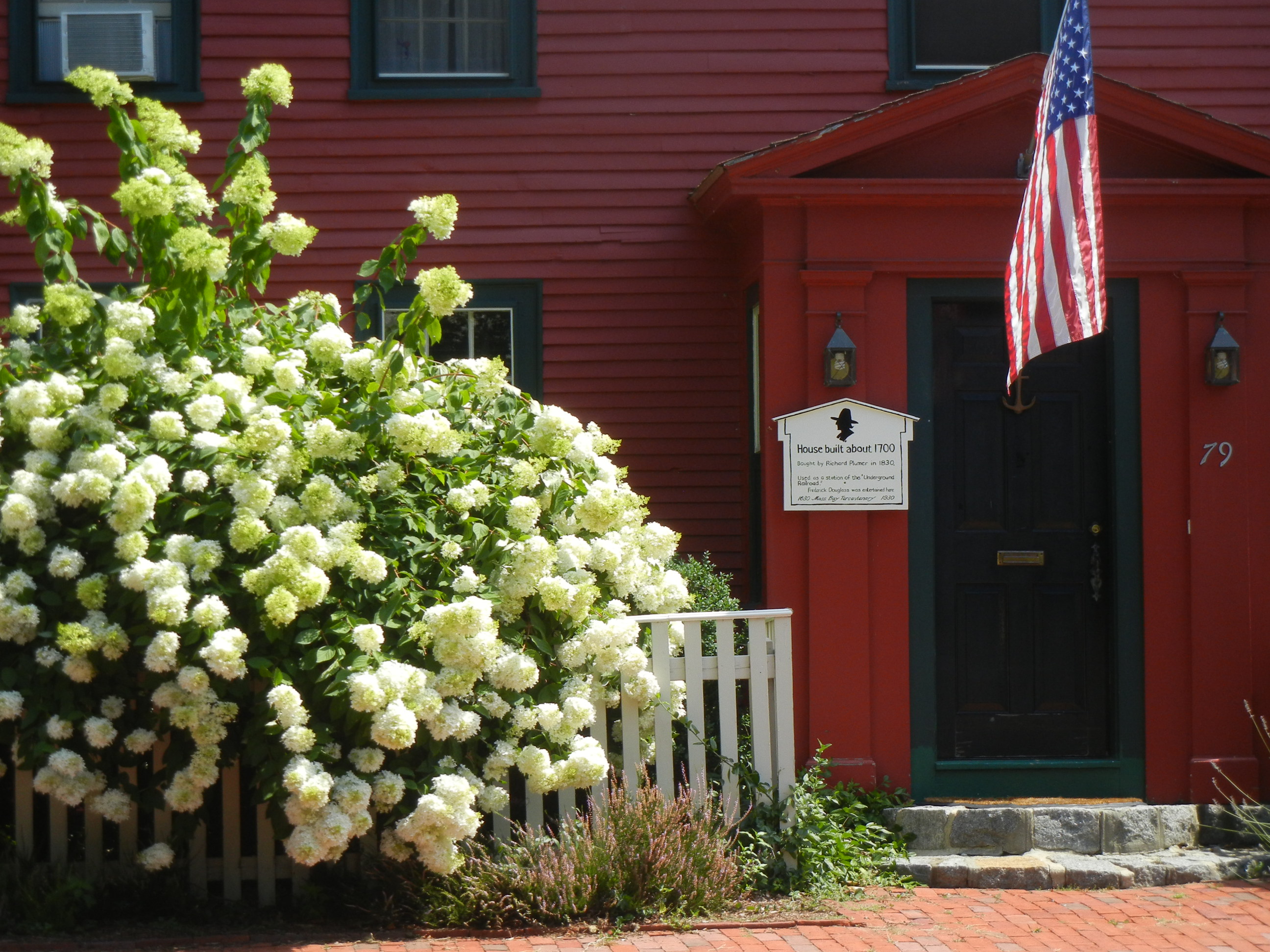
It’s been an endless summer of blue hydrangeas; I prefer white myself, although I’m not much of a hydrangea fan, I must admit. They’re a bit too ostentatious, conspicuous, fluffy, Victorian, much for me.  They don’t have a particularly interesting history, they’re not very practical, and they don’t really belong in colonial gardens. They seem to be much more of a colonial revival plant than a colonial one.  I have this silly rule in my head that hydrangeas, even blue hydrangeas, are fine for coastal shingle cottages (probably because I grew up in one) but that clapboard houses in old towns, large and small, must do without or at the very least have white hydrangeas.

Despite my disdain for the blue, I couldn’t help but be impressed by the blue hydrangeas at my parents’ house in York Harbor this summer; the bush below, which appears to be producing two varieties of blooms, is in fact (of course) two conjoined plants.  As you can see, the more violet of the two blooms are HUGE.

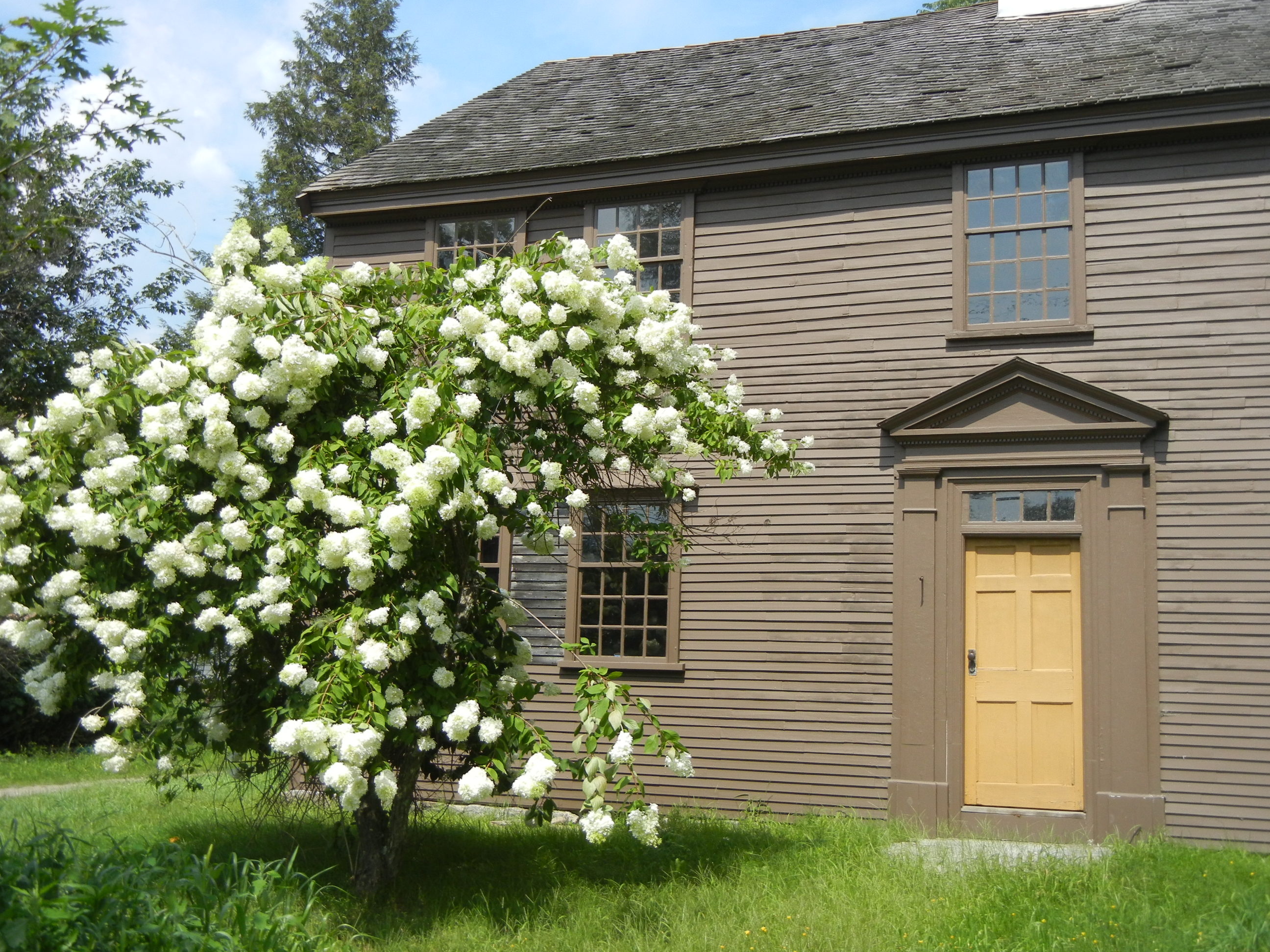
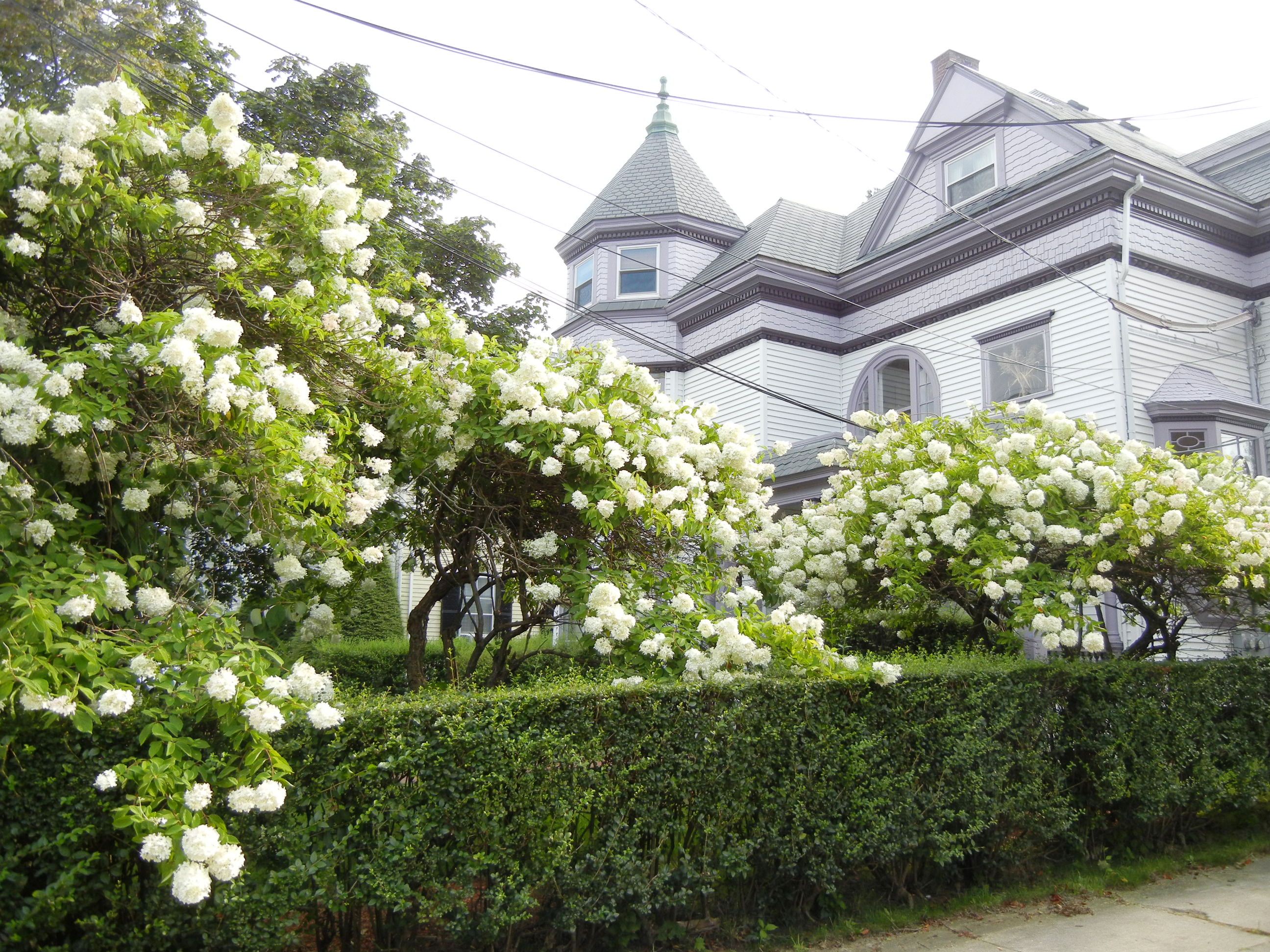
Impressive, but still blue.  Back in Massachusetts, I tried to capture some white hydrangea shrubs/trees that impressed me, many of them apparently quite old.  I do like hydrangeas that spill over fences, like the first two photographs below, the first taken in Newburyport, the second in Salem.

I also like the older shrubs that have turned into little trees, as illustrated by photographs of a Concord house along route 2A and Lafayette Street in Salem.

Two century-old photographs for some historical context:  the first is a Detroit Publishing Company postcard entitled California Hydrangea, the second, by the pioneering Canadian-American photographer Jessie Tarbox Beals, is a portrait of Kate Douglas Wiggin (author of Rebecca of Sunnybrook Farm and other children’s books) on the white hydrangea-bordered steps of her Maine house in the first decade of the twentieth century (Schlesinger Library, Harvard University).


Mr. Allen’s Amazonian Lily

In the summer of 1853, an Amazonian water-lily blossomed in Salem, the second to be cultivated in North America, under the careful watch of amateur botanist John Fisk Allen (1807-76).  Descended from several Salem shipping families, Allen had the means to pursue various horticultural pursuits, and he maintained a greenhouse on Flint Street (not far from his Chestnut Street residence) where he cultivated several varieties of grapes as well as tropical flowers.  He is part of what I am realizing was an active and influential botanical circle in nineteenth-century Salem, with Nathaniel Hawthorne’s uncle, Robert Manning, right in the center. Allen wanted to share his success with the world, or at least his world, so he commissioned America’s first chromolithographic printer, Boston-based William Sharp, to produce six detailed plates of the lily for inclusion in his account of  its cultivation, Victoria Regia; or The Great Water Lily of America (Boston, 1854).

I have seen a really nice edition of this volume in person, and the plates below (from the Internet Archive digital edition) do not do justice to the real thing.  They are really stunning, but apparently Sharp also took a bit of artistic license.  Allen’s text is interesting as well, as he follows the rules of strict scientific observation and tells his readers everything the lily was doing that Salem summer long ago, down to the minute.

The first two cycles of the plant’s growth:

From first flowering through full bloom:


Very Odd Apples

My title actually refers to tomatoes rather than apples, a great example of a New World crop that was introduced into Europe though the “Columbian Exchange” and then brought back to America in the eighteenth century. Like another consequential import from the western hemisphere,  the potato, the tomato was slow to find acceptance among Europeans, primarily due to its first introduction in print by the Italian physician and botanist Pietro Andrea Mattioli (Matthiolus) in his 1544 Commentaries (the tomato page from a 1590 edition is below).  Matthiolus refers to the tomato as a “poma aurea” or golden apple, which is generally taken as evidence that yellow tomatoes preceded their red counterparts across the Atlantic.


Matthiolus tells his readers how to eat the tomato (fried in oil with salt and pepper) but he also classifies and compares the new vegetable (fruit?  He is confused as well) to the mysterious magical mandrake, which gives it a rather malevolent reputation in the early modern era.  Northern naturalists included the tomato in their “new” herbals in the sixteenth century, with name variations but the same magical associations. Conrad Gesner stressed the aphrodisiac qualities of mandrake but maintained its connection to the new plant in his Historia Plantarum (1553),  and thus “golden apples” became “love apples” (and sometimes “wolf’s peaches”) in northern Europe while in Spain the term “Moor’s apples” prevailed.  The most beautiful herbal of the sixteenth century, Leonart Fuchs’ De historia stirpium, included an illustration of the tomato in its later editions, as did Rembert Dodoens’ Cruydeboeck:

The most comprehensive herbal issued in sixteenth-century England, John Gerard’s Herball, was primarily plagiarized from Dodoens’ earlier work (there was a lot of “sharing” in the early modern publishing industry), but Gerard was a gardener who experimented with tomato cultivation (and consumption) himself.  He found the plant to be “of rank and stinking savour” and added this commentary:  In Spain and those hot regions they use to eat the Apples [of love]  prepared and boiled with pepper, salt, and oil:  but they yield very little nourishment to the body, and the same naught and corrupt.  Likewise they do eat the Apples with oil, vinegar, and pepper mixed together for sauce to their meat, even as we in these cold countries do mustard.”  An early reference to tomato sauce, this observation also tells us a lot about the difference between Mediterranean and northern European cuisines, then and now!

Taking their cue from Gerard, the tomato was scorned in Anglo-American cuisines until the modern era, despite efforts by such varied advocates as Thomas Jefferson, who cultivated tomatoes at Monticello, and the Neapolitan artist Michel Felice Corne, who escaped the Napoleonic Wars by departing Naples in 1800 on one of Elias Hasket Derby’s Salem-bound ships, the Mount Vernon.  Corne lived and worked in Salem for the next six years, ostensibly introducing both Italian painting techniques and Italian tomato sauce to the town, but Salemites would have none of the latter.  It would take another half-century or so, and a huge wave of Italian immigration, for “love apples” to become American (again).

Michel Felice Corne, The Ship Mount Vernon of Salem Outrunning a French Fleet

An 1869 Advertisement, Library of Congress