Tag Archives: Home

Midsummer Garden

Early to mid-July is about peak time in my garden, though over the years I’ve tried my best to make it as attractive as possible all summer long and into the Fall.  The garden has been shaped much more by my preference for individual plants rather than overall design, however, and several plants are pretty dominant right now.  Several cases in point:  the huge hosta which was here before me, and really thrives in its shady location in the back (sorry, I don’t know the varietal; if anyone does, I’d appreciate it), the double meadowsweet (filipendula ulmaria flora plena) that I purchased bareroot from Perennial Pleasures Nursery up in Vermont only three years ago, and the red baneberry (actaea rubra)  in the side garden along Hamilton Hall.  The last plant has a nice fluffy white flower in the spring, which turns into these bright red (poisonous!) berries that last all summer long.


There are so many plants–probably far too many plants–in my garden that I’m particularly grateful at this time of year for those that just exist looking lovely without any need of tending.  In my opinion, the best low maintenance plant of all time is this shiny European ginger (Asarum europaeum) groundcover that thrives in the shade.

The last of the June roses; they’re definitely on a midsummer break now but come back with a vengeance in August (IF I take care of them properly):


Lady’s Mantle, Roses and Rue

My garden is more plant-based than design-oriented, and I generally choose plants for their interesting historical associations rather than their appearance.  This doesn’t mean that if a plant is really ugly I won’t yank it out–despite its historical relevance (take that, horehound); I have some aesthetic sensibilities.  Three attractive plants that are in full flower now and have been used in all sorts of interesting ways in the past are Lady’s Mantle, roses, and rue.

Lady’s Mantle (alchemilla mollis or vulgaris) is a really common, self-seeding plant which some gardeners perceive as a weed, but I love everything about it:  its large and soft gray-green leaves and chartreuse flowers, its neat habit, and its history.  It forms a nice border in the shade garden pretty quickly, and blends in nicely with lots of other plants.  Here are some views of one of my shade borders, comprised of lots of Lady’s Mantle, sweet cicely,white baneberry, astilbe, and daylillies.

Like most herbs, Lady’s Mantle had lots of medicinal uses in the pre-modern past, but its Latin name, alchemilla, represents the role it played in alchemy, which moved out of the secretive laboratory and into the garden in the sixteenth century.  The water preserved on its velvety leaves was used for alchemical distillations, which amplified the healing powers of plants.  The common name denotes a multi-layered feminine association:  the “Lady” refers to the Virgin Mary (not just any lady!), the “mantle” to an women’s cloak, and (in the words of Nicholas Culpeper, a seventeenth-century physician and author of The Complete Herbal), “Venus claims the herb as her own”, meaning that it had long been perceived as a cure-all for the full range of “women’s problems”.

The Alchemical Garden. Theseaurus of Alchemy, 1734, Wellcome Library, London

Lady's Mantle illustration from Otto Brunfels' Herbarium, c. 1530

In addition to its aesthetic virtues, the rose was also used in both medicinal and cosmetic (as well as culinary) preparations in the medieval and early modern eras.  I can’t tell you how many rosewater recipes I’ve come across from the sixteenth and seventeenth centuries.  For some reason, I’ve never been able to find the rose variety that was prized the most for its medicinal properties in this era, the Rosa Gallica Officinalis (also called the “Apothecary’s Rose”).  Instead, I just have really pretty, dependable David Austin roses.  Though I generally refrain from showy plants in the garden, this orange rose bush (whose name I can’t remember), blooms all summer long.

Symphorien Champier, Rosa Gallica, Paris 1514. Wellcome Library, London

Rue (Ruta Graveolens or “Herb of Grace”) was perceived as an extremely important plant before 1800 largely because of its role as a “counter poison” against the plague.  To quote Nicholas Culpeper again, rue “causes all venomous things to become harmless”; it was pretty powerful stuff.  It’s neat to have in a plague cure in your garden, but I love rue because it’s so beautiful, with the same soft colors as Lady’s Mantle:  silvery gray leaves, yellow-chartreuse flowers.  It’s a willowy shrub, that can work in lots of (sunny) places.  Here’s rue, along with lots of other herbs (skullcap, avens, dill, flax, calamint) at the front of my sunny perennial border, and in a fourteenth-century herbal.  The attendant snake is meant to accentuate the plant’s anti-venomous virtues.

British Library MS Egerton 747

I wanted to sneak one more shot of the shade border here from the other perspective, but somehow how an orange kayak snuck in here!


Cats Modern and Medieval

Since the weather has turned so dramatically summer-like over the past week, I’ve spent a lot of time in the garden, generally accompanied by a cat or two.  My own cats, Darcy and Moneypenny, are primarily indoor cats, but our garden is pretty sheltered so I let them out in the summer and they hang out there.  They have lots of company, as cats like our garden for the following reasons:  1) I have used catnip very liberally as a border plant; 2) our garden serves as a cat “highway” to the park across the street, and; 3) we are one of the few households on the street which doesn’t have a dog.  So there is generally a cat or two back there, particularly on sunny days.  Below is my big tabby Darcy lying on the deck, Moneypenny lying on the bricks, and my neighbors’ cat (Lord of the Garden and King of the Street) surveying his domain.

When I compare these modern cats to their medieval predecessors, it occurs to me that this is an animal that has drastically improved its standard of living over the centuries.  Medieval cats were clearly not pets, and they did not just lie around in the sun; they had working lives.  Looking at the images in medieval bestiaries from the 12th, 13th and 14th centuries in the manuscript collections of the British Library, the Bodliean Library, and the Getty and Morgan libraries, it is clear that while dogs served as companions (as well as hunters), cats existed solely to kill mice and rats.

A leashed companion and working cats, all from the British Library digital catalogue of illuminated manuscripts:

From the Northumberland Bestiary (mid-12th century) at the J. Paul Getty Museum:

A trio of cats from the Aberdeen Bestiary(c. 1200) at the University of Aberdeen is below, which is accompanied by this great caption:

The cat is called musio, mouse-catcher, because it is the enemy of mice. It is commonly called catus, cat, from captura, the act of catching. Others say it gets the name from capto, because it catches mice with its sharp eyes. For it has such piercing sight that it overcomes the dark of night with the gleam of light from its eyes. As a result, the Greek word catus means sharp, or cunning.

Only occasionally (generally in the marginalia of the manuscripts) are cats given a break from catching:  here we have two musical cats (one playing, one listening) and one (inexplicably) encased in a snail shell.


Civil War Remembrance

Collective memory and expressions of remembrance have been fashionable topics among historians of the last generation or so; it seems like European historians prefer to focus on the culture of remembrance that developed after World War I while American historians dwell on that of the  Civil War.  These were devastating conflicts in so many ways.  And of course World War II has its own unique commemorative culture.  I find that holidays in general, and summer holidays in particular, are a great time to develop, or solidify, a sense of place, an increasingly elusive feeling in this generic world.

Given the fact that we’re in an anniversary year–the 15oth anniversary of the beginning of the Civil War–I decided to follow the path laid out by the Grand Army of the Republic (G.A.R.), America’s first veteran’s organization and the inspirational force behind Memorial Day ( which was first known as “Decoration Day” and exclusively devoted to Civil War veterans) and examine Civil War remembrance here in Salem.

Before I get to Salem, a brief detour back to my hometown of York, Maine, where the Civil War statue resembles a CONFEDERATE officer, or at least what we have come to perceive as a Confederate officer.  He looks odd not because he is incorrectly garbed but because he is anachronistically garbed, in the Spanish-American War uniform that was contemporary to the time of his creation in 1906.  This statue, like all historical monuments, is reflective of both the time of its installation and the time it commemorates, perhaps more so the former than the latter.

Back to Salem.  There is a Civil War plaque adjacent to the Common but the cemeteries provide a less perfunctory form of commemoration, I think.  Salem has many old cemeteries, but the two newest and largest ones, Greenlawn and Harmony Grove, have the most Civil War grave sites as well as designated shrines.  Both are nineteenth-century “garden” cemeteries;  Greenlawn is public and thus a little worse for wear while Harmony Grove is private though still very accessible.  Actually, Greenlawn’s slight shabbiness adds to its poignancy, represented so well by the Gothic Dickson Chapel in its midst.

Down the path to the monumental Civil War statue, dedicated in the 1880s, surrounded by the graves of Salem men who lost their lives during the War between the States.  Their markers are very subtle, so obscured by grass you don’t realize what they are until you’re right on top of them.  All the attention is focused on the large monumental anonymous (but recognizable) Union soldier in the center of the mound, who represents all of them.  This statue bears all the marks of the official Civil War commemorative organizations, both the G.A.R and the Sons of Union Veterans of the Civil War.  Lieutenant Colonel Henry Merritt, the namesake of the SUVCW Camp, was killed at the battle of New Bern in April of 1862.

The Battle of New Bern, Harper's Weekly, April 1862

Over to Harmony Grove, a beautiful, terraced cemetery laid out in a series of winding paths lined by the crypts and semi-enclosed plots of some of Salem’s most prominent families.  Despite a circle of decommissioned cannons,  Harmony Grove’s Civil War installation is not as impressive as Greenlawn’s, and many of the individual soldier’s graves are in a deteriorating condition.  A bit further down the path, however, is the impressive grave of one of Salem’s most eminent Civil War heroes, Luis Fenollosa Emilio (1844-1918).

Emilio was part of the amazing Fenollosa-Emilio family of Salem, Spanish immigrants and ardent abolitionists.  He was a cousin to Ernest Fenollosa, the future Japanese cultural minister who I wrote about in an earlier post.  Even though he was only 16, Emilio had enlisted in the army at the beginning of the Civil War, and when Massachusetts Governor John Andrew created the first Northern black regiment in 1863, the 54th Massachusetts Volunteer Infantry Regiment (memorialized in Glory), he sought and received an officer’s commission.  In fact, Captain Emilio was the only officer of the 54th who survived the disastrous assault on Fort Wagner and successive conflicts to tell the tale of the Regiment, which he did in A Brave Black Regiment.  The History of the Fifty-Fourth Regiment, or Massachusetts Voluntary Infantry, 1863-65 (1891).


Wrapping up my cemetery tour, I took a walk through the much older and smaller graveyard near my home.  There were no flags here; these veterans lie unacknowledged.  Two particularly poignant markers caught my eye, one of a seldom-heralded Revolutionary War soldier named Joshua Cross, and the other of Samuel Cook Oliver, a Civil War veteran who was severely wounded at the Battle of Antietam [and] died after many years of suffering cheerfully and bravely borne.


Spring around Salem

Just a few photographs of Salem sites with no particular connection other than the season.  It’s been a cold spring so far, and I think blooming is a little delayed—always the case with my own garden, which doesn’t look like much until a little later in the year.  I’m kind of a quirky gardener as I’m more interested in individual plants rather than the garden as a whole, and I tend to like plants with interesting historical connections, which generally means later-blooming herbs.  But I did inherit a nicely laid out garden from the previous owners of our house, bordered by boxwoods which thankfully survived the harsh winter.

The central perennial bed is above, and off to left is a little “woodland garden” with a pond and this amazing plant, which is in bloom right now.

Jack-in-the-pulpit (Arisaema triphyllum)!  Aren’t they amazing?  They always surprise me this time of year, along with my yellow lady slippers which are not quite ready for exposure.  Across the street from our house, is “McIntire Park”, the site of the former magnificent McIntire South Church, which I wrote about in an earlier post.  Today it is home to flowering dogwoods, among other trees.

A few more shots of Salem over the past week:  tulips in the Ropes Mansion garden on Essex Street, the shop window of Modern Millie Vintage and Consignments on Washington Street, and the “Mighy Wave”, a one-day installation of plastic bottles collected in one week from last Saturday’s Clean Salem, Green Salem event on the Common.

Finally the view as I approach my office at Salem State University: twin rows of trees lining the path to work.


The Social History of Wallpaper

Nearly every man I know hates wallpaper while most of my female friends love it; I wonder if this gender division existed in the past?  I hear from the paper-hating men that wallpaper is too “busy”, “distracting”, and “floral” (even if flowers are far from the central motif).  They seem predisposed to dislike a wall-full of images and more inclined to focus on just one (or maybe two).  We have some really ghastly wallpaper in our front  hall which I’m sure my husband hates but I find strangely comforting in a grandmotherly sort of way.  Neither of us are inclined to do anything about it as it covers two stories’ worth of wall, but he must have to shield his eyes everyday.

Wallpaper can reveal more than gender preferences; it can also reveal the cultural values of society at large (if you are prepared to engage in gross generalizations, which I obviously am).  Relying heavily on my favorite historical design books (primarily Judith  & Martin Miller’s Period Details and Period Design & Furnishing), and a few other sources, I’m going to attempt a social history of wallpaper, beginning with Tudor Age.

The fragment of  sixteenth-century block-printed wallpaper above was preserved as the lining of a deed box and is part of the collection of the British National Archives.  It is typical dark and dense decoration; the Tudors loved embellishment of all kinds, but particularly natural motifs.  Here you see royal insignia, the emblem of St. George (the patron saint of England) and the ever-present Tudor rose.  The grotesques look a little medieval to me; I’m not sure what they’re doing there.  On to the seventeenth century.

This is a fragment of later seventeenth- century scenic wallpaper in the collection of the Victoria & Albert Museum.  In the middle part of the seventeenth century, the Puritan-dominated Parliament prohibited the production of things as frivolous as wallpaper (and theater!),  but after the monarchy was restored in 1660, people demanded entertainment and embellishment.  Restoration wallpaper seems to have developed as a middle-class form of decoration, as it was a relatively cheap way to mimic more expense tapestries, embroidery, and plasterwork, which were featured in more aristocratic homes.

Things get lighter in the eighteenth century, due to the influences of the “Chinese style” (the example above is from the vast collection of the Victoria & Albert Museum) and the new textile, cotton.  Production became more  complicated, due to the increasing popularity of flocked papers with raised textures, and scenic (even panoramic) papers.  Great Britain was of course an empire, and one of the best examples of later eighteenth-century wallpaper (still on the walls, and recently restored)  is right here in this former colony, in the 1768 Jeremiah Lee Mansion in Marblehead, Massachusetts.  The Lee Mansion has both rare hand-painted murals and block-printed papers still in place, and the former have been reproduced in decoupage form by Neptune Studios, also based in Marblehead.  Of course, I snapped them right up and here they are on one of my mantles:

Thanks to Salem’s own photographer-entrepreneur Frank Cousins (who I referred to in an earlier post), we have a photograph of another local example of early mural wallpaper, in the dining room of the Samuel McIntire’s Cook-Oliver House (1802-3).  The French-made wallpaper depicts the world’s four climate regions, and is still hanging.

The Cook-Oliver House, Federal Street, Salem. Photograph by Arthur Haskell, Historic American Building Survey, 1938. Library of Congress

Frank Cousins' photographs from his "Pageant of America" series, New York Public Library Digital Gallery

So shortly after the American Revolution, Captain Samuel Cook (or his wife) probably preferred to install French wallpaper in his home rather than English, as a native industry had yet to develop.  But French designs and designers dominated the industry everywhere in the early nineteenth century.  French emigres to the United States, most prominently the Philadelphia wallpaper printer Henri Virchaux, produced scenic and neoclassical papers for the homes of America’s new elites.  Below are two examples of papers produced for Messrs. Virchaux & Co. in 1815, from the collections of the Library of Congress.  Adelphi Paper Hangings produces licensed reproduction papers of Virchaux designs (as well as those of other nineteenth-century manufacturers) and has lots of period patterns on their website.

Even though French designs were preferred by upper-class consumers on both sides of the Atlantic, the British wallpaper industry was still extremely profitable, due to both new industrial techniques and marketing strategies.  The wallpaper industry was showcased in the Great Exhibition of 1851, featuring over 100,000 objects on display and attracting 6 million visitors, both by the officially licensed wallpaper featuring the Exhibition’s symbol, the Crystal Palace, and this prominently placed advertisement by one of Britain’s largest manufacturers, Townsend, Parker & Townsend:

National Archives, United Kingdom

New York Public Library Digital Gallery

After 1850, machine printing replaced the hand block-printing process and wallpaper became a more egalitarian form of embellishment.  Lots of large floral patterns, produced for mass consumption; perhaps this is when wallpaper became a dirty word for men!  I’ve taken my share of Victorian wallpaper off walls, but when looking for mid-nineteenth-century wallpaper to put back on the walls of my house I turned to Waterhouse Wallhangings.  Dorothy Waterhouse became an advocate for early American papers after she discovered subtly colored prints underneath  “ugly” 1890s papers in the process of restoring her 1799 house on Cape Cod in the 1930s.  She wrote and spoke about her love for hand-printed papers, people sent her samples from up and down the east coast, and she started a reproduction historic wallpaper company which is still in business.  Historic New England possesses and licenses wallpapers from the Waterhouse archival collection, and you can see the collection in its entirety (along with thousands of other samples) at their website; below is the Waterhouse wallpaper that I have in my library and dining room.  It’s actually two variations and colorways of the same 1850s background pattern, and of course my husband dislikes it.

Because the Victorian era is so long, it encompasses many different, often contradictory, design styles:  naturalistic and mechanistic, traditional and modern, simple and complex. Two men with divergent styles but  an equally influential impact on wallpaper design were Christopher Dresser and William Morris, both working in the later nineteenth century.  Dresser is among the first “industrial designers”, who sought to take advantage of the mechanized production process by incorporating repetition and standardization into his designs, while Morris was a steadfast naturalist whose (more expensive) papers were still block-printed by hand.

Christopher Dresser Wallpaper (1876), New York Public Library Digital Gallery

William Morris woodblock print wallpaper, Victoria & Albert Museum Collections

The dialogue between machine-made and man-made, combined with increasing globalization, created a golden era for design in general (and wallpaper in particular). So we see the aesthetic movement, the arts and crafts movement, the art nouveau movement, and the art deco movement, before the transition to full-scale modernism, in the early decades of the twentieth century.  I’m not sure how any of these styles affected the average consumer; when you look at the material evidence for the twentieth century what you see are such a variety of papers produced, with traditional (though more cheerful!) florals, and a new emphasis on the pictorial, and the novelty:  popular culture on the walls.  If you search through the online collections catalogue of the largest repository of historic wallpaper in the United States, the Cooper-Hewitt, National Design Museum (over 10,000 samples!) you will see an amazing variety of twentieth-century papers:  Gibson girls, all sorts of literary characters, cowboys, love letters, college memorabilia, all forms of transportation, anything to do with children, Andy Warhol cows. 

Some of the most popular twentieth-century patterns have been reproduced by Bradbury & Bradbury Art Wallpapers, including an art deco “aeroplane” paper, pictured here in blue, and the mid-century “gee gee” paper in sage. Finally, back to the future:  two modern takes on a classic French toile:  Harlem Toile  (in two colorways) and  London ToileToday there’s a toile for everyone and everywhere.


Anglo-Americana

As an English historian living in a Federal/Greek Revival house in an iconic (small) American city, I’m always shooting for an interior style I call “Anglo-Americana”:  a fusion of English texture and American spirit, for lack of a better term.  In the past I went for a more strictly-period look, but now I prefer to mix it up and be eclectic, which is very, very English.  I’m just about to paint the double parlor, which means some rearranging after I take it all apart and put it together again, so I’ve been scouting for some new/old things I could add to the present mix.

By the end of the nineteenth century, all the animosity between Britain and America was over, if the poster below (from the 1890s) is any indication.  One the eve of World War One (literally!) a huge  Anglo-American Exposition was held in the “White City”, Shepherd’s Bush, London; the ticket to the big event (below) has a cancelled stamp most likely because of the outbreak of the war.  Thereafter, the two countries were bound together by war.

Courtesy Museum of London

Following in a long line of  British textile entrepreneurs like Laura Ashley and Cath Kidston, Helkat Designs  makes hand-printed cushion covers that instantly introduce a touch of Englishness into a room, and there is also a perfect “Anglo-American” pillow:

I’m not sure I can sneak any more wallpaper into the house, but these lady of the manor and little teapot prints are really charming.

Anything to do with tea!  I already have some “teaeana” (that doesn’t look like a word; tea-related stuff, stuff with tea motifs) so it’s probably better to refrain, but I do like these tea canisters from Mothology:

Vintage English textiles that look to my untrained eye like vintage American textiles are available at Parna; below is a simple hand-loomed linen tablecloth in a nice size.  I’m looking for something different to spice up the walls (besides new paint), but I’ve already got very nice period hand-colored botanicals, architectural prints, and etchings.  This bicycle print caught my eye, but it might be a bit too whimsical for downstairs.

Finally, a beautiful late seventeenth-century map of America, North and South, by London cartographer and instrument-maker John Seller, available for purchase as a cropped print in a variety of sizes at the New York Public Library Digital Gallery.


The Key to……..

This was a week of keys; I lost a key (temporarily), got a new key, and seemed to be perpetually teaching about Renaissance popes who asserted their power visually by wielding big keys (to the kingdom of heaven, of course) in an age of questioning authority.  I have always liked keys, both their material existence and their symbolism.  They represent access, understanding, the revelation of secrets, possession. When I moved into my house a decade ago I found a big box of skeleton keys in the basement, far more keys that I have doors.  So I strung them up on ribbons which I hang from hooks on my back stair landing.  Of course, everyone who passes by thinks I have a key fetish so I have collected even more keys over the years.

Fifteenth-century popes seem to be in the possession of an ever-present key, symbol of their possession of jurisdiction over salvation, bequeathed to them by St. Peter.  Here are images from two mid-fifteenth century illuminated manuscripts in the British Library showing popes and their big keys:

Jumping forward into the modern era, keys have lost their religious symbolism and taken on all sorts of associations.  Here they appear on tarot cigarette cards, in illustrations from a mid-century text called Robbery as a Science (with instructions on how to pick a lock, very useful for potential burglars!) on an abolitionist envelope, in a political cartoon entitled “the key to the situation” featuring President Grover Cleveland (all from the New York Public Library Digital Gallery), and in the titles of  two popular genres of twentieth-century entertainment:  sheet music and a Clark Gable film from 1950 (Library of Congress Digital Collections).

The keys to the city custom has a history all its own, dating back to when medieval cities were independent entities that extended the “freedom of the city” to special visitors.  There are lots of references and images of early modern kings like Louis XIV entering, claiming, and receiving keys to cities (like Strasbourg below, in 1681) but obviously the modern custom represents recognition rather than possession.  Below Louis, we have presidential candidate Dwight Eisenhower receiving the keys to the city of Rock Island, Illinois from its mayor Melvin McKay in 1952 (Time-Life Photographs) and a very recent photograph from the Wall Street Journal of Ralph Lauren with his newly acquired key to the city of New York.

Below are some neat keys that I’ve had my eye on for a while:  a porcelain set made in Japan, a “steampunk clockwork magic key” textile border, and USB flashdrives, “the key to love, success and all your photos, files, and music”.  What better key for our age?


Demon-made Rum in Salem


It is no coincidence that in the 1830s and 1840s Massachusetts was both a leading producer of rum and an early center of the Temperance movement.  A third-generation Salem distiller named John Stone built our house in 1827, and 8 years later he found himself at the center of a storm whipped up by a pro-Temperance pastor named George Barrell Cheever, a classmate of Nathaniel Hawthorne’s at Bowdoin College who had recently taken up the pulpit at the Howard Street Congregationalist Church.  Cheever was a passionate Northern reformer, equally zealous about banning alcohol and slavery.  For both theological and moral reasons, he was also quite opposed to the Unitarian Church, which was very well established in Salem.  So John Stone was a perfect target:  not only was he Salem’s largest and wealthiest distiller, but he was Deacon John Stone of the Unitarian First Church in Salem.  An attack on him would be like killing two birds with one stone!

Reverend Cheever in the 1850s, NYPL Digital Gallery

a mid-nineteenth-century Tree of Temperance, producing all good things

In 1835 Cheever published an article in the religious newspaper The Salem Landmark entitled “Inquire at Amos Giles’ Distillery”  about an allegorical dream featuring a deacon/distiller, “a man who loved money, and was never troubled with tenderness of conscience”, whose employees were devils who manufactured not only rum (or “liquid damnation”) but also diseases, murder, insanity and all the evils of the world.  All hell broke out with the publication of this article:  Deacon Stone immediately recognized himself as Deacon Giles (Cheever had inserted many obvious clues in his “dream” story), his foreman attacked Cheever in the street, and a mob descended on the offices of the Salem Landmark.  Cheever was sued for libel, found guilty, and ordered to spend a month in jail (where Nathaniel Hawthorne apparently visited him) and pay a $1000 fine.  There was no sympathy in Salem for Cheever, who was referred to as the “Lord’s Annoited” by The Salem Gazette, but he moved on to bigger and better things: a new post in New York City and a national stage for his pro-temperance, anti-slavery advocacy.  His little story fled Salem as well, and was reprinted as a broadside and pamphlet in New York and elsewhere under variant titles of Deacon Giles’ Distillery.  


Scenes from “Deacon Giles”:  demons in the distillery & dispensing damnation, from Building the Nation:  Events in the History of the United States  from the Revolution to the Beginning of the War between the States, by Charles Carleton Coffin (1882)

And what role does our house play in this story?  Not much of one, except for the fact that we have lots and lots of storage compartments in the basement, including a “secret” one that actually extends under part of the street (or at least the sidewalk; I’ve never ventured into it–too scary).  All of this storage space could have been used for supplies and stores, as Deacon John Stone operated our house as a rooming house while he lived across the street, or just maybe it housed all that rum.


Images of Ice

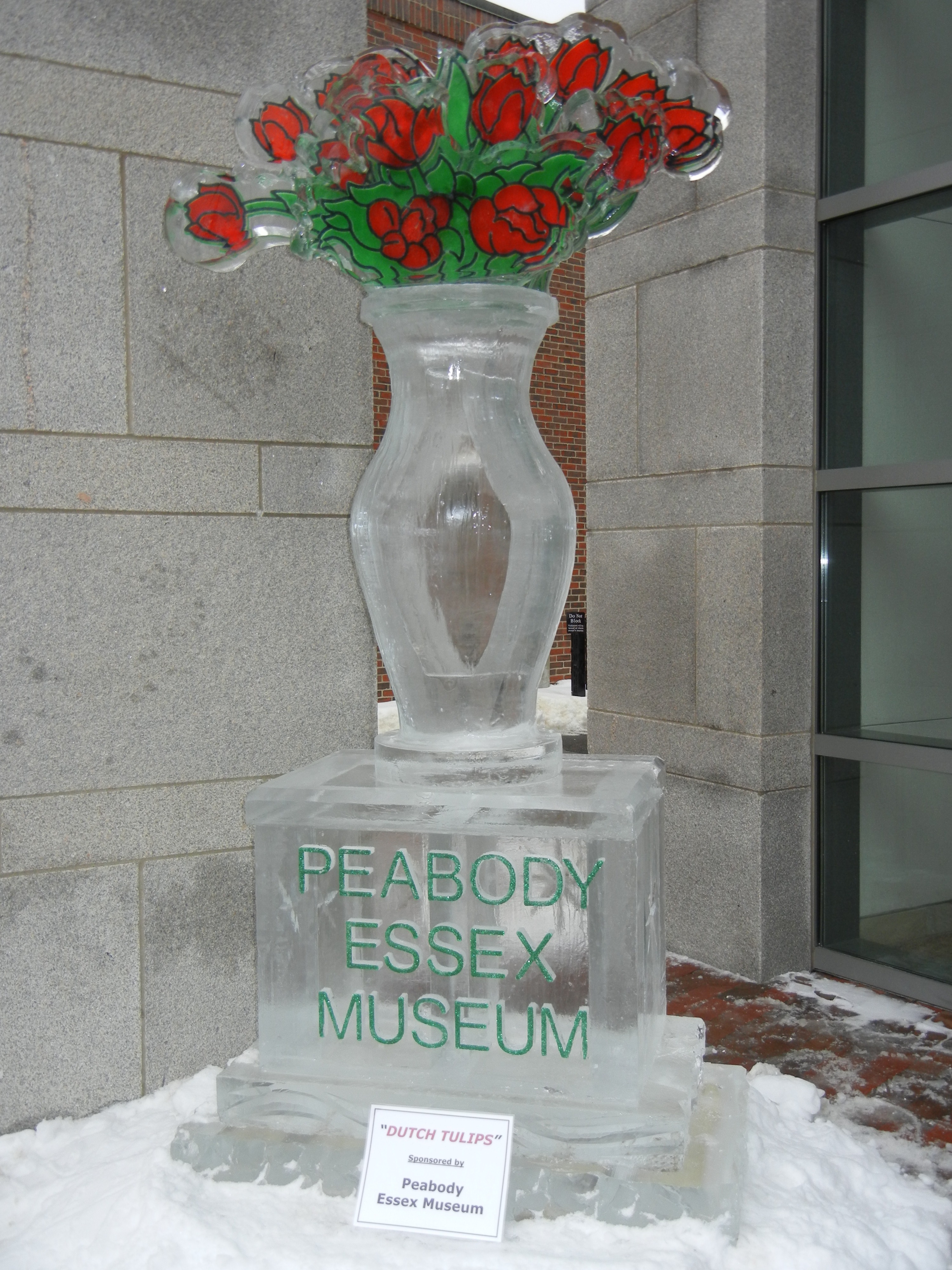
It’s all about ice this weekend. Menacing icicles are hanging off our roof and those of other building around town, but friendlier cold creations are at street level, as 21 ice sculptures line the downtown as part of  the annual “Salem’s So Sweet” festival sponsored by Salem Main Streets.  I’m impressed with the effort; I walked around to take the photographs below and saw a lot of people on the streets and in the shops.  It wasn’t quite Halloween, but it was an impressive turnout in the doldrums of dreary February.

And now for a more threatening image of ice:  tentacles on the side of City Hall, provoking the closure of the alley below.

Finally, some really scary images of ice.  While searching through the National Weather Service Historic Photographs Archive for pictures of the great Blizzard of 1978  (which happened this weekend), I came across these views of ice storms in Portsmouth, New Hampshire in 1886 and outside Providence, Rhode Island in 1921.  My trees have really taken a hit this year, but these pictures put it all in perspective, as history often does.