Tag Archives: holidays

Letterpress Love

The revival of traditional letterpress printing in this past digital decade is a very interesting trend to me; or perhaps my impression is incorrect and letterpress never went away.  It does seem like small letterpress printers are popping up everywhere, hopeful signs that craftsmanship is still valued–even pursued–in an age of mass and massive production. I wanted to feature some local letterpress printers for this pre-Valentine’s Day post and I found quite a few, but very few of them were really offering valentines, which makes perfect sense:  their business is a bespoke one, and custom-ordered Valentine’s Day Cards are probably pretty unusual (and unprofitable).  I did find a few, and I broadened my search a bit to include letterpress offerings on the neat (and new-to-me) site Felt & Wire Shop and Etsy.

I’m looking for rather streamlined Valentine’s Day cards this year:  no cutesy animals, only minimalist hearts, typographical motifs, and beautiful printing, although a quirky card always catches my eye.  The cards below particularly appealed to me, beginning with one from a local printer: B.IMPRESSED.  Just click on the image to get to the source.

I had to put one animal-themed card in here, plus this is beautifully printed.

A bit overtly romantic for me but again, beautifully printed.  The bleeding hearts look like BLEEDING HEARTS.

Not a valentine, but a great photograph (by Maggie Holzberg) of an example of some very nice printing and the “bite” of type into paper, from the Massachusetts Cultural Council’s Folk Art & Heritage Apprenticeship Program.


Herrick’s Holiday

February 2:  whether it is Candlemass in the past or Groundhog Day in the present, people are craving change and hope at this time of year.  I think it is interesting how the very secular Groundhog Day replaced a Christian holy day which probably replaced an earlier pagan festival day.  In the end, the weather and the season are the constant variables, and people’s desire for Spring, in every era.  One thing is for sure:  you must take your Christmas decorations down by Candlemass/Groundhog Day:  Valentine’s Day is just too late.  This has been determined by custom and expressed best, I think, by the seventeenth-century English poet Robert Herrick (1591-1674).

Herrick’s major work was Hesperides; or the Works both Human and Divine of Robert Herrick, published in 1648 in the midst of the English Civil War but revealing no sense of a troubled time.  It is full of little odes and ditties, to women (Julia, Chloris, Anthea, Electra; most are judged fictional by scholars), flowers, and the changing seasons.  Herrick seems to exemplify the gather ye rosebuds while ye may mentality that he first expressed.  He also provides a guide to seasonal decorating in his poem Ceremonies for Candlemasse Eve:

                                   Down with the Rosemary and Bays, Down with the Mistletoe; Instead of  Holly, no up-raise the Box (for show.)

                                   The Holly hitherto did sway; Let Box now domineer; Until the dancing Easter-day, or Easter’s eve appear.

                                    Then youthful Box which now has grace, Your house to renew; Grown old, surrender must his place, Unto the crisped Yew.

                                               When Yew is out, then Birch comes in, and many flowers beside:  Both of a fresh and fragrant kin To honour Whitsuntide.

                                    Green rushes then, and sweetest bents, with cooler Oaken boughs; Come in for comely ornaments, To re-adorn the house. Thus times do shift; each thing his turn do’s hold; new things succeed, as former things grow old.

Times do shift, and former things grow old.  I’m sure that Herrick poems were quite old in the eighteenth century, but they seem to have experienced a revival in the Victorian and Edwardian eras, resulting in the production of  some beautiful editions of his collected works.  I have one illustrated by Edwin Abbey and published by Harper Brothers in 1882.

The 1903 edition issued by the Elscot Press (in only 260 copies) looks really beautiful too; the first page contains Herrick’s philosophy of life and poetry:  Times trans-shifting.

A more timely greeting for the Day:


First Footing

I have many plans for this year, and in order to give myself as much support as possible, I adhered–as best as I could–to the Scottish New Year’s tradition of “first footing”.  According to this custom, whoever enters a house first upon the New Year determines its fortune in the coming months, and the preferable “first footer” is a tall dark man. All women are (of course) unlucky, and fair-haired men equally so, perhaps out of a long-held fear of Viking invaders.  Unfortunately for my household, only two people were in a position of entry after midnight last night:  myself (a woman) and my husband (a fair-haired man, of Swedish descent, even more problematic).  My stepson is not with us for this weekend, and as he’s equally fair-haired he would not be much help.  I thought of pushing some dark-haired neighbor over the doorstep at midnight (this is no doubt what the Scots do), but instead decided to over-compensate with the lucky gifts that the first-footer should bring into the house:  bread (or the alternative shortbread or fruitcake), whiskey, coal, salt, and coins.  Just one of these gifts should suffice, but I fixed up a basket with all of them for extra luck, and we carried it over the doorstep when we came back from our New Year’s Eve party.

Hope it works!  Good luck to everyone in the New Year.


Numerical New Years

I’ve collected a sequence of New Year’s Day cards (+ one poster) from a century ago, when separate New Year’s Day greeting cards were issued by the thousands, both in America and Europe.  The collective “Season’s Greetings”/ “Happy Holidays” cards began to dominate the message after World War II, with the consequence that New Year’s now seems to be a mere afterthought of the Christmas celebration.  New Year’s Day cards are interesting because they feature an assortment of trans-Atlantic traditions and tropes which are supposed to bring good luck in the next year:  pigs are very popular, as are the traditional horseshoes and clovers. There are babies, of course, and the occasional champagne glass or bottle. For some reason, mushrooms appear on a lot of cards, particularly European ones, sometimes with gnomes, sometimes not.  I thought I’d feature “year” cards–in chronological order–from the first decade and a-half of the twentieth century, from my own collection and that of the New York Public Library Digital Gallery.  First off, cards from Germany and Switzerland, followed by my very favorite card (1904):  a lady on a pig against a background of four-leaf clovers, holding a glass of champagne. And mushrooms!  How lucky can you get?

“Smoking New Year’s”, evoking the two-faced Janus, by artist and illustrator Frank Graham Cootes (1879-1960).


After Christmas

Happy Boxing Day, St. Stephen’s Day, Day after Christmas, everyone.  We had lots of family for the holiday, and I’ve been elbow-deep in dishes all day long because the garbage disposal had the audacity to become jammed right in the midst of my Christmas feast preparations, taking the kitchen sink and dishwasher out of service.  Just to clear out the kitchen, I put dirty dishes in the bathtubs, the mudroom, the cellar…and after everyone left this morning I started working my way through them, primarily in the powder room sink!  No plumber to be found yet….

The calm before the storm:  all the clean dishes on the table before the Christmas Eve Feast of Seven Fishes, cooked almost entirely by my husband.  I went a bit more formal for the next day’s feast, despite my lack of dishwasher, and I paid the price today.

I’ll spare you too many pictures of after:  I’m sure everyone has faced their fair share of dirty dishes, trash bags full of wrapping paper, and too many empty boxes and wine bottles.

But I’m not complaining; I’m happy to clean up after this holiday weekend, full of family, friends, food, drink, and very thoughtful and creative gift-giving!  Snowshoes from my husband, which I can’t wait to try out but will probably have to given our complete lack of snow (just a few flakes on Christmas Day).  Beautiful Christopher Moore linen tea towels with prints from the late seventeenth-century series of etchings by Nicolas de Larmessin and Gerard Valck entitled Les Costumes Grotesques et les Metiers (Fantastic Costumes of the Trades)  from my brother and brother-in-law, including the Parfumeur, the Vigneron (see below), the Paticier, and the Jardinier.  A pretty Anthropologie apron from my stepmother that I wore all day yesterday to cook in, and much of today to wash my dishes.

Here’s an after image:  another present from my stepmother, which I haven’t opened yet because I can’t believe she took the time to search out wrapping paper that looks exactly like the upholstery on my couch, a wilted evergreen arrangement which held out until today, the day after Christmas, and a truly grotesque sheep (the bright orange “ball” you see are his lips), a family “heirloom” which we wound up with in the Christmas Eve Yankee swap.


Trimmings and Tidings

The streets of Salem at Christmas time, 2011:  a walk around the decorated city.  I was attracted to simplicity and creativity, two things that I’m going to strive for in the New Year.

Skates and a sweater on black doors, on and around Federal Street.

River Street always goes all out, for every season.

These two houses on Federal Street always look great.

It doesn’t really “pop” in my picture, but the juxtaposition of the tiny vintage Christmas figurines in the window of this Broad Street house with the rusty old piece of machinery was really neat.

Minimal decoration, but I love these carriage houses.  The top one belongs to the Pickering House on Broad Street; the bottom one, just off the Common, has been recently restored.

Adorable window at the Mighty Aphrodite, a maternity consignment shop on Essex Street.  Green and red maternity dresses and a snowy, sparkly baby.

Glad Tidings to everyone this holiday season.


Juleneg

I don’t have a drop of Scandinavian blood in my veins, but I really love the northern European custom of Juleneg, in which a wheat sheaf is attached to a roof gable or adjacent pole or tree at Christmas time.  Elves or fairies are often pictured affixing these “Christmas bundles”– holiday feasts for the birds.  The wheat sheaf is so symbolic; for us it tends to symbolize the harvest, but it can also represent sustenance through the winter and hope fulfilled:  what better Christmas message?  I think we should adopt the Juleneg custom, especially here in Salem, where wheat sheaves have the additional connection to Samuel McIntire, the architect of our beautiful Federal city.

Wheat Sheaves for Christmas:  a Juleneg card from 1911, a McIntire mantle and pin from the PEM shop, the cover of a Federal-era snuffbox, and proofs for chromolithographic Christmas cards from Prang of Boston, 1880s (New York Public Library Digital Gallery).


Green (Room) Christmas

Apparently it was “Silent Cal” Coolidge who initiated the customs of both the national Christmas Tree (in 1923) and the presidential Christmas Card (in 1927).  The former began as a subtle promotion for Coolidge’s state of Vermont, which sent along the tree, while the latter custom seems to have emerged from Mr. and Mrs. Coolidge’s sincere appreciation for the large number of condolence and Christmas cards they received after the sudden death of their youngest son from blood poisoning in 1924.  The Christmas Cards from the Coolidge, Hoover, Roosevelt and Truman administrations are pretty sedate, which makes sense considering they were issued in an era dominated by the Depression and World War, but things begin to liven up with the Eisenhower and Kennedy eras:  could White House Christmas cards be signs of the times?

I was going to showcase chronological Christmas cards by administration, but frankly the pre-1960 ones were pretty boring.  A completely representative example is this 1941 card below,  but its simplicity and sedateness is understandable–this was only a few weeks after Pearl Harbor.

The first National Christmas Tree, 1923; Library of Congress; the Roosevelt 1941 Christmas Card, White House Historical Association.

Looking at all these cards, I became fixated on those showing White House interiors in general, a tradition that began with the Kennedy Administration, and the Green Room in particular:  I’m a big Red Room fan too, but the Green Room Christmas cards really capture the essence of the season for me.  So here they are:  Green Room Christmas cards from the Kennedy, Reagan, and Clinton administrations.  The first one, by illustrator Edward Lehman, is obviously the most poignant (and valuable), as it was issued only a few weeks after President Kennedy’s assassination to only a select few–primarily White House staff.  Twenty years after the Lehman image, interior designer Mark Hampton reproduced the newly-redecorated Green Room in watercolor for the Reagan’s 1983 Christmas Card.  And finally, the Clinton’s 1996 Christmas card by artist Thomas McKnight.

The Green Room decorated for the Holidays this season, with wreaths and trees made of recycled newspapers and magazines, illustrating the theme “Reflect, Rejoice, and Renew”.


The Christmas Dance at Hamilton Hall

Hamilton Hall was built as an assembly house in 1805 by Samuel McIntire and it retains this essential function over 200 years later.  It has been the setting for festive fetes for important people (the Marquis de Lafayette, Nathaniel Bowditch, Andrew Jackson), debutante assemblies, lectures, forums and exhibitions, and the annual Christmas Dance.  I believe that the Christmas Dance began just after World War II, along with another annual event, the Hamilton Hall Lecture Series, but it retains traditions that herald back to earlier assemblies:  patronesses, ushers, curtseys, a lethal bourbon punch, and a “Grand March” at the end of the evening.  I never miss it.

Mary Harrod Northend (1850-1926), author, photographer, and descendant of several old Massachusetts families, recounts many Hamilton Hall traditions in her book Memories of Old Salem (1917) and Colonial Homes and their Furnishings (1912).  Like her contemporaries Wallace Nutting and Alice Morse Earle, Northend had a rather sentimental view of  the “ye olde” colonial past, Salem’s past, and her past, but her books and photographs are still charming.

I went over and took some pictures of the empty Hamilton Hall, well before the caterers and dancers arrived.  There’s something about an empty “party” hall, especially this particular one with its interesting acoustics and spring dance floor, that is compelling, even romantic.  As you can see, the Hall has an elegant but somewhat spare interior, which was disdained by the Victorian ladies of Northend’s Memories, who were always embellishing it with flowers and oak leaf garlands and swags. The gilt mirrors, which are always referred to as the Russian mirrors, were an addition of that time, along with the lighting.

The second-floor ballroom.

The Lafayette Room, with the Marquis over the mantle.

More mirrors in the Supper Room on the third floor.

Hours later, the food and attendees were assembled in the Hall, the latter not quite as orderly as in one of Northend’s photographs, despite their participation in the Grand March.


Christmas Shopping in Salem

I wrapped up most of my Christmas shopping this past weekend, right here in Salem.  I wouldn’t have been able to accomplish that a few years ago; the retail situation has improved considerably.  About the only type of person for whom you couldn’t find a gift in Salem shops is an outdoorsy man, and I have two of those on my list so I might have to break my self-imposed rule of shopping local.  I really would love to be the sort of crafty person who makes lovely gifts for family and friends, but I know that’s never going to happen; I’m a college professor, this time of year means finals and papers as well as shopping and entertaining, so I have no time (and little skill, really, unless endless amounts of time are available) to make gifts.  The best I can do is search out creative upcycled gifts and shop local.

Shopping local is no hardship:  you walk along festive streets to nicely-decorated and -edited shops, browse and purchase, perhaps pop in for a drink or coffee, and then shop some more.  No traffic, no crowds, no malls, no generic gifts.  Walk, shop, drink.

Here are some of the shops and their wares I visited on Sunday, and some trends I spotted, which might transcend my local focus.

Urban Elements , 83 Washington Street, just a few buildings down from Salem City Hall

Urban Elements is a large store full of great furniture and large things, but small things too.  There are several walls of decorative items for the home, including kitchenware, bookends, ceramics, interesting little metal statues (bicycles and gears—very steampunk), pillows and throws, and signs.

Scrubs, Roost, & the Beehive, 230 Essex Street and 38-40 Front Street

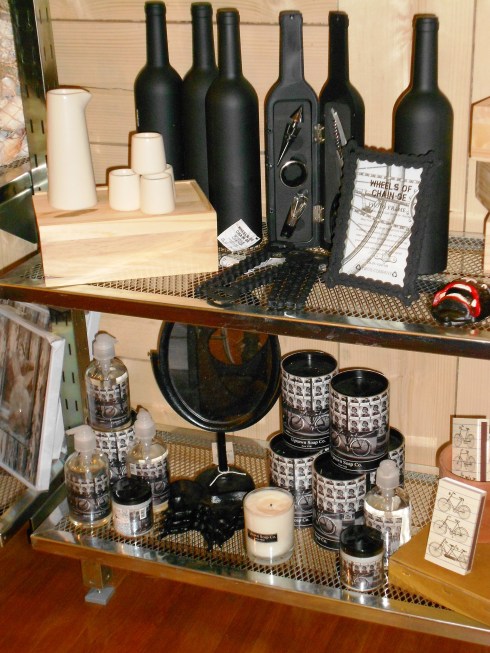
Scrubs, Roost, and the Beehive are a family of shops offering all things for the bath (Scrubs), home furnishings and gifts (Roost), and cards, games and novelty items (the Beehive).  The Beehive is the store for Secret Santa and Yankee Swap gifts, trust me.  There is a strong focus on local products in all three shops, and particularly in Roost, I always see things that I never see anywhere else.  Below, Santa bathing in the window of Scrubs, sock monkeys at the Beehive and gifts for the home (bicycle motifs:  a strong trend) at Roost.

Sidewalks and storefronts along the way: Witch City Consignment & Thrift, Mud Puddle Toys, the award-winning window at Paxton, and planters, pails and buoys at Olde Naumkeag Antiques.

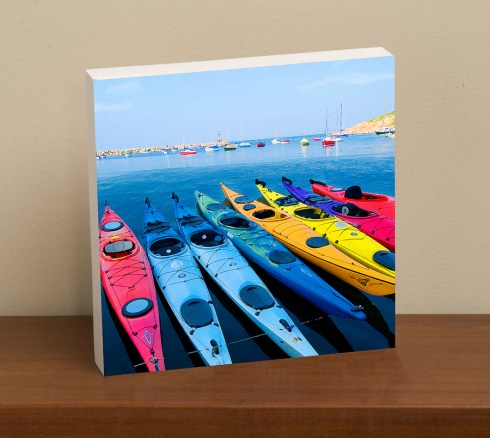
The Peabody Essex Museum ShopYou can find things for practically anyone at the large PEM Shop on Essex Street (except, of course, for the outdoorsy man), including jewelry, all sorts of things for the home, throws and scarves, books, and art.  I particularly liked “Marthablox”, the little photographic box prints produced by local photographer Martha Everson.

Pamplemousse, 185 Essex Street

Part gift shop and part gourmet food and wine shop, Pamplemousse also carries a lot of local items, including a large selection of the great candles from Witch City Wicks that I featured in an earlier post.  There are lots of kitchen items here, both practical and decorative, and German winter wines that you can heat up for the coldest days–and mead.  As you can see below, Pamplemousse always carries seasonal items as well.

[TIME FOR A DRINK]

Sophia‘s, 105 Essex Street

Further down (or up) Essex Street, across from the Hawthorne Hotel, is Sophia’s (pronounced SophEYEa’s, after Mrs. Nathaniel Hawthorne), a gem-like boutique with an emphasis on the romantic and the whimsical.  Here there are Sid Dickens’ “memory blocks”, Diptyque candles, perfumes and paper, jewelry, and hand-created hats, among lots of other indulgent items.  Below, silhouettes and a silver tureen full of watch parts, the makings of steampunk (a strong aesthetic in Salem) jewelry.

J Mode, 17 Front Street & Treasures over Time, 139 Washington Street

Back to Front Street, the center of Salem shopping, to go clothes shopping at J Mode.  This is a beautiful store with some of my favorite brands:  Tracy Reese dresses, tops by Three Dots and Velvet. Not inexpensive, but the emphasis is on quality and service.  The same can be said for Treasures over Time, a very interesting shop around the corner on Washington Street.  The shop represents the joint interests and expertise of a married gemologist and numismatician (coin dealer–I looked it up), so there is beautiful jewelry here, as well as collectible coins, minerals, and geological items.  A great shop for boys and women, and probably the best bet for those pesky outdoorsy men on my list as well.

A rack of Three Dots at J Mode, one of several jewelry cases at Treasures over Time

Addendum:  I forgot to mention that on this coming Friday evening, December 16, there will be a special shopping Open House Night, in which over 50 Salem shops downtown will be participating.