Tag Archives: Historic Preservation

Samuel Chamberlain’s Salem

The Phillips Library of the Peabody Essex Museum, steward of so much of Salem’s printed, written and visual history amongst its many collections, has recently digitized over 5000 images from the “Samuel V. Chamberlain Collection of Photographic Negatives, 1928-1971″ and they are available and searchable at the Digital Commonwealth. Combined with the Frank Cousins images which the Phillips made available several years ago, there is now a very strong visual record of Salem’s architecture and streetscapes in the first half of the twentieth century, or at least some of Salem’s buildings and streets as neither Cousins or Chamberlain were particularly interested in “working Salem”. Cousins was a bit more of a documentarian than Chamberlain, especially as his era (roughly 1890-1920) encompassed the Great Salem Fire of 1914. Chamberlain was a man of the world, a gourmand, and an artist: his Salem photographs encompass only one part of his work, but an important part as he lived in nearby Marblehead for many years so developed quite an intimate knowledge of the city. I’ve always been struck by his perspectives, but I thought that I’d seen most of his Salem shots as he published so many books of photography of New England scenes in general and of Salem structures in particular, including Historic Salem in Four Seasons (1938), Salem Interiors (1950), and A Stroll through Historic Salem (1969). But I was wrong: there are discoveries to be made among the 1600+ Salem images included in the Phillips Library’s Chamberlain negative collection at Digital Commonwealth. The vast majority of these photographs are of the McIntire Historic District in the 1930s, 1940s, and 1950s, but I can see different details and angles in Chamberlain’s images of these perennially-showcased streets and structures—and lots of wonderful TREES.

New perspectives of old streets: and the interior of the depot!

These are images which struck me as “new” for one reason or another, although the first photograph is just the view of Chestnut Street from my window, over a half-century ago, and everything looks pretty much the same! Look at all the amazing elms: on the other end of Chestnut, on Essex, at the intersection of Federal and Washington Streets. A great photograph of the Lindall-Barnard-Andrews house (c. 1740; 3rd from top) and its amazing fence before some serious mistreatment in the later 20th century. Interesting views of Lynn Street, the Salem Maritime National Historic Site with trees, St. Nicholas Russian Orthodox Church and the Post Office and Washington Street before it became Riley Plaza (What is the white house on Norman?) One of my favorite little buildings on upper Essex Street was a bookstore! The Thomas Sanders house on Summer Street (2nd from bottom) looks much the same, but I want Mr. Chamberlain to turn around: what is behind him? And finally, a rare shot of the interior of the Boston & Maine train depot—rare in general but also for Chamberlain who preferred more timeless and aesthetic perspectives.

Change: Chamberlain was more interested in timelessness and continuity than change, but he couldn’t help but document some changes in Salem over the span of his work, from the 1930s through the 1960s. He was far more interested in urban survival than urban renewal, however: this was a man that sketched French chateaux amidst the destruction of World War I.

Two views of the London Coffeehouse or Red’s Sandwich Shop on Central Street; Nathaniel Hawthorne’s birthplace in its original location and from Hardy Street; The Curwen House rounds the corner from Essex to North Streets; 8 Chestnut Street very hemmed in by the second Second Church; which burned down in 1950, The Richard Derby House also very hemmed in; Charter Street before urban renewal; the cupola from the Pickman-Derby-Rogers House on Washington Street on the grounds of Essex Institute, now gone; the entrance to what Chamberlain called “the Italian Church,” St. Mary’s, built in 1925 and closed by the Archdiocese of Boston in 2003.

A few interiors: Chamberlain’s interior images are lavish and full of architectural and decorative detail; I’ve only included a few shots here but what a resource! All the PEM houses are here, and many Chestnut Street interiors, as well as views of interiors of both public and private homes which are seldom seen. His Salem Interiors has been a favorite book of mine since I was a teenage, and this Phillips/Digital Commonwealth collection includes many shots which are not included in that publication so I’ll going back quite a bit.

Pictorial paper in the Sanders house on Summer Street (see exterior above); much to see in the Northey house parlors, but ships on mouldings—how Salem can you get? Amazing fireplace in the East India House on Essex Street.

Chestnut Street Days! Who knew Chamberlain was such a great photographer of people? Certainly not me. Probably the most charming Salem photos in the Phillips Chamberlain collection are his portraits of Salem residents in colonial dress for the Chestnut Street Days which were held on at least 5 occasions from 1926 to 1976. I think that the photos below are from the 1947 and 1952 Chestnut Street Days, but I’m not entirely sure about the former date. These are wonderful photos of happy people, men, women and lots of children, smiling at the man behind the camera, Samuel Chamberlain. Just delightful. I’m going to post more on these in the future, but I’ve really got to do some oral histories first.

Chestnut Street Day, c. 1947-52. Not a great photograph to close out this wonderful collection, but is this the great man himself? Plus, the dog.


Gilded Age Salem

Let me be very clear: Salem is NOT a Gilded Age town. In reference to the new series from Julian Fellowes, Salem is the two Old Money sisters in the stuffy house, not the nouveau riche couple across the street in the bright and shiny Beaux-Arts building. In fact, there are no Beaux-Arts buildings in Salem, which was so Old Money that its dominant Gilded Age style was Colonial Revival, expressed characteristically through renovation rather than new construction. But I wanted to produce a Gilded Age post for Salem for two reasons: 1) despite the mixed reviews, I really like the new HBO series (though I think it should have a more nuanced title than The Gilded Age) and; 2) this time period (I’m going with 1870-1900, though I made one exception) provides me with an opportunity to address a big myth about Salem history, chiefly that it was all over for the city’s economy by 1820 or so. That’s just not true: I see a lot of prosperity and vitality in Salem’s economy in the later nineteenth century, and I think the buildings I have chosen to illustrate its own spin on the Gilded Age prove it. My choices were inspired by shots from the series premiere, although I must say that some of the cgi exterior views (in which everything is so CLEAN) contrasted sharply with those of more textured interiors). But before I get to the new, let me reassert and illustrate my claim that (re-) gilding the lily that was the Federal style was the Salem Gilded style, as we can see so clearly in architect Arthur Little’s 1885 plans for the George Emmerton House on Essex Street.

 Arthur Little and Herbert W.C. Browne architectural collection, Historic New England

Along Essex Street, which is undoubtedly Salem’s most dynamic street, there are also several prominent later-nineteenth-buildings that testify to the vibrancy of that age, but I want to start with a very showy building on parallel Chestnut Street which I think might be Salem’s ultimate Gilded Age construction: the Wheatland-Phillips House, built in 1896 for Mrs. Stephen G. Wheatland following the design of architect John B. Benson. At a glance, this imposing house fits right in with its Federal neighbors, but there is no restraint of scale or detail: it seems very “gilded” to me! Now on to Essex: even though it was built prior to the Civil War and Gilded Age, I’m still including the Bertram Mansion, built in 1855 for philanthropist John Bertram and donated by his family to the City for use as the Salem Public Library in 1887. This building really impressed contemporaries when it was built: I am always looking for signs of a nascent historical preservationist consciousness in the nineteenth century, and I found absolutely no trace of that sentiment in contemporary newspaper accounts of its construction, despite that fact that several “ancient” houses were swept away to make way for this “ornament” to the City of Salem. There are other candidates for such novel ornamentation on Essex Street, but none more than the Putnam-Balch House built in 1872, which once served as the headquarters for the American Legion in Salem.

I have no doubt that Salem had some really grand Gilded Age mansions on Lafayette Street, which was very much the new street of that era. But these structures were swept away by the Great Salem Fire of 1914. I don’t have photographs of all of them, but the Cassino Mansion at 192-194 Lafayette had to be among the most impressive, and it was gone in a day, an afternoon (A Cassino descendant gave me the photograph below, which I cherish!) Probably the grandest survivor on Lafayette is the Gove House built in 1888, the home of patent-medicine millionairess Lydia Pinkham’s very philanthropic daughter, Aroline Gove. The Pinkham story/connection is perfectly gilded.

Back in the center of town and heading north, I think I’m going to add the George C. Shreve House at 95 Federal Street and the James Dugan House on Dearborn Street, both built in 1872, to my list, as Italianate is as close as we’re going to get to Beaux-Arts in Salem. I love the situation of the Dugan House: it’s very grand.

Salem probably has more commercial or institutional architecture that approaches a Gilded Age style than residential: there are blocks on Essex and Washington streets downtown that evoke that era, still and fortunately, even though uninspired contemporary buildings are encroaching. The Superior Court Building on Federal Street (shown from Bridge, below) is an incredible structure inside and out, positively soaring and charming at the same time. It represents an era of unlimited opportunity and decoration quite well, but in typical Salem style, is an extensive 1887-91 renovation of an earlier Renaissance Revival building.


Sidney Perley’s Houses

Sidney Perley (1858-1928) exemplified that exhausting mix of endeavors—historical, genealogical, archaeological, architectural, legal, literary—which in his time was represented by the occupational identity of an “antiquarian.” It was a title he proudly bore, and one which had primarily positive associations a century ago. Now it is itself an antiquated term and I don’t know any historian who would refer to themselves as such. I’ve read pretty much everything Perley wrote about Salem, including the multi-volume History of Salem he published just before he died, and while I wish his work had a bit more context and interpretation, I still value it and think of him as a historian, primarily because he was so very focused on making early public documents public. His meticulous research and publication of probate records, deeds, and town documents was service-oriented; he was very much a public historian in his own time. And more than that: there is a famous dual characterization/division of historians by the French historian Emmanuel Le Roy Ladurie, who observed that they fell into one of two camps, either that of truffle hunters, “their noses buried in the details,” or of “parachutists, hanging high in the air and looking for general patterns in the countryside far below them.” Perley was the ultimate truffle hunter, and I’m grateful for all of the detailed information he dug out for me. Because he was trained as a lawyer, Perley’s publications on local history are overwhelmingly based on deed research, and this focus made him somewhat of an architectural historian as well: he sought to portray the built environment, not just land grants and transfers. His wonderful little series of “Parts of Salem in 1700” (and other Essex County towns too), first published in the periodical Essex Antiquarian and/or the Historical Collections of the Essex Institute and later incorporated in the the History of Salem, always included charming illustrations of houses, both on his hand-drawn maps and in the text. Now while I trust Sidney Perley completely in his dates for the construction, transfer, and demolition of these houses, sometimes I think he displays a little artistic license in their depiction. But maybe not: I’m just not sure.

The Essex Antiquarian Volume III (1899).

I’m not sure because sometimes he is a bit vague about the sources for his house illustrations. I would say that I have complete confidence in the depictions of about three-quarters of his illustrations: they were still standing in his time, or had been recently demolished, or had been sketched or photographed before demolition. But with some houses, he is relying on the memory of an anonymous elderly gentleman who gazed at the house early in his life, or on an undated sketch by an anonymous artist found in the depths of the Essex Institute. I’m always interested in the early days of historic preservation, or the first stirrings of some kind of preservation consciousness, so the depictions of these first period houses by Perley and his fellow antiquarians are just fascinating to me: their visions created houses that are still showcased in Salem, most notably the House of the Seven Gables and the Witch (Jonathan Corwin) House. Their visions shaped our visions of the seventeenth century. I like to imagine Perley’s houses still standing, and the best way to do that is to map them: my progress in the acquisition of digital mapping skills stopped as soon as I got my book contract in the summer of 2020, and as I am now working on another book it will stay stalled for a while, but I can cut and paste with the best of them! I am using Jonathan Saunder’s 1820 map of Salem from the Boston Public Library as the background for an evolving Perley map here, but later maps, with more crowded streets, really make these structures stand out too: they must have been so very conspicuous in Perley’s time. I find it interesting that in Europe, very old and very modern structures can coexist, side by side, but we seldom see that in America.

Jonathan P[eele?] Saunders / Engraved by Annin & Smith, Plan of the TOWN OF SALEM IN THE Commonwealth of Massachusetts from actual Surveys made in the years 1796 & 1804; with the improvements and alterations since that period as Surveyed by Jonathan P. Saunders. Boston, 1820. Proceeding clockwise rather haphazardly from the Epes House, on the corner of the present-day Church and Washington Streets, to the Lewis Hunt House, which was photographed before its demolition.


The MacCarter and Bishop Houses: the latter burned down in the 1860s but was fortunately sketched a few years before.


Some survivors in this bunch! The John Day House survived until Frank Cousins could photograph it in the 1890s (Phillips Library, Peabody Essex Museum), I’m not sure if Perley’s “John Beckett” house on Becket Court is the “Retire Becket” House on the House of the Seven Gables’ campus? Half of the Christopher Babbidge house survives to this day, though it moved to the parking lot of the 20th century building which replaced it.


What About Fort Pickering?

I love commemorations: I have posted about them often here, particularly at the beginning of a new year like 2020, during which the long-planned commemorations (of the achievement of women’s suffrage, the Mayflower voyage, and the bicentennial of the state of Maine) didn’t quite go off as planned, obviously. As I spend much of my time thinking about the past, I relish any moment in which a more collective present is so engaged. In four years’ time, Salem is going to be thrust into a big commemorative year, even bigger than 2020 and hopefully more celebratory and reflective: 2026 will mark the 250th Anniversary of the beginning of the American Revolution and the 400th anniversary of the first European settlement in Salem. Revolution 250 has been planning the regional observance of the Revolutionary anniversary for quite some time in a collaborative and dynamic manner, because “commemorations bring people together.” I think there is some Salem participation in this effort, but I’m really not sure. I’m even less sure about what is being planned for Salem’s 400th anniversary: when I look at the organizing that has been going on in two other cities facing big anniversaries, Portsmouth and Gloucester, I see much more organization than is in evidence here in Salem, but then again these cities’ 400th anniversaries are next year so they better have their acts together! Salem certainly has time, but from what foundation and inspiration will it proceed? Who is in charge and who is involved? What will “Salem 400” entail and hope to achieve? I google that term from time to time but all I get is this. Without a professional historical society or heritage commission to shepherd such an initiative, there is no doubt that the 400th anniversary of Salem’s founding will be a much more “top-down” initiative than that of its sister cities, or even its own Tercentenary, which inspired a multi-layered calendar of commemorative events and expressions, including a parade of 10,000 participants, pageants and performances, musters and medals, open houses, bonfires, and headlines in national newspapers.

Official Tercentenary Program, 1926: you can see some great photographs of the events here.

I can’t imagine 10,000 people turning out for a Quadricentennial parade in 2026! The past century has transformed history into a product in Salem, something to be exploited rather than contemplated or celebrated. A singular focus on 1692 seems to have deadened the city’s interest in nearly everything else, save for the occasional nod to the military or the marginalized. I’m not sure how anyone can engage in history in Salem, save for nostalgic facebook postings. The few references to plans and goals for 2026 seem to acknowledge this by emphasizing places over people, and the present over the past: foremost among them is Mayor Kimberley Driscoll’s “Signature Parks Initiative,” which is “focused on planning and carrying out improvements and preservation work in six of Salem’s busiest and most beloved public parks and open spaces, ensuring that they will remain available and enjoyable for future generations to come: Forest River Park, Palmer Cover Park, Pioneer Village, Salem Common, Salem Willows and Winter Island.” Certainly this initiative is welcome, and will be beneficial to Salem’s residents (as will more trees, also a part of “quadricentennial planning”) but is it commemorative? Is it engaging, inspiring, and challenging the public, as opposed to simply providing for them? Maybe it is for some, or even many, but not for me: I want more history—and more humanity—in my quadricentenary. Compare Mayor Driscoll’s Signature Parks Initiative with the centerpiece of the Gloucester 400 commemoration: the 400 Stories Project, “a citywide undertaking whose goal is to collect, preserve, and share 400 stories of Gloucester and its people” from 1623 until 2023. The Project’s administrators invite Gloucester residents to “help us make history” by sharing their stories. This is a pretty sharp commemorative contrast between these two old Essex County settlements.

“Our People, Our Stories”: I wonder what the tagline of Salem’s Quadricentenary will be?

So far the most conspicuous work of the Signature Park Initiative in Salem has been in evidence at Forest River Park in South Salem: one end of the park now features new public pools and trails along with an enlarged and renovated bathhouse while the other is slated for a dramatic alteration revolving around the exchange of the Colonial Revival reproduction “Pioneer Village” currently situated there with the YMCA camp formerly located at Camp Naumkeag in Salem Willows. The writing has been on the wall for Pioneer Village, built for the Massachusetts Tercentenary of 1630, for quite some time as the City has neglected its buildings and landscape for decades and expanded the adjacent baseball field more recently. However, the exchange plan has hit a snag recently, as the City had to apply for a waiver of its own demolition delay ordinance before its own Historical Commission in order to remove the buildings at Camp Naumkeag, which was first established as a tuberculosis camp over a century ago. So far this waiver has not been granted, and a notable resistance to both the destruction of Camp Naumkeag and the relocation of Pioneer Village has emerged. I wrote about Pioneer Village at length last summer, and I have been rather ambivalent up until last month, when several admissions shifted me into the wary and possibly-even-opposed zone: I’m still thinking about it as I find it a particularly vexing public history problem! This is an ambitious plan: Pioneer Village is not simply going to be relocated but rebuilt and re-interpreted with the addition of a visitors’ center and a new focus on the relationship between the European settlers and the indigenous population of pre-Salem Naumkeag. This is an admirable goal for sure, but to my ears, the new interpretive plans sound vague, simplistic and ever-shifting, and above all, lacking in context. They are supposedly the work of the numerous consultants who have worked on the project, paid and unpaid and including several people whom I admire, so it might just be a matter of presentation, but there are several statements that I find concerning. In the first Historical Commission hearing, one consultant responded to the argument that Camp Naumkeag was itself an important historical site because of its role in public health history with an assertion that that role would enhance the new Pioneer Village’s focus on the virgin soil epidemic which devastated the indigenous population even before settlement, as if infectious diseases were interchangeable and detached from time and place! [“Pioneer Village Complicated by History,” Salem News, September 16, 2021] Several months later, the City posted its plans on its website, with this all-encompassing but yet incomprehensible statement of goals: increased access and visibility to the breadth of Salem’s history as represented by the breadth of the site’s history, including Salem Sound’s natural history, the original inhabitants, Fort Lee and the Revolutionary War, the Willows, Camp Naumkeag, and the Pioneer Village. So now it seems as if the newly-situated Pioneer Village will be utilized to interpret almost the entirety, or breadth, of Salem’s history, and in a space which the accompanying plan revealed will have parking for only ten cars. In terms of both interpretation and logistics, this is a flawed plan as presented: its reliance on the seasonal trolley for access is confirmation of its orientation to tourists over residents as well as its seasonal status, in contradiction to the breadth of its stated goals and costs.

The current Plan for the new Pioneer Village on Fort Avenue, on the site of the present-day Camp Naumkeag.

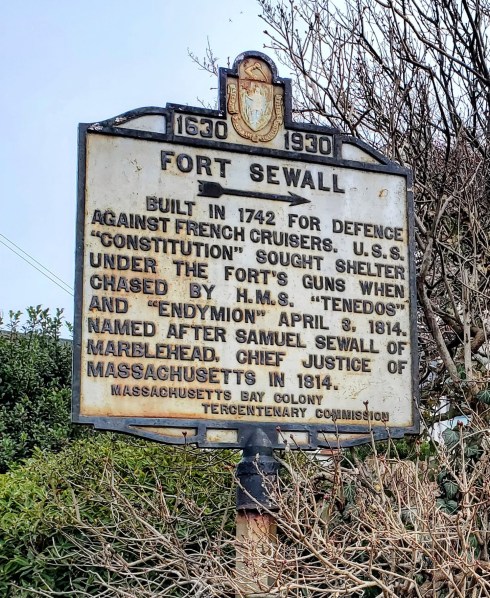
While at face value the inclusion of yet another long-neglected Salem historical resource, Fort Lee, looks like a good thing, I find it concerning. Why should Fort Lee be included in the interpretation of the faux Pioneer Village and not its very authentic (and far more important) neighboring fort on Winter Island, Fort Pickering? This is the guiding principle of the the 2003 study commissioned by the City and the Massachusetts Historic Commission, the Fort Lee and Fort Pickering Conditions Assessment, Cultural Resources Survey, and Maintenance and Restoration Plan: that the forts should be “restored, maintained and interpreted together [emphasis mine] as part of the Salem Neck and Winter Island landscape for enhanced public access.” To its credit, the City has begun a phased rehabilitation of Fort Pickering, but I see much less energy and far fewer resources committed to it than to the Pioneer Village project, which is perplexing given its authenticity and historical importance. Winter Island has served successively as a fishing village, a shipbuilding site, and in continuous military capacities from the very beginning of Salem’s settlement by Europeans to the mid-twentieth century.  The storied fortification which became known as Fort Pickering in 1799 was built on the foundation of the British Fort William, part of a massive effort by the new American government to fortify its eastern coastline beginning in 1794 under the direction of French emigré engineer Stephen Rochefontaine. Fort Pickering was manned, and rebuilt, on the occasions of every nineteenth-century conflict, and was especially busy during the Civil War. Another regional Rochefontaine fort, Fort Sewall in Marblehead, shines under the respectful stewardship of that town. Salem is so fortunate to have so much built history:  why can’t we focus our energies and resources on preserving and re-engaging with authentic sites, rather than creating new ones? (And could someone please find our SIX Massachusetts Tercentenary markers? Every other town in Massachusetts seems to have held on to theirs).

Talk about a site that can illustrate the BREADTH of Salem history: Winter Island was an early site for fishing and fish flakes (and even more substantial “warehouse” structures) as well as the location of Salem’s first fort William/Pickering. The Salem Frigate Essex (depicted by Joseph Howard) was built adjacent to the Fort in 1799, and Winter Island also served as the site of Salem’s “Execution Hill” in the later eighteenth and nineteenth century and of a Coast Guard air station from 1935-70. Members of the US Coast Guard Women’s Reserve, or SPARS, were stationed on the island during World War II. Rochefontaine’s 1794 plan and block house sketches and Frank Cousins’ photographs of the island and fort in the 1890s, Phillips Library of the Peabody Essex Museum. Marblehead’s Fort Sewall on the last day of December, 2021.


The Rebecca Nurse Homestead

As I write this on a sunny warm Saturday afternoon, there’s a line of cars extending down my entire street which has been continuous since about 10:00 this morning; I’m sure every other entry road into Salem is the same. My windows are open so I can hear and smell the exhaust as well as booming radio music; the situation has been much the same over the past three weekends and it will be the same for the next two. Salem in October! Of course we’re all supposed to grin and bear it because it’s good for local businesses, and we do. Generally I make plans to get away but that hasn’t been the case this year for some reason: a big mistake. Last week I didn’t even provision properly before the weekend: an even bigger mistake! This week, I provisioned properly and went on a lovely twilight tour of the Rebecca Nurse Homestead in Danvers, a town which approaches its Witch Trial history with far more reverence than Salem. So today I am not only better-provisioned but also considerably calmer than a week ago: the cars are annoying but really I just feel sorry for their passengers.

A Tale of Two October “Salems”: Salem Town and Salem Village, part of what is now Danvers.

I’ve been to the Nurse Homestead before, but I wanted to return this year as I’ve been teaching a course on the trials, and Rebecca’s experience has been the most impactful on my somewhat jaded freshmen, who are taking a required “first year seminar” rather than a course (and a subject) of their particular interest. They are cool customers, all majoring in business or criminal justice or nursing or something “practical”, and I’m not sure they know what to think of hyper-historical me, perpetually indulging my curiosity! But I’m making them read all sort of primary sources, and I can tell that Rebecca’s trial moved them: this well-respected grandmother, supported by her Salem Village neighbors and exonerated first by a jury, only to indict herself because she couldn’t hear a second round of questions clearly, one of three Towne sisters to be accused in 1692 and two to die. This year marks the 500th anniversary of her birth, in Yarmouth, England. Rebecca and her husband Francis spent most of their married life in Salem town, citizens of good standing, but moved out to the Village when they were in their fifties along with their married children, creating a family compound, in the center of which was and is the c. 1678 house now under the stewardship of the Danvers Alarm List Company. Not far from the house is a family graveyard, where Rebecca is supposedly buried, along with another accused and executed “witch”, George Jacobs. In its midst is the very first memorial to a victim of 1692, erected by her descendants in 1885.

I was among descendants on the tour, making a regular pilgrimage to this sacred site, happy to be on familiar and familial territory on such a beautiful October evening. The young guide was great, eager and happy to answer as many questions as we could direct her way. Not a single reference to ghosts! The only discordant element of the entire evening was a woman wearing a frilly witch hat, the only one among us so adorned, of course. How odd to see someone snapping a photo of a memorial to someone who was falsely accused of witchcraft, a martyr, in that hat, a party hat, from the other Salem.

No flash allowed inside, and as you can see it was quite dark, but this is believed to be the very “great” room in which Rebecca Nurse was arrested in the spring of 1692.


Venus Rising

As we enter/endure that season where hordes of tourists come to the Witch City for ghost tours, I’d like to celebrate some dynamic local history initiatives: over the past five years or so, there’s been a virtual Renaissance of African-American history, and consequently we know much more about how some REAL people lived and worked in Salem. Charlotte Forten, our city’s first African-American public school teacher, remains the focus of continuing commemoration at her alma mater, Salem State University, and is now the namesake of a relatively new city park. Her hosts in Salem, the Remond Family of Hamilton Hall, also have a park named after them, and a variety of real and digital resources documenting their entrepreneurial and advocacy activities is available at both the Hall and its website. Hamilton Hall was also the site of an exhibition on African-American enfranchisement by Salem United, Inc. this summer (soon to be on view at the Lynn Museum). The Salem Maritime National Historic Site has made a substantive commitment to regional African-American history in its recent interpretive initiatives, which include a general “History of Slavery in Salem” walking tour as well as more focused “Pathways in Freedom” and “Business of Slavery” digital tours.

The West India Goods Store, one of the “stops” on the “Business of Slavery” tour of the Salem Maritime National Historic Site.

This is all very exciting; such cross-institutional initiatives almost compensate for Salem’s lack of a historical museum, at least in reference to this one aspect of the city’s history. With so much focus on African-History in general, and in the immediate pre- and post-emancipation periods in particular, discoveries will doubtless be forthcoming. Another initiative is both a literal and metaphorical expression of this rising interest in African-American history: the restoration of several graves long neglected in the Howard Street Cemetery. The graves of Prince Farmer and his wife Mary, Samuel Payne, and Venus Chew have been lifted up and repaired, so that the lives of these three distinguished Salem African-American residents are once again marked. This important work was a pro bono, close-to-the-heart project of the two gravestone conservators who make up Epoch Preservation, Rachel Meyer and Joshua Gerloff. As far as I know, the only thing that the Farmers, Mr. Payne, and Mrs. Chew have in common besides their final (segregated) resting place is the fact that they all died in the 1850s. Farmer and Payne were both respected businessmen and by all accounts quite wealthy; Chew died in the Salem Almshouse at the very end of 1852, despite a life of hard work. She was the victim of marital misfortune, despite her very public attempts to defend herself and her property. Venus Thomas Chew was born in nearby Lynn to Peter Thomas, “a free Negro man” and Lavinia/Lucretia Trevet, “a mulatto girl,” in 1779 (The Marblehead Museum has a wonderful history of her famous tavern-keeping sister and brother-in-law here). She married Henry Chew, a mariner, in 1801 and they had at least three children before they separated, by her account, in 1819. They never lived together again, but remained married and thus entangled: this was problematic for Venus as she was clearly the most consistent wage earner. She “declared her independence” in September of 1841 but lost a legal case brought on my her husband’s creditors’ attempts to empty her bank account a year later. She wouldn’t be free of Henry until his death in 1848, and over the next few years her moves from Lemon to Dearborn Street and finally to the Salem Almshouse indicate that she was never completely free.

Notices in the Salem Gazette, 28 September 1841; the segregated listing in the Salem Directory, 1842; “Caleb M. Ames vs. Henry Chew & Trustee, November 1842, in Reports of Cases Argued and Determined by the Supreme Judicial Court in Massachusetts, ed. Theron Metcalf, Volume V (1858); Salem houses associated with Venus: 198 North Street, built for Henry Chew and apparently financed by Venus, 15 Dearborn St. and 18 Lemon Street; Massachusetts Report of the Commissioners of Alien Passengers and Foreign Paupers (1852; I have no idea why Venus was considered “Alien” or “Foreign”).

I went over to see Rachel and Josh of Epoch Preservation and a few other history-minded people on this rainy afternoon for a toast to Venus, and the Farmers, and Samuel Payne (“once a slave, but the last 17 years a resident of Salem. He was an industrious, honest man, and by strict attention to business had acquired a good estate, and a full share of the confidence of the citizens of Salem” in the words of his touching obituary) upon the completion of the restoration of their graves. We toasted with Joe Froggers, the famous molasses, rum and seawater cookie invented by Venus’s sister Lucretia for visitors to the Marblehead tavern which she and her husband Joseph Brown operated for many years. Cheers to these hardworking people that came before us, as well as to the historians, educators, preservationists and restorers whose hard work sustains their memory and memorials.

Venus T. Chew, Died December 31, 1852, Aged 73. Josh Gerloff and Rachel Meyer stand behind their work. Joe Froggers (made by Josh!)


A Cape Full of Color

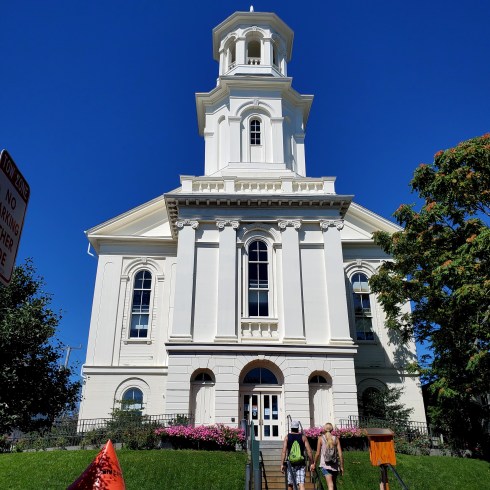
So every year in early September we journey to Cape Cod on the weekend after Labor Day for my husband’s birthday. It is an odd time, just after “summer” is over and we have established our fall routines, and I always complain, but off to the Cape we go because he has wonderful memories of fishing in Provincetown and that’s what he always wants to do for his birthday. As is generally the case with us, he will fish and I will walk or drive around looking for old houses, but this time we spent most of the weekend together. Provincetown is one of those towns that I don’t think I want to go to before I go but once I’m there I’m happy: actually everyone seems happy in Provincetown! It’s not that it isn’t a wonderful, dynamic and scenic town, it’s that I always feel that it is overbuilt and too crowded, with both houses and people. And it is, but if you stop and look at individual houses you’ll see some wonderful details and landscaping. I had not seen the Public Library before, and that was a special treat, and of course I had to make my yearly pilgrimage to John Derian’s summer house with its shop in back. Another highlight: the recently-restored eighteenth-century Mary Heaton Vorse House, on which interior designer Ken Fulk seems to have spared no expense.

Saturday in Provincetown: the Pilgrim monument, Public Library in the former Center Methodist Church, featuring a half-scale model of the Rose Dorothea schooner on its upper floors, John Derian & Mary Heaton Vorse Houses, and, of course, the beach.

I posted a few pictures and an Instagram friend informed me that there was an “All around the Common” event on Sunday way back in Yarmouth Port, during which several historic houses would be open, including Historic New England’s Winslow Crocker House, which I had never visited. So that was all I needed to hear: I had no problem driving back to get into that house. It was a very blustery day, so my husband decided to join me in lieu of fishing: a big surprise. We then commenced a long drive back to Salem via nearly every Cape town on Sunday, with stops in Harwich and Yarmouth. We both really wanted to visit the Atwood-Higgins House in Wellfleet, which is part of the Cape Cod National Seashore, but as soon as we got to the gates of the property a rather frantic park ranger drove up to us in his SUV and told us to proceed with extreme caution as there was a major mosquito infestation. We were still pretty gung-ho, but about ten steps in we were covered with mosquitos and ran back to our car: one Wellfleet mosquito rode all the way back to Salem with us! And then it was on to Yarmouth.

All we saw of the Atwood-Higgins property in Wellfleet.

I dashed through the Edward Gorey House and the Bangs Hallet across the Common, and then spent quite some time in the Winslow Crocker House: too much time for my husband. The house was built during the Revolution by privateer Crocker in West Barnstable, and moved by collector and descendant of an original land grant Cape family, Mary Thatcher, to Yarmouth Port in 1935-36. She had a new foundation laid, and removed all evidence of the division made by earlier owners. Miss Thatcher lived in the house all year long and filled it with antiques, all of which she donated to Historic New England. It’s a gorgeous Georgian house with warm wooden paneling throughout, lots of light, and some great William & Mary and Hepplewhite furnishings. I have added Miss Thatcher to my list of heroic female preservationists.

The Edward Gorey and Captain Bangs Hallet houses on Yarmouth Port Common and the Winslow Crocker House, built c. 1780. Miss Thatcher.

Our last visit was to the 1790s house of an old friend of my husband’s, also on architect, on the Herring River in West Harwich. Amazing setting and decoration, and some very striking mantles in particular (I hope you can pick up the detail in the pictures). A perfect end to our Cape dash, and then we dashed for home, with (miraculously) no traffic!

A beautiful end of our weekend in West Harwich.


Hudson River Valley Highlights

I’m just back from almost two weeks staying at my brother’s house in Rhinebeck, New York, right in the middle of the Hudson River Valley. I’ve seen a lot, and have many beautiful photographs to upload here, but I’m not quite sure how to curate them: no theme is emerging other than wow, there’s so much here. I’ve been to this region quite a bit over the past few decades, and I thought I knew it, but this longer stay has convinced me that I do not, really. You know I’m not really interested in nature (apart from its harnessing) so it’s not about the River for me, it’s about the houses and the towns, the built environment. Do I organize my hundreds of photos of structures and streetscapes by family (the Livingstons are everywhere), by chronology, by origin (Dutch vs. English), by size (the two cities of Kingston and Hudson on the west and eastern sides, surrounded by smaller towns and “hamlets” and the larger cities of Poughkeepsie and Tarrytown to the south), or by style? Mansions or private residences? Shops, or more particularly, shop windows (which seem to be curated here to a level we haven’t seen in Salem since the 1950s)? One theme which might work is that of stewardship, which I always think about when I’m in the midst of a region as architecturally and institutionally rich as this valley, but that will take some work and as I have officially entered the last week before classes that means I have SYLLABI looming: better stick to highlights!

Mansions and Cottages:

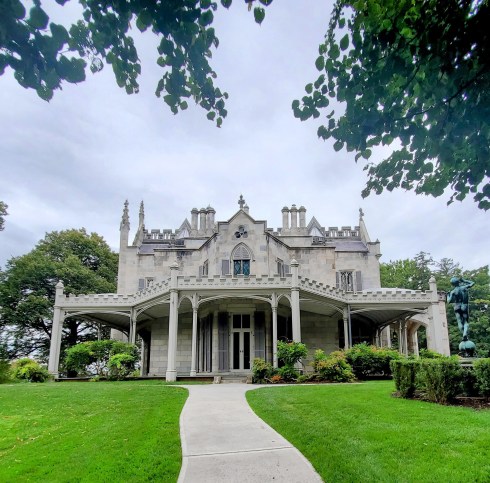
The stunning Lyndhurst Mansion in Tarrytown, designed by Alexander Jackson Davis for the Paulding and Merritt families over several decades beginning in 1838 and later acquired by Jay Gould, whose daughter left it to the National Trust for Historic Preservation; neighboring Sunnyside, the home of Washington Irving; Wilderstein in Rhinebeck and a detail from its stables; Montgomery Place and its stables, now the property of Bard College.


A Decayed Mansion with much potential: The Point, or Hoyt House, at the Mills Mansion/Staatsburg State Historic Site, Hyde Park.

There are several impressive structures on the vast riverfront acreage of the Staatsburg State Historic Site, including the Classically columned Mills Mansion, but I only had eyes for the Hoyt House on my hike. Designed by Calvert Vaux before his Central Park partnership with Olmsted, it just looks perfect, despite its decay (or maybe because of it?) The Calvert Vaux Preservation Alliance, of which my brother-in-law Brian is a director, is raising funds for the Hoyt House’s restoration and potential repurposing as a center of traditional craftsmanship training—talk about stewardship! I’m wondering if this cottage on the main road outside of the park is tied to the estate, as well as this adjacent entrance?


Alexander Jackson Davis’s furniture: almost everything is arched.

Chairs, beds, mirrors, even tables, so there is no “head” of the table: all at Lyndhurst.


Private residences: both vernacular and very high style—-all sorts of styles.

A Foxhollow Farm cottage, more contemporary board and batten, and two houses in Claverack to the north (I spent a lovely hour or so inside the white brick Hillstead, at the gracious invitation of Bruch Shostok and Craig Fitt); all sorts of restorations going on in Hudson; the lighthouse at the entrance to Kingston’s harbor.


And shopping! Mostly at Hudson, a bit at Kingston (Grounded) lured in by creative shop windows (which we need more of in Salem). History was in the windows too.


Merrimack Meandering: the Whitefield Project, part II

I’ve got a lot of gardening and exterior house projects to do, but we’re in the midst of a stretch of rainy, foggy and soggy weather, so I can’t trim my hedges or paint my scraped and sanded deck (especially the latter). After last year’s summer of writing, I am more focused on activity this year, but we’ve had too few days of that perfect dry and sunny New England weather: it’s either wet or hot! I know I shouldn’t complain, as many parts of our country have it far worse, but I seem to be doing it anyway. Tuesday seemed particularly gray, so I threw Edwin Whitefield in the car and drove off in search of greener pastures: to the Merrimack River Valley. It was lush, lush, lush, a benefit of this icky weather for sure, and I really didn’t get very far: I went for more byways than highways and consequently just covered a southeastern corner of a much larger area. Whitefield was not a great guide, frankly: he missed a lot of Homes of our Forefathers in Amesbury, and West Newbury, and even the major metropolis of the region, Haverhill (I didn’t make it as far west as Lawrence or Lowell). Here’s my route (well, sort of):

Obviously I did not follow a thought-out or straightforward path, which explains why I didn’t cover much ground: one place led to another and these are large towns with lots of great houses to be found on nearly every road, requiring many stops. I don’t know Haverhill as well as some of the other towns in the valley, and it is large and diverse with lots to see: I really could have spent the entire day there. I drove up to the river on route 97 through Beverly, Topsfield, Boxford, Georgetown and Groveland, and searched for the one little house Whitefield sketched in the last town: not sure I found it but below are my top candidates. The bottom house is the wonderful George Hopkinson House on the National Register: unfortunately it faces the river rather than backing up to it, as in Whitefield’s sketch. Then it was across the river into Saltonstall country: like Salem and several other Massachusetts towns, the storied Saltonstall family looms large in Haverhill. But there is no Saltonstall house standing: the first one, the so-called “Saltonstall Seat” overlooking the river, burned down in the early 18th century, and a Georgian house later relocated to the shores of Lake Saltonstall was taken down in 1920. The Buttonwoods Museum (which really should update its hours) is home to the Haverhill Historical Society and the Duncan and Ward Houses, situated on the site of the Saltonstall Seat. Behind the Museum are historic cemeteries and the Highlands neighborhood, full of amazing houses in every conceivable architectural style. And then lakes! Haverhill really has a lot going for it, including a pretty vibrant downtown.

Groveland houses; Haverhill and the Merrimack in the 1880s; Whitefield’s Haverhill houses; the Duncan and Ward Houses of the Buttonwoods Museum.

After exploring the Highlands for a while I wanted to see if I could find a vista similar to the one in the print above, so I crossed the river over into Bradford, which is actually part of Haverhill. It is home to the charming campus of the now defunct Bradford College which originated as an academy at the seventeenth-century Kimball Tavern, now for sale. As I looked at this building, built in 1692, I began thinking about Haverhill’s famous captive, Hannah Dustin, who has been in the news recently as there is discussion about the appropriateness of her statue, given that she killed and scalped ten members of the Abenaki family holding her hostage after the raid on Haverhill in 1697. Her statue is scary, so I decided to cross the river again and go in search of the garrison house which her husband Thomas was building at the time of the raid. It now sits rather oddly next to a modern house and across from a golf course, but still intact. Then I got back on Whitefield track and went in search of the birthplace of another famous Haverhillian, John Greenleaf Whittier. From Whittier’s birthplace, now open, I naturally wanted to visit the house in which he resided later in life, in nearby Amesbury.

The Kimball Tavern, Dustin Garrison House and Whittier’s birthplace in Haverhill, and Whitter Homestead, Macy-Colby House, and a private 17th century house in Amesbury.

I took a very indirect route to Amesbury via Rocks Village, yet another village of sprawling Haverhill! Its bridge brings you across the river into West Newbury, which is full of eighteenth-century houses, and then I drove east into Newburyport and across the old chain bridge into Amesbury, also home to many early houses and ignored by Whitefield. As the day progressed towards the golden hour, things got a bit brighter, but it was also time to drive south towards home along route 1A. As is the case with Salem, the two houses which Whitefield chose to sketch in Newburyport are no longer standing: the Toppan and Pillsbury-Rawson Houses, which were both on High Street, I believe. But all of the first period houses he sketched in “Old” Newbury have survived, including the Noyes and Coffin Houses. The former is one of my very favorite old houses in Essex County, if only for its situation: it takes you right back to the seventeenth century. The latter is a Historic New England house, and open on Saturdays over the summer. Newbury and Rowley to the south are North Shore towns that link the Merrimack River Valley to Cape Ann, which Whitefield sketched a bit more actively, but I’ll have to leave that for another day trip.

The Noyes and Coffin Houses in Newbury.


Riding with Edwin Whitefield

This was supposed to be the summer of LONG road trips but various things keep tethering me to Salem, so I’m taking lots of short ones. My companion over the last few trips has been Edwin Whitefield, a nineteenth-century English expat artist who loved old New England houses, and presented them in a series of portfolios entitled Homes of Our Forefathers published between 1879-1889. I’ve been an admirer of Whitefield for years, primarily because I admire his pioneering preservation perspective: he sketched obscure houses in small towns shorn of their modern additions and “improvements” to reveal their beauty and craftsmanship so that an ever-“improving” society might actually stop and see them and/or to document them, fearing that they were not long for this world. Whitefield had a successful career as a landscape and botanical artist, engraver, and lithographer from about 1840, with a specialty in color lithographs of North American city views. His Homes portfolios represent the last stage of his career as he died in 1892, and the portrayals of these old houses seem not only charming, but also poignant to me, with his little notes about their history and the precariousness of their present conditions. I imagine him walking around with his sketchbook, and now I’m driving around with my camera—and his books in the backseat. I fear that many of the houses which Whitefield preserved on paper will no longer exist in materiality.

The “Whitefield Project” started last week when I decided to drive over to Medford, an old city just outside of Boston which is home to Tufts University and the oldest brick house in New England, once called the Craddock House and now called the Peter Tufts House. There are so many photographs of this structure, but I wanted to see it as it might have been built, and so I pulled out one of my Whitefield volumes, and decided to take it (him) along. The Tufts House was so spectacularly preserved, and it was such a nice day, that I decided to keep going west along Route 16 (through Cambridge, which deserves its own Whitefield post), in search of a house which shares its page in my 1880 edition, the Abraham Browne House in Watertown, now one of Historic New England’s properties. As the Tufts House is a private residences and the Browne house is closed indefinitely, that was about the extent of my trail for that day.

This past Saturday, I had to go down to Plymouth, so I decided to bring Whitefield along. The South Shore was “Pilgrim country” to him: he clearly wanted to trace the tracks and document the efforts and experiences of his fellow countrymen. He sketched lots of houses in this region but I decided to follow Route 53 and focus on Hingham, Pembroke, and Kingston on this trip. I do not need an excuse to visit the Old Ship Meeting House in Hingham, one of the most important structures in New England. It is in amazing condition (but there seems to some kind of issue with its Federal-esque Rectory across the street), and Hingham is one of the prettiest towns in Massachusetts. Then it was off in search of the famous Barker House in Pembroke, which Whitefield believed was the oldest house in New England, built in 1628. Alas, Pembroke has a lovely old Quaker Meeting House, and a seventeenth-century house which serves as the headquarters of its historical society, but the Barker House is long gone: a genealogy of the Barker family informed me that it was likely built in 1650 and “fell to pieces” after the last of its members died without issue in 1883. Whitefield must have been heartbroken.

Heading south to Kingston, Whitefield led me to the Bradford House, another seventeenth-century structure maintained in immaculate condition (although with an altered roofline if we are to believe Whitefield) by the Jones River Historical Society, complete with a period garden. It was still closed for the pandemic, but the gentleman gardener watering on a hot afternoon told me all about the activities that generally went on there, including weekly breakfasts in the summer and the annual Lobster Boil. He admitted that he had added a few modern varieties among the period plants “for a spot of color” and left me to wander the grounds. And so I had a perfect seventeenth-century stroll, at the end of a long hot day.