Tag Archives: Historic Preservation

The Road to Mount Vernon

We have spring break this week, so I’m on one of my road trips, loosely following the footsteps of George Washington. I always feel like I need a theme beyond “interesting old houses” but often I find one along the way which replaces my original intention. Not this year though: George has been pretty present! I started out in northern New Jersey, where I visited a house that I’d long wanted to see because I love Gothic Revival architecture and it looked like the ultimate GR cottage, but it turned out to be much older with a Washington connection: the Hermitage in Ho-Ho-Kus. General Washington was headquartered here following the Battle of Monmouth and during the court martial of General Charles Lee in the summer of 1778, in the company of his aide Alexander Hamilton and the Marquis de Lafayette. Aaron Burr was there too, and a secret romance was initiated between the future Vice-President/duelist and the lady of the house, Theodosia Prevost, who happened to be married to a British officer. At the close of the war and after the death of Theodosia’s husband, the two were married. Decades later this very strategic house was “gothicized” and acquired its present appearance.

Not too far away is a house where Washington and his men spent much more time: the Dey Mansion in Wayne, New Jersey, which served as the General’s headquarters for several months in 1780. This is a beautiful property, maintained and interpreted by Passaic County, which acquired the house in 1934 after which it underwent an extensive restoration. A very knowledgeable guide took me all around the house, even into the atttic, which was absolutely necessary as I couldn’t understand how so many people could have lived in this house during the General’s residence: the Dey family did not vacate! You’re not going to see the house’s gambrel-esque roof that accomodates all this space because I didn’t have a drone with me, but check out the website. It’s a stately house for sure, but the spacious attic made everything clear. Washington, of course, was given the two best rooms, a large parlor/office on the first floor and a bedroom just above, by the master of the house, Colonel Theunis Dey.

The Dey Mansion: the first photos above—all the way down to the blue parlor—are rooms used by George Washington and his aides, including Alexander Hamilton. Then there’s the semi-detached restoration kitchen, and the spacious attic.

So at this point and place, if you really want to do the Washington tour, you should probably drive to Morristown, Trenton, Princeton, east to the Monmouth Battlefield, west to Valley Forge. But I’ve been to all those places several times, so I drove to the General’s last Jersey and last period headquarters in Franklin Township, a rather isolated farmhouse called Rockingham. No Pennsylvania for me; I headed south into Maryland to Annapolis, where Washington resigned his commission at the beautiful State House (obviously my chronology is all over the place, but these two stops did dovetail). I just really wanted to go to Annapolis in any case; George was just an excuse.

Rockingham: Washington’s last headquarters—and on to Annapolis.

A bronze George in the old Senate Chambers of the Maryland State House (Harriet Tubman and Frederick Douglass are just across the way); Hammond-Harwood, Shiplap and row houses in Annapolis.

On to Alexandria, where Washington touchstones abound, given its proximity to Mount Vernon. Like Annapolis, but MORE, Alexandria is full of beautiful townhouses: I started in the center of the Old Town and made my Washington stops—his church, his townhouse (actually a reproduction thereof) his pub—and then walked the streets taking photographs of doorways and wreaths, myriad details, spite and skinny houses. A bright sunshiney day: you almost can’t see this bronze Washington, sitting on a bench outside Duvall’s Tavern, where he was feted after his great victory.

From my parking place on North Washington Street, I drove straight out to Alexandria to Mount Vernon, mere miles away, along the George Washington Memorial Parkway. It definitely felt kind of like a pilgrimage at this point! I have been to Mount Vernon before, but have no vivid memories—an obligatory school trip, I think. It’s one of those houses that looks much bigger on the outside than the inside: it feels quite intimate within, especially as one side was closed off for renovations. I signed up for the “in-depth” tour so I could get some interpretation–and up into the third floor. While the mansion is a must-see, I think you can actually learn more about Washington from the many outbuildings on the estate: he was “Farmer George” and for all of his heroism he was also a slaveowner who seemed to have no regrets in that capacity. There are a lot of Washington contradictions, and there are a lot of Mount Vernon contradictions: while the subject of slavery is addressed up front the overall impression—reinforced especially at the museum adjacent to the orientation center—is of a “great man.” It was a bit too ra-ra for me, but I’m still headed to Yorktown for the last leg of my trip.

Mount Vernon: a house with 10 bedrooms and no bathrooms: the white-canopied bed is in the bedroom where Washington died. The presidential desk, parlor and dining room, key to the Bastille (a gift from Lafayette), greenhouse and garden, and view of the Potomac from the porch.


A Salem Walking Tour for Presidents Day

Sorry I’m a little late with this Presidents Day post, but I woke up this morning with an earnest desire to take a walk around Salem, an urge I haven’t felt for quite some time. And since it was Presidents Day, I had a walking theme, which is always nice. We had a lovely weekend in New Hampshire with old friends and a equally lovely dinner with my brother and brother-in-law when we returned last night, and I woke up feeling happy and finally rested from finishing THE BOOK. So off I went in search of presidential places on this sunny but chilly day. This is a little breezy, I certainly didn’t do any research, so feel free to make corrections and/or additions. I’ve plotted my tour on a 1915 “New Map of Salem for the for Motorists and Tourists” from the Library of Congress, and most of the tour stops (marked with stars) are standing today: one had yet to be built (the Hawthorne Hotel) and another (the Ruck House, marked by a special star) was torn down to make way for the new Post Office in the 1920s, along with 50+ other old structures in the vicinity.

I always start my walking tours at Hamilton Hall on lower Chestnut Street because I live right next door. So many things happened at the Hall, however, that it is not only a convenient place but also a logical place to start a Salem history tour. Quite a few presidents have visited the Hall, John Quincy Adams, Martin van Buren, and Theodore Roosevelt for certain. The latter came up to Salem from Harvard for debutante assemblies in the later 1870s, and I think he might have even met his first wife, Alice Lee, there, as several letters in the Pusey Library refer to their courtship amidst the assemblies. Then Vice-President Van Buren reportedly referred to Chestnut Street as “the most beautiful street I have ever seen” at an 1817 reception though this oft-quoted opinion has been attributed to others.

Keep walking up Chestnut and cross over to Essex on Flint, then walk eastward towards Grace Church, our second stop. President William Howard Taft, who maintained  “Summer White Houses” over in Beverly for several seasons, attended services here occasionally from 1909-1912. Like several other presidents, Taft also visited the Peabody Museum and the Essex Institute and spoke at the Salem Armory, and an endorsement from Mrs. Taft indicates that he was a big fan of the chocolates at the Moustakis Brothers’ “Palace of the Sweets” at 220 Essex Street (although I’m pretty sure he didn’t shop for them there himself.) Continue walking eastward on Essex and cross over to Federal Street at Monroe, after passing the Cabot-Low-Endicott house on the right: I really think President Grover Cleveland visited his first Secretary of War, William Crowninshield Endicottt, there but I can’t find the documentation.

On Federal, we’re just going to head west for a bit until we come to the Peabody Essex Museum’s Assembly House, where President George Washington was wined and dined at a reception during his big trip to Salem in October of 1789–he stayed at the Joshua Ward House on the street that would be renamed in his honor after this visit, now The Merchant Hotel. Then it’s a long walk towards downtown along Federal Street to Washington and the Tabernacle Church, where Calvin Coolidge attended services while maintaining his Summer White House in Swampscott in the 1920s. Then we walk down to Town House Square where several presidents traversed and campaigned, including Ulysses S. Grant, Chester Arthur, and Theodore Roosevelt.

President and Mrs. Coolidge attending services at the Tabernacle Church, Salem, on July 4, 1925, Special Collections and University Archives, University of Massachusetts Amherst Libraries.

Walk down Essex Street to the East India Marine Hall of the Peabody Essex Museum, which was visited by a succession of presidents from John Quincy Adams to Taft and Coolidge. The Salem Armory (or what’s left of it) also hosted several presidential receptions. It’s difficult to orient yourself historically on Essex Street as so much is new, but Thomas Jefferson (1784), James Monroe (1817), and Andrew Jackson (1833) all visited famous dwellings in this vicinity. Jackson was not popular, and he did not attend a special  “handsome and good dinner including mock turtle soup” for 150 attendees on June 26 prepared by famed Hamilton Hall caterer John Remond, pleading illness. His great opponent, the former president John Quincy Adams, later expressed his doubts about Jackson’s debility, which he called “politic,” at best.

Make your way over to Salem Common by the Hawthorne Hotel, from which President George H.W. Bush WALKED down Hawthorne Boulevard and Lafayette Streets for his speech at Salem State College (now University) in May of 1994. I’m not sure whether or not his fellow presidential speakers in the famed series, Presidents Ford, Carter, and Clinton, stayed or were “received” at the Hotel, but they were certainly in Salem!

On the Common, head for the northeast corner and the Washington Arch, recently restored by the Salem Common Neighborhood Association. (unfortunately the attendant sign is incorrect: while Salem’s privateering record is impressive, the port did not account for half of the estimated 1800 captured British vessels during the Revolution. This kind of sloppiness is unfortunately all too common with Salem’s historical signage). From the arch you can look at two “presidential” houses at either side of this corner, the former Silsbee house (now beautiful condos!) and the Joseph Story house, both of which served as venues for the reception of President James Monroe in the summer of 1817. From this vantage point, I can also imagine President James K. Polk’s entourage speeding down Winter Street towards Beverly in 1847.

Walk south towards Salem Harbor and Derby Street, where you will find the stately Brookhouse Home for Aged Women right next to the Custom House. It was built for Benjamin Crowninshield, who was a US representative and Secretary of the Navy under both Presidents Madison and Monroe, and the latter stayed her during his 1817 visit to Salem. From there its a pretty straight shot along Derby, Charter and Front Streets to the Joshua Ward House/Merchant, where President Washington stayed  in October of 1789. A friend of ours restored the building (very meticulously!) and so as soon as it was open for business, we booked the very room in which Washington slept, which was quite a thrill! From the Merchant you can look out to where the Ruck house once stood, now occupied by the Salem Post Office. This was the home of Abigail Adams’ sister and brother-in-law so often visited by the Adamses in his pre-presidential years. The two wonderful pastel portraits of Abigail and John by Salem artist Benjamin Blyth were no doubt a product of their familiarity with this house and Salem.

Abigail and John Adams by Benjamin Blyth, c. 1766, Massachusetts Historical Society.


Glover Squad

With my February 1 deadline constantly in mind, I worked intently on the Salem book all weekend with the exception of Saturday afternoon and early evening, when my husband and I drove over to Marblehead for a tribute to Revolutionary War Brigadier General John Glover. Well, two tributes really: the revelation of the acquisition of a letter to Glover signed by General Washington by the Marblehead Museum, and then a walk from the Old Town to Burial Hill following Glover’s Regiment to mark the anniversary of the General’s death (which is actually today). Glover was a native son of Salem, but you’ll never hear boo about him here, and I knew the Marblehead commemoration would be poignant. And it was. The link between the big reveal and the cemetery commemoration is Glover’s Marblehead Regiment, a reenactment unit which takes its role as “custodian” of Glover’s revolutionary role and life in and out of Marblehead very seriously: its members funded the acquisition of the Washington letter and led us up the hill. I’ve been thinking about Glover for the last few months, ever since the beginning of a campaign in adjoining Swampscott to save the eighteenth-century house to which he retired after the war. They take their history seriously there too. Huzzah to all of the historians and preservationists and “pastkeepers” in Marblehead and Swampscott and to General Glover!

Our hero: Brig. General John Glover. It’s hard to overestimate his heroism. He and his regiments performed essential and  exemplary service both ferrying and fighting. I like this account of his military career, which illustrates why Washington didn’t want to let him go (as stated in the newly-aquired letter).

The events of the day and night in Marblehead, and things that caught my eye along the way.

Marblehead Museum Executive Director Lauren McCormack with members of Glover’s Marblehead Regiment; the letter; more members of the Regiment.

Glover’s “town” house in Glover Square; a great plaque, the March to Burial Hill and back to Glover’s house for another tribute.


Special Little Places: Closes, Corridors and Courts

Still basking in my Edinburgh afterglow as we finish the last week of classes of the Fall 2023 semester: at home, as a deficient boiler has rendered Salem State’s North Campus an uninhabitable place. Shades of 2020-2021 for sure! I’m actually teaching two online classes by choice next semester, but I was not expecting to be back on Zoom so soon. I had a bit of time to think about some themes I wanted to emphasize about my Scotland trip, and one is “special little places”: I find that in most (not all) European cities that I have visited there are urban spaces which preserve a bit of the past, off the beaten path. Little courtyards and lanes and ways. Off the Royal Mile in Edinburgh there are so many “closes”! It’s quite extraordinary really–some access other ways, some are closed-off, all seem to transport you off a busy street into somwhere else. Here are just a few: Riddell’ss Close AND Court, Advocate’s Close, Tweeddale Court and Bakehouse Close: the latter two arre Outlander locations, and I encountered an Outlander tour just after I took these pictures!

There are some special places in Edinburgh’s 18th century “New Town” as well, but not as many: it was laid out for breadth, perspective, and movement, just like an American city (well, at least the latter). There are places and lanes that give you a bit of that enclosure within the larger city feeling, like Circus Lane below, and the spectacularly picturesque Dean Village. You can still get away, or get back, in the New Town.

There are a few places in America where you can get this out-of-time experience. Beacon Hill in Boston is like that for me. Neighborhoods in Charleston, Alexandria, Annapolis, Newport and Nantucket. Salem used to have lots of little ways and squares, but it has always evolved, and most have disappeared. Everybody’s favorite little street is actually a court, Bott’s Court between Chestnut and Essex, and I can spot a really special little way on a 1916 map of Salem: (the) North Pole! I’m not sure where that place went, but it’s definitely no longer here.


Meeting Houses of Rockingham County

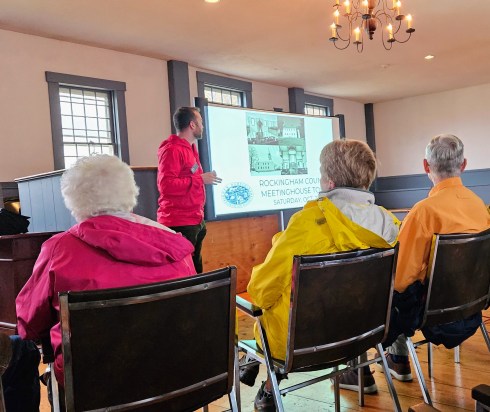
(Sorry—I have been reading and writing about meeeting houses for the past few months but still do not know if their identifier is one word or two). On this past Sunday, a rather dreary day, the New Hampshire Preservation Alliance sponsored a driving tour of meeting houses in southern Rockingham County, encompassing structures in Hampstead, Danville, Fremont, and Sandown. I drove over from York Harbor, fighting and defeating an inclination to just stay cozy at home. There was an orientation at Hampstead, the only colonial meeting house of the four that features a steeple addition (I envisioned Salem’s third meeting house, built in 1718), and then we were off to Danville, Fremont and Sandown. I have to tell you, I was in awe all day long: these structures are so well-preserved (cherished, really), simple yet elegant, crafted and composed. I remember thinking to myself when I was first set foot in the Danville meeting house: “I’d rather be here than in Europe’s grandest cathedral” (I think because I had just talked to my brother, on his way to Rome).  There’s just something about these places, and the people who care for them. Just to give you a summary of  the orientation that I received: they were built in the eighteenth century as both sacred and secular buildings, as close to the center of their settlements as possible and by very professional craftsmen. In the early nineteenth century, their religious and polical functions were seperated, so they became either churches or town halls or were abandoned altogether as other denominations built their own places of worship. It seems to me that they survived because of the preservation inclinations of their surrounding communities, and we were introduced to each meeting house by contemporary stewards who were clearly following in a long line of succession. Nice to encounter historical stewards rather than salesmen.

Hampstead:

The second floor of the meeting house, with its stage and original window frames propped up against the wall and all manner of remnants of civic celebrations, was really charming.

Danville: (which used to be called Hawke, so that’s the name of the meeting house. Hawke, New Hampshire–how cool a name is that!)

Incredible building—I had to catch my breath! I think it has the highest pulpit of these meeting houses, and there was just something about the contrast of that feature and the simplicity (though super-crafted) of the rest of the interior that was striking.

Fremont (which used to be called Poplin):

This meeting house is the only one remaining in NH with “twin porches” on each side, plus a hearse house (see more here–I have long been obsessed and have been to Fremont before but never inside the meeting house or the hearse house) with a horse-drawn hearse inside plus an extant town pound! Very simple inside, but note the sloping second-floor floors in picture #4 above. Took me a while to get used to those.

Sandown:

The most high-style of this set of meeting houses, particularly impressive from the back, I thought. Very light inside, even on this miserable day. Another high pulpit, and more marbleized pillars. Short steps to the second floor–I’m a size 7!

My photos are a bit grainy–not sure what my settings were, I was shifting them around to get more light, and too awestruck by the architecture to really focus, so in compensation I want to refer to you the wonderful work of photographer Paul Wainwright, who has photographed all of these meeting houses and more. Simply stunning!


Colorways: a Parade of Portsmouth Doors

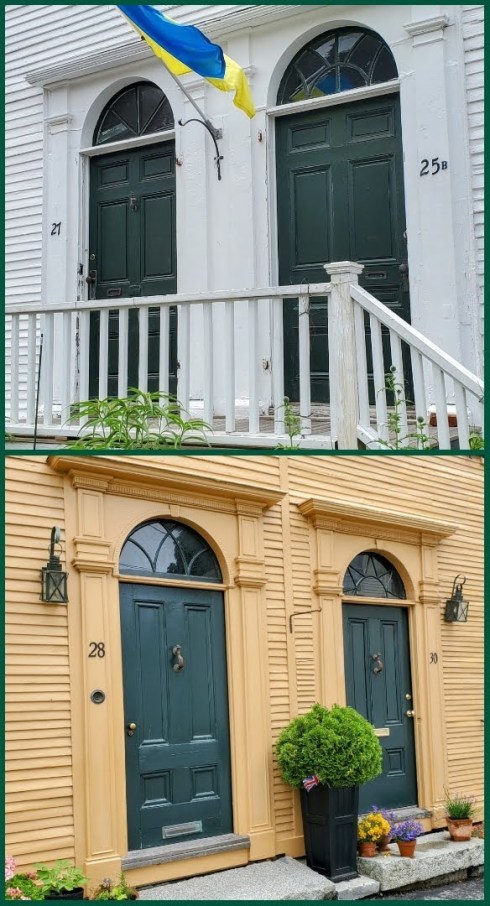
I’ve been in York Harbor all June and just returned to Salem. It was a very productive month removed from daily tasks and diversions, but I missed certain things and people: my husband (I brought the cats), my garden, my street. Certainly not the tour guides and groups though: they were in part what drove me away. Of course I found the usual Dunkin iced-coffee cup propped up on my stoop the moment I got home. Salem is busy and festive all year long now it seems; while the incessant witch tourism annoys me the other celebrations are great, and June is a particularly festive month with its mix of private and public celebrations: weddings and graduations, Juneteenth and Pride. Salem goes all out for Pride and  I missed that, and definitely craved some color amidst our rainy and foggy weather, so I took off for Portsmouth late last week seeking flags but finding doors. When I was growing up across river, Portsmouth was a much shabbier place: now you are hard-pressed to find an old house that is not in perfect condition. I expanded my usual downtown walk to include neighborhoods a bit more outlying like that bordering Christian Shore and the South End, and found so many lovely houses, all with very colorful entries. Red was an exotic front-door color before; now there is a veritable rainbow of Portsmouth doors. And I’ve got some flags here too.

Ok, I think I have the whole spectrum represented! It was surprisingly difficult to find white doors: as you see, one is hiding behind a tree. I wasn’t sure where to put taupe, so I paired it with brown. There are no painted brown doors, just various shades of natural woodwork. Not too many black doors either, but lots of green, and lots of yellow. Do not tell me that one of my purple doors is blue; it is purple. Portsmouth is the best walking city ever: beautiful neighborhoods, dynamic downtown, tons of historical markers, pocket parks, well-maintained sidewalks. More rainbows are there for the making!

Some singular Portsmouth doors: two-tone green and Happy Fourth!


A Big Move

No, not me: the Crowninshield-Bentley House! Visiting Louise DuPont Crowninshield’s former garden in Marblehead last week prompted me to reconsider her impact on Salem as a preservation advocate and philanthropist as it is considerable. At least two institutions in Salem, the Salem Maritime National Historic Site and the Peabody Essex Museum, reflect her commitment to the preservation of Salem’s material heritage which was manifested both by her direct involvement and her inspiration. The best example of the latter is one of the Peabody Essex Museum’s historic houses, the Crowninshield-Bentley House, which was moved by the Essex Institute from a rather precarious position on Essex Street to its current location in 1959. This early Georgian house, home to generations of the Crowninshield family as well as Salem’s pre-eminent diarist the Reverend William Bentley, was originally located at 108 Essex Street. In 1958 the Hawthorne Hotel donated the house to the Essex Institute with the condition that it be removed to make way for a parking lot. The move to its new site adjacent to the Gardner-Pingree House and across the street from the Hotel, was preceded by the demolition of a venerable commercial building and succeeded by a comprehensive restoration to its 18th century form under the direction of Abbot Lowell Cummings as a tribute to the “work and memory of preservationist Louise DuPont Crowninshield.” The Crowninshield-Bentley House became the cornerstone of the Essex Institute (now Peabody Essex Museum)’s main “campus” of historic structures, and to complete the vision, gardens also dedicated to the legacy of Mrs. Crowninshield were installed in its midst. Another reason I wanted to post on this big move today is the great visual documentation by Essex Institute President Albert Goodhue, Jr., who snapped photographs of the the entire process over what must have been several days (weeks???) in 1965. These are among some great sources at the Phillips Library in Rowley documenting Salem’s ever-evolving streetscape, one of the major topics we’ll be covering in our upcoming book Salem’s Centuries.

Washington Square West and Essex Street, Salem (Mass.) Photographs, MSS 0.1619. Courtesy of Phillips Library, Peabody Essex Museum, Rowley, MA.

Amazing!!! I love the nonchalance of the pedestrians, and not a police detail in sight. Everyone is just going about their business while the walls are tumbling down! The building being demolished was quite a storied commercial building, also an 18th century structure (I think) but altered and extended considerably. There were some very notable apothecary and stationary shops located within, and Salem architect/artist William Henry Emmerton made an iconic image of it in 1850 when it was his cousin’s apothecary shop (Emmerton was a great draftsman, and the Phillips Library has digitized the records of his architectural firm, Emmerton, Foster & Putnam, so you can see more of his work here). Those big storefront windows were apparently the second of their kind installed in Salem, and the Paracelsus bust trade sign was pretty conspicuous too. After the move and restoration was completed, the Crowninshield-Bentley House received a lot of attention in both academic and popular publications: there are both feature articles and cover stories throughout the 1960s into the 1970s and even the 1980s. The more scholarly pieces tend to focus on the detailed 1761 probate inventory of Capt. John Crowninshield as a primary source for the restoration (which includes references to “a Negro man” valued at £66.13.4 and a “Negro woman” valued at £40 about whom I’d like to know more)§ while trade periodicals seem to focus overwhelmingly on the kitchen. There’s a big spread on the interior of the house in the July 1987 Colonial Homes, part of feature on Salem as the “showcase of early America,” which it was, then.

William Henry Emmerton, Apothecary shop of James Emerton in Salem, c.1850 (pen & ink and sepia wash on paper), Peabody Essex Museum; the Crowninshield-Bentley House on the cover of Americana, September 1973; the kitchen as photographed by Samuel Chamberlain (1970, Phillips Library via Digital Commonwealth) and in House and Garden, January 1974; Frank Cousins photograph of the house in its original Essex Street location, 1890s, Phillips Library via Digital Commonwealth. The House today.

§ The Phillips Library has also digitized all of the booklets in the Essex Institute Historic House Booklet Series, including The CrowninshieldBentley House, Essex Institute historic house booklet series, no. 2, by Abbot Lowell Cummings, Dean A. Fales, Jr., & Gerald W.R. Ward, which you can access here. “An Inventory of the Estate of Capt. John Crowninshield Late of Salem and Apprized by Us the Subscribers at Salem November 10th 1761” is included as an Appendix.


The Elizabeth Perkins House

One of the chapters I’m working on for Salem’s Centuries this summer is about Colonial Revival Salem, or should I say, a group of antiquarians who lived and worked in Salem from about 1890-1930 who were dedicated to preserving and promoting any and everything about Colonial-era Salem in their time and for the future. Our book is a work of social history, so our focus in on Salem people. But when it comes to the various expressions of the Colonial Revival movement, if you can call it that, I’ve always found that individuals and their often-passionate attachments to the past are so important, and this is particularly true in the case of the Elizabeth Perkins House, one of the Old York Historical Society’s  properties that has recently been reopened. For some reason, this is the one Old York house that I’ve never been inside, and I’d always heard that it was a perfect example of Colonial Revival influence in this region, so I was pretty eager when I showed up for my tour this past Friday.

The Elizabeth Perkins House of the Old York Historical Society, looking over the York River, Sewall’s Bridge and the Hancock Warehouse beyond. Its restorers, expanders and occupants: Mary Sowells Perkins and Elizabeth B. Perkins (photo on right from Old York Historical Society as featured in a very helpful Willaim & Mary 1988 thesis by Melisssa Mosher shows Elizabeth Perkins in front of the house).

This house is absolutely central to the preservation history of York as its early 20th century occupants, Mary Sowles Perkins (1845-1929) and her daughter Elizabeth B. Perkins (1869-1952) contributed it and several other structures (the Old Gaol, Jefferds Tavern, the old Schoolhouse, and the John Hancock warehouse) to what would eventually become the Old York Historical Society as well as encouraging other preservation efforts. So it seems right that Old York’s administrative offices have been relocated to this site as well. There was a whirlwind of restoration, expansion, embellishment and entertaining after the Perkins family purchased the house in 1898: they were from New York, and seem to have known everyone. Mark Twain came over from his summer rental across the river to use their telephone, the first one in York, and in 1905 they hosted the grandest party of the era: a Japenese-themed fête to celebrate the conclusion of the Portsmouth Peace Treaty ending the Russo-Japanese War of 1905 with over 700 guests in attendence. The tour really focused on their house, so much so that I’m not really sure of its pre-Perkins history. Old York is dating the house to around 1730 now, which seems about right to me, but I have postcards from my childhood (showing the house exactly as it looks now and at the time of Perkins’ death in 1952) bearing the date of 1680. The one below of the dining room shows the very “colonial” room that the Perkins created but also one of its most off-putting features for me—the electrified girondoles along the back wall.

Postcard of the dining room from 1960s or 1970s? I think it is a rule that every Colonial Revival house must have Hessians!

At first the house seemed to me like one of those sprawling recreations/creations which Mary Harrod Northend, one of the Colonial Revivalists in my Salem chapter, showcased in her Remodeled Farmhouses (1915) and I immediately wanted to know if Harrod knew either of the Perkins women–the two Marys were of the same generation. But inside, besides the dining room, it felt a little different to me than standard Colonial Revival: I guess there is no standard Colonial Revival because it is often an individual expression. The parlors of the Perkins house felt very traditional to me, but also more cosmopolitan, more worldly, more lavish, more of a mashup between past and present than a “period rooms”. A case in point would be this wonderful 20th century copy of an earlier portrait: this modern woman dressed in period costume just like Elizabeth Perkins above (well, a bit more elegantly). I love this portrait!

Hooked rugs abound of course, but the Perkins ladies were great travelers so that accounts for the worldliness of their rooms and all the interesting assemblages. Now I’m wondering about comparative Colonial Revival settings: if you’re trying to create and preserve a “colonial” home in the country it’s a different experience than in the city, where change is so much more apparent—and threatening. My Salem people, including Harrod, Frank Cousins, George Francis Dow, Caroline Emmerton and Daniel Low, are living and working in an environment of constant development, fire, pollution, and immigration: it seemed like things were being swept away. The Perkins ladies were facing none of that in York, so I’m thinking that they didn’t have to be quite so strident in their pusuit and preservation of the Colonial. Just a thought.

Front parlors and a very traditional entry; love the 17th century “open-back” ??? chairs.

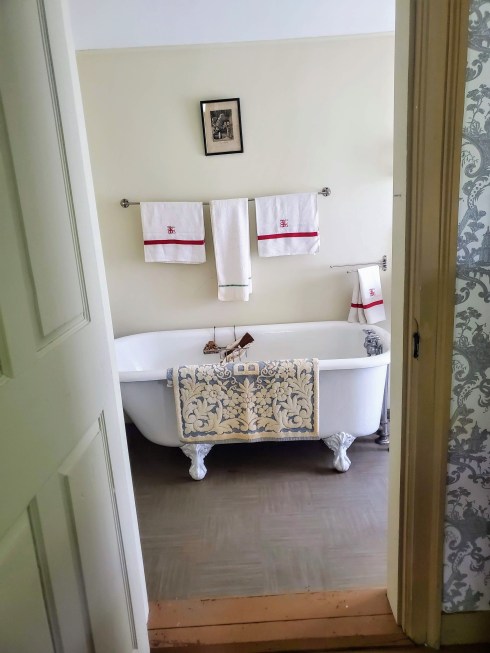
Loved the Currier & Ives presidential prints in the guest bedroom, which also has an en suite bathroom. The other bedrooms, including that of Mrs. Perkins above, have that “just left”/ I was just reading……. feeling, which is very Colonial Revival too: George Francis Dow pioneered the use of the folded-newspaper-by-the-gentleman’s chair motif in his period rooms in Salem, I believe.

Tours every Friday and Saturday available here.


One Hero and 17 Rescinders

I am staying in my family’s house in York Harbor for the month of June, mostly writing with occasional breaks for gardening and sightseeing. But you know me: I can never really get away from Salem! On this past Saturday, a single word was uttered which provided me with a connecting link between my hometown and my principal place of residence: rescinders. This is not a word you come across often, but within a couple of days I did, quite by happenstance. I love it when that happens, so here’s the context and the connection, starting with yet another preservation challenge back in Massachusetts concerning a structure associated with Revolutionary War Brigadier General John Glover. Glover is associated with two standing structures, a landmark house not far from Marblehead Harbor and a “retirement” home located on the Marblehead/Swampscott/Salem line which had a long and varied history following his death in 1797. “Glover Farm” was most recently the “General Glover House,” a restaurant owned and operated by Anthony Athanas of Pier 4 fame, but the entire property, including the 1762 house in which John Glover lived and died, has been left to deteriorate following its closure in the 1990s. While various officials of the town of Swampscott have proclaimed the property “blighted,” the Swampscott Historical Commission (which seems to be 10x more proactive than its counterpart in Salem) voted to issue a demolition delay and is seeking ways and means to save it in collaboration with the Swampscott Historical Society and local preservationists and any- and everyone who is interested in material heritage.

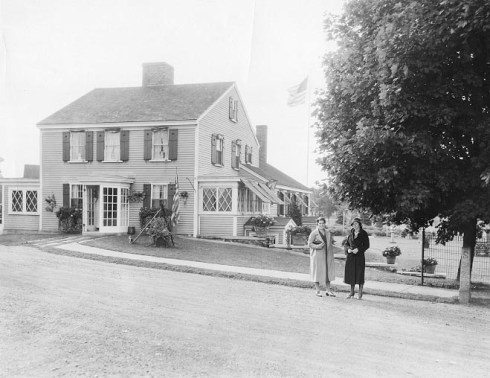
Glover Farm as the General Glover Inn, part of Sunbeam Farm, 1920s-1930s, Swampscott Public Library. Anthony Athanas opened the General Glover House in 1957 and here are menu covers and ads from the 1950s, 1960s and 1970s from guidebooks of those eras. It looks like the perfect “ye olde” restaurant: I wish I had went!

General Glover was a true American hero, outfitting his own ships as privateers, ferrying General Washington across the Delaware on that fateful Christmas night in 1776 and serving at Saratoga, Newport, and the Hudson River highlands successively between bouts of ill health on his part and returns to Marblehead to attend to his ailing wife. He sought retirement at the close of the Revolution, and General Washington notified him of Congress’s approval in a letter dated July 30, 1782, closing with wishes for a restoration of health, attended with every happiness in your future walks of life. Apparently Glover found that happiness at the rural farm some distance from Marblehead’s busy docks, in a house that its still standing despite decades of active development all around it. I started digging into this particular Glover House when my friend and former colleague, Nancy Lusignan Schultz, brought it to my attention: as chair of the Swampscott Historical Commission, she is right at the center of the preservation efforts (which you can learn much more about in this podcast). But as soon as I realized who built the house, I was caught, or caught up: it was William Browne, Salem’s richest and most notorious Loyalist, whose considerable properties were confiscated after he fled to Britain in 1776, eventually ending up as the colonial Governor of Bermuda. Browne deserves much more scrutiny than I can give him here, but he was a powerful man in Salem and Massachusetts, whose fall from grace came when he became one of the 17 “Rescinders” who were described by John Adams as Wretches, without Sense or Sentiment after they voted to rescind the Massachusetts Circular Letter which had been drafted by the provincial Assembly in response to the Townshend Acts in 1768. The Letter called for resistance, and was sent to all of the other colonies, prompting the protest of Governor Francis Barnard on behalf of London. Bernard ordered the Assembly to rescind the letter, and the Assembly put the matter before a vote: 92 nays and 17 yeas, with Salem’s representatives Browne and Frye loudly voting YEA. This lead to one of the most important moments in Salem’s political history, a town meeting assembled to vote for replacements for Browne and Frye which exposed the deep divisions of the day, and about 30 Salem Loyalists. Browne and Frye and their 15 fellow wretches were “memorialized” by the ever-ready Paul Revere in his adaptation of a British broadside entitled The Scots Scourge issued under the title A Warm Place—[in]Hell and Boston merchant John Rowe noted the names in his diary, “for my own satisfaction.”

A Warm Place—Hell by Paul Revere, American Antiquarian Society.

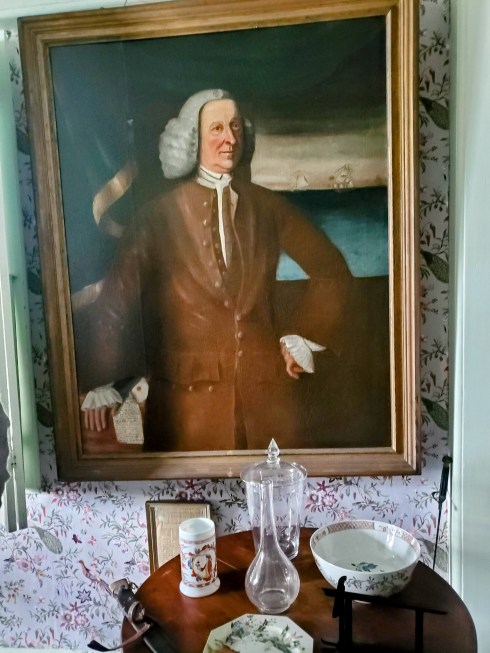
How I love Rowe’s sentiment: I record the 17 yeas, that were so mean-spirited to vote away their Blessings as Englishmen, namely their Rights, Liberties and Properties and how lovely that one of Browne’s properties should go to such a self-sacrificing patriot as General John Glover. But this is not the end of my rescinder rap. I was so focused on Frye and Browne and Salem that I did not take note of all the names on Rowe’s list immediately. I drove up to York on Friday and went to an open house at our local Historic New England property on Saturday: the Jonathan Sayward House, where I interned in college. As soon as I stepped in the parlor, I remembered: he was a rescinder too, and there he is on Rowe’s list, just above Browne (Maine was of course part of Massachusetts until 1820). Sayward did not suffer as much loss as Browne, who I believe was a much bigger fish: no exile (just confinement to this very home), no confiscation, and reconciliation after it was all over. George Washington and King George III share wall space in the Sayward House today.

Portrait of Jonathan Sayward, Rescinder, in his family home, anonymous artist, and the right parlor, above. Below, our hero, Brigadier General John Glover: a study by John Trumbull drawn while Glover was living at his farm, 1794. Yale University Art Gallery.


Paint it Black

There are more and more and more witch shops in Salem, or perhaps I better loosen up that description to goth shops or macabre markets? In any case, our local chronicler had to reassure his readers that there were, in fact, places downtown where socks could be purchased. But sneakers? I think not. It is concerning as many of these shops are only open “in season,” producing a deadening effect downtown in the “off-season.” [Somewhat off-topic tangent: I often think that Salem’s planners are going for a “15minute city” but I don’t understand how that goal is compatible with Witch City—I’ll follow up in a later post] In the downtown, there is oversight for these shops’ signs and exteriors, and Salem is a constantly-evolving city, so I’m not inclined to get too perturbed about this darkening trend, unless said shops alter an historic interior radically, perhaps permanently: and that’s the case with the former Merchants National Bank, a much-heralded 1908 Little & Browne Colonial Revival structure on Essex Street now transformed into a local outlet of Blackcraft Cult, a Goth fast-fashion retailer based in California. The creative vision of this store is simple: paint it black, all black, walls and trim, ceiling and much of the floor. All is black except for a red witch descending from the center dome, replacing the gilded eagle that overlooked everything previously. Witch kitsch displaces classicism: I don’t think you can find a better visual metaphor for what’s happened to Salem over the last decade or so.

Once an Eagle……now the former Merchants National Bank building on Essex Street is home to Salem’s largest witch! In the vicinity are more seasonal shops, closed on this beautiful & sunny February afternoon.

This building was the fourth headquarters of the Merchants National Bank in Salem, founded in 1811. It received quite a bit of attention after it opened for business in 1908: in national architectural publications and local periodicals, as well as the Bank’s own centennial anniversary publication which tied its history and success to Salem’s history and success. There’s so much craftsmanship and detail and sheer abundance in Salem’s traditional architecture that we take it for granted: I wish I had spent more time in this building considering its now-darkened detail, and I wonder if Salem’s preservationist organization, Historic Salem, Inc., is considering a more agressive policy of seeking interior preservation restrictions and covenants. Perhaps it is time, before everything goes black.

Images of the Bank from 1911: in the Brickbuilder, its centennial anniversary booklet “In the Year 1811,” and an unsigned watercolor, Bull Run Auctions.