Tag Archives: Historic Houses

White Houses of Thomaston

We’re up in midcoast Maine for a long Memorial Day weekend and I spent an afternoon walking around Thomaston, which was the site of a very early English arrival in 1605: I’m not sure why this is not more heralded, or at least discussed. It became a very important shipbuilding town over the nineteenth century but for me, growing up in southern Maine, Thomaston had two associations: the prison and large white houses. The Maine State Prison at Thomaston was in operation from 1824 to 2002, and because of my adolescent preoccupation with the Isles of Shoals and the 1873 Smuttynose Murders I knew that the murderer, Louis Wagner, was held and executed at there. My other Thomaston association is far more pleasant: an impression of a succession of large white houses as we drove through on Route One. So I went back to look for the great white houses: there are indeed so many, and not just on the highway.

The most majestic white house of Thomaston (likely very prominent among my childhood impressions) is actually a recreation: of General Henry Knox’s Montpelier. The Revolutionary War hero was married to an heir of the Waldo Patent, which had allocated a large chunk of midcoast Maine to Boston merchant Samuel Waldo in the early 18th century. Waldo’s grandaughter Lucy Knox became his sole heir as her family, the Fluckers, were notable Loyalists who left the country at the onset of the Revolution. After Knox had finished his military and government service, he and Lucy retired to Thomaston and built Montpelier in 1794. They lived there until his death in 1806, after which the house was occupied by members of the Knox family until 1854, when it was sold. Several decades later it was demolished to my way for the Knox and Lincoln Railroad, and recreated in 1930 as a perfect Colonial Revival monument: now it houses the Henry Knox Museum. Was Montpelier the inspiration for all the stately white houses of Thomaston or was it James Overlock (1813-1906), who designed and built scores of solid structures in vernacular and revival styles with all the new building technologies of his day? Likely both, with a healthy measure of New England traditionalism, but all these white houses are certainly a testament to Thomaston’s shipbuilding wealth in the nineteenth century, and to the preservation efforts of their successive owners.

Just one sample of Thomaston’s white houses.


When Salem was Pretty

The Salem visual vibe is darker now, and focused firmly on “Gothic” rather than Federal or Colonial, but the Witch City used to be pretty. I wrote the chapter on the Colonial Revival in our forthcoming book Salem’s Centuries. New Perspectives on the History of an Old American City (for which we have our cover, and a production schedule, and a publication date coming soon!), spotlighting four Salem “influencers” who emphasized the city’s beauty and craftsmanship through various cultural initiatives: Mary Harrod Northend, Frank Cousins, George Francis Dow and Caroline Emmerton.  They were so successful that Salem coasted into a period of being known primarily for its architectural and aesthetic heritage that lasted well into the 1960s, an image that was sustained by the Essex Institute’s house museums and the very public battle over urban renewal. A succession of commercial and graphic artists celebrated Salem through their accessible imagery, and we see Salem grouped with Colonial Williamsburg, Historic Deerfield, Sturbridge Village, Mystic Seaport, and other traditional heritage destinations. In today’s competitive tourism realm Salem has pulled ahead of (or moved behind?) that pack by emphasizing horror over beauty, Gothic over Federal, and darkness over light. At least that’s the projection I see in so many shop windows and on so many websites, but I think I better do some more searching in the real world. There are also many AI images of a Salem that doesn’t even exist, a concocted Victorian-Gothic world with black cats and cute witches, but also church spires! Fantasy Salem is even more idealistic than what came before, depictions in color and black and white of well-manicured car-free streets and stately houses, a “city of treasures” according to Katharine Butler Hathaway.

Some of my favorite images of Salem from the 1920s to the 1960s: Felicie Waldo Howell’s “Spring on Chestnut Street” + various houses; shelter magazines LOVED Salem in the 1920s; Rudolph Ruzicka made several Salem prints; interior vignettes from House & Garden, June 1939;Chestnut Street scenes from Philip Kappel and Samuel Chamberlain; LOVE these notecards from Nantucket artist Ruth Haviland Sutton; the “Silent Traveler,” Chiang Yee’s view of the Custom House.


Weekend in Wiscasset

Just back from a long weekend in Wiscasset, Maine with family, lots of eating and drinking, house-hunting, and pumpkins. My stepson is working at an oyster farm in the region so we’re going to midcoast Maine pretty regularly, and this Columbus/Indigenous Peoples Day weekend was of course a good opportunity to escape Witch City. We stayed in a lovely house in Wiscasset, one of Maine’s prettiest towns, and made regular trips up Route One to Damariascotta, which was holding its annual Pumpkinfest, complete with Pumpkin Queen, Pumpkin Drop, Pumpkin Derby, Pumpkin Regatta, and a main street embellished with large embellished and carved Pumpkins.

Wiscasset houses & shopping & Damariascotta pumpkins.

I worked at Historic New England’s Phillips House in Salem on Saturday and visited Historic New England’s Nickels-Sortwell House in Wiscasset on Sunday. It certainly has been an HNE summer for me! We spent so much time with the pumpkin festivities in Damariascotta that I turned up at Nickels-Sortwell at 3:00 pm: the last tour of the day on the last day of their season! Bad form on my part, and I apologized profusely, but of course my guide was  completely gracious and welcoming and eager to show off the house. Historic New England has two houses in Wiscasset: the very dramatic Castle Tucker and the very……..strident Nickels-Sortwell, and I had never been to the latter so I was thrilled to be able to squeeze it in this weekend. I always look at history and houses through a comparative Salem prism, and this was not difficult to do regarding the Phillips and Nickels-Sortwell Houses: both are Federal constructions which evolved into a Victorianized rooming house/hotel and then were restored with Colonial Revival inspiration by wealthy Yankee families.

I learned a lot about the house and the families who lived in it on my tour, but after we said our goodbyes I was still puzzled by the assertion of my guide that in the year of the house’s construction, 1807, “Wiscasset was the busiest port north of Boston.” Of course I couldn’t stop myself from contesting that statement: I think Salem was? Certainly Portsmouth and Portland were busier? She responded that she wasn’t sure but that was a pretty standard Wiscasset claim. And she’s right: I looked at all the the Wiscasset tourist and historical information on the web and there it was, again and again: Wiscasset was the busiest port north of Boston, Wiscasset was the busiest port east of Boston in 1807, the year of the Jefferson Embargo Act. This is clearly not true in terms of tonnage or voyages, but I’m wondering if “busiest” means something else? Shipbuilding and other maritime industries AND customs revenues? HELP early American maritime historians!


The First Weekend of October in Salem

It’s been a long time since I spent an October weekend in Salem, but there I was on this past Saturday, walking through the crowded streets on my way to the Peabody Essex Museum to take their new “Brick by Brick” architectural walking tour (this is the exact same name as Historic Salem’s Christmas in Salem Tour this year; I sense collusion). I got behind some baby strollers which cleared my path like a snowplow, and dodged and darted amidst the sea of felt witch hat wearers. I knew they would put me in a nasty mood, so as soon as I spotted one “1692/They Missed One” t-shirt, I put on invisible blinders. This was the only day that I could take this tour, and I was desperate to get into one of the Peabody Essex Museum’s long-shuttered period houses: I wasn’t sure which one we were entering but it turned out to be Gardner-Pingree, the most beautiful house in the world! The tour encompassed all of the PEM’s houses save for the Assembly House, and we navigated the path between them relatively quietly armed with audio devices and earbuds, hardly new inventions but still apparently unknown to many Salem tour guides.

random scenes on my way and back; don’t drive to Salem!

I always feel sorry for the Gardner Pingree House this time of year: it’s so beautiful and the tourists don’t seem to notice it; they lean on its amazing fence looking away and down at their phones. But being inside while the crowd was outside was very calming; I could barely hear a thing! It’s a fortress against vulgarity. We got to go into the McIntire summerhouse out back and then heard brief histories outside the exteriors of all the other PEM buildings, again while tourists turned their back on them, their doors rendered to mere frames for selfies.

 Gardner-Pingree, Crowninshield-Bentley, Derby-Beebe summerhouse, John Ward, and Andrew Safford houses of the Peabody Essex Museum.

The main guide (Isabel? I believe, in the striped shirt) was very good at weaving in general Salem history with the history of the houses, so I think this would be a very good tour for new visitors to Salem who are not looking for well-worn witch trial narratives and ghost stories. It also has the benefit of getting new visitors out of the congested downtown into the McIntire Historic District, where the Peirce-Nichols house and Ropes Mansion are located. Salem’s “Heritage Trail” (yellow line) just doesn’t go there. The Ropes is the only PEM House that is open on weekends, and it is a Hocus Pocus house with a beautiful late-season garden, so it’s always a draw, but Peirce-Nichols hasn’t been open for decades. I don’t follow the party line in Salem that “tourists come for the witch stuff, but come again for the history” but my summer at the Phillips House has convinced me that a certain percentage of our tourists are actually coming for the history, so I’m glad that there are institutions which can provide it.

Peirce-Nichols house and Ropes Mansion garden–now in full bloom.

back to work: one good thing about October is I can’t find excuses not to walk to work, along Lafayette Street where there is a range of “decorations”. I like these little skeletons.


The Road to Mount Vernon

We have spring break this week, so I’m on one of my road trips, loosely following the footsteps of George Washington. I always feel like I need a theme beyond “interesting old houses” but often I find one along the way which replaces my original intention. Not this year though: George has been pretty present! I started out in northern New Jersey, where I visited a house that I’d long wanted to see because I love Gothic Revival architecture and it looked like the ultimate GR cottage, but it turned out to be much older with a Washington connection: the Hermitage in Ho-Ho-Kus. General Washington was headquartered here following the Battle of Monmouth and during the court martial of General Charles Lee in the summer of 1778, in the company of his aide Alexander Hamilton and the Marquis de Lafayette. Aaron Burr was there too, and a secret romance was initiated between the future Vice-President/duelist and the lady of the house, Theodosia Prevost, who happened to be married to a British officer. At the close of the war and after the death of Theodosia’s husband, the two were married. Decades later this very strategic house was “gothicized” and acquired its present appearance.

Not too far away is a house where Washington and his men spent much more time: the Dey Mansion in Wayne, New Jersey, which served as the General’s headquarters for several months in 1780. This is a beautiful property, maintained and interpreted by Passaic County, which acquired the house in 1934 after which it underwent an extensive restoration. A very knowledgeable guide took me all around the house, even into the atttic, which was absolutely necessary as I couldn’t understand how so many people could have lived in this house during the General’s residence: the Dey family did not vacate! You’re not going to see the house’s gambrel-esque roof that accomodates all this space because I didn’t have a drone with me, but check out the website. It’s a stately house for sure, but the spacious attic made everything clear. Washington, of course, was given the two best rooms, a large parlor/office on the first floor and a bedroom just above, by the master of the house, Colonel Theunis Dey.

The Dey Mansion: the first photos above—all the way down to the blue parlor—are rooms used by George Washington and his aides, including Alexander Hamilton. Then there’s the semi-detached restoration kitchen, and the spacious attic.

So at this point and place, if you really want to do the Washington tour, you should probably drive to Morristown, Trenton, Princeton, east to the Monmouth Battlefield, west to Valley Forge. But I’ve been to all those places several times, so I drove to the General’s last Jersey and last period headquarters in Franklin Township, a rather isolated farmhouse called Rockingham. No Pennsylvania for me; I headed south into Maryland to Annapolis, where Washington resigned his commission at the beautiful State House (obviously my chronology is all over the place, but these two stops did dovetail). I just really wanted to go to Annapolis in any case; George was just an excuse.

Rockingham: Washington’s last headquarters—and on to Annapolis.

A bronze George in the old Senate Chambers of the Maryland State House (Harriet Tubman and Frederick Douglass are just across the way); Hammond-Harwood, Shiplap and row houses in Annapolis.

On to Alexandria, where Washington touchstones abound, given its proximity to Mount Vernon. Like Annapolis, but MORE, Alexandria is full of beautiful townhouses: I started in the center of the Old Town and made my Washington stops—his church, his townhouse (actually a reproduction thereof) his pub—and then walked the streets taking photographs of doorways and wreaths, myriad details, spite and skinny houses. A bright sunshiney day: you almost can’t see this bronze Washington, sitting on a bench outside Duvall’s Tavern, where he was feted after his great victory.

From my parking place on North Washington Street, I drove straight out to Alexandria to Mount Vernon, mere miles away, along the George Washington Memorial Parkway. It definitely felt kind of like a pilgrimage at this point! I have been to Mount Vernon before, but have no vivid memories—an obligatory school trip, I think. It’s one of those houses that looks much bigger on the outside than the inside: it feels quite intimate within, especially as one side was closed off for renovations. I signed up for the “in-depth” tour so I could get some interpretation–and up into the third floor. While the mansion is a must-see, I think you can actually learn more about Washington from the many outbuildings on the estate: he was “Farmer George” and for all of his heroism he was also a slaveowner who seemed to have no regrets in that capacity. There are a lot of Washington contradictions, and there are a lot of Mount Vernon contradictions: while the subject of slavery is addressed up front the overall impression—reinforced especially at the museum adjacent to the orientation center—is of a “great man.” It was a bit too ra-ra for me, but I’m still headed to Yorktown for the last leg of my trip.

Mount Vernon: a house with 10 bedrooms and no bathrooms: the white-canopied bed is in the bedroom where Washington died. The presidential desk, parlor and dining room, key to the Bastille (a gift from Lafayette), greenhouse and garden, and view of the Potomac from the porch.


Holiday Tables

If I’m hosting for Christmas or any other holiday, I spend more time thinking about the table than the menu: much more time. I love setting the table, and once I attain my “vision” we’re all relegated to eating in the kitchen, no matter how many days before the big meal. Here it is, December 22, and I am hosting Christmas dinner and the table is not set! I just finished my grading, however, so I’ll get it together. I have a different animal theme every year for Christmas decorating and some animals are easier than others. Obviously deer are super easy, and I’ve also done bears, foxes, sheep, swans, pheasants, mice and hedgehogs—and more. This year, I chose lions, and they have been challenging! But I do have these great lion placemats which are everything. I’m not quite ready, however, so here’s a succession of holiday tables from both sides of the Atlantic.  First we have some Scottish tables from my trip last month, and then a succession of tables from Strawbery Banke in Portsmouth, NH: every year they have a Candlelight Stroll among and within their historic houses, featuring a sweeping and colorful view of holidays past.

Scotland: first up are parlor, dining room, and kitchen tables in the Georgian House in Edinburgh’s New Town, owned and operated by the National Trust for Scotland, then a Georgian “everything” room in another National Trust House, Gladstone’s Land. You’re looking at a table, but a lot more is going on in this room–it reminded by of another Georgian room, just below, in the Concord Museum, which I just visited last week. Back in Edinburgh, nothing is more festive than a pub table, and the city is in the midst of major gin craze. The Jolly Botanist is a great gin bar that we really enjoyed.

Back Home (well in Portsmouuth): Strawbery Banke is a museum “neighborhood” of historic houses, some of which were located in the Puddle Dock area of Portsmouth, others which were moved there when the museum was founded in the 1960s. It’s always been a part of my life, as I grew up across the river in southern Maine. The annual Candlelight Stroll features decorated houses with reenactors, representing different periods and stratas of society. The opulent Goodwin Mansion, first up below, was built in 1811, but it is interpreted as an 1870s house. Below its dining room is that of the Chase House, a Georgian structure that is interpreted c. 1818, followed by that of the Rider-Wood House (1830s), the Shapiro House (1919) and the time-capsule 1950s kitchen of the Pridham House.

My table is not set yet but here are the lions, ready to go! Best wishes for a restorative and merry Christmas.


Sanctuary from Salem 2023

The last time I wrote that title—with another date, 1693—it was nine years ago and I was referring to Salem Witch Trials refugee Sarah Towne Clayes, who found sanctuary in Framingham, Massachusetts, the hometown of both of my parents. Her house was a decayed relic at that time, with little prospects of rehabilitation, but now it has been completely restored! You can see and read about it here: and kudos to the Framingham History Center and the dedicated preservationists who saved this important house. This time, the refugee is me: I have found sanctuary from Salem in my childhood home in York Harbor, Maine. The comparison references the title only of course: my situation hardly rivals Sarah’s, having lost her two sisters to the mob, running for her life. I feel a bit uncomfortable using the same title, but I also feel fortunate to have a place to live outside of Salem and I wanted to convey that feeling. I had to get out of town: away from the sonorous tour guide right outside my door, the haunted halloween party hall right next door, and all that trash and traffic and all those people in little black felt witch hats and Hocus Pocus t-shirts. I’m still working in Salem, so ironically I have developed just a touch more empathy for Salem tourists as I try to make my way back into town. Just a touch. On the other hand, I feel tremendous empathy for my fellow Salem residents who commute by car outside of town! I’m still working on my contributions to our Salem book (as well as a talk I’m giving at the First Church in Salem next week) so it’s still Salem most of the time, but during my down time I can walk or drive around York and see some beautiful scenery. So that’s pretty much this post: some of my favorite places in York.

Our house, a summer “cottage,” one of many built in the summer colony of York Harbor; the buildings of the Old York Historical Society  in York Village, and the First Parish Church.

The McIntire Garrison on Route 91, and one of many walking trails in York just down the road. Then it’s back to York Harbor, following the river.

A view in Cape Neddick, and more favorite houses–more coming!

York is HUGE, encompassing over 54 square miles according to the US Census Bureau. Even though I grew up here, I don’t know it that well, because it is so huge and because it has grown over the decades: when I was driving around last weekend I discovered lots of new developments and even a new road I knew nothing about. I always thought there were four distinct villages within York—-York Harbor, York Village, York Beach, and Cape Neddick—but apparently there is another, Bald Head. York was settled even before Salem and was the first incorporated city in America. I’ve got a lot of territory to explore and a lot to learn, so stay tuned over the next few weeks as I dig a bit deeper.


Bewitched, Bothered and Bewildered

Love that song, although I never realized its lyrics were so risque (“horizontally speaking”)! The title is how I feel living in Salem most of the time now, especially bewildered. I don’t understand why our local government is trying to impose out-of-scale and ugly buildings on this beautiful city, relentlessly. I don’t understand why the city’s roads and sidewalks are maintained so poorly. I don’t understand anything about our tourism industry: its management, messaging and particularly the economic impact it has on our city, which seems shrouded in mystery. I don’t understand why everything in this city is named “witch” when the victims of 1692 were not witches. I don’t understand why two tattoo shops are located right next to each other on Essex Street and two pirate “museums” are located right across from each other on Derby Street. I could go on and on and on. I came here for the architecture decades ago, and I’m really out of it when it comes to all the rest: the bones, the black, the business of selling all things spooky. I’m so alienated that I have become increasingly detached from Salem, to the extent that my husband and I and the cats are moving up to Maine for the month of October. I’m not going for good, however (at least not yet) and I also have an academic-esque interest in figuring out what’s going on: unlike me, it’s clear that many, many people love to come to Salem in the fall and increasingly throughout the year. What are they looking for? Last week was interesting because I took a deep dive into social media to answer that question, intentionally and non-intentionally! The non-intentional dive when I posted a picture of the back of my house on a really nice facebook group called Our Old House. It was a beautful day, and we painted the back of the house this summer so it was looking good! I’ve been following this group for a while because the people on it are so appreciative and lovely: everyone loves their own old house and everyone else’s old houses! No facebook rudeness at all. You can learn a lot too: people share their restoration experiences and knowledge. Our house is such a mish-mash in back that I thought everyone would enjoy seeing the different additions: and they certainly did! Nearly 7000 likes and comments, with a serious thread of people expressing their praise of both my house and Salem: I love Salem, You’re so lucky to live in Salem, We go to Salem every Halloween, I really want to go to Salem (it was funny to read these comments as I was literally packing my bags for our departure next week).

How and when my Salem house was built.

So that was interesting, and even more informative was my dive into one of the many Salem tourist groups on facebook: I picked Things to do in Salem, but there are many others. A couple of weeks ago, USA Today named the Salem Witch Museum the second biggest tourist trap in the world, and I was interested in reading some reactions to that. I found a solid defense of this attraction, based mostly on nostalgia: apparently its interpretation and presentation is so dated that it has become “historical” itself. There’s this relatively new defense of Salem attractions, that they are not and should not be Disney-esque, which is offered up with complete unawareness that it was the Salem Witch Museum that started us down that path. Most people also seemed to believe that the Salem Witch “Museum” presented a straightforward and accurate account of the Trials in a historical and global context and did not want to hear otherwise. I disagree, but this was no place to have a discussion: there is no place in Salem to have such a discussion. The type of information that people are seeking in these groups is perhaps 90% non-historical: how to get to Salem, how long to stay here, where to park, where to eat, the best attractions for kids, all about Hocus Pocus, and whether or not certain attractions are “worth it”? When “history” is referenced, I’m not sure what the meaning is, actually—just a kind of general historical environment or atmosphere? Other forums may yield different results, but I don’t discern a great deal of historical curiosity, and even less interest in architecture (though just like my fellow old house owners, everyone is very excited and enthusiastic). So it seems like the biggest thing I don’t get about Salem is the attraction! Ah well, to each his own, best to retreat to Maine and my academic pursuits. I did take a nice long walk around Salem last weekend so I’ll leave you with some pictures (and annotations) of not-quite calm before the storm. There’s quite a bit of ironwork below as that was my orginal pursuit, but it kind of got crowded out.

First up in my neighborhood, I wanted to showcase these two houses whose owners have invested in a lot of work! Kudos to them! Both are on Chestnut. As you can see, the first house has a way to go, but its very impressive entrance was just re-attached. It’s such a great house, with an amazing garden. Nathaniel Hawthorne lived briefly in the blue house. A rare Salem front garden on Essex—and this house has been thoroughly renovated as well. Besides the Witch House and the House of the Seven Gables, the only historic house that Salem tourists seem interested in these days is the Ropes House, because it was featured in Hocus Pocus of course. The Ropes Garden is consequently very crowded in the fall, but I caught it during a relatively calm time: more ropes in the Ropes Garden than ever before. This gate on Federal Court started off my iron hunt–I’m obsessed with it.


Downtown is quite a vibrant shopping scene with more than occasional bones and bats, and porta-potties, of course. There are some very well curated shops amidst the general kitsch, particularly Diehl Marcus & Co. (great ironwork and a Bulfinch building to boot) and Emporium 32 (in the old Custom House) on Central Street, and I’m so impressed that the owner of the new Silly Bunny and enduring Wicked Good Books (on different blocks of Essex Street) has declined to carry Bill O’ Reilly’s Killing Witches that I’m going to go in and buy a big bundle of books before I leave for Maine. The Peabody Essex Museum has opened a pop-up shop called the Bat Box to highlight its current bats exhibition: it’s a cute shop featuring the works of some local makers, but (once again) I don’t understand the attraction of coasters featuring a famous murder any more than I do witch souvenirs in the location of a series of famous judicial murders of accused witches.


Ghosts might trump witches this year eveywhere but Salem, of course. The ironwork at the Peabody Essex’s Gardner-Pingree House (which is never open) is simply astounding! A very busy Common, as the annual Food Truck Festival was underway, but once you get into the realm of Salem Maritime along Derby Street, not so busy. I still haven’t been in the Derby House even though it has been open this summer. The last photo just above is to remind me that I want to plant that particular variety of clematis next year!


I finished up my walk on Charter Street, where the Witch Trial Memorial and Burying Ground is located. As soon as I entered the latter, I was confronted by these strange mannequins, propped up right against the Cemetery’s gate and stones! So Salem: the juxtaposition of the sacred and the tacky, remembrance and exploitation, enduring and ephemeral.


Little Brick Houses

Last week was my spring break, and I was determined to get away after spending the past three right here at home during the prolonged Covid Time. I wanted to drive off alone so I could indulge myself with days of endless historic house-spotting: my husband needs a destination and a drink after too much of that! First I planned an extensive trip around revolutionary taverns along much of the east coast, and then I narrowed down my target area to the short-lived colony of New Sweden, incorporating areas of New Jersey, Delaware, and Pennsylvania (and even a bit of Maryland, I think). This trip was further restricted by a delayed departure and the big snowstorm that hit many parts of the northeast: I ended up snowed in at my brother’s house in Rhinebeck, New York. And then I was off, bound for New Castle, Delaware, a small historic city that I had always passed through too quickly. This would be the center of my exploration, but along the way, right before I passed over the Delaware Memorial Bridge, I decided to get off the turnpike and explore Salem County, one of the counties of southern New Jersey that borders Delaware Bay. The sun was shining and it was warm: it seemed as if I had passed from winter into spring, and from the North into the South. I had never been in this region of Jersey, but I had heard about some of its revolutionary history and seen pictures of some of its distinct 18th century houses built of patterned brick, dated and decoratively embellished on one side. I wanted to see one, and I did, and then I wanted to see more: and so I drove down rural roads for hours to do so. Before I knew it, it was dusk, and then I had to drive over that damn bridge in the dark (I have a mild bridge phobia issue and a much stronger tunnel one). New Castle was charming at night and the next morning, when I saw rows of little brick town houses. So forget about any theme of history or function: my spring break (or what was left of it) was just going to be all about little brick houses—and some big brick houses too.

The Dickinson and Oakford Houses, Alloway Township, Salem County New Jersey; the collage is all New Castle houses, with the exception of the conjoined houses in the center–which are in Salem TOWN, New Jersey (more about this other Salem below); New Castle’s old library; this 18th century map shows my travels–on both sides of the Delaware.

Established in 1651 by the Dutch, New Castle was at the center of shifting colonial sovereignties in the middle of the seventeenth century: it became part of a the short-lived colony of New Sweden in 1654, but was recaptured by the Dutch within the year, and in 1680 it was included in the land grant of William Penn, along with the rest of Delaware. New Castle was the capital of the Delaware colony until the Revolution, but before and after it was a center of trade and transportation due to its strategic location on the river. Its pre-revolutionary and pre-industrial wealth created a beautiful city that survives today relatively intact. I don’t really agree with its chamber-of-commerce description: thanks to preservation efforts, this vibrant, fully occupied community remains one of the most important Colonial/Federal villages in America—second only to Williamsburg, Virginia in the number and authenticiy of its historic structures. Williamsburg is a creation, an open-air museum: New Castle is a living city. Though they both have that fixed-in-time feeling, I saw the residents walking around engaged in all sorts of tasks as I walked the streets of New Castle, and they weren’t in colonial costume, like the “residents” of Williamsburg. New Castle is real, but almost too perfect: perfectly-preserved buildings, perfect signage, perfectly laid and -maintained brick sidewalks (it’s like an opposite-word of Salem: they seem to be letting their asphalt sidewalks languish as they replace with brick!), no litter in sight. And while late colonial and federal houses rule, they come in different sizes and were built with different materials: rows of modest brick and wooden houses were just as perfectly maintained as more stately structures. And there are new houses too, built with an obvious mandate to integrate with the old.

Just perfect New Castle, on a perfect day! These are all residences: I’m going to show the museums in my next post. The last two photos show a new house rising on the Strand, and the very old Anglican/Episcopalian Church, Immanuel on the Green, the parish of which has been operating continuously since 1689.

I spent a couple of days in New Castle and then drove lightly northeast into the Brandywine Valley, ostensibly to do some research at the Winterthur library, but I spent more time in the museum and (you guess it) driving around looking for little stone houses. And on my way back home, I turned off the bridge right after I crossed into Jersey rather than before I crossed into Delawar: I wanted to go back to Salem County to hunt for more houses and see the city of Salem as well: I had driven through it days before but didn’t stop. It’s somewhat blighted, with boarded up houses on the main street, but other houses were perfectly restored: it seemed to have quite a bit of integrity and potential. Of course, this Salem has a historical society, and a completely over-the-top but unfortunately former city hall: I wonder what will become of it?

Salem, New Jersey: historical society, murals, and the “exuberant Queen Anne” former municipal building.

One last stop in old New Jersey and then I turned northward. Most of the patterned brick houses are in private hands and hard to find, but one has been turned into a state park: the Hancock House, in Alloway Township, or more particularly a little village within called Hancock’s Bridge. On this very day in 1778, raiding British rangers under the command of Major John Simcoe raided the house and bayoneted as many people as they could find inside: at the very least ten Patriot milita men and also the owner of the house, Judge William Hancock, who was a Loyalist and also, as a Quaker, a pacifist. This became known as the Massacre at Hancock’s Bridge, and just as I was arriving at the house on Saturday morning regiments of reenactors were as well, for the annual commemoration of the massacre. I couldn’t stay around, unfortunately, but I have borrowed a photograph from the HM 17th Regiment of Infantry in America’s facebook page, below. Then I drove home to Massachusetts, making just one stop along the way: at Guilford, Connecticut to see another very old stone house, the 1639 Henry Whitefield House.

Above: The Hancock House, 1734 and members of the HM 17th Regiment of Infantry in America, 1775-1784 on Saturday. Just two streets over, the Quaker Meeting House, built on land donated to the community by Judge Hancock, who was slain on March 21, 1778.

Below: Bonus round. Two little stone houses in Pennsylvania and Connecticut: the John Chads House in Chadds Ford, and the Whitefield House in Guilford.


The Golden Ball Tavern

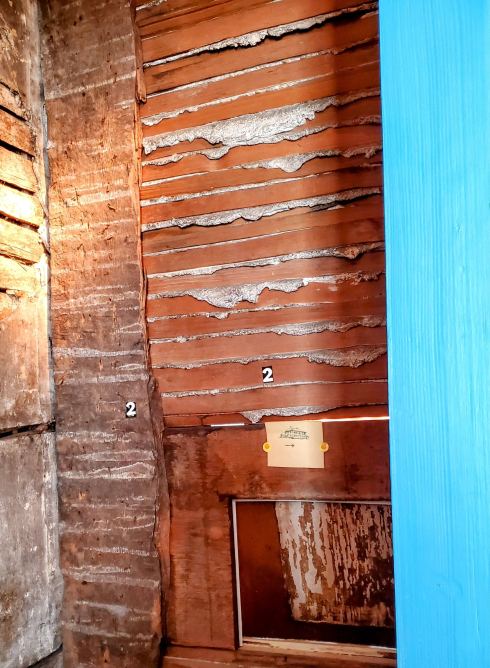
It’s spring break week and I’m slowly making my way down to “New Sweden” but as I write this I’m stuck in a snowstorm at my brother’s house in New York! I should be able to get out tomorrow and want to spend three or four days looking at old houses in Delaware, south Jersey, and Pennsylvania. This was supposed to be a Revolutionary tavern tour, but I think it’s going to be a bit more general: we’ll see! But because it was supposed to be a tavern tour, I did visit a tavern back in Massachusetts on Sunday: a sunny day which seems like it was weeks away rather than days away. I’ve driven by the Golden Ball Tavern Museum on the old Boston Post Road in Weston for years but never ventured inside before, and decided to take advanage of its monthly second Sunday open houses to take a tour. It was very interesting: a spacious eighteenth-century building left quite deliberately in a lived-in, layered condition. Weston is a very wealthy town, and I expected the house to be in mint restored condition but that is not the approach here: the ceilings were sloping in places, patchy plaster was everywhere, and I read a cautionary note on the central stairway: “original avocado paint—do not paint.” This house museum is an independent, self-sustaining operation which is staffed by enthusiastic docents who appeared to be discovering the house right alongside its visitors: it all felt very personal, like we were all just dropping in, or into a house built by tavern-keeper Isaac Jones in 1768 which sheltered six successive generations of his family. In the heated environment of the early 1770s, Jones gave shelter and sustenance (in the form of tea!) to British soldiers, prompting his neighbors to attack the tavern on March 28, 1774 in what later became known as the “Weston Tea Party.” He later came around to the right side, but the interpretive identity of the Tavern as museum seems to be focused on family history and Loyalist history. And layers, literally. If you’re into material textures, this tavern is the place for you: the historic paint, paper, and hardware was on full revelatory display.

The first floor of the Golden Ball Tavern: proceeding from the rear old kitchen, with many layers exposed, towards the tavern room in the front. LOVED this little Sheraton settee! Original paint and plaster in the central hallway and the right-side parlor and bedroom have been refinished.

Upstairs there are bedrooms, of course, but also a room which was used for more public purposes: and consequently it has one of the most interesting and practical architectural details I have ever seen. Doors that open up to the ceiling and are affixed to hooks! Hooks which are still there! And right across from this room is that in which poor Mrs. Jones was lying in bed with her newborn infant when her neighbors broke in in search of her Tory husband (these little notes are everwhere in the tavern, another aspect of its very personal presentation). I really loved all the colors and textures in this room, including the adjacent “office” and stairways upstairs and downstairs. So many details in this one space, just a corner of this one house.

Details, details, details! The door on the ceiling, hooks, paint, stairs, and a colonial filing system.