
Tag Archives: Heritage Tourism

Destination Tamworth

Even though I previously, and unjustly, relegated New Hampshire to the status of “drive-through” state, it doesn’t mean that I never stopped in its midst. I brake for historical markers, and I’m pretty certain that New Hampshire has more markers than all of the other New England states combined—and not just to dead white men like Mr. Webster below. All sorts of events, institutions and individuals are memorialized by green road-side Bicentennial markers: combined with the historical societies which seem to be located in nearly every New Hampshire town, they are a testament to a state that takes its history seriously. This earnest presentation is refreshing, frankly, especially when contrasted with Salem’s more cynical commercialization of just one aspect of its more varied past: history for history’s sake rather than for profit. Driving northwesterly across the state to the Lakes Region, I wanted to stop at each and every historical society, but I was pressed for time: I did stop at many markers.

NH Marker Webster

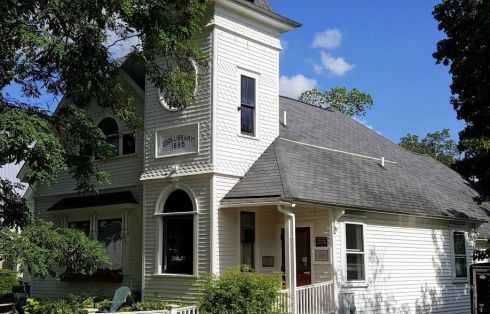
Many people are drawn to New Hampshire for its mountains and lakes, but these attractions are secondary to me: if you’ve spent any time at all on this blog you will have noticed my preference for the built landscape! So even though I had a prominent lakes/mountain destination last weekend, I became much more fixated on a town nestled between the two: Tamworth, established in 1766. Tamworth has everything: a picture-perfect town center, a pedigreed summer theater (the Barnstormers), a museum dedicated to life and work of  two country doctors (The Remick Country Doctor Museum & Farm) a presidential (Grover Cleveland) summer house, a babbling brook (the Swift River), a farm-to-table restaurant and grocer (The Lyceum), a general store (the Other Store), an amazing foundational edifice named Ordination Rock, a shiny-new distillery (Tamworth Distilling), and an inn (Highland House) built by a Salem sea captain! I’d love to have a summer house here (if I can convince my husband that it is possible to live more than a half-mile from the ocean and still be happy, a big if).
Tamworth Library

Tamworth House

Tamworth House 3

Tamworth Sign

Tamworth Barnstormers

Tamworth Poster Barnstormers

Tamworth Remick Museum

Tamworth Remick Barns

Tamworth Remick House

Tamworth Livestock

Tamworth Cow

Tamworth Brook

Tamworth Lyceum

Tamworth Poster

Tamworth Concert

Tamworth Distilling

Tamworth Brandy Sights & happenings of Tamworth: the Library, Barnstormers Theater, Remick Museum +Buildings+”Inhabitants”, Tamworth Lyceum, Sunday concert, Tamworth Distilling & Mercantile.

Given its heritage, of course Tamworth also has a historical society, recently re-christened (as you can see below) the Tamworth History Center. We found it open and bustling, with volunteers within eager to tell us about the town and the Center, which features revolving exhibits in its two ground-floor rooms: currently the early history of the Barnstormers is on, along with a very comprehensive genealogical exhibition on one of Tamworth’s prominent families. There is a dual preservation/presentation mission at present: focused continually on the town’s heritage as well as on the ongoing restoration of the Center’s c. 1830 headquarters. I enjoyed the exhibits immensely, but became a bit distracted by the untouched-for-decades attractions of the house’s central hallway! When restoration is complete, the house will not feature the traditional period rooms; instead it will serve as a forum, or center, for “the many stories that have made Tamworth unique, from 1766 onwards”. I want to hear more.

Tamworth History Center

Tamworth collage

Tamworth Exhibit

Tamworth HC

Tamworth HC2 Inside the evolving Tamworth History Center above; another visual presentation of Tamworth’s past—and present.

Tamworth PC


Forward and Back, Present and Past

It was an interesting weekend in Salem, full of events, exuberance and achievements, as well as a bit of contradiction, from my perspective. Salem’s Trials, the symposium that my department organized in collaboration with the Essex National Heritage Area and Salem Award Foundation for the 325th anniversary of the Trials, was on Saturday and then the Foundation’s 25th Anniversary was on Sunday: I came away happy and optimistic from the first event, convinced we had remembered and honored the victims of 1692 in the best possible way, and a bit confused by the second. It was certainly festive and forward-looking, focused on an array of six-word memoirs on the theme of inclusion as well as the recognition of two (extraordinary!) “rising leaders” newly-graduated from Salem High School and Salem Academy, but also on the contributions of the owner of the Salem Witch Museum–who happens to be a major beneficiary of the cumulative tragedy that is the Salem Witch Trials. One day I was sitting on a panel titled “The Making of Witch City” (filmed by C-Span) in which we discussed the unfortunate exploitation of the “witches” of Salem, the next I was observing a very public expression of gratitude offered up to the driver of Haunted Happenings! It was a bit surreal for me but I think I was the only one: one savvy Salem insider observed that he pays for shit in response to my bewilderment. Ah well, the memoirs did look lovely, shimmering in the sun on a beautiful, breezy day.

Salem's Trials SAF

Salem's Trials Memoirs

Salem's Trials Memoirs 2

Like everything, it’s about perspective: ultimately the Salem Award Foundation, whose full name is the Salem Award Foundation for Human Rights and Social Justice, is more focused on the present than the past and needs the resources, network, and flexibility to achieve its goals and mission: I have the luxury of being able to remain laser-focused on the past and the victims. That’s just what we did on Saturday morning, but in the afternoon we shifted to a more layered discussion of how these victims have been remembered, driven as much by the symposium attendees (including several descendants of victims of 1682 who recorded their “testimonies”) as presenters. The keynote address by geographer Ken Foote, “Salem Witchcraft in Landscape and Memory”, was particularly resonant for me. Dr. Foote laid out the full spectrum of “marking” sites of tragedy, from sanctification to obliteration, and viewed Salem in this context. He noted that when he first came to Salem in 1984, no one could really tell him where the victims of 1692 were executed, and now there is not only the 1992 tricentennial Witch Trials Memorial but a new memorial on the site of the recently-confirmed execution site at Proctor’s Ledge (now scheduled to be dedicated on July 19). As I was listening to him, the question that kept running through my mind was: what if the sacredness of a site is challenged–or not even recognized? as that seems to be what happens to the downtown Witch Trials Memorial every October when Haunted Happenings is in full swing and it is transformed into a convenient place to eat fried dough. It seems like contradictory commemoration will remain in force in Salem until the sanctification of that site can be realized, and I don’t know if that will (can) ever happen.

Salem's Trials BB

Salem's Trials Tad

Salem's Trials Foote Just one weekend in Salem: The Salem Award Foundation’s 25th Anniversary Celebration and Salem’s Trials Symposium. Below, the Witch Trials Memorial off Charter Street, yesterday: for much less contemplative times, click here.

Salem's Trials Memorial


Salem and “Dark Tourism”

For a while I’ve been wondering where Salem fits into the academic field of “Dark Tourism”, a term coined by Scottish tourism professors John Lennon and Malcolm Foley in 1996 and utilized by a succession of authors, operating from a variety of perspectives and within several disciplines, over the past thirty years. There is even an Institute for Dark Tourism Research (at the University of Central Lancashire in the UK), and its director, Philip Stone, has crafted the most succinct definition of a concept-in-progress to date: ‘the act of travel and visitation to sites, attractions and exhibitions which have real or recreated death, suffering or the seemingly macabre as a main theme’. While this certainly sounds like October in Salem to me, it could also apply to many heritage tourism sites: Civil War battlefields, World War One cemeteries, concentration camps—much of Dark Tourism literature is concerned with the memorialization of the Holocaust. Certainly one could call a visit to the 9/11 Memorial an expression of Dark Tourism, and maybe even the Fabulous Ruins tour in Detroit. Dark Tourism is about death and suffering, but it can also be about remembrance and awareness.

prypiat-ukraine

dark-tourism-salem

The abandoned town of Prypiat in Ukraine, now a stop on the Chernobyl tour, ©Getty Images; Charter Street Cemetery in Salem.

Call me cynical, but I don’t think the majority of Salem’s witch businesses or tourists are focused on remembering the names and experiences of Ann Pudeator, Wilmot Redd and  Elizabeth Howe. They seem to be indulging in a sub-category of Dark Tourism called “Fright Tourism” (which itself seems to be a sub-category of Morbid Tourism–and there are many other sub-categories, such as “grief tourism” and “disaster tourism”–as well as a more academic umbrella term, Thanatourism ) identified by Westfield State geographers Robert S. Bristow and Mirela Newman, in which the authors compare two major Halloween destinations: established Salem and Romania, emerging center of Dracula tourism. They conclude that “the fantasy afforded by Salem or the one proposed in Romania is basically harmless to the visitor, yet may degrade the quality of life for the local population”. While I find no argument with that statement, I’m as focused on historical memory as economic infrastructure in Salem (probably more so) so I’m looking for a more comprehensive, cultural analysis. At this point, I’m not sure that the literature of Dark Tourism is going to satisfy me, but two titles just might: Tiya Miles’ Tales from the Haunted South. Dark Tourism and Memories of Slavery from the Civil War Era and Stone’s and Richard Sharpley’s The Darker Side of Travel: the Theory and Practice of Dark Tourism.

The more I delved into this literature, the more I realized that Gettysburg (rather than Romania!) might be the best comparison for Salem so I would love to hear any insights about the tourism scene there, and I also think it may be all about GHOSTS. A post on the Gettysburg Compiler, a great blog written by the students and staff of the Civil War Institute at Gettysburg College, really resonated with me when I read it a while ago. The author, Susan Johnson, writes about her experience at a Civil War conference panel on Dark Tourism. On the panel was a ghost tour leader in Gettysburg, who tacitly implied that the Park Service’s efforts to portray complex historical interpretations to the public were too mentally exhausting for the average tourist, who, instead of wanting to engage with the big questions of Civil War history, would rather have fun learning about the Civil War through the means of a ghost tour. One of the main points the panel argued was that Dark Tourism was the new way of tourism, a “fun” and “spooky” way for tourists to engage with the past. I left the panel disgusted by the macabre fascination with death and the exploitation of the very real suffering of men and women living from 1861-1865 to sell a few tickets and walk around town at night with a goofily-clad individual holding a lantern and telling ghost stories that usually are not true. Bingo, just substitute 1692.

dark-tourism-tales-from-the-haunted-south-book-cover

dark-tourism-collage

Looking for some insights into Dark Tourism, “haunted heritage”, and Salem (always Salem!). The travel writer J.W. Ocker lived as one of us last October, so this book should be interesting–it’s just coming out now.


The Salem “Heritage” Trail needs more…..Heritage

It is pretty well-known here in Salem that the Red Line that runs though downtown, the official “Heritage Trail”, is more representative of commerce than history. It encompasses heritage sites like the House of the Seven Gables, the Corwin (“Witch”) House and the Salem Maritime National Historic Site, but also more dubious enterprises like the Salem Witch Museum, the Salem Witch History Museum, and the Salem Witch Dungeon Museum, with no discernment. There are no standards along the Heritage Trail: the Peabody Essex Museum with its vast collections, blockbuster exhibitions, and professional staff and the Witch History Museum, a storefront shop which lacks collections, curators, and content, have equal status in terms of their roles as provisioners of “heritage”.  According to the American Alliance of Museums (AAM), a museum is a nonprofit institution, which maintains, interprets, and exhibits its collections for the public good. As Salem’s witch museums are for-profit enterprises, which maintain no collections and offer their performances and “exhibits’ exclusively for their private gain, I don’t think they qualify as museums under the professional definition: I prefer to refer to them as “experiences”.

Museum Collage A Tale of Two Museums; Alvin Fisher’s View of Salem from Gallows Hill, 1818, Peabody Essex Museum, and the Gallows Hill exhibit at the Witch History Museum (Of course now we know that the victims of 1692 were hanged at Procter’s Ledge rather than Gallows Hill).

Of course, people are free to choose whatever experiences they would like, but if tourists stick to the Red Line they are going to be missing out on much of Salem’s heritage. And they do stick to the Red Line, believe me: I followed several groups of tourists the other day (on the hottest day of the year) as they walked along it with great dedication, all the way from the Salem Witch Museum to the Salem Witch Dungeon Museum, bypassing several sites which are related to the real history of the Witch Trials: St. Peter’s Church, under which the body of Philip English lays, the Howard Street Cemetery, adjacent to where Giles Corey was pressed to death, the former sites of Bridget Bishop’s house and orchard, the Salem Jail and Court House where the accused witches were held and tried. The Salem Witch Dungeon Museum removed the plaque which marked the spot of the original jail and affixed it to their building, so now they “own” that history. The imprimatur of the Red Line makes it official.

lynde-street-076

Plaque on the Witch Dungeon Museum along the Red Line; the second, smaller plaque was added a decade later than the first.

The problem with the existing Red Line/Heritage Trail is not just its presentation of an incomplete and often-shoddy history of Salem. Because it is so obviously inadequate, it has led to a form of cultural “segregation”: other organizations, chiefly the National Park Service in collaboration with local groups, developed alternative walking trails to fill the gaps: architecture tours, a maritime tour, a tour featuring sites related to Salem’s African-American history, and a Hawthorne tour (you can download all the brochures here). There are also a wide range of commercial tours, which seem to have multiplied dramatically over the past few years. Visitors to Salem can have quite a different experiences depending on their degrees of preparation, resourcefulness, and curiosity. I also think that Salem’s reputation has suffered by comparison with the other Red Line (what I have often heard called the real Red Line), Boston’s Freedom Trail, which does not include commercial sites.

Salem has been a tourist destination for a long time, over a century, and we could learn from our past projections. The map included in my favorite old guidebook, What to see in Salem (1915) projects a route that is not dissimilar from today’s Heritage Trail in terms of geography, but exhibiting very different priorities: public places rather than private enterprises, an integrated city of real museums, sites associated with Hawthorne and the Revolutionary War as well as the Witch Trials, colonial and Federal houses and gardens. The problem with the 1915 route is immediately apparent, however, especially if you compare it with the current Heritage Trail map: no one stood to make any money.

What to see in Salem map 1915

What to see in Salem text 1915

Red Line Map 2016

Map and Key from What to see in Salem (1915) and current Heritage Trail Map, available here–all the numbers refer to local businesses and the museums, real and faux, are in text. Judging by font size, the Gallows Hill Museum/Theatre looks like the place to go! (But it’s never open, except in October).


Lynde Street Variety

Walking to and from my polling place on a bright November election day, I was struck, not for the first time, by the architectural diversity that is Lynde (rhymes with blind) Street, a downtown cross street between Salem’s major commercial thoroughfare, Washington Street, and one of it major entrance corridors, North Street. Lynde Street is one of those old-city streets that had no preservation protections until relatively late in its development, so it features structures that date from the 1750s to the 1950s, and everything in between. The 1750s house is the Georgian Colonial James Barr House, with expansive additions in back, and across the street is the 1950s house, which is one of the more unprepossessing structures in Salem, in my opinion, though now that I’m looking at pictures of it and the Barr house side by side, I’m wondering if its builders were going for a 1950s version of a gambrel roof?

Lynde Street 099

Lynde Street 109

Lynde Street 110

Lynde Street 108

In the middle of Lynde Street are three structures that further testify to its architectural diversity: adjacent to each other on one side of the street are the former East Church Chapel and Christian Scientist Church (1897), now the Witch Dungeon Museum, and the Rufus Choate House (1787), while on the other side is Temple Court, a brick apartment complex built in 1910. The red line that runs along Lynde Street’s brick sidewalk was no doubt bought and paid for by the owners of the Witch Dungeon Museum, who also purchased the sign that was affixed to a structure situated on the site of the original jail building over on Federal Street in the early 1980s—not until a decade or so later were they called to task for this and compelled to put up a second plaque informing tourists that their Victorian structure was not in fact Salem’s seventeenth-century “gaol”.

Lynde Street 111

Lynde Street 075

Lynde Steet Church

Lynde Street 076

The red line, bringing tourists to “heritage” sites, the Witch Dungeon Museum and Rufus Choate House, the former in the early 1980s, Massachusetts Historical Commission, the two plaques.

The Rufus Choate house is named after the famous congressman, senator, and lawyer who resided on Lynde Street from 1828-1834. Choate (1799-1859) spend considerable time in Washington after his elections, but he is more famous for his Salem and Boston displays of courtroom tactics, including the origination of a successful “sleepwalking defense” for one of his clients. The Lynde Street house in which he lived experienced considerable deterioration in the twentieth century, and at one point was apparently condemned by the city of Salem before it was purchased and restored in the 1980s.

Choate House 1891

Lynde Street Choate House MACRIS

Lynde Street 080

Lynde Street 081

The Choate House in photographs from 1891 (Frank Cousins), 1981 (Massachusetts Historical Commission), and yesterday.

And finally we come to the comparatively massive Temple Court, an apartment complex built in 1910 almost opposite the Choate House. I wonder what was here before! This seems like an unusual structure for Salem:  you see these turn-of-the century courtyard complexes on Commonwealth Avenue as it extends westward out of Boston into Brookline, but they are more rare in the outer suburbs. Perhaps its existence indicates that Salem did not think of itself as a “suburb” in 1910.

Lynde Street 079


Fenced In

While taking a twilight stroll around Salem the other day/night, it seemed to me as if the street-fronting fences were straining to contain the abundant shrubs, flowers and vines within. September is such an abundant time–even in the city. Salem has some great fences, although it once had many more: when I look through pictures from a century ago I am always struck first by the elaborate fences that lined its streets. Most of the wrought iron ones have survived, many of the wooden ones have not. I think commercialization is the main enemy of the elaborate wooden fence–and a great case in point is the “Dr. Phippen House” on the Common (misidentified by the Historic American Building Survey at the Library of Congress as located on Chestnut Street):  pictured below in 1938 and the other day. It is now a funeral home with no fence in front, and a chain-link fence along its side yard.

Fence Phippen House Salem

Fence Phippen House Salem MA

Fences 021

Most definitely a loss, as this house occupies a prominent position on the Common. But there are similar fences throughout Salem that survive, primarily, but not exclusively, in the McIntire Historic District.  Iron fences are sturdier survivals, and can be found all over downtown Salem, in varying states of repair. For those who read my post last year about the sad state of the Salem Common fence, I have great news:  it is being repaired and restored. We all benefit when a city, or any property owner, puts their best fence forward.

Fences 015

Fences 018

More examples of front fences from my (increasingly-dark) walk around town, ending up at the Ropes Mansion garden, which is really stunning at this time of year–definitely worth a trip from near or far.

Fences 008

Fences 030

Fences 033

Fences 035

Fences 037

Fences 010

Fences 048

Fences 047

