Tag Archives: Halloween

Two Nights in Salem

As you might imagine, my teenage stepson is not at all sympathetic to my I don’t want to see tacky & exploitative witchcraft “attractions” attitude in October so we have ventured downtown for the last couple of nights.The weather has been warm but rainy so there weren’t that many people milling about but we did avoid the more commercial sites. I think I first took him to the Salem Witch “Museum” when he was six or seven and he thought it was ridiculous then; so he has no desire to return now, thankfully. On Thursday night we went to a few shops on the way to one of the Peabody Essex Museum’s monthly themed PEM/PM evenings, which are always great.This month’s theme was “Moon Landing”, in reference to their brand new exhibition “Lunar Attraction”, which is just the kind of multi-media, multi-genre, multi-era, and multi-perspective presentation that I always enjoy. We spent a lot of time watching the colorized version of Georges Méliès’ A Trip to the Moon (1902) that was playing continuously, but I found many of the exhibit items almost as captivating.

two-nights-pem

two-nights-to-the-moon

two-nights-melies

two-nights-vaca

two-nights-2-the-moon

two-nights-rabbit

two-nights-holyoke-eclipse

The Peabody Essex Museum on Thursday evening past: atrium and “Lunar Attraction” exhibits, including screen shots from A Trip to the Moon; Beth Hoeckel’s “Campground” collage from her ongoing series “Point of View”; Scott Listfield’s “To the Moon”, 2004, a Japanese moon rabit, and Edward Holyoke’s ink illustration of a solar eclipse, 1713.

On our way over to the Museum we stopped in at the Salem Arts Association, where there were works both timeless and ephemeral and seasonal-macabre, some more witty than others. I liked these little coffins in the window and a “Vampire Test”mirror; my stepson liked a map of the United States divided into regions which have Waffle Houses and regions which do not.That came home with us.

two-night-arts-2

two-nights-arts

On Friday night, before the deluge we had later and the PBS documentary on the making of Hamilton, we went to the House of the Seven Gables for one of their seasonal experiences, “Legend of the Hanging Judge”, in which actors play out different roles relating to the witch trials in the rooms of Nathaniel Hawthorne’s birthplace: the author himself was in residence, consumed with guilt, as his ancestor is the title character. The one good thing about Salem’s crass commercial Halloween tourism is that it gets tourists through the doors of real museums like the Gables, although I fear out-of-town sausage sellers make more money.

two-nights-gables-at-night

The Gables at Night. I can never get a good night shot–was trying for the contrast of garden and house and this is the best I could do!


Greetings from Witch City

I really tried to give Salem Halloween a chance this year. I kept telling myself to forget that this celebration is based completely on the tragic death of innocent people over 300 years ago and that there is no connection between Halloween and the Salem Witch Trials other than a manufactured one that has to be based on the completely unfounded assumption that these people WERE witches. People just don’t want to hear that, and my persistent haranguing has made me into a bit of a pest to my family and friends. A lighthearted attitude towards the month-long Haunted Happenings “celebration” is completely impossible for me to adopt, so instead I went for detached, either in time or of place: concentrate on the past (this always works for me) and avoid downtown at all costs. But yesterday I just put myself right into the fray, for you, dear readers, who have also been exposed to my Halloween snarkiness for years. I tried to adopt an objective attitude as I mingled among the huge crowds, but I couldn’t really maintain it and then I lost it altogether! So here are my observations, both in words and pictures–that latter a bit more objective than the former–I actually think they are a fair representation of what Salem looks like on Halloween. From my street-level perspective, however, I couldn’t quite capture the immensity of the crowd: estimated at 100,000 people, more or less.

What I observed (words):

  1. Huge crowds, very international in nature: I heard Spanish, French, German, Japanese, and (I think) Polish.
  2. Mostly they just mill about, taking pictures of themselves and others.
  3. There were some great costumes, but also a sea of generic witches and zombies. Lots of ghoulish brides, for some reason. My favorites were a pair of tarot cards, which I didn’t quite catch (see below). People really seemed to enjoy dressing up (humiliating) their dogs–this is just one reason I am a cat person.
  4. Long lines at all the schlocky businesses (the Salem Witch Museum, the Salem Witch History Museum, all the witch and “horror” shops). The Peabody Essex Museum was completely empty, but I was glad to see the House of the Seven Gables doing a brisk business. Kudos to the PEM and the National Park Service for keeping the Ropes Mansion and the Customs House open and free. These were the only real historical sites available to people, apart from the Witch House and the Gables.
  5. Good for business? This is the major reason people think Haunted Happenings is good for Salem. I suppose it is, but I’m really not sure. It seemed to me that the seasonal businesses were bustling while many of the more permanent ones were relatively empty, or even closed altogether. All the restaurants were packed, with long lines, but don’t all those sausage and fried dough stands eat into their business?
  6. Tours: one business that is obviously profiting big time from Haunted Happenings is that of walking tours, which seem to have multiplied exponentially from previous years. Both former and current students of mine were giving tours while I walked about, and I tried not to get too close so that I might hear what they were saying……
  7. Comments overheard during the crush. There are so many people packed together, that you can’t help but hear what they are saying (unfortunately). Most common comments/questions: where were the witches burned? what does that [building] have to do with the witches? Look at that dog!
  8. Crowd control: there is a huge police presence downtown, which is very necessary but must also be very costly.
  9. Trash: everywhere. Salem gets trashed during Haunted Happenings. The city was definitely on top of the trash situation, but again, at what cost?
  10. Desecration: the two most sacred sites downtown, the Old Burying Point on Charter Street and the adjacent Witch Trials Memorial were completely desecrated yesterday. There is no word more appropriate: desecration. The cemetery is simply fodder for tour groups and photo shoots, and the Memorial was reduced to a place where people could sit down and eat their fried dough or text. Drunken clowns (literally) sat on the stones representing the victims of 1692 while smiling tourists took their pictures. I ran home and poured myself a stiff drink.

What I observed (pictures):

Crowds converge around the Witch House and towards downtown; the requisite “sea of heads” shot, on Washington Street.

Witch City 191

Witch City 187

The center of the storm, Lappin Park, at Washington and Essex Streets. Here Samantha, evangelical preachers, tourists, and fried dough converge. It’s really hard to convey how odd this juxtaposition of elements is.

Witch City 065

Witch City 047

Some of the more creative costumes I spotted…..and uncreative: the last ladies were all sporting the super tacky “Salem Witch” costume I featured in a post a month ago.

Witch City 116

Witch City 123

Witch City 126

Witch City 163

The Business of Witch City.

Witch City 147

Witch City 127

Witch City Businesses

Witch City 166

Witch City 143

Witch City 179

A few random shots. Overheard in front of both the Derby House and the Ropes Mansion: did a witch live here?

Witch City 144

Witch City 142

Witch City 038

Witch City 150

The Burying Point on Charter Street and Witch Trials Memorial. No comment.

Witch City 092

Witch City 098

Witch City 100

Witch City 111

Witch City 114

Witch City 101

Witch City 172

Witch City 177

Witch City 167

End note: Things did pick up after I went home and had a drink and received my trick-or-treaters, who were cute and gracious. There were the usual pirates and princesses, but one costume, worn by a boy about 10 years old, I found quite perplexing: a black, inflated, puffer suit of sorts, rendering him quite round. No mask, no graphics. I asked him what he was supposed to be, and he shrugged while his sister answered for him: America. Morbid Obesity.


Season of Contrasts

I have some free time on Saturday, so I’m going to walk around and take pictures so that I can present Salem’s Halloween to you in its full glory, but today I have prettier, and for the most part, calmer pictures of Salem and Essex County that I’ve taken over the last few weeks. When looking through my picture files, I was struck by how many contrasts were depicted:  between city and country, Salem in its Witch City mode and the county in its luxuriant fall mode, a lot of energy in Salem and a lot of tranquility on its outskirts. But everywhere there is color at this time of year, contrasting color: bright, dark, golden. October is such a beautiful month, but I really do prefer the slightly starker, Halloween-free November: just a few more days.

Salem:

Fall 7

Fall Windows

Fall Immersion 9

Fall Immersion 12

Fall 5

Fall Immersion 4

Fall 032

My back yard at night–the mansard tower of the building on Broad Street that was the original Salem State Normal School and is now condos is always lit of with purple flashing light during October. It looks cool but I can never take good night pictures.

Ipswich, Newbury, Newburyport:

Fall Immersion 11

Fall Immersion 14

Fall Immersion 13

Fall Immersion 17

Fall Immersion 15


Cakes for Souls and Spouses

Some day, some night, I swear I am going to offer the hordes of Halloween trick-or-treaters that darken my door traditional soulcakes rather than Kit Kats or Butterfingers: now that would be asking for a trick! I think about doing this every year but never follow through: I’m too scared of the consequences, I think, or lacking in confidence in my ability to produce some decent looking cakes. I have already purchased my requisite 1400 pieces of candy so I’ll probably chicken out this year too. Soul cakes are often described as a cross between a biscuit (in the English sense, or an American cookie) and a scone, and sometimes as shortbread: there are lots of recipes available on the web, many adopted from early modern cookbooks. If I were going to go for it, I would probably go with one of the two recipes available here, my go-to source for food history. I suppose that the cakes are more appropriately distributed on All Saints or Souls Day (November 1 and 2), but no one will be coming to my door then: Salem will be returned to its residents! In any case, my Halloween cakes would be perfectly respectable with recognition of the pre-modern Hallow-Tide, which covers all three Hallowed days: from All-Hallows Eve or Halloween on 31 October through All Saints and All Souls Days. These Christian days were superimposed upon earlier Pagan holidays and traditions, creating a period in which the dead and the living were particularly close, and could affect one another’s fate. The medieval Christian view was that this was a time that the living should be working to get the dead out of purgatory, so bells were run, prayers were said, and gifts were given–in the form of cakes disbursed to bands of “soulers” who went from house to house singing ancient souling songs and offering prayers for the dearly departed. After the Reformation and the disappearance of a soul-packed Purgatory in most of Protestant Britain, souling evolved into outright begging, and eventually (jumping the Atlantic) into trick-or-treating. If there was no English Reformation, I wonder if we would all still be giving out soul cakes? Probably not.

Souls 17th Century

Soul-Cake-Main

soulcake

Seventeenth-century Souls, simply existing and ascending directly to Heaven without stopping at Purgatory–they don’t need any prayers or cakes! (Karel van Mallery after Jan van der Straet, Antwerp, 1609 and Johannes Amos Comenius, Orbis sesualium pictus, Nuremburg, 1658 , both Wellcome Library Images); Shropshire Soul Cakes, from a recipe available here, and a more modern Halloween cake on an early 20th century postcard.

Another cake long associated with Halloween in parts of the British Isles, most particularly western Scotland and the Isle of Man, is dumb- cake, very simple, salty grain and water cakes baked in the fire by unmarried women at midnight, with the aim of revealing their future spouses. While holding the pan, they were said to recite an ancient rhyme—Two must make it, two must bake it, and two must break it— and afterwards their future mates would be revealed in their dreams. Presumably the word “dumb” is a variant of “doom”, the Old English word for fate or destiny, although I’ve also read that the girls were supposed to remain mute while they baked the cake (then how would they recite the rhyme?). This kind of “divining for husbands” takes many different forms (cabbage-pulling, mirror-gazing) on both sides of the Atlantic, and survives in the form of various cultural expressions into the twentieth century.

Dumb Cake Play 1907

Halloween cake postcard

Title and first page of the play entitled The Dumb-Cake by Arthur Morrison and Richard Pryce, London, 1907, and an early twentieth-century variant of a dumb cake on a postcard from the same era.


Turnip Ghosts

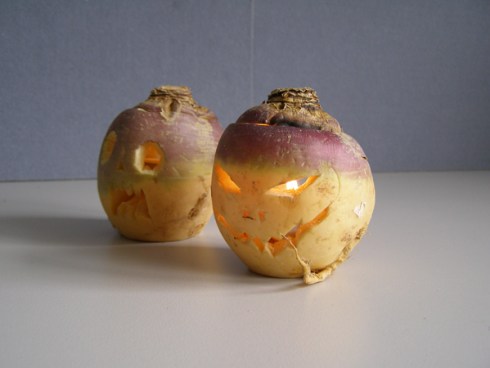
There is a great quote from the prolific and eminently quotable British writer G. K Chesterton about ghosts–or really belief– in general which references turnip ghosts in particular: I am quite ready to believe that a number of ghosts were merely turnip ghosts, elaborately prepared to deceive the village idiot. This is from a column in the Illustrated London News in 1936: the assumption is that his audience would immediately understand the phrase “turnip ghost”, and as they were British, they probably did. An American audience would and does require some translation. A turnip ghost refers literally to a Jack o’lantern made out of a turnip (but I would also include turnip-headed scarecrows)–something out there in the fields that was not a real ghost but that could create fear–a bugaboo (the best word ever). Old World turnips predated New World pumpkins as the material of choice for All Hallows Eve Jack o’lanterns, and remained predominate for some time, both in the British Isles and on the Continent. And you can easily see why: turnips are scary.

OLYMPUS DIGITAL CAMERA

Turnip Seed Packet Ghosted

Turnip Jack o’ lanterns from Work of Fiction (+directions); my own ghosted turnip seed packet.

The turnip-headed scarecrows are equally eerie: they turn up on Halloween postcards from the early twentieth century in both the United States and Europe, but are not exclusively tied to the holiday. Turnips just easily lend themselves towards anthropomorphic expressions.

Turnip Halloween Card

Turnip Head Howl's Moving Castle

Turnip Head Shakers

Vintage Halloween card, c. 1920; the Turnip-head scarecrow from  Hayao Miyazaki’s Howl’s Moving Castle; Vintage salt & pepper shakers available here.

I bought some turnips the other day–larger ones from a farm up north and smaller ones at our farmers market–with the intent to carve them into something scary, but I’m not sure I can do it–even with Martha Stewart’s assertive advice. They don’t have the soft insides of a pumpkin, and they are much more diminutive. I might chicken out and merely draw on them, because I’m not sure that I want to put in the time and effort: every single time I’ve carved out a pumpkin it has been stolen days before Halloween, and I’m sure my little turnip lanterns would be even more vulnerable!

Turnips 093

Martha Stewarts Turnips

My turnips and Martha’s creations: I might just settle for the turnips (and radishes) in a dish decoration, lower right. See a very scary traditional turnip Jack o’lantern here.


Pyewacket

Pyewacket: lots of cats named “Pye”, why? If you’re of a certain age (born in the 60s at the very least) you might associate this name with the 1958 Jimmy Stewart/Kim Novak film Bell, Book and Candle, in which the modern sexy witch Novak had a Siamese familiar named Pye OR the children’s book by Rosemary Weir titled Pyewacket published a decade later. The origin of this name goes way back to the seventeenth century, when the notorious and self-proclaimed “Witchfinder-General” Matthew Hopkins tried several women for witchcraft (among many others) who claimed to have a number of “imps” or familiars in their service, including Holt, Ilemauzar, Pyewackett, Pecke in the Crowne, Grizzedl Greedigutt, Jarmara, Sacke & Sugar, Newes, and Vinegar Tom. All of Hopkins’ “discoveries” are proudly proclaimed in the 1647 pamphlet THE Discovery of Witches: IN Answer to severall QUERIES, LATELY Delivered to the Judges of Assize for the County of NORFOLK. And now published By MATTHEVV HOPKINS, Witch-finder. FOR The Benefit of the whole KINGDOME.

Pyewacket Life

Pyewacket finally

Pyewackett Hopkins 2

The pamphlet reports that in March 1644 there were some seven or eight of that horrible sect of Witches living in …. a Towne in Essex called Maningtree, with divers other adjacent Witches of other towns, who every six weeks in the night (being alwayes on the Friday night) had their meeting close by his house, and had their severall solemne sacrifices there offered to the Devill, one of which this discoverer heard speaking to her Imps one night, and bid them goe to another Witch, who was thereupon apprehended, and searched by women who had for many yeares knowne the Devills marks, and found to have three teats about her, which honest women have not: so upon command from the Justice, they were to keep her from sleep two or three nights, expecting in that time to see her familiars, which the fourth night she called in by their severall names, and told them what shapes, a quarter of an houre before they came in, there being ten of us in the roome. Holt appeared “like a white kitling”, then Jarmara, “who came in like a fat Spaniel without any legs at all, she said she kept him fat, for she clapt her hand on her belly, and said he suckt good blood from her body”. Next was Vinegar Tom, “who was like a long-legg’d Greyhound, with an head like an Oxe, with a long taile and broad eyes, who when this discoverer spoke to, and bade him goe to the place provided for him and his Angels, immediately transformed himselfe into the shape of a child of foure yeeres old without a head, and gave halfe a dozen turnes about the house, and vanished at the doore”. Sacke & Sugar appears like a black rabbit and Newes, a polecat, and the rest of the imps, including Pyewacket, are not identified, so among them we only have one cat, Holt (kitling is an old form of kitten). I have searched in vain for Pyewacket references in the eighteenth and nineteenth centuries and found none: the author of the 1950 play on which Bell, Book and Candle was based, the English playwright John van Druten, must have plucked Pyewacket out of semi-obscurity and associated the name with a cat, because by that time, everyone knew that familiars were feline.


Broken Brooms?

Besides dodging the crowds (and zombies) here in Salem on this past (absolutely beautiful) Columbus Day weekend, we went up north for a bit. Just off the highway in my hometown of York, Maine, I became fixated on an installation of witches on bicycles at the entrance to Stonewall Kitchen: as if I didn’t have enough witches in Salem! Of course, they resonated with me not just because they were witches (on bicycles) but because of the Wizard of Oz visual reference: few things were scarier in my childhood than the transformation of Miss Almira Gulch into the Wicked Witch of the West during the terrifying tornado. The fact that I have this very vivid image seared into my brain is one of the reasons that I’m glad I was born in the ’60s (although I think the ’70s would work too): every year when the Wizard of Oz came on we were glued to the screen and each scene made at impression because we would have to wait the entire year until we could see it again: we couldn’t just rewind a DVD or access a YouTube clip. So we remember.

Witches on Bikes 1

Witches on Bikes 3

Witches on Bikes 4

Witches on Bikes 007

Witch on Bicycle Wizard of Oz

Witch transformation wizard of Oz

Witch Oz


Zombies on the Streets of Salem

A pack of zombies infiltrated Salem on this past Saturday, “landing” at Collins Cove and making their way through downtown, along the Common and Essex Street, into Derby Square to Derby Wharf. It wasn’t quite an invasion, but more of a parade: they had a police escort (as well as a hearse and banner) and did not really proceed in that distinct zombie shuffle (?): I suppose that would have taken too long, so they just walked. I really don’t mind zombies: even though they are often disgusting, at least they are creative, and they’re not out to make a quick buck like all the witches around town (of course they have no zombie “forbears”–that we know of–on whom to capitalize). One little stroll on a sunny Saturday and they’re gone, although a few will, no doubt, linger until the end of the month.

Zombie Arrival

Zombies 1

Zombies 2

Zombies 051

Zombies 062

Zombies 073

Zombies 066

A little scuffle at the corner of the Common, but most of the zombies were peaceful paraders, like the lovely family above. Derby Square in the clear.


The Making of Witch City

As tonight marks the beginning of the month-long “Haunted Happenings” in Salem, a true celebration, so it also begins my annual (and perennial) consternation over “Witch City”,  Salem as mecca for all things Halloween. City authorities, merchants, restaurant owners, and yes, even museum directors, will say that Haunted Happenings is not trading on Salem’s notoriety as the site of the nation’s most notorious witch trials but such a statement is impossible to defend: there is no other compelling reason why Salem, Massachusetts would evolve into the Halloween destination aside from its dark history. Even those who acknowledge the darkness and the connection victimize the accused “witches” yet again: they are of course well-intentioned, but those who seek to turn 1692 into a mere lesson about the necessities of toleration and social justice are distorting the historical reality, just like modern witches identifying with “ancestors”.

So opportunism reigns in Salem, but it has done so for a very long time. Even though the festivities have really intensified over the last 33 years (Haunted Happenings commenced as a one-day affair back in 1982), Witch City evolved over a long time and as a result of many forces and contributors, both deliberate and unintentional. Several people have written about this evolution before (and I’ve devoted quite a bit of time and space to it myself), so I’m going to constrain myself to a veritable laundry list of these factors, all appearing after about 1867, the year of the publication of the first serious study of the 1692 Trials, Charles W. Upham’s Salem Witchcraft, With an Account of Salem Village and a History of Opinions on Witchcraft and Kindred Subjects. This book itself is influential, as is its abstract, along with the succession of guide books for Salem and the North Shore published from the 1870s until the first World War, “romantic” histories and fictional works featuring Salem issued in this same period, the bicentennial of the Trials in 1892 and everything it inspired, including the famous Daniel Low witch spoon and other witch wares, postcards, Salem’s own Tercentenary in 1926, branding (of goods, ships, trains, companies, public services, schools, neighborhoods), films and television shows, from Maid of Salem (1937) to Bewitched to Salem, The Crucible in all versions, The Salem Witch Museum, Salem’s Chamber of Commerce, and the initiation of Haunted Happenings, the arrival of Laurie Cabot, the “official” witch of Salem who “claimed” the victims of 1692 as fellow witches and the emergence of an influential and entrepreneurial Wiccan community, the Tercentenary of the Witch Trials in 1992, and the increasing national (global?) popularity of Halloween. In many ways, Witch City is a simple product of converging forces of supply and demand, with all that opportunism thrown in.

Witch City Collage 2

“Witch’s Parade”, n.d., Dionne Collection of Salem Images, Salem State University Archives and Special Collections.

Ye Salem Witch Train

Boston & Maine RR “Ye Salem Witch” locomotive, operational 1937-53.

Witch_City

Two Salem Witches

Two “witches”, a century and a half apart: Thomas Satterwhite Noble’s Witch Hill (The Salem Martyr), 1869, New York Historical Society, and the “Adult Salem Witch” costume from Party City.

It is important to note that the long evolution of Witch City has been marked by resistance and criticism at nearly every phase of its escalation. She was probably just as ineffectual as I, but I share most of the sentiments of Caroline Howard King, a Salem native who returned to the city to write her memoir (When I Lived in Salem, 1822-66) just when witchcraft tourism was really heating up in the 1890s. She recalls being taken on the same route on which the “witches” were led to the gallows by her father when she was a child, and observes that it may be the influence of those early days which make it so impossible for me to look with toleration on the witch spoons and witch symbols which are so much sought after now. The whole witch episode seems to me a blot and disgrace upon the history of Salem, an awful tragedy to be regretted and mourned, instead of a thing to be gloried in and perpetuated, and I should be glad if Gallows Hill could be leveled and forgotten.


Halloween Morning in Salem

I am sorry to drag out this hackneyed phrase, but Halloween morning in Salem really is the calm before the storm. I’m pretty calm myself, having managed to avoid most of the things that annoy me (the Salem Witch Museum–the most egregious trader on tragedy by far, Essex and New Derby Streets, tour guides–walking founts of misinformation) about this prolonged “holiday” for most of the month of October. I’m looking forward to November 1st (tomorrow!!!), but a bit concerned that I don’t have enough candy to get me through the night, as this is a Friday Halloween with projected good weather. I was praying for rain this morning as I took a walk under the clouds (that’s how much of a Halloween grinch I have become) but then the sun broke out, casting Salem in a beautiful light. Of course it will be even more beautiful tomorrow, or perhaps on Monday, when all of the porta-potties, motorcycles, and demons have left.

Halloween 069

Halloween 072

Halloween 075

Halloween 077

Halloween 083

Halloween 091

Halloween morning

Big pumpkins and Big candy: there are big pumpkins on River Street every year, and every year I complain to my students about having to spend so much money on candy–so this year one of them (Samantha Ferraro) drew me with my very full shopping cart.