Tag Archives: Halloween

“Salem is not a Theme Park”

You hear my title phrase all the time in Salem now, with increasing frequency. It’s a way to acknowledge the fact that residents of Salem have to (or want to): go to work, drive to their appointments, take their kids to school, walk along the sidewalk or sit on their front stoops in the prolonged Halloween season of September and October (and a bit of November, and…….) when a million people shuffle around our very small city taking pictures of each other. Most people say it out of frustration. I’ve heard this expression from members of our City government as well, no doubt to also express frustration but at the time time, as coverage for doing nothing to ease it. Because the (other) official party line is that no one can do anything about it; the tourists just come and we have to do everything possible to accomodate them. We couldn’t possibly be asking them to come, in any way, because that would indicate a deliberate campaign to exploit an historic tragedy. Nope, they just come, we can’t stop them, and Salem is a real city, not a theme park, and if it exhibits theme park characteristics in response to the demands of the crowd, it’s the tourists’ fault and not ours! I understand the desire to point out that Salem is not a theme park, but at the same time, it looks like one to me, during this time of year, and increasingly all year long. And there’s a bit of protesting too much that it isn’t one going on here.

Here’s my argument for.

Some definitions of a “theme park”:

Oxford English Dictionary (my holy grail): an amusement park designed or organized around a unifying idea or subject.

Merriam-Webster: an amusement park in which the structures and settings are based on a central theme.

Cambridge Dictionary: a large permanent area for public entertainment, with entertaining activities and big machines to ride on or play games or restaurants, etc., sometimes all connected with a single subject.

Collins: theme park is a large outdoor area where people pay to go to enjoy themselves. All the different activities in a theme park are usually based on a particular idea or theme.

This last definition could undermine my assertion, as people do not pay an admission fee to enter Salem—but they certainly pay in all sort of other ways. Still, it makes the point that a theme park is generally seen as a private enterprise, and I think that’s a big part of the “Salem is not a theme park” refrain. It’s not Disney. But I’m still going to beg to differ. And certainly no one can argue that Salem does not have a central, unifying theme! I could show you tons of pictures of a packed Essex Street which would look very theme-parkish, but I really feel that the City looks most like a designated entertainment zone—or even a movie set– early in the morning when no one is about. Right in the center of it all is Samantha, the Bewitched statue, surveying her domain.

It was a slow burn, but once the Hocus Pocus fan base reached critical mass, that gloss was added to Salem’s veneer as key scenes were shot here. During the week before Halloween, the Peabody Essex Museum dresses up the Ropes Mansion as “Allison’s House,” which you can see above, along with the City’s new bollards installed to protect picture-takers and tour groups. This scene definitely reinforces the “Salem as set” impression! Across town, Salem Common is transformed into a marketplace, food court, and carnival site at this time of year, and you can’t get more theme park than that–a large outdoor area where people pay to go to enjoy themselves.

And then there’s the coordinated messaging/marketing. Don’t get me wrong, it is necessary: people need to know which roads are closed and encouraged to take the train. But it looks and feels commercial rather than civic. Look at this first photo–posted by the Salem Police Department, whose badge bears the image of a witch on a broomstick. Just below, a post from the City’s official travel and tourism agency, Destination Salem: I’m sure this cookie is delicious (the Chocolate Pantry on Derby Street features wonderful treats all year long), but would it be front and center if it didn’t bear the City’s offical witch brand? The “unifying” or “central” focus is the defining characteristic of a theme park and you just can’t miss it in Salem. I completely understand the sentiments of frustrated Salem residents—-I think I actually uttered these same words myself to a squad of felt witch hat ladies who were just standing in the middle of my street obliviously when I was trying to pull out of my driveway, nearly late for class. But I think the City should own it; after all, it is no mean feat to transform a city into a theme park.


In Praise of a Handcrafted Halloween

So here I am in Salem, supposedly the Halloween capital of the world, wondering where all the creative costumes are. I’ve tried to embrace the “holiday” (invasion) this year (well not really, but I did take several walks) but all I have seen for costumes are flimsy puritans, vampires and superheroes and a sea of those little felt witch hats: nothing original or creative or made from a natural fabric (well, maybe the hats). My stepson came down from Maine for the weekend to prowl about with his friends in a pirate costume that he had purchased from one of those Halloween superstores along the way: I said “you can’t put together a PIRATE costume yourself! He did have the cool idea of going as Tiny Tim as he is 6’5” and on one crutch because of a sprained ankle, but I have yet to see him put this costume together. I’m wondering where the creativity is? Salem is instagram city at this time of year and those cheap costumes are hardly instagrammable: more of an effort would certainly result in viral views. Dogs have better outfits out there: I’ve seen pumpkins, bees, and even avocado toast! There is certainly lots of historical inspiration for humans, including British fancy dress books and digitized fashion plates and some great photography books on Halloween. We’ll see: the big day approaches.

But what are we to wear? Some suggestions from Arderne Holt’s Fancy Dresses Described or What to Wear at Fancy Balls (1887). You can be a box of dominoes or a bowl of lemons, and also a hornet or a witch (if you must). I think the hornet costume could do double duty as a bee.

Costume books published in the US are a bit less elaborate and historical than their British counterparts in the later nineteenth century, and also more…..paternalistic (is that possible)? We will skip past all the Native American costumes and go straight to the usual Halloween suspects, with a bit of whimsy for Miss Chess and Master Chimney Sweep….plus a pint-sized Guy Fawkes. These are still pretty elaborate costumes though—I’d have to distil them down considerably in terms of detail. Masquerade and carnival: their customs and costumes (1892) also includes some from Robin Hood: perhaps the inspiration for a c. 1907 item in the collections of Historic New England?

From the same period is this incredible handcrafted “Imperialist” skirt from the John Bright Collection—a template for any political commentary surely. I am hoping for some political costumes this year but we’ll see.

When I was looking for inspiration for this post, I discovered a new book and dusted off another. The discovery is an amazing book of photography entitled Dressed for Thrills: 100 Years of Halloween Costumes and Masquerade (2002) by Phyllis Golembo.I’ve ordered this book but haven’t received it yet, so the photos below are from Golembo’s website. I can’t wait for the book to arrive so I can see every single photograph, because what I have seen is so very arresting: who knew that just photographing scraps of fabric could be so effective? We’ve all seen those photographs of early 20th century costumed revelers, from the time when tricks and masking were more important than the recognition of pop culture personas. They look eerie and odd. But somehow the costumes alone look eerier and odder still! The evil bunny mask below is frightening, and so is the Mickey Mouse costume, both from the 1930s.

The book I dusted off is a book I never opened and I have no idea when or where I got it: Jane Asher’s Fancy Dress, first published in 1983 (and later as Jane Asher’s Costume Book). It’s full of whimsical costumes modeled by British actors and actresses of the 1980s, including Terry Jones. One day last week I was showing an episode of Jones’ Crusades series to my students and the next I was looking at him dressed as a “blob”! Now these are costumes you can actually make, from around-the-house materials like cardboard toilet paper rolls (glued together to make a British judge’s wig). The little Elizabeth and peapod below are a little more involved, but this bat has wings made from a broken black umbrella!


The First Weekend of October in Salem

It’s been a long time since I spent an October weekend in Salem, but there I was on this past Saturday, walking through the crowded streets on my way to the Peabody Essex Museum to take their new “Brick by Brick” architectural walking tour (this is the exact same name as Historic Salem’s Christmas in Salem Tour this year; I sense collusion). I got behind some baby strollers which cleared my path like a snowplow, and dodged and darted amidst the sea of felt witch hat wearers. I knew they would put me in a nasty mood, so as soon as I spotted one “1692/They Missed One” t-shirt, I put on invisible blinders. This was the only day that I could take this tour, and I was desperate to get into one of the Peabody Essex Museum’s long-shuttered period houses: I wasn’t sure which one we were entering but it turned out to be Gardner-Pingree, the most beautiful house in the world! The tour encompassed all of the PEM’s houses save for the Assembly House, and we navigated the path between them relatively quietly armed with audio devices and earbuds, hardly new inventions but still apparently unknown to many Salem tour guides.

random scenes on my way and back; don’t drive to Salem!

I always feel sorry for the Gardner Pingree House this time of year: it’s so beautiful and the tourists don’t seem to notice it; they lean on its amazing fence looking away and down at their phones. But being inside while the crowd was outside was very calming; I could barely hear a thing! It’s a fortress against vulgarity. We got to go into the McIntire summerhouse out back and then heard brief histories outside the exteriors of all the other PEM buildings, again while tourists turned their back on them, their doors rendered to mere frames for selfies.

 Gardner-Pingree, Crowninshield-Bentley, Derby-Beebe summerhouse, John Ward, and Andrew Safford houses of the Peabody Essex Museum.

The main guide (Isabel? I believe, in the striped shirt) was very good at weaving in general Salem history with the history of the houses, so I think this would be a very good tour for new visitors to Salem who are not looking for well-worn witch trial narratives and ghost stories. It also has the benefit of getting new visitors out of the congested downtown into the McIntire Historic District, where the Peirce-Nichols house and Ropes Mansion are located. Salem’s “Heritage Trail” (yellow line) just doesn’t go there. The Ropes is the only PEM House that is open on weekends, and it is a Hocus Pocus house with a beautiful late-season garden, so it’s always a draw, but Peirce-Nichols hasn’t been open for decades. I don’t follow the party line in Salem that “tourists come for the witch stuff, but come again for the history” but my summer at the Phillips House has convinced me that a certain percentage of our tourists are actually coming for the history, so I’m glad that there are institutions which can provide it.

Peirce-Nichols house and Ropes Mansion garden–now in full bloom.

back to work: one good thing about October is I can’t find excuses not to walk to work, along Lafayette Street where there is a range of “decorations”. I like these little skeletons.


Salem in the Press, 2023 Halloween Edition

Since I’ve been living outside of Salem for the past month, only coming in for classes and shooting right back to Maine on my (not-so) secret routes, I followed the press coverage on seasonal tourism a bit more closely than in years past. I set up a google alert and got notifications nearly every day. There are always a lot of what I would call obligatory articles about Salem at this time of year focusing on crowds and traffic but it struck me that in this particularly year the coverage was a bit more negative, though as you know, I’m not a Haunted Happenings fan, so I could have been reading what I wanted to read. I will be the first to admit extreme bias in this realm, but I tried to read every article which came my way several times, and there was definitely an underlying tension in several, between the “success” of Salem’s tourism and its costs, whether they were traffic, trash, or exorbitant short-term rentals. For me, the tone seemed to be set in late August, when the Salem Witch Museum was identified by as the #2 tourist trap in the entire world by USA Today: this generated more stories in the regional press, concluding with the recent “visit” of the Boston Globe to the “Museum.” This article is not especially probing in its exploration of either a for or against position on the attraction’s rating, and gives a rather blase tourist the last word: “you have to expect it to be a tourist trap. It’s Salem in October. Isn’t that kind of the whole point?” Indeed.  The Globe featured a stronger, more focused article in mid-October on the skyrocketing prices of Salem airbnbs, which was no surprise to anyone who lives in Salem. They’re everywhere, even though municipal regulations attempted to limit their number a few years back. The article quoted Mayor Dominick Pangallo as asserting that there are “250 t0 300 airbnbs” in Salem, while the rental website listed considerably more units in October.

Of course the victims of 1692 were NOT witches, but Airbnb puts a special focus on “haunted” or themed Salem rentals in October, like this one featuring a “100% that witch” bedroom./Airbnb

This year’s offering from the Washington Post is longer than the Globe pieces, but nevertheless manages to say very little. I don’t understand its title, “Salem bet big on spooky season. Now witch girlies are everywhere,” nor do I discern anything close to a theme or thesis. It’s all over the place with lots of quotes from locals, including my colleague, the president of our preservation organization, and several Salem shopkeepers. But none of the quotes seem to have much context, including one which made me see red after (apparently) confining twentieth-century Salem to the simplistic characterization of a “horrible factory town.” This is the tourist industry’s party line: witchcraft tourism saved Salem. After a summer of reading and writing about the past century for our book, I just can’t stand to hear it anymore–it erases the hopes, dreams, activities and achievements of generations. It’s a falsehood, but also a quote out of context according those who offered this characterization. So now I’m wondering what it, and the entire article, means. I can tell that my colleague is presenting an argument here—about the balance of history and entertainment, the need to discern the authentic from the fake, and tourism’s toll on Salem’s residents, but his quotes are so strung out that I couldn’t quite grasp it–and I know him! And then there are the captions, like the one for the photo below: “people dress up in Salem in late October.”  Wow, really? I have news for you, Washington Post, people dress up in Salem in late July.

Washington Post

The Wall Street Journal’s Salem story, “Living in the Middle of Halloween Central is Not Wicked Fun,” is much tighter and much better. And as you can tell from its title, more negative with its focus on the experience of residents. It’s far more historical in its analysis of how Salem evolved from shame to exploitation in its attitude to the trials, with one Salem tour guide furnishing a very interesting anecdote about Southern slaveholders taunting Salem abolitionists for “burning their grandmothers” and yet another referencing Joey Buttafuoco and Amy Fisher (the spectrum of Salem tour guides never ceases to amaze). And then there is the suggestion of a Florida (of course) tourist, who wants to see “a life-size wooden replica of the gallows where they hung the witches,” in order to “give a real sence of how intense it must have been.” A wary Salem social worker worries that “we’re commercializing a tragedy” and yes, her use of the word “we’re” is spot on: Salem’s exploitative and ever-encroaching tourism not only impacts but also reflects upon all of its residents. The WSJ article was my pick of the litter until a late-season entry appeared on my screen just two days ago: “Salem’s Unholy Bargain” by Lex Pryor, a writer for the sports and popular culture website The Ringer. A BRILLIANT writer: just read this one paragraph, and you’ll be hooked, like me:

It is awesome, financially beneficial, and out of control. In Salem, Halloween is a monthslong beast with an unquenchable appetite. It gobbles late-summer weekends and the first-of-winter snows. There are people who welcome it and people who flee it, but everyone feels it. And though by lineage this creation is at best rarely theirs, by geography and the inalterable stain of days gone by, they are full inheritors of its weight. Because of history—its burdens and allure—a community is held in a periodical and self-imposed state of bedlam. Look beyond the hoopla and you’ll see in Salem a storm, age-old as it is modern, that manages to unmask the knotty, innermost contents of the place and the folks who frequent it.

And one more: a brilliant quip involving bratwursts: the morbid nature of Salem’s appeal isn’t that uncommon among travel destinations. Millions visit the Colosseum every year. Same with Hiroshima and Nagasaki. I have never been to Auschwitz, but I am wholly certain that someone is selling something like bratwursts somewhere nearby. Salem is Salem because, unlike those sites, in Salem a plurality of people come for the bratwursts. They arrive in spite of the history, and they have no shame in this.

THEY COME FOR THE BRATWURSTS! And we can’t get away.

Well I could keep quoting this brilliant piece, but you can read it for yourself: you should read it for yourself if you’re interested in what Salem has become. I was going to conclude with the New York Times’ Salem article for this year but it is quite literally so small by comparison with Mr. Pryor’s piece in its focus on the plague of nip bottles on the streets of Salem that I think I’ll just leave you with the link.

NOVEMBER 1!!!


A Salem Ghost Story

Even though I recognize no connection between Halloween in general and the Salem Witch Trials (because #theywerenotwitches) and for that reason don’t particularly care for Salem Halloweens, I do like the holiday itself, especially its All Hallows Eve foundations. I like ghosts too, and ghost stories, especially if they are crafted elegantly and not just made up by Salem tour guides. For these reasons, I am always looking for a good Salem ghost story and last week I found one! It’s a humorous ghost story rather than a scary tale, written by Brander Matthews (1859-1929), the very prolific and pioneering professor of dramatic literature at Columbia University. “The Rival Ghosts” was first published in Harper’s Magazine in 1884 and then in Matthews’ Tales of Fantasy and Fact in 1896. Its plot features a Salem house haunted by two ghosts who duke it out before they enter into a spectral marriage, bringing peace to both the house and its owner, a Mr. Eliphalet Duncan, on the eve of his own marriage. Eliphalet Duncan is a young New York lawyer, of Scotch and Yankee stock, as his father had come over from Scotland and married a girl from an old Salem family, dating back to the days of the Witch Trials of course. Both his parents died when Eliphalet was quite young, leaving him two legacies: a haunted Salem house and (eventually) a Scottish title. The Salem house is described as “little” and dates back to the seventeenth century, so I’m picturing it as either the Narbonne House or the John Ward House, both of which I gothicized a bit. The Crowninshield-Bentley House might be a bit late but I’ll throw it in there too: “The Rival Ghosts” is not illustrated in either of its editions, but it seems to be calling out for some imagery!

The Narbonne House of the Salem Maritime National Historic Site; John Ward and Crowninshield-Bently Houses, Peabody Essex Museum.

The Salem ghost never appears to the master of the house, but visitors would see and hear its presence on the second day of their stay, when it became determined to drive them away. So Eliphalet was a bit isolated in his little old Salem house, which became even more unwelcoming after he received word that his Scottish cousin had died, leaving him with the family title. Apparently the title came with a ghost, who was to attend his lord at all times and places, and so the Scottish Ghost was suddenly in Salem. Neither ghost was threatening to the new Lord Duncan, but they clearly hated each other, and caused quite a ruckus in his little house: wailing, rapping, throwing things, and playing a variety of musical instruments. He was determined to find out more about them in order to get rid of them, so that he might have peace and visitors in Salem. Towards that aim he invited an old friend to the house, a very brave friend with whom he had fought in the Civil War: his comrade left on day three of what was supposed to be a week’s stay, driven away by the the cacaphony of the rival ghosts. A very frustrated Eliphalet fled as well, to the White Mountains, accompanied by the personal Scottish Ghost and leaving the House Ghost in Salem: “spooks can’t quarrel when they are a hundred miles apart any more than men can,” our narrator observes.

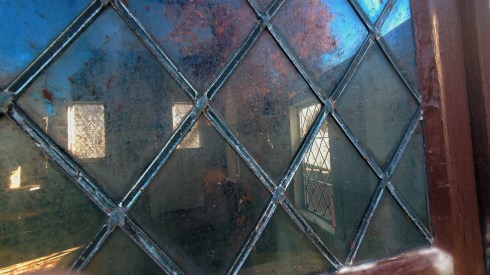
Window of Quaker Meeting House, Salem, Peabody Essex Museum.

On the top of Mount Washington (I guess the cog railway had been built), Eliphalet met the love of his life, the sister of a former classmate who was he immediately determined to marry: Miss Kitty Sutton. A long courtship and engagement ensued, during which he told her about the ghosts. She expressed great interest in his family house, but wanted it cleared of spectres, so Eliphalet returned to Salem on a mission. He pleaded with the ghosts to vacate and managed to enter into a dialogue with them, during which it was revealed that the House Ghost was a woman! She had been murdered by her husband back in seventeenth-century Salem and had lingered ever since. Eliphalet suggested a spectral marriage to give them all some domestic peace, but the ghosts protested that there was too much of an age difference (the House Ghost was about 200 years old, while the Scottish Ghost claimed to be 450 years old) before finally consenting. There followed a double wedding, of ghosts and humans, and off the former went, leaving the little old Salem house to the new Mr. and Mrs. (Lord and Lady) Duncan. While it’s not entirely clear how their marriage led the ghosts to vacate, it’s a nice ending to a charming tale, full of spirited negotiations! Another discovery this past week: the old house interiors paintings of the Russian-American artist Morris Kantor (1896-1974), painted in 1930-31 after a summer tour of visiting historic houses. Maybe it was just the timing of these twin discoveries, but they seem like perfect atmostpheric illustrations for “The Rival Ghosts,” particularly this first one: The Haunted House. 

Morris Kantor, The Haunted House (1930), Art Institute of Chicago; Still Life (1931), Artemis Gallery; Interior (1931), Smithsonian American Art Museum.


The Most Magical Plants

Well, October is upon us here in Salem, so that means I’m going to spend all my time inside or on the road. I’m just not a fan of Haunted Happenings, the City’s Halloween festival that starts earlier with each passing year: crowds are converging from at least mid-September now. On September 22, when eight convicted “witches” were hung at Proctor’s Ledge in 1692, you can see people dancing in the streets in Salem. Haunted Happenings is now in its 50th year and this is an anniversary worth celebrating for many, but for me, it’s just fifty years of turning tragedy into treasure. While I do not see or celebrate the connection between the tragedy of the Salem Witch Trials and Halloween, I still find the customs and traditions associated with the latter holiday very interesting, and as I’m teaching my “Magic and Witchcraft in early Modern Europe” course this semester, I find myself subsumed in the source and secondary literature of these complex topics. I haven’t taught this course in 5 years so it definitely needs a refresh! I have learned so much teaching this course over my career at Salem State: at the beginning I offered it simply as a corrective to what I saw (and still see) as a simplistic understanding of witch trials here in Salem, but every time I taught it I learned more about Christian theology and European folklore: after about a decade of teaching it I felt that I needed to undertake more serious study of the former and and contemplated going to Divinity School and now I feel like I need an advanced degree in folklore! It’s all so interwoven, and the focus on both magic and witchcraft over the medieval and early modern eras enables one to see how and why pre-Christian beliefs were assimilated into Christianity—and/or demonized. This coming week we are going to look at some important high and later-medieval herbals and the “magic” that was contained therein, so I decided to make a list of the top ten magical plants. This was a more difficult task than I though it would be as so many plants have protective/proactive virtues associated with them, but this is my list. I’m leaving out Mandrake because we all know that’s the most magical plant of them all, and as many plants were seen to be powerful in both facilitating and dispelling magic I’m going with the most efficacious, by reputation.

Vervainactually might be more powerful than mandrake. It was known as both an “enchanter’s plant” and an antidote against witchcraft. Gathering vervain seems to have been somewhat of a sacred ritual and there doesn’t seem to be anything that this plant could not do: protect, predict, heal, preserve chasteness and procure love. Snakes are often included in illustrations of vervain: both slithering varieties in the marginalia and more threatening serpents at center stage. Clearly it was percieved as an effective weapon against both.

British Library MSS Sloane 1975 and Egerton 747.

St. John’s Wort: a powerful demon-repellent as you can see by this retreating demon in the fifteenth-century Italian Tractatus de Herbis (British Library Codex Sloane 4016). Referred to as a “devil-chaser” on the Continent, St. John’s Wort was also worn as a protective amulet and used as decoration for doorways and windows on St. John’s Eve at midsummer, when its yellow flowers bloom. Its association with St. John the Baptist also bequeathed it medical virtues, and it was used to staunch bleeding, especially from the thrusts of poisoned weapons, and treat wounds.

British Library Codex Sloane 4016 and MS Egerton 747.

Rue: one of my very favorite herbs, and the sole survivor of my garden of plague cures from twenty years ago! The “herb of grace” was prized for its potency against the plague, infections, and also poison, signalled by its bitterness. It was also believed to be a preserver of eyesight, but it’s best to focus on the general rather than the particulars with this very efficacious herb, which could ward off witchcraft and was used in masses and exorcisms as well as an abortifacient. I just think its gray-green leaves are beautiful, and it adds structure to the garden all season long.

Plantae Utiliores; or Illustrations of useful plants, employed in the Arts and Medicine, M.A.Burnett,1842. 

Scabiosa: was far more interesting in the medieval period than its profile as a perfect cottage garden plant now. It was known as “Devil’s Bit” because of the appearance of its root, which looks like someone took a bite out of it. According to John Gerard, who was known to “borrow” information rather indiscriminately, “the great part of the root seems to be bitten away; old fantastic charmers do report that the Devil did bite it for envy, because it is an herb that has so many good virtues, and is so beneficial to mankind.” It was perceived as particularly beneficial to the skin, hence its name, a far cry from “pincushion flower.”

British Library MS Egerton 747; William Catto, 1915, Aberdeen Archives, Gallery & Museums.

Garlic: also has a devilish nickname, the “Devil’s Posy,” and cure-all connotations, so that it was also known as the “Poor Man’s Treacle.” (Treacle is an English sweet now, but in the late medieval and early modern eras it was an anglicization for “theriac,” the universal panacea.) There’s an interesting old tale that when Satan stepped out of the Garden of Eden after his great triumph, garlic sprang from the spot where his left foot lay, and onions from where he had placed his right foot. Like so much folklore, I’m not entirely sure what to do with this information. The key attribute of garlic was its pungent odor: like the bitter taste of rue, this signalled strength: enough to ward off witches, plague, and I guess vampires (though medieval people do not mention the latter).

Garlic (right) and a coiled snake, British Library MS Egerton 747.

Foxglove: a plant with more folkloric pseudonyms than any other! Foxglove: gloves for foxes or fairies or witches? Fairy fingers, ladies’ thimbles, rabbit flowers, throatwort, flapdock, cow-flop, lusmore, lionsmouth, Scotch mercury, dead man’s bells, witches’ gloves, witches’ bells: these are just some of its variant nicknames. Dead man’s bells indicates some knowledge of its potentially poisonous effects, but its cardiac attributes were not known until the eighteenth century. What a tangle with all these names! It’s so interesting to me that a plant can be associated with both witches and the Virgin Mary, as digitalis apparently was. Some of its names also testify to belief in the “doctrine of signatures” by which the appearance of herbs signals their use: foxglove flowers were said to look like an open mouth, and their freckles symbolic of inflamation of the throat: hence, throatwort.

Woodblock trial proof for textiles, 1790-1810, Cooper Hewitt Museum.

Hollywas perceived as very holy, of course. Very little nuance or contradiction with this plant, which Pliny, who seems very accepted by the medievals even though he was a Pagan, credited with the powers to protect and defend against withcraft, lightening, and poison. Its red berries became associated with the blood of Christ over the medieval era, along with its thorny leaves, which made it even more potent. Plant it close to the house, all the traditional authorities say (I feel fortunate that someone did that for my house long ago).

Elizabeth Blackwell’s Curious Herbal, 1737-39.

Moonwort: a little lesser known, but worthy of inclusion if only because it supposedly possesses the ability to open locks and guard silver, as well as unshoe any horses that happen to tread upon it or even near. Ben Jonson referred to it as one of the ingredients of “witches’ broth,” but by his time I think they were throwing everything into that brew. It’s a tiny, tight-fisted, flowering fern (Botrychium lunaria) that just looks like it must have magical qualities, but was also used to heal wounds.

George William Johnson, The British ferns popularly described, and illus. by engravings of every species (1857).

Henbane: is perhaps the most powerful of the bane plants, indicating death by poison, and another plant with both harming and healing virtues, demanding skillful use. It is always mentioned in reference to witchcraft in the late medieval and early modern eras, specifically as an ingredient in ointments (and salves which enabled witches to stick to their brooms!) This might be why it was referred to as the “Devil’s eye” in some regions. But it was also a powerful sedative, known to take away pain, and a hallucinogenic which could take away sense.

Henbane (on the right) in BL MS Egerton 747; Patrick Symons, Still Life with Henbane, 1960, Royal Academy.

Deadly Nightshade: related to henbane, but even more potent. Every bit of this plant was known to be poisonous, and early modern botanical authors urged their readers to banish it from their gardens. With knowledge and caution, henbane was a plant one could work with, but hands off deadly nightshade! Only the Devil tended it; in fact it was difficult to lure him away from this menacing crop of  “devil’s berries” and of course it was yet another ingredient in the strange brews of witches. Its botanical name, Atropa belladonna, indicates its use:  The eldest of the Three Fates of classical Greek mythology, the “inflexible” Atropos cut off the thread of life, and the “beautiful ladies” of Renaissance Venice used it in tincture form for wide-open, sparkling eyes. The English adopted the term belladonna in the later sixteenth century, but they also referred to deadly nightshade simply as “dwale,” a stupefying or soporific drink.

William Catto, Aberdeen Archives, Gallery & Museum.


The Spectre Ship of Salem

Despite the Salem marketing memo, Halloween is the time for ghosts, not witches, who already have their Walpurgis eve. I don’t think any ghost story could be more appropriate for a Salem Halloween than that of the legendary “Spectre Ship of Salem” which was supposedly reported by Cotton Mather in his Magnalia Christi Americana, according to all the internet “sources” and their sources. I can’t find the original reference, however, only one nineteenth-century gothic tale which asserts that it is embellishing Mather and indeed provides its readers with all sorts of romantic detail: a young couple bound for Old England set sail from Salem sometime in the later seventeenth century aboard the Noah’s Dove only to be presumably shipwrecked and perpetually cast adrift, their ship (and themselves) appearing periodically as an “apparition in the air” to the startled souls of Old Salem (always just before sunset, of course). The story of the “Spectre-Ship of Salem” first appears in print in Blackwoods Magazine in the spring of 1830, is transformed into one of the poetic Legends of New England by John Greenleaf Whittier, and then reappears in prose form in American periodicals over the next twenty years or so: with its repeated references to the elusive Mather, it is actually a ghost story about a ghost story! Mather does write about a ghost ship in his grand New England history, and cites a near-contemporary letter as evidence, but it is a ship out of New Haven rather than Salem, wrecked in 1647 and “perpetually sailing against the wind” thereafter.

Cotton Mather (including map embellished by me, 1702), John Greenleaf Whittier (1831) and Gleason’s Pictorial Drawing-Room Companion (1851).

Although his poem was penned early in his career, I suspect Whittier is responsible for the periodical popularity of the Salem spectre ship “legend” in the mid-nineteenth century, along with the fact that it could be linked to another spectral story increasing in appearances at the time, that of the Salem “witches”. It’s also so Hawthornesque. George Francis Dow commissioned the printing of a stand-alone edition of the Whittier poem in 1907, an act that was definitely in keeping with his other efforts to preserve/showcase/create colonial traditions. Ghost ships are the most global of eternal apparitions, so why shouldn’t Salem have one?

The Dow edition of the Spectre Ship of Salem, published in Salem in 1907; J. Flora illustration of a ghost ship from A Red Skelton in Your Closet: Ghost Stories Gay and Grim (1965).


A Picky Guide to October in Salem

I think this might be the first time I’ve written up a “things to do” in Salem for Halloween, a holiday that lasts for at least two months here and seems to be on the way to becoming a year-long “celebration” with perhaps a month break for Christmas. I’m the ultimate Halloween Scrooge, I’ll never be able to get past the opportunistic exploitation of tragedy issue, and Salem has enough boosters already. BUT, this year is a bit different as I am teaching the Salem Witch Trials for the very first time, in a couple of seminars for freshmen designed not only the explore the historical event and its impact but also to introduce them to the requisite skills of critical thinking and effective discourse. None of my students are from Salem, so I want to introduce them to the city as well. They are excited to be here and the last thing they need is a Halloween Scrooge: every Thursday after our last class of the week they ask for weekend recommendations and it would terribly wrong for me to simply say LEAVE. They should form their own impressions about Salem in general and Salem in October, so here is my guide to helping them do that. It’s not just for students and those new to Salem: I get emails about October every year so I’m trying to address general queries as well.

Get the story straight and the lay of the land. Where to go for general orientation when there is no Salem Museum? The only option is the Salem Visitor Center on Essex Street, right in the midst of the sprawling Peabody Essex Museum campus. The Center is a collaboration between the National Park Service and Essex Heritage: at present there’s not much there besides flyers, books for sale, banners, and restrooms, but you can purchase tickets and view the best introduction to the trials: Salem Witch Hunt: Examine the Evidence. We’ve spent the last month in class doing just that, but I still recommend this documentary to my students and anyone visiting Salem with the goal of learning more about the trials.

The Salem Armory Visitor Center and the Peabody Essex Museum’s Plummer Hall and Daland House adjacent: empty in the midst of much activity!

Choose your tour carefully. Walking tours are the best way, and really the only means, for the student/visitor to get both the lay of the land and the Salem story, but it’s important to know which Salem story you want to hear. I have no idea how many walking tours are offered now: I was walking down Charter Street the other afternoon (a relatively short street) and I encountered six, encompassing amplified guides each surrounded by 30+ tourists. It felt like a gauntlet. It’s impossible not to hear what guides are saying as you walk down the street, and they are spinning very different tales. So this is an opportunity for consumer research. Use the crowd-sourced tourism review sites: they are very illuminating. I’m taking my seminar students on their own walking tour in November, but I’m sure many of them want to go on ghost tours now and are are too afraid to ask for recommendations from me: I have none, so I would just tell them (and any visitor so-inclined) to do their research. There are a few below-the-radar historical and architectural tours that I’d like to mention here, however. Dr. Donald Friary, the former executive director of Historic Deerfield who now lives in Salem, is giving two focused tours of the Salem Maritime National Historic Site sponsored by Essex Heritage, and you can also book tours with him (and other guides) here. Two other tour companies which seem to be offering more intimate and focused (cultural and architectural) experiences are here and here.

In addition to Dr. Friary’s tours, the Salem Maritime National Historic Site offers several audio and digital tours of their site; The tour group in Derby Square above is about the average Salem size in October: this particular guide was doing a great job explaining the changing coastline of Salem while keeping their rapt attention: I’m sure I couldn’t do that!

Salem museums are not created equal. Salem has only two museums which are accredited by the American Alliance of Museums, whose core standards are available here: the Peabody Essex Museum and Historic New England’s Phillips and Gedney Houses. Actually the small museum administered by Essex Heritage out at Bakers Island is also accredited, but I doubt that very many October visitors are going to make it out there and it is closed for the season. The word museum is used very loosely in Salem, so beware: this is another realm for which online reviews will be helpful. Last year, the Peabody Essex Museum decided to engage with the Witch Trials by offering its first exhibition on the events of 1692 in quite some time, and it was truly wonderful to see objects and texts which I had only read about for the first time. This year, the PEM is continuing its engagement with The Salem Witch Trials: Reckoning and Reclaiming. I’m a bit confused by this exhibition so I’m going to go back again myself as well as with my students, but I will say that, once again, the authenticity of the objects and texts is striking when contrasted with so much faux in Salem, and I know from reading all these reviews that authenticity is something that very many Salem visitors are seeking. Historic New England offers a bit of specialty programming for both of its Salem properties in October: just the other day I went to a stirring presentation of Poe poems at the Gedney House, and the Phillips House is presenting Wicked Wednesdays for children.

Poe at Gedney House by Theater in the Open: these performance are over but remember, remember for next year. They use the house really well.

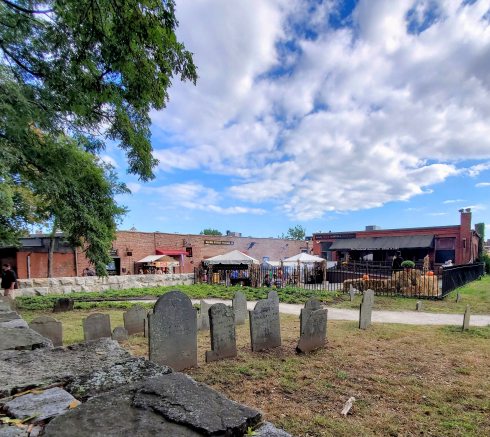
The Salem Witch Trials Memorial and Charter Street Cemetery. A big change here in terms of stewardship, so I can recommend a visit to these important, sacred sites. In past years, they were both overrun, but a partnership between the Peabody Essex Museum and the City of Salem has created a more protected and interpretive environment, based at the adjacent first-period Pickman House. The cemetery has been restored very carefully, and it’s really one of the most poignant places in Salem. Unfortunately the tackiest attractions in Salem are adjacent, literally blowing smoke into the cemetery, but that’s the reality of Salem in October: poignant and tacky.

FilmsThere are many opportunities to see timely films in Salem during October: on the Common, at the recently-revived Cinema Salem, on the patio of the East Regiment Beer Company. I’m looking forward to a screening of the animated House of the Seven Gables at Cinema Salem on the 28th in an evening sponsored by the Gables which will also feature a Q and A with the creator/director, Ben Wickey.

Just walk around: I suspect that my students just want to walk around in the midst of the packed Instagram crush that is downtown Salem, although a few of them did express concerns about the density of the crowds last weekend. So for them, and any visitor seeking a bit more space, I would recommend just walking around the neighborhoods: in the McIntire District, adjacent to the Common, along  and off Derby Street. There’s lots of beautiful houses to see, many decorated for the season, and lovely gardens behind the Ropes Mansion and Derby House. I’m hearing that the Haunted Happenings Marketplace, now on Salem Common, is a bit more carefully curated than in years past, so I might even venture over there today (a Saturday!) on foot, of course: opinions may differ about the character and impact of Salem’s Halloween, but the one thing everyone agrees on is the need to discourage driving dramatically: traffic and parking are just too scary.

Derby and Ropes Gardens, Federal Court, and WAY further afield on Lafayette Street.


Home is Where Everything Is

I can’t get through the 2020 Year of Blogging on #SalemSuffrageSaturdays, historic houses, and the occasional book-inspired post alone: the most important place for everyone this year was the home, and so I need to show you more of mine to be true to its spirit. There were also some big changes to my home this year: for better, for worse, and just change. Now that we’re in the final months of this challenging year, my overwhelming sentiment is one of gratitude: I feel fortunate to have a safe and secure home, full of lovely things, and more than sufficient space for work, sleep, play, and procrastinating. So here are my three domestic themes:

The year of three cats:

About a month ago, I lost my cat Darcy, who was nearly 20 years old. He had been sick with kidney disease for quite a while—so I knew this was coming, but I was quite determined that he should die at home. He lived his whole life in our house, and he was not a social cat: he really only tolerated me. Actually I think he liked me, as every time I walked into a room he was in he would turn up his nose and give me a little trill (the only word I can come up with to describe that sound—it wasn’t quite a meow). Because of the pandemic, and then my book contract, I had a lot of time with Darcy over these past seven months: we would sit together and I would work and he would sleep or stare at me. Despite eating and wanting to eat constantly, he grew thinner and thinner, but he seemed very comfortable and I just hoped he would drift off, at home. I had experienced the deaths of two previous cats—Flannery and Moneypenny—through disruptive seizures and I craved a peaceful death for Darcy, but my vet convinced me that a crisis was imminent, so we had to put him down. Our other cat Trinity came to us shortly after she had given birth to her litter outside, been rescued, and fixed–while all of her kittens were put up for adoption. She has been making “nests” and crying for them for five years, so I always thought after Darcy was gone we would adopt a kitten: I knew she would not recognize the kitten as her kitten, but I though it would be at least a better age match—so I moved pretty quickly to adopt and now we have Tuck! Trinity is not pleased with this addition: for a while she seemed to have lost her own personality and become stand-offish Darcy incarnate but she seems to be reverting to form now: hopefully she just had to establish her “ranking” status. We have a bit more to work out, here at home.

One of Darcy’s last photographs, Trinity, Tuck.

The new kitchen!

We’ve needed a kitchen remodel forever; I don’t know why we moved forward in this particular year but apparently renovations are a big trend in this home-focused year. Kitchens in older houses are generally just boxes added onto the back; our house’s original kitchen is in the basement, and it looks pretty original. Our “modern” kitchen looked like it was put in in the 1950s or 1960s, but we found the bones of a much older kitchen when we ripped everything out; the new kitchen is completely new, except for the floorboards, which we found under three layers of vinyl. Thank goodness for them, because my pet peeve is new kitchens that don’t have anything to do with the rest of the house. We put a lot of thought—and spent quite a lot of money—connecting the kitchen to the rest of the house through materials and details, because it really wasn’t before. We commissioned a big slab of mahogany for our island because we wanted to balance the mahogany staircase in the front, and more practical quartz for the other counters. I think we succeeded in making the “box out back” more connected to the main house, but it took all summer: another reason why Darcy and I got to spend so much time together up on the third floor away from the dust and the noise! Here’s the whole process: before, during, after:

Stripping down and building back layers: that wattle & daub look is called “backplastering” and look at the floor “before”! Cabinets everywhere on the first floor for six weeks or so. The general contractor was our neighbor across the street, Leon Kraunelis, of Redwine Development, floors by Dan Labrecque , and mahogany table top by Alpine Woodworks right here in Salem. I changed up my jadeite for ironstone from my friend Betsy at Windy Hill Antiques

Living and working all over the house:

So I received my book contract in early July and went right to work: primarily in my third-floor study, a third-floor bedroom (because it had a bed for Darcy) and a second floor bay-window room that we call the “Nosy Room” because the previous owners did and it looks out over all of Chestnut Street. I taught a summer class, and now I’m teaching four classes in addition to writing. I find that I need to change my surroundings to be productive—and I can’t really go anywhere: not to my office, not to the library. So I’m basically working all over the house. I’ve been zooming everywhere, just to change it up for my students:  I decorated the double parlors this past weekend with the rationale that it was for them but it was really because I bought so much John Derian Halloween stuff at Target!  The only room I haven’t taught in yet is the kitchen: moving into there this week.

Various “studies”, and one of my big scores of the summer: a Salem Marine Society certificate! I have never been able to resist John Derian, so off to Target I went as soon as his stuff hit the stores. I bought three of those black cats.


If You Build it, They will Come

Two very different tourist towns during the Pandemic of 2020: at the beginning of the summer, I was up in my hometown of York, Maine, so I wrote about its opening in the midst of Covid with every intention of writing a comparative “bookend” post on Salem. I am only getting to this now, with summer over and Salem’s Halloween season, 2020 version, gearing up. Yes: Halloween has arrived in Salem: apparently nothing can stop it, even a pandemic! The traffic and the crowds have increased noticeably over the last few weeks, and on Saturday I went for a walk to see to see what was up: I turned around after 5 minutes, it was simply too crowded for me to feel safe, after so many months of relative isolation. Then I went back on Sunday, and it was much better: less crowded, masks much in evidence, enough space away from the restaurants. I am wondering if social distancing downtown will be possible on October weekends: shops, restaurants, and attractions have limited capacity under the Covid conditions, so lines will form—and grow longer with each weekend until Halloween I expect.

Sunday 9/27/20: Salem downtown: not too bad! Most people had on masks, as the whole downtown is a mandatory mask zone. Mask ambassadors out and about. Longer lines at restaurants than the museums, with the exception of the Witch “Museum”, of course—which is not really a museum. This year, it finally gets some stiff competition from the Peabody Essex Museum with TWO Salem exhibitions on view: “Salem Stories” and the “Salem Witch Trials, 1692” (with authentic artifacts, expert curatorship and current historiography, as opposed to mannequins, narrative, and interpretation from circa 1968).

So I was originally going to title this post “City of Mixed Messages”, but after walking around, reading, and thinking a bit, I decided that wasn’t fair: I don’t think the City is putting out mixed messages. All the official events are canceled: people are just coming. There are attractions of course, like the traditional schlocky ones and the new PEM exhibitions, as well as a new Destination Salem app and a Frankenstein-esque Hampton Inn, but apart from the specific draws, I just think people like to come to Salem for (a very extended) Halloween. Witch City has been built with a very solid foundation, and they will come. Away from Essex Street, all was pretty quiet even in the city center: the Charter Street Cemetery has been closed for repairs for quite some time, and I saw only respectful wanderers at the adjacent Salem Witch Trials Tercentenary Memorial: certainly a far cry from thisThe City’s message this year seems to be come with a mask and a plan (like voting!) and hopefully that’s what people will do.

Six feet apart was possible at the Salem Witch Trials Tercentenary Memorial this past weekend.

But it’s still September. I am wondering how state protocols can be observed with more crowds. I saw lots of out-of-state license plates downtown: have these people quarantined for 14 days before they descended upon Salem? Last week when I visited the Beverly Historic Society, there were contact-tracing questions before I could enter the exhibition: is this happening in Salem? What’s going to happen on Halloween night, which is (of course, 2020) on a Saturday this year? No candy from me, kids; I’m sorry, I’ll double up next year.

As you can see, all was pretty quiet in the McIntire Historic District this past weekend, even in the Ropes Mansion garden, which is just GORGEOUS now—it’s the ultimate late-summer garden. The owners of this beautiful Italianate never do anything in half measures, but I suspect they must be part of Historic Salem’s  Halloween event: Halloween in Salem, a “festive virtual house tour” which will go live on October 9. A great idea and a safe way to experience Halloween in Salem.