
We haven’t had many snowstorms this winter, but two nights ago about a foot of snow dropped onto the streets of Salem. My first thoughts when I woke up were: how much snow did we get (and) should I run down the street and take a picture of the snow house? Classes had been cancelled the night before, so that was no concern of mine. I saw that we had quite a bit of snow, so of course I thought of the Wheatland/Pickering/Phillips house, a Classical Revival confection that I always think of as the “snow house” or the “snow castle” as it looks so beautiful when its exuberant trim is frosted with snow. I adore this house in every season, but especially in the winter. It really is my first thought when I wake up on a snowy morning.


It was quite warm yesterday morning, and so the snow had already started to melt by the time I made it down the street (as a snow day meant an extra cup of coffee) so here are some “freshly frosted” views from a few years back, when the blue sky afforded more contrast and shadow.


My Snow Castle, which I guess we should call the Wheatland-Phillips House after its original and present owners, was designed by Salem native John Prentiss Benson (1865-1947), a brother of the well-known American Impressionist Frank Benson who became an esteemed artist himself after his retirement from architecture. I don’t possess the architectural vocabulary to describe this house so I’ll use the words of Bryant Tolles from Architecture in Salem: “a spectacular, flamboyant example of the Colonial Revival style……[in which] the architect employed a variety of Colonial Revival idioms, including the ornate cornice (with dentils and pendants in relief), the wide fluted Corinthian pilasters (reminiscent of the work of McIntire, the flat window caps, the second-story Palladian window with miniature pilasters, the broad doorway with semi-elliptical fanlight, and the overly large flat-roofed porch with Corinthian columns” in a “innovative, almost whimsical manner”. Tolles concludes that “the house gives the impression of being an original late 18th century building” even though it is in fact one of the newest houses on Chestnut Street, constructed in 1896 for Ann Maria Wheatland, the widow of Stephen Wheatland, who served as the Mayor of Salem during the Civil War. I’m not sure why Mrs. Wheatland desired such a large house, but she lived in it until her death in 1927. Despite its mass, the house has always seemed whimsical to me, and also timeless, and its allure is no doubt enhanced by its stillness as I don’t think anyone has lived there during the whole time I’ve lived on Chestnut Street. I have to resist trespassing every time I walk by this house, in every season: in summer I see myself having a gin & tonic on its left-side (deck? seems to mundane a word) and I would love to see if there is a veranda out back. I do resist, so I don’t know.
 The House in 1940; HABS, Library of Congress.
By many accounts, John Prentiss Benson wanted to be an artist from early on, but as that trail was blazed by his brother Frank, he settled for architecture. Nevertheless, he seems to have had a successful career, with a New York City practice and several partnerships. He lived for several years in Plainfield, New Jersey where there are several John P. Benson houses: there was a tour devoted to them in 1997 titled the “Mansions of May”. None of these houses—or that designed for his other brother Henry on Hamilton Street in Salem—seems to bear any resemblance to the Wheatland-Phillips House: it’s as if he just let loose with wild abandon. Perhaps Mrs. Wheatland gave him carte blanche, or very strict instructions. Or maybe he was influenced by memories of the Benson family home on Salem Common: an exuberant Second Empire structure that was situated on what is now the parking lot of the Hawthorne Hotel.


 Other Benson houses, including his own, top right; the Benson family home on Salem Common and Willowbank in Kittery Point, Portsmouth Athenaeum.
After his retirement from architecture in the 1920s, Benson moved to a waterside estate in Kittery Point, Maine named Willowbank and began painting full-time until his death in 1947: he was prolific, and consequently his identity is more that of a maritime artist than an architect at present. The Portsmouth Athenaeum has his papers, and has digitized many photographs of his life and work at Willowbank, which also happens to be the birthplace of the 6th Countess of Carnarvon, Ann Catherine Tredick Wendell, who became mistress of Highclere Castle in 1922. And thus we have a very distant and indirect connection, through John Prentiss Benson, between the Snow Castle and Downton Abbey!


Galleon, 1923 by John Prentiss Benson @Vose Galleries: I love galleons, and I’m using this one to sign off for a while as I’m off to Portugal on spring break! I’ll be back with many pictures of azulejos, no doubt.


 The Cotting-Smith Assembly House yesterday afternoon and in 1926, 1920 (in a painting by Felicie Ward Howell, collection of the Museum of Fine Arts, Boston), c. 1910 (Cornell) and an undated drawing (Historic New England).


 Photographs of the Cotting-Smith Assembly House interior, Historic New England; Los Angeles Time, 1926; Boston Globe, 1963 and 1985.


 That staircase!
 1818 & 1912

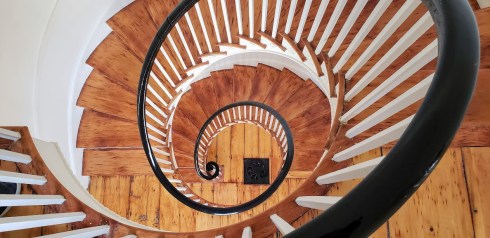


 Apparently over 1.5 million people visit Salem each year, with nearly 54% of that number in the month of October: for many of those 800,000 or so (I am severely math-challenged), this ⇑⇑ is historical interpretation.

 Carnival Confusion: a City ordinance against mechanical rides on the Common prohibited the annual carnival there, so it was relocated to the middle of Federal Street, but somehow there are electrical rides on the Common as well. This is all very confusing to me, but a colleague of mine commented that the Federal Street location was ok, as those columns on the Greek Revival courthouse are Egyptian Revival, so the Pharaoh fits right in.
 22 Andrew Street: a beautiful Federal (built 1808) located on a lovely street right off the Common (which will not be the site of a carnival for much longer): looks like its
  One Forrester Street is right on the Common—it looks Federal but was actually built in 1770. When I first moved to Salem this was the home of a lovely woman whose family had owned it since the 19th Century. It’s been cherished throughout its history, and is still for
  The Stephen Daniels House is a first-period house which just came on the


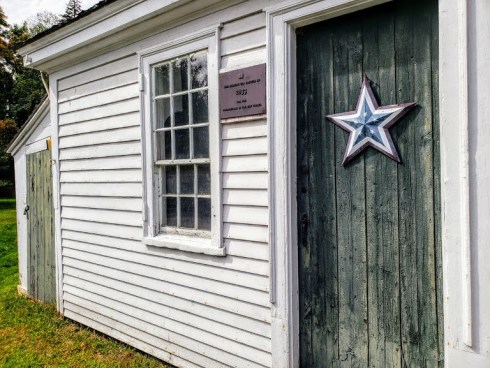


 The Kittredge Mansion & gate in HABS photographs from 1940-41, Library of Congress.


 The Rundlet-May House (1807) and views out back from its second and third floors.


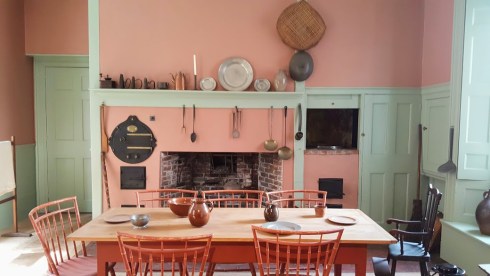
 First-floor parlors, hall and kitchen (with Rumford Roaster) and fire buckets, of course. I found several early 20th-century postcards of the house which referred to Samuel McIntire as the carver of the right parlor’s mantle (above), but I think this is just an illustration of the Salem architect and woodcarver’s fame in the midst of the Colonial Revival era.


 Second and Third Floors, including Ralph May’s 3rd floor study, with all of his stuff. Below: this “musical” decorative motif ran through the house—it caught my eye because the same motif is on one of my Fancy chairs. (the last photograph).




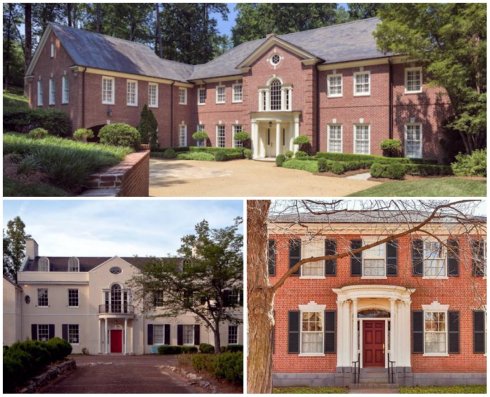 Detroit Publishing Co. photograph of Gardner-Pingree, 1906, Library of Congress; Albert MacDonald, Old Brick Houses of New England, 1917; Mansions of Massachusetts, 1977; the front parlor in the 1940s,houses in Atlanta and Brookline, MA supposedly inspired by the Gardner-Pingree.


 My pedestrian pictures, and a stunning photograph by Carol Highsmith in the 1980s, Library of Congress.


 White Court in 1900, Bain News Service, Library of Congress; The arrival of President and Mrs. Coolidge at White Court in Swampscott in June of 1925, and the pair with one of their white collies (either Rob Roy or Prudence Prim ) at the estate during the summer,


 Leslie Jones photographs of President and Mrs. Coolidge at White Court, Swampscott, 1925, Boston Public Library; the Coolidges attend the Tabernacle Church in Salem, July 1925, Blackington Collection, University of Massachusetts.
 The drawing room of White Court in its residential era, Historic New England; an exterior view by Leslie Jones, Boston Public Library.






