On a sunny afternoon last week, I had to the opportunity to go inside Two Oliver Street on Salem Common, a grand brick Federal house built in 1811 and currently for sale (so you can go in too, if you want). I hadn’t been in the house for a while, maybe a decade or so, and while there have been some alterations made to the more utilitarian spaces, the historic “public” rooms remain perfectly preserved, including the Zuber & Cie wallpaper in the dining room. There is a beautiful double parlor, very large center halls on all three stories, a sweeping serpentine staircase, and countless bedrooms—I really lost count, though three third-floor rooms have been combined to make a large poolroom, rec room, man cave, whatever you want to call it (it’s not very cave-like). There is also a wine cellar, a lovely deck overlooking an enclosed garden, and a carriage house with a second-floor apartment! All of these features are wonderful, but for me, the key attraction of the house was its combination of modernized facilities and systems combined with historical “texture”: I don’t like it when age-old plaster looks too smooth. Well see for yourself: here are my photographs of the exterior and first, second, and third floors.


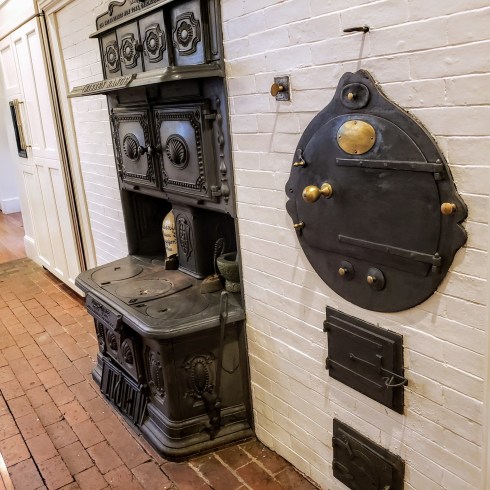 Another Rumford Roaster! I really believe that Salem can lay claim to being the city with the most Rumford Roasters.


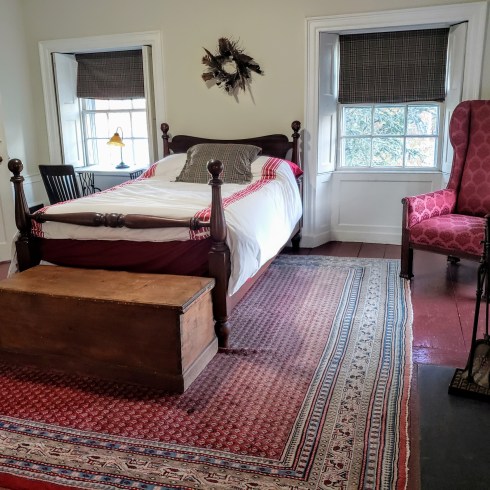

 Beautiful views over Oliver Street on one side of the house, and the Common on the other.


I love old basements—-if they are clean, which this one definitely was (unlike mine). On our way back upstairs from the wine cellar (just below), we popped in to see the “unfinished” part of the basement, which is really quite impressive. Combined with all of the exterior aspects of the building, it really reinforces the sense of masonry craftsmanship. Yes, the woodwork is beautiful too (as you can see above) but I walked away thinking about brick.


Generally I write about the occupants of historic houses, but as I walked away from Two Oliver with all that brick on my mind I wanted to research the builder: I knew it was Joshua Upham, who also built Old Town Hall and part of Derby Square, but that was about all I knew about this “talented” (I found this adjective in several places) mason. Fortunately his son published a biography: even though it’s a bit more focused on Upham’s faith and activism (he was a Deacon of his church and a very passionate abolitionist) we also get to read a bit about his long career, which began in Boston as a mason’s apprentice. After a fallout with his fellow apprentices, he went down to the docks to catch a ship for Newburyport (as there had just been a fire) but wound up in Salem instead. This was in 1803, just before Salem’s Federal building boom, and in the words of his son, “in the reckless runaway, with his one shirt, one pair of duck trousers and a spencer, it would have needed a prophetic eye to see the most successful master mason in town, under whom the larger part of its ancient brick dwellings and stores were erected.” Two Oliver Street was built for merchant Joseph White Jr., who lived in the house for only five years, until his death in 1816. There followed a long occupancy by Benjamin H. Silsbee and family in the middle of the nineteenth century, after which the house became the parsonage of the Tabernacle Church on Washington Street and the long-time residence of several generations of the Clark family. Joshua Upham’s spectacular building career was followed by an equally spectacular second career as an inventor of fire “annihilators” designed to protect buildings under the auspices of the Salem Laboratory on Lynde Street, and when he died in 1858 he was still in the possession of several patents.

Joshua Upham, the builder of 2 Oliver Street/33 Washington Square North, which is now for sale through J. Barrett & Company.


 The new McIntire-Hermanksi Tea House on Monroe Street, the old McIntire Tea House on the grounds of the Peabody Essex Museum, and Charles Bulfinch’s sketch of the Derby Mansion by McIntire, with its flanking outbuildings, c. 1795, Phillips Library, PEM.


 The John Hermanski-Barbara Taylor House on Monroe Street in Salem, 2019 (+accessory) and c. 1950, Digital Commonwealth.


 A dreamy house—and former tavern—in Montague Center: listing


 All around Montague Center: house & barns, the Book Mill, Valley cats, Viennese heirlooms, the Homestead.


 Turners Falls, 1877, Digital Commonwealth ( I don’t think all of those streets were filled out!); the fast-flowing river after the Falls; workers’ housing. On the way home, the French King Bridge over the Connecticut River.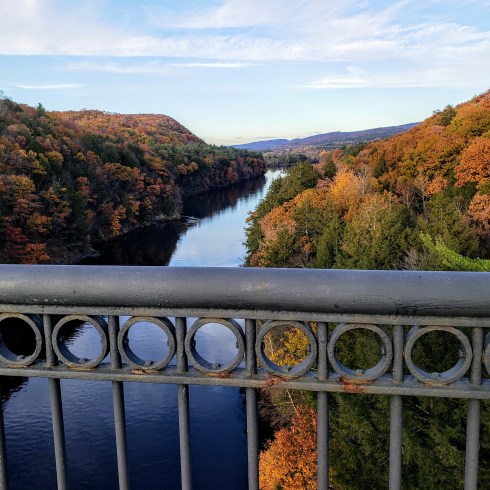


 1931 Cheshire House edition with illustrations by Abner Epstein; 1950 British film version.


 The house exterior in the 1928 American film, the 1950 British Film, and the 1960 Roger Corman film; Jean Epstein’s 1928 film prefers to focus on its baronial interior.


 The House: illustrations by Robert Swain Gifford (1884); Daniel Walper (1922), Albert Dubout (1948), Arthur Rackham (1935) and Gris Grimly (2004).
 Confronting a GEORGIAN haunted house: The Little Stranger (2018). Talk about a house-centered story! In both the film and the book, the house is a MAJOR character, even more so than in Usher. The juxtaposition of the airy (though decayed) Georgian and the “presence” heightens the tension, and you realize that possession has multiple meanings.


 The Old Burying Point on Charter Street is closed (thankfully) all month long; if you do come during the week you can ride a scooter around town—but not on the weekend as they have been banned because of the crowds.


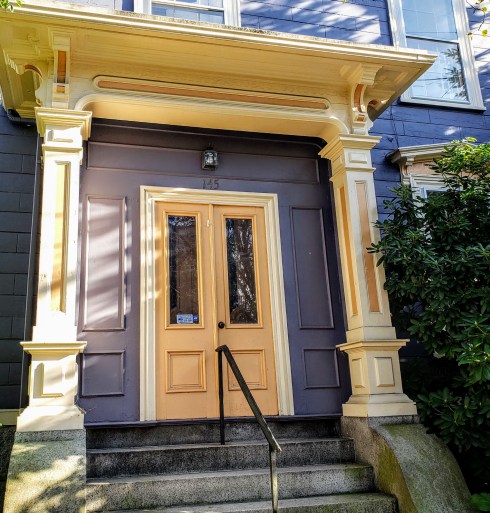

 Another reason to praise PEM: the beautiful restoration of the Daniel Bray House on Brown Street: it doesn’t have its new/old door yet as you can see–and I’m not sure if it will be painted this light orange color.


 Dark Brown/Red is a classic Salem combination.

 Turquoise is the current it-color, I think.


 T
T


 Longwood Gardens + Conservatory and “Green Wall” surrounding restroom doors!


 Treasures of the Brandywine River Museum of Art, including: Howard Pyle’s influential “historic” illustrations and a N.C. Wyeth cover, Andrew Wyeth’s Snow Hill and Jamie Wyeth’s Lime Bag, N.C.’s studio exterior and interior and in Andrew’s North Light, N.C. Wyeth, framed by his parents and looking down on his talented family, a Jamie Wyeth Christmas card for his beloved wife Phyllis.


 There WILL be fiddlers—and dancing! (Not really sure who took these pictures at the last ball two years ago, sorry)