Tag Archives: Garden

May Day

Thanks to fond childhood memories (which I wrote about in last year’s May Day post) and my own rather whimsical penchant for the past, the first of May is one of my favorite days of the year. This year it is even better than usual because it marks the end of classes (yes, professors look forward to this just as much as students, perhaps more). There is lots of age-old advice about May Day, which, combined with artistic representations of bringing in the May–feasting, dancing, and processions (all while wearing garlands)– leads me to believe that it was once a much more important holiday than the non-event it is today. This is just a small list of things that you are supposed to do or not do in May, culled from a variety of sources, most from the seventeenth through nineteenth centuries:  take off your “flannels”, organize a parade (especially if you are a milkmaid or a chimney sweep), cut down trees and greenery and deck the halls, dance, pick a May Queen, move house (???), but do not get married (unfortunately my anniversary is in May) or sleep with a blooming Hawthorn branch in your bedroom.

For my own May Day observance, I’ve collected a few flowery images from the past–where May Day is depicted with a strong undertone of liberation on at least this first day of the merry month of May–and my own present-day Salem. I think everyone feels a bit more liberated in the springtime, and students and professors at semester’s end.

May Day 1820

Thomas Lord Busby, Costumes of the Lower Orders of London, 1820 (New York Public Library Digital Gallery).

Here is a rather fanciful depiction of  milkmaids and chimney sweeps in their May Day costumes, with the traditional Jack in the Green in the center, covered by a more masculine version of the traditional garland. Quite elaborate costume for the “lower orders”! This is one of 24 hand-colored etched plates “engraved from nature’ by Thomas Lord Busby in 1820: a rather voyeuristic, and expensive, collection that is brand new to me. Both milkmaids and chimney sweeps (but no Jack in the Green) are the central subjects of Francis Hayman’s earlier (and even more romanticized) painting, The Milkmaids Garland, or Humours of May Day (1741-42), below.

May Day Garland

Victoria & Albert Museum, London

More than a century later, Walter Crane’s images of May Day are both romantic and relevant: as devoted to the cause of the “lower orders” as he was to his art, he created the iconic Garland for May Day, 1895 which grounded politics in the same traditional imagery that is evident in his later illustration for Charles Lamb’s A Masque of Days (London: Cassell & Company, 1901).

May Day Garland 1895

May Day Masque of Days Walter Crane

Rather than a full-floral display, there are pops of color around town this morning:  it’s still early Spring in Salem. In my own garden, my perfect pulmonaria (lungwort) was in full flourish, and the boring forsythia a little past. Elsewhere in Salem, there was a lot to see on this May Day morning on my brief run around before (the last day of) classes.  I particularly like the last little striped flowers in the herb garden behind the Richard Derby House at the Salem Maritime National Historic Site–some type of tulip?

May Day 2 010

May Day 008

May Day 026

 May Day 029


Fool’s Parsley

My scholarly, botanical and materialistic interests intersected the other day when I came across a beautiful Arts and Crafts wallpaper print by Charles Francis Annesley Voysey named “Fool’s Parsley”, first produced in 1907. Even though it’s not really appropriate for my 1820s house, I love art nouveau and Arts and Crafts wallpapers in general, and Voysey’s designs in particular. The more I looked at the design, the more it reminded me of Sweet Cicely, one of my favorite plants in the garden, and so it was no surprise to learn that these two plants are in the same family. Though they have a very similar appearance, these herbs have very different natures:  while Sweet Cicely “is so harmless you cannot use it amiss” according to the old herbalists, Fool’s Parsley is very, very poisonous. Beauty can be deceiving.

Fool's Parsely Voysey 1907 V and A

Fool's Parsley 1856 Herbal

L0013947 L. Fuchs, De historia stirpium commentarii

“Fool’s Parsley”, or Aethusa cynapium, in a 1907 wallpaper pattern by Charles Voysey, Victoria & Albert Museum, London and 1856 and 1542 herbals by Constantin von Ettingshausen and Leonhart Fuchs, respectively, Wellcome Library, London.

Fool’s Parsley is often called “Lesser Hemlock” in herbals from the Renaissance onwards, emphasizing its Socratic connection and toxic qualities rather than the evergreen tree. Along with Sweet Cicely, it belongs to the large Umbelliferae plant family, named for and distinguished by its lacy, umbrella-like flowers and including such beneficial vegetables and herbs as carrots, celery, dill, chervil, parsnips, and, of course, parsley. Besides the deprecating designation, there are many stories and anecdotes of poor fools who mistook the poisonous parsley for the passive one and ended up with severe nausea, headaches, and worse. But for CFA Voysey, this lethal plant was as beautiful as a rose, and by all accounts, his very best birds embellish the design.

PicMonkey Collage

Fools Parsley 1893

Trustworth Studios has reproduced Voysey’s design in light and dark colorways; Fool’s Parsley page from an 1893 German herbal, Etsy seller CabinetOfTreasures.


First Snow

On Saturday we had our first snow here in Salem; by Sunday it was gone.  I was very happy to see it and hope to see more:  last year, we had no snow in the winter, not a flake. There was the Halloween storm on my birthday (while a month or so ago my birthday fell on Superstorm Sandy, or vice-versa: what is the cosmos trying to tell me?)  So this year, I”d like a white winter:  not the huge, towering snowbanks of winters past, but just a little snow on the ground. Here are a few photographs of my garden and downtown, with barely a whisper on the ground.

First Snow 019

First Snow 011

First Snow 014

As you can see, where there was no grass, there was no snow. Not much of a display for New England, but I’m a little desperate as it has been a while. When I feel like waxing rhapsodic about snowflakes, I always conjure up the charming images from Robert Hooke’s Micrographia (1665), but I think I’ve already done that once or twice on this blog.  So instead, I want to focus on another man, several centuries later, who was similarly obsessed with snowflakes:  Wilson Alwyn Bentley (1865-1931), a pioneer in photomicrography. Bentley was a self-taught farmer from Jericho, Vermont who developed a process by which snowflakes could be photographed before they melted; he captured over 5000 images, demonstrating (like Hooke before him) that no two snowflakes were alike. Bentley was so taken with the singular, fleeting beauty of snow crystals, that he strove to capture them forever, on film, and first did so in 1885. Just after his death, about half of his images were published in a book entitled Snow Crystals (1931) which was republished by Dover in 1962. You can also see many his images at sites maintained by the University of Wisconsin and the Jericho Historical Society, as well as a few other places. Apart from their scientific and photographic value, Bentley’s images are just simply beautiful. Washington photographer Theodor Horydczak was inspired by Bentley to create his own grouped snowflake images, but I think I prefer the singular sensations.

First Snow Bentley Camera

First Snow Bentley 1910

First Snow Wilson Alwyn Bentley 1910

First Snow LC

Wilson Alwyn Bentley with his special microscope/camera in Vermont; lantern slides of two of his captured crystals, c. 1910, Metropolitan Museum of Art; Theodor Horydczak photograph, 1920, Library of Congress.


High Summer Gardens

August is beyond peak time in New England gardens but there is still a lot of color out there:  primarily from phlox, phlox and more phlox. I’ve been taking pictures on my local travels and those below are from eastern Massachusetts, coastal New Hampshire, and southern Maine. The first group were taken during a visit to Fuller Gardens in North Hampton, New Hampshire. The garden was designed by landscape architect Arthur Shurcliff (of Colonial Williamsburg fame) for the 50th governor of Massachusetts, Alvan Fuller,  and his wife Viola, who maintained a summer seaside home in North Hampton, which is only about ten miles from the Massachusetts border. The house is no longer there, but its adjacent gardens are, laid out in a series of  “rooms” in the Colonial Revival fashion. Everything is so immaculately maintained, especially Mrs. Fuller’s beloved roses, that it is a treat to visit here in August when nearly every other garden I see (including my own) is looking a bit tired and overgrown.

Up the road a piece, some gardens and flowers in Portsmouth, New Hampshire:  Prescott Park in the afternoon and early evening, a vertical garden on a utility box, and the terraced garden across from the MoffatLadd House (1763) on Market Street.

Some very diverse images of plants and landscapes in southern Maine:  a coastal garden in Kittery Point, a checkerboard courtyard, a border, and my father’s cabbage, all in York.

Back home in Massachusetts, the colonial garden at the Parson Capen House in Topsfield, with its raised beds and very practical herbs and flowers, and my own Salem garden, which I think is a bit behind due to its sheltered location:  the bee balm is still reigning, the phlox (I have only the white, mildew-resistant David variety) is just starting to bloom, and the ferns are starting to sag:  August is not their month.


The 8th Wonder of the World

It’s almost shameful to follow up a post on my garden with one that is acknowledged to have been one of the most beautiful in early modern Europe, but be assured I am suggesting no comparison!  A seventeenth-century German garden called the Hortus Palatinus (the Garden of the Palatinate) was so beautiful, so majestic, and such a bold expression of the mastery of nature that contemporaries referred to it as the 8th wonder of the world. Somehow, it’s all the more legendary because it was such a fleeting creation: elaborately planned by French engineer extraordinaire Salomon de Caus for the challenging terrain adjacent to Heidelberg Castle over a five-year period prior to 1619, it was installed that year and perhaps lasted a year or two before becoming a victim of the Thirty Years’ War (1618-1648) that ravaged much of central Europe.  Fortunately the image and elements of the garden were captured in de Caus’s book, entitled Hortus Palatinus, which has been digitized by the University of Heidelberg.

Engraving by Matthäus Merian from the Hortus Palatinus (1620); painting by Jacques Fouquières, circa 1620.

The garden was commissioned by Frederick V, Prince-Elector of the Palatinate and the briefly-reigning “Winter King” of Bohemia, as a romantic tribute to his new bride, Elizabeth Stuart, the eldest daughter of James VI and I of Scotland and England. De Caus, an exiled French Huguenot who was a favorite of the Stuarts and had served as Elizabeth’s tutor, seems to have possessed a variety of talents:  he is mathematician, civil,mechanical, and hydraulic engineer, landscape architect, and horticulturist all at the same time. The Heidelberg garden was not only a schlossgarten carved out of the earth, it was a walled world of waterworks, moving statues, and mechanical birds, all enhancing its wondrous reputation.  So too did its romantic associations:  Frederick and Elizabeth seem to have had that rare royal marriage that was actually based on affection, and the surviving “Elizabeth Gate” , supposedly erected overnight in 1615 on the orders of the Prince-Elector as a surprise gift to his wife, is a living testament to (at least their early) relationship.

Frederick V and Elizabeth, early 17th century line engraving by Balthasar Moncornet, National Portrait Gallery, London; the Elizabeth Gate at Heidelberg.

The ultimate legacy of the garden is de Caus’ 1620 book, published about the same time that its namesake was being destroyed!  The amazing illustrations of Matthäus Merian (among others, apparently) bring us into the garden and its world, and preserves it forever.

More images from the Hortus Palatinus at the University of Heidelberg, and Salomon de Caus’ design for a mechanical bird, from his earlier work,  Les raisons des forces mouvantes (1615).


Overgrown, “Old-fashioned” Gardens

For the decade that I’ve worked on my garden I’ve been going for a lush, flower-packed, “old-fashioned” look, popular a century ago when there was a strident Colonial Revival reaction against Victorian gardens. Recently a good friend gave me a copy of a special edition of The Mentor (which had a logo/mission which I just love:  learn one thing every day) published in 1916 with a focus on “Historic Gardens of New England”, and after perusing the pictures inside, I realized that I’ve attained my goal, in a way. The author of the featured article, Mary Harrod Northend, was a native of Salem and consequently asserts that “the old-fashioned garden of New England reached its highest development” in her (my) fair city, though she highlights gardens in Newburyport, Portsmouth, and other New England towns as well.  Besides axial paths, arbors, and sundials, the key characteristic of her chosen gardens are their flowers:  not the exotic varieties preferred by the Victorians, but native (or better-yet, brought over by the colonists) varieties that will attain that perfect, bursting-forth-from-the-border look: peonies, hollyhocks, phlox, dianthus, bachelor buttons.  All contained within box borders, of course.

I’ve got the box borders (which really need trimming now) and the sundial, and some of Northend’s preferred flowers but others (hollyhocks and peonies) would take over my small garden so I’ve chosen other plants–like the meadowsweet on the left–that are still taking over my small garden.

To control the chaos, I’ve been putting in germander for edging; Northend doesn’t mention this great plant (similar to rosemary but hardy here in New England) but the Elizabethans loved it for their knot gardens. I’ve also included a few close-ups of some of my favorite plants, in bloom now:  alstroemeria (set against variegated calamint) and red baneberry (set against astilbe).

In the shade garden in the back is a “plant” over which I’ve clearly lost control:  a monstrous hydrangea shrub, now grown into a tree.  It seems to be tapping into the water pump for the pond right next to it, and is reaching for the sky! Follow the path and you run right into it–unfortunately I can’t seem to get a good picture of just how giant it is.  It’s scary.

And now some of Northend’s 1916 Mentor pictures for comparison:  the first is of the Hoffman house on Chestnut Street in Salem (now currently for sale), which featured a famous garden established by merchant/horticulturalist Charles Hoffman in the late 1830s and maintained for over a century.  The photograph below is centered on the “ancient” Dutchman’s Pipe-draped summer house, no longer there.  There has to be some structure in the center: pergolas, arches and arbors prevailed in the old-fashioned garden.


When Hostas Attack

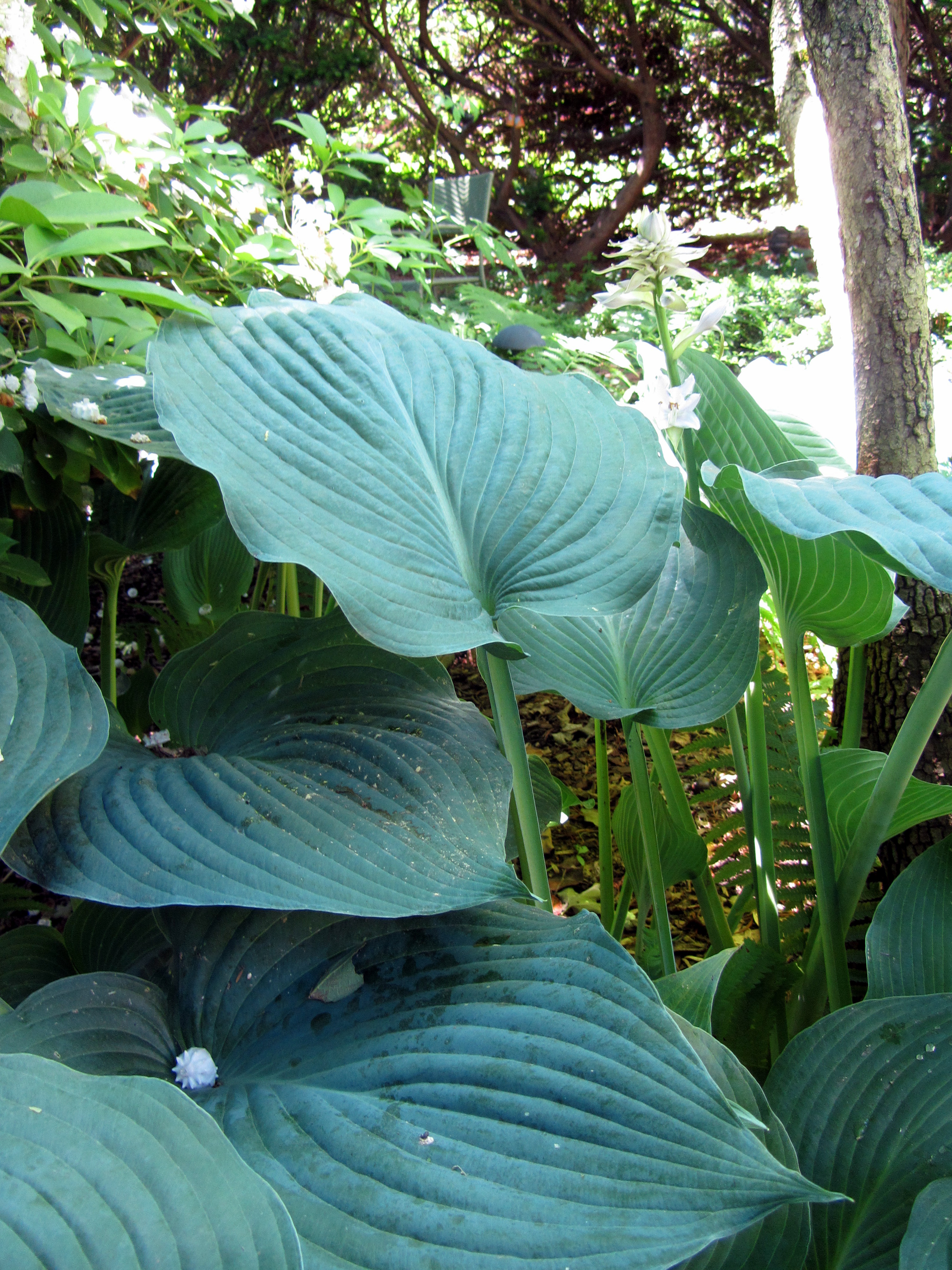
I’m looking forward to getting into my wild garden this weekend for some frenzied weeding and general taming, but I have to admit that I’m a little afraid of the hostas in the shade garden.  These are plants that I inherited so I’ve never been particularly predisposed towards them, but they are so thoroughly rooted that I’ve never considered taking them out.  I don’t even know their varieties, I’m embarrassed to say:  I pay them no mind whatsoever except for a few hours in July or August when I snip off their less-than-impressive flowers.  I have the generic shiny dark green plants (none of those variegated ones that you see everywhere, thank goodness), and then the less common greenish blue variety, which are always large but GIGANTIC this particular year:  these are the ones that are intimidating me at present.

I will admit that the advantages of this particular hosta are its relative resistance to slugs, who seem to prefer the shinier varieties, and its flowers, which are a bit more delicate:  an odd juxtaposition as the leaves are tough. Perhaps the slugs are fearful as I am!  I’ve included a shot of the garden looking west towards Hamilton Hall, so you can see how wild it is at present:  I’ve got my work cut out for me.


Slippers and Slipware

It’s perhaps a bit early–though not too early considering our warm spring– but the lady’s slippers have arrived in my garden.  Late last week I took a walk through the woods and encountered the pink variety (sorry, no camera!) and this weekend out popped my yellow variety ( Cypripedium parviflorum or Cypripedium calceolus, there seems to be an ongoing debate about classification):  they always take my breath away the first time I turn the corner and see them.

I must say I do prefer the yellow variety; the pink ones look a little fleshy close up, with the flower resembling a lung more than a slipper!  Thanks to the journal function of writing a blog, I checked in on my lady’s slippers last year to find that I had seven slippers, while this year I have eleven, including one stem that has two flowers on it!  Words fail to contain my excitement.  Here is a shot from early this morning, after last night’s thunderstorm (during which I had to restrain myself from going outside to put an umbrella over them):  they survived, but are looking a bit put upon.

I was looking around to see how artists have been inspired by the Lady’s Slipper in the past and the present and found that ceramics seem to be the preferred medium for depicting this particular flower, which was once so common, and now relatively rare. My favorite discoveries were a beautiful piece of Staffordshire creamware from the late eighteenth century in the collection of the Victoria & Albert Museum, a Whately jug from the mid-nineteenth century, and a lovely little vase by Michael Stanley Pottery.


Ever Eglantine

I’ve got roses on the brain, but not just any rose, eglantine roses, a wild, shrubby variety (otherwise known as sweetbriar or Rosa rubiginosa or eglanteria) at once very common but surprisingly elusive now.  I’ve been thinking about these roses for several reasons.  It is late May, and my roses are about to bloom, and I’ve come to the realization that I just don’t like several of them:  hyper-hybridized varieties that let me down every summer. Too pumped up and showy.  I want to go back to basics, and the eglantine rose is a very old rose, pared down and rambling, with a lovely scent. Chaucer wrote about this rose, as did Shakespeare, and Elizabeth I adopted it as her favorite symbol.

A beautiful sweetbriar rose in the Cloisters Garden.

So I have personal reasons for thinking about the eglantine rose, but also scholarly ones.  Summer classes start this week, and after an administrative semester, I’m back to teaching (gratefully): a course on “Shakespeare’s England” and one on Renaissance art, science and technology.  Content from both will probably appear in future posts, and the eglantine rose definitely ties in to the first, because “Shakespeare’s England” was largely Elizabethan England, and Elizabeth loved eglantine roses. The last Tudor had her family emblem, the Tudor Rose, and she used it often, but she adopted the more natural eglantine, symbolizing royalty and chastity, as a personal device, particularly after she had forsaken marriage in favor of “marrying England”.  The “Phoenix Jewel”, from about 1574, show Elizabeth surrounded by intertwined Tudor and eglantine roses (as the Virgin Queen, she preferred white), though in the more public “Phoenix portrait”, from about the same period, she is holding the Tudor Rose. Almost two decades later, William Rogers’ print “Rosa Electa” shows her with the Tudor Rose on one side (left) and the eglantine on another:  at this last phase in her long reign, she was widely associated with eglantine roses, even sometimes referred to as the Eglantine.

The Tudor Rose in BL MS Royal 11 E xi, ff. 2v-3 (a canon for Henry VIII); The “Phoenix Jewel”, circa 1574, British Museum; The “Phoenix Portrait”, attributed to Nicholas Hilliard, c. 1575, National Portrait Gallery, London (on loan to the Tate Museum since 1965).

More visual evidence of the first Elizabeth’s association with eglantine roses is her court painter Nicholas Hilliard’s miniature, Young Man among Roses (1585-95), in which a young courtier (often identified as Robert Devereux, the 2nd Earl of Essex) pays tribute to her simply by standing among eglantine roses (with his hand on his heart).  And then there is George Peele’s exhortation to his fellow Englishmen and -women to wear eglantine, and wreaths of roses red and white put on in honor of that day, for her Accession Day, November 17.

Nicholas Hilliard, Young Man among Roses (1585-95), Victoria & Albert Museum, London.


After Elizabeth, the eglantine rose continues to be admired, though perhaps not with the symbolism it had before. It’s a simple, country rose, contrasted with more extravagant varieties:  natural, wild.  Like all roses, it acquires all sorts of romantic associations in the eighteenth and nineteenth centuries, only to be turned into a tobacco brand in the twentieth!

“Rosa Eglanteria Zabeth” (Queen Elizabeth’s Eglantine Rose), Pierre-Joseph Redoutélater 18th century;  The “Wild Rose”, W.L. Ormsby lithograph, NYPL; a lithograph by Jane Elizabeth Giraud from “The Flowers of Milton”, 1846, NYPL; Tobacco Card, Duke University Emergence of Advertising Digital Collection.

The prettiest paper eglantine roses seem to be on paper:  William Morris chose the rose and its vine for one of his earliest, and most popular designs, “Trellis” (1864), and there is a lovely, simple pattern reproduced by Carter & Company Historic Wallpapers based on paper found in a house in Georgia that dates from the 1840s.  I love this company’s slogan:  History repeating itself….

“Trellis” wallpaper by William Morris, Victoria & Albert Museum, London; “Marietta Eglantine” wallpaper by Carter & Company Historic Wallpapers, LLC.


Chartreuse

Green has long been my favorite color, but more recently I have come to realize that chartreuse is my favorite shade of green. A bit unusual, but true:  my spirit lifts when I see it or wear it (and I just counted 7 chartreuse cardigans in the closet, so apparently I wear it often).  How can you beat a color named for a liqueur, the “elixir of life” made by French Carthusian monks from the early eighteenth century?  Spring is the time for yellowy greens, and there’s quite a bit of chartreuse in the garden, even though the lady’s mantle has yet to bloom. Even the boring yews, hardly my favorite plants, have a chartreuse gloss at this time of year.

Chartreuse in my garden:  yews, creeping jenny (also known as Lysimachia nummularia or moneywort), heuchera, and an artfully-placed bottle.

I’ve been a bit more restrained about using chartreuse in the house; in fact, there is no chartreuse in the house (except for the bottle, when I bring it back inside).  But it might sneak in there; I have assembled an entire folder of chartreuse-colored housewares, as well as some tear sheets of interior chartreuse accents.  It’s a strong color, obviously you have to be careful with it, but at the same time it seems to be somewhat neutral:  is that possible?

Silver Chartreuse “bottle ticket”, early 19th century, Victoria & Albert Museum, London; Ranunculus Swirl Shade in chartreuse, Anthropologie; “Chartreuse” by Mary Heilman, 1988 and chartreuse chandelier by Dale Chihuly,1993, both photographed by Larry Qualls; Milanese melanine plates from House Beautiful ; a chartreuse wall and door from Canadian House and Home.

The use of color in fashion requires its own post, one I’m not quite up to, I think.  Given its proximity to gold it must be a color of power, and one that is worn when you want to be in the spotlight:  think of Nicole Kidman’s Oscar dress from more than a decade ago and the First Lady’s outfit from the last inauguration.  Because it’s the absolute perfect shade of chartreuse (in my opinion), I did want to include this Charles James bodice of an evening gown, from 1951.

Charles James chartreuse velvet bodice, 1951 (Brooklyn Museum Costume Collection at the Metropolitan Museum of Art).