Tag Archives: Frank Cousins

Time Wears Some Down

I tend to spend much of September in Salem’s cemeteries, running around the perimeters of Harmony Grove and Greenlawn in North Salem and walking slowly through the older cemeteries downtown reading the gravestones. The former will retain much of their serenity in October while the latter will be transformed into circuses, clogged with tourists and walking tours and trash. Salem’s oldest cemetery, the Old Burying Point on Charter Street, is particularly vulnerable given its age and proximity to the Janus-faced nexus of Salem Halloween tourism, the Witch Trials Memorial and the Salem Witch Village (or neighborhood or world or whatever it is called–a conglomeration of horrors) on Liberty Street. The city has contracted with a landscape designer who specializes in historic cemeteries to improve security, perimeter fencing, entrance accessibility, and circulation, and while I welcome these improvements, I doubt that they will address what I see as the central problem facing this sacred space: the lack of respect shown by too many of its visitors. Even on the relatively calm mid-week September day on which I took these pictures, I saw a group of people sitting on a cenotaph merrily eating, drinking, texting and smoking, and such scenarios will be the norm a month from now.

past-sign

Yet even if we closed the gates of the Old Burying Point to all but the descendants of those within (which would be my preference: I will stay out too!) time would still takes its toll. This point was really driven home for me when I compared the pictures that I took the other day to an assortment taken by photographer/author/preservationist/entrepreneur Frank Cousins between 1890 and 1910, preserved in a sample book for his art company in the collection of Historic New England. I can’t do a precise “past and present” comparison for every marker as I was pressed for time and couldn’t find several of the gravestones that Cousins captured (they might be there, but they’ve lost their inscription) and variant stones seemed to have captured his interest and mine. Yet it is readily apparent that even those gravestones that have stood the test of time are now surrounded by a very different world than the Salem of a century ago.

past-lindalls-2016

past-lindalls-cousins-hne

past-timothy-lindall

past-timothy-lindall-cousins-hne

past-lindall-children-2016-charter-street

The various graves of the Lindall family look pretty good in 2016 (on top, in color–such as it is) compared to Cousins’ photographs from c. 1900; I don’t think we can get wooden buildings back, but I far prefer the wooden fence to the present chain link one.

past-jm-crowninshield-2016

past-jmcrowninshield-cousins-hne

John and Mary Crowninshield’s gravestones do look a little worse for wear in 2016 but are still standing. I could not find all of the Crowninshield graves captured by Cousins, but below are those of Captains John and Clifford Crowninshield today and a century or so ago. All of the Crowninshields lie in the shadow of the Witch Village or whatever it is called.

crowninshield-collage

clifford-crowninshield-collage

Besides those of the Lindalls and the Crowninshields, Cousins captured the gravestones of the famous (Samuel McIntire, Nathanael Mather, Mary Corey) and the not-so-famous Shattucks, Marstons, Cromwells, and Hollingsworths. He was clearly drawn to the graves of the very young and the very old, as we all are, and those stones which were the better for wear and still bore detailed artistic flourishes. I was after much of the same, but somehow we only “shared” the Lindalls and the Crowninshields; I think I’ll go back and uncover some more comparisons when I have a bit more time.

charter-street-cousins-gathman-hne

charter-street-mansfield-cousins-hne

charter-street-shattock-cousins-hne

past-cousins-higgonson-hne

Some of my favorite of Cousins Charter Street photographs: the sad triple grave of the Gat(h)man children and the elusive one of Retire Shattuck–I easily found Mary Higginson but missed John. The rehabilitated gravestone of Elizabeth Millett illustrates the work that is yet to be done on many stones in the Old Burying Point, while Elizabeth Wellcome’s slightly-chipped and -leaning one has always been a particular favorite of mine for some reason.

charter-street-higginson-2016

charter-street-elizabeth-millett-gravestone

charter-street-wellcome


A Hidden House with quite a History

Hidden behind a four-story brick apartment block built in the early twentieth century on lower Essex Street is a much older, much-altered house which has the appearance of a Georgian cottage. It’s not quite that, but close. The Christopher Babbidge House has been through quite a……..metamorphosis; I’m not sure if I have it completely straight or correct but here goes. According to Frank Cousins’ Colonial Architecture in Salem, the house is first period, built by tailor Babbidge as early as the 1660s on Derby Street. It descended in the Babbidge family until the mid-eighteenth century, at which time is was acquired by Richard Derby, patriarch of the famous Salem merchant family. Cousins is the only source of the original Derby Street location and seventeenth-century origins, but all the other sources (Sidney Perley, Historic Salem Inc., plaque research, and MACRIS seem to agree that it acquired its Georgian appearance and was considerably enlarged (and presumably moved to Essex Street if you follow Cousins) at this time or shortly thereafter, as Mr. Derby transferred it to his daughter Mary and her new husband George Crowninshield as a wedding gift. So by the 1760s we have a large (five-bay) Georgian house with a gambrel roof located directly on Essex Street. This was the house in which several of the famous Crowninshield sons (George Jr., Jacob, and Benjamin) were born.The wealthy Crowninshields had many Salem houses, so this one was eventually sold to a succession of owners, and in 1859 it was cut in half by current owner Phineas Weston, who wanted to build a new (Italianate) structure on the eastern end of the lot. The eastern half of the house was removed to Kosciusko Street while the western half remained on Essex, presumably shored up. The house seems to have flourished under the ownership of the Bowker family in the later nineteenth century, when Cousins took some lovely pictures, but in 1914 it was moved (again, according to Cousins) to the rear of its lot to make way for the brick buildings in front. So there we have it: a house that was moved, remodeled, expanded, cut in half, remodeled, and moved again. A true survivor on (or just slightly off) the streets of Salem!

Babbidge House Essex Street Cousins

Hidden House 2

Hidden House Babbidge

Babbidge House Stairways

Derby House Stairway HABS

The Babbidge-Crowninshield-Bowker House on Essex Street by Frank Cousins, 1890s, and today; drawing by Sidney Perley from the Essex Antiquarianits celebrated stairway by Cousins and Perley, and detail of the newel post at the Richard Derby House on Derby Street (HABS, Library of Congress, 1958)–so you can see the Derby connection.


What to do with my Stereoviews?

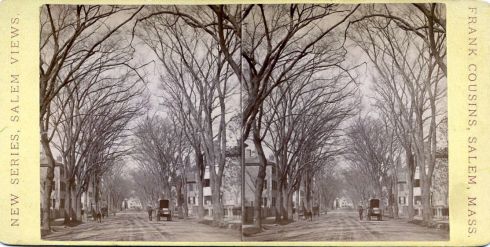
I’ve been a collector of sorts for much of my life but I never collected historic photographic images until I started this blog: I quickly realized their power to tell stories and provide context in this, our digital age. So I started buying some Salem images, mostly stereoviews, which were produced in vast quantities in the later nineteenth century. There were about six or seven major publishers of stereoviews here in Salem at that time, but I’ve focused almost all my collecting efforts on images associated with Frank Cousins, as either photographer or publisher. I just completed my collection of his sentimental “Salem in 1876” views, encompassing nearly every corner of central Salem. Now I’ve got a (shoe) box of stereoviews and I’m not quite sure what to do with them.

Stereoviews

Stereoviews 2

Steroview Chestnut Street Cousins

Frank Cousins published views taken both up and down Chestnut Street and all over the city, documenting “Salem in 1876”.

Stereoviews are relatively easy to acquire, especially of a city like Salem which has been selling its image, in one way or another, for quite some time. They turn up online very frequently and I always find them at the larger flea markets and paper shows. My collection is pretty focused on Cousins, but it also has a few views that I have never seen anywhere else, including a great (though completely unattributed and undated) view of Front Street from Washington Street and a rather unusual (forested!) view of the South Church that stood across Chestnut Street from my house for nearly a century. This McIntire masterpiece burned down in 1803: I’m trying to gather as many images of it so I can glean its impact from every possible perspective. My verdant view is contrasted with a more typical image of the church, from the best source for digitized stereoviews: the Robert N. Dennis Collection of Stereoscopic Views at the New York Public Library (where you can make “stereogranimators”).

Stereoview Front Street Salem

Stereoview Second Church Tilton

Stereo South Church Salem NYPL

(Stereo)view of Front Street, ?date, ?photographer); the South Church on Chestnut by Peabody & Tilton, c. 1875 and Guy & Brothers, c. 1884, Dennis Collection, New York Public Library.

Obviously I have a predilection for streetscapes but I like some (not all; some are creepy) of the more intimate, “up close and personal” stereoviews too. I’ve seen quite a few of people just standing outside their houses, being captured for posterity. A double dose of daily life. I love this image of a Salem Willows summer cottage with its residents, all ready for summer. This is not mine, unfortunately, but from another great source of stereoviews: the Center for Lowell History at the University of Massachusetts at Lowell Libraries.

Stereoview Juniper Point UMASS Lowell SP

“View at Juniper Point, Salem Neck, Mass.”, n.d., Center for Lowell History at the University of Massachusetts Lowell Libraries (the original Willows cottages were built for Lowell residents who wanted to summer on the coast).

So again, what to do with those stereoviews that I do possess? Ultimately I will leave them all to the Salem State University Library’s Archives and Special Collections, because what Salem needs is a Center for Salem History there, as the Peabody Essex Museum ceased its historical-society function long ago. But in the meantime, I’d like to find a more clever and creative way to preserve and display them. I’d like to get them out of the box! I guess I could frame them in some interesting combinations and create a gallery wall, but that’s about the extent of my creativity. Brass floating frames? Display them with a special “twinscope” at hand like this cool exhibit from just last year, Syracuse in 3-D (1860-1910)? I’m open to suggestions, because I do think there is something very engaging–both aesthetically and historically– about images in multiples. As evidence, I give you this beautiful invitation to the Pickering House’s annual garden party by Salem artist Racket Shreve, paired with Cousins’ stereoview, of course.

OLYMPUS DIGITAL CAMERA

Stereo Pickering

Stereoview Pickering House Cousins 1876

Scene from the interactive “Syracuse in 3-D” exhibit by Colleen Woolpert (+ more here); Racket Shreve’s quatre-Pickering House invitation; Frank Cousins’ “Salem in 1876” stereoview of the Pickering House.


Ever in Transition

The tensions between public and private interests, commercial and residential concerns, and historic preservation and economic growth are nothing new to Salem, which has always been a dynamic city proud of its past and poised for the future. Some eras are more dynamic than others, however, and I think we’re in a particularly dynamic period now, but any city or town or settlement is always in transition, of course. When I hunt for historic photographs I’m always on the lookout for the mix of “ancient” and “modern”, residential and industrial, small-scale and larger, dirt roads and railroad tracks. My very favorite visual chronicler of Salem, Frank Cousins, who was himself living through a very dynamic age, was clearly attracted to that mix as well, as one of the photographs that he submitted as part of Salem’s exhibition at the 1893 Columbian Exposition was that of a divided Derby Street doorway labelled “modern” and “colonial” (A subtle distinction for our modern eyes).

In Transition Cousins 1892 Columbian Exposition

Frank Cousins photograph of a Derby Street doorway, c. 1892, courtesy of Duke University’s digital Urban Landscape collection.

More illustrative of the city in transition, as opposed to a co-joined household, are the many pictures of Town House Square that date from the 1880s to about 1910. There you see predominantly brick multi-story commercial buildings, but if you look closer, there are still some surviving wooden residential structures (although they are probably serving a multitude of uses). For several years, I have had in my possession a stereoview of a building labeled “Ward-Goldthwaite & Co. Salem” which I thought might be one of these structures, only to realize that I had made a rookie historian’s mistake (not questioning a label): the Ward-Goldthwaite Company was located in Chicago, not Salem (even though it was published by the Moulton firm of Salem). Nevertheless, it’s a great image of a city in transition: you know that house isn’t going to last long.

In Transition Cousins Town House Square 1892 LOC

In Transition 1906 LOC

Stereoview Ward Golthwaite Co Salem

Town House Square at the intersection of Essex and Washington Streets, Salem, (Library of Congress) and a stereoview of the Ward Goldthwaite & Company in Chicago published by J.W. and J.S. Moulton of Salem as part of their “American Views” series.

The idea of zoning starts to catch on in Salem after 1900, and it was definitely accelerated by the Great Salem Fire of 1914. But before this momentous event, factories and residences co-existed in close proximity in the Point, Blubber Hollow and even the more residential North Salem, where the large Locke Regulator Company bordered the North River and a line of colonial houses on North Street. Some of the houses are still there, serving mixed uses as they did a century ago, while the Locke factory has been replaced by a junkyard and a car wash. The streets along Salem Harbor have always been among the most densely settled in Salem, but the 1903 photograph seems to show structures which are primarily residential–I’m not sure of the precise vantage point, but I’m assuming these buildings were all swept away by the Fire. The last photograph, from the PEM’s Phillips Library, shows fire bystanders watching the conflagration on Lafayette Street from the roof of a building on Highland Avenue: a view of mixed-used zoning with the new High School, the factory, and residences all in close proximity to one another. Highland Avenue became a preferred location for commercial development over the twentieth century, but as this photograph indicates, residences were built along it as well–and a few older structures, drastically transformed–still stand among the big box stores.

In Transition North Bridge 1890s

Salem 1903 Locomotive's Journal

phillipslibrarycollections.pem.org

Looking north along North Street from the old bridge, 1890s, Boston Public Library; A Perspective on Salem Harbor, 1903, Brotherhood of Locomotive Engineers Monthly Journal, September 1903; Watching the Great Salem Fire from Highland Avenue, 1914, Phillips Library, Peabody Essex Museum


One Photograph and Three (?) Mantels

Today I am featuring another lost Salem house that we can only “see” in the form of its surviving pieces and photographs–only one photograph, really, which I presume was taken just before it was demolished in 1856 to make way for the Salem Athenaeum’s new Plummer Hall (now part of the Peabody Essex Museum). This is the Nathan Read House (1793), designed by Samuel McIntire for a man who was not a Salem merchant and/or shipowner but distinguished himself nonetheless, as an entrepreneur and the inventor of such diverse machines as a steamboat with paddles, a nail-cutter, a self-winding clock, and a coffee-huller, as well as a congressman and judge. Read’s house was McIntire-made but Bulfinch-inspired and it is reminiscent of another Essex Street house that is no longer with us: the Ezekiel Hersey Derby House further along Essex Street–Salem’s commercial “high” street was too dynamic and valuable for residences, even ones as lovely as these. It’s a miracle that the Gardner-Pingree House survived. The Read House was short-lived but pretty imposing while it lasted.

Read House Salem MA

The Nathan Read House (1793-1856).

In 1799, Read sold the house to Captain Joseph Peabody, a very wealthy Salem shipowner, and eventually decamped for Maine. For the rest of its existence, the Read House remained in the Peabody family, who eventually sold it to the shareholders of the Salem Athenaeum. Joseph’s son Francis dismantled several McIntire mantels from the house before its demolition, and installed them at his summer house in nearby Danvers, the eighteenth-century “King” Hooper mansion, better known as “The Lindens”. There they remained until the 1930s, when the Lindens itself was dismantled, shipped to Washington, D.C. in pieces, and reassembled in the Kalorama neighborhood of the District. The intermediary (and short-term owner of the Lindens) in this transaction was up-and-coming antiques dealer Israel Sack, who arranged for the house to be measured and photographed by HABS architects and also sold some parlor paneling to the Nelson-Atkins Museum of Kansas City: the mantels appear in the HABS photographs (but looking quite different from previous photographs!) but not in the collections of the Nelson-Atkins museum, and they certainly don’t seem to be down in Washington (where the house is now for sale), so I’m not really sure where they are. The whole is demolished, but the parts are scattered: a not-uncommon Salem story!

McIntire Mantels Collage

McIntire Mantels HABS

Lindens Listingp

Lindens Living Room AD

Above: McIntire Mantels at the Peabody Essex Museum (upper right) and installed at the Lindens, Danvers, from Cousins’ and Riley’s Woodcarver of  Salem (1916) and Arthur Haskell photographs, 1934, Library of Congress. Below: the Lindens in its current Washington, DC location from its current listing, and its living room from January 2014 Architectural Digest. No McIntire mantel here!

See a related house story at the great blog Stories from Ipswich.


The Most Poignant Epitaph Ever

The Old Burying Point is a sacred site best visited in the winter, or the summer, or the spring, or anytime other than October when costume-clad tourists are not draped over the graves taking pictures of each other. I prefer winter, because the very gnarly trees are bare, and nothing other than these same trees competes with the graves themselves. I was walking by the other day, thinking about the very recent death of a young scholar whom I knew, when I remembered a famous epitaph on a seventeenth-century grave of another young scholar: Nathanael Mather, son of Increase, and brother of Cotton. Nathanael died in Salem in 1688 at aged 19 and his grave is located on the western perimeter of the cemetery, just behind the Peabody/”Grimshawe” house. I went through the gate, turned right, and there he was, there it was, the most poignant epitaph ever.

Epitaph 026

Epitaph 030

An Aged person/ that had seen but Nineteen Winters in the World.

An Aged person that had seen but Nineteen Winters in the World is a sentiment that is immediately and universally affective, and timeless: as moving now as it was when it was inscribed in 1688 (or later? see below). There are testimonies to these words that date back to the early nineteenth century; no doubt there are far more that I am aware of. Hawthorne incorporated a similar epitaph into his first novel Fanshawe for the title character (one imagines him sneaking out back before or after he visited his future wife Sophia at the Grimshawe house) and Lovecraft referenced it a century later. In between, my favorite photographer Frank Cousins gave it pride of place in a portfolio of Salem images which he marketed nationally.

Epitaph Cousins 1890s 2p

Epitaph Cousins 1890sp

The Grave in the 1890s

And what of Nathanael, the inspiration for this memorable epitaph? By all accounts he was a young man feverish with the desire to learn, both for his own sake and as way to know and glorify God, and this “fever” ultimately killed him. His “unusual industry” drove him to enter Harvard University at age 12, and during his time there he mastered Latin, Greek, and Hebrew and wrote several books. His “pious education” continued after his graduation, and he followed a disciplined regime of constant study and prayer which rendered him a virtual shut-in. Real fevers set in, and “distemper”, and ultimately he was sent to Salem as a patient of Dr. John Swinnerton, at whose home he eventually died. His elder brother Cotton Mather, who apparently “closed his dying eyes” wrote later that it may be truly written on his Grave, Study kill’d him. In his Diary, Samuel Sewall recounts visiting Nathaneal at Dr. Swinnerton’s and, quite perplexingly, an alternative epitaph: the Ashes of a hard Student, a good Scholar, and a great Christian, which is also asserted in Cotton Mather’s Magnalia Christi Americana. So now we have an epitaph mystery: are both Sewall and Mather mistaken, or do we have an instance of an “enlightened” epitaph substitution at some later date?

Epitaph 038


The Town Dyer’s House

My interest in Salem’s historic architecture has been narrowed down over the past few years that I’ve been writing this blog: while I still appreciate most of our city’s older (let’s be generous and say pre-World War II) structures, I’ve become increasingly fascinated with its oldest buildings in general and those that were demolished in particular. I’ve developed a somewhat peculiar fascination with “lost” houses, a demolition expert of sorts!  I’m constantly wondering why some houses are deemed too important to be swept away and others were leveled with little comment. My focus in this post is a house that was almost as famous a “Witch House” as the actual “Witch House” that still stands at the turn of the last century, yet it was demolished with little or no opposition that I could detect. The Samuel Shattuck House, built by 1680 just a few steps away from the Jonathan Corwin/”Witch House” on Essex Street, actually had a more direct tie to the Trials that the latter: the accusations and testimony of its occupants, a dyer named Samuel Shattuck and his wife Sarah, led directly to the conviction and execution of the first victim of 1692: Bridget Bishop. This poor widow, not quite as notorious as depicted by a succession of historians who confused her with the tavern-keeping Sarah Bishop, nonetheless had several encounters with the Shattucks, bringing them oddly-sized scraps of lace for dyeing–perhaps for a poppet? The affliction of their son convinced them that she was up to some mischief, and so they testified with considerable detail and vehemence, even though these encounters had occurred twelve years previously. Bridget Bishop was executed on June 10, 1692, despite her consistent affirmations of innocence.

Jump forward two hundred years later, when the Bicentennial of the Trials was stirring up a cauldron of commemorative and commercial products: witch spoons, postcards and plates. Contemporary Salem guidebooks typically featured several Trial-related sites at this time:  the Witch House, supposedly the site of interrogations, Gallows Hill, the site of the executions, and the Shattuck House, a “scene of the crime” as well as the source of allegations. My major window into the world of lost Salem houses, photographer Frank Cousins, marketed his print of the “olde” Shattuck House with the label it was through evidence of the Shattucks that Bridget Bishop was convicted as a witch.

Cousins Shattuck House DUKE

Shattuck House and Gallows Hill

Shattuck House Salem BPL

Frank Cousins photograph of the Shattuck House, 315-317 Essex Street, in the 1890s and the same photograph in The Visitors’ Guide to Salem, Essex Institute, 1895; another late nineteenth-century view, Boston Public Library.

It was so notable in 1895, and 1897, and 1900, but by the end of 1902 it was gone, demolished to expose to view only the two huge chimneys….showing the clam shell clay in which the brick was laid before the days of stone and mortar according to the brief notice in the Boston Evening Transcript on October 30, 1902. No notice at all that I could find in the Salem papers! And so despite its Witch Trial connections, the Shattuck House passed quietly in the night (like the Hunt House, the Parkman House, and the Ruck House before it), only to be replaced by an indistinct Colonial Revival structure that served in a variety of capacities (Gainsborough’s Photography Studio when I came to town) before it succumbed to condo-izaton.

Shattuck House Salem

Boston Evening Transcript clip, October 30, 1902; sketches of the Shattuck House from Nooks and corners of the New England Coast by Samuel Adams Drake (1905) and The Romance of Old York by Herbert Milton Sylvester (1909).


Scholarship and Shopping

Few moments are more exciting for me than when my intellectual and material endeavors merge, and believe me, they are fleeting! One happened this past Saturday. I had been struggling with two pieces that I am writing for publication on Frank Cousins, Salem’s turn-of-the last century architectural photographer, and a passionate advocate for all thing Colonial. I know a lot about Cousins, and I have a lot to say about him (because no one else has said anything), but I am not a trained 1) American Historian; 2) Architectural Historian; or 3) Art Historian, so that is why I was struggling: could I place him in his proper context? It’s one thing to refer to his “imaginary walks through Salem” and lectures on “Old Architectural Salem” and quite another to assess his contributions to American architectural history and the Preservation movement. I had finished one piece and was thoroughly blocked on the other, when I decided to go over to the first ever (and hopefully not last) “Vintage Market” on Derby Square. I just love the idea of an antiques market in Salem, which has such a long tradition in this trade, and even though I appreciate our farmers’ market, I would rather buy things than vegetables in Derby Square! So off I went, and there was some great stuff: baskets, bottles, buttons, snowshoes, pottery, tins, bottles, and prints, lots and lots of prints, including an old box full of Frank Cousins prints. These were not the original albumen images, mind you, but large reprints made for resale at a mid-century Salem gift shop according to the man who sold them to me, who happens to run his own Salem tours. I bought quite a few, took them home, spread them out on the floor of my study, and waited for inspiration to strike. It took a while (more than a moment to tell the truth), but eventually I finished my article. I think there are two lessons here: 1) if you’re writing about someone who expresses himself visually, you must consider these expressions and 2) shopping always helps.

Close-up: offerings at the First Annual (?) Vintage Market on Derby Square in Salem, and my catch of Cousins photographs.

Shopping in September 031

Shopping in September 016

Shopping in September 032

Shopping in September 015

Shopping in September 026

Shopping in September 027

Collectibles Collages Salem Vintage Market

Shopping in September 042

Shopping in September 047


The Razing of the Ruck House

Years ago central Salem was oriented both towards its harbor as well as around an adjacent pond formed by the South River: Mill Pond, which was filled in to accommodate the growing city in the later nineteenth century. The beautiful map of Salem in 1851 by Henry MacIntyre shows the centrality of Mill Pond, and a neighborhood between Margin Street, the Broad Street Cemetery, and the Pond which is dotted with homes–some large and some small. In the midst of this neighborhood was Mill Street, where a very old and storied house was situated: the Thomas Ruck House, built around 1650 and razed, by my best estimation, around 1902. The Ruck House was not a victim of the larger forces that decimated this neighborhood—the Great Salem Fire of 1914 which singed its western boundary, and the construction of the U.S. Post Office which leveled its eastern part in the 1930s. It was (apparently) gone before both of these events. Given its notability–Salem guidebooks were directing visitors to it because of its importance just before it was destroyed (and in some cases, after)– why was it razed?

railway-map-015

Salem 1871 Atlas

Thomas Ruck House Mill Street Cousins

Ruck House Essex Antiquarian Perley 1900

Ruck House Salem Map

Detail of Henry MacIntyre map of Salem, 1851, Salem Athenaeum; Salem Atlas, 1871 by Walling & Gray; Frank Cousins photograph of the Ruck House from his Colonial Architecture of Salem, 1919; Illustration of the House in Sidney Perley’s Essex Antiquarian, Volume IV (1900);  map of central Salem with the Ruck House marked, from Edwin M. Bacon’s Boston: a Guide Book (1903).

At this point, I really can’t answer that question, as discreet factors (condition, the will of the property owner) are more difficult to discern than global forces. However, I can offer some historical facts and opinions about the importance of the Ruck House. Edwin Bacon informs his readers that “South of the railroad station is a nest of old buildings in old streets, among them the Ruck house, 8 Mill Street, dating from before 1651, interesting as the sometime hope of Richard Cranch, where John Adams frequently visited (Adams and Cranch married sisters), and at a later time occupied by John Singleton Copley, the Boston painter, when here painting the portraits of Salem worthies”. Adams and Copley, quite a pedigree right there, and the house was also owned by Samuel McIntire’s father. Adams writes about the house in a journal entry from 1766: “Cranch is now in a good situation for business, near the Court House….his house, fronting on the wharves, the harbor, and the shipping, has a fine prospect before it.” Obviously that prospect changed dramatically with the filling in of Mill Pond, but the house retained its stature. The influential Salem architectural historian, photographer, and entrepreneur Frank Cousins asserts that: “In its U-shaped arrangement with wings of unequal length and virtually three gambrel-roof dwellings in one the Ruck House, number 8 Mill Street, has few if any parallels in American architecture”. Now here is where I am confused: Cousins is writing (in 1919) as if the house was still standing, but an article in the Boston Evening Transcript dated October 30, 1902 clearly states that it had been demolished, along with another notable Salem landmark, the Shattuck House on Essex Street. In addition to the great reference about baked beans, this article is just what I’m looking for–early expressions of a preservationist consciousness in Salem–but obviously I still need more information about the razing of the Ruck House.

Ruck House Razed 1902 Boston Evening Transcript

Post Office Construction c. 1933

Boston Evening Transcript, October 20, 1902. What came after: the construction of the Salem Post Office, c. 1933, Dionne Collection at Salem State University Archives and Special Collections.


Greek Revival Salem

I think I’ve covered just about every architectural style represented in Salem over the past few years: lots of variant Colonial houses, the very dominant Federal style, and many of the nineteenth-century styles, including Gothic Revival, Italianate, Queen Anne and Second Empire. But I haven’t featured many houses built in the so-called “National Style”:  Greek Revival, which dominated public and domestic architecture across the United States in the mid-nineteenth century. The very first house I lived in in Salem was assertively Greek Revival (built in the 1840s, the peak of the style) and my present house (built in 1827) should probably be classified as such too but it’s such a miss-mash it doesn’t really feel classical.  That’s a bit early for the Greek Revival in Salem, which held onto its Colonial and Federal styles longer, I think. For that reason, as well as the Great Salem Fire of 1914, it always seems like Salem has fewer Greek Revival structures than it should have: many of the public buildings, including the “new” City Hall, are Greek Revival, but you don’t find too many domestic structures as they would have been built in the “newer” neighborhoods along Lafayette Street, the center of the conflagration. Some of the most poignant “postcards from the Fire” show Greek Revival houses being devoured. Yet there are Greek Revival houses on nearly every street in the older sections of Salem too, signs of success in the mid-19th century city, no long a center of a global commerce, but still bustling. Two such houses, located on Winter Street, are now for sale, which prompted my long-overdue Greek Revival post.

walker-evans-city-hall

Greek Revivals 055

Walker Evans’ photograph of Salem City Hall, taken in the early 1930s when he visited Salem and shot only Greek and Gothic Revival structures–no Federal! (Collection of the Metropolitan Museum of Art, more here) These were clearly his architectural preferences, and he captured similar structures wherever he went. Quite contrarily, Salem’s own Frank Cousins was quite condescending about the Greek Revival, probably because such structures replaced his beloved Colonial houses in downtown Salem. The now-mothballed Greek Revival courthouse on Federal Street.

Greek Revivals 039

Bertram House Salem

Greek Revivals 042

Greek Revivals 023

Winter Street Greek Revivals presently for sale:  The Captain John Bertram House at number 24, built in 1842-43 by Salem’s greatest philanthropist. The black & white MACRIS photo is from 1998 (An absolutely stunning house: check it out), and the Payson-Fettyplace House at number 16, built in 1845, which has been operating as an inn for some time. Below: more Salem Greek Revivals, by no means an exhaustive collection! A Greek Revival “cottage” on Northey Street, a recently-revived Greek Revival on Bridge, a row of Greek Revivals on Federal, a Greek Revival with many additions on Essex, and the stately Lee-Benson Mansion on Chestnut, all built in the 1840s.

Greek Revivals 046

Greek Revivals 026

Greek Revivals 058

Greek Revivals 063

Greek Revivals 071

Greek Revivals 074