Tag Archives: films

Oz Everlasting

Even before the big new Oz prequel movie debuted this weekend, I was already thinking about the Wonderful Wizard of Oz, as yet another candidate for the Salem Athenaeum’s Adopt-a-Book program this year is the fourth title in L. Frank Baum’s series, Dorothy and the Wizard of Oz (1908). Like the new film (which doesn’t seem to be garnering the best reviews), this book features a wizard who plays a much larger role than in the first book and classic 1939 film. In fact, the Wonderful Wizard is really the star of the story, defending Dorothy and her companions (including a cat named Eureka rather than a dog named Toto) from fierce vegetables, invisible people and bears,  gargoyles and “dragonettes”:  all in an underground world which swallowed them up following an earthquake. The Wizard is so exhausted after his labors that he decides to remain in the Emerald City permanently at the book’s end, and so he becomes the Wonderful Wizard of Oz forever.

Oz

Oz 2

In his Preface, Baum as much admits that he was reluctant to keep writing about Oz:  It’s no use; no use at all. The children won’t let me stop telling tales of the Land of Oz.  I know lots of other stories, and I hope to tell them, some time or another; but just now my loving tyrants won’t allow me.  They cry “Oz–Oz!  More about Oz, Mr. Baum!” and what can I do but obey their commands?  He also admits that his “tyrant” readers wanted to know more about the “humbug” Wizard who blew off in a balloon, and so he brought him to earth–or below the earth–again.  Not only does the storyline of Dorothy and the Wizard of Oz focus on the latter’s heroics, the majority of illustrations in the book–both black-and-white sketches and watercolor paintings by John R. Neill, feature the Wizard, who does indeed enter the story in a balloon. Towards the end of the book, when everyone returns to the Emerald City, the Wizard reveals his and its origins, and this backstory seems to provide some of the plot for the current movie:  a humble circus performer from Nebraska whose appellation was Oscar Zoroaster (and many other names) Diggs, he emblazoned the initials “O.Z.” on all of his possessions, including his balloon, and was blown away to a strange land of rival witches whose inhabitants took him for a wizard. And so he became one.

Wizard in Balloon 1901

Wizard fightin Gargoyles

Wizard fighting Gargoyles 2

Oz Portrait of the Wizard

baum-poster 1901

A decade of the Wizard:  up and away in a W.W. Denslow illustration from the first book, 1901; fighting gargoyles in two watercolor illustrations from Dorothy and the Wizard of Oz and a “portrait” (“From the Wizard’s latest photograph taken by the Royal Photographer of Oz”) by John R. Neill, 1908; the real Wizard of Oz, L. Frank Baum, featured with his best-selling titles on a contemporary  poster issued by his publishers, Library of Congress.


Salem Film Fest 2013

Despite some very nasty weather, the sixth annual Salem Film Fest opened yesterday, bringing 32 documentary films to town for screenings at the Peabody Essex Museum, Cinema Salem, and the Visitors  Center of the National Park Service. This festival gets bigger and better every year; I can tell because (it’s all about me) I always make a list of films I want to see and each year the list gets longer and more of my choices sell out. This year, I had The Ghost Army on the top of my list, and it sold out immediately. They’ve added another show next week, but I’m sure it’s selling out as I write. This film, by award-winning documentarian Rick Beyer, tells the incredible story of the 23rd Headquarters Special Troops, a World War II Army unit whose job was to deceive the Germans by staging fake battlefield maneuvers, often very close to the front lines. They staged more than 200 “performances” between D-Day and V-E day, using inflatable tanks and a variety of sound effects. Can you imagine a better subject for a documentary?  While its premiere was right here in Salem last night, it will be broadcast later this Spring on PBS, so look for it.

Inflatable Tank

Bill Blass Jeep

Pictures from the Ghost Army website: an inflatable tank an a smiling Bill Blass, a member of the unit. Yes, THAT Bill Blass, the future fashion designer.

Next on my list is another World War II-related film, Andrew Shea’s Portrait of Wally, about a Nazi-plundered painting, Egon Schiele’s Portrait of Wally (1912), its acquisition by Austria’s Leopold Museum and subsequent discovery in a 1997 exhibition at the Museum of Modern Art, and the long legal struggle which followed.

pow_title2

The Missing Piece: The Truth about the Man who Stole the Mona Lisa considers the motivation behind Vincenzo Peruggia’s daring theft of Leonardo’s masterpiece in 1911. Apparently Peruggia’s 84-year-old daughter believes it was a patriotic action on the part of her father, a former worker at the Louvre who committed the “art theft of the century” (actually, I think the 1990 robbery at the Isabella Stewart Gardner Museum takes that prize) in order to return the painting to its “homeland”. This might explain the fact that Peruggia was sentenced to a mere 15 days for his crime by an Italian court in 1914 and never served a day; no doubt a French court would have come up with a stiffer sentence.

Missing Piece

After these three, I am a little torn:  Big Easy Express, about a musical train journey from California to New Orleans, looks great, as does Radio Unnameable, about a pioneering 1960s disc jockey. Town of Runners, about a small Ethiopian town that produces more Olympic gold medalists per capita (by far) than any other place in the world, looks interesting, as does The World before Her, which takes us to a beauty boot camp for 20 aspiring Miss Indias (you can see why the festival’s tagline is “come to Salem, see the world”).  There is no question that my own award for Best Title goes to Furever, a film about the remembrance of pets past.

Furever


Hollywood History

This has been quite the year for historical movies: the majority of best-picture nominees are set in the past, even if it’s the relatively recent past of Argo and the very recent past of Zero Dark Thirty. In addition, there has been lots of discussion about the historical accuracy of these films which, while occasionally interesting (particularly the Connecticut v. Lincoln controversy, initiated when Connecticut congressman Tom Coutenay criticizing the film for its portrayal of two fictional Connecticut congressmen voting against the 13th amendment when in fact all four congressmen from the state voted for the amendment outlawing slavery) is hardly news. All historians know that “historical” films are never accurate, but I, for one, still have my favorite films set in the past. I like these films for various reasons– the feelings they provoke, the certain aura or spirit that they might capture, the way they look, the performances, the soundtracks– but I rarely learn anything from them. There are some films that I like to show in class just because they provide a lesson in just how inaccurate “historical” films can be!

lincoln_med

So, in honor of Oscar night, here are my top ten period films, in chronological order of setting. I’ve left out the major epic movies, most of which I do not like either as movies or history, in favor of “smaller” films that are personal favorites.  And remember, I teach medieval and early modern history, so most of my films come from these eras:  sorry, no World War II films, guys (I actually like war films, but I’m more of the Mrs. Miniver and Best Years of Our Lives type, with the exception of submarine movies, which for some reason I adore. If I could add an eleventh film, it would be Das Boot).

Medieval Movies:

The Thirteenth Warrior (1998):  this film was a financial and critical failure, but I like it, or parts of it. Based on Michael Chrichton’s novel Eaters of the Dead, the plot is a curious combination of Beowulf, pre-Christian Scandinavian culture, and a real early medieval source:  the Risala of Ibn Fadlan, the chronicle of a 10th century Arab diplomat who journeyed to eastern Europe and Russia and encountered the Vikings along the way.

Valhalla Rising (2009): an extremely atmospheric film in which a one-eyed Norse warrior (Odin?) and his child companion go on a mysterious journey, and end up in the New World. They come out of the fog into a dramatic encounter with Native Americans (apparently played by Tibetans) at the very end of the film. This is not an easy film, but its marriage of mysticism and blind faith are pretty compelling.

The Seventh Seal (1957): Ingmar Bergman’s classic film about a returning Swedish (again–I didn’t realize I was so obsessed with Scandinavia before writing this post!) Crusader’s encounter with the Black Death and Death Personified, with whom he plays chess intermittently throughout the films until Death wins. The scene in which the knight and his companions wait for death/Death at dinner in his castle is haunting, as is their “Dance of Death” at the very end of the film. This is one of the few films which I try to show in its entirety in class, rather than just clips, and the students usually get (into) it.

seventh-seal-chess

A Knight’s Tale (2001):  and on a much lighter note………….you might be surprised to find this film on my list but I love this film’s spirit as well as its use of very deliberate anachronisms. I like to think of Chaucer’s world this way. You can’t recreate the fourteenth century on film anyway, so you might as well have fun!

Henry V (1989): this is my favorite Shakespeare film as well as my favorite Kenneth Branagh Shakespeare film. The St. Crispin’s Day speech is of course extremely inspiring, as is the score by Patrick Doyle, most especially the choral epilogue at the end of the Battle of Agincourt:  “Non Nobis, Domine”. Most students have a rather romantic view of medieval warfare, which the long and bloody battle scene helps to dispel.

The Passion of Joan of Arc (1928): it is difficult to over-emphasize the power of Carl Theodor Dreyer’s film, which narrates the examination, trial and execution of Joan of Arc in 1431 through extreme close-ups of the participants, warts and all. The master negative of the film was destroyed in a lab fire only a year after its release, and so the complete film was lost for decades, until a copy was miraculously found in the closet of a Norwegian mental hospital in the early 1980s. The DVD release in the 1990s includes an oratorio by Richard Einhorn called “Voices of Light” which actually makes the silent film even more compelling, but the real star of the production is actress Renée Jeanne Falconetti, who appears to be in a near-ecstatic state for most of the film, as if possessed by Joan.

A Queen and Two Kings:

Elizabeth (1998): this film is a historical hot mess which plays with chronology and the facts with abandon—and the sets are terrible. Nevertheless I do like Cate Blanchett’s characterization of the young Elizabeth, and the movie is useful to me as I can teach against it.  I really like the poster too: I have framed versions in both my university and home offices.

elizabeth 1998

A Man for all Seasons (1966):  now here is an example of much more subtle anachronism, with Thomas More not only deified for his faith, but also for his individualism. There were so many English “historical” movies made in the 1960s (The Lion in Winter, Becket, Anne of the Thousand Days, Mary Queen of Scots, Lawrence of Arabia, etc…) that I felt that I should include one, and More’s struggle between conscience and obligation to Henry VIII is universally appealing. Paul Scofield as More and Richard Shaw as Henry VIII are both great; in fact, Shaw is probably my favorite screen Henry VIII. If I show clips in class, however, I feel that I have to balance the film’s portrayal of More’s resolute passage to martyrdom with his zealous persecution of Protestants.
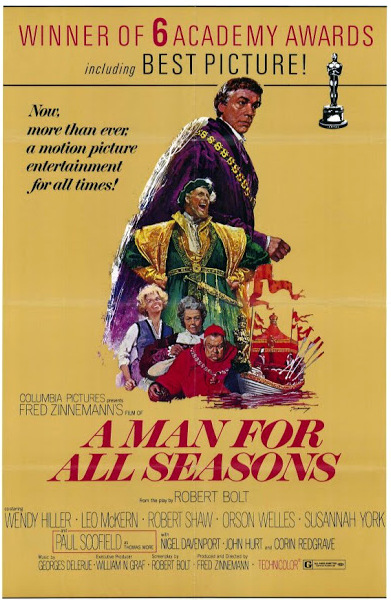
Man for all Seasons movie poster

The Madness of King George (1994): a very entertaining presentation of King George III’s descent (and recovery) into a porphyria-induced insanity in the late eighteenth century, and the ensuing Regency Crisis. The actual events seem to be accurately, albeit dramatically, portrayed, but this is not really my period so I can’t critique accuracy; I’m just entertained. Nigel Hawthorne as King George is amazing in this film; he was robbed by Forrest Gump of the Oscar that year.

One War Film:

All Quiet on the Western Front (1930): an extremely powerful view of another descent, of innocent, whipped-up German boys into the hell of World War One. This film was on TCM several weeks ago and I sat watching it, riveted, even while it was extremely difficult to do so. I think this movie benefits from its age; you can tell that it was made by the same generation that experienced the first World War. And of course all the battle scenes would be computer-generated if the film were made today, which would transition it into video-game territory and rob it of its humanistic power.

All Quiet on the Western Front (1930)

So there you have it:  my top ten list of historical films–for now.  This was tough; I think I would come up with a different list next week, or maybe even tomorrow.  All comments and suggestions are more than welcome (even for war films): the list is always subject to substitutions.


Christmas with Barbara

I love classic films, so naturally my favorite television channel is Turner Classic Movies:  I often have it on in the background when I’m home, as you never know what–or who–might turn up!  This month, I have to admit that it’s been on even more than usual, as December’s “Star of the Month” is Barbara Stanwyck, my very favorite movie star.  No one comes close to Barbara in her ability to fill the screen and capture her audience’s attention, in my opinion; certainly no actor or actress in the present (a time when movie stars seem much smaller), and perhaps only Cary Grant and Bette Davis in the past. I love everything about Barbara:  her toughness and her vulnerability, her flexibility, her stature, her walk, her ability to sit a horse, her little cropped jackets, her obvious professionalism. There is a sense of inner “simmering” in her that I find captivating, and I think she chose her roles very well. I find even her early 1930s movies–in which she seems to be playing the same downtrodden character again and again–watchable, but she really comes into her own in the 1940s, when she became the highest paid woman in America.

Barbara 1940s

Miss Stanwyck at the height of her power and popularity, Billy Rose Theater Collection, New York Public Library Digital Collection.

Two of my favorite Stanwyck films happen to be Christmas movies: Remember the Night (1940) and Christmas in Connecticut (1945). For as long as I can remember, I have generally watched both at least once during the holiday season, but this particular month I seem to be watching them again and again, so many times that I almost feel like I’m having Christmas with Barbara!

Remember-the-Night-321473cd

Christmas-in-Connecticut-d4c67732

I think most people have heard of or seen Christmas in Connecticut, and it is certainly a wonderful film with a charming Barbara (and a great supporting cast), but she is even more endearing in Remember the Night.  This movie, the first of what I think were three pairings with Fred MacMurray, shows the actress in transition from her 1930s vulnerability to her 1940s confidence:  she is both sad and funny, tough and vulnerable, skittish and resolute. MacMurray plays a New York City Assistant District Attorney who prosecutes Stanwyck’s shoplifter character in a Christmas Eve trial:  when he realizes 1) that the joyful jury will let her off in a collective display of Christmas spirit; and 2) that she is a fellow Hoosier, he postpones the trial until the New Year, bails her out of jail, and offers to drive her home to Indiana for the holidays as he is heading home himself (you have to suspend some  judgement here). On the way west, back to the country, they have various escapades and encounters that bring them closer together. One of the most poignant scenes in the film is when they arrive at her childhood home and face her dreadful mother; Fred will not let her stay there and he whisks her away to his own mother, the polar-opposite perfect mom, played, of course, by Beulah Bondi, Mrs. Bailey from It’s a Wonderful Life!  On the farm, they celebrate Christmas the old-fashioned way and fall in love, always knowing that they’re going to have to go back to the big city, and the big trial, after the holidays. And they do: neither compromises their principles or their admiration for one another and so the “resolution” of the film provides a nice contrast to more predictable Christmas fare, including Christmas in Connecticut.

rememberthenight_1940_bts_01_1200_100820090459

Barbara Stanwyck and Fred MacMurray look over their scripts with director Mitchell Leisen in this behind-the-scenes shot, TCM Archives.

Actually, as I write this, I am realizing that there is a major similarity between Remember the Night and Christmas in Connecticut:  in both films a very urban Barbara has got to go to the country and experience an “old-fashioned” Christmas (complete with country dances in both films) in order to find herself. In Christmas, Barbara plays a Martha Stewart-like character named Elizabeth Lane who writes a monthly column about her bucolic married life in Connecticut, including elaborate menus for perfect home-cooked meals. The problem, which doesn’t become a problem until her publisher (Sydney Greenstreet) forces her to entertain a war hero named Jefferson Jones (Dennis Morgan) for the holidays, is that Elizabeth Lane is actually a single “career woman” who lives in a New York City apartment and relies on local restauranteur Felix Bassenak (a perfect S.Z. Sakall) for both her daily sustenance and recipes for her column. She cooks up a scheme with her editor, Felix, and her long-suffering architect beau (Reginald Gardner), whom she promises to marry in exchange for his perfect Connecticut country house, which becomes the setting for their deception. The house is so perfect, with its vaulted ceilings, picture window, and huge stone fireplace, that it is almost a character in the film. In crystalline Connecticut, many situations ensue, involving babies, a cow named Mecushla (there’s a big cow scene in Remember the Night as well), flapjacks, a horse-drawn sleigh, and rocking chairs, and in the midst of all this Elizabeth/Barbara and her war hero fall in love. It is 1945, it is Christmas, and all is well.

barbara 036

barbara 043

barbara 060

Barbara in my bedroom:  facing her architect fiancé (“when you’re kissing me, don’t talk about plumbing”), facing the war hero seconds later, and in her perfect little cropped Christmas jacket.


Eternal Elizabeth

Today is the birthday (in 1533) of Queen Elizabeth I, a fact that would have been well-known in her own time.  The coincidence of Elizabeth’s birthday with the eve of the nativity of the Virgin Mary was not lost on her subjects, and obviously enhanced her public reputation as the Virgin Queen. In a Protestant England shed of its saints, Elizabeth must have offered some consolation. There is so much to say about Elizabeth, but too much to say in a blog post and little that has not been said before. In addition to her rather remarkable lifetime, the thing that has always impressed me about Elizabeth is her durability; even though she was a mortal person who died in 1603 she never really seems to go away. Every generation has had its Elizabeth:  the seventeenth century brought her back as a stark orderly contrast to Civil War-strife, there were lots of comparisons between Elizabeth and the equally-long-reigning Victoria in the nineteenth century, and we have certainly had our share of Elizabeths–from Bette Davis to Cate Blanchett to Judy Dench and Helen Mirren–in the last century.

Images of Elizabeth:  her lifetime.  Except where noted, all portraits are from the collection of the National Portrait Gallery, London.

The “Clopton Portrait”, 1560, one of my favorites:  a portrait of the young queen before she became the subject of sophisticated royal iconography. Private Collection.

The “Pelican Portrait”, c. 1575, often attributed to Nicholas Hilliard.  Here we have a highly stylized Elizabeth and all sort of symbolism.  This mask-like face will be the template for some time.  The pelican brooch on her bodice is a reference to self-sacrifice:  a long-held legend told of pelicans feeding their children with their own blood.  At around this time, it was clear that Elizabeth would not marry, therefore she had sacrificed her personal desires for the English people. Walker Art Gallery, Liverpool.

One of several official Armada portraits, this painting by George Gower marks the wondrous victory over the “invincible” Spanish Armada in 1588.  Elizabeth is now well on her way to becoming larger than life.

Elizabeth does not age in her portraits in the 1590s, even though she is in her sixties.  Her waistline gets smaller and smaller, and she wears increasingly fantastical clothing.  Commissioned by Bess of Hardwick in 1592, this painting is still at Hardwick Hall.  It has been copied many times, and the amazing skirt has served as the inspiration for wallpaper and textiles in the twentieth century. The drawing, from the collection of the British Library, is dated 1775.

Elizabeth Ever After:

Line engraving by Crispijn de Passe the Elder, after Isaac Oliver, 1603.  A very influential image, disseminated widely in the seventeenth century, and influencing images of Elizabeth to the present.  As an example, look at Alix Stone’s costume design for Elizabeth in a production  of Benjamin Britten’s Gloriana, 1966.  Victoria and Albert Museum, London.

In a 1868 lithograph, a Vision of Queen Elizabeth tries to rouse Queen Victoria from her prolonged mourning following Prince Albert’s death:  snap out of it!

Modern Elizabeths:  Bette Davis, one of my favorite Elizabeths, in The Private Lives of Elizabeth and Essex (1939), and Cate Blanchett in the poster for Elizabeth (1998).  I love the poster (which is based on the “Coronation Portrait” of Elizabeth in the center–the original portrait, attributed to Nicholas Hilliard, was destroyed by fire and this is an early seventeenth-century copy), and Cate Blanchett, but the movie is a historical hot mess!

Appendix:  the best book on representations of Elizabeth:  Sir Roy Strong’s Cult of Elizabeth.  Elizabethan Portraiture and Pageantry.


Utopia, not Dystopia

Last week was a bit unnerving, unsettling, disconcerting.  Not only because of the unseasonably warm weather, but also because of a word (or two):  dystopia or dystopian.  The opposite of utopia, not a perfect, elusive place, often in the future, but rather a repressive and hostile place, definitely in the future, where individual freedoms are subjected to some all-powerful system. Whenever I was near a radio or a television,  I kept hearing that word, at least 20 times, more than I have ever heard that word in my life.  The primary contexts for the word were reviews of the Hunger Games film, set in a decidedly dystopian future, and related stories about the popularity of dystopian themes in young adult fiction, which is itself disconcerting.

As is always the case when things are not just quite right for me, I retreat to the past.  What better way to counter dystopia in the present than with some utopias of the past?  I really don’t know that much about ancient history, so I skipped the Garden of Eden, the Isles of the Blessed and Elysian Fields and went back to the Renaissance Utopia, Thomas More’s 1516 book, and then moved forward, more happily, toward the present.

Early Modern Utopias:  More’s Utopia, Tommaso Campanella’s City of the Sun (1602), Bartolomea del Bene’s City of Truth (1609), and Francis Bacon’s New Atlantis (1624).

As you can see (you’ll have to take my word on the cropped Bacon image), all of these utopias are self-contained islands or cities, apart from the corrupt world, and their very existence is a commentary on that world.  It’s also very interesting to me that in these four works, two written by Englishmen and two by Italians, a distinct nationalistic vision of utopia has emerged:  More and Bacon have located their utopias on islands and Campanella’s and del Bene’s utopias are walled cities.  The Italians seem to think they can find utopia through urban planning, which was both an artistic and a logistical enterprise. Not only did the Italian Renaissance inspire and create paintings like Piero della Francesca’s Ideal City (c. 1470) but also the Venetian “development” of Palmanova in 1593, a real “ideal city”.

With the coming of industrialization in the modern era, cities could not possibly be utopian.  The ideal life/world could now only be found in a long-lost Arcadian past or a pastoral enclave in the present.  American utopianism in the nineteenth-century seems to be best represented by the romantic landscapes of the Hudson River Valley school, like Thomas Cole’s Dream of Arcadia below, and social experiments like Brook Farm here in Massachusetts, where Nathaniel Hawthorne spent a few (apparently miserable) months in 1841.  A young and struggling writer at the time, Nathaniel clearly did not find his utopia at Brook Farm:  too much manure.

Thomas Cole, Dream of Arcadia, 1838. Denver Art Museum.

Joseph Wolcott, Brook Farm with Rainbow, 1845. Massachusetts Historical Society.

I’m not sure how the quest for utopia has fared in the twentieth century, and into the twenty-first.  Have we given up on it?  Are utopian ideas and ideals so personal that we don’t have a collective cultural vision?  Is is all about dystopia?  At least in the first part of the century, and despite the dreadful First World War, the Bauhaus movement was definitely driven by utopian ideals as well as the passion for modernism and the desire to integrate art, design and technology.  All of these goals are exemplified by the title and the typography of their publications from the early twenties:  the volumes of  Utopia:  Dokumente der Wirklichkeit (Utopia: Documents of Reality) were designed by Oskar Schlemmer in a style that still looks modern today.

An etching by the American artist Peter Larsen from just about the same time as the beginning of the Bauhaus School shows a decidedly more inaccessible Utopia, like that of Thomas More.  So we’re right back where we began, with those who believe that Utopia is within reach, or at least worth striving for, and those that believe it’s just a fantasy.

Peter Larsen, Utopia,1919. Smithsonian American Art Museum.


Salem Film Fest 2012

The Salem Film Fest began yesterday, marking its fifth year.  It’s an all-documentary festival with screenings at three downtown venues (Cinema Salem, the Peabody Essex Museum, and Salem Maritime’s Visitor Center) spread out over a week.  This is a nice Salem event: well-organized, well-timed, and increasingly well-attended. I’m very pressed for time this week as somehow I find myself putting together an exhibit of the literary and historical sources of steampunk culture at the Salem Athenaeum (more later–am I qualified to do this? no) among other more academic obligations, so I’m probably going to be able to see only one film.  Therefore I must choose well.  Last year, I saw some ok films but missed the big hit of the festival (and the year):  Bill Cunningham New York.  I saw it later on television but Mr. Cunningham was so charming I would have liked to have seen him on the big screen.

So what do I have to choose from?  Films which examine:  a matchmaking mayor in Slovakia, trying to reinvigorate his demographically-challenged town, the architecture of the Cuban Revolution, Native American ironworkers, the making of a Santa Claus, the artistic process of Gerhard Richter, Mardi Gras Indian Chiefs in New Orleans (which I really would like to see, as I do like the HBO series Treme but can never figure out where the Indian Chief is coming from), the transformation of a western feminist into a devoted Muslim in Yemen, and the world of romance novels, just to name a few of the diverse offerings.  The Festival’s theme is see the world, and these are certainly very different worlds.

All (well, most) of the films on the schedule sound interesting, but the two that I am particularly drawn to are Battle for Brooklyn, about one man’s battle against the Atlantic Yards development in Brooklyn, and In Heaven, Underground, about the 130-year-old Weissensee Cemetery, one of the largest Jewish cemeteries in Europe, located in one of the northeastern suburbs of Berlin.  The former film appeals to me because I’ve seen my share of downtown development battles (albeit on a much smaller scale) here in Salem, and I love films that look at a big issue from a very personal perspective.  Also, my brother lives in Brooklyn and I think it’s amazing.  In order to make my decision, I looked up some reviews of the film (all of which were very good) and found myself on the Develop don’t Destroy. Brooklyn site, which has a header quote by Atlantic Yards developer Bruce Ratner that made me really want to see the film:  “Why should people get to see plans?  This isn’t a public project”.

But as compelling as Battle for Brooklyn sounds, I think I’m going to have to go for In Heaven, Underground.  I’ve got to find out how this amazing cemetery, framed by art nouveau mausoleums, survived the Nazi Regime.  Apparently more grave sites were lost to incidental allied bombings!  The Weissensee Cemetery survived more than the Nazi Regime however; it also survived 40+ years of neglect under the German Democratic Republic, because (of course) there were no German Jews left to safeguard it.

Tough choice; maybe I can make both, or more.

Still photograph from In Heaven, Underground; Albert Eisenstadt, A Girl in the Jewish Cemetery, Weissensee, East Berlin, 1979.  International Center of Photography’s eMuseum.


Wilderstein

I spent the last beautiful day of my Hudson River Valley Thanksgiving weekend visiting some of the region’s grand estates:  the Vanderbilt Mansion, Clermont, Olana and Wilderstein, all within a hour’s drive of one another. These are just a few representatives of the area’s rich legacy of past wealth and present preservation. Having been on the boards of historic structures here in Salem for the past couple of decades, I am very aware of the immensity of collective effort (and the piles of cash) it takes to preserve just one property; I can’t imagine how the Hudson River Valley community manages to maintain so many.

The Wilderstein estate in Rhinebeck  is referred to as the “stepchild” of the Hudson River Valley mansions in a 2007 article in the New York Times because it was the last to be transferred from the family that built it—the Suckley family, cousins to the venerable Livingstons who seem to be the foundation of all the great families of the Valley–to trusteeship.  The fact that the Suckleys ran out of money about 80 years before this transfer occurred in 1991 created a considerable preservation challenge for the non-profit organization that runs the mansion today.  When I first visited the house about a decade ago, it was a dreary dark brown, having received its last paint job in 1910 with very “good paint” according to the recorded remembrances of its most famous, and last, resident, Margaret “Daisy” Suckley, some 70 years later.  Miss Suckley was the very close friend, correspondent and confidant of her sixth cousin, Franklin Delano Roosevelt, who lived right down the road in Hyde Park when he wasn’t in the White House.  It was she who gave him the famous dog Fala, namesake of one of Wilderstein’s most popular annual fundraising events, the “Fala Gala”.

A lot of improvements have been made to the exterior of the house in the 20 years following Miss Suckley’s death, the most striking of which are shingle and siding repairs and the return of the original polychrome paint scheme.  The mansion is an elaborate Queen Anne confection, complete with a five-story tower, and it demands bright, contrasting colors!  You can see the dramatic change in the house’s appearance from the images below in which my photographs from yesterday are followed by those of HABS photographer Mark Zeek, taken in 1979.  I approached the house from the woods below, so it was neat to see that looming bright tower, followed by the gradual appearance of the entire facade.

The dramatic appearance of the Wilderstein mansion is accentuated by its situation, on a bluff overlooking the Hudson River, and its surrounding grounds, designed by Calvert Vaux.  On these same grounds, close to the river’s edge, is the estate’s carriage house/garage.  As you can see from the photographs below, including mine (sepia and color detail) from yesterday interspersed with the HABS images from 1979, this building has been in decline for some time.  Another great challenge for the overseers of Wilderstein, but I have no doubt that they are up to it.

Addendum:  a still image from the upcoming film (summer of 2012) Hyde Park on Hudson, starring Laura Linney as Daisy Suckley and Bill Murray (!!!!!) as FDR.


An Abandoned House

I find old abandoned houses captivating, and there is one in Salem that is particularly so.  The 1807 house off Federal Street has so much going for it:  its size, scale, and elegant transitional stature, its generous lot, its location, on a shady traffic-free court bordered by the Ropes Mansion Garden, and its overall sense of (faded) grandeur.  But it is abandoned—or is it?  This summer, the garden was cropped for the first time I can recall, and a building permit appeared in a dusty downstairs window.  Signs of hope for this old house.

I don’t know much about the history of this house, but almost from the moment I came to Salem I heard an interesting anecdote about it.  In the late 1970s, while the Merchant-Ivory film The Europeans was being filmed in the adjacent garden over which the house overlooks, its owner placed anachronistic twentieth-century electronic items in each window in a rather overt protest against the disturbances of filming the mid-nineteenth century period piece.  This story has become an urban legend and it is just that.  Last night, Turner Classic Movies aired The Europeans and I saw it for the first time, including the radio-free and television-free windows of our abandoned house, behind Lee Remick in the garden.

