Tag Archives: Fashion

Flame-Stitch

For antiques aficionados, August is all about Americana auctions (couldn’t resist all the alliteration!) and there are always Salem pieces to discover. Among the lots of Skinner’s upcoming Americana auction, a late eighteenth-century pole fire screen captured my attention immediately, not just because it was made in Salem, but also because of its flame-stitch embroidery. Flame-stitch is one of my favorite perennial patterns, characterized by its durability and adaptability: it spans the ages (from at least the Renaissance) and can be easily adapted by time and place. It’s somewhat obscure origins–according to the curators at the Victoria & Albert Museum, it is a technique also sometimes known as Irish stitch, Hungarian stitch, Florentine stitch and bargello stitch, the variety of names indicating the uncertainty of its origins–perhaps explains its mutability. It is one of those patterns that can appear both “antique” and “modern”: flame-stitch cushions, in particular, seem timeless.

Flame-stitch Pole Screen Skinner

flamestitch collage

Flamestitch garden pillow

Mahogany pole screen, late 18th century, Skinner Auctions/ Flame-stitch pincushion, late 17th century, Victoria and Albert Museum/ Flame-stitch “Jasper” pillow, Jayson Home/ 18th century flame-stitched pillow, 1stdibs/ a faux flame-stitch pillow in my backyard.

In its modern incarnations, flame-stitch doesn’t necessarily need to be a stitch: the zig-zag, chevron pattern seems to be sufficient for the more general identification. No needle required, pattern without technique. The vibrant contrasting colors of flame-stitch fabrics past have also given way to more tone-on-tone variations of the present. I’ve always wanted to upholstery one of my couches in a flame-stitch fabric, and I must admit that both the Federal-era embroidered version (on the left) and the more contemporary variation (on the right) both appeal to me (although I really love the 18th-century embroidery fabric from a Newport-made slip seat–which might have originated as a pocketbook–AND the early 19th-century French and Lee Jofa chartreuse fabrics below).

flamestitch collage2

Flame-stitch Winterthur

a-woven-flamestitch-panel

Flamestitch Lee Jofa

American Country Federal Sofa, Northeast Auctions/ Southwood Mahogany Flame-Stitch Sofa, Chairish/ 18th-century slip seat upholstery, Winterthur Museum Collections/ Woven early 19th century French flame-stitch panel, 1stdibs/ Lee Jofa watersedge fabric.

Two historic flame-stitch items that often pop up at auctions are men’s pocketbooks or “wallets” and stools. An extraordinary example of the former is included in the upcoming Skinner auction: a later eighteenth-century Massachusetts wallet featuring African-American servants, or slaves, well-dressed but definitely in service. This was featured on Antiques Roadshow a while ago, and so I was not surprised to see it come up for auction (with an estimate of $10,000-$15,000). There are so many (somewhat less singular) examples in museum collections and auction archives that I imagine every late eighteenth-century man walking around with a flame-stitch wallet! For women, there were flame-stitch embroidered shoes, from earlier in the century. Obviously there are endless variations of both the historic technique and the modern pattern, but I think the form that captures the cherished quality of flame-stitch best are bible and book covers, which were also produced in great quantity in the eighteenth century.

Flamestitch wallet collage

Flame-stitch pocketbook bonhams

Flame-stitch purse CH

28.102.17a-b 0002

FS stool collage

Flamestitch Book Cover PMA

Rare flame-stitch Massachusetts wallet featuring African-American figures, Skinner Auctions/ American silver-mounted pocketbook inscribed “Thomas Stubbs”, 1798, Bonhams Auctions/ Flame-stitch pocketbook, late 18th century, Cooper Hewitt Museum, Gift of Mrs. Rollin Stickle/ Flame-stitch Latchet Shoes, c. 1700-1729, Metropolitan Museum of Art/ Early 18th century French fruitwood stool, Bonhams Auctions/ Folk art painted stool with flame-stitch seat, Northeast Auctions/ Pair of mid-century modern flame-stitch benches, 1stdibs/ Bible cover, 18th century, Philadelphia Museum of Art.


18th-century-esque

Next weekend is the first-ever Resistance Ball at Hamilton Hall, commemorating Leslie’s Retreat, Salem’s opening act of the American Revolution, as well as the spirit of resistance over time and in our own time. Its organizers are encouraging, but not demanding, period dress so I have to figure out what I’m going to wear. I have a magic closet on the third floor full of evening dresses from the late 50s and early 60s that I rely on for all formal occasions, but I think this event calls for something different. It’s too late to go the custom reproduction route and I detest cheap costumes. About a decade ago, I commissioned a period gown (and stays!!! which were actually more expensive than the gown) for a ball marking the 200th anniversary of the Salem Athenaeum: I just assumed I would wear this regency gown for the Resistance Ball but when I took it out, put it on, and pranced around in it the other night I realized it was wrong, wrong, wrong. Too late, too Jane Austen, not enough Abigail Adams. So now I’m at a loss as to what to wear.

Resistance Ball

If I had realized my mistake sooner I probably would have ordered a dress or a robe à l’Anglaise from one of the amazing seamstresses out there: I have an old silk petticoat that would suffice. I particularly like the silk jacket below, but putting together an outfit around that little number would take time and considerable money, not just for the jacket, but for all the underpinnings: it’s all about the silhouette in historical clothing. With my time constraints, I’m thinking about the basic design elements of late eighteenth-century fashions—corsetry, cinching, embellishment, neckline, silhouette–and seeing if I can come up with something “18th-century-esque” for next week. I don’t think I’m going to go as far as the Versace corset dress from the 90s below, but I definitely want an updated eighteenth-century look.

18th century jacket

18th century ish 2

There is lots of inspiration out there because of the combined aesthetic influence of Hamilton and Outlander: polyvore sets abound! American Revolutionary women have never been singled out for their sartorial style, but their near-contemporary across the Atlantic, Marie Antoinette, seems to have a fashion moment every twenty years or so. Now, however, the Schuyler sisters and Clare Fraser rule. There are lessons for updating in the strategies of the costume designers of both productions. Hamilton designer Paul Tazwell seems to focus on color, and notes that “in keeping the overall design as contemporary feeling as possible while still in the silhouette of the 18th century, I kept the detailing as simple as possible so that it didn’t feel too decorative and fussy. I used mostly silk taffeta for the dresses on the women because it stays crisp and light and moves in a way that viscerally feels like the 18th century to me”. Outlander designer Terry Dresbach (who maintains a beautiful blog with many insights into her process) is dealing with a time-traveler, so a bit of adaptation is required: a 1940s Dior jacket that Clare might have worn in her 20th century life is transported to the eighteenth century along with her, and both are altered in the process!

Hamilton Girls

outlander-christian-dior-exclusive-designHamilton’s Schuyler sisters on stage, dressed by Paul Tazwell; the Dior inspiration for Outlander’s “time-traveling” jacket by Terry Dresbach.

Thinking about both the essentials of eighteenth-century style and their adaptation, I browsed around for hours (what a rabbit hole!) and put together a working digital inspiration board. Pinned mostly from ebay and various designer archives, these are the dresses that seem to represent the look I’m going after best. Moving around the board clockwise, we have a very editorial look by Jean Paul Gaultier, a detail of a really beautiful Prada black taffeta gown, an Azzedine Alaia wedding ensemble (for some reason this screams 18th century to me!), a Zac Posen dress, a Carolina Herrera gown, and Dita von Teese in a Vivienne Westwood toile dress complete with panniers. Even if I could find one of these pieces, I couldn’t afford them, but they got me thinking in different directions about bodices, bows, draping, and toile…….what about a toile dress? Too day/summery? It would have to be the right toile, and the right style–too late for that now.

Resistance collage

Of all the designers above, it is clearly Vivienne Westwood who has been the most immersed in and influenced by the eighteenth century over her long career. She’s amazing at focusing in on the key elements and bringing a new artistic sensibility to them. The poster for the big present/past fashion moment several years ago, Le XVIIIeme au goût du jour (The 18th Century Back In Fashion) exhibition at the Palace of Versailles, features (half of) her bold dress on its poster, and two years ago her eighteenth-century-esque clothes were exhibited in situ at the newly restored Danson House in London (lately seen in the television series Taboo). Westwood’s “Sunday” day dress from a few years back looks to me like the perfect distillation of eighteenth-century style, but it’s really too informal for a ball and I can’t find one anyway.

Resistance collage 2

18th century Westwood Cut From the Past Danson House 2015 A Vivienne Westwood corset at Danson House.

So that’s where I am now, pretty much nowhere, although I can just raid my third-floor closet and wear classic vintage formal. I’m trying to remember what my now-vintage Laura Ashley dresses, which I think are still at my parents’ house up in Maine, look like, though I seem to recall they are more nineteenth-century-esque than eighteenth-century-esque. And very puffy sleeves: all wrong.


She Wears the Green

I looked back through my posts of St. Patrick’s Days past and found: green cards, green plants, greenbacks, green fairies, and green men. Lots of men, in fact, but very few women, unless they were representing (rather negatively) envy or absinthe! So on this particular St. Patrick’s Day, I’m featuring only women, in more positive (though also rather frivolous) displays. I’ve recently discovered the short-lived and absolutely amazing Gazette du bon ton, a French fashion magazine packed with artistic illustrations which was published from 1912 to 1925. Was there a war in there somewhere? You wouldn’t know it leafing through these whimsical pages. The Gazette features lots of seasonal green, and it was also a favorite color of one of my favorite graphic artists from this same period, Mela Koehler. Perhaps these early twentieth-century representations of lively, festive green are meant to counteract the color’s toxic associations of the previous century? I am opening and closing my portfolio with two more serious real females, both anonymous: a folk art portrait from the mid-nineteenth century (featuring a woman who is hopefully not wearing an arsenic-dyed dress–though I fear for the anonymous artist), and a photograph of a (Salem?) girl taken by a Salem photography studio with which I have taken some liberties: I love her jacket so much I wanted to highlight it by “greening” it up a bit for the holiday.

Green Dress Folk Art MFA 1838

Green dress 19th C MET

Women_19001914_Plate_191

Green Dress Clover Girl Kirchner 1899

Green Dress MK 1910 3 MFA

Green Dress Koehler collage

Green Dress Philip Coles NYPL 1912

Green dress Gazette de BonTon Worth 1912

Green Dress Gazettedubonton00B_0355 1914

Green Dress Gazettedubonton00A_0303 1920 Poiret

Girl in Green

Portrait by unidentified artist, 1838-40, M. and M. Karolik Collection of American Watercolors and Drawings, Museum of Fine Arts, Boston; Dress and Coat, Costume Institute Collection of Fashion Plates, Metropolitan Museum of Art; Raphael Kirchner and Mela Koehler cards, c. 1910, Lauder Collection, Museum of Fine Arts, Boston; Coles Phillips, Woman in green dress sitting beside tulips, 1912, New York Public Library Digital Collections; Illustrations from Gazette du Bon Ton, 1913-1920, Smithsonian Libraries; undated Salem, MA photograph.


Winter Dress

Another distraction; it happens to me every time I venture into a digital archive. This time I was looking for Lutheran “cartoons” from the early sixteenth century, and somehow I ended up fixated on a critical caricature of women’s winter dress from a century later: Wie sich ein All’ modo Monsieur im Winter kleiden solle (1629). I’m not sure of the exact translation—how the German gentleman should dress in the winter? (help!)—but I can tell it is a comical critique, as the three women on the right are portrayed as dressing a bit too mannishly (the one in the middle is even wearing pants under her skirt!) and badly-behaving animals are never a good sign. Even though the men look like dashing cavaliers, there is something “off” about them too; I’ve got to dig in and try to translate the accompanying text. Clearly something is rotten in the state of Germany, and it’s not just the Thirty Years’ War. Women are an easy target in early modern print culture because of their dress, in all seasons really, but winter is even easier: one of the more effective satires of flimsy Regency dress is titled Parisian Ladies in their Winter Dress for 1800, reprinted countless times over the next decade.

winter-dress-german-1629-bm

winter-dress-1800 Wie sich ein All’ modo Monsieur im Winter kleiden solle (1629), and Parisian Ladies in their Winter Dress for 1800, collection of the British Museum.

The fashion plate dates from the eighteenth century and really thrives in the nineteenth; in these idealistic advertisements there is no judgemental “tone” even though some of the clothing appears almost as impractical as the garb above: light coats or little “mantlets” worn over the dresses of the day. Muffs can never be too big in the eighteenth century, or bustles in the later nineteenth.

winter-dress-london_dresses_winter_1799

winter-dress-1888

Fashion Plates from 1799 & 1888 in the collection of Claremont Colleges Digital Library.

The dashing, sporty but at the same time elegant “Winter Girl” emerges in the very last decade of the nineteenth century and first decades of the twentieth: cover girls on an array of contemporary magazines and cards. Just as idealistic as fashion plates, really, but more artistic.Two sides of this coin are below: a sporty girl from around 1906 and a very elegant Puck cover from 1911, along with “a slip of girl” cigarette card from 1901, because mockery is always in season.

winter-dress-1906-9

winter-dress-1911

winter-girl-1901-tobacco-card-nypl

Cover and cards, 1901-1911, New York Public Library Digital Collections.


It began with a Fan

The story of my great-grandparents’ courtship could be more accurately titled “it began in East Boston”, but my point of entry into their relationship is a fan given by Joseph W. McIntyre to Katherine G. Wall in 1896. Their daughter, my grandmother, died a few months ago at age 104 and I came into possession of some of her personal effects, including a box labeled “A. Stowell, 24 Winter Street, Boston” containing a silk and ivory fan with gold accents. Written in the very recognizable script of her sister, my great aunt Margaret (the family historian), is a note indicating that the enclosed was a courtship gift from their father to their mother. I’m sure it was packed away years before Margaret wrote this note, and years afterward. And now here it is in the light of day.

fan-pic-3

fan-pic

fan-pic-5

There’s just one tear in the middle–no telling how that happened–otherwise the fan is in perfect, clean condition. I put it right back in its box after I took these photographs. The cursive script on the box is almost abstract, so at first I thought it read A. Powell, but a little digging revealed that the name of the business was in fact A. Stowell, a prominent jeweler in downtown Boston, which issued a series of trade cards in the shape of a fan advertising its stock of an “elegant variety of fans, constantly on hand and arriving by every steamer from Europe”. every steamer: apparently this was the place to buy a fan in Boston in the 1890s.

fan-stowell-tc-boston-athenaeum

valentines-day-fan

It is not noted by Margaret on which exact day my great-grandfather gave my great-grandmother her fan (Valentine’s Day?) but on October 26, 1896 (the date my grandmother chose for her own wedding) they were married at East Boston’s stately Church of the Most Holy Redeemer. At the time of Joseph’s and Katherine’s marriage, the streets on which they grew up (both named for European ports : Liverpool for her, Bremen for him) were home not only to the predominantly Irish families with whom they were raised but also to more recently-arrived Canadians, Italians and Eastern Europeans. Joseph and Katherine were both born in the United States, but their parents, John McIntyre and Anne Harkins, and John Wall and Margaret Murphy, had all emigrated from Ireland individually and married in East Boston in the 1850s. I like to think of them all hobnobbing with the Eastie great-grandparents of John F. Kennedy, Patrick and Bridget, but I’m sure they were all too busy working (and I’m not sure this image would have pleased my Republican grandmother).

fan-east-boston

East Boston in 1838, after it was assimilated into Boston, and before its explosive growth in the later nineteenth century.

While his father John was a “laborer”, Joseph McIntyre was a bookkeeper for a wholesale grocery in Boston at the time of his marriage to Katherine in 1896: within the next decade he would own his own wholesale business. Katherine and he made the move out of the old neighborhood slightly north to the coastal town of Winthrop, where they would raise four children: Margaret (at left), Joseph Jr., Katherine Jr., and my grandmother Anne (the baby): all pictured below in 1914.

mcintyre-family-1914

The McIntyre Family of Winthrop, Massachusetts, 1914.


Royal Recommendations

As we move into a new era (“reign”?) here in the United States I am quite determined to keep my blog as apolitical as possible but some events and occurrences will no doubt be provocative and/or inspirational. At those times I’ll probably have to delve in, but I will strive for a relatively detached perspective by placing these events and occurrences in as wide an historical and/or cultural context as possible. Here is a first attempt. The other day, our President-elect tweeted his endorsement of L.L. Bean based on a significant contribution on the part of one its family owners, the granddaughter of L.L. Bean himself. I immediately felt and heard the indignation and desire for retribution of seemingly-everyone in my adopted state of Massachusetts focused on one of the largest businesses in my home state of Maine. The employees of this venerable company are probably trembling in their boots: did they ask for this? And are we now entering an era of presidential commercial endorsements akin to the “Royal Warrant of Approval” system in Britain and other European countries which still have monarchies? Imagine the presidential seal of approval where the Royal Arms are below (along with very different entities) provoking an equal measure of purchases and boycotts across the nation.

Royal Warrants of Appointment granted to some of my favorite purveyors: Penhaligon’s (represented by my “Juniper Sling” perfume–which smells a lot like a gin & tonic!), Barbour, and Hatchards Bookshop in London. I’m sure there are a lot more royally-approved goods around the house, including the Twinings tea and Carr’s crackers in my cupboard and the Hunter boots in my closet. Apparently there are approximately 800 Royal Warrant Holders in Great Britain, representing myriad goods and services, everything from movers to jewelers.

royal-warrant-perfume

royal-warrant-barbour

royal-warrant-hatchards

Royal Warrant Holders past and present: Eighteenth-century trade card for Maydwell and Windles, glass manufacturers, British Museum; Carter’s garden seeds, 1897; Pears soap advertisements from 1902 and 1911;  a Daimler ad from the 1930s, and a Colman’s Mustard label from 1887: this company is a particularly proud bearer of the royal arms; Sanderson Fabrics, a warrant holder since 1923, pays homage to Queen Elizabeth II during her Diamond Jubilee in 2012.

royal-warrant-cartouche

royal-warrant-seeds-bm

royal-warrant-collage

royal-warrant-car-2

royal-warrant-colmans-mustard-1887

sanderson-blog-fit-for-a-queen1


Footcandy in Salem

And now for the shoes. While I didn’t find the latest PEM blockbuster material exhibition Shoes: Pleasure and Pain to be particularly probing, it was definitely aesthetically pleasing, and I enjoyed the insights into the production and collection of shoes. For me, the other exhibition themes of transformation, status and seduction did not seem quite as well-developed as those of creation and obsession. The cumulative presentation focuses on the extreme rather than the mundane, and on the colorful rather than the neutral, and thus is tailor (cobbler?)-made for social media. I kept thinking that I had seen it before, and then I realized I just missed it at the Victoria & Albert Museum when I was in London last winter, but must have absorbed a lot of the publicity when planning my trip. Two minor comments: 1) I was really happy to see a high-heeled King Charles II rather than the usual Louis XIV, Sun/Shoe king (after all, Charles II was a tall man whose shoes were a choice of fashion while the much-shorter Louis XIV’s heels were partly an invention of necessity); and 2) Loved the creative use of shoe boxes, and our opportunity to “peak” into the closets of some local collectors.So what’s next?  We have seen myriad garments, hats and now shoes: perhaps purses or gloves? Since the PEM seems to follow in line with the Victoria & Albert Museum with these types of exhibitions I went to the latter’s website to look for upcoming events, and my bet is on lingerie based on their spring showUndressed: A Brief History of Underwear.

My highlights from Shoes: Pleasure and Pain, beginning with perspectives on Charles II’s coronation portrait by John Michael Wright, Sebastian Errazuriz’s “Heart Breaker” shoe and iconic heels from Christian Laboutin and Manolo Blahnik. 

shoes-charles

shoes-charles-ii

shoes-with-arrow

shoes-laboutin-pem

shoes-blahnik

An assortment of heels, one of several Latchet shoes in the exhibition, North Shore shoes, and myriad embellishments: feathers, polka dots, pom poms, laces………………

shoe-heels

shoes-pem-latchet

shoes-local

shoes-with-feathers

shoes-with-polka-dots

shoes-with-pom-poms

shoes-with-laces

The last part of the exhibit, on collection/obsession, was probably the most introspective, if only because it featured the collections of some local shoe lovers–and insights into how they wear/store/display their shoes. Love the last shoe “box”, which I suppose can double as an ottoman in the dressing room.

shoes-under-glass

shoe-collage

shoe-box2


Fashion Shoots in Salem

I would not say that Salem is the most fashionable place I’ve ever been to, but it does have its moments, and one of those moments is happening now. When it comes to clothing, “Salem style” is dominated by perceptions and projections of revamped goth, but this motif has penetrated the highest realms of fashion in recent years. The Fall 2007 ready-to-wear collection of the late great Alexander McQueen was inspired by the experience of his distant ancestor, 1692 victim Elizabeth Howe, and this year has been proclaimed “the season of the witch” by several fashion journalists who noted the dominance of capes, collars, chokers, and “chanelling gowns” in the spring runway shows. According to The Gaurdian‘s Priya Elan, the idea of “caricature” is what the witchy aesthetic is about, distilling femaleness down into opposites. It’s a high-fashion update of goth, with its incorporation of Victorian fashion and the tension between bold, dark colours, delicate fabrication, malevolence and timidity. Standing in opposition to the unfussy silhouettes of athleisure, it retains a certain otherworldly mystique and is all the more interesting for it. 

witchy-wear“Salem-inspired” looks from Alexander McQueen (Fall 2007) and Prada (Fall 2016), Vogue Magazine.

This “witchy aesthetic” is on full display in the September 2016 issue of W Magazine, which features a portfolio of images entitled “Power” by renown fashion photographers Inez van Lamswweerde and Vinoodh Matadin, shot in Salem. To set the scene, the introduction to the fashion story proclaims that “over 300 years have passed since the Salem witch trials, but echoes of the hearings still haunt the Massachusetts town”, apparently making it the perfect setting for moody modern enchantresses. Shot at Pioneer Village and Derby Wharf and a few other locales around town, the photographs are beautiful but the projections pretty standard.

salem-fashion-5-w

salem-fashion-4-w

salem-fashion-6-w W Magazine photographs by Inez and Vinoodh, styled by Edward Enninful.

But there are other aspects of “Salem Style”. The Peabody Essex Museum is the beneficiary of two major collections of contemporary fashion, those of local icon Marilyn Riseman and international icon Iris Apfel. Certainly these pieces (700+900) are more of a reflection of these ladies’ styles rather than that of Salem, but at the very least they will make the city a more fashionable destination! And while it doesn’t have the couturier air of the W Magazine shoot, the Boston Globe also chose Salem for its Fall 2016 fashion feature. Rather than atmospheric fog and weathered buildings, the Globe feature was shot at the recently-refurbished Merchant hotel, with its bright and colorful, even glossy, interiors. Here we have a more enlightened expression of Salem style. 

salem-fashion-3

salem-fashion-2

salem-fashion Photographs by Sadie Dayton for the Boston Globe/Styling by Janine Maggiore/Ennis, Inc.

Appendix:  Some tourism features on Salem from the past could almost be fashion features—I particularly like this National Geographic photograph from 1945 and Life magazine photo from 1949, which illustrated an article on Marion Starkey’s Devil in Massachusetts. 

Girls pose by a jail that recalls the witch trials of 1692 in Salem

salem-fashion-nina-leen-august-8-1949 B. Anthony Stewart for National Geographic, 1945/ Nina Leen for Life Magazine, 1949.


Craftsman Confidence

As part of my recent immersion in early nineteenth-century design trends, I browsed through digital volumes of The Craftsman over its 1901-1916 run, every issue readily accessible at the University of Wisconsin’s wonderful Digital Library of the Decorative Arts and Material Culture. This was not a difficult task, as Stickley’s magazine is so interesting: such a heady mix of practicality, philosophy, and politics! How can you not enjoy a magazine with article titles like “Was Jesus a Carpenter?”, “The Century of Ugliness” (which was of course the 19th century from their point of view–when craftsmanship was compromised by industrialization), and “A Plea for True Democracy in the Domestic Architecture of America”?  In the end though, I came away feeling sad, as the editors and authors were so very hopeful for their new century, and their hopes were not fulfilled–the most anachronistic aspect of the magazine is its strident optimism. Everything can be reformed and everything is “civic”: not just education and urban planning, but also architecture and horticulture, even clothing. Birds are just as essential as bookcases, as the magazine espouses an integrated doctrine of conservation, craftsmanship, and community. The persistent quest for everything that is simple and “true” does get a bit pedantic as time goes on, even though I would like to live in their well-crafted and orderly world much more than in our disposable and disorderly one! But as soon as I saw Kaiser Wilhelm II depicted in a rather romantic fashion by the “new” German artist Arthur Kampf my browsing grew increasingly melancholy: I knew that the twentieth century would obliterate all opportunities for “Craftsman World”, and transform all those hand-crafted bungalows into cookie-cutter ranches.

crafstman1

craftsman-mark

craftsman06newyuoft_0530-entrance

stickley-house-1908

craftsman-living-room-c1901

craftsman11newyuoft_0302-dresses

craftsman-city-planning-1904

craftsman-collage

craftsman-roland-park-c1903

craftsman-cover-1914

craftsman-portrait-of-kaiser-arthur-kampf

Images from The Craftsman, 1901-1916, including the first cover and Stickley’s device, “Als Ik Kan” underneath a joiner’s compass, borrowed from Jan Van Eyck (Flemish for “All that I can do”), a Craftsman door and two-family house, “affording an opportunity for economy of construction without loss of architectural beauty”, living room, dresses “designed for comfort with a purpose in their ornamentation”, hexagonal urban planning, bookcases, urban villages, 1914 cover, and the foreboding Kaiser.


The Two Mrs. Fenollosas

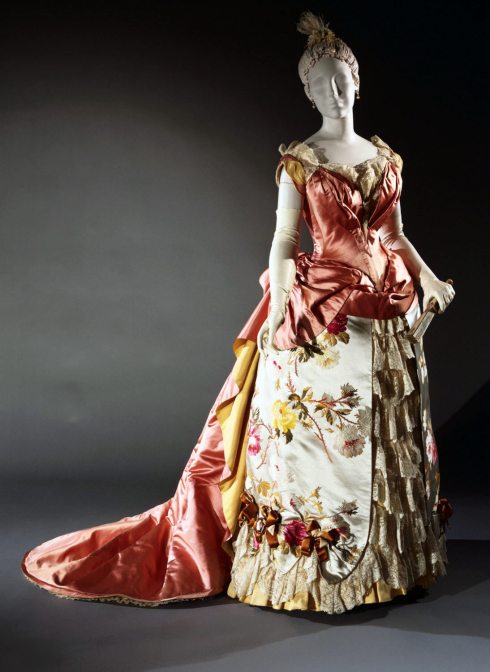
I came across a dress so beautiful the other day that I started thinking about its owner/wearer, Elizabeth Goodhue Millett Fenollosa, wife of the famous “Orientalist” and cultural ambassador Ernest Fenollosa, who happened to grow up in the house right next door to mine here in Salem. Actually “Lizzie” Fenollosa, who was also Salem-born and -raised, was Fenollosa’s first wife, who accompanied him to Japan, where he was eventually appointed Director of the Imperial Museum in Tokyo in 1888. Here is the Worth dress, which the curators of the Philadelphia Museum of Art believe might have been worn for her presentation at the Imperial Court coincidentally with her husband’s appointment. [Correction: please see comment below; Mr. Fenollosa was a professor of philosophy at Tokyo University and a curator at the Imperial Museum, but not its director.]

Fenollosa Dress

Women’s Evening Dress: Bodice and Skirt. Designed by Charles Frederick Worth, English (active Paris), 1825 – 1895. Worn by Mrs. Ernest Fenollosa, c. 1886-1887, Philadelphia Museum of Art. Gift of Mr. and Mrs. Owen Biddle, 1978.

I had never seen this stunning dress before but I was not surprised to see it in the collection of the Philadelphia museum, as the Fenollosas’ daughter Brenda was married into the prominent Biddle family of that city in 1913. Her son Owen Biddle and his wife donated the gown (along with another) to the museum, and she herself donated a lovely Meiji scroll from her father’s collection (and in his memory) in 1941. I was surprised to see another Fenollosa-related item in the museum’s collection, however: a photograph of her father’s second wife, Mary McNeil Fenollosa, by the photographer Eva Watson-Schütze, dated 1905. Obviously this item was not donated by the Biddle family, for the Fenollosa divorce was scandalous its day. I have no idea what Brenda’s feelings were, but her mother named Mary as a co-respondent in the 1895 proceedings.

Fenellosa Mary

Portrait of a Woman in Japanese Dress (Wife of Ernest Fenollosa), Eva Watson-Schütze, 1905. Philadelphia Museum of Art, 1905. Gift of Harvey S. Shipley Miller and J. Randall Plummer, 2004.

Ernest and Lizzie Fenollosa were childhood sweethearts in Salem; they were married right after his graduation from Harvard and then set off together for Japan, where he took up a position at the Imperial University at Tokyo and became fully immersed in traditional Japanese culture, eventually rising to his post at the Imperial Museum. He converted to Buddhism, but they did not appear to lead an ascetic lifestyle, if their house, their many western visitors (and her dress!) are any indication. During their time in Japan, Fenollosa also acquired a huge collection of traditional Japanese art, which he sold to Boston physician and philanthropist Charles Goddard Weld with the condition that it eventually be donated to the Museum of Fine Arts, Boston, where it now constitutes the Fenollosa-Weld Collection. The Fenollosas returned to Massachusetts in 1890, where he was appointed curator of the Department of Oriental Art at the MFA and organized several high-profile exhibitions. After he took up with Mary McNeil Scott, a twice-married southern secretary at the Museum, both his marriage and his curatorial career were over–although he continued in his scholarly activities. Lizzie and Brenda remained in the Boston area, but Ernest and Mary took off after their marriage: to New York, back to Japan (she had spent time there too, which explains much of their instant connection), to Mobile, Alabama (her hometown), and to London, where he died of a heart attack in 1908.

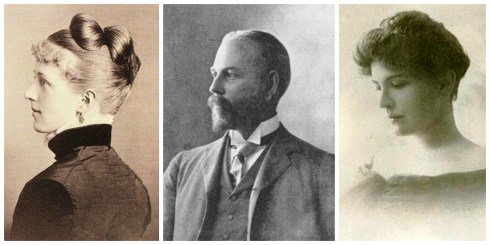
Fenollosa CollageElizabeth Goodhue Millett Fenollosa, Ernest Fenellosa, Mary McNeil Scott Fenollosa.

The two Mrs. Fenollosas were very different women bound together by one man, as well as their experiences in Japan, I suppose. Elizabeth Fenollosa seems to have been a private woman, although by all accounts she was a gracious hostess and certain details about her divorce did leak out to the papers…..Mary Fenollosa was much more public, writing popular novels under the pseudonym Sidney McCall, poems under her own name, and serving as an advocate for her husband’s work after his death. Truth Dexter, her first and most popular novel, tells the story of a southern wife (the title character) whose marriage is endangered by a brazen Boston socialite! That was too much for Lizzie, who told the New York Times that her intellectual ex-husband must have collaborated on the book as it contained too many little-known details of their lives together. I think that book, plus the fact that she’s a Salem girl, puts me on Team Lizzie, but both women certainly lived colorful lives that took them far from their places of origin.

Fenollosa House Buffum Street

Fenollosa House Japan Harvard Houghton

From Salem to Tokyo: Elizabeth Fenollosa’s childhood home on Buffum Street in Salem, and the Tokyo home she shared with Ernest, Fenollosa Papers, Houghton Library, Harvard University.