Tag Archives: Exhibitions

Cabinets on Canvas

After stuffing ourselves with Thanksgiving dinner the day before, and Thanksgiving breakfast pie yesterday morning, we walked downtown to the Peabody Essex Museum to see their latest blockbuster exhibition, Shoes: Pleasure and PainIt is a fine visual feast for sure, but not exactly thought-provoking for me (and I’m not really a shoe girl–but I did get some great pictures for another post), so I wandered next door to another current exhibition, Samuel F.B. Morses Gallery at the Louvreand the Art of InventionThis traveling exhibition focuses on Morse the artist and “copyist” rather than Morse the inventor: his 1831-33 painting of an imagined exhibition of 40 artworks at the Musée du Louvre in Paris, combined with his role as the “father of American photography” based on his early experimentation with the daguerreotype process, is the inspiration for a complementary display of over 65 photographs from the PEM’s extensive collection. I must admit I didn’t quite grasp the connection between the painting and the photographs—“the spirit of curation, storytelling, and cross-cultural affinities”—but I was happy to see both, and I spent some time trying to find my own connections, which is the very best impact any exhibition can have.

cabinets-1

cabinets-2

cabinets-5

1992-51-morse-8-center-figureslowres

Samuel F.B. Morse’s Gallery at the Louvre (Terra Foundation for American Art) in the PEM show, along with his copy of Titian’s portrait of François I and a crop of the artist/inventor instructing his daughter in the center of the painting from a blog post by Shoshana Resnikoff on the PEM blog Connected.

After a bit of thought and browsing around, ultimately I think I made one of the connections the curators of this exhibition wanted me to make by comparing Morse’s “gallery painting” with the original examples of this genre from the seventeenth century. The whole idea of collecting and creating a “cabinet” of curiosities, wonders, or magnificent works of art is so very early modern, and best expressed by Francis Bacon who prescribed that every Renaissance Man should have a goodly huge cabinet, wherein whatsoever the hand of man by exquisite art or engine hath made rare in stuff, form or motion; whatsoever singularity chance and the shuffle of things hath produced; whatsoever Nature hath wrought in things that want life and may be kept; shall be sorted and included. In idealized ways, these cabinets were depicted by a succession of artists, and most ardently by Flemish and Dutch Golden Age painters such as members of the multi-generational Francken dynasty and David Teniers the Younger. There are notable differences between gallery paintings of the seventeenth century and Morse’s painting (besides the fact that the earlier paintings are obviously much better): the people depicted in the former are engaged with the art on the walls and tables through collection and admiration, not replication. As (old) Europeans living in an age of confidence–they probably thought they would always be surrounded by art: the gallery of Archduke Wilhelm, in the Teniers painting below, was newly-assembled following a bout of Swedish looting during the Thirty Years’ War (and many of these same painting came from the estates of English Royalists confiscated by Oliver Cromwell!). Morse’s painting seems more about capturing and transmitting art and culture–by whatever means possible– from the Old World to the New, which seems very appropriate for the inventor of his namesake code.

cabinet-of-an-art-collector

cabinet-of-art-and-curiosities-f-francken

david_teniers_el_joven_-_el_archiduque_leopoldo_guillermo_en_su_galeria_de_bruselas_kunsthistorisches_museum_de_viena_1650-52-_oleo_sobre_lienzo_123_x_163_cmHieronymus Francken II, The Cabinet of an Art Collector, 1621, Royal Museum of Fine Arts, Brussels; Frans Francken II, Chamber of Art and Curiosities, 1636, Kunsthistorisches Museum, Vienna; David Teniers the Younger, The Archduke Leopold Wilhelm in His Gallery at Brussels, c. 1650, Kunsthistorisches Museum, Vienna.


Boston Halloween

Besides living in the self-proclaimed Witch City, yet another aspect of my tortured relationship with Halloween is my birthday, which falls a few days before and inevitably gets colored (darkened) by the proximity. It’s not quite as bad as having a Christmas birthday, but close, especially for me. There’s generally a big storm on my big day too–but not this year, thank goodness. This year we have family in town to celebrate their first Salem Halloween, but there was no way I was going to be their guide, so I left them to my husband and fled to Boston for the day. I went to the Museum of Fine Arts for the William Merritt Chase and Della Robbia exhibitions (the women!), then to the Antiquarian Book Show  (the prices!) at the Hynes Convention Center, and then I just walked around the Back Bay and Beacon Hill, as the weather got progressively warmer over the day. Oddly enough, I found myself enjoying the Halloween decorations on the stately brownstones and townhouses: very creative and such a contrast to the architecture! Maybe I like Halloween after all (just not in Salem).

Back Bay:

boston-halloween-back-bay

boston-halloween2-back-bay

boston-halloween-3-back-bay

boston-halloween-book-show

Just one book from the show at the Hynes in keeping with the theme: next post I’m going to write about a beautiful ($45,000) incunabulum I had never heard of before (if I can find out enough about it).

Beacon Hill: who knew that Louisburg Square was Halloween central? This first house was amazing.

boston-halloween-13-ls

boston-halloween-10-ls

boston-halloween-11-ls

boston-halloween-12-ls

boston-halloween-8-lq

boston-halloween-9-ls

boston-halloween-collage

j IOP-[0

boston-halloween-14-bhill


Face-based History

I am a longtime admirer of Simon Schama, as both historian and art historian, presenter and public intellectual. For me, his study of the Dutch Golden Age, The Embarrassment of Riches: An interpretation of Dutch culture in the Golden Age (1987) is a classic of cultural history, illustrating a masterful engagement of textual and material sources, almost Burckhardtian in its scope. I always have it close at hand. Even though Schama is not principally an English historian, I show bits and pieces of his History of Britain series in class, just because he is such a good communicator–and teacher. As any reader of this blog (or former student) knows, I’m always utilizing (I think of it as playing with, actually, as I am not trained) art in class, in large part due to Schama, even though I am far less knowledgeable and adept than he. Schama’s latest project focuses on British portraits in the National Portrait Gallery, probably my very favorite museum in the world: The Face of Britain is a multi-media history of Britain through its portraits, rather than a history of British portraits. Through an exhibition last year at the NPG, and an accompanying book and television series, Schama examines Britain’s relatively modern history (after all, the portrait is a Renaissance creation) through portraits of individuals which represent both precise historical moments and dynamic trends. A very representative, and compelling, vignette relates the creation of a famous (or infamous) portrait of Winston Churchill, commissioned for the Prime Minister’s 80th birthday by Parliament. There was quite a bit of push-and-pull between Churchill and the commissioned artist, Graham Sunderland, resulting in a portrait that is described by Schama as a “beautiful ruin” detested by the subject, the humiliation of the artist at its public unveiling in 1954, and its eventual  destruction by Lady Churchill or one of her delegates. All we have are studies and photographs of the painting that captured this particular historical moment.

NPG 5332; Winston Churchill by Graham Vivian Sutherland

Preparatory Study for Winston Churchill’s 1954 portrait by Graham Vivian Sunderland, National Portrait Gallery.

The making of Churchill’s portrait is a study in power dynamics, and Schama explores other kinds of relationships in his exhibition/presentation/narrative: “The Face of Power” is accompanied by “Faces of the People”, “The Face of Fame”, “The Look of Love”, and “The Face of the Mirror”. The essential relationship in all of these categories, however, is between the artist and the subject, and consequently it is a bit difficult to string along an entire collective history. I didn’t see the exhibition, but I heard from friends that it was confusing because of its conceptual-rather-than-chronological structure. I do have the book and I’ve seen several episodes of the series, and (once again) Schama’s superior communication skills do seem to carry us along, especially as we move among variant genres: “portable portraits”, miniatures, statues, engravings, photographs. I didn’t learn too much from his analysis of the Tudor and Stuart portraits–I’ve heard all that virgin and martyr stuff before–though I do appreciate the inclusion of Oliver Cromwell’s “warts and all” portrait and the “mourning portraits” Kenelm Digby commissioned of his beloved Venetia. I got a little lost in the later seventeenth century, but thought he made effective arguments for the representational value of portraits from the eighteenth century up through much of the twentieth, and I LOVED his “faces of the mirror”: I always though of self-portraits as being exclusively individualistic and not particularly dependent on context, but no longer! As is often the case with Schama, his transitions were subtle and his connections convincing, so in the end I found myself agreeing with his assertion that”portraits bring you into their company”.

Historical faces from Schama’s Face of Britain: Sir Francis Drake, whom Schama calls “the first genuine heroic famous Englishman”, principally because he is a “man of action”; Two very different portraits by William Hogarth: David Garrick as Richard III and the convicted murderess Sarah Malcolm in prison; Two earnest expressions of love by Thomas Gainsborough (for his daughters) and Dante Gabriel Rossetti (for Jane Morris, the wife of his William), and some amazing artists’ self-portraits, for which Schama provides plenty of context: Gerlach Flicke (cropped), an imprisoned sixteenth-century artist who painted the first English self-portrait so that his “dear friends….might have something by which to remember him after his death.”, Sir Joshua Reynolds, and William Orpen, “Ready to Start” fighing (?) in the Great War. Apparently Orpen later regretted his trivializing accouterments.

NPG 4032; Sir Francis Drake by Unknown artistSir Francis Drake by an unknown artist, c. 1580, ©National Portrait Gallery

british-faces-800_hogarth_davidgarrick_as_richardiii David Garrick as Richard III, William Hogarth, © Walker Art Gallery

british-faces-hogarth-sarah-malcolm-in-prison Sarah Malcolm by William Hogarth, Sarah Malcolm © Scottish National Gallery

british-faces-gainsborough-daughters-npgThe Painter’s Daughters chasing a Butterfly, Thomas Gainsborough ©National Gallery

Rossetti, Dante Gabriel, 1828-1882; Blue Silk Dress (Jane Morris)Blue Silk Dress (Jane Morris) by Dante Gabriel Rossetti, ©Society of Antiquaries of London

british-faces-gerlach_flicke_by_gerlach_flicke_crop Gerlach Flicke, ©National Portrait Gallery

British Faces Self-portrait_c.1747-9_by_Joshua_Reynolds_(2).jpgSir Joshua Reynolds, ©National Portrait Gallery

british-faces-498px-william_orpen-ready_to_start-1917 William Orpen, Ready to Start, ©Imperial War Museum


Blaze of Glory

I know, Summer doesn’t really end until September 20, but I’ve lived and worked on an academic schedule for my entire life, so believe me when I say that Summer ends on Labor Day. This year I have mixed feelings: on the one hand, I worked all summer teaching and doing various administrative tasks (not, unfortunately, writing, except for here), so it seems like there never was a summer in academic terms. So who cares, bring Fall on. On the other hand, because I didn’t really have a summer (again–in academic terms: I know how privileged I am), these last few days are even more poignant. Whatever–it’s over–as I write this I am sitting in an empty classroom awaiting transfer registration. September is one of my favorite months (October would be too if I didn’t happen to live in WITCH CITY), and because the month is so beautiful, I always have this idea that I’m going to make my garden last through it rather than just giving up and ceasing all garden activities.My garden actually looks pretty good, as we are not under a water ban here unlike many towns in Essex County. I water sparingly, because I feel kind of guilty doing it, but it’s pretty green back there if lacking in color.Unfortunately I am not crazy about late summer/early fall flowers: dahlias are too showy, and sedum too………fibrous (succulents creep me out, for some reason). I found a few other plants to replenish my garden up at Pettingill Farm the other day, but it’s never going to look like the ultimate late-summer garden at the Ropes Mansion.

Last Days of Summer Pettingill Farm

Last Days of Summer 2PF

Last Days of Summer 3 pf

Late Summer Ropes

Late Summer flowers

Late Summer Dahlia Ropes

Late Summer flowers at Pettengill Farm in Salisbury and the Ropes Mansion, Salem. I had planned to go to the Tower Hill Botanic Garden in Boylston on Friday to see the amazing floral/architectural paper creations of Tiffanie Turner but now I see that they are not there! So disappointed. I might just start to like dahlias: hers look like floral armor for the challenges of Fall.

Tiffany Dahlia

A dahlia by Tiffanie Turner: more here.


Preparing to Paint

Is there anything more engaging than an artist’s sketchbook? Or even a notebook with a few sketches in it? I suppose the end product doesn’t have to be visual, it’s the insight into that conception/creation/ working it out process that I’m interested in, but imagery tends to be far more accessible, of course. I use Leonardo’s notebooks extensively in my Renaissance, Scientific Revolution, and early modern courses, and students are immediately engaged, entranced even, far more than they are when I show them the finished product. It’s interesting to see the wanderings of a very fertile mind in his case, what inspired him and what he also had to work out: perspective, motion, hands. Most of Leonardo’s sketches never made it onto canvas; once a particular challenge was overcome he moved on to the next one, but the sketchbooks of more (focused, disciplined, on-task???? it’s hard to compare Leonardo negatively to anyone) artists illustrate the progress from page to paint: those of Claude Monet immediately comes to mind. But again, it doesn’t have to be about images. The sketchbooks of  Massachusetts artist Alvan Fisher (1792-1863), a pioneer in American landscape, genre, and “view” paintings, gives us insights into his preparation for one of the first views of Salem from “Gallows Hill”, a scene that would be imitated time and time again over the course of the nineteenth century. Fisher jotted down notes about the Salem Witch Trials in his sketchbook, indicating that his inspiration for the Salem painting was not just the view he saw before him, but the events that brought him to this particular place.

Fisher View of Salem from Gallows Hill

Fisher Sketchbook no 5 1824

Alvan Fisher’s View of Salem from Gallows Hill (1818), Collection of the Peabody Essex Museum, Salem, and Sketchbook no. 5, containing notes about the Salem Witch Trials, Museum of Fine Arts, Boston. With the recent validation of Proctor’s Ledge below rather than Gallows Hill above as the 1692 execution site, it occurs to me that the inspiration for this famous “view” is based on a falsehood! Indeed, I think that the figures in the foreground are sitting on THE ledge. But clearly a perspective from that point would not be as revealing of the city below.

From what I can see, most of the sketches in Fisher’s notebooks in the Museum of Fine Arts contain more conventional preparatory sketches: houses, hills, streams, animals. Creatures, particularly creatures in motion and even more particularly birds, seem to captivate artists for centuries, from Leonardo to Salem’s most famous artist, Frank Benson. Browsing around sketchbooks which have been digitized (especially those included in this archived exhibition at the Smithsonian’s Archives of American Art), I can’t tell which is more captivating to me: individual sketches or the entire sketchbook, the works themselves or the works in progress. 

Fisher Notebook 1

Benson Sketchbook 1882

Bird Collage

Sketchbook Rockport

Sketchbook Porter

Page from Alvan Fisher’s Sketchbook no. 1, Museum of Fine Arts, Boston; Autographed sketch by Frank Benson, 1882, Skinner Auctions; Leonardo’s sketches from the Codex on the Flight of Birds and one of Benson’s bird sketches, Northeast Auctions; Covers of sketchbooks of Harrison Cady (1943) and Fairfield Porter  (1950) from the Archives of American Art.


Marked by a Witch

I have featured maps on this blog many times: maps allegorical, anthropomorphic, and antique, maps featuring octopuses, spiders, relationships and myriad places and perspectives. An ongoing exhibition of pictorial maps at the University of Southern Maine’s Osher Map Library has inspired me to examine this particular cartographical creation yet again–along with a recent ebay score of one of my favorite local pictorial maps, Alva Scott Garfield’s “Scott-Map of Salem, Massachusetts”. Maps with pictographic elements go way back, but the Osher exhibition is focused on the mid-twentieth century, identified as “The Golden Age of American Pictorial Maps”. I wanted to confirm this chronology in my own mind, so I began perusing the larger collection of pictorial maps at the David Rumsey Map Collection: casual browsing led me down the virtual rabbit hole, of course!  Clearly you can map anything in a pictorial way: plants, animals, commodities, imaginary places, infrastructure and material culture, the past and the present: one of the major reasons the Osher exhibition identifies the mid-twentieth century as a golden age for these maps is the production of so many maps related to the campaigns of World War II, and these are among the most striking maps of this genre. I love global and national pictorial maps (a particular favorite is pictorial-map pioneer MacDonald Gill’s “Tea Revives the World”, produced in the darkest days of Britain’s World War II experience and pictured below), but the more I looked at the Osher and Rumsey maps and my newly-acquired ScottMap of Salem the more parochial my perspective became. Since the golden age of pictorial maps was roughly coincidental with the Salem’s increasing identification as the Witch City, I wondered if this would be apparent on regional and local maps. How often did a witch mark Salem’s place on the map?

Tea-Revives-the-World-Gill

Pictorial Map America 1940 Osher

Two Patriotic Maps from 1940: “Tea Revives the World” by MacDonald Gill and “America–A Nation of One People from Many Countries”, published by the Council Against Intolerance in America, Rumsey Map Collection and Osher Map Library.

Quite often, it seems, though the struggle between Salem’s divergent commercial and cultural identities is also evident on local pictorial maps from the mid-twentieth century. Situated between the big shoe representing Lynn’s characteristic industry to the south and the fishermen of Cape Ann to the north, Salem is represented alternatively by either the House of the Seven Gables or a broom-mounted witch, and sometimes both. Coulton Waugh’s beautiful map of “Cape Ann and the North Shore” (1927) identifies Salem with the Gables and the famous ship Hazard, but over the next several years the witch appears on Griswold Tyng’s illustrated Map of the Eastern United States (1929), Harold Haven Brown’s Picture Map of Massachusetts (1930) and Elizabeth Shurtleff’s very detailed map of Massachusetts, “the Old Bay State” (1930). One of my very favorite pictorial maps, Raymond Lufkin’s “Old Massachusetts” produced for The House Beautiful in 1930, is focused on the state’s architectural heritage, so witchcraft is literally marginalized (along with another notable event in Salem’s history, the landing of the first elephant in North America). Surprisingly there is no witch on Paul Spener Johst’s 1931 picture map of Massachusetts (just a BIG pilgrim), but the increasingly-familiar figure returns on Elmer and Berta Hader’s cartoon map of Massachusetts published in 1932, from their Picture Book of the States. From that point on, the flying witch marks the spot of Salem on most pictorial maps. By the time we get to the end of the “golden era”, Salem is firmly established as the Witch City on Ernest Dudley Chase’s official travel map of Historic Massachusetts, and the “Scott-Map of Salem” can make the rather whimsical claim that “aviation started in Salem”.

Pictorial Map North Shore 1927 Osher

Pictorial Map US Tyng 1929 Rumsey Map Collection

Pictorial Map Massachusetts Brown 1930

Pictorial Map Shutleff 1930

Pictorial Maps House Beautiful 1930

Pictorial Maps House Beautiful detail Salem 1930

Pictorial Map Massachusetts Johst 1931

Pictorial Map Haders 1932 Rumsey Map Collection

How Salem is marked on the map, 1920s-1960s: ABOVE: Coulton Waugh’s map, 1927; details of Tyng US Pictorial map, 1929, Brown “Picture Map“, 1930, and Shurtleff map, 1930; “Old Massachusetts” published by The House Beautiful, 1930; Johst map of Massachusetts, 1931; Hader pictorial map of Massachusetts, 1932; BELOW:  Ernest Dudley Chase’s Historic Massachusetts, “A Travel Map to help you feel at home in the Bay State”, 1957 (published by the Massachusetts Department of Commerce) and Alva Scott-Garfield’s “Scott-Map of Salem, Masschusetts”, 1960.

Pictorial Map Mass 1957 Chase

Pictorial Map Scott-Salem 1960

Save

Save

Save

Save

Save


What to do with my Stereoviews?

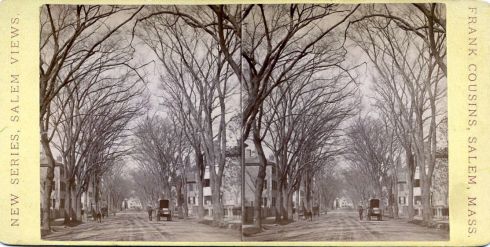
I’ve been a collector of sorts for much of my life but I never collected historic photographic images until I started this blog: I quickly realized their power to tell stories and provide context in this, our digital age. So I started buying some Salem images, mostly stereoviews, which were produced in vast quantities in the later nineteenth century. There were about six or seven major publishers of stereoviews here in Salem at that time, but I’ve focused almost all my collecting efforts on images associated with Frank Cousins, as either photographer or publisher. I just completed my collection of his sentimental “Salem in 1876” views, encompassing nearly every corner of central Salem. Now I’ve got a (shoe) box of stereoviews and I’m not quite sure what to do with them.

Stereoviews

Stereoviews 2

Steroview Chestnut Street Cousins

Frank Cousins published views taken both up and down Chestnut Street and all over the city, documenting “Salem in 1876”.

Stereoviews are relatively easy to acquire, especially of a city like Salem which has been selling its image, in one way or another, for quite some time. They turn up online very frequently and I always find them at the larger flea markets and paper shows. My collection is pretty focused on Cousins, but it also has a few views that I have never seen anywhere else, including a great (though completely unattributed and undated) view of Front Street from Washington Street and a rather unusual (forested!) view of the South Church that stood across Chestnut Street from my house for nearly a century. This McIntire masterpiece burned down in 1803: I’m trying to gather as many images of it so I can glean its impact from every possible perspective. My verdant view is contrasted with a more typical image of the church, from the best source for digitized stereoviews: the Robert N. Dennis Collection of Stereoscopic Views at the New York Public Library (where you can make “stereogranimators”).

Stereoview Front Street Salem

Stereoview Second Church Tilton

Stereo South Church Salem NYPL

(Stereo)view of Front Street, ?date, ?photographer); the South Church on Chestnut by Peabody & Tilton, c. 1875 and Guy & Brothers, c. 1884, Dennis Collection, New York Public Library.

Obviously I have a predilection for streetscapes but I like some (not all; some are creepy) of the more intimate, “up close and personal” stereoviews too. I’ve seen quite a few of people just standing outside their houses, being captured for posterity. A double dose of daily life. I love this image of a Salem Willows summer cottage with its residents, all ready for summer. This is not mine, unfortunately, but from another great source of stereoviews: the Center for Lowell History at the University of Massachusetts at Lowell Libraries.

Stereoview Juniper Point UMASS Lowell SP

“View at Juniper Point, Salem Neck, Mass.”, n.d., Center for Lowell History at the University of Massachusetts Lowell Libraries (the original Willows cottages were built for Lowell residents who wanted to summer on the coast).

So again, what to do with those stereoviews that I do possess? Ultimately I will leave them all to the Salem State University Library’s Archives and Special Collections, because what Salem needs is a Center for Salem History there, as the Peabody Essex Museum ceased its historical-society function long ago. But in the meantime, I’d like to find a more clever and creative way to preserve and display them. I’d like to get them out of the box! I guess I could frame them in some interesting combinations and create a gallery wall, but that’s about the extent of my creativity. Brass floating frames? Display them with a special “twinscope” at hand like this cool exhibit from just last year, Syracuse in 3-D (1860-1910)? I’m open to suggestions, because I do think there is something very engaging–both aesthetically and historically– about images in multiples. As evidence, I give you this beautiful invitation to the Pickering House’s annual garden party by Salem artist Racket Shreve, paired with Cousins’ stereoview, of course.

OLYMPUS DIGITAL CAMERA

Stereo Pickering

Stereoview Pickering House Cousins 1876

Scene from the interactive “Syracuse in 3-D” exhibit by Colleen Woolpert (+ more here); Racket Shreve’s quatre-Pickering House invitation; Frank Cousins’ “Salem in 1876” stereoview of the Pickering House.


Considering Caroline

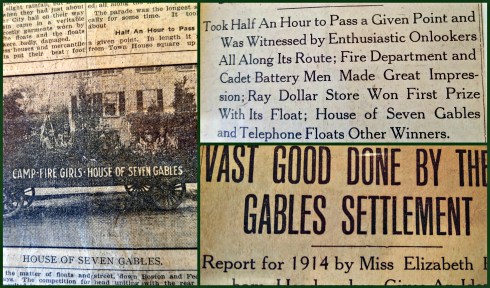
The House of the Seven Gables is featuring a new exhibit on its founder, Caroline O. Emmerton (1866-1942) in commemoration of the sesquicentennial of her birth and as the rather mysterious Caroline has long intrigued me I took advantage of a preview invitation to check it out even before the official opening. Despite her fortunate birth into one of Salem’s wealthiest and most philanthropic families, her connections, and her achievements, Caroline is a bit enigmatic, and I was hoping that Caroline Emmerton. An Unbounded Vision would shed new light on her for me. It did, but my suspicion that Caroline can only really be known in context rather than strictly on her own was confirmed. The exhibit actually presents Caroline in several contexts and it is through these perspectives that we come to know her: the wealth, privileges, and sense of civic duty that came to her through her family, her interest in the emerging Settlement Movement, with its aims of aiding and assimilating (or “Americanizing”) the country’s expanding immigrant communities, and the corresponding Preservation Movement, which aimed to preserve the pre-industrial past in an era of dynamic change. You can definitely perceive how Salem shaped her. The exhibit appropriately emphasizes Caroline’s settlement activities over her preservation goals but you certainly get the sense that they are going to merge with the formation of the House of the Seven Gables Settlement Association in 1910.

Gables Exhibition

Gables 2

Gables 4.jpg

Gables Panels 2

Gables Panels

Gables 10

Caroline Emmerton: an Unbounded Vision, at the House of the Seven Gables through August 31: A young Caroline and a very famous photograph of her with children at the Settlement House c. 1920; Exhibition panels, which were also produced in Spanish (a 21st-century update on Caroline’s settlement goals).

Gables 13

Gables 3Gables Scrap Collage

Context, context: the Gables in the Community. Great photograph of a Derby Street factory and worker, instructing neighborhood girls in the Settlement House kitchen; newspaper clippings from a Gables scrapbook.

So the context was definitely there but what about the personal Caroline? There was a sense of her in the exhibit, actually: a photograph of her home on Essex Street (with a wallpaper sample and a few household possessions), a range of photographs of her at different stages in her life, an original notepaper version of her (very ye Olde) tour for the Gables, and my favorite, the hand-written manuscript of her book Chronicle of Three Old Houses, which she published in 1935 for the 25th anniversary of the Gables. It was lovely to see these things, and also to talk with Irene Axelrod, the former Research Librarian of the Phillips Library of the Peabody Essex Museum, who knows more about Caroline than anyone else. I asked Irene where Caroline went to school, because in my experience institutions often offer up lots of evidence, and she said that Caroline was tutored at home and then probably went on the Grand Tour. So there goes that source. Irene told me that her research forayed into oral history, and she was able to interview some (quite old) people that actually knew Caroline. So that’s about as close as I’m going to get, I think: four degrees of separation?

Gables 12

Gables Emmerton Handwriting

LOVE this handwritten manuscript of Caroline’s Chronicles of Three Old Houses complete with little intextual illustrations! The companion book to the exhibition by David Moffat features a full-page view, along with lots of other illustrations from the Gables archives, sources, and more context.


Ghostly Courtiers

I’ve just got a few more English posts before I get back to the actual streets of Salem: I just took so many great pictures over there if I do say so myself! I’m going back to Hampton Court today–the other side of Hampton Court, which if of course a bilateral palace, with a Tudor side and a Baroque/Georgian one, the cumulative work of Sir Christopher Wren and Sir John Vanbrugh who were commissioned by the last Stuarts and the first Georgians to remodel the entire castle in a more modern (and presumably comfortable) style. If completed, this modernization plan would have resulted in the complete demolition of the Tudor palace but lack of funds and the shifting preferences of monarchs determined that it was (fortunately) not. I far prefer the Tudor palace, inside and out, but I really enjoyed the furnishings, paintings, and overall interpretation of the “Secrets of the Royal Bedchamber” exhibit in the royal apartments on the other side, populated by courtiers all draped in white Tyvek.  Like any old place touched by tragedy, there are rumors of ghosts at Hampton Court Palace, and it as if you are walking among them in these rooms.

20160315_111841_Burst01~2[1]

London 735.jpg

London 724

London 726

London 728

London 727

London 725

London 731

London 730

London 732

Baroque facades–with the Tudor roofline peaking out behind, dining rooms and courtiers; Below, the “Grey Lady” ghost, Sybil Penn, wandering through the palace.

Grey-Lady-low-res


John Dee, Renaissance Man

The first ten or so years of my teaching career I would bring up John Dee (1527-1609) in one of my classes–he’s relevant to most of them really, whether it’s English history, or Atlantic history, or my courses on the early modern witch trials or the Scientific Revolution–and my students would look perplexed:  who? Once I told them a bit about the “Arch-Conjurer of England” they definitely wanted to know more, but they had no prior knowledge. That all changed about a decade ago when the first book in Michael Scott’s adolescent novel series The Secrets of the Immortal Nicholas Flamel was published, which features John Dee as a central character (Joan of Arc, Machiavelli and Shakespeare also show up as the series unfolds): now I’ve got a generation of students who know all about John Dee, or at least they think they do: in any case, the stage has been set.

(c) Wellcome Library; Supplied by The Public Catalogue Foundation

Anonymous English Artist, John Dee, c. 1594. Wellcome Library; Supplied by The Public Catalogue Foundation

For me, Dee represents one of the last generations of men who could pursue “magic” and “science” at the same time: his life’s work represents just how blurry the line was between these two endeavors in the sixteenth century. He’s also a great example of the multi-faceted Renaissance Man, or at least an English example thereof. It’s really difficult to confine Dee’s interests and activities to a short blog post, but I’ll try: he was first and foremost a mathematician, but this foundational field drew him into so many others: astrology, astronomy, alchemy, geography, cartography, linguistics, cryptography, optics. He started out his professional life, while still in his teens, as an academic, but clearly sought to be a courtier, and enjoyed a close relationship with Elizabeth I, who at one point called him “hyr philosopher”. This connection gave him security, prestige, and influence, which he used to advocate for a stronger imperial policy for England; indeed he is generally credited with coining the term “British Empire”. It must have enriched him too, as he spent considerable money (and time) amassing a huge library which he installed at his primary residence at Mortlake, just outside London. He was an avid manuscript-hunter, pursuing and collecting all written knowledge on “high” (learned) magic, predominately alchemy and cabalism. But written, human knowledge was never enough for Dee: he came to believe that all of his questions could be answered only by beings of a higher order: angels. His pursuit of communion with the angels ultimately drove him down a path that threatened both his livelihood and his reputation, as a Renaissance magus practicing learned, “white” magic had to be very careful not to cross the line into the “black” arts of divination and necromancy in this age of intensive witch-hunting. Dee died a natural death, but lost his fortune, and his complex character was reduced to that of Prospero and Dr. Faustus by his contemporaries Shakespeare and Marlow.

(c) Wellcome Library; Supplied by The Public Catalogue Foundation

The Victorian View of Dee as Conjurer: Henry Gillard Glindoni (1852-1913), John Dee Performing an Experiment before Queen Elizabeth, c. 1880,Wellcome Library; Supplied by The Public Catalogue Foundation. Apparently the skulls in the original painting were painted over at some point!

Modern scholars (as well as authors of adolescent fiction) love Dee and have restored much of his complexity, but it is a difficult task to reconcile the scientist and the spirtualist. And now there is a new exhibition of materials (and instruments) from his own library at the Royal College of Physicians Museum in London: Scholar, courtier, magician: the lost library of John Dee. Perhaps this is an opportunity for Dee to “speak for himself”: the RCP website states that: “Our exhibition explores Dee through his personal library. On display for the first time are Dee’s mathematical, astronomical and alchemical texts, many elaborately annotated and illustrated by Dee’s own hand. Now held in the collections of the Royal College of Physicians, they reveal tantalising glimpses into the ‘conjuror’s mind’.” I’m bringing students in my Tudor-Stuart class over to London during spring break this year, and this is on my itinerary–I think we can build on Nicholas Flamel a bit.

johndeemagic02-768x512

johndeemagic06-768x512

johndeemagic09-768x802

John Dee’s own illustration of a page of the complete works of Cicero. (‘Opera,’ published Paris, 1539–1540) (© Royal College of Physicians / John Chase);  A horoscope chart scribbled in the lower margin of Claudius Ptolemy’s Quadriparti, Venice, 1519 (© Royal College of Physicians / John Chase); another great Dee doodle of three bearded faces in the margin of a treatise on alchemy (Arnaldus de Villanova, ‘Opera,’ published Venice, 1527) (© Royal College of Physicians / Mike Fear). You can see more items from the exhibition here.