Tag Archives: ephemera

Skiing through the Depression

Certain eras have a visual signature that is much more assertive than others, and when it comes to the last century, I’ve always thought that the 1930s was a very strong decade in terms of graphic design, in sharp contrast to the weakness of the economy. Is there an inverse relationship between art and anxiety? I think so. The bold WPA posters with their fat fonts seem like compensation for the bleakness and leanness of the times, and so too do commercial posters from that era. You see just one, and immediately you know when and why it was made: Cheer Up! An upcoming auction of vintage posters at Swann’s Auction Galleries is dominated by skiing posters from the 1930s, several of them designed by American artist Sascha Maurer (1897-1961) who seems to have specialized in this very specific genre. Whether they were sponsored by the railroad, or the ski manufacturer, or the resort, they all show shiny happy people on the slopes, and a bright world not too far from home for some, but still probably quite inaccessible. Go Skiing!

M30359-12 001

M32661-4 001

M30904-65 001

Skiing Poster Collage

M27331-15 001

M24261-51 001

Vintage Ski Posters by Sascha Maurer , c. 1935-37, Swann Auction Galleries auctions past and upcoming.


Hex Appeal

A week or so ago when I posted on the Samantha statue in downtown Salem many people voiced their support of this…….(searching for objective word) semblance, most expressing the point of view that Bewitched came to Salem at its low point, after the Northshore Mall had been built and all the Salem shops had left downtown and urban renewal had emptied the city. Samantha symbolizes the full-scale, no-holds-barred adoption of witchcraft tourism as Salem’s key late twentieth- and twenty-first century industry, the equivalent of its maritime trade in the early nineteenth century and its textile and leather industries in the early twentieth. So it follows that this television show is an important part of Salem history, right up there with the Witch Trials, Leslie’s Retreat, the China Trade, the Massachusetts 54th, the Great Salem Fire, and the contributions of Salem men and women to the cumulative national efforts in both World War I and World War II and later conflicts. With this in mind, I feel completely justified in my focus on a rather silly (but nonetheless charming) movie today, just because this particular movie is the precursor/inspiration for the all-important Bewitched. Without this movie, I Married a Witch (1942), there would be no Bewitched, and presumably for some, without Bewitched, there would be no Salem!

Veronica Lake Poster

I’m a devoted TCM fan but somehow I had never seen this classic, so when it aired on Sunday afternoon I gave it my full attention. It definitely paved the way for Bewitched in more ways than one: adorable blonde witch (in this case Jennifer played distinctively by the it-girl of the moment, Veronica Lake), stiff husband (Frederic March), mischievous witch parent (Cecil Kellaway rather than Agnes Morehead), a Hollywood view of the old country (Massachusetts). Here’s a succinct plot summary: Jennifer and her father were burned at the stake after being found guilty of witchcraft in 1672 (not 1692) with stalwart Puritan Jonathan Wooley serving as the key accuser; in return they curse successive Wooleys with bad wives, and we see some brief scenarios from 1770, 1861, and 1904 in which Wooleys are married to shrews. Flash forward to 1942 when lightning strikes the old oak tree in which the witches have been encased: they are liberated as mere wisps of smoke and they venture to a nearby house, where Wallace Wooley (March) is attending a fundraiser in support of his bid for Governor of Massachusetts, shrewish fiancée (Susan Hayward) in tow. Jennifer sets her sights on Wallace–she wants to continue the curse–so they follow him to Boston, still as puffs of smoke. When they see the Pilgrim Hotel, they decide to light it on fire (not quite sure why, except for the PILGRIM name), and Wallace stops to show his concern since he is running for governor. He ends up rushing into the hotel and “rescuing” Jennifer, who now assumes her Veronica Lake form. She seldom leaves his side after that, and concocts a love potion so that he will marry her rather than Susan Hayward. By mistake, SHE drinks the love potion and then all bets are off…….and marriage ensues. The ending suggests that Wallace is going to have an interesting life (like Darren!) from that point on.

Verinca 001

Verinca 003

Verinca 008

Verinca 011

Verinca 026

Verinca 043

Verinca 044

Veronica Lake 2

Veronica Collage

Verinca 091

A few notes on the scenes and the film:  opening shots–Preston Sturges was originally involved with the  film, and Dalton Trumbo was one of the (uncredited) screenwriters! A blurry scene (sorry): but this is where they are selling concessions between witch burnings, which is immediately telling the audience that this is not your standard Salem film. I wasn’t crazy about March in this film and apparently he wasn’t crazy about Lake; “in flight”; the PILGRIM HOTEL before it is set ablaze; from then on, it’s all Veronica: she spends a lot of time curled up kittenishly in the wing chair in Wooley’s “colonial” house in what is presumably Boston, before portraits of his unhappy ancestors. Couldn’t they find an all-black cat? All you see are the white paws and nose as it dashes around. Together at the end, back in “Salem”, Veronica in a beautiful sheer black dress, almost rivaling her hair.


Scraps of Salem History

Moving on from rocks to paper today, as it is time for a more ephemeral and less serious topic. I am by no means a serious collector, but I seek out and purchase ephemera pretty consistently, generally but not exclusively Salem items. Things have to appeal to me both aesthetically and historically, and I love unusual fonts and illustrations as well as things that are architectural or zoological. I have several folders of stuff, but certainly not boxes. Trade cards continue to be an ephemeral favorite, but I seem to be buying a lot of programs lately, as well as various “visitors’ guides” to Salem: these serve as my guide to the city’s changing identity over time. Is the emphasis on Witch City or “Old Salem” or the China Trade or the city of Hawthorne? Somehow it doesn’t seem possible for Salem to be all of these things simultaneously for the authors and editors of the guides in my collection, but the programs of the various historical “pageants” that occurred over the period from 1890 to 1930 reflect a more comprehensive (though wildly historically incorrect) approach. One of my favorite recent purchases is the program for a concert/pageant sponsored by Salem’s G.A.R. Post in 1895 entitled Historic Salem Illustrated. Representing Epochs in the History of Salem from the Time of its Settlement up to the Present Year with really cool illustrations of each “epoch” (“Indian”, Colonial, Revolutionary, Commercial, “Patriotic” (basically the Civil War), and “the Present or Electric Period”) by George Elmer Browne (1871-1946) who later emerged as an important Cape Ann/Provincetown artist. The historical vignettes, set to music, include “Chief Naumkeag welcoming the Puritans”, a tableau of Colonial punishments, and “The Blue and Gray of 1895”. What better way to tap into this particular historical perspective?

Salem Scraps GAR Programp

So here is a random sampling of some recent additions to my ephemera files, along with some things I haven’t featured before and some notes about why I like these scraps of paper and what I have learned from them, starting with some items I chose completely for their aesthetic qualities, and more particularly, their fonts: even though Salem: its Representative Businessmen and Points of Interest is from the “Electric Age” (1893) and the menu from the Calico Tea House (in the Hawthorne Hotel) is from the Atomic Age (1953) they have a similar aesthetic quality. On the menu in 1953: “Witch House Chicken”, “Derby Wharf Scrod”, and “Seven Gables Salad”. Still in the realm of color, a few trade cards from the first decade of the twentieth century (I think): the first is a very unusual view of the Custom House, and the second features cute rabbits. And how can you beat insects and architecture! A program for an Essex Institute “Social Evening” in 1868 at Hamilton Hall which featured all these creatures viewed under a microscope with musical interludes (LOVE this snail), followed by a program for the annual meeting of the members of the Salem Club in 1914 and a ticket (multiplied) to the 1952 Chestnut Street Day house tour which was held sporadically from the 1920s to the 1970s (it would be great to revive this event).

Salem Scraps in color

Salem Scrap 1910s PC Custom House

Salem Scraps TC Burnett

Program Final

Salem Scraps Snail

Salem Club 1914

Salem Scraps CSD 1952

It’s a lot easier to find things that our intended for an external audience–advertising and tourism pieces basically–than the entomological item above, or the G.A.R. or Salem Club programs. Salem really crafted and disseminated its image from at least the 1890s on and so there is a sea of promotional materials out there: brochures for walking, trolley and automobile tours, little pamphlets of photographic “glimpses” of Old Salem (besides postcards of which there are oceans). Witch City is nothing new, but it was definitely less all-encompassing a century ago, or fifty years ago, or at any time before the 1980s. One thing that you definitely notice when you look over older promotional materials is a consistent emphasis on Revolutionary Salem that is absent now. If you want to be a specialist collector, you could form a collection out of paper items created for the 1926 Salem Tercentenary alone, and at its center would be the Highlights in the History of Salem pamphlet published by the Salem Evening News, which has the perfect title for an ephemeral history.

Salem Scraps 1896

Picture2

Picture1

Salem Scraps 1926


This Time with Dignity

Exciting history news today, and no, history news is not a contradiction in terms. A century-old theory about the execution site of the victims of the 1692 Witch Trials has been verified through a combination of historical, archaeological, and geological analysis by my Salem State colleague Emerson Baker and his fellow members of  The Gallows Hill Project, which includes SSU Geology Professor Emeritus Peter Sablock and Dr. Benjamin Ray, a Professor of Religion at the University of Virginia, as well as local museum professionals, scholars, and writers. Following the assertions of local historian Sidney Perley over a century ago, the team supplemented eyewitness testimonies and material evidence with “ground-penetrating radar and high-tech photography” to verify that the actual Gallows (a sturdy tree or trees) was not located at the apex of the rocky hill in the northwestern corner of Salem known as Gallows or Witch Hill from time immemorial, but considerably below and closer to the main route out-of-town (Boston Street) in a rocky copse of trees called Proctor’s Ledge. It has also been confirmed that there are no human remains on the site, verifying various tales of the recovery of the victims’ bodies by family members under cover of darkness. You can read more about the participants and the process here and here.

Salem Atlas 1897 State Library of MA

Salem Witches PC SSU

The long-assumed execution site, “Witch Square” on the top of Gallows Hill, and the newly-verified site, on Solomon Stevens’ property below, on the 1897 Salem Atlas, State Library of Massachusetts; a “Ye Salem Witches on Gallows Hill” postcard from the 1910s, Salem State University Archives and Special Collections.

Proctor’s Ledge is a terrible place, appearing cursed by its tragic history, both in the seventeenth century and the twentieth, when it was the wellspring of the Great Salem Fire of June 25, 1914. Currently it is a wooded and trashed wasteland behind a Walgreen’s parking lot on busy Boston Street, fortunately purchased and preserved by the City of Salem in the 1930s as “Witch Memorial Land” but essentially left untouched while commercial and residential developments grew up around it.

Proctor's Ledge 002

Proctor's Ledge 004

Proctor's Ledge 006

The verification of the execution site is exciting to me, both professionally and personally. I’ve done a lot of work on the late medieval era and the Black Death, and this is a field in which collaborations between history and science have been profoundly revealing–and interesting. I’m not such an innocent that I believe that history is always about the pursuit of the truth, but if and when it is, science can help us open the “black box”. Personally, this announcement has also renewed my hope that we–the City of Salem–can acknowledge the tragedy of the Trials in a dignified and historical way: not as a lesson about tolerance today but simply and respectfully as a tragedy for the individuals who lost their lives in the past, and not as an event to exploit, but rather as an episode to solemnize. I’ve been rather depressed since Halloween: the images of people trashing the downtown Salem Witch Trials Memorial and adjacent Old Burying Point, combined with the lack of any meaningful response by city officials to whom I appealed to make it stop, have left me soul-searching about why I would want to live in a place that has such little respect for the dead. Frankly, I still don’t have much confidence in the City Council, but Mayor Kimberley Driscoll’s pledge that “Now that the location of this historic injustice has been clearly proven, the city will work to respectfully and tastefully memorialize the site in a manner that is sensitive to its location today in a largely residential neighborhood” is hopeful. At the very least, the neighbors and relatively distant location from downtown– combined with the site’s rather chilly atmosphere–should deter the transformation of Proctor’s Ledge into another Witch City prop.

Calm Descends 367

The Salem Witch Trials Memorial, October 2015.


The Charm of Chimney Sweeps

It is somewhat difficult to comprehend how chimney sweeps–soot-covered, often very young boys who were virtually enslaved to climb up and down narrow flues, brush in hand–could be transformed into good luck charms in the later nineteenth century, but if you examine more than a handful of vintage New Year’s postcards, especially those from central and northern Europe, you will see them there, along with four-leaf clovers, horseshoes, mushrooms, pigs, and occasionally cats. Only in the British and American traditions do you see Father Time, and the infant new year, and numbers, and because Germany was so dominant in the greeting card industry at the turn of the last century their Schornsteinfeger turn up on cards made for those markets as well.  I understand the whole sweeping out the old year message, as well as the basic assurance of a clean chimney (especially now, with my new ones rising!) but that’s about all. The dissonance between the grim reality of one of the dirtiest jobs anywhere, anytime and its artistic representation on greeting cards from the 1880s onward is pretty glaring, as sweeps are depicted in elegant art nouveau compositions, as well as more commercial creations, as laughing, clean children of both genders. And then of course there is the sexy chimney sweep, again of either gender, with the masculine variety usually corrupting (dirtying) some naive chambermaid, and the feminine variety distinguished by her (lack of, form-fitting) dress. The only things that identify all these sweeps as such are their ever-present ladders and/or brushes.

Chimney Sweep Art Nouveau Card

Chimney Sweep MFA Card

Chimney Sweep Gnomes Card

Chimney Sweep MFA 1Card

Austrian New Year’s Postcards, Metropolitan Museum of Art and Museum of Fine Arts, Boston.

As you can see from the images below, the angelic (whitewashed) little chimney sweeper sweeping in the New Year became a bit standardized in the 1910s and 1920s, and if the text message wasn’t enough, the addition of other good luck symbols–and even the very American champagne bottle–drove home the message. The very distinctive red-and-white-spotted “red fly” mushrooms (amanita muscaria) are ever-present on New Year’s postcards, even those that don’t feature chimney sweeps, and once again, I’m not precisely sure why. This species of mushroom is credited with both poisonous and hallucinogenic qualities, neither of which translate into good luck (or maybe it is good luck if you don’t eat them), but they were also used as insecticides in some parts of Europe I believe, so maybe there is another “clearing out” connection. Later in the twentieth century, both the chimney sweeps and the toadstools get a bit more abstract and a bit less cute, but they’re still there.

Chimney Sweeps Postcards

Chimney Sweep Skating Scenep

Chimney Sweep Estonian 1960 Playles Card

A Selection of New Year’s Postcards from the teens and 1920s available here; Skating scene sourced here; an Estonian card from the later 1950s from here.

The Lucky Chimney Sweep tradition varies quite a bit as you move westward in Europe: I couldn’t really find much of a trace in France and in Great Britain it is more associated with the occasion of weddings than the New Year. I have found several sweep motifs among the New Year’s postcards of Britain’s most prolific publisher, Raphael Tuck & Sons, but they were manufactured in Austria:  I imagine a somewhat confused British audience. Given all the horrific stories about the “climbing boys” in Britain, including the well-publicized death of a 12-year-old boy named George Brewster in 1875 which led to the passage of a Parliamentary bill prohibiting the use of such “apprentices” in the same year, it’s hard to see how chimney sweeps could be considered charmed or charming (even with the innocuous images below). John Leighton’s depiction of a shivering and suffering sweep (perhaps from the dreaded Chimney Sweeps’ cancer or “soot wart” though that generally appeared later in life) on a doctor’s doorstep, packaged with what can only be the sarcastic greeting A Merry Christmas and a Happy New Year, is a more realistic sign of the times.

Chimney Sweep Tuck

Chimney Sweep Cat Tuck

Raphael Tuck & Sons postcards at TuckDB; John Leighton’s Chimney Sweep, c. 1850, at Wellcome Library Images.


Chimneys, Mantles & Mice

I just finished sweeping up the last bits of mortar and plaster dust in the house, the consequences of some oddly-timed house projects: a major rebuilding of two of our towering chimneys and some minor plastering and painting in our central hallway. So after I clean myself up, I’ll be ready for the Christmas festivities! I hope that wherever you are, things are a bit more peaceful, and less dusty–and if it is your preference (it certainly is mine), colder: we are expected to hit 7o degrees on this Christmas Eve, 2015. What an odd year, weather-wise, with Snowmaggedon in February and Christmas in July in December–such extremes are portents of the future, I fear. Before everything gets messed up again, I took some pictures of both inside and outside, decorations and scaffolding. We have a great tree this year, if I do say so myself, but as I find it impossible to photograph Christmas trees I’m not sure you will be able to appreciate its glory. You’ll have to trust me. My mantle decorations are the usual excessive winter wonderland installations. I was inspired this year by two particular creatures: an Asiatic dormouse in the form of an Asian export soup tureen dated 1760 I spotted at the Peabody Essex Museum and a Christmas card featuring a drypoint etching of a rabbit by the artist Bruce North from 1996. Nice mice are hard to find though, and the combination of mice and rabbits made my double parlor look a bit nursery-ish, so I mixed it up a bit with foxes and of course, deer.

Chimneys and Mantles 2 086

Christmas Inspiration

Chimneys and Mantles 2 082

Chimneys and Mantles 2 089

Chimneys and Mantels 042

Chimneys and Mantles 2 111

Chimneys and Mantles 2 096

Chimneys and Mantels 015

Chimneys and Mantles 2 058

Chimneys and Mantles 2 038

Chimneys and Mantles 2 087


Christmas Play

The invention of Christmas as not only a religious and social holiday but also as family time over the course of the nineteenth century meant that people had to find things to do while at home for stretches of time. Imagine what we now call “the Holidays” spent in the company of our extended families with no telephones, televisions, or computers and you can can quickly grasp the need for some form of distraction, occupation, or Christmas “merriment”: songs, tales, but above all, games. The Victorians were great entertainers and also avid consumers of board games, first for educational and later for entertainment purposes, so it only makes sense that they would develop parlor games which were specifically focused on their favorite holiday. The first Christmas game I found actually pre-dated Victoria herself:  Christmas circles : or amusement for the new year. A new game designed to entertain a numerous party, featuring a board of concentric circles consisting of Christmas objects and characters, dates from about 1825. There are tokens but no apparent rules, and in the center of the board said objects and characters are “staged”, suggesting a pantomime at home. This is a London-made game, and given the British propensity for pantomines at holiday time, a domestic version makes sense. Just a few decades later, Alfred Crowquil’s Pantomime (As it was, is, and will be…to be played at home) brought pantomimes into the parlor, though accessible illustrations of stock characters.

Christmas Circles VandA

Christmas Pantomines 1849

Pantomimes Harvard

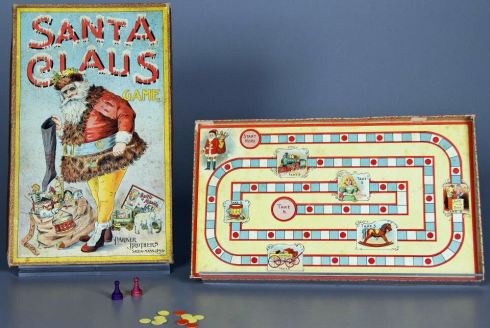
Christmas pantomimes never really caught on on this side of the Atlantic, and I don’t think a Christmas dinner party game called The Feast of Reason. A Christmas Dinner Party Puzzle did either, as I have been able to locate only two copies, one in the collection of the Boston Athenaeum and one which sold to a private buyer at auction a few years ago. Both were published by the Salem firm C. M Whipple and A.A. Smith in 1865, after a charming drawing by the artist William Emmerton (featuring marginalia that looks like a medieval manuscript) and lithography by the J.H. Bufford firm. There are multiple riddles for each course, and I have yet to figure out even one. Later in the century, another Salem producer, Parker Brothers, manufactured several games for Christmas time, including The Santa Claus Game and The Night before Christmas.

Feast of Reason BA

Feast of Reason 2p

Christmas Games Santa Claus Parker Brothers

Christmas Games Parker Brothers 1896 BGG

As the Parker Brothers’ games illustrate, by the twentieth century Christmas games seem to have evolved into children’s games primarily, rather than family or parlor games. There are a few exceptions, but there seems to be a holiday segregation of sorts, with the children preoccupied with gaming and gifts and the adults occupied elsewhere (purchasing, preparing, drinking?). At least everyone comes back together for the feast, followed by a little Crackers merriment, always over in Britain and increasingly over here.

Christmas Game 12 Days

Christmas Crackers V and A

Christmas games:  Christmas Circles, c. 1825, The Twelve Days of Christmas, c. 1950, and Batger’s Crackers, 1920s-30s, Victoria & Albert Museum Collection; Alfred Crowquil’s Pantomime, Harvard University; The Feast of Reason, c. 1865, Boston Athenaeum, Parker Brothers’ Santa Claus games, 1890s, National Museum of Play, ©The Strong.


The Merry Boys of Christmas

One of the most dramatic examples of raucous Christmas revelry happened in Salem Village on Christmas Day, 1679 when four youths barged into the home of John Rowden and started singing loudly before the fire. After a few off-key tunes, they demanded compensation in the form of spirits: perry, in particular, as Rowden maintained a profitable pear orchard and was known to make a pleasing pear cider. According to the record of the subsequent trial: it was Christmas Day at night and they came to be merry and to drink perry, which was not to be had anywhere else but here, and perry they would have before they went”. Rowden and his wife were not pleased with the songs, or the demands, so they sent the young men away, but they quickly returned with a scrap of lead which they tried to pass off as coin to pay for their perry. The Rowdens rebuffed them again, and then all hell broke loose. According to Mr. Rowden’s testimony, The threw stones, bones, and other things against the house. They beat down much of the daubing in several places and continued to throw stones for an hour and a half with little intermission. They also broke down about a pole and a half of fence, being stone wall, and a cellar, without the house, distant about four or five rods, was broken open through the door, and five or six pecks of apples were stolen.”  This was a case of Christmas wassailing gone bad, very bad, recounted by Stephen Nissenbaum in his wonderful book The Battle for Christmas as “The Salem Wassail” and a great example of why Puritans on both side of the Atlantic abhorred Christmas. Their power in both Parliament and the Massachusetts Bay Colony resulted in the great Christmas ban of the mid-17th century: from 1651 to 1660 in England and 1659 to 1681 in Massachusetts.

Vindication of Christmas

The Vindication of Christmas, 1652, lamenting the prohibition of its “keeping” in England during the Interregnum.

There were three major reasons why the Puritans hated Christmas. Their insistence on scriptural authority cast doubt on its date, as nowhere in the Bible does it say that the Nativity occurred on December 25th. They could only conclude, very reasonably, that some ancient winter festival, the Roman Saturnalia or the Winter Solstice, had determined this date, and that the Christian Church had merely adopted and assimilated it: consequently Christmas was perceived as a pagan holiday with a Christian gloss. Given their mandate to purify the Church of all its non-scriptural “traditions” and Popish trappings, it became a conspicuous target. The third reason was primarily social: the Christmas that the Puritans targeted was “Old Christmas”, or “Merry Christmas”, which they saw principally as a prolonged season–Christmastide, which could stretch beyond the twelve days of Christmas to encompass all of December and January–of disorder, misrule, and excess. In Cotton Mather’s words, the “Feast of Christ’s Nativity is spent in Reveling, Dicing, Carding, Masking, and in all Licentious Liberty….by Mad Mirth, by long eating, by hard Drinking, by lewd Gaming, by rude Reveling…..”.  By the time Mather  wrote this, “Old Christmas” had returned to England with the Restoration of the Stuart monarchy. Salem seems a little behind the times in 1679 when those young men wassailed the Rowdens so crudely; indeed in that same year the government of Charles II begin requesting that the Massachusetts General Court repeal its anti-Christmas law. If the Rowden revelers had been a bit less rude (and much better singers) one wonders if they would have been let off as mere “merry boys of Christmas”, the subjects of a popular British ballad who cast off all constraints in their keeping of Christmas: these Holidays we’l briskly drink, all mirth we will devise, No Treason we will speak or think, then bring us brave mine’d Pies: Roast Beef and brave Plum-Porridge, our Loyal hearts to chear: Then prithee make no more ado, but bring us Christmas Beer!

Christmas oldp

Christmas Merry 2p

Christmas merryp

carols

Keeping “Old” Christmas and the “Merry Boys of Christmas” broadside woodcut illustrations from 1680s; Christmas Carols return to Old England at about this time, but New England will have to wait a bit longer.

Dedicated to my friends at the Salem Historical Society and Creative Salem, big supporters of history AND revelry.


Hats off to Saint Catherine

There is a holiday more feminine than Thanksgiving and it is today: the feast day of St. Catherine of Alexandria, whose hagiography established her as the patron saint of philosophers and students in the Middle Ages, and of unmarried women and milliners in the modern era. An interesting evolution from the spiritual to the secular, like many medieval saints, with librarians and all penitents in need representing the transitional beneficiaries. According to her Legend, Catherine was a lovely young woman of noble birth in the early fourth century who converted to Christianity following a vision. She caught the eye of the Emperor Maxentius (r. 306-312) and her refusal to marry him resulted in her martyrdom: after she shattered the first instrument of her torture and execution, a spiked wheel, with a mere touch, she was put to the sword and beheaded. Catherine is seldom seen without these attributes as reminders of the strength of her faith, but there is also a genre of Renaissance depictions which show her rising above them and vanquishing the evil emperor.

Saint Catherine Pacher

Saint Catherine withe the Defeated Emperor

Friedrich Pacher, Saint Catherine of Alexandria, 15th-16th century, deYoung/Legion of Honor Museums, San Francisco; Master of the Legend of Saint Lucy, Saint Catherine of Alexandria, with the Defeated Emperor (c. 1482), Philadelphia Museum of Art.

I’m not sure of the precise transition, but at some point in the later eighteenth or nineteenth centuries, Catherine evolved in a patron saint for spinsters, or more precisely unmarried women over the age of 25. This was particularly a French development, and young women began to commemorate the day by praying to Saint Catherine for a husband, donning hats specially made for the occasion, and sending notes and cards to each other as a form of comfort and companionship. The emphasis on hats led to another evolution of Catherine’s patronage, and she became associated more specifically with unmarried women who worked in the fashion and millinery trades of Paris, where large “Catherinette” celebrations occurred on this day in the 1920s and 1930s, a “tradition” that was revived after World War II and apparently continues to this day. As would only be fitting for the women who worked in these creative industries, the hats worn by the Catherinettes were often (but not always) confined to Catherine’s colors of yellow (for faith) and green (for wisdom), but also exemplified unlimited forms of structure, substance and style. And still do.

Catherinets Paris Flammarion

Catherinettes 1950s

Catherinettes Etsy

Catherinette PC

Catherinette Paris 2013

Catherinettes in the 1930s (from Ernest Flammarion’s Paris (1931)) and 1950s; a modern print of vintage Catherinettes; a St. Catherine’s Day card from the 1940s, and a Chanel Catherinette creation, 2013.


Fabricating the Feast

Can there be any other holiday more closely associated with women than Thanksgiving? Forget the quasi-mythical “First Thanksgiving”, for which we only have references to men fowling and feasting–after that it’s all about women. What emerged as a New England tradition in the early nineteenth century was transformed into a national holiday through the intense efforts of author and editor Sarah Josepha Hale, eventually resulting in Abraham Lincoln’s Thanksgiving Proclamation of 1863. Several other New England ladies contributed to this effort, including Lydia Maria Child, whose “Over the River and through the Wood” we traditionally associate with Christmas but was first published in 1844 as “The New England Boy’s Song about Thanksgiving”. Successive presidents followed Lincoln’s precedent until 1941, when Congress established the fourth Thursday of November as a permanent Thanksgiving holiday. In the interim, a major medium for the adoption of a national harvest holiday seems to have been women’s magazines, chief among them Hale’s own Godey’s Ladies Book and later Good Housekeeping, The Ladies’ Home Journal (and Practical Housekeeper), (The) House Beautiful, and even Harper’s Bazaar. There was definitely a bit of culinary imperialism at work here: the ideal Thanksgiving menu published in Hale’s first novel, Northwood, was Yankee fare (cranberries!), but as turkey assumed the center stage (pushing out the very popular chicken pot pie and assorted other fowl) regional dishes could be assimilated as “sides”. And need I even say it? Women were making all those Thanksgiving feasts.

Thanksgiving HP 1894

Thanksgiving 1895 Bradley

Thanksgiving LHJ 1897-98

Thanksgiving 1904 Puck

Thanksgiving Pictorial Review 1906 Cover

Bearing Thanksgiving HP 1914

Thanksgiving gh 1937

Fabricating a very FEMININE Thanksgiving in the popular print media, 1894-1937: 1894-95 covers by Louis John Rhead and William H. Bradley, Metropolitan Museum of Art and Museum of Fine Arts, Boston; Ladies’ Home Journal Thanksgiving covers for 1897 and 1898; 1904 Puck Magazine cover, Library of Congress;  Pictorial Review and Ullman Manufacturing calendar page for November 1906; Harpers Bazaar and Good Housekeeping covers, 1914 and 1937, Library of Congress and Good Housekeeping archive.