
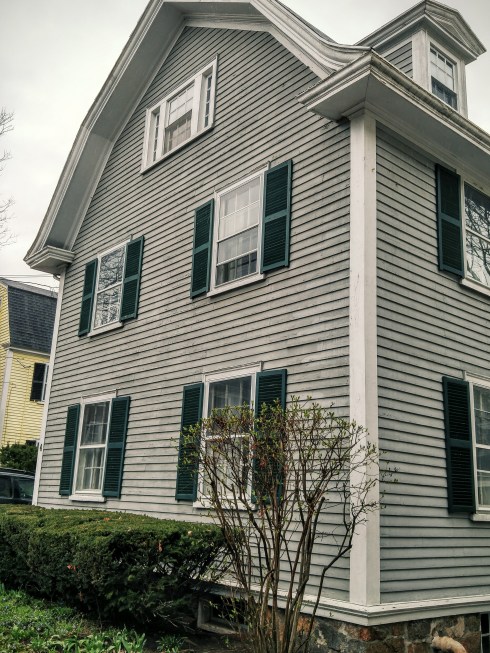
I tend to romanticize architects and the practice of architecture. When I first went to the house of my now-husband, who is an architect, I expected it to be Monticello-like, with a study in which a drafting table took center stage, surrounded by lovely hand-drawn renderings on whitewashed walls. My vision was not realized, and of course he is generally bent over a computer rather than a drafting table. It’s impossible to romanticize his work now that I know much more about it, so while I maintain a wifely interest in his business and projects, I also tend to drift away, back, towards architects who lived in ages past, who can easily engage and distract me. Just yesterday I walked over to take a picture of a Salem house which was built and occupied by a very prominent horticulturist and landscape architect, Harlan P. Kelsey, about whom I wanted to write a post (it is spring after all, even if it is a frigid spring, and so time to turn to gardening). But the more time I spent looking at the house, the less I was interested in its occupant and the more I was interested in its architect. And so I forgot Kelsey (for now–I’ll come back to him because he is pretty amazing), and began to focus on Ernest M. A. Machado, the likely architect of One Pickering Street and a man who is very easy to romanticize because he died relatively young, very tragically, and with much apparent promise.
Fortunately Machado’s life his well-documented: he seems to come from a family that wanted him (and all of its members) to be remembered: there is a nice genealogy and some pictures here, and the family donated his own photographs of completed projects to his alma mater, MIT. Ernest Machado was born just up the coast in Manchester-by-the-Sea to a Cuban émigré father and a North Shore mother who was orphaned but nevertheless connected. Juan Francisco Machado and Elizabeth Frances Jones met and married in Massachusetts, returned to Cuba for a decade, and then settled in Massachusetts permanently to raise their large family, first in Manchester and later in Salem. The Machado house is one of my favorite in Salem: a stunning brick Federal on Carpenter Street. Ernest attended Salem schools and then the Massachusetts Institute of Technology, graduating from its pioneering architecture program in 1890. After working for at least two prestigious Boston architectural firms, he established his own practice in partnership with his future brother-in-law Ambrose Walker, with offices in Salem (on Church Street), Boston and Ottawa (where his brother was an established banker). In the later 1890s he seems to be working feverishly, with commissions in several Boston suburbs, Salem, and all along the North Shore. This pace continued in the new century, all the way up to his death by drowning in Lake Ossipee in New Hampshire in September of 1907: he was 39 years old and had just completed his most challenging commission: the 14,000 square foot brick mansion of Governor Charles B. Clarke on Portland’s Western Promenade.


The Kelsey House on Pickering Street & Machado family home at 5 Carpenter Street.
Machado’s mark on Salem is not hard to find. Besides the Kelsey house and a few other residences in the McIntire Historic District and the Phippen house on the Common, he supervised substantial renovations to the Salem Club and the Bulfinch Bank on Central Street. He rebuilt the Salem Lyceum on Church Street, and as a testament to his versatility, designed both a commercial building on Washington Street for the dry goods retailer Charles W. Webber and the Blake Memorial Chapel in Harmony Grove Cemetery. Yesterday I trudged over through driving rain to contemplate the chapel, and then walked up the hill to his grave, part of a family plot of elegant markers which apparently he also designed (and unfortunately very wet by the time I got there).



Machado in Salem: 16 Beckford Street and Four Carpenter Street; his own photograph of the Webber store on Washington Street, from the MIT Machado Archive; The Blake Memorial Chapel at Harmony Grove Cemetery and the (very wet) Machado grave(s) at Harmony Grove.
Looking at his Salem work as well as the portfolio of North Shore commissions (lots of residences and clubhouses for both the Salem Country Club and the Manchester Yacht Club) in the digital archive at MIT, it’s hard to discern a distinct Machado style: there are Colonial Revival houses in both the classical and Tudor traditions as well as lots of Shingle residences reflecting contemporary trends. But remember, he was a young architect, just establishing his practice and business and no doubt catering to the desires of his clients. Who knows what he would have achieved over the next thirty or so years of his working life? He could have maintained and expanded his practice as a Gold Coast residential architect, or he could have rebuilt Salem after the Great Salem Fire of 1914. Or both.


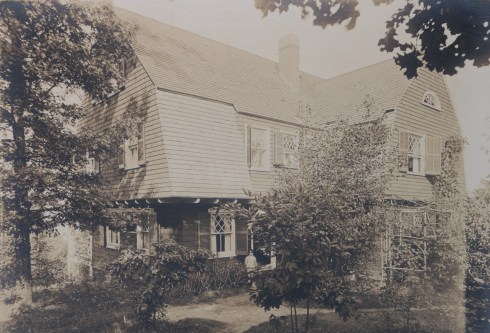


Machado’s photographs of his own work at the Machado Archive at MIT: the Agge, Allen, R. Wheatland, and Sanden houses, and two unidentified houses (one of which looks just like a house in my hometown, York Harbor, Maine); a Tudor house in Lynn, from American Architect and Building News, 1906.
Appendix: you can stay in Machado’s recently-restored Clarke “Manor” (below) in Portland via airbnb; My Machado-obsessed day ended appropriately with a birthday party at one of his buildings: the Salem Lyceum, now Turner’s Seafood.






