Tag Archives: Decorative Arts

A Cabinetmaker is Captured

Even though a Salem company of militia men did not make it to Lexington and Concord in time to participate in the battles that commenced the Revolutionary War (I still can’t figure out what Timothy Pickering was doing on that day), there are still some important connections and contributions to note on this Patriots Day, including the publication of one of its most essential primary sources, the coffin-embellished broadside Bloody Butchery of the British Troops: or, The Runaway Fight of the Regulars, by Salem printer Ezekiel Russell. Russell documents the death of Salem’s one casualty of the day, Benjamin Pierce, but a source from years later established another important connection: Elias Phinney’s History of the Battle of Lexington, on the Morning of the 19th of April, 1775, published for the occasion of the 50th anniversary of the battles in 1825. Phinney took oral histories from participants who were still alive, published in the form of sworn affidavits in the book’s appendix, and the very first account was that of Elijah Sanderson, who was at the end of a long career as one of Salem’s most successful cabinetmakers. Sanderson’s testimony was given just weeks before his death in early 1825, and published not only in Phinney’s account but also in the regional newspapers that year, when historical consciousness of the importance of the Battles of Lexington and Concord seems quite well-developed.

Sanderson Phinney

Sanderson Essex Register Essex Register

Elijah Sanderson and his younger brother Jacob were among the most prolific and consequential cabinetmakers of Salem, who spread the city’s craftsmanship and style far beyond New England through an expansive export trade in alliance with their partner Josiah Austin and several prominent merchants and shipowners.  Through their collaborative business, and with half-shares in several Salem ships themselves, they sent cargoes of furniture to the Southern seaports, the West Indies, Africa, and India in a series of voyages that are well-documented in the Phillips Library and have been analyzed by scholars Mabel M. Swan, Thomas Hamilton Ornsbee, and more recently, Dean Lahikainen. Their success was clearly tied to Salem, but in 1775 the Sanderson brothers were living in Lexington, in the home of their elder brother Samuel, when Elijah found himself swept up in the events of April 18 and 19, for a time even finding himself in the captive company of Paul Revere! I love his testimony because it rings true in its lack of heroism and drama: it must be true because it is recounted in such a detailed yet mundane manner! The Sanderson house was on the main road from Boston, and relatively late on the evening of the 18th Elijah noted the passing of a party of British officers “all dressed in blue wrappers”. He decided to discern what was up, so made his way to John Buckman’s tavern where an older gentleman encouraged him to “ascertain the object” of these officers, so he did so, on a borrowed horse in the company of two other comrades. There was general concern that the British were after John Hancock and John Adams, who had been “boarding some time at Parson Clark’s”. Elijah’s party was stopped by nine British officers a few miles down the road in Lincoln, and they were detained and examined, along with two other “prisoners”, a one-handed pedlar named Allen and Col. Paul Revere. After “as many question as a Yankee could” ask, the entire party mounted and made their way to Lexington, where the British officer named Loring observed “The bell’s a ringing, and the town’s alarmed, and you’re all dead men” but let them go, after cutting the bridle and girth of Elijah’s horse. We hear no more of Revere, but Elijah made his way to the tavern in Lexington and there promptly fell asleep! Yes, he fell asleep in the middle of the opening act of the American Revolution.

Buckman-Tavern-1

Sanderson Lexington The taproom of the Buckman Tavern, where Elijah Sanderson fell asleep by the fire; early 19th century view of the Battle of Lexington, New York Public Library Digital  Collections.

Well not for long: Elijah awoke to the sound of drums and ran out to Lexington Common where he fell in, without a gun, but then stepped out “reflecting I was of no use” to become the perfect eyewitness bystander of the Battle of Lexington. He heard the British commander say “Fire” and then all was smoke and fire. After the British left for Concord, Elijah ran home to get his gun,, but it was gone (his brother took it) and so he returned to the center of town to “see to the dead”. A few hours later he witnessed the retreat of the British from Concord, firing houses as they made their way back to Boston. He ends his testimony with two statements that he clearly wanted to get on the record: 1) he spoke with one casualty of the day several days prior: a certain Jonas Parker who “expressed his determination never to run from before the British troops” and; 2) his wayward musket was still in his possession, and his brother “told me he fired at the British with it” on that fateful day. What a life this man led: his experience in Lexington, combined with his brilliant Salem career, could provide the basis for an absolutely amazing book. Reading between the lines of the Sanderson scholars, I’m guessing it was the younger brother, Jacob, who was the better craftsman and workshop manager, while Elijah was the traveling dealer and supercargo, with the responsibility of selling their wares up and down several coasts. Jacob died in 1810, and Elijah carried on through a series of less profitable (or at less amenable if the legal notices are any indication) partnerships. Lexington pops up in each and every obituary notice of this memorable man.

Sanderson Label Winterthur

Sanderson Collage

20190413_120059

20190413_120006

20190413_120122

20190413_120224

Sanderson Salem Observer Feb 19 1825

“E & J Sanderson” label on a Salem-made pembroke table, Winterthur collections; Sanderson pieces from the New England Historic Genealogical Society, Christie’s Auctions, and the State Department; The Elijah & Jacob Sanderson House on Federal Street, 1783 (a very rare— I think—back-to-back double house which received Historic Salem Inc.’s first plaque!); just one Sanderson obituary.


Fabricating Revere’s Ride

Because of his entrepreneurial engravings, his silverwork, portraits of him and by him, his storied ride, and his boundless brand, Paul Revere as always been the most material of our Founding Fathers: he didn’t just act, he produced, and after his legendary life was over he continued to be a focus and force of production. As we head into (a rather early) Patriots Day weekend, I am thinking about Revere, mostly in reference to Grant Wood’s 1931 painting The Midnight Ride of Paul Revere, which supposedly aims to highlight the mythology overwhelming the event from the publication of Longfellow’s 1863 poem. The painting is so very accessible, however, that I fear that it simply reinforces Revere’s singular ride, or it has just become an aesthetic object: Wood himself transformed the image into a textile design (in which the rider gets lost in the landscape) for the Association of American Artists, and now you can even buy laminated placemats of it on Etsy! Revere the Midnight Rider was featured in a design by Anton Refregier in another “Pioneer Pathways” design, issued in several colorways by Riverdale Fabrics in 1952. A few decades earlier, Walter Mitschke also included Paul Revere’s ride in drawings for his “Early America” series of textile designs produced by R. Mallinson and Company.

Revere Wood

Reveres Ride of Paul Revere Textile

Revere the Rider Pioneer Pathways

Revere Red

Reveres Ride Mallinson

Grant Wood, The Midnight Ride of Paul Revere, 1931, Metropolitan Museum of Art. Textile designs by Grant Wood and Anton Refregier for the Association of American Artists, produced by Riverdale Fabrics as part of the “Pioneer Pathways” series, 1952, Cooper Hewitt Museum; Walter Mitschke’s drawings for the Mallinson Company, 1927, Museum of Fine Arts, Boston. 

Obviously Paul Revere’s Ride is larger than the man himself in terms of its myriad representations in text, image, and fabric, but I think the most effective displays are those that were created close to home: Robert Reid’s 1904 mural in the State House, the iconic statue of Cyrus Dallin, the Paul Revere pottery produced by the Saturday Evening Girls Club, all those calendars issued by another institution with a founding- father-affiliation, the John Hancock Life Insurance Company. For a more updated presentation of the route rather than the ride, there is an exhibition of drawings by artist and illustrator Fred Lynch on view now at the Scottish Rite Masonic Museum & Library in Lexington (which used to be called the National Heritage Museum) titled “Paul Revere’s Ride Revisited”.

Massachusetts-State-House-Mural-Paul-Reveres-Ride-Boston-MA-2016-09-26

pp-caproni-and-brother-painted-cast-plaster-relief-panel-paul-reveres-ride (1)

Reveres Ride Tile MFA

Revere Calendars

Robert Reid mural in the Massachusetts State House, 1904, Caproni Brothers plaster bas-relief sculpture, Skinner Auctions, Tile by Paul Revere Pottery of the Saturday Evening Girls Club, 1917 (decorated by Sara Galner), Museum of Fine Arts, Boston; 1889 & 1903 calendars by the John Hancock Life Insurance Company, Historic New England.


Portuguese Pavement

Like everyone else in the world, I admire Portuguese sidewalks, paved in mosaic patterns of polished white and black limestone, hand-cut and hand-laid: calçada Portuguesa is definitely an important part of Lisbon’s municipal identity, with a bronze installation of two pavers (calceteiros) at work situated in one of its central squares. We had great weather last week, but I’ve been on these sidewalks in the rain before, and I know that they are definitely slippery when wet. Consequently they have their critics, but I think the more serious threat to their continuing existence comes from the production side, as low wages, arduous work, and long hours have diminished the number of calceteiros working in Lisbon in recent decades. One article asserts that there are a mere ten pavers in Lisbon today, compared with 400 in the eighteenth century. I saw several pavers working while I was there, and they looked just like this bronze pair below: craftsmanship from time immemorial, still very evident along the streets of Lisbon.

Port Pav 9

Port Pav 6

Port Pav 2

Port Pav

Port Pav 8pixlr

Even the beautiful store Vista Alegre was inspired enough by Portuguese sidewalks to design and produce an entire line of dinnerware with some traditional motifs: just stunning. It was hard to resist these plates but I was worried about breakage: and now I see I can buy them here!

Port Pav 4

Port Pav 3

Port Pav 5


City of Seven Hills

I’m just back from a wonderful vacation to Lisbon during which I took hundreds of photographs, so advance warning to those who are more interested in local history and culture: this is definitely going to be a “streets of Lisbon” week! I’ve been to Portugal several times before, but my last visit was quite a while ago, and I never spent more than a few days in the capital so there were many discoveries: plus Lisbon is incredibly photogenic as it is so full of texture and color. I walked everywhere so I could capture every little detail, only popping on a yellow tram near the end of a long day when I was looking up at yet another hill (there are seven, just like Rome) which had something I had to see at its top. We had wonderful weather, and Lisbon appeared very bright and shiny, with its multichromatic buildings, both tiled and color-washed, contrasting with its black and white sidewalks and squares. Yellow popped out particularly, not just on the trams but also on private and public buildings and even the cranes which hovered over sections of the city. Like so many other cities, Lisbon appears to be having a building boom, encompassing both the construction of new structures and the “renewal” of others. It’s a city that has always embraced the new and cherished the old in a particularly effective way, certainly since the devastating earthquake of 1755 and no doubt well before, as it is an ancient settlement. I’ve got my favorite photos from the trip today, and my next posts will focus on the sidewalks and shops of Lisbon, then I’ll get back to some Salem stuff (though I think I have enough photos to feature Lisbon for some time).

Yellow City 20

Yellow City 33

Yellow Lisbon Black Horse Square

Yellow City 2

Yellow City 25

Yellow City 5

Yellow City 26

Yellow Lisbon 2The arch of the Praça do Comércio, the Square of Commerce, is the proper entry to Lisbon, from the sea, but it’s a nineteenth-century construction after the rebuilding of the square following the earthquake of 1755. A great mural in the Museu Nacional de Arte Antiga shows the pre-1755 square. The Church of The Church of Nossa Senhora da Conceição, the ruins of the Cormo Convent (another memorial to the losses of 1755), the interior of Lisbon Cathedral, just another beautiful church square, and a quote by the 18th century Jesuit father Antonio Vieira “Para nascer, Portugal. Para morrer, o mundo” testifying to the still-evident Portuguese pride in its global reach.

Yellow City

Yellow City 9

Yellow City 10

Yellow City 8

Yellow Lisbon Castle2

Yellow City 31

Yellow Lisbon Castle

Yellow Lisbon Church

Yellow City 4

Yellow City 3I’m trying to show the integration and proximity of new and old with these pictures, which include several streetscapes, views from the Castelo de S. Jorge, the Church of São Vicente of Fora, and a shot of the botanical garden, but they also present a lot of yellow, a very conspicuous color in Lisbon.

Yellow Lisbon Belem 3

Yellow City 32

Yellow Lisbon Belem

Yellow Lisbon Belem 2

Yellow Clevely Belem

Tarts

Yellow Lisbon CarriageBelem: site of the iconic Manueline Jerónimos Monastery and Belem Tower + tarts and the maritime history and coach museums, and a very strident 20th-century monument to the discoveries. 

Yellow Lisbon Museum

Yellow City 24

Yellow City 23

Yellow City 21

Yellow City 40

Yellow City 12

Yellow City 22

PharmacyMuseums:  so many! History museums and museums of every conceivable form of art: “ancient” (pre-1850), modern, decorative, TILES, marionettes. The famous Gulbenkian collection and several less well-known house museums: I was blown away by the CasaMuseu Medeiros e Almeida in particular. I have a new appreciation for Portuguese artists of the Renaissance (Gregório Lopes in particular: look at that Martyrdom of St. Sebastian). And I couldn’t leave without visiting the Museu da Farmácia, of course. 


Really Rubbish Royal Relics

Sometimes, no all the time, I think that I’m devoting too much time to social media, but occasionally you find yourself in the middle of some very interesting exchanges. The other day a really funny thread about the sheer dreadfulness of English delftware coronation plates from the late Stuart era unravelled on Twitter, and I couldn’t help but jump in, as I had just seen this William & Mary plate in a Sotheby’s auction and I needed some context and “conversation”!

William and Mary Sotheby's 2

Oh no, poor William, and even poorer Mary, with so much exposed. Neither looks very happy–or dignified. These crude plates started to appear with the Restoration, when people apparently sought them as symbols of a revived and “colorful” monarchy after years of dour Cromwellian rule. Many of the images of King Charles II in his coronation robes appear naive but charming, but by the time his niece and nephew were crowned, it looks like aesthetic standards have deteriorated quite a bit—or perhaps the potteries could not keep up with demand. When we look at these items now, they look comical, rather than reverential. The curatorial contributors to our Twitter exchange labeled these plates “Really Rubbish 17th-century Royal Memorabilia” so I am following suit, but I can’t help but also notice a distinct differentiation of display by gender in these plates: after Queen Mary’s untimely death (from smallpox, at the age of 32 in 1694), King William is depicted in a more stately fashion alone, and after he is succeeded by (poor) Queen Anne, we once again see the return of extensive decolletage. Why such excessive immodesty?

Coronation Plate Collage

William and Mary Charger BM

William and Mary Winterthur

editrs365881_603191-lpr_0

Queen Anne V and A

Delftware Queen Anne Ashmolean

William and Mary Coronation plates, c. 1690-94 from (clockwise): Samuel Herrup Antiques; Sotheby’s; and the collections of the Victoria and Albert Museum; Queen Mary does come off a bit better (or at least more covered up) in SOME of the coronation plates in which she and William are standing, but it varies, as these two examples from the British Museum and Winterthur illustrate (and occasionally he is handing her the orb, which is good). It’s hard to make Queen Anne look good, but I don’t understand why she has to display such extravagant cleavage in these delftware plates from the Victoria and Albert collections and the Ashmolean Museum of Oxford University.


Enquiries and Enslavement

I’m in the process of teaching myself how to create digital maps with layers of history so I can visualize different times, places, events and environments. Such maps are a great teaching tool, and I also think it would be a great way to put all of the discoveries I’ve made while blogging into a more compact form. “Spatial history” is a very big trend in historical interpretation and the digital humanities, but it’s going to take me quite some time to reach this level of presentation. I thought I’d start small with a series of maps of Salem with one layer each: how many first period houses survived in say, 1890, houses of notable women of Salem from different periods, and houses (or locations) where enslaved people lived and worked before the abolition of slavery in Massachusetts in 1783. I decided to start with the latter topic because I thought it would be manageable, but it is not: there were far more enslaved people in colonial Salem than I thought—but this makes it all the more important that we place them.

Slave Adverts White Collage

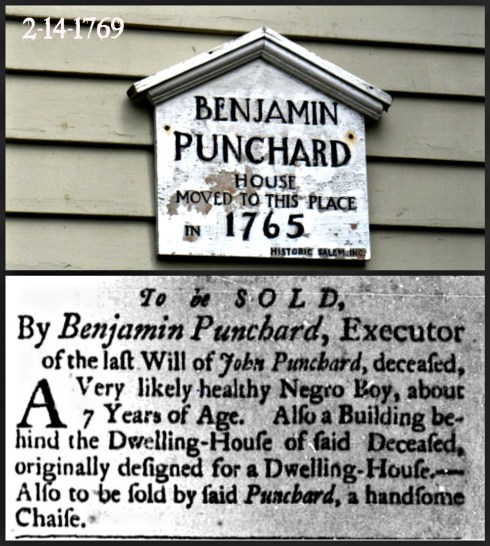
I’m still working on my “data set”, having searched through newspapers (for both “for sale” and “runaway” advertisement, vital statistics, and the amazing 1754 census at the Phillips Library in ROWLEY (yes, I’ve been there; I will report later). The latter breaks down Salem’s residents into five categories: “rateable”, males under 16, females, widows, and negroes, and according to its survey, there were 3462 people in Salem in 1754, of which 123 were African-Americans. The word “slave” is never used; only servant. There are discrepancies between this survey, the advertisements, and the vital statistics, so I’m not sure how I’m going to be able to come up with an absolutely accurate number: this might have to evolve into a collective or crowd-sourced project. I’ve identified some of the larger slave-owning families though: an analysis of their papers (most are also in the Phillips) would undoubtedly reveal more information

Slave Adverts Punchard

Slave Adverts June 13 1769 Essex Gazette

Slavery 1 collage

Slave Adverts Oct 29 1771All Essex Gazette

Enquire of the PrinterRunaway slave advertisements are very detailed; for sale notices less so. It’s almost as if people don’t want to give their names out, with some notable exceptions, like Captain David Britton, who was definitely more than personally invested in this trade. The map will require me to place the enslavers and the enslaved, but I don’t have much information on Britton: all I’ve found so far is a reference in Phyllis Whitman Hunter’s Purchasing Identity in the Atlantic World. Massachusetts Merchants, 1670-1780 to his membership in a Salem club called “The Civil Society” which met at a local inn on Tuesdays and Fridays ” for friendship and conversation”. There were club rules against cursing and unrefined behavior, but apparently not against slave-trading.

Slave Adverts Boston Evening Post July 24 1738

Slave Adverts Pompey and Horse

Slavery Waite

Slave Adverts PhelpsBoston Evening Post and Essex Gazette

Once you start researching this topic, it shapes how you look at your environment. I’m sure people in the South are used to this, but not people in New England. There were enslaved people in the House of the Seven Gables, and the very wealthy merchant Aaron Waite, whose long partnership with Jerathmiel Pierce has inspired the naming of Salem Maritime’s gift shop, enslaved at least one person, named Pompey. Nathaniel Hawthorne’s great-grandfather Jonathan Phelps, let out both his blacksmith shop and his “excellent workman” in 1773. Several enslaved men were compelled to work for their master Samuel Barnard in the Ropes Mansion, and he also loaned them out to his nephew way out in Deerfield. Richard Derby owned at least one slave, as did William Browne, Jonathan Clarke, Daniel King, Edward Kitchen, Josiah Orne, William Pynchon, and Bezaleel Toppan, and many more residents of mid-eighteenth-century Salem, both wealthy merchants and less conspicuous craftsmen. The fabulously wealthy Samuel Gardner (1712-1769), whose house was located on the corner of Essex and Crombie Streets and whose many possessions are easy to find in auction archives and museum collections, listed several enslaved men among his possessions in his will: he left his “Negro boy Titus, as a servant for life” to his “beloved wife Elizabeth”, but freed a man named Isaac, adding the provision that if Isaac was “unable to support himself, that he be supported by my sons George, Weld, and Henry, in equal shares…..so as to free the Town of Salem from any charge”.

Slavery Ropes

Samuel Gardner's Sugar Box.Samuel Gardner’s sugar box, collections of the Museum of Fine Arts, Boston.


Allegorical Arrows

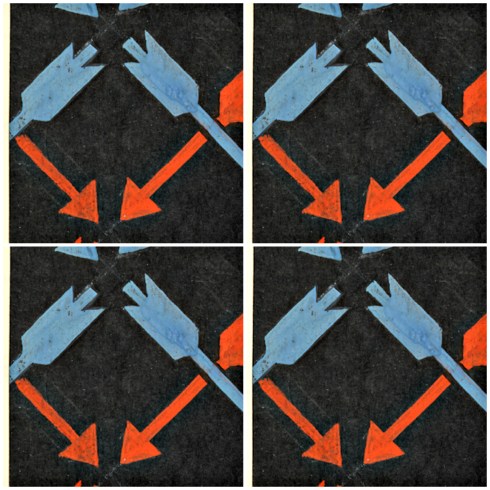
Historical imagery often contains symbols and emblems that we don’t understand:  we must learn to read them; whereas a contemporary audience could simply see them and understand the message within. I enjoy teasing out the meanings behind images from the past both here and in class–though here I’ve got a bit more creative freedom, and can chart the evolution of images all the way up to the present, when they have often lost their associations and exist simply as images. A great case in point (literally) is the simple and straightforward arrow: once I’ve swept away my seasonal decorations at home I’m often left with a bunch of arrows here and there as they are seasonless, timeless, and largely meaningless: I simply like their form. This is an Americana week for several auction houses, and yesterday as I was perusing the digital catalog for an important auction of folk art at Sotheby’s (The History of Now: The Important American Folk Art Collection of David Teiger|Sold to Benefit Teiger Foundation for the Support of Contemporary Art) all I could see was arrows, which for the most part had assumed their modern directional meaning on myriad weathervanes.

artful arrows horse weathervane

artful arrows diana the huntress sothebys

artful arrows soaring bird sothebys

artful arrows goddess of liberty sothebysPrancing Horse, Diana the Huntress, Soaring Bird, and the Goddess of Liberty weathervanes from the Teiger collection, Sotheby’s.

Another lot in this same auction is an incredible later nineteenth-century Chinese wall plaque representing the Great Seal of the United States, with the emblazoned bald eagle clutching a cluster of arrows in his left talon—thirteen to be exact, representing the thirteen colonies, but also strength through unity. There is an explicit sense of martial strength on display as well, projected through the contrast with the olive branch in the eagle’s right talon. The Great Seal’s designer, Charles Thompson, was influenced in his use of arrows by other confederations such as the Iroquois (with their five nations) and the Dutch Republic (with its seven provinces) as well as by early modern emblem books such as Joachim Camerarius’s Symbola et Emblemata (1590-1604), merely substituting them for the more classical lightening bolts.

artful arrows chinese eagle sotheby's folk art auction 20 jan

Obverse Great Seal.tif

arrows symbols 16th c.The Chinese Great Seal and Charles Thompson’s original sketch, US National Archives; Joachim Camerarius, Symbola et Emblemata.
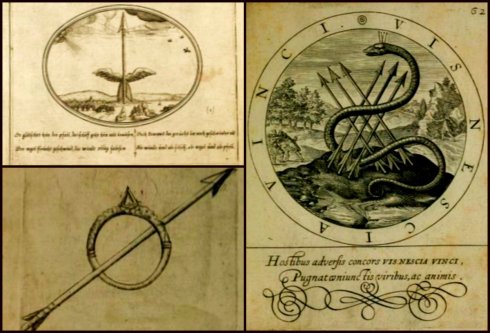
Emblem books are one of the rabbit holes of early modern literature, as you will see if you go here: but you can also find many arrows, representing not only military force, but also time and inevitable mortality, flight, children (Psalm 127), punishment, and of course love, when in one of the countless cupids’ bows. Medieval arrows are never ambiguous: they represent force and violent death in general, and martyrdom in particular. Saint Sebastian (died 288) and King Edmund the Martyr (d. 869) were both attacked by hordes of pagan/heathen archers, and so often depicted as shot so full of arrows they resemble porcupines; arrows remained their essential attributes as their cults developed over the medieval era. In the later medieval era, Sebastian re-emerged as the most popular plague saint, as the arrow came to symbolize the plague itself: the most dramatic expression of this motif is a fourteenth-century fresco on the wall of the former Benedictine Abbey of Saint-André-de-Lavauadieu in France, depicting a faceless woman armed with the arrows of plague and her pierced victims all around her.

arrow 2 collage

love removed

arrows of black death

arrows pub

Some early modern arrow emblems: “Ich fliehe sehr schnell”– Fly far and fast; “Vis nescia vinci”–force cannot be overcome with force; “Supplicio laus tuta semel”—he that was worthy of praise was one free from punishment; Cupid holds up the world: “Sublato Amore Omnia Ruunt“–When Love is Removed, All things tumble down; the Lavaudieu fresco, and a street sign in Bury St. Edmunds, bearing the three arrow-crossed crowns that have come to symbolize the Anglo-Saxon king Edmund the Martyr.

Back to the future: I guess arrows are just arrows, or mundane symbols telling us where to go, BUT who knew there was a hidden arrow in the FedEx logo? Not me.

arrows collage

arrow fed ex

Mid-century textile design by Tommi Parzinger, Cooper-Hewitt Museum.


It started in Salem for John Derian

I’ve been a fan of decoupage artist and entrepreneur John Derian forever or what seems like it: since I bought my first piece at a little Marblehead shop named C’est la Vie, which is still very much up and running. And then I bought more glass trays: most from this same shop but I also took pilgrimages to his stores in New York City and Provincetown. Thanks to his collaborations with Target, I was able to obtain even more of Derian’s rediscovered prints, covering utilitarian objects like storage crates, coffee cups, and jewelry boxes. Beautiful stationery that I can’t even bring myself to use. So now there’s probably something Derian in every room in the house (except for those inhabited exclusively by my husband and stepson) but despite his omnipresence in my life I somehow never knew that it all began in Salem for John Derian! I knew he was from Massachusetts, Watertown in particular, but not until I read the forward to an engagement diary which my parents gave me for my birthday last week did I realize that a few colorful prints found at the Canal Street Flea Market in Salem in 1983 inspired his whole brilliant career!

Derian

Derian Collage

Colorful nineteenth-century floral prints found in a box of broken-up antique books and loose papers at a flea market in Salem, Massachusetts. I’m pretty sure this was the Canal Street Flea Market, which was before my time: I checked with Salem’s chronicler of record, Jim McAllister, to see if he had an image but no luck. This was a rather famous flea market though—I can remember hearing about it when I started poking around in markets a bit later than this—so I can understand how it might have drawn Derian up from Watertown. His description of how he was struck by the “power” of these particular images resonates with me completely—I’ve felt that power time and time again on my hunts. How impressive to be able to turn that reaction and appreciation into a decorative arts empire—and how neat that I can add this empire to the increasingly-long list of things that started in Salem.

John Derian around the house–not an exhaustive portfolio!

Derian 10

Darien 7

Darien 6

Darien 5

Darien 3

Darien 11

Darien 12

Darien 9

Darien Sheep


A Turnkey Homestead

I’m using the expression “turnkey” in typical contrary fashion here: it’s a real estate term which generally means a house that requires no repairs or refurbishment, just turn the key and you are home in your new purchase. The Rundlet-May house in Portsmouth struck me as a turnkey house in another sense: Ralph May, the fourth of his generation to live in the house, donated it to Historic New England (then the Society for the Preservation for New England Antiquities) in 1971 and now when you enter the house (or turn the key, in a sense) it seems as if you are within a space that he just left. This is an imposing Federal, made less so by the lived-in ambiance of a home to four generations of the same family.

Rundlett May 11

Rundlett May 14

Rundlett May 18The Rundlet-May House (1807) and views out back from its second and third floors.

Even though the house itself is an extravagant construction on large urban acreage, everything about its interior speaks to Yankee thrift: from the original peach damask wallpaper in one of the front parlors to the original Edison light bulb in a fixture on the second-floor landing–which is turned on once a year. It’s the perfect old-money house. John Rundlet, the self-made man who built (and apparently designed?) the house purchased and commissioned the best of everything (including a Rumford Roaster and a Rumford Range) and his descendants seem to have changed very little other than altering the use of its rooms to suit their activities and professions.

Rundlett May 12

Rundlett May 13

Rundlett May 10

Rundlett May 8

Rundlett May 9First-floor parlors, hall and kitchen (with Rumford Roaster) and fire buckets, of course. I found several early 20th-century postcards of the house which referred to Samuel McIntire as the carver of the right parlor’s mantle (above), but I think this is just an illustration of the Salem architect and woodcarver’s fame in the midst of the Colonial Revival era.

There’s probably too much furniture–beautiful as it all is—in the house: tables and dressers and painted chairs. Should a beautiful card table be situated just inches away facing an even more beautiful Portsmouth bureau in a narrow window nook of an upstairs bedroom? No necessarily, but this placement allows us to see both of these pieces. There’s also a lot of stuff. But it’s their stuff and their home, and we are all privileged to be able to enter within!

Rundlett May

Rundlett May 5

Rundlett May 15

Rundlett May 4

Rundlett May2

Ralph MaySecond and Third Floors, including Ralph May’s 3rd floor study, with all of his stuff. Below: this “musical” decorative motif ran through the house—it caught my eye because the same motif is on one of my Fancy chairs. (the last photograph).

Rundlett May 16

Rundlett May 17

Fancy Chair


Georgian Grandeur in Portsmouth

Portsmouth always struck me as a Georgian town, even from a young age, when I first developed an appreciation for historic houses at Strawbery Banke and first spotted what is still one of my very favorite houses nearby. There are Federal houses too, but it doesn’t feel as Federal as its sister seaports to the south, Newburyport and Salem. There is a range of Georgian houses in Portsmouth, from relatively simple to absolutely grand: on this past weekend I revisited three of the latter varieties: the Warner House (1716) the Moffatt-Ladd House (1763),  and the Governor John Langdon House (1784). Each house has a different owner, and a different………style, but all are exquisite representations of their era. The combination of the entirety of their construction with all the crafted details within—including the wonderful Portsmouth furniture in each house—is hard to capture: you’ll just have to visit each one yourself.

Georgian Portsmouth 14

Georgian ML

Georgian Langdon HouseThe Warner House, owned and operated by the Warner House Association from the early 1930s, The MoffattLadd House, owned and operated by the National Society of The Colonial Dames of America in the State of New Hampshire, and the Governor Langdon House, a property of Historic New England.

I loved the colors of the Warner House: rich jewel tones throughout. It’s not too pristine: you do get the feeling that you are imposing on the past (although there is quite a lot of plastic fruit). Those wild murals! The textures are wonderful too—especially of the smalted rooms upstairs. This is the oldest urban brick house in North America and it feels that way: both old and urban. You look out its windows and see a bustling city—this would not have been the case in the 1930s when it was rescued or even later: the Warner guide, like all the Portsmouth guides I encountered last weekend, stressed the fact that the city’s current vibrance contrasts with its more depreciated state in the 1970s—and I remember that to be the case.

Georgian Portsmouth 21

Georgian Portsmouth 25

Georgian Portsmouth 24

Georgian Portsmouth 19

Georgian Portsmouth 22

Warner 2collage

Georgian Portsmouth 20

Warner 3collageParlors and bedrooms at the Warner House, a scary squirrel, and always the threat of fire (the tool is to take apart your very valuable bed).

The Moffatt-Ladd House has been very much in the thick of things from its construction; once it faced the wharves of prosperous Portsmouth, but now the horse chestnut tree planted in 1776 by General William Whipple upon his return from signing the Declaration of Independence still stands guard at the entrance to its courtyard. It’s a very airy house inside due to its elevated situation as well as its large entrance parlor—and its beautiful rear parlor, now in the midst of restoration, runs parallel to the wonderful terraced garden outside.

Georgian Portsmouth 12

Georgian Portsmouth 11

Georgian Portsmouth 10

Moffatt-Ladd Stairs

Georgian Portsmouth 8

Georgian Portsmouth 13Moffatt-Ladd parlors and stairs, front parlor original wallpaper and the parlor-in-process with its amazing mantle and Chinese Chippendale chairs; I always brake for fire buckets! The amazing garden.

I think Georgian houses have to be pre-revolutionary, but I’m the only one who thinks that, so I am including the Governor Langdon House, which was built the year after the American Revolution concluded. The scale is even larger here than Moffatt-Ladd, and the house reflects the passage of time, with Greek and Colonial Revival rooms as well as a dining room designed by Stanford White. It seems both national in inspiration but also very much a crafted Portsmouth house, as illustrated by those distinctive staircase balusters, contrasted below with those of Moffatt-Ladd (on the left).

baluster collage

Langdon Hallway

Georgian Portsmouth 7

Langdon Mantle

Georgian Portsmouth 4

Georgian Portsmouth Details

Georgian Portsmouth 3

Georgian Portsmouth 2Those Rococo mantles! And all that beautiful Portsmouth furniture. As you move back through the house, you move up in time, into Greek and Colonial Revival rooms.

While I was looking around for images of the houses in their earlier situations, I came across the works of two women artists among the digital collections of the Portsmouth Public Library: Sarah Haven Foster (1827-1900) and Helen Pearson (1870-1949). Both Portsmouth women clearly loved the architecture of their native city, and rendered it in series of charming vignettes, which were incorporated in their successive guidebooks. Wonderful discoveries: Foster’s naivete and Pearson’s detail both capture Portsmouth’s charm, past and (fortunately) present.

Georgian Warner Haven

Georgian Warner Pearson

Georgian Ladd Pearson

Langdon DoorVignettes by Sarah Haven Foster (the Warner House) and Helen Pearson (Warner, Moffatt-Ladd garden, Langdon doorway), Portsmouth Public Library Digitized Collections.