Tag Archives: Culture

Opening Day at Fenway

For everyone in New England (excluding pockets of Connecticut and Vermont where New York fans abound) and those regions of Red Sox nation beyond, tomorrow is an exciting day:  the opener at Fenway against the Yankees.  I always feel better knowing that baseball is on, even if I’m not watching.  And this is also an opportunity for me to showcase some really great photographs:  of the park but mostly of the players.

Fenway Park was built almost a century ago, in 1912, to replace the older Huntingdon Avenue Grounds.  A few years ago I wasn’t sure it would be standing for its centennial (it was placed on Preservation Massachusetts’s most endangered list in 1999) but its present owners seem committed to its preservation.  A century ago, it was the most modern of parks featuring all sorts of innovations for crowd accessibility and control:  reserved seating (with gold leaf lettering!), separate entrances for the bleacher, grandstand and pavilion seating (which some contemporaries feared was destroying the egalitarian sociability of baseball games).   I think of Fenway as the most intimate of stadiums, but at least one historian has noted that it and the other “modern” parks built just before World War I “standardized and depersonalized the sport while allowing more fans to see the game”, separated these same fans from the players, and “generally removed much of the previous informality”. (Robert  Bluthardt, “Fenway Park and the Golden Age of the Baseball Park, 1909-1915”, Journal of Popular Culture 21 (1987), a reference I owe to my SSU colleague Brad Austin) Still, Fenway is a far cry from the super stadiums of the later twentieth century, and for that I am grateful.

Some images of Fenway in its first few years (1912-14) from the Bain News Service archive at the Library of Congress; the last one features backup catcher Hick Cady who is so prominent in pictures from this era you would think he was Babe Ruth!

And now for some photographs of the old towne team in the same era.  From the collection of the Boston Public Library, photographs of the 1911 and 1912 Red Sox teams, the first on a down day in Los Angeles, the second in a (rather strange) diamond formation, and the third at the World Series of 1912.  The last photograph is a conventional roster shot of the 1913 team on a cigarette card from the New York Public Library.

The ability of the modern sports stadiums of the twentieth century, both early and late, to separate the players on the field from the fans in the stands must explain why I find the photographs of individual players (and managers) of the early century so particularly poignant.  The photographs below are from another archive in the Library of Congress:  a collection of photographs taken by Chicago Daily News photographers from 1902-33.  Among this collection are several of Boston Red Sox players at Comiskey Field.  Babe Ruth was there and is here, but the rest of the photographs I have chosen are of players (and one manager, Patsy Donovan) who are not quite as well-known:  after Patsy (1911), there is Harry Bartholomew Hooper (1912), Clarence “Tilly” Walker (1916) and Babe Ruth (1918).

I chose these particular photographs just because they seem so immediate and intimate.  Baseball players, politicians, average everyday people, it doesn’t matter:  people just seem to have a closer, more honest relationship with the camera in the earlier days of photography.  They are really there; look at Harry Hooper.

Baseball cards deserve another exclusive post, as they’re important forms of ephemera as well as cultural artifacts.  I’m going to include Harry Hooper’s card from 1912 here, however, just because of my particular fascination with him. 

Hooper is also an inspirational figure for the beginning of the season,  as he is the only player (SO FAR) to be a part of FOUR Red Sox World championship teams:  those of 1912, 1915, 1916, and 1918.


Bicycles Built for Everyone

While many European countries have had a consistent bicycle culture for a century or so, America’ s relationship with two-wheelers seems to run in cycles (pardon the pun).  I think we want to be a bicycling nation now, but this was certainly not the case twenty years ago and our national obsession with the automobile will never go away.  This weekend, instead of getting out on my bike (one of the few forms of exercise that I really enjoy) I read (or perused) two books on bicycles, both of which made a pretty strong visual case for the existence of a vibrant American bicycling culture at the turn of the last century.  Cyclopedia by William Fotheringham is an illustrated reference book about the history and trivia of bicycles, a pick-up-and-learn-all-sorts-of-little-things type of book, while Wheels of Change:  How Women Rode the Bicycle to Freedom (with a Few Flat Tires along the Way)  by Sue Macy explores the interesting relationship between women’s’  liberation and bicycling, a connection that is easily supported by the print and popular culture of the period.

An editorial cartoon from the June 19, 1895 edition of Puck magazine links the many varieties of the “new woman” (wearing pantaloons!) with bicycles, and a poster advertisement for the New York Ledger from a couple of years later features a woman wearing even shorter bloomers.  It appears that the bicycle aided the progress of dress reform, at the very least.

Actually the famous bicycless (?) Elsa von Blumen was one of the first ladies to blaze this trail, winning races against horses and other women racers on her high-wheel bicycle in the 1880s and marketing photographs of herself in full bicycle dress.  Bicycle racing of all forms seems to have been extremely popular in the two decades on either side of the turn of the twentieth century:  women against women, women against horses, men against men.

Elsa von Blumen in 1889

A very alliterative advertisement for the “Racycle”

The replacement of the high-wheel (penny-farthing) bicycle by the modern “safety” bicycle intensified interest in two-wheelers in general and racing in particular.  Bicycle clubs were very common and there was a brief window of opportunity just after the turn of the century  for bicycles to become the primary means of transportation, particularly in urban areas.  Advertisements and other forms of ephemera were very prevalent; Americans just seemed to like the image  of the bicycle, as the last poster below indicates.

Bicycle Races in 1895, Library of Congress

Library of Congress

After about 1910 or 1920, with the increase in the production of automobiles and the consequential decrease in price, bicycles seem to have lost their appeal as an adult form of transportation.  The advertising of that era onwards clearly indicates that bicycles were now marketed primarily to children.  Here in Salem, Parker Brothers took advantage of the emerging juvenile market by turning out bicyle-themed books and games.

No matter what product or service they were selling, late nineteenth -and early twentieth-century trade cards often featured children, as well as cute and fuzzy little animals.  Add a bicycle motif and you have an even more adorable image, if that’s possible.  The J & P Coats Thread Company’s bunny and kitten cards below, have always been among the most popular cards with ephemera collectors.

Back to the Future:  Britain’s “Tweed Run” movement (a crusade against bike shorts founded in 2009) spawns American’s “Tweed Ride” movement:


Fools for April

I’m not clever enough to come up with a real April Fool’s post, so instead I’m going to revert to custom and offer up some historical fools for All Fool’s Day. Of course, the first images of fools in western culture come from the Bible, specifically Psalm 52, in which the fool denies God (“The Fool said in his heart ‘there is no God'”).  So we see various fools appearing in illustrated psalters and books of hours from the 13th century onward, often with King David or his contemporary equivalent, often pointing up to an apparently Godless heaven, sometimes in league with the Devil, and increasingly looking foolish, as anyone who denied God would have to be.  

British Library Harley MS 1892, 14th Century

The Fool Enthroned, National Library of the Netherlands

From the Renaissance onward, the fool retains some of his religious connotations, but also becomes an entertainer, of both a harmless and critical nature:  by being foolish, he can put the spotlight on folly.  He is often in a court setting, as is the case from this illustration from the Chronicles of  Jean Froissart and the more unusual image of Henry VIII and his court fool Will Sommers playing out Psalm 52 in the king’s personal psalter, also from the collection of the British Library.

British Library Royal MS 14, 15th Century


Another Renaissance image of the fool comes from Sebastian Brant’s Ship of Fools, an allegory of clueless, frivolous fools adrift on a vessel, going nowhere in this world or the next.  The 1494 printed edition of the Ship of Fools included illustrations by Albrecht Durer (below is the “tempting fool” ) that I think were particularly inspirational in fixing the image of the fool, and the book also inspired the great work of the same name by Hieronymus Bosch (as well as a 1965  film by Stanley Kramer).  


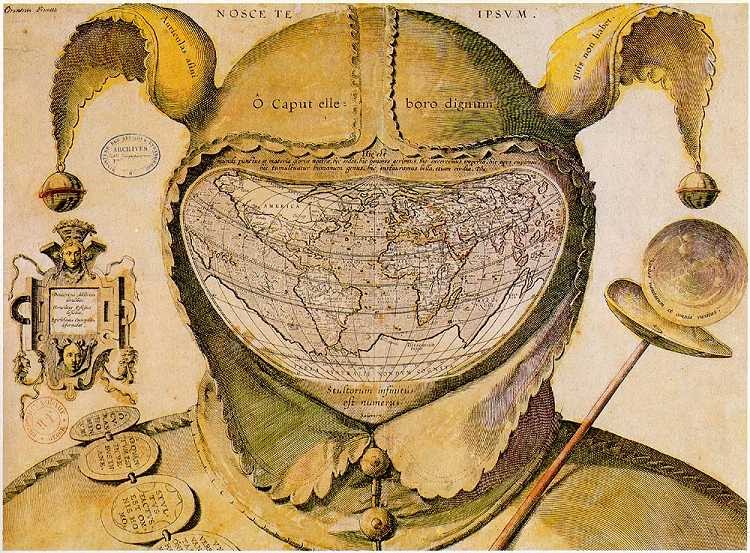
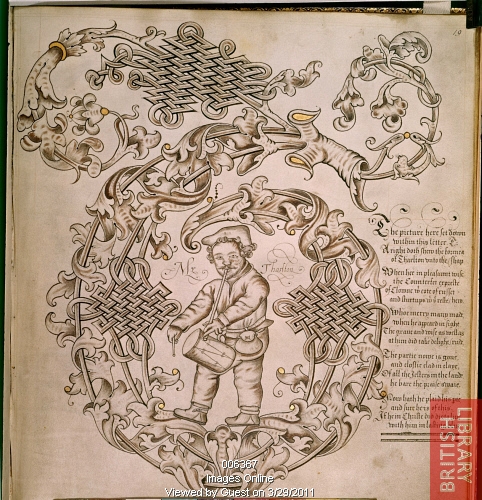
The Elizabethan stage featured two famous actor-fools, Queen Elizabeth’s favorite Richard Tarleton and William Shakespeare’s favorite Robert Armin, who defined what it was to be a fool, in all the role’s  incarnations, both onstage and off in his Foole upon Fooles (1600).  At just about this very same time, the famous (and anonymous) “World Map drawn in a Fool’s head” was published.

Richard Tarleton in costume, c. 1588

Bibliotheque Nationale, Paris

 Over the modern era, fools lost a lot of their luster and became simply fools, or else they were lumped together with the less nuanced clowns and jesters.  The periodical press in general, and editorial cartoonists and caricaturists in particular, could make their points very easily merely by using the fool.   Consequently more than anyone else, politicians became fools.  James Gillray, London’s leading popular printmaker during the “golden age” of caricature from about 1780 to 1820, certainly succeeded in making all politicians of his day, including King George III and the Prince of Wales, Prime Minister William Pitt, and Napoleon, look very, very foolish.  At the other end of the nineteenth century over here in America, turning politicians into fools was also a common practice (and still is).  Below is a striking image of two-time Democratic presidential candidate William Jennings Bryan portrayed as a fool (for his anti-imperialist stance, which was seen as foolish a century ago) on a 1900 cover of  Judge magazine.  And finally there is the simple fool of a early twentieth century cigarette card, made so by an April Fool’s day prank.

James Gillray, "The Prince of Wales", 1802, Princeton University Library

James Gillray, "The April Fool Consigned to Infamy and Ridicule", 1801, Victoria and Albert Museum


Witchcraft Schools

Sorry–my title does not refer to Hogwart’s School of Witchcraft and Wizardry but rather to two elementary schools on either side of the Atlantic Ocean:  the Witchcraft Heights Elementary School here in Salem and the Warboys Community Primary School in Cambridgeshire, England.  There has been some discussion in Salem about renaming Witchcraft Heights after a recently deceased city councillor, during which the School Committee member who proposed the change commented that the term “witchcraft” could cause confusion about “what type of school it is”.  Never mind that the proverbial cat has long been out of the bag regarding witchcraft terminology and iconography in Salem and the fact the school is situated in the city’s Witchcraft Heights neighborhood, this little flurry reminded me of a somewhat similar debate in Warboys.  Here are logos for the two schools in question, first Salem’s, then that of Warboys:

Look familiar?  Well, both communities are products of their history, and the marketing of that history.  A century before the Salem Witch Trials there was another sensational trial involving apparently possessed adolescent girls throwing fits and naming names.  The sensational “Witches of Warboys” case began in 1589, when the five daughters of local baronet Sir Robert Throckmorton demonstrated signs of a hysterical demonic affliction, and cast blame for their states on a poor neighbor, Alice Samuel, and her family.  The Samuels were powerless to prove their innocence, and found guilty and executed for witchcraft in 1593.  The circumstances of the trial, involving the lurid testimony of the girls, captured the attention of the kingdom and ultimately led to the publication of a very popular pamphlet and the passage of a much stricter English Witchcraft statute in 1604.


Sound familiar?  Well, there are lots of similarities between the Warboys and Salem witch trials but that is not the subject at hand.  Flash forward to the twentieth century, when both towns began employing witchcraft emblems for some (or in the case of Salem, ALL) of their public institutions.  Warboys, which is much smaller than Salem, certainly did not turn itself into Witch City, but the witch logo above was adopted for the primary school in 1946, and 60 years later the school governors began to question it, fearing that it might have been “putting off” prospective teachers and students.  A counter-campaign to keep the witch ensued, with the end result of a newly designed logo incorporating several aspects of Warboys’ history:  the witch, the tree for which the village was named, an open book (and crossed pencils) representing learning, and the village clock tower.  The children of Warboys designed and approved the new symbol for their school, which might be a good solution for Salem.


Colonial Dress Up

The previous residents of the street where I live periodically dressed up in “colonial” costumes and opened their houses to the public in the 1920s, 1930s, 1940s–as late as the 1970s, I believe.  These were “Chestnut Street Days”, and various variations of this event occurred all over the country in the first half of the twentieth century.  For lots of cultural and historical reasons (patriotism, the desire to escape the dark days of depression and war, the constant drive to define what is “American” in an increasingly diverse nation, perhaps it was just fun), Americans loved to dress up in colonial costumes in the last century.  Below is a photograph of  Chestnut Street Day in the 1940s from The National Geographic  Magazine:

All this dressing up was probably inspired by several specific developments.  No doubt the “living history” museum movement had an impact, with the establishment of Colonial Williamsburg in the 1920s, Salem’s own Pioneer Village in 1930, and Old Sturbridge Village and Plimoth Plantation in the 1940s.  The popular works of Alice Morse Earle, including Customs and Fashions in Old New England (1893), Home Life in Colonial Days (1898), my favorite Curious Punishments of Bygone Days (1896), and Two Centuries of Costume in America (1903) must have been influential as well, because they were so popular and because they shifted the historical focus from big events to “daily life”.


Alice Morse Earle images:  a 1907 edition of Home Life in Colonial Days with a photograph of a young boy in colonial clothing playing a colonial game, and the punishment for drunkenness from Curious Punishments of Bygone Days.

The other major motivator for colonial dress up days must have been Wallace Nutting (1861-1941), as his hand could be seen everywhere in the first hand of the twentieth century, to which anyone who has browsed a flea market or lower-end antiques store can attest.  Nutting was a retired New England minister turned photographer/antiquarian entrepreneur and author, whose hand-colored (by the 200 colorists whom he employed at the height of his career, in the 1920s) “colonial” photographs were distributed everywhere, individually and in publications like his “States Beautiful” series; by his own estimation he sold ten million images over his career.  Here are several of Nutting’s colonial ladies from photographs he published in the 1910s and 1920s in the collection of the Library of Congress; the last one is titled the “Salem Sea Captain’s Daughter”.

I find these photographs a little odd, perhaps haunting, even creepy, but people seemed to like them a century ago, and well into the last century.  The photographs of everyday people from that time dressed up for occasions like parades and parties rather than staged somehow seem a bit more natural even though they are in colonial costume in the midst of twentieth-century settings. These men below, marching in a parade in Chicago heralding America’s entry into World War One, look like they’re recreating  Archibald McNeal Willard’s The Spirit of ’76, which is probably more design than accident.


Mr. Benson’s Birthday

Today marks the birthday of Salem’s most renowned artist, Frank Weston Benson (1862-1951).  Benson is perhaps best known as an American Impressionist, whose plein-air paintings captured New England summer and family life around the turn of the last century, but he worked sucessfully in several mediums over his long career.  Benson loved painting children, usually his daughters, out in the sun and by the sea, and these are the paintings that remain his most popular and representative.  Below is Summer, 1909, the image most associated with the Peabody Essex Museum’s recent exhibition Painting Summer in New England, along with Children in the Woods and Two Little Girls, which recently sold at auction for nearly 2.1 million dollars.

Summer, 1909, Museum of Art, Rhode Island School of Design

Children in the Woods, 1905, Metropolitan Museum of Art

Two Little Girls, 1903

Benson was born in a house on Salem Common and lived in Salem his entire life, the last twenty-five years in an imposing Greek Revival house on Chestnut Street.  With his lifelong friend and fellow artist Phillip Little, he also maintained a studio on the street.  He spent his summers in New Hampshire and Maine, but always returned to Salem.  Many of his paintings with interior settings, including The Black Hat below, feature architectural and material details of Salem houses and the products of the China trade.

Frank W. Benson in 1895, Smithsonian Institution

The Lee-Benson House in a Frank Cousins photograph from 1891 and (below) today

The Benson-Little "Studio" on Chestnut Street


The Black Hat, 1904, Providence Museum of Art

 Benson’s artistic career actually began with an etching of Salem Harbor, made while he was a student at the School of the Museum of Fine Arts in Boston, and he would return to that medium later in life after gaining fame as one of  “The Ten”  American Impressionists who exhibited their works together from 1898-1918.  From about 1920 on until the end of his life, Benson specialized in nature and sporting scenes, rendered as etchings, drawings, and watercolors.  His two most important public commissions, completed at either ends of his long career, also represent his versatility: the  “Seasons” murals at the Library of Congress  (with a close-up on “Spring”) and the 1935-36 Federal Duck Stamp.

Salem Harbor, 1882

"The Ten" American Impressionists, 1908, Smithsonian Institution

The Waders, 1933, Smithsonian Institution


The Moon at Hand

I really tried, but my pictures of last night’s “supermoon” looming over Salem did not turn out very well; all you see is a bright orb, it could be a street light.  Too bad, because it was really beautiful, especially over the harbor earlier in the evening peaking through dark clouds.  This was more of a global event than a local one, however, and fortunately there are professional news service photographers out there whose more skillful photographs of the very large,very bright,very proximate perigee moon have been posted on the web.  Here are my two favorites, of the moon over Washington and East London, both demonstrating a good frame of reference which is precisely what my pictures did not provide:

The moon has always been the most intimate of the “heavenly bodies” beyond the earth, never more so when it is full.  In the medieval period, the moon was often perceived as heaven, as in the case of Dante’s Divine Comedy when Dante and Beatrice visit the “heaven of the moon” and the souls that reside there.  For religious, medical, and alchemical reasons it was necessary to chart the moon’s movements and phases and because of its proximity it was possible to do so.  The moon was never scary, and almost familiar, or as familiar as an entity that was not of this earth could be.  Most importantly, knowing the Moon was a way to know God.

British Library Egerton MS 943, Dante,14th century

The Moon in hand, British Library Harley MS 4940, 14th century

Phases of the Moon, British Library Yates Thompson MS 31, 14th century

The big transformative moment in man’s perception of the moon came with the publication of Galileo’s Starry Messenger in 1610:  through Galileo’s telescope it was revealed to be an orb with very “earthly” imperfections rather than the smooth, perfect “heavenly” body it was perceived to be before.  Soon it seemed possible to map the moon, just as one might map earth, and perhaps even to go there.

Illustrations from the Starry Messenger, 1610

Johannes Hevelius (1611-1687), Map of the Moon, 1645

Francis Godwin, The Man in the Moone, or, A Discourse of a Voyage thither, 1638. Early English Books Online

In the modern era, the moon gets increasingly familiar and metaphorical, the stuff of political cartoons, nursery rhymes and advertising, as well as scientific endeavors.  It was first photographed in the 1850s, and over the next century it appears in nearly every form of popular culture:  painting, theater, music, literature, and above all advertising.  Sometimes the moon is the focus, sometimes it is a metaphor, sometimes it’s just setting the scene. Below is a photograph taken by John Whipple in the collection of the Library of Congress, along with an 1890 illustration from London’s Punch Magazine, a 1909 play-bill and a song sheet from the same year, all from the New York Public Library Digital Gallery:

Collectible cigarette cards are among the most popular genres of advertising in the later nineteenth and early twentieth centuries and hundreds of them have moon motifs, both emblematic and realistic.  Many were clearly marketed to children (strange for cigarette advertisements, but true), while others are more topical, like the World War I-era card below where the “old” moon is shining on both the home and battle-fronts.

And finally, an illustration (from a 1918 article in Cosmopolitan Magazine entitled “The Future of the Earth” in the Library of Congress) of an extremely adjacent moon and earth by Polish-American artist W.T. Benda.  I don’t think the moon was quite this close-at-hand yesterday.


The Hawthorne Diaries

The Morgan Museum & Library in New York City has a great exhibition (among several) on entitled The Diary:  Three Centuries of Private Lives which features a range of seemingly-private journals, from the first printed edition of St. Augustine’s Confessions to Bob Dylan’s record of his 1974 concert tour, with Jean-Jacques Rousseau, Queen Victoria, Albert Einstein and Tennessee Williams (among others) in between.  Taken together, the collection raises questions about the motivations behind diary-keeping in general and reveals lots of little personal details about public figures in particular.  Two nineteenth-century Massachusetts authors figure prominently in the exhibition:  Henry David Thoreau and Nathaniel Hawthorne.

Actually it’s the Hawthorne family who are featured in the Morgan exhibition.  Nathaniel Hawthorne and his wife, Sophia Peabody Hawthorne, together kept  journals which were not so private; they shared them with each other, made responsive comments, and later their children added illustrations.  The end results were Hawthorne marriage and family  journals.  Both the Hawthornes were great diarists, giving us insights into his years toiling as a public servant in Boston and Liverpool and her views of Civil War-era Concord, but the diaries in the Morgan exhibition are unique because of their collective nature.  The first joint Hawthorne diary is also available in published form, as Ordinary Mysteries.  The Common Journal of Nathaniel and Sophia Hawthorne, 1842-43, edited by Nicholas R. Lawrence and Marta L. Werner.

Diary of Nathaniel and Sophia Hawthorne, Purchased by Pierpoint Morgan, 1909. Morgan Museum & Library

Despite their focus on the family, the Morgan diaries do reveal insights into  Hawthorne’s creative process, including his idea for a story about “the life of a woman, who, by the old colony law, was condemned always to wear the letter A sewed on her garment, in token of her having committed adultery”.  Notes for A Scarlet Letter, published this very week in 1850.  Below are two daguerreotypes taken of Hawthorne and two of  his children at just about that time,  and a postcard of t 14 Mall Street, the Hawthorne’s last Salem house, where he wrote his first bestseller.

Nathaniel Hawthorne, c. 1848-1850, Library of Congress

Julian and Una Hawthorne, c. 1850. Boston Athenaeum


The Salem Film Festival

We are in the midst of the Salem Film Festival, ongoing until March 10.  The all-documentary festival, now in its fourth year, is one of several relatively recent initiatives that is bringing life to downtown Salem in the middle of winter.  I love the festival’s slogan (Come to Salem, see the world), which harkens back to the city’s cosmopolitan port days.  This message echoes the programming and marketing of the Peabody Essex Museum, which is currently running a great exhibition of Dutch Golden Age paintings (Golden:  Dutch and Flemish Masterworks from the Rose-Marie and Eijk van Otterloo Collection), through June 19.

We had some scheduling and preference conflicts and missed two of the films that were on my list (Bill Cunningham New York and Echotone) but saw Grown in Detroit and Pink Saris this weekend.  Both films are really about attempts to empower teenaged girls, in places as diverse as Detroit and India.  The proposed route to independence in Detroit is urban agriculture, which is apparently one of the few things that is flourishing in the Motor City.  Because of the vacant lots, lack of pesticides, and weeds gone wild, bees and beekeeping are really thriving in Detroit.  Bee City?

A Detroit “feral house” from the great blog Sweet Juniper, which is documenting the highs and lows of living in Detroit in our time.


Salem’s Orientalist

Orientalist is an anachronistic term these days, but a century and more ago it was an occupational identity and inclination which was much in vogue.  Today is the birthday of one of America’s most respected Orientalists, Salem native Ernest Fenollosa (1853-1908), scholar, educator, curator, collector and passionate advocate of East Asian art and literature.  After completing his education in Salem and at Harvard, Fenollosa arrived in Japan in 1878 to teach western philosophy at Tokyo Imperial University and quickly became immersed in what became his life’s work:  the preservation and dissemination of eastern culture.

The world in which Fenollosa lived was one shaped by western imperialism but also by cross-cultural interaction.  Most of Fenollosa’s biographers (of which there is a long list; I liked Christopher Benfey’s The Great Wave:  Gilded Age Misfits, Japanese Eccentrics, and the Opening of Old Japan for general context) emphasize his own “diverse” family (Spanish musician father, old Salem shipping family mother) and the fact that he grew up in a city shaped by the profits and products of the China trade.  His personal story seems to represent two post-1870 trends very well:  an increasing American fascination with all things Asian in general and Japanese in particular following the Philadelphia  Centennial Exposition of 1876 and the influx of  “foreign advisors”  into Japan as part of the Meiji government’s twin policies of westernization and modernization.  Fenollosa attended the Centennial Exposition and was apparently impressed with the Japanese exhibits, which showcased traditional craftsmanship in glaring contrast to American industrial production.  He and his new wife, Lizzie Goodhue Millett (descended from two old Salem families) Fenollosa, left for Japan 18 months later.

Japan was in the midst of dynamic change when the Fenollosas arrived.  The long reign of the Meiji (“enlightened”) Emperor Mitsuhito (pictured with his family, below, dressed in a mix of western and traditional clothing) was characterized by rapid industrialization and the material culture on display in Philadelphia appeared to be in danger of disappearing.  It was full speed ahead into the twentieth century.  More than anyone, the prolific printmaker Kobayashi Kiyochika captured the contrast of traditional and modern Japan in the Meiji era; below is a print of a Tokyo journalist covering a regional rebellion in 1877.


Fenollosa fulfilled his teaching responsibilities but put most of his energy into travelling around Japan (with his colleague and translator Okakura Tenshin, to which the Tenshin Memorial Museum of Art is entirely devoted) visiting ancient shrines and temples in Nara and Kyoto and “discovering”, cataloguing and collecting traditional art.  His avocation became official with his appointment to the Ministry of Education and his efforts ultimately led to the foundation of the Tokyo Fine Arts School in 1887.  Two other life-changing  events occurred during this time:  Fenollosa converted to Buddhism and sold his large personal collection of Japanese  art to the Boston physician Charles Goddard Weld, with the condition attached that he donate it to the Museum of Fine Arts in Boston.  Weld did so, and in 1890 Fenollosa and his family returned to Massachusetts upon his appointment as the Museum’s first curator of Oriental art.

The “Boston Orientalists”: Okakura and Fenollosa (left, right in the center) with Edward Morse (left) and William Sturgis Bigelow, 1882

The MFA Boston in Copley Square, 1890s

Fenollosa remained at the Museum of Fine Arts for six years, after which he left for personal and professional reasons.  There was a somewhat scandalous divorce and quick remarriage to southern author Mary McNeill Scott (with whom he worked at the museum), but he was also clearly interested in a more wide-ranging and public scholarly life:  he lectured frequently and began writing on such diverse topics as art education and Japanese theater and poetry.  The turn-of-the-century Orientalist was a geographical specialist, but apparently not a disciplinary one.

Fenollosa was revered in his lifetime, and after.  His  most visible legacy is the large collection of traditional Japanese paintings in the Museum of Fine Art’s “Fenollosa-Weld Collection”, as well as smaller collections in the Philadelphia Museum of Art (Brenda Fenollosa, born in Japan, married into the prominent Philadelphia Biddle Family and donated her paintings to the Museum in her father’s memory), and the Freer and Sackler Galleries at the Smithsonian.  Probably he is best seen as a cross-cultural translator and educator; indeed this is the role that was recognized by the Meiji Emperor himself when he inducted Fenollosa into the imperial Order of the Sacred Treasure on the eve of his departure for Boston with the directive (paraphrased by his widow in her preface to Fenollosa’s posthumously-published Epochs of Chinese and Japanese Art:  an Outline of East Asiatic Design): “You have taught my people to know their own art; in going back to your own great country, I charge you, teach them also.”  Here in Salem, the most recent, and public, tribute to Fenollosa comes in the form of the custom house plaque commissioned by the present owners of his childhood house.

Photography credits and copyrights:  Ernest Fenollosa circa 1890 (Tenshin Memorial Museum of Art); Images of the Philadelphia Centennial Exhibition 1876 (Library of Congress Digital Collections); The Imperial Family (Library of Congress Digital Collections); Kobayashi Kiyochika print, 1877 (British Museum Collections); the “Boston Orientalists”, 1882 (Kevin Nute, “Frank Lloyd Wright and Japanese Art: Fenollosa: the Missing Link”, Architectural History 34 (1991)); The Museum of Fine Arts, Boston, circa 1895 (Library of Congress Digital Collections).