Tag Archives: Culture

Pine Cone Time

(Having spent more time than I have trying to determine whether “pinecone/ pine cone” is one word or two, I’m opting for two).  Along with the Christmas tree, there is no more omnipresent natural motif at Christmas time than the pine cone, which is rather ironic, given its decidedly pagan roots.  In classical mythology, the pine cone is most prominently featured on the thyrsus, the staff held by Dionysus and his bacchanalian cohorts.  The thyrsus is made from a stalk of fennel topped by a pine cone, representing the farm, the forest, and all sorts of fertility; in both classical and more modern imagery it is more representative of revelry than religion.

A.E. Becher, Bacchanal Scene (with pine cone-topped thyrsus leading the way, in left-hand corner),1903

With the coming of Christianity, the pine cone fades into the background as a natural motif and a way to bring some “life” indoors during the long winter.  I’ve seen pine cones in medieval manuscripts, but I think they become more apparent in early modern decorative arts.  Pine cone knobs are common features of eighteenth-century porcelain, like this beautiful coffee pot from the 1730s.  Fabrics and wallpapers also featured pine cones in the eighteenth and nineteenth century, as they do today.

Mulhouse Fabric, 1830s, Victoria and Albert Museum

Cotton Pine Cone fabric from the Whispering Pines Catalog.

Even if pedestrian pine cones don’t make it into the final product, they often served as objects of study for artists.  The two charming studies (made between 1950-75) by Samuel Chamberlain (also a brilliant photographer, whose Salem Interiors remains one of my favorite books) in the Smithsonian’s Archives of American Art illustrate his composition process.  The pine cone comes into its own in the recent drypoint by Jake Muirhead, from the Old Print Gallery.

Pine cones remain a popular element of seasonal decor because they’re so affordable (free!), accessible and flexible:  you can make ornaments, garlands, swags, topiaries, tablescapes, and wreaths out of pine cones, or just scatter them around.  And when the holidays are over and the glitter goes away, the pine cones can remain until the Spring, when more signs of life begin to appear.  Here are a few pine cone items that transcend holiday decor, and could (I think) be made at home (relatively) easily.

Pine cone garland from Anthropologie, map “pine cone” ornament from Turtles and Tails, and rustic pine cone mirror from Wisteria.


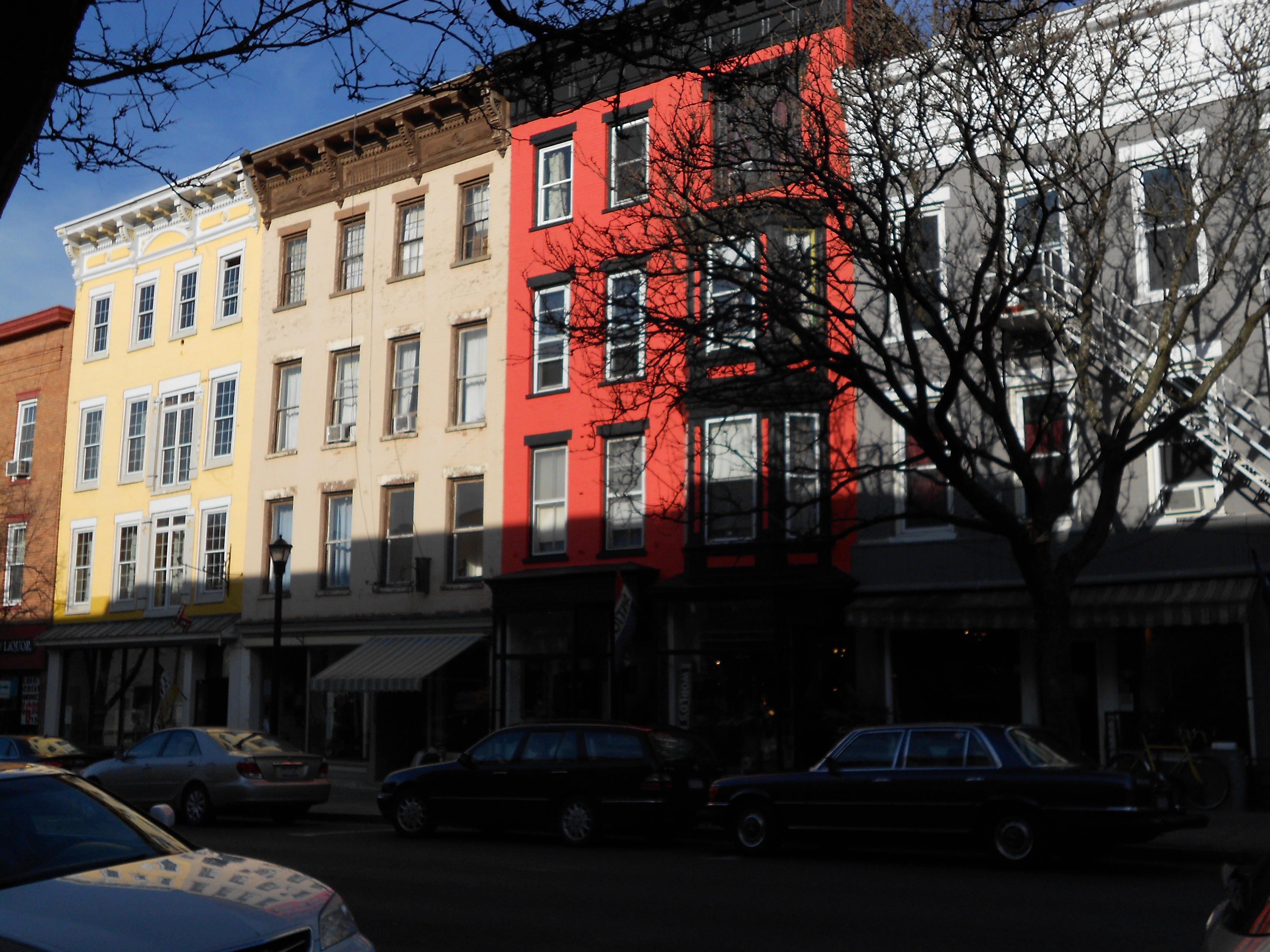
Streets and Shops of Hudson, New York

I am not in Salem for Small Business Saturday but I promise to make it up to my city’s small businesses when I return from my Thanksgiving holiday.  Today I’m going to feature another historic small city which is experiencing dramatic revival and redevelopment:  Hudson, New York.  Like Salem, Hudson was a bustling commercial port in the first half of the nineteenth century, only to realize a similarly spectacular decline in the twentieth.  Hudson is now being refashioned as an antiques center in particular and a distinct interiors shopping mecca in general.  Strolling up and down a historic city street while browsing carefully choreographed windows at merchandise that you don’t see anywhere and everywhere is my idea of shopping, and yesterday’s very civilized experience was highlighted even more by the repellent scenes from the mall that I saw on the evening news when I returned.

Some scenes from yesterday’s Hudson shopping excursion, all taken on Warren Street, the main street that runs right through the center of town:

Streetscapes, including the Hudson Opera House and a very carefully restored Greek Revival House just off Warren Street.

Some shop windows and signs, along with a really beautiful metal Christmas wreath in the center.

Shop interiors and merchandise:  Rural Residence, Hudson Home, Moderne, and (unfortunately) a few shops whose names I did not jot down.  EVERY shop in Hudson is worth a visit.


Stars, Stripes and Turkeys

A century or so ago, Thanksgiving seems to have been commemorated as one of our most patriotic holidays, on a par with Independence Day.  Its gradual transition from custom to national holiday was definitely accelerated by wars:  the Revolutionary War, the Civil War, and World War II all brought official recognition of a day of collective and public thanks-giving in November.  In 1789, George Washington signed a proclamation designating November 26 a day of national Thanksgiving, and in the midst of the Civil War President Lincoln proclaimed that the last Thursday of November be “set apart as a day of thanksgiving and praise”.  During another time of national crisis, just after the attack on Pearl Harbor, Congress gave its official seal of approval for the last-Thursday holiday in an act that was signed by President Roosevelt on December 26, 1941.  Along with wars, the constant flow of immigration no doubt also motivated the celebration of Thanksgiving as a unifying, national (and also increasingly secular) occasion, and the postcards below really reflect that message.  They are all from the first decade of the twentieth century, a peak period for European immigration into the United States, and the vast postcard collection of the New York Public Library.

The New York Public Library also has a large collection of historic restaurant menus, many of which are digitized, allowing you to chart changing culinary traditions.  The standardization of Thanksgiving fare and the official recognition of the holiday definitely go hand in hand.  Having spent several Thanksgivings in Britain, I found this menu cover from the 1906 Thanksgiving Day Banquet put on by the American Society in London particularly appealing, and it also reflects the language of both Washington’s and Lincoln’s earlier proclamations, which called for the national day of Thanks-giving to be celebrated by Americans everywhere.


Political Pumpkins

Here is the first of a series of Thanksgiving-related posts, although this particular one doesn’t really have much to do with the holiday at all:  only pumpkins.  There is something about the pumpkin–the word, the shape, the associations–that renders it particularly suitable for satire and caricature, political and otherwise.  You can place a pumpkin in a scene and immediately send forth a message, without words.  The image conjures up nativist, patriotic associations for Americans, while the Cinderella connection and sheer rotundity seem to be the central message of European illustrations.  I put “pumpkin” in the search engines of some of my favorite digital archives and this is what I got, in chronological order:

First off, a too-easy “pumpkin”:  poor Daniel Lambert, the largest man in Britain, who was forced to put himself on display out of extreme poverty in the early nineteenth century.  He died at age 39 and 739 pounds in 1809.

Two pieces of political ephemera from the Library of Congress:  a sheet music cover of the “Know Nothings Quick Step” dated 1854, featuring the American symbols of pumpkin, turkey and badger framing the “European invaders” who were so threatening to the anti-Immigration Know Nothing Party, and a Civil War-era pictorial envelope of former General George McClellan, who ran against Abraham Lincoln in the 1864 presidential election after being relieved of his military duties; I assume this is a pro-Lincoln piece.

An 1871 caricature of French Third Republic minister Ernest Picard, from the collection of the Victoria & Albert Museum in London.

Finally, two illustrations from Puck Magazine (1871-1918), always a source of great historical images:  “Uneasy Turks” from 1908 (a time of popular revolution in Turkey not unlike the “Arab Spring”) and “Thanksgiving:  a study in Proportion” from 1912.  The latter seems to be a rather modern commentary on the trivialization of the holiday:  a very small church is dwarfed by material symbols of the day’s amusements:  feasting (pumpkin and turkey), entertainment (theater mask), and sports (golf clubs, shotgun and riding crop).


Mirror, Mirror

The convex mirror in the corner of my very favorite painting, The Goldsmith in His Shop by Petrus Christus, was not the only curved looking glass I saw in New York last weekend.  During my time in the American period rooms, I spotted several Federal girandole mirrors, and in the paintings gallery I encountered a work by one of Christus’s near-contemporaries, The Marriage Feast at Cana (c. 1500-1504) by Juan de Flandes, and the charming Victorian painting In the Studio (1888) by Albert Stevens.  Two very different paintings with similar mirrors in the background, projecting out to us, the viewers.

Of course Renaissance artists, particularly northern Renaissance artists, loved their mirrors and used them not only in their paintings but (probably) as a device to perfect their technical skills.  The three most common examples of the “mirror painting” are Jan van Eyck’s Arnolfini Portrait (1434, National Gallery, London), which never fails to produce an intense questioning scrutiny on the part of my students, The Money Changer and His Wife by Quentin Massys (1514, the Louvre), which is very reminiscent of The Goldsmith, and Parmigianino’s Self-portrait in a Convex Mirror (1524, Kunsthistorisches Museum, Vienna), which seems to capture the very essence of the Renaissance.

I had no idea that the use of the convex mirror persisted into the modern age until I saw the Stevens painting above.  Apparently there was a revival in its appearance as a background emblem and device at the turn of the last century, exemplified perfectly in several works of the Irish artist William Orpen (1878-1931), generally classified as a portrait or “war painter” but obviously possessing a broad range of ability.  I had never heard of Orpen before (shame on me) but did see his dashing Self-portrait (1910–a mirror, but not a convex mirror) at the Met last weekend and made a mental note to look him up.  Then came my escalating convex fascination, which led me to his other works.  Below is the Self-portrait, followed by The Mirror (1900, the Tate), A Mere Fracture (1901, with a girandole mirror in the background), and The Bloomsbury Family (1907, National Gallery of Scotland), with Orpen himself (just like van Eyck!!!) reflected in the convex mirror.

I’m really impressed with Orpen’s paintings, and apparently they impressed his contemporaries as well if my last painted convex mirror is any indication:  the Australian artist George Lambert’s Convex Mirror, which really moves the mirror to the foreground, like Parmigianino’s Self-portrait above.

George Lambert, The Convex Mirror, 1916.  National Gallery of Australia.

Wow!

We did manage to do some shopping this past weekend, after the weather cleared to produce a glorious Sunday.  At the John Derian shop I encountered (of course) more convex mirrors. Small and black-framed, and very elegant.  I have some lovely period mirrors, gilt and brass and very Federal, but decidedly square and flat.  Perhaps the cosmos is telling me that I need my own convex mirror.  After the John Derian mirrors below are some high ($$$$, Richard Rothstein–a reproduction of the van Eyck mirror), moderate ($$$, Twos Company), and low ($$, West Elm) options for consideration.


Alternative Halloween

As a cynical Halloween-in- Salem resident, I’m recognizing the alternative commemoration days today.  Halloween, Hallowe’en, or All Hallows Eve, marks the eve before All Hallows’ or All Saints’ Day, a long-standing Christian holiday commemorating the hierarchy of saints.  So we have All Saints images from the past and the present.  Because the Reformers preferred to recognize strict scriptural monotheism, October 31 became “Reformation Day” in Protestant areas of early modern Europe.  Happy Halloween, All Hallows Eve, and Reformation Day to everyone, everywhere.

Images from fifteenth- and sixteenth-century Books of Hours from the Morgan Library & Museum Collection; an Allsaints Spitalfields storefront; Reformation Day cards from the New York Public Library Digital Gallery.


Witch City: the Paper Trail

Throughout the (almost) year that I’ve been writing this blog, a consistent topic and theme has been Salem’s transformation into “Witch City”, either through private marketing efforts like Daniel Low’s “witch spoons” and Frank Cousins’ branded products and photographs, or through public campaigns like the city’s official schedule of  “Haunted Happenings”.  We’ve seen it all:  from witch creams to witch plates.  It seems like an appropriate time to showcase the “Salem Witch” postcards that must have blanketed the nation throughout the twentieth century, even though these postcards are not selling Halloween, they’re selling Salem.  As time went on, however, the two things became increasingly connected (and now it seems like they’re inseparable!)

I’m relying on the Salem vintage postcard seller Iconic Postcards for this first postcard because I do not possess it and I think it really encapsulates the early “Witch City” message.  It’s not from Germany, but from local publisher W.B. Porter.

The “ye olde” language is utilized in the first of a succession of more standardized witch images, as if to capitalize on both Salem’s colonial and witchcraft associations.  And while the language changes over the decades, from the turn of the century to the 1930s, the image remains the same.  This is basic branding.

And now from the other direction……… two witches from Germany, including an interesting “stamp witch”, and one published by G.W. Whipple of Salem.

These are the standard “Salem witch” postcards, but of course there were lots of other paper witches in circulation, in the first half of the twentieth century and beyond.  Here are some of my favorites, beginning with two “adaptations” forwarded to me by local historian Nelson Dionne.  The first pair is the famous painting The Witch of Haarlem by Frans Hals, recast as the “Witch of Salem” (which strikes me as a very brazen move!), while the second shows one of illustrator Frances Brundage’s most famous Halloween cards adapted (rather sloppily) for Salem. Finally we have a rare 1908 German card showing several Salem witches, and a (relatively) recent card marking the worst day (September 22, 1692) in the history of the Salem Witch Trials.

Frans Hals, Malle Babbe, the "Witch of Haarlem", c. 1630


German Witches

It is very interesting to me that Germany was at the absolute center of the “witch craze” of the sixteenth and seventeenth centuries and the creation of a commercial Halloween/witchcraft culture several centuries later.  No area experienced more witchcraft trials in the early modern era than the German-speaking lands of central Europe, and no country contributed more to the modern conception of Halloween than Germany.  It’s a very Salem-like connection between tragic history and contemporary consumerism.

The most credible estimates for the number of executions for witchcraft between 1450-1750 are in the range of 40,000 to 60,ooo people across Europe, with southern and central regions of Germany accounting for between 17,000 and 26,000 executions, as compared to between 5000-6000 executions for all of France, around 1000 executions for England and Wales, and a mere 50 estimated executions in Spain, where there was little religious diversity to fuel the fires.  The intense witch-hunting in Germany, especially between 1580-1630, has led its leading historian to assert that “witchcraft is as ‘German’ as the Hitler phenomenon, and will similarly occupy our attention for a while longer”. (Wolfgang Behringer, Witchcraft Persecutions in Bavaria:  Popular Magic, Religious Zealotry, and Reason of State in Early Modern Europe, 1989 & 1997).

Images of conspiratorial witchcraft in early modern Germany are lurid, much more lurid than the hexentanz (witches’ dance) and hexentanzplatz (witches’ dancing place/floor) postcards issued in huge numbers from the mid-nineteenth century onwards, although there are similar motifs and themes.  Below is an illustration of the hexentanzplatz at Trier from a 1594 Flugbatt (“flying pamphlet”) about the massive witch trials in that city (which may have resulted in as many as 1000 executions between 1581 and 1593) and a hexentanzplatz postcard from about 400 years later.  As you can see, the earlier image is of an orgy-like witches’ sabbat, while the later image is of an equally fantastic, but much less nefarious, dance.

The other difference between these two images is that the one below refers to an actual place:  the Hexentanzplatz is a mountain plateau in the Harz Mountains of north central Germany.  Located in modern-day Saxony-Anhalt, it is a site that has long been associated with pre-Christian rituals, along with the nearby Brocken, the highest peak in the mountain range and another supposed sabbat site.  As interest in German folklore intensified in the nineteenth century, so too did interest in this region, and it became the site of a mountain-top hotel, an open-air theater, and Walpurgis Night (April 30-May 1) festivities.  So this postcard is both an expression of the popular interest in witchcraft as well as a form of advertising.  More Hexentanzplatz postcards from the 1890-1930 period are below, some a bit more commercial, some a bit more creative, and all featuring witches.

And here are two images of Brockenhexen, witches flying to Brocken mountain for the Sabbat:  the first is a commercial postcard from the 1890s, the second an illustration from an 1878 article in Harper’s Magazine (via the New York Public Library Digital Gallery).

These German witches actually have nothing to do with Halloween; they flew to the mountains on Walpurgis night, the transition between spring and summer.  But their images were easily relevant to another pre-Christian seasonal holiday, Halloween, especially given the German dominance of the postcard publishing industry before World War I.  In fact, 75% of all postcards disseminated in the United States before 1914 were printed by one of Germany’s 30 postcard manufacturers, either under their own auspices or in collaboration with an American publisher.  Americans wanted their witches to be on Halloween postcards, along with other symbols of the holiday, and Germans responded to this demand, generally with images of much less menacing withes than the Brockenhexen. Here are three more witches “made in Germany”, including one flying over a very familiar place.


Flying Waldensians

We’re about halfway through my Magic & Witchcraft in Early Modern Europe course and I haven’t even got to the witch trials yet, most likely much to my students’ frustration.  For foundation, I drag them through centuries of medieval history and theology to get them to understand the initial connection between witchcraft and heresy.  I could probably accomplish this task in a much shorter time, simply by presenting the image below in full context.

These flying women are included in the marginalia of the manuscript version of Martin le France’s long poem Le Champion des Dames (The Champion of Women), dated circa 1440.  You will notice that they are identified as “vaudoises” at the top, which could generally refer to witches, but more likely is a specific reference to the Waldensians (Waldenses, Vaudois), a heretical sect who existed on the fringes of medieval Christian society from their emergence and almost-immediate condemnation in the later twelfth century.  The Waldensians were essentially reformers, emphasizing the authority of the Bible over the Church, but their zealous preaching led to their gradual demonization by branding them as disciples and servants of Satan.  The Waldensians of the later middle ages, like the witches of the early modern era, were said to worship their master at inverted/perverted “sabbats” in which they are envisioned paying homage to a goat/devil.  Another text from the mid-fifteenth century, Johannes Tinctoris’s Traite du crisme de Vauderie, includes a graphic illuminated image of a Waldensian sabbat—note the flying figures in the sky.

Martin le France and Johannes Tinctoris MSS at the Bibliotheque nationale de France.

The association of a well-known heresy and witchcraft through the sabbat demanded some sort of travel mechanism, as everyone knew that demonic rituals were held in faraway places–the inaccessible “blue mountain”, the dense Black Forest, the isolated “field of the goat” (Akelarre in the Basque Country).  What better way to get there than on a flying broom?  The alluring image of dangerous and demonic agents utilizing a familiar household object to reach their secret destinations immediately caught on, and remains very much in play today.

Raphael Tuck Halloween Postcard from the 1910s.


Cutting Cartoons

As we’re off to New York City at the end of the month for a little break, I’ve been making of list of things I’d like to do and see.  Time will be limited, and I’m going for a nice balance of cultural pursuits and shopping.  Regarding the former, one event that is pretty high on my list is the new exhibit at the Metropolitan Museum of Art:  Infinite JestCaricature and Satire from Leonardo to Levine (through March 4).  A genre that exists at the intersection of print and visual culture is right up my alley, but the prints that I’ve been able to access online look a little tame, mocking manners and fashions rather than actions and ideas. Here are two images from the exhibit:  the first is an English print based on an image of the Swiss artist Samuel Hieronymus Grimm of a gentleman farmer aghast at the appearance of his dandified son, while the second is a hand-colored lithograph by an anonymous French artist, mocking the fashions of 1830.

Apparently one section of the exhibit focuses on political satire, and (of course) includes James Gillray’s classic “Plum Pudding” cartoon from 1805, in which the very thin British Prime Minister William Pitt and the very small Napoleon carve up the world.  You can’t beat this for an image, and a teaching tool; it is immediately accessible.

I often incorporate cartoons into my teaching as they really drive home the point I’m trying to make.  Reformation cartoons, in particular, hammer (bludgeon) my points home.  I can understand why the curators of the exhibit began with Leonardo (everything begins with Leonardo!) but I would have worked Luther into the title as Reformation cartoons are really in a league of their own.  The early Protestants would stop at nothing to demonize the Pope, as you can see.

Not-so-subtle Reformation “cartoons”:  Martin Luther’s “Against the Papacy founded by the Devil”, 1545 (the Pope, with donkey ears, is sitting on a pyre in the midst of the mouth of Hell, surrounded by demons who are in the process of crowning him their king), a really neat cartoon card with a flap which folds down, exposing Pope Alexander VI as the Devil, and Philip Melanchthon’s famous/infamous “Pope-Ass”, first published in 1523.

What better way to reveal the zeal of the reformers than through these images?  More than a century later, the connection between the Pope and the Devil is maintained in this print from 1680, at probably the height of popular anti-Papism in Britain.

Moving into the more secular world of the later eighteenth and nineteenth centuries, cartoons branch out in several directions; they continued to mock those in power but also those in “fashion”.   At nearly the same time that Gillray was making fun of Pitt and Napoleon, he was taking on the elaborate turbans of society ladies in the delightful “Lady putting on her Cap” (Collection of the Victoria & Albert Museum).

Several decades later, a more serious subject is taken on by Robert Seymour, in “The Absentee” (1830).  An absentee landlord of an Irish estate lives the good life while his tenants starve, years before the great potato famine.

And finally, two cartoons that anticipate twentieth-century political caricatures:  the first, from 1871,  illustrates Chancellor of the newly-unified Germany Otto von Bismarck on top of the world.  It’s by the French illustrator Jean Renard, and clearly presents a French perspective:  not only is Bismarck stepping on France, he’s only wearing his underwear.  Renard manages to make the imposing Bismarck look both imperialistic and ridiculous at the same time.  The second is a classic images that always helps me to explain late-nineteenth imperialism to my students:  “China–the Cake of Kings…and Emperors” from 1898.  The cake (it actually always looked more like a pizza to me) that is China is being carved up the world’s powers (Queen Victoria/Great Britain, Kaiser Wilhelm/Germany, Tsar Nicholas/Russia, Marianne/France, a Japanese warlord) while its personage looks on helplessly.  Things have definitely changed over the last century!