Tag Archives: Commemorations

Remembrance, Recreation and Reenactment

The blogger part of my brain is whirling in anticipation of this long weekend of Patriots’ Day/Easter/Marathon Monday: what to write about? I think I’ve offered up enough Easter eggs, bunnies and witches, and Patriots’ Day, the Massachusetts (and Maine) holiday which commemorates the Battles of Lexington and Concord and the beginning of the American Revolution, coincides with Marathon Monday. I have always thought of my own personal ritual–a walk or run down the Battle Road on which the British retreated back to Boston–as sort of a combination of the two holidays, a form of patriotic athleticism. But last year I had a bad cold and stayed home and watched the Marathon on television, including the horrors that unfolded at its finish line in Boston. Now, after last year, the holiday seems different, darker. I am afraid that I am a bit numbed by the nonstop media coverage of the Marathon memorial that we have experienced in the Boston area (and perhaps nationally?) over these past few weeks, so I think I’ll go back to 1775, or at least our impression or “memory” of it. After classes yesterday I flew down to Concord to catch the first day of the new exhibition at the Concord Museum, timely titled The Shot Heard Round the World: April 19, 1776, and while I was there I poked around a bit, looking for Minutemen and Redcoats–or at least their shadows.

Remembrance 014

Remembrance 010

Remembrance 016

Remembrance 030

Remembrance 037

In Concord: the entrance to the exhibition, with a militia man inside, flints from the battlefield, a 1930 diorama, and across town, the Major John Buttrick House and adjacent monument.

Concord does commemoration very well, much better than we do here in Salem: of course they a good event to commemorate–the courageous shot heard round the world–and we have a bad one–the intolerant, irrational witch trials. But I would really like to replace the tacky, exploitative, and out-of-date Witch Museum–which is really just one BIG diorama dated circa 1971–with the tasteful and reflective Concord Museum, which seems just as concerned with Concord’s history as the making of Concord’s history. I long for an exhibition on the creation of “Witch City” but doubt I will ever see it.

Remembrance 022

Remembrance 023

There’s another exhibition I’m looking forward to further down the road (battle and otherwise): The Battle After the Battle: the Lexington-Concord Tug of War for Revolutionary Fame, opening at the Lexington Historical Society on May 3. I thought these two towns worked together in the spirit of collaborative commemoration, but apparently not! They’ve both been in the business for quite some time, to which the Boston Globe photographs from the 1920s and 1930s below attest. As I was heading back to Salem I spotted a few present-day reenactors outside the Concord Museum: I think they’re camping out tonight so they can be on the spot, rested and ready, for tomorrow’s battles.

Concord Bridge

Lexington Green

Remembrance 039

Reenactors in Concord (1928) and Lexington (early 1930s) © Leslie Jones, Boston Public Library, and yesterday, outside the Concord Museum.


Patched with Plastic

I was planning a post on tax collectors for this Tax Day, but it got too overwhelming and too depressing: as one of Lucifer’s Four Evangelists (with the usurer, the banker, and the miller (???), the tax man has been reviled for centuries, and depicted in images and prose in all sorts of unflattering ways. I don’t think anyone wants to see paintings of tax collectors on the day their returns are due, even if they are the creations of Renaissance artists (who seem to have a singular obsessions with tax farmers). So instead, I’m offering LEGO art!

T, The New York Times Style Magazine has some interesting features in its latest edition, despite a thematic focus on minimalism (not my favorite style). There is a lot of texture in the magazine, and one particular photograph stopped me in my tracks: an ancient, crumbling wall, patched with plastic. The close proximity of very new and very old is my favorite aesthetic, so I had to see more of the work of artist Jan Vormann.

Lego

Jan Vormann/© 2014 ARS, New York/VG Bild-Kunst, Bonn

At first glance, I thought the above image was photoshopped but no, as his website and this Daily Telegraph article make clear, Vormann travels the real world and places bright LEGO blocks in the midst of conspicuous decay, drawing attention to buildings and places as part of a “Repair Manifesto”. He wants onlookers to see the holes, question why they are there, and seek their repair–except perhaps where they serve as constant reminders, as in the case of the bullet and shrapnel destruction of Berlin. How I wish he would come to Salem! We need the colorful and constant reminders of our past, and the manifesto to repair.

Vormann Berlin-001

Vorrman NYC Bryant Park NYC-001

Vormann Venice

Vorrmann Bamberg

Lego “repairs” in Berlin, New York City, Venice and Vormann’s hometown of Bamberg, Germany: JAN VORMANN / BARCROFT USA and Dispatchwork.


The Princes in the Tower

As today marks the accession of Edward V in 1483, I thought I would explore visual representations of one of the most popular mysteries in English history: the princes in the tower. My students certainly love this story: everything stops when we get to this moment, and I have to let them indulge in what if history, at least for a little while. The basic facts are these: the 12-year-old prince succeeded his father Edward IV on April 9, but his uncle Richard, the Duke of Gloucester and Lord Protector, assumed the head of a regency government. The boy king, along with his younger brother Richard, was placed in “protective custody” in the Tower of London (then more of a palace then a prison), from which they never left. The Regent Richard produced evidence of their father’s prior betrothal in June of 1483, invalidating their parents’ marriage, rendering them illegitimate and enabling his own succession; at some point in August or September they disappeared. Two years later, in the end game of the long dynastic struggle that was later romantically labeled the Wars of the Roses, Henry Tudor killed Richard III on the battlefield of Bosworth and proclaimed himself King. The Tudor Dynasty commenced and along with it, the demonization of Richard III, the murderer of the Princes in the Tower, his every own nephews. This was a campaign waged most effectively by Tudor apologists Sir Thomas More in the early part of the sixteenth century, and Shakespeare later on. The skeletal remains of two bodies found in the foundation of a Tower staircase in 1674 were interred in an urn designed by Sir Christopher Wren in Westminster Abbey, marked with the inscription proclaiming that the the young king and his brother were stifled with pillows…by the order of their perfidious uncle Richard the Usurper.

NPG 4980(11); King Edward V by Unknown artist

A Sixteenth-century Portrait of Edward V, National Portrait Gallery, London

And that’s been the standard story ever since, despite continuous Riccardian attempts to point out that there were other perfidious candidates, and other scenarios. And there are. The recent discovery of Richard III’s remains renewed interest in his most famous crime for a bit, but really, curiosity about the princes’ fate always seems to be simmering under the surface: there have been repeated calls for the testing of the urn’s remains which royal and church officials have repeatedly resisted, and Westminster Abbey’s official position is that the mortal remains of two young children widely believed since the 17th century to be the princes in the tower, should not be disturbed.  So that’s where we are with this story, and that is indeed what the princes in the tower has become:  a story about two young children confronted and overwhelmed by evil, close to home. A Grimm tale. While the sixteenth and seventeenth centuries certainly contributed to the outline and character development of this story, it was the nineteenth century that filled in all the details, especially in terms of the all-important visuals. It was actually a late eighteenth-century painting, James Northcote’s Murder of the Princes in the Tower (after Shakespeare’s Richard III) that set the scene which later artists recreated in variants over the next century: young, innocent, blue-eyed angelic boys, increasingly “real”, either sleeping unaware or clutching each other in fear and apprehension, helpless in the face of encroaching evil (which is always more ominous when it is not in the picture).

(c) National Trust, Petworth House; Supplied by The Public Catalogue Foundation

Princes in the Tower Mordecai

(c) Paintings Collection; Supplied by The Public Catalogue Foundation

Princes in the Tower Delaroche

Princes in the Tower Ward

Princes in the Tower Millais

James Northcote, The Murder of the Princes in the Tower (from William Shakespeare’s “Richard III”), 1786, National Trust, Petworth House; Joseph Mordecai, The Murder of the Princes in the Tower, City of London Corporation, Guildhall Art Gallery; Charles Robert Leslie, The Two Princes in the Tower, 1837, Collection of the Victoria & Albert Museum, London; Paul Delaroche, The Princes in the Tower (Edward V and the Duke of York), mid-19th century, Tower of London; Henrietta Mary Ada Ward, The Princes in the Tower, 1861, Touchstones Rochdale; John Everett Millais, The Princes in the Tower, 1878, Royal Holloway, University of London. The work of Millais, setting the boys before the staircase where their supposed remains were later uncovered, has been a particularly influential image.


Anniversary History 1914

I used to disdain what I call “anniversary history”–the commemoration of historical events only on their centenaries, a temporary historical consciousness–as not serious and media-driven: a History Channel approach to history. I tried to engage in a bit of anniversary myself back in 2012, and the results were indeed a bit superficial! I still believe that “history” happens every day and everything is “historical” but I also realize that it’s impossible for the average person to go about their day (or their life) in a historical fog so the marking of anniversaries of events large and small, public and private, and global and local is important, and even necessary. They make people stop and think about the past–and its relation to the present–at least for a little while.

From my perspective(s), 1914 promises to be a big year for anniversary history:  this summer marks the centenary of both the Great Salem Fire and the beginning of World War I in Europe. Over there, commemoration of the latter has already begun in earnest and will intensify over this year; I expect American engagement will really commence in 2017, the centenary of our entry into the Great War (although President Obama visited Flanders Fields a few days ago). This coincidence of local and global  “Great” events is interesting to me because it mirrors historiographical and cultural trends, and because both events were so very disastrous, testing the mettle of men and women in myriad ways. Here in Salem, we began our commemoration of the 1914 fire last night with a presentation by the scholar Jacob Remes, author of the forthcoming Disaster Citizenship: Urban Disasters and the Formation of the North American Progressive State, to a standing-room-only crowd at the National Park Service Visitor Center (the former drill shed, or what remains of the Salem Armory, where the Fire relief efforts were based). Remes’ focus, on the aftermath of the fire both in the camps (where fire refugees were called “inmates”!) and the rebuilt factories a bit later, bridged the local and the global with its emphasis on labor, and started us off on a thoughtful and reverent note. There will be a centenary symposium in June, on the weekend before the date of the Fire (June 25) and just before the commemoration of the Great War really kicks off across the Atlantic.

Salem Fire-001

salemfire093

World War One Soldiers

Faces of the Great Fire and the Great War:  In Salem, after the Fire, unidentified men and Mrs. Henry Reed and her daughter Helen, from the Dionne Collection at the Salem State University Archives and Special Collections; Soldiers of the West Yorkshire Regiment sitting in a captured German pillbox awaiting their orders at the Battle of Polygon Wood, 1917, Ministry of Information First World War Official Collection, Imperial War Museums:  ©IWM (Q2903).


Resistance and Retreat in Salem, 1775

The American Revolution did not, of course, begin with a single “shot heard round the world” but was rather the result of a simmering opposition developing in Massachusetts from at least 1770. A singular event in this intensifying insurgence occurred here in Salem on this day in 1775: while referred to alternatively by historians as the “Salem Alarm” or the “Salem Gunpowder Raid” (the subtitle of Peter Charles Hoffer’s recently-released book, Prelude to Revolution), its more popular designation is “Leslie’s Retreat”.

The reference is to the British Lieutenant-Colonel Alexander Leslie, who was dispatched by General Thomas Gage–who had proclaimed Massachusetts in “open rebellion” just weeks earlier–to Salem in search of the cannons and powder he suspected was there. Indeed, there were 17 cannons in the shop of blacksmith Robert Foster, who had been commissioned by Colonel David Mason of the Massachusetts Committee of Public Safety to affix them to carriages in preparation for the inevitable conflict. On a chilly Sunday, Leslie and his men (about 240 fusiliers from the 64th Regiment) disembarked from their ship in Marblehead and commenced the 5-mile march to Salem towards Foster’s foundry, located on the bank of the North River just across what was then a drawbridge. The alarm went out, and by the time they got to Salem Leslie and his men faced a large, angry, armed crowd and a raised drawbridge. A tense standoff of several hours ended with a compromise which was really both a defeat and a retreat for the British: the bridge was lowered, enabling Leslie to fulfill his orders and inspect the foundry, but he went no further–and the cannons were long gone. No blood was shed, with the exception of that of one Joseph Whicher, pricked by a British bayonet. There are many indications that this was considered a momentous moment–in its own time and after. A few months later–and across the water, The Gentleman’s Magazine reported that the Americans have hoisted their standard of liberty at Salem.

Leslies Retreat Repulse of Leslie feb 26 1775 Bridgman

Leslies Retreat map EIHC

PicMonkey Collage

Lewis Jesse Bridgman, “The Repulse of Leslie at the North Bridge, Sunday, February 26, 1775” and sketch of the scene, from Robert Rantoul, “The Affair at the North Bridge, Salem, February 26, 1775”, Historical Collections of the Essex Institute 38 (1902); Some of the major players:  Colonel David Mason on right, a Gainsborough portrait of Lieutenant-Colonel Alexander Leslie upper left, and the Reverend Thomas Barnard of Salem, lower left, who by all accounts negotiated the retreat.

In the nineteenth and early twentieth centuries, Leslie’s Retreat was a heralded historical event, marked by addresses, commemorations, and compilations of source materials that we draw from now, including  Charles Moses Endicott’s Account of Leslie’s Retreat at the North Bridge on Sunday Feb’y 26, 1775 (1856) and Rantoul’s 1902 article, cited above. Such interesting characters (and large crowds) emerge from these accounts:  Sarah Tarrant, a Salem woman who openly mocked the British troops, the equally rebellious militia captain John Felt, and the “Paul Revere” of the event, Major John Pedrick of Marblehead, whose role seems a bit mythological to say the least (see much more about this particular gentleman and his role here). Pedrick’s role in carrying the alarm to Salem was certainly romanticized by the Marblehead folk artist J.O.J. Frost in his 1920s (?) painting, Major Pedrick. To the Town of Salem, to Give the Alarm, which went up for auction at Skinner a couple of years ago. I can’t resist adding a photograph from the collection of the New York Historical Society Museum & Library of the original enlarged painting in the hands of a gentleman identified as “Colonel Leslie” but whom I suspect is the artist.

Frost Pedrick

Leslie and Frost Painting

At present, I do not think Leslie’s Retreat is either revered or even remembered: perhaps Professor Hoffer’s book will bring it back into our civic consciousness. Many of the streets in the vicinity of the standoff are named for its participants: Mason, Felt, Foster (no Tarrant), but the widening of North Street, the multiple replacements of the bridge, and the damming of the river have created a landscape that would be unrecognizable to any of these people–and not a particularly reverent one. What remains to remind us of Leslie’s Retreat? A weathered memorial, a dog park, and a restaurant.

Leslies Retreat 004

Leslies Retreat 001


Last Men Standing

We are accustomed to seeing photographs of veterans—of the recent wars in Afghanistan and Iraq, of Vietnam, of World Wars I and II, of the Spanish-American War, and even of the Civil War—but not of the American Revolution, as the first daguerreotypes were made a half-century after its conclusion. But such images do exist, first compiled in an extraordinary book that I’ve just discovered:  E.B. Hillard’s The Last Men of the Revolution (1864). The Connecticut minister clearly had a mission of remembrance in the midst of the Civil War, and he made pilgrimages to the homes of six surviving Revolutionary War veterans, accompanied by Nelson and Roswell Moore, brother photographers from Hartford. I’m sure my Americanist colleagues know of this book, but its existence is a revelation to me: how shocking to gaze upon the images of men who, in Hillard’s words, “looked on Washington…[and] heard his words”.

Hillard’s little volume contains eagle-encircled images of the old men in their best dress, along with color plates of their homes and wonderful little vignettes which cover their experiences in the war and in life, along with their views of the “present rebellion”—no confederate sympathies here! There are also prescriptions for longevity: lots of smoking, moderate drinking, “no particular attention to diet”, lifelong physical exertion. You can see the book’s plates here, and below are individual carte-de-visite images from the Library of Congress–beginning with William Hutchings, who was born in my hometown of York, Maine (then Massachusetts, of course) and ending with Newburyport-born Samuel Downing, who harvested fifteen bushels of carrots on the 90-degree day before Hillard came to call.

Last Men Hutchings

Last Men Waldo

Last Men Link

Last Men Cook

Last Men Millener

Last Men Downing

I wish I knew much more about the contemporary reception of Hillard’s book and the Moores’ photographs, but they are certainly inspirational now. “New” images of Revolutionary War veterans have been uncovered/discovered, most notably by Utah-based journalist and collector Joseph M. Bauman, who recently published his collection in a book entitled Don’t Tread on Me:  Photographs and  Life Stories of American Revolutionaries (2012) and “daguerreotype detective” Maureen Taylor, who has published two volumes entitled The Last Muster. Images of the Revolutionary War Generation. The more interest there is in something, the higher the likelihood of finding more of it, in the case of these rare daguerreotypes, uncatalogued family collections are probably the key source. You can see a lovely portfolio of Bauman’s collection here:  my favorites among them are another Massachusetts/Mainer, James W. Head, and the flamboyant George Fishley, famous resident of Portsmouth, New Hampshire and “last of the Cocked Hats”.

Last Men James W. Head

Last Men George Fishley

Revolutionary War veterans James W. Head and George Fishley: images courtesy of Joseph Bauman.


Bodies on the Beach

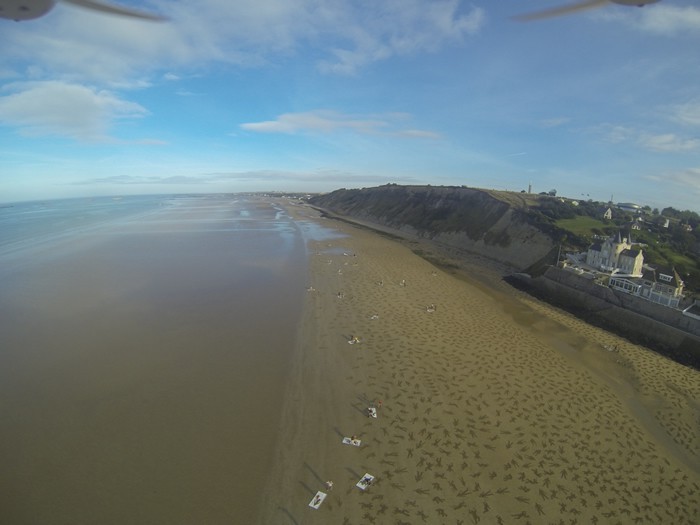
My friend Betsy drew my attention to an installation called The Fallen last week and I have not been able to get the images out of my mind. Conceived and engineered (with the help of some 500 stenciling volunteers) by the British artists Andy Moss and Jamie Wardley of Sand In Your Eye in honor of International Peace Day (September 21), the interactive project involved the production of thousands (9000 to be exact) of sand silhouettes designed to represent the enormous loss of life that occurred on D-Day. The landing beach of Arromanches in France appears littered with shadowy “bodies”: now washed away by the tide, they remain, at least for me, an unforgettable sight.

The-Fallen-19

The-Fallen-24

The-Fallen-31

Fallen1

Fallen

All Images from The Fallen website.


Boccaccio’s Birthday

Now that I’ve made this big transition to chair of the History Department, I’m doing very little teaching: only one class (on the Renaissance and the Reformation) as opposed to the normal four-course-per-semester load. That’s just how administrative the job is. I’d much rather be teaching three more courses, frankly, but at the same time I have a renewed appreciation of the time I do get to spend in the classroom. The Ren/Ref course is an old standard, easy and fun to teach with its contrasting and continuous movements and its visual and theological drama, and my students are open and engaged and undemanding. It takes me a while to get into the period as the course has no prerequisites and most of them need some medieval footing in order to proceed; consequently we’ve just finished an examination of the late medieval crisis (intense famine, plague, war, schism, all at the same time) and the “worlds” of the “three crowns” of early Italian Renaissance literature:  Dante, Petrarch and Boccaccio. I usually focus almost exclusively on Petrarch as the key transitional figure in the emergence of the Renaissance humanist mentality, and this course was no exception, but all of the celebratory initiatives associated with the 700th anniversary of Giovanni Boccaccio‘s birth are making me reconsider my practice. Perhaps the Decameron, Boccaccio’s allegorical collection of 100 stories told by ten young Florentines seeking to distract themselves and pass the time while they wait out the Black Death in a deserted rural villa, should be read for more than its plague prologue.

Vasari002

Boccaccio, in the company of Petrarch, Dante, and three other Renaissance writers, in Giorgio Vasari’s Six Tuscan Poets, 1544, Minneapolis Institute of Arts.

Boccaccio 2013” is a multi-disciplinary, multi-event happening in Italy, and Boccaccio is also being celebrated in Britain, where he has always been recognized as an inspiration for another essential late medieval work, Chaucer’s Canterbury Tales (as well as John Lydgate’s Fall of Princes). There was a major conference at the University of Manchester this summer, as well as a coincidental, and ongoing exhibition, focused on Boccaccio’s currency.  He endured because (like any true Renaissance man) he sought fame in his own time and among his contemporaries, but also because his accessible prose and format inspired a succession of authors, from Shakespeare to Voltaire, to Tennyson, Longfellow and Poe. Readers past and present also wanted to see those beautiful noblemen and -women telling their tales–as well as the characters in their tales–while the world was dying all around them, and so centuries of artists have been inspired by Boccaccio as well. Renaissance escapism:  modern and universal at the same time.

Boccaccio

Decameron Crivelli Bodleian

Boccaccio Botticelli

Boccaccio Stothard 1825

Boccaccio after Stothard etching

Boccaccio Waterhouse

Boccaccio the author, in a French manuscirpt of his De Claris Mulieribus, 1440, British Library MS Royal 16 G V; Eat, drink, and be merry for tomorrow we die:  illustrations of the Decameron from Taddeo Crivelli’s 1467 manuscript edition, Bodleian Library MS Holkam mis. 49, and by Sandro Botticelli, the Story of Nastagio degli Onesti: The Banquet in the Pine Forest, 1483, Museo del Prado, Madrid, Thomas Stothard, c. 1820, British Museum; and John Williams Waterhouse, A Tale from the Decameron, 1916, Lady Lever Gallery, Liverpool.


Pendle and Salem

While weeding in front of my house yesterday I encountered a group of tourists who had come to Salem for the “witches” but were surprised to find so many nice buildings too. Poor people! Once we started chatting I couldn’t stop myself from subjecting them to a lecture, well, several really: first I told them all about Samuel McIntire and the merchants and sea captains who built Chestnut Street and then we got into the witch trials. They did ask questions, but clearly it’s a good thing that the semester is about to start.

One thing became clear in our “discussion”: they thought Salem was the only place in the world that prosecuted accused witches, at least after the “Dark Ages”. Even after fifteen years of teaching a popular course on the thousands of witch trials that occurred in early modern Europe, I was surprised. The singularity of Salem always bothers me; “our” trials are so seldom placed in western or global context, at least outside of academia.

There are important parallels between the Salem trials and the largest and most notorious English witchcraft prosecution, the Lancashire (“Pendle”) trials in northern England in 1612. The Pendle trials were held 401 years ago this week, and their 400th anniversary was commemorated last year. Salem and Pendle were both (relatively speaking) “frontier” communities, with the Pendle district of Lancashire located in the “dark corners of the north” of England, where various types of nonconformity still reigned. Salem cast a much wider net (185 accusations, 59 trials, 31 convictions, 19 executions, one death by torture/interrogation) than Pendle (16 trials and 10 executions, with one death in prison), but both were notoriously collective, conspiratorial episodes–unusual in the history of English prosecutions for witchcraft. Both trials were well-publicized, with the Pendle “source”, (more of a personal reflection really), clerk of the Lancashire court Thomas Potter’s Wonderfull Discoverie of Witches in the Countie of Lancaster (1613) being particularly influential.

Pendle and Salem 1

Potts_Thomas-The_vvonderfull_discouerie_of_witches-STC-20138-1554_24-p8

Thomas Potts, The Wonderfull Discoverie of Witches in the Countie of Lancaster. London, 1613. STC 20138.

But the most important comparison/connection between Pendle and Salem was the admission of legal testimony by a minor in the former trials, which set the precedent for the latter. Before the Pendle trials, the testimony of children under the age of fourteen was inadmissible in English courts, but nine-year-old Jennet Device was the star witness of the 1612 trials, offering up testimony that implicated her entire family as well as others. Jennet’s family would have been vulnerable anyway–they were a marginalized family led by a “cunning” matriarch, and probably represented the lethal mixture of nuisance and nonconformity to the community–but her vivid testimony was key to their conviction. Jennet was the informer at what became a sensationalistic show trial. Like Salem, the Lancashire trials seem to have become a somewhat self-generating process, engulfing the accusations of the “Pendle Hill” witches as well as so-called “Samlesbury Witches” who were also implicated by the testimony of an adolescent girl. The Salem girls most definitely had their forerunners, and perhaps their inspiration.

Then, of course, there is the cultural aftermath, theatrical and fictional accounts based on Pendle and Salem, tourism, commemorations. Several decades after Pendle, Thomas Heywood brought his comedy to the London stage, while several centuries after Salem, The Crucible transformed the American trials into an ongoing allegory. Salem has, of course, transformed itself into “Witch City”, and in the Pendle district there is a Witch Way bus service with individual buses named after the officials and victims of the Lancashire trials. There are statues in both places, although Pendle’s is of a real victim, Alice Nutter of the village of Roughlee, and ours is of Samantha Stevens, a fictional television character! (Of course we have the beautiful and meaningful 1992 Witch Trials Memorial, but I am afraid that more tourists see Samantha). There are also logos galore, on both sides of the Atlantic, official and otherwise, with just a sampling below.

Witchcraft Plays

witchwayrh3

Witchcraft Statues

PicMonkey Collage


Celebrating Summer

Salem is just wrapping up its two weeks of Heritage Days activities, which included a Maritime Festival at the Salem Maritime Historic Site, the Firemen’s Muster at the Willows, the Essex Street Fair, the Witches’ Cup bicycle race around Salem Common, the antique car meet here on Chestnut Street, and lots of events involving ice cream and/or music. You’ve got to love a town that celebrates itself AND summer. And we are now in the midst of those perfect New England summer days: clear, bright and sunny in the high 70s/low 80s during the day, high 50s/low 60s at night–you need a light (cotton) blanket, but not an air conditioner. Minimal humidity. PERFECT. This particular celebration has been going on for more than 50 years, but before that, there were other pageants, commemorations, festivals: I don’t think Salem has every missed an anniversary, or an opportunity to celebrate something, and before Haunted Happenings took over in the past few decades, these celebrations usually happened in the summer. So here’s a portfolio of festivities, present and past.

Scenes from Salem’s Heritage Days, these past few weeks: the Maritime Festival, the Witch House, The Antique Car Meet on Chestnut–which was bigger and better than ever this year.

???????????????????????????????

???????????????????????????????

Summer Celebrations USS Constitution

Summer Celebrations 002

Summer Celebrations 061

Summer Celebrations 041

Summer Celebrations 053

And some summer celebrations from the past:  once again, I’m turning to long-term (1917-67) Boston Herald-Traveler Photographer Leslie Jones, whose archives are at the Boston Public Library. Jones was in Salem often in the later 1920s and 1930s, to record swimming meets and other activities at the Willows, the arrival of the replica Arbella in the 1630 pageant marking the Tercentenary of  Salem’s founding, and a very interesting water festival at the Smith Memorial Pool, the largest open-air “natural” swimming pool on the east coast, where Summer was REALLY celebrated for many years.

Summer Celebrations Swim Meet 1929 Leslie Jones

Summer Celebrations Arbella 1930

Summer Celebrations 1936 Leslie Jones

Summer Celebrations Smith Pool