Tag Archives: Colonial Revival

Salem as Source

I’ve been fascinated by architectural drawings for as long as I can remember; actually I do remember the moment I was “caught”: I was in the attic at York Harbor, in my adolescence or early teens, when I encountered some very fundamental sketches made by my uncle Jeff, an aspiring architect. I never really knew him, and he never realized his ambition, as he died in a car crash on the Cape just after his graduation, at age 21. He was always a mystery to me, so when I saw these sketches they seemed like a clue. They drew me in, literally, and over time my appreciation for architectural studies evolved, through total immersion into the Renaissance in college and graduate school, historic preservation work, old house ownership, and marriage to an architect. Since I’ve been writing this blog, I’ve become increasingly aware of just how important Salem was to the burgeoning architectural profession in the later nineteenth century in general, and to the Colonial Revival movement in particular. The literary references are there, and the drawings, though mainly they are the work of New England architects. Just recently I’ve found a few more digital archives that contain sketches of Salem structures drawn by architects from other parts of the country. Today I am featuring the sketchbooks of two southern architects, William Martin Aiken and  Joseph Mordecai Hirschmann, who came to Salem for inspiration, forty years apart, in 1883 and 1923 respectively. William Martin Aiken was born in Charleston, South Carolina, but he studied at the Massachusetts Institute of Technology and worked in Cincinnati and later Washington, D.C., as the Supervising Architect of the Treasury Department. Joseph Mordecai Hirschmann was also a Charleston native, but spent most of his professional life working at the New York architectural firm of Walter and Gillette. Their professional papers, which include many drawings, are in the College of Charleston’s library and included in the Lowcountry Digital Library, a surprising sources for anything to do with Salem! But as institutions across the nation and around the globe digitize their collections, new sources of information pop up every single day.

SS Savannah Sketch SS Rockland Chapel

Before he came to Salem, Aiken sketched houses in Savannah, and after: Rockland, Maine.

While in Salem, Aiken sketched the interior of the Pickman House on Essex Street, a famous Georgian house (then), now long gone, the first-period Narbonne House, also on Essex, a Derby Street door and an obviously early house which I can’t quite identify. The note reads “Temple Hardy”? Hardy Street? Help! (see what I mean about sketches being clues).

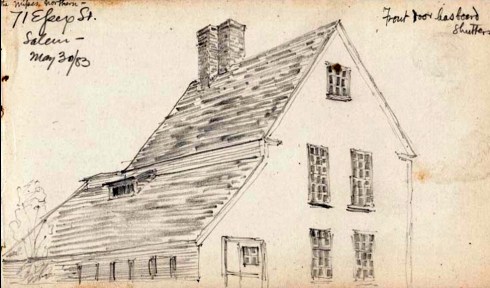
SS Pickman House

SS Narbonne House

SS 106 Derby SS Salem Hardy St

Where is/was this early Salem house?

His sketches indicate that Hirschmann wasn’t particularly interested in early architecture when he came to Salem: he went right to the McIntire District, where he sketched details: wrought iron fences, garden arches, classical columns. He was more of a note-taker than Aiken, and I particularly love his notation on the column sketch:  “very beautiful”.

SS Hirschmann Fences Sketch

SS Hirschmann Arch Chestnut Street Salem

SS Hirschmann Columns Sketch

The Architectural Sketches of William Martin Aiken and Joseph Mordecai Hirschmann, Lowcountry Digital Library.


Salem’s Very Own Wallace Nutting

I have a little gallery wall of Salem images I’ve collected over the years in my downstairs hall, mostly prints, but a few photographs–among them a faded hand-tinted image of an ethereally-dressed woman descending the steps of the Andrew Safford house which I long-presumed was by Wallace Nutting. It has all the Nutting touches: the hand-coloring, the colonial-esque setting, the dreamlike character, and of course there are thousands of Nuttings out there, maybe more. But when I actually took it off the wall the other day to see the signature, the attribution was to “Florence Thompson” rather than Nutting:  Florence Thompson of Salem, a “Nutting-like” photographer of the early twentieth century. It didn’t take long to find more Florence Thompsons in auction listings, particularly those of the Nutting and “Nutting-like” expert Michael Ivankovich, but I haven’t been able to flesh out her life here in Salem or any of the details of her background or business. There were so many women entrepreneurs in this little city at this time–and then there was Frank Cousins, who must have shared her Colonial Revival leanings if not her predilection for fanciful settings. I wonder if she learned her craft from the master, and was one of the many women who worked for Nutting at his Framingham studio. I wonder where she produced her works—and where she sold them. I’ve got a lot of questions about Florence Thompson, but for now, just a few examples of her Nutting-like work from the 1910s and 1920s: more evidence of the seemingly-insatiable demand for calm and crafted antiquarian images in an age of dynamic change. When I look at these “compositions”, I can’t help but think how radically our artistic sensibilities have changed over a relatively short amount of time, a mere century.

Thompson 2 002

Thompson 003

Florence Thompson Clarks Door Salem

Florence Thompson Cushing Door

Florence Thompson Hillside Pasture Auction Listing

Florence Thompson Annisquam Auction Listing

Wallace Nutting Salem Dignity aUCTION lISTING

My Florence Thompson print, “The Safford Door” (which looks very similar to the popular Nutting print, “The Sea Captain’s Daughter”, which you can see here); “The Clarks’ Door”, 1911, Etsy seller Bittersweet 13; (same model?  Maybe Thompson just moved her from door to door); “The Cushing Door”; “Hillside Pasture”; “Annisquam”, all from Ivankovich Auctions, along with Wallace Nutting’s own “Salem Dignity”, a bit more dignified without the waif. Its title was based on the Alice Morse Earle quote: Salem houses present to you a serene and dignified front, gracious yet reserved, not thrusting forward their choicest treasures to the eyes of passing strangers; but behind the walls of the houses, enclosed from public view, lie cherished gardens, full of the beauty of life.


Ropes Mansion Refresh

I’ve been anticipating the reopening of the Ropes Mansion for some time so it was with great excitement that I crossed the threshold yesterday for the first time in a decade or so: the house was shuttered for restoration after an accidental fire in 2009 and I remember it being a bit tired even before that. Not now: refreshed was the word that came into my mind almost as soon as I set foot in the front hall. It’s not just the new paint and paper (and absolutely beautiful carpets): it feels like the house’s spirit has been renewed. Most appropriately, the interpretation focuses on the Ropes family, who donated the house–as a Memorial— to the Peabody Essex Museum (then Essex Institute) in 1907, almost as much as the interior architectural features. Their possessions are all around you as you walk through the rooms: their china, their pictures, their books, their trunks, their own memorials. There are touches of modern whimsy in several of the rooms which added to the overall feeling of renewal, and details, details, details, galore. I think I’ll have to go back again and again: it’s open every weekend this summer from noon until 4pm.

The house was built in 1727 but extensively remodeled in the 1890s, so it feels (to my untrained eye) almost like a perfect blend of the Colonial and the Colonial Revival. This was most apparent on the first floor: as you walk front to back you move forward in time–from 1727 (or more precisely 1830, the date of the Asher Benjamin-influenced entrance) to the perfectly-preserved 1894 kitchen, with all its “new” equipment. Two dining rooms on the right–or I suppose a breakfast room and dining room decorated in a later 19th-century style–and on the left a double parlor with an amazing front-to-back fireplace. I’ve always loved this room, and when I walked into it yesterday it instantly reminded me of one of my favorite architectural drawings: Arthur Little’s sketch of the parlor of the long-lost Benjamin Pickman house further up Essex Street, from his (now-reissued by Historic New England) 1878 book Early New England Interiors. And for cupboard connoisseurs, the first floor of the Ropes Mansion is heaven, with fully-stocked butler’s and kitchen pantries and dining-room china cabinet.

Ropes Mansion 1

Ropes 007

Ropes 022

Ropes 024

Pickman House Parlor Arthur Little Early New England Interiors

The Benjamin Pickman House Parlor by Arthur Little, Old New England Interiors, 1878. Courtesy of Historic New England.

Ropes 109

Ropes 027

Ropes 039

Ropes 103

Ropes 104

Ropes 102

Ropes 048

Ropes 054

The second floor of the Ropes Mansion is even more intimately interpreted than the first, with one side of the house devoted to lavishly-recreated bedrooms and the other side to displays of possessions, some quite touching: I was struck particularly by a leather fire bucket (after all, this was a family, and this is a house, that experienced three major fires: besides the 2009 fire, there was a fire during the 1894 restoration and most tragically Abigail Pickman Ropes died in 1839 after her dress caught fire on this very floor–the posthumous portrait of Abigail by Charles Osgood is also on view) as well as a lovely watercolor memorial wreath dedicated to the memory of Abigail’s niece, Elizabeth Ropes Orne, who died of consumption at age 24 in 1842 (see her own sketches here). The bedrooms with their canopy beds are lovely: one rather ghostly and/or innocent, the other displaying a much more vibrant reproduction textile, and there is a fully-outfitted bathroom in the 1894 back of the house, just as “modern” as the kitchen below. Altogether a beautiful house bearing testimony to lives lived: the best kind of memorial.

Ropes 087

Ropes 091

Ropes 062

Ropes 065

Ropes Bedroom

Ropes 095

Ropes 061

Ropes Mansion Salem Marine Society

Ropes 070

Ropes Memorial

A true Ropes Memorial: watercolor memorial wreath for Elizabeth Ropes Orne by her former teacher, Eliza B. Davis, who presented it to Elizabeth’s mother Sally in 1851. Elizabeth’s signature, presumably from a letter, is in the center. 


Mary Harrod Northend

I’m not bound to such designations, but as we’re almost running out of Women’s History Month and our mayor has declared March 29 Salem Women’s History Day I’ve decided to feature a notable Salem woman on this last weekend in March. After much deliberation–as there are many notable women in Salem’s history–I’ve settled on the author and entrepreneur Mary Harrod Northend (1850-1926). She has interested me for some time, and she’s popped up in several posts in the past, but she deserves her own. Northend was from old, old Massachusetts families on both sides, and this heritage is key to her life and work. Both parents were actually from northern Essex County, but moved south after their marriage: her father, William Dummer Northend, became a prominent attorney and a state senator for Salem. Mary was born at 17 Beckford Street, a side-to-street late Federal house, but the family moved over to Lynde Street, in the shadow of the Federal Street courthouses, in the later 1850s. Their grand Italianate double house, photographed for Mary’s books later, is now sadly chopped into 12 apartments by my count. The few biographical details I could gather refer to a childhood sickness; in fact by all accounts (or by no accounts) Mary led a quiet life in her childhood and adulthood, until she burst out in her 50s and started writing all about colonial Salem and colonial New England, necessitating regional travel, which she clearly embraced. Eleven books were published between 1904 and 1926, when she died in Salem from complications sustained from a car accident, and many, many articles for magazines such as Good Housekeeping, The Century and The House Beautiful: I haven’t had time to compile a proper bibliography. But she was an incredibly prolific woman: an acknowledged expert on New England architecture and antiquities, with a touch of Martha Stewart-esque domestic stature as well, forged by her publications on decorating and party-planning. Let us, she writes in a very Martha tone in The Art of Home Decoration: link the old and the new, working out entrancing combinations that are ideal, making our home joyous and bright through the right utilizing of great grandmother’s hoard.

Northend Birthplace Beckford Street Salem

Northend 1862 Portrait

Mary Harrod Northend’s birthplace at 17 Beckford Street, Salem; her father William Dummer Northend, newly-elected State Senator from Salem, 1862, State Library of Massachusetts.

Her books and articles reveal Mary to be a fierce advocate for “Old-time” New England; she is at the forefront of that (second?) generation of strident Colonial Revivalists, fearful that the (changing) world around them hasn’t developed proper appreciation for colonial architecture and material culture. She is evangelical in her love of clapboards, mantles, arches, doorways, garden ornaments, pewter and seamless glass. The phrase “detail-oriented” doesn’t even come close to capturing Mary’s appreciation of the things that were built and made in the colonial past: these things are her life and her world. And like any good educator–which she was–Mary wanted her (growing) audience to see her world and so she spared no expense when it came to photography, first taking her own photographs and then “directing” commercial photographers in the manner of a cinematographer, according to Mary N. Woods’ Beyond the Architect’s Eye: Photographs and the American Built Environment (2011). The end result was a vast collection of still images (there are 6000 glass plate negatives in the collection of Historic New England alone, though the entry in the biographical dictionary Who’s Who in New England for 1915 indicates that Mary has “20,000 negatives and prints of American homes”) which she used to illustrate her own books, sold to other architectural writers, and colorized in the style of  Wallace Nutting to sell directly to the public.

Northend Historic Homes 1914

Northend Doorways 1926

Northend Cook Oliver

Northend Framed Photo Cook Oliver

Two of Northend’s most popular titles, Historic Homes of New England (1914) and Historic Doorways of Old Salem (1926); the Cook-Oliver House on Federal Street in Salem, featured in Historic Homes and sold as an individual colorized print, “The Half Open Door”.

It’s relatively easy to research the work of Mary Harrod Northend: her books are still readily available in both print and digital form and prints from her photographic collection are at Historic New England and the Winterthur Library. But I wish I knew more about her business, the business of publishing books and photographs, writing, lecturing, collecting. I’m also curious about money: there’s definitely a bit of voyeurism in Northend’s books and I can’t discern why she remained in the family home on busy Lynde Street rather than move to the McIntire District just a few blocks away. In one of her most personal, yet still fictionalized, books, Memories of Old Salem: Drawn from the Letters of a Great-Grandmother (1917), the great-grandmother in the title lives on Chestnut Street, but Mary never did. This might have been a family matter: her widowed mother and sister lived right next door in the Italianate double house, which was also an appropriate “stage” for some of her photographs. I also think it was quite likely that Miss Northend was seldom at her own home, as she was so busy documenting those of others!

A very random sampling of Mary Harrod Northend photographs, mostly from Historic Homes and Colonial Homes and their Furnishing (1912), all from the Winterthur Digital Collections:

northend-gables-door1

Northend 10 Chestnut Door

Northend Robinson House Summer Street

Three very different Salem houses:  doorway at the House of the Seven Gables, entrance of 10 Chestnut, side view of the Robinson House on Summer Street.

Northend Pewter Mantle

Northend Waters House Mantle

Northend Mantles

Salem mantles: a pewter display, McIntire mantle at the Waters House (LOVE this louvred fire screen), Whipple and Pickman mantles.

Northend 29 Washington Square Hallway

Northend Ropes Windowseat

Northend Saltonstall House Haverhill Hall

Northend Kittredge House Yarmouth Remodeled Farmhouses Cape

Northend Bright House Beds

Details & decor I love:  hallway of 29 Washington Square, Salem, Ropes Mansion windowseat, entry hall at Saltonstall House, Haverhill, Attic and twin canopy beds on the Cape (from Remodeled Farmhouses, 1915–but all of Miss Northend’s books feature canopied beds! I would place them headboard to headboard.)

Northend Kate Sanborn House Spinning Wheel

Northend House Winterthur

Flagrant displays of Colonial Revivalism: Spinning wheel and fire buckets at the Kate Sanborn House, and Miss Northend’s own house on Lynde Street, all dressed up for Spring.


Sepia Streets

The other day I came across a cache of historic photographs of Boston and its surrounding communities at the turn of the last century among the digitized collections of the Boston Public Library. The Salem scenes caught my attention but as I had seen most of them I moved on and examined the rest of the 320+ photographs: sepia scenes of lost Boston, lost Chelsea, lost Arlington, lost Medford….lots has been lost but some of the structures in these photographs still remain. I had to check on each and every one, of course, and so hours passed, maybe even days….I lost track. These photographs remind me of those taken by Frank Cousins in Salem around the same time; he may even be one of the photographers as no credits are given. There is an explicit reverence and respect for the pre-Revolutionary structures and streets captured, and an implicit message that they not be there for long. The collection was commissioned by the Daughters of the American Revolution, then quite a young organization, founded in 1890. Certainly the DAR has not been the most progressive of institutions over its history, but historic preservation was absolutely central to its mission then, and it remains so today. I certainly get that as I gaze at these photographs, and I am reminded of just how many early preservationists were women: Ann Pamela Cunningham and the Mount Vernon Ladies’ Association, Margot Gayle, the savior of Soho, fierce urban renewal opponents Jane Jacobs and Ada Louise Huxtable. Certainly we have had our share here in Salem: those avid advocates of “Old Salem” culture and architecture, Mary Parker Saltonstall and Mary Harrod Northend, Louise Crowninshield, an influential board member of the Society for the Preservation of New England Antiquities (now Historic New England) who facilitated the acquisition of the Richard Derby House by the new Salem Maritime National Historic Site in the 1930s, and many of my own contemporaries who have contributed much to the preservation of Salem’s existing fabric in this challenging environment.

But I think I’m digressing a bit, let’s get to the pictures, starting with a few long-long scenes of Boston: Webster Avenue (Alley!), and Hull and Henchman Streets.

Wesbster Avenue BPL

Hull Street Boston PBL

Henchman Street Boston BPL

A bit further out, the Dillaway House in Roxbury, built by the Reverend Oliver Peabody who dies in 1752. The headquarters of General John Thomas at the time of the siege of Boston. The Dillaway House about a century later, and at present, at the center of the Roxbury Heritage State Park.

Dillaway House Roxbury BPL

Dillaway House 2 MIT

Dillaway House 3

Three seventeenth-century houses that survive to this day: the Pierce House in Dorchester, the Cradock House in Medford (more properly known as the Peter Tufts House, one of the oldest, if not the oldest, all-brick structures in the U.S.), and the Deane Winthrop House in Winthrop:

Pierce House Dorchester BPL

Cradock House Medford BPL

Deane Winthrop House Winthrop BPL

As I said above, most of the Salem photographs were familiar to me and I’ve posted them before: with a few exceptions. Clearly the DAR was looking for Revolutionary-related sites, so their photographer captured the much-changed locale of Leslie’s Retreat on North Street, along with a few other predictable sites like the Pickering House. Two houses identified as “Salem” in this collection are unfamiliar to me: the first (in the middle below) is–or was–obviously situated downtown, but I don’t recognize it: maybe someone out there will, or maybe it is gone. The second looks like it was located on a country lane: not very Salem-like, even a century or more ago, but it could be North Salem, or possibly even Salem, New Hampshire?

North Bridge Salem 1890 BPL

Old House in Salem 1890 BPL

Country House Salem BPL

North Bridge, Salem, “Old House” Salem, and a country house in Salem, c. 1890-1905, from the DAR-commissioned Archive of Photographic Documentation of Early Massachusetts Architecture at the Boston Public Library, also available here.


The Last Days of the Loring House?

Perhaps because I grew up in a Shingle-Style cottage on the southern coast of Maine, I have always taken the style for granted, even now and here, living on the North Shore of Boston, where it also reigned in the last decades of the nineteenth century. The strident Federal architecture of Salem appealed to me much more when it came time to buy a house–not quite at war with nature but not really melding with it either. But now, just across the water in the Pride’s Crossing section of Beverly, one of the most iconic Shingle cottages is apparently nearing its end: a house so harmonious with its surroundings yet so exacting in its details that even I can appreciate it. The Charles G. Loring house was built between 1881 and 1884 as a mid-career commission of the architect William Ralph Emerson (1833-1917), who is widely credited with originating what came to be known as the Shingle Style. The man who coined that term, Yale architectural historian Vincent Scully, calls the Loring House the very best of all the houses along this coast and considers that it may well be the finest surviving example of the Shingle Style, yet despite these and other weighty judgments, it may soon be taken down by its present owner, one of the co-founders of iRobot.

Loring house by Steve Rosenthal

© Steve Rosenthal

Loring House by Steve Rosenthal 2

© Steve Rosenthal

Loring House by Steve Rosenthal 4

© Steve Rosenthal

Loring House by Steve Rosenthal 3

© Steve Rosenthal

Loring House 1969

Ryerson & Burnham Archives, Art Institute of Chicago: Myron Miller photograph, 1969

Loring House 1969 2

Ryerson & Burnham Archives, Art Institute of Chicago: Myron Miller photograph, 1969

Loring House 3

Ryerson & Burnham Archives, Art Institute of Chicago: William Ralph Emerson’s “Plan of Principal Floor” of the Loring House, 1881

The house was built as a summer cottage by Charles G. Loring (1828-1902) on family land. Loring (like his father) has an amazing biography: he was a thrice-breveted Major-General of the Union army, the second time “for gallant and meritorious services at the battles of the Wildneress, Spottsylvania, and Bethesda Church and during the operation before Petersburg, Virginia” (Loring Genealogy). A passionate Egyptologist, he became one of the first trustees and curators at the newly-founded Museum of Fine Arts, Boston after the war, and then its first director. After his death in 1902 the estate was transferred to another old Boston family though its acquisition by Quincy Adams Shaw, one of the Museum’s major benefactors. It remained in the Shaw-Codman family for over a century, until the death of Mr. Shaw’s grandson, Samuel Codman, in 2008 (at age 100). After he inherited the house in the 1960s, Mr. Codman worked tirelessly to maintain it, apparently single-handedly, and I think you can see the impact of his care when you compare the photographs above. Even before Mr. Codman’s death, a group of “Friends” organized to raise funds in order to endow and preserve the house as a study property of Historic New England; very sadly, their fundraising goals fell short and consequently the house went on the market and was purchased first by several Loring descendants and then by Ms. iRobot. Her proposed “alterations” were deemed destructive by the Beverly Historic Commission, which imposed a one-year demolition delay that has now expired. An application sent to the Beverly Conservation Commission last week indicates the Loring House will be replaced by a larger structure (surprise).

Loring House 1969 4

Ryerson & Burnham Archives, Art Institute of Chicago: Myron Miller photograph, 1969

Loring House Detail Rosenthal

© Steve Rosenthal

All of my preservationist friends are desolate: their only consolation is that this house is very well-documented, inside and out. There are the Myron Miller photographs that I have showcased here, along with the beautiful images of the renown architectural photographer Steve Rosenthal, who provided his services pro bono to the Friends of the General George G. Loring House. Another reason why I never really appreciated the Shingle Style is its characteristic interiors, which always seemed a bit drab to me, but obviously I’ve been looking at the wrong Shingle Style houses. As Mr. Rosenthal’s photographs illustrate so well, the Loring House glows with light and features details that are most likely irreplaceable, but apparently also ephemeral.

Loring House Interior Rosenthal

© Steve Rosenthal

Loring by Steve Rosenthal interior

© Steve Rosenthal

Loring House Rosenthal Stair

© Steve Rosenthal

Loring Upstairs Rosenthal

© Steve Rosenthal


Crafting a Colonial Salem

There are many people who have contributed to the creation and projection of Salem’s image over the last century and more, beginning with the rather solemn portrayals of Nathaniel Hawthorne and proceeding through the material-based photographs and writings of Frank Cousins and Mary Harrod Northend towards the Witch City profiteers of our own time. But perhaps no one was more avid and energetic in these efforts than George Francis Dow (1868-1936), a prolific author and editor, secretary of the Essex Institute (now absorbed into the Peabody Essex Museum), director of the museum of the Society for the Preservation of New England Antiquities (now Historic New England), and the principal force behind Salem’s recreated colonial settlement, Pioneer Village. It’s difficult to categorize Dow: he was not a trained historian but this was no obstacle to his efforts and achievements. Generally he is referred to as an antiquarian, which is a rather antiquated word now. He certainly possessed the technical expertise of a preservationist. Above all, I think, he was an interpreter and an admirer of the colonial past. When he was 30 years old, he simply quit his job at a wholesale metal company in Boston and began to indulge his passion for the colonial history of Essex County full-time, with rather impressive results: a succession of books (The Sailing Ships of New England,  Whale Ships and Whaling, The Arts and Crafts of New England,  Every Day Life in the Massachusetts Bay Colony, just to name a few titles), the installation of pioneering period rooms at the Essex Institute, the relocation and restoration of the seventeenth-century John Ward House, and “Salem in 163o: Pioneer Village”, erected for the 300th anniversary of the Massachusetts Bay Colony. In 1920 (at the age of 52) he married Alice G. Waters, one of the co-editors of his four-volume edition of The Diary of William Bentley and a long-time librarian at the Essex Institute (so romantic!).

I often think about Dow when I come across one of his books, but most especially whenever I go to Pioneer Village, which still survives as America’s first living history museum, predating Colonial Williamsburg by several years. The village was meant to be a temporary installation for the Tercentenary celebration but Dow and his associates (principally architect Joseph Everett Chandler) put so much effort and thought into its design and construction that it remained a tourist attraction well into the 1950s. Shuttered for several decades thereafter, it deteriorated precipitously, but was restored in several sequences by devoted Salem museum professionals in the later 1980s and after 2007. This past weekend, I went to the village for the first-ever “Salem Spice Festival” and began thinking about Dow’s work–and vision–again. The village is much changed from its original appearance, as will be immediately obvious by the contrasting photographs below. But it’s all in the details: in several structures the colonial craftsmanship which Dow so admired and strove to recreate is still in evidence, almost 85 years later.

Dow 005

Pioneer Village 1 Ryerson

Dow 015

Pioneer Village 3 Ryerson

Dow 034

Pioneer Village 4 Ryerson

Dow 031

Pioneer Village 6 Ryerson

Dow 019

Dow 036

Pioneer Village, Forest River Park, Salem in the 1930s and today, including the Governor’s “Fayre” House interiors: period photographs from the Ryerson & Burnham Archives Archival Image Collection at the Art Institute of Chicago (several of which were used in Dow’s Every Day Life in the Massachusetts Bay Colony). Dow’s narrative of Pioneer Village can be found in the journal he edited for the Society of New England Antiquities: “Old-Time New England”,”A QUARTERLY MAGAZINE DEVOTED TO THE ANCIENT BUILDINGS, HOUSEHOLD FURNISHINGS, DOMESTIC ARTS, MANNERS AND CUSTOMS, AND MINOR ANTIQUITIES OF THE NEW ENGLAND PEOPLE”; Volume XXII; JULY, 1931; Number I. Sadly, the reproduction Arbella, which carried John Winthrop’s expedition to “Salem 1630”, has not survived, but Leslie Jones captured it in all its glory for the Boston Globe in 1930.

Arbella


One, two, three, four, five……….

GABLES. Before I knew anything about historic architecture (and I still really don’t know all that much, to be honest), I always thought the gables (generally one, occasionally two or three) that seem to burst out of the roofs of mid-19th century houses were rather radical departures from the more straightforward colonial and Federal styles. Radical for American architecture, that is: obviously gables are a long-standing feature of European structures. But now I know they are just another revived element, derived not only from much older European elements but also 17th century “medieval” houses built in America (I know that term is widely used by architectural historians, but I find it awkward, as the 17th century is decidedly not medieval). Just the word gables in Salem is a reference to the House of the Seven Gables, which is more early nineteenth-century creation than seventeenth-century survival: when philanthropist Caroline O. Emmerton acquired the fabled mansion it had three gables rather than seven and she hired Boston architect Joseph Everett Chandler in 1909 to “restore” the “missing” gables and transform the house into Hawthorne’s inspiration. Chandler was more of Colonial Revival architect than a restoration architect, and he writes about the “development” of the House of the Seven Gables in his 1916 book The Colonial House, citing other first-period gabled structures in Salem and Boston as his inspiration. Hawthorne scholars believe that the author was also inspired by Boston gabled houses in his conception of the House of the Seven Gables, including Captain John Turner’s mansion on Beacon Street and the famous  “Old Feather Store” at Dock Square. Certainly there were gables aplenty to choose from in Hawthorne’s time, both new and old.

Gabled Julien House Boston-001

Gables 021

Gables 035

Gables 024

Gables 037

Gables 039

Gables 038

old feather store

Drawing of “Julien’s Restorator” in Boston, taken down in 1824, from James Henry Stark, Antique Views of Ye Towne of Boston, 1901, and center-gabled houses in Danvers and Salem; a two-gabled house in Danvers, and two adjacent three-gabled houses in Salem; The “Old Feather Store” in Boston, c. 1680-1860, shortly before it was taken down, Boston Public Library.


Olde Salem on Silk

I never tire of expressions of “olde Salem”: books about colonial furniture, furnishings and architecture, old-fashioned gardens, and photographs and drawings of Salem buildings and scenes, real or imagined, from the first few decades of the twentieth century. There appears to have been an entire generation of authors, photographers, architects, and preservationists who either emerged from or descended upon Salem to capture its fiber before it was lost to modernity:  Frank Cousins, Mary Northend, Arthur Little, William Rantoul. I’m sure the Great Fire of 1914 intensified their pursuit, and they are also representatives of a national Colonial Revival, of which Salem was a singular inspiration. I’ve covered a lot of Salem stuff in this blog, but I don’t think I’ve focused on fabric before, so I thought I’d take a first stab.

I’m inspired by some drawings I found in the collections of the Museum of Fine Arts, Boston by Walter Mitschke, a German-born textile designer for H.R. Mallinson & Company, which specialized in the production of silk fabrics in the early twentieth century. Their most productive and profitable period was in the 1920s, when they offered a series of American prints, many designed by Mitschke:  American National Parks, Wonder Caves of America, American Indians, and Early America.  His preparatory drawings for the latter series include several “Olde Salem” vignettes.

Early American Salem

Early American

Mallinson MFA

Walter Mitschke, Drawings for the”Early American” Series of Designs by H. R. Mallinson & Co., 1927, Museum of Fine Arts, Boston. Gift of Robert and Joan Brancale.

As you can see, the House of the Seven Gables, perhaps Salem’s most iconic “olde” building and image, is front and center in Mitschke’s emerging design. And Olde Salem is most definitely maritime Salem, not industrial Salem or witchy Salem. A large collection of his drawings and fabric samples was donated to the MFA, and you can see several portfolios of his work via the museum’s Interactive Tours. The Museum of the Rhode Island School of Design has some of Mitschke’s finished fabrics, including the very patriotic (and dynamic) Betsy Ross-Liberty Bell print.

Mallinson MFA Betsy Ross

Mallinson fabric

Mallinson Print 2

Walter Mitschke, Drawing for the “Early American” Mallinson Series, Museum of Fine Arts, Boston, and Fabric Samples, 1927-28, Museum of the Rhode Island School of Design.

I wish I could find the finished product for the Salem drawings; I’m struck by Mitschke’s modernization of “ye olde” images and would love to see the old Gables in such a striking setting. In any case, comparing drawings to finished fabrics is a lesson in how textile designers plotted out the repeat–no small consideration for them. I tried my hand at an old Salem silk print on Spoonflower, and as you can see, I’m no Walter Mitschke!

Salem Spoonflower Fabric

Two more sources for information on Mitschke and Mallinson:  this post on the blog On Pins and Needles, and the current exhibition at the Bard Graduate Center: An American Style: Global Sources for New York Textile and Fashion Design, 1915–1928.