Tag Archives: Colonial Architecture

So much WOOD!

The Historic New England season is closing this Columbus/Indigenous People’s Day weekend and as I am up in York Harbor, I went to visit one of HNE’s oldest houses (both in terms of sheer vintage and time under its stewardship): the Jackson House in Portsmouth, built circa 1664. This is an extraordinary house: I’m sorry to be posting at this time when you won’t be able to visit it until next June, because I’d really like to urge everyone reading to go. I had been in it before, but when I was much younger and couldn’t appreciate it properly. But now, wow. I always thought it was a saltbox: it is not. It’s a seventeenth-century two-story small square house which had an elaborate lean-to added a bit later, along with two additions on each side. It is also a lavish display of wood: certainly not from an American perspective, but from an English one, which would have been its builder, Richard Jackson’s perspective. When I was writing my first book, The Practical Renaissance, I was reading treatises written for carpenters and shipbuilders, as well as some more general agricultural pamphlets, all of which made me aware of the increasing concern about the shortage of wood in seventeenth-century England. All the first-growth forests had long been chopped down, so to come to North America and see all this wood must have been something. So for me, the Jackson House was just a great illustration of that abundance. Our guide emphasized this theme adroitly as she described the house’s framing, exterior and interior, and she also illustrated the construction impact of less-abundant woodland in New Hampshire by showing us the attic over the eighteenth-century addition, with its decidedly less-robust timbers. The Jackson House is one of Historic New England’s unfurnished study houses (like the Gedney House in Salem), so the emphasis is decidedly on construction, but we got to learn a fair amount about the family as well, who possessed the house until 1924, when William Sumner Appleton, the founder of the Society for the Preservation of New England Antiquities (now Historic New England) purchased it.

Perfect 17th century parlor and east and west wings, with a patch of preserved wallpaper.

Appleton had apparently been obsessed with the Jackson House since his freshman year at Harvard, when he came up from Cambridge and knocked on the door. A pioneering preservationist and critic of “one property museums,” he began acquiring choice properties after the founding of SPNEA/HNE in 1910. Rather than stripping off the east and west additions of the house, he removed stucco and plaster to reveal its construction. The original property was extensive, fifty acres or so just across the North Mill Pond from downtown Portsmouth, in a neighborhood named Christian Shore. When I was growing up across the Piscataqua River in southern Maine in the 1970s and 1980s, Christian Shore seemed to me a drive-through area with delapidated old houses, but then suddenly appeared The Inn at Christian Shore and I started noticing all the beautiful old houses and now they really are all beautifully restored. Portsmouth is actually growing in this direction, with several hotels built in what were once vacant lots which divided Christian Shore from downtown. But when you look out the windows (replaced by Appleton, but in their original openings) of the house on its slightly elevated lot, you can imagine, and even sort of feel, the aura of its first century.

The replacement windows and upstairs, including some wood-carvings. I knew all about the counter-magical daisy wheel from the M.A. thesis on apotropaic marks by Alyssa Conary at Salem State, so it was fun to see it (a perfect example of how I didn’t “see” on my first visit as I have no memory of it). A watercolor and Detroit Publishing Co. (Library of Congress) photograph of the house before it became a museum.


Stone Enders

I met several work deadlines last week so now it’s officially summer road trip season: about time! So yesterday I drove south to Rhode Island to see a very distinct form of its early architecture: stone enders. This is a very descriptive term: stone enders are late 17th century houses which feature one exterior and interior wall consisting entirely of an expansive side chimney. They are rare because they are so old, but also because in several documented cases the chimney walls were assimilated into an expanded house, rendering them central: stone enders were and could be hiding in plain sight! Often there are interesting house detective stories associated with stone enders, and for those that do survive, there is always a restoration story. Both cases were true with the two stone enders that I visited, the Clemence Irons house (1691) in Johnston and the Eleazer Arnold house (1693) in Lincoln, both owned by Historic New England.

Clemence-Irons (top) in Johnston and the Arnold house in Lincoln.

The Arnold House, one of Historic New England’s (then the Society for the Preservation of New England Antiquities) earliest acquisitions in 1918, survived through adaptation and expansion in the back with its chimney wall always exposed but still there were mysteries to solve about its original appearance. It went through several restorations, which are discussed in a great little article that Abbot Lowell Cummings wrote for the magazine Antiques in 1960:

  • The Eleazer Arnold is one which students have loved for its persistent puzzles, not all of which were entirely solved by laying bare nearly every scrap of structural evidence the house had to offer. As early as 1895 Norman M. Isham (in his Early Rhode Island Houses) was concerned about both the original plan and the window arrangement. From what he could then see of the structure he assumed that the house had originally been built, as the rear slope of the stone chimney indicates, as a two-story house with lean-to and with its present full length, providing for two rooms at the front on the ground floor and two rooms behind them in the lean-to. The roof had been finished with an impressive facade gable, the valley rafters of which remain in the attic (though not restored). Without having full knowledge of evidence concealed in the frame of the house, Mr. Isham suggested the possibility of single casement openings in the front or south wall. By the time his Early American Houses was published in 1928 he had had a chance to explore enough of the hidden frame to know that the pattern of original wall studs there confirmed his supposition about these windows.

The Isham restoration is characterized as one of “exploration and stabilization” while the later restoration was far more ambitious, focused on returning the house to its seventeenth-century appearance, however, apparently “inauthentic fenestration” was introduced at this time. As Isham was also involved with the Clemence-Irons house, I went off on a midnight deep dive into some of his books, and I have to say that Early Rhode Island Houses is absolutely charming with its wonderful architectural drawings by Albert Frederic Brown. The later book, Early American Houses, is less charming as no Brown but it does have several photographs and some discussion of Salem houses.

I had a very detailed tour which focused on the Arnold family and the evolving roles of the house before taking us inside to examine its interiors from ground floor great room to the garret, where a succession of contractors signed their names on its beams. Obviously, one (or two or three) conspicuous interior detail of a stone ender are its expansive hearths. The Arnold house is pretty large for a stone ender, and became larger still over time, and its scale and convenient location along the Great Road in Lincoln made it a logical choice for a tavern and it still felt very taverny to me.

The Clemence-Irons house is about a twenty-minute drive south from Lincoln, but I realized that there was actually another stone-ender in town, the Valentine Whitman house (1696), which was not only currently for sale but had a scheduled open house in my window of opportunity between Historic New England tours! So I popped right over there, of course. This house was restored under the auspices of Preserve Rhode Island several years ago, and I was quite impressed by its combination of modern livability and traditional details. It’s even bigger than the Arnold house—at one point it was actually a four-family house. Beautiful lot too, further along the Great Road. I admitted that I wasn’t going to buy it to the listing agent, and she was really nice and said that I could take as many pictures of the interior as I liked but she wanted to request permission from the owners before I posted them. I promptly lost her business card, so I couldn’t ask permission, but the listing is here if you want to peek inside.

So then I was off to Clemence Irons in Johnston, where I had a very informative tour (along with two ladies from the Arnold tour—it’s a great idea to do these together, and not just because of their proximity) from a guide who was a historic preservationist. Clemence Irons is interpreted a bit differently than the Arnold house, more as a 1930s restoration of a seventeenth-century house than a seventeenth-century house. After the last owner/occupant of the house, Nellie Irons, died in 1938, it was sold to a trio of wealth Rhode Island siblings who wished to restore it to its original appearance and operate it as a museum. They hired Norman Isham to supervise the restoration, and he oversaw a great stripping of the structure down to its studs, following by a rebuilding with original materials as well as newly-sourced ones. The result is a bit of reverential and romanticized Colonialism, in keeping with the Colonial Revival era: Isham also fashioned seventeenth-century furniture for the museum, a practice that began by George Francis Dow right here in Salem when he created the first “Period Rooms” for the Essex Institute. I love the photograph of the house circa 1910 below: I think it’s the first “adulterated” house which I find aesthetically pleasing but it became even cuter after its restoration/recreation. The house was gifted to Historic New England in 1947, and it represents an important acquisition not only because it is a stone-ender, but also a well-documented example of mid-twentieth century restoration theory and practice.

There are more stone enders to see in Rhode Island: Preserve Rhode Island estimates fourteen in all though more may be hiding in plain sight. But I was focusing so hard on all of the architectural details of these two houses that I was exhausted by the middle of the afternoon so I headed north towards home. But I’m going back!


Meeting Houses of Rockingham County

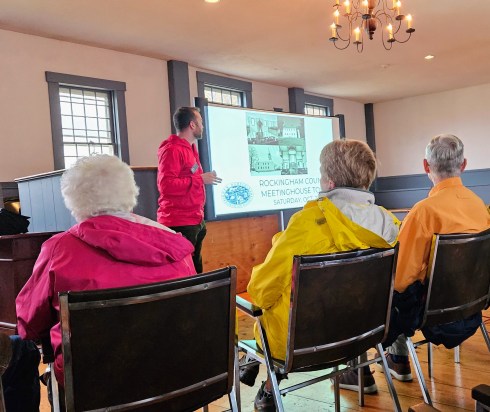
(Sorry—I have been reading and writing about meeeting houses for the past few months but still do not know if their identifier is one word or two). On this past Sunday, a rather dreary day, the New Hampshire Preservation Alliance sponsored a driving tour of meeting houses in southern Rockingham County, encompassing structures in Hampstead, Danville, Fremont, and Sandown. I drove over from York Harbor, fighting and defeating an inclination to just stay cozy at home. There was an orientation at Hampstead, the only colonial meeting house of the four that features a steeple addition (I envisioned Salem’s third meeting house, built in 1718), and then we were off to Danville, Fremont and Sandown. I have to tell you, I was in awe all day long: these structures are so well-preserved (cherished, really), simple yet elegant, crafted and composed. I remember thinking to myself when I was first set foot in the Danville meeting house: “I’d rather be here than in Europe’s grandest cathedral” (I think because I had just talked to my brother, on his way to Rome).  There’s just something about these places, and the people who care for them. Just to give you a summary of  the orientation that I received: they were built in the eighteenth century as both sacred and secular buildings, as close to the center of their settlements as possible and by very professional craftsmen. In the early nineteenth century, their religious and polical functions were seperated, so they became either churches or town halls or were abandoned altogether as other denominations built their own places of worship. It seems to me that they survived because of the preservation inclinations of their surrounding communities, and we were introduced to each meeting house by contemporary stewards who were clearly following in a long line of succession. Nice to encounter historical stewards rather than salesmen.

Hampstead:

The second floor of the meeting house, with its stage and original window frames propped up against the wall and all manner of remnants of civic celebrations, was really charming.

Danville: (which used to be called Hawke, so that’s the name of the meeting house. Hawke, New Hampshire–how cool a name is that!)

Incredible building—I had to catch my breath! I think it has the highest pulpit of these meeting houses, and there was just something about the contrast of that feature and the simplicity (though super-crafted) of the rest of the interior that was striking.

Fremont (which used to be called Poplin):

This meeting house is the only one remaining in NH with “twin porches” on each side, plus a hearse house (see more here–I have long been obsessed and have been to Fremont before but never inside the meeting house or the hearse house) with a horse-drawn hearse inside plus an extant town pound! Very simple inside, but note the sloping second-floor floors in picture #4 above. Took me a while to get used to those.

Sandown:

The most high-style of this set of meeting houses, particularly impressive from the back, I thought. Very light inside, even on this miserable day. Another high pulpit, and more marbleized pillars. Short steps to the second floor–I’m a size 7!

My photos are a bit grainy–not sure what my settings were, I was shifting them around to get more light, and too awestruck by the architecture to really focus, so in compensation I want to refer to you the wonderful work of photographer Paul Wainwright, who has photographed all of these meeting houses and more. Simply stunning!


Little Brick Houses

Last week was my spring break, and I was determined to get away after spending the past three right here at home during the prolonged Covid Time. I wanted to drive off alone so I could indulge myself with days of endless historic house-spotting: my husband needs a destination and a drink after too much of that! First I planned an extensive trip around revolutionary taverns along much of the east coast, and then I narrowed down my target area to the short-lived colony of New Sweden, incorporating areas of New Jersey, Delaware, and Pennsylvania (and even a bit of Maryland, I think). This trip was further restricted by a delayed departure and the big snowstorm that hit many parts of the northeast: I ended up snowed in at my brother’s house in Rhinebeck, New York. And then I was off, bound for New Castle, Delaware, a small historic city that I had always passed through too quickly. This would be the center of my exploration, but along the way, right before I passed over the Delaware Memorial Bridge, I decided to get off the turnpike and explore Salem County, one of the counties of southern New Jersey that borders Delaware Bay. The sun was shining and it was warm: it seemed as if I had passed from winter into spring, and from the North into the South. I had never been in this region of Jersey, but I had heard about some of its revolutionary history and seen pictures of some of its distinct 18th century houses built of patterned brick, dated and decoratively embellished on one side. I wanted to see one, and I did, and then I wanted to see more: and so I drove down rural roads for hours to do so. Before I knew it, it was dusk, and then I had to drive over that damn bridge in the dark (I have a mild bridge phobia issue and a much stronger tunnel one). New Castle was charming at night and the next morning, when I saw rows of little brick town houses. So forget about any theme of history or function: my spring break (or what was left of it) was just going to be all about little brick houses—and some big brick houses too.

The Dickinson and Oakford Houses, Alloway Township, Salem County New Jersey; the collage is all New Castle houses, with the exception of the conjoined houses in the center–which are in Salem TOWN, New Jersey (more about this other Salem below); New Castle’s old library; this 18th century map shows my travels–on both sides of the Delaware.

Established in 1651 by the Dutch, New Castle was at the center of shifting colonial sovereignties in the middle of the seventeenth century: it became part of a the short-lived colony of New Sweden in 1654, but was recaptured by the Dutch within the year, and in 1680 it was included in the land grant of William Penn, along with the rest of Delaware. New Castle was the capital of the Delaware colony until the Revolution, but before and after it was a center of trade and transportation due to its strategic location on the river. Its pre-revolutionary and pre-industrial wealth created a beautiful city that survives today relatively intact. I don’t really agree with its chamber-of-commerce description: thanks to preservation efforts, this vibrant, fully occupied community remains one of the most important Colonial/Federal villages in America—second only to Williamsburg, Virginia in the number and authenticiy of its historic structures. Williamsburg is a creation, an open-air museum: New Castle is a living city. Though they both have that fixed-in-time feeling, I saw the residents walking around engaged in all sorts of tasks as I walked the streets of New Castle, and they weren’t in colonial costume, like the “residents” of Williamsburg. New Castle is real, but almost too perfect: perfectly-preserved buildings, perfect signage, perfectly laid and -maintained brick sidewalks (it’s like an opposite-word of Salem: they seem to be letting their asphalt sidewalks languish as they replace with brick!), no litter in sight. And while late colonial and federal houses rule, they come in different sizes and were built with different materials: rows of modest brick and wooden houses were just as perfectly maintained as more stately structures. And there are new houses too, built with an obvious mandate to integrate with the old.

Just perfect New Castle, on a perfect day! These are all residences: I’m going to show the museums in my next post. The last two photos show a new house rising on the Strand, and the very old Anglican/Episcopalian Church, Immanuel on the Green, the parish of which has been operating continuously since 1689.

I spent a couple of days in New Castle and then drove lightly northeast into the Brandywine Valley, ostensibly to do some research at the Winterthur library, but I spent more time in the museum and (you guess it) driving around looking for little stone houses. And on my way back home, I turned off the bridge right after I crossed into Jersey rather than before I crossed into Delawar: I wanted to go back to Salem County to hunt for more houses and see the city of Salem as well: I had driven through it days before but didn’t stop. It’s somewhat blighted, with boarded up houses on the main street, but other houses were perfectly restored: it seemed to have quite a bit of integrity and potential. Of course, this Salem has a historical society, and a completely over-the-top but unfortunately former city hall: I wonder what will become of it?

Salem, New Jersey: historical society, murals, and the “exuberant Queen Anne” former municipal building.

One last stop in old New Jersey and then I turned northward. Most of the patterned brick houses are in private hands and hard to find, but one has been turned into a state park: the Hancock House, in Alloway Township, or more particularly a little village within called Hancock’s Bridge. On this very day in 1778, raiding British rangers under the command of Major John Simcoe raided the house and bayoneted as many people as they could find inside: at the very least ten Patriot milita men and also the owner of the house, Judge William Hancock, who was a Loyalist and also, as a Quaker, a pacifist. This became known as the Massacre at Hancock’s Bridge, and just as I was arriving at the house on Saturday morning regiments of reenactors were as well, for the annual commemoration of the massacre. I couldn’t stay around, unfortunately, but I have borrowed a photograph from the HM 17th Regiment of Infantry in America’s facebook page, below. Then I drove home to Massachusetts, making just one stop along the way: at Guilford, Connecticut to see another very old stone house, the 1639 Henry Whitefield House.

Above: The Hancock House, 1734 and members of the HM 17th Regiment of Infantry in America, 1775-1784 on Saturday. Just two streets over, the Quaker Meeting House, built on land donated to the community by Judge Hancock, who was slain on March 21, 1778.

Below: Bonus round. Two little stone houses in Pennsylvania and Connecticut: the John Chads House in Chadds Ford, and the Whitefield House in Guilford.


Some Great Early Gloucester Houses

I feel like I should know more about Gloucester, the port city about a half hour to the north of Salem. I have quite a few Salem friends who have summer homes in Gloucester, or have moved to Gloucester, or just go to Gloucester often: it’s like an escape hatch of sorts. 2023 marks Gloucester’s 400th Anniversary, and I have been super impressed with the city’s commemoration efforts: they are creative, comprehensive, and most importantly, expressions of the community rather than of a limited pool of “stakeholders,” as seems to be the case with Salem as it gears up to its 400th in 1626. I’ve been to Gloucester often, but I can’t even begin to characterize it as a place: it doesn’t seem like one city to me, but rather several. It’s certainly big: I decided to drive around in search of some of its earliest houses the other day and it took me all afternoon and I feel like I barely scratched the surface! I’m not even sure that I have the neighborhoods straight, to be honest: I started out in West Gloucester, then drove downtown, then to East Gloucester and Rocky Neck, then through Rockport to the northern side of Gloucester, stopping in Lanesville and Annisquam. Depending on where you are, you can find any style of house you want in Gloucester: big old shingled “cottages,” smaller cottages in a variety of styles, Greek Revivals, vast Victorians, stucco Craftsmans and even a Tudor or two. Not too many three-story Federals so prevalent in Salem, Newburyport, and Portsmouth: Gloucester was/is a fishing port so not as many wealthy merchants. I was looking for Colonials on this little expedition, the older the better, so that determined my route. Unfortunately, I forgot my sources: Prudence Paine Fish’s excellent books on Gloucester’s old houses (Ms. Fish died recently; a great loss for Gloucester) and Edwin Whitefield’s Homes of our Forefathers. On my own I missed quite a bit of this sprawling old city with its innumerable inlets so expect return trips over the next year or so!

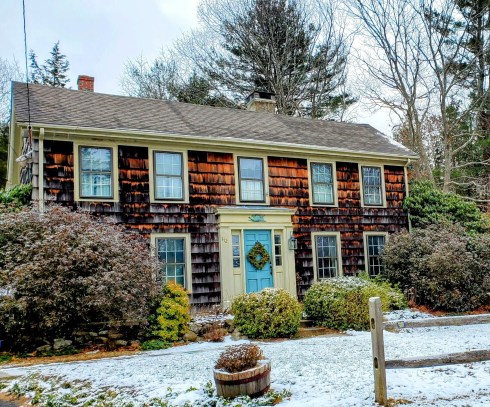
I started out in West Gloucester where I drove way out along Concord Street: in my experience streets named for other Massachusetts towns have the oldest houses. At least part of the first house below, the Ella Proctor Herrick House, was built in the seventeenth century and the last one proudly bears a first-period plaque as well.

Along Concord Street, West Gloucester.

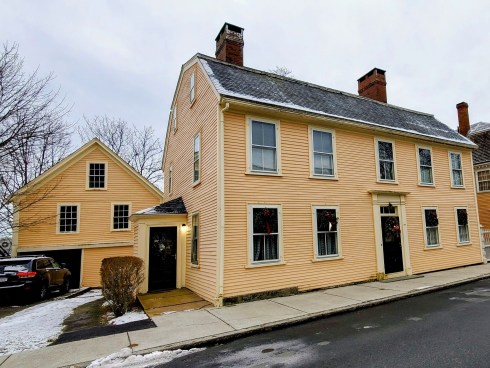
Then I drove miles to downtown Gloucester, overlooking its expansive harbor. This is the most densely-settled area of the city, obviously, and also where you can find the most architectural variety. It’s also where the Cape Ann Museum (CAM) is, a museum of art and history which also owns and operates several house museums. Of course I’m jealous that Gloucester has a professional local museum, but CAM’s existence is just one of several indicators that Gloucester is serious about preserving and interpreting its heritage, material and textual: I also like the way older houses are interwoven with newer, professional and institutional structures in the city center. The first house below, on Middle Street, is wedged between a bank and some other professional office building, and has lots of Georgian neighbors.

Along Middle Street, Gloucester.
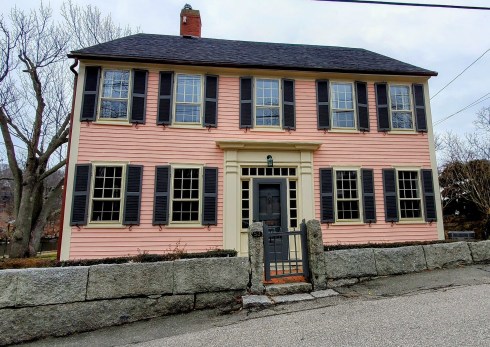
On the way to the Green, where CAM owns and operates two historic houses, I passed by this first cute and very characteristic of Gloucester house and one of the city’s oldest houses, the Whittemore House (1700), now a frame shop. The Green, situated right on Gloucester’s traffic rotary on Route 128, features three historic structures (the White Ellery House, 1710 and the Babson-Alling House, 1740 are below) and CAM’s newest exhibition space, the Janet & William Ellery James Center (2020), which has expanded the museum’s exhibition and archival space signficantly.

I hopped right on the rotary and drove to East Gloucester, which was a pass-through for me as I didn’t have my sources! So I did the Cape Ann loop, enjoying the views and driving through Rockport, and ended up in Lanesville and Annisquam on Gloucester’s northern shore. As you can tell from these photographs, it was a cloudy, dreary day (as has been the case for most of January in our parts) and so I had to snap this bright orange cottage in Lanesville and then it was on to Annisquam, which is really almost too precious and perfect (and with too many “private drives”!) but I had to see the Edward Harraden House (c. 1660)—one of several structures built by this family in Gloucester. It’s a storied name in Salem too as Jonathan Harraden was one of our most famous revolutionary privateers. It did not disappoint.

Eighteenth-century houses in the Lanesville (ORANGE!) and Annisquam villages of Gloucester, and the Edward Harraden House, c. 1660.